Our Top Picks


What's inside
- The design vocabulary of the mid-century watch
- Timex Marlin: the hand-wound heart of the revival
- The Timex Q: quartz, colour, and the late seventies
- Casio: the digital branch of nostalgia
- Seiko 5: retro colourways on a modern workhorse
- Other families worth a place on the shortlist
- Movements: old silhouettes, new manners
- Crystals: acrylic charm, Hardlex, mineral, and sapphire
- Water resistance: the invisible modern upgrade
- Straps and bracelets: mesh, beads of rice, and leather
- Why buyers choose a reissue over the real vintage watch
- Where true vintage still wins
- Buying checklist for a vintage-style watch
- Living with a small watch in a large-watch world
- Matching the reissue families to buyers
- Dials, lume, and the details macro photographs reveal
- Dress, field, and dive: three vintage dialects
- How the reissue market behaves, and how to buy inside it
- Solar, radio control, and other quiet anachronisms
- Common regrets, and how the checklist prevents them
- Check prices on Amazon
- Gifting, first watches, and the gateway effect
As an Amazon Associate I earn from qualifying purchases. This post may contain affiliate links at no extra cost to you.
A watch can look seventy years old and behave like it left the factory last spring. That double identity is the whole appeal of the modern vintage-style watch: domed crystals, gilt dials, slim cases, and printed numerals drawn from mid-century originals, wrapped around movements with hacking seconds, hand-winding, modern seals, and warranties that a genuine period piece can never offer. This guide walks through the leading reissue families, the materials and movements inside them, and the practical reasons so many buyers now choose a faithful remake over the fragile, unknown-history original that inspired it.
Guides like this one stay free to read because readers occasionally buy through affiliate links after finishing them. As an Amazon Associate we earn from qualifying purchases. The selections and criticisms below follow the specifications and the ownership realities either way, including the places where a reissue’s romance outruns its substance.
Terminology matters before any shopping begins. A reissue is a manufacturer’s own remake of a historical model, ideally drawn from its archives. A homage copies the look of a famous watch from another brand. Vintage-style is the broadest label, covering any new watch designed in an older idiom without claiming a specific ancestor. The distinctions affect value, pride of ownership, and how honestly a buyer should describe the watch later. Most of the strongest choices in this category are true reissues, because the brand reissuing its own design carries the story legitimately and usually works from original drawings, dial samples, and case profiles held in its archive.
The design vocabulary of the mid-century watch
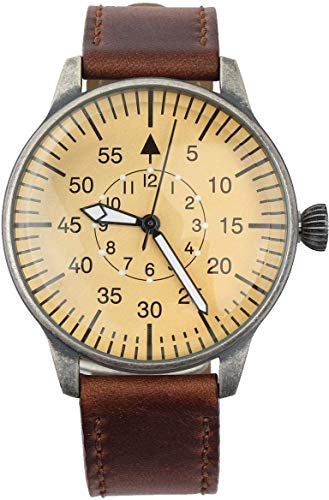
Certain visual cues signal vintage intent instantly, and learning to read them separates faithful design from lazy costume. A domed crystal, rising gently above the bezel and distorting the dial’s edge at oblique angles, belongs to the era when acrylic glass was standard and its curvature was a manufacturing consequence that designers turned into a virtue. Gilt dials, where lettering and minute tracks appear in a warm gold tone against black, recall a printing process in which the dial’s brass base showed through reserved areas of the surface. Slim printed indices, narrow dauphine or stick hands, and modest case proportions complete a language that modern oversized sports watches abandoned decades ago.
Fauxtina is the most debated element of that vocabulary. The term describes lume material tinted cream, tan, or pale orange to imitate the aged tritium or radium plots on surviving vintage dials, whose luminous paint darkened unevenly over decades. Critics call it artificial ageing, a costume effect no honest new object should wear. Defenders answer that colour is colour: a warm-toned lume plot harmonises with gilt printing and cream dials in a way that stark white-green lume cannot, and nobody is deceived, because the watch is sold openly as new. Buyers should decide which camp they occupy early, since fauxtina appears across most reissue ranges and avoiding it narrows the field considerably.
Proportion is the cue that photographs hide best. Vintage men’s watches commonly measured 34 to 36 millimetres across the case, sizes that modern marketing long treated as women’s dimensions. Reissues split into two philosophies: exact-proportion remakes that keep the original 34 or 35 millimetre case and trust the wearer to rediscover how elegant a small watch feels, and adapted remakes that stretch the design to 38 or 40 millimetres for contemporary tastes. Neither is automatically better, but they wear very differently, and lug-to-lug length, the dimension that decides whether a case overhangs the wrist, matters more than the headline diameter in both camps.
Timex Marlin: the hand-wound heart of the revival
The Timex Marlin reissue of 2017 is widely credited with proving that mainstream buyers wanted mechanical vintage remakes at accessible prices. The original Marlin of the 1960s was a hand-wound, water-resistant everyday watch, and the remake honoured that formula closely: a 34 millimetre case in its first form, a clean silver or black dial with applied Arabic numerals at selected hours, and a hand-wound mechanical movement visible in spirit if not through the case back. Later versions added 38 millimetre cases, automatic movements, day-date complications, and dial colours drawn from period catalogues, but the line’s identity remains the small, slim, manually wound original.
Hand-winding deserves explanation for buyers raised on quartz. A hand-wound movement stores energy in a mainspring that the wearer tensions by turning the crown, typically each morning, for a reserve of roughly a day and a half to two days depending on the calibre. The ritual is the point for many owners: thirty seconds of quiet winding becomes a daily punctuation mark, and the absence of a rotor keeps the case thin in a way automatics rarely match. Data sheets for the Marlin’s movements list hacking on some automatic variants, while the simplest hand-wound versions keep the specification deliberately basic, matching the honest tool-watch character of the source material.
The Marlin line also demonstrates the reissue strategy of expanding from a faithful core. Once the 34 millimetre hand-wound model established demand, Timex added automatic editions with exhibition case backs, Marlin Jet variants with period-correct crosshair dials, and collaborations that reinterpreted colours while keeping case architecture constant. For a buyer, the practical advice is to start from the original proposition, small case and simple movement, and only move up the range if a specific feature such as automatic winding or a date window genuinely matters, because each addition moves the watch a step away from the purity that made the design resonate.
The Timex Q: quartz, colour, and the late seventies
If the Marlin channels the early sixties, the Q Timex line revives the late seventies, when quartz movements were the new technology and watch design answered with bold colour, integrated-look bracelets, and rotating bezels in bakelite-style materials. The Q reissues began with a diver-style model featuring a blue and red bezel, a woven-look stainless bracelet, and a domed acrylic-feel crystal, and the range has since multiplied into chronographs, GMT models, and dial colours spanning avocado green to salmon pink. The Q name itself references the quartz branding Timex used when the original line launched.
Quartz power changes the ownership equation completely. A Q watch keeps time to within seconds per month, asks for a battery change every few years, and shrugs off the positional accuracy variation that mechanical owners accept as character. Purists sometimes dismiss quartz reissues as costumes without the mechanical soul, yet the historical record supports Timex here: the original Q watches were quartz, proudly so, and a mechanical remake would be the actual falsification. Fidelity to an original sometimes means a battery, and buyers who grasp that point shop the category with clearer eyes than those who equate vintage style with mechanical movements automatically.
Bracelet design is the Q line’s other signature. The woven stainless steel bands fitted to many models imitate the flexible mesh and link bracelets of the period while using modern clasps and solid construction. Sizing them involves removing links or sliding an adjustable clasp depending on the version, and buyers should check which system a specific model uses before assuming a home adjustment is simple. On the wrist, the Q’s 38 millimetre case and short lugs suit a wide range of wrist sizes, one reason the line found an audience well beyond committed vintage enthusiasts. Readers curious how such analogue design priorities contrast with screen-first wearables can compare against best affordable round android smartwatches, where round cases hide touchscreens instead of dials.
Casio: the digital branch of nostalgia
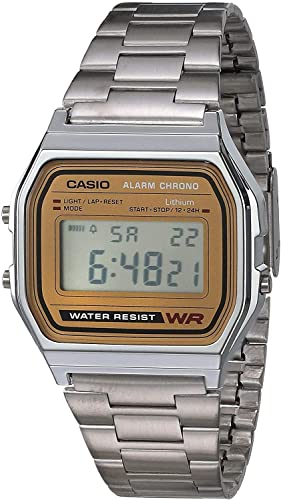
Vintage style is not exclusively analogue, and Casio’s retro digital range proves it with designs that have barely changed since the eighties and nineties. The A168 and its A158 sibling wrap a chrome-look resin case and a steel bracelet around a digital module showing time, stopwatch, alarm, and calendar, in a silhouette anyone who attended school in the nineties recognises instantly. The F-91W, smaller and lighter still in matte resin, has remained in continuous production for decades and occupies a unique position: it is simultaneously a vintage design and a watch that never actually left, so calling it a reissue understates its continuity.
The appeal here runs on different fuel than the mechanical revival. A Casio retro costs very little, weighs almost nothing, survives knocks that would mark a polished dress case, and asks for nothing but a battery every several years. The aesthetic is honest in a way fauxtina never tries to be: these watches look old because the design is old, carried forward unchanged rather than recreated. Gold-tone versions lean into period flamboyance, clear and coloured resin editions nod to later nineties style, and the metal-cased A1000 line lifts the same digital layout into a more substantial case for buyers who want the look with more wrist presence.
Specification sheets for these models carry a lesson in reading water resistance markings. Many retro digitals are rated as water resistant without a depth figure, which in Casio’s terminology means splash resistance rather than swimming suitability, while selected models carry 50 metre or 100 metre ratings that permit more. Buyers charmed by the vintage look sometimes assume period-style fragility is part of the package; with Casio the fragility is mostly imaginary, since modern resin and module construction tolerate daily abuse well, but the water rating is the one figure worth verifying model by model before a holiday swim depends on it.
Seiko 5: retro colourways on a modern workhorse
Seiko approaches the vintage brief from a different angle, because the Seiko 5 line never disappeared either. The current Seiko 5 Sports range, relaunched in 2019, organises dozens of models into style families, several of which lean explicitly retro: cream and gilt dials, cushion-adjacent case shapes borrowed from the SKX era and earlier, mesh bracelets, and colour palettes labelled by the brand itself with words like vintage and retro. Underneath, the watches run the 4R36 automatic calibre, a modern movement with hacking and hand-winding that the classic Seiko 5 movements of earlier decades did not offer.
That movement upgrade encapsulates the reissue argument in miniature. The beloved Seiko 5 movements of the past could not be hand-wound and did not stop their seconds hand when the crown was pulled, small frustrations owners tolerated because nothing else at the price wound itself at all. The 4R36 removes both compromises while keeping the architecture’s reputation for durability and inexpensive servicing. Data sheets list a power reserve around forty-one hours, a day-date display true to Seiko 5 tradition, and 100 metre water resistance across the Sports range, figures no genuine sixties Seiko 5 could approach after fifty years of seal ageing even if it matched them when new.
Specific retro-leaning references rotate through the catalogue quickly, which is itself a buying consideration. Seiko releases limited and regional colourways frequently, and a gilt-dial variant admired in a review may be gone within a season, replaced by a near-identical successor with a different reference number. Buyers who find a colourway they love should treat availability as temporary, while bargain hunters can exploit the churn by watching outgoing references. The Hardlex crystal fitted across the range, Seiko’s proprietary hardened mineral glass, sits in the middle of the crystal hierarchy discussed later: tougher against shattering than sapphire, softer against scratches than sapphire, and entirely period-appropriate for a sports watch lineage.
Other families worth a place on the shortlist
The revival extends well beyond three brands. Orient’s Bambino line applies vintage dress-watch grammar, domed crystal, domed dial, slim baton indices, to an in-house automatic movement with hacking and hand-winding, in case sizes from roughly 38 millimetres upward, and its smaller Bambino 38 editions answer the proportion question directly. Bulova’s Archive Series reissues designs from its own history, including lunar and military references, sometimes fitted with the brand’s high-frequency quartz movements that sweep the seconds hand smoothly like a mechanical. Hamilton’s Khaki Field Mechanical draws on its military-issue ancestry with a hand-wound movement and a 38 millimetre case that has become a default recommendation for buyers wanting field-watch authenticity.
At higher prices the fidelity deepens further. Longines builds an entire Heritage segment on archival remakes with period-correct proportions and modern automatic calibres, while Tissot’s PRX applies late-seventies integrated-bracelet styling across quartz and automatic versions at accessible prices, its case shape quoted from a 1978 design. These tiers show how the vintage impulse scales: the same domed profiles, gilt accents, and restrained diameters recur, executed with finer finishing, sapphire crystals, and longer warranties as budgets rise. A buyer moving up the ladder pays mostly for finishing, brand heritage depth, and movement refinement, not for a different idea of what the watch is.
Smartwatch owners sometimes arrive in this category from the opposite direction, wanting a watch that asks for no charging and carries no notifications. The contrast is instructive: categories such as best android smartwatches looks judge wearables partly on how convincingly they imitate traditional watch design, while a reissue simply is traditional watch design, with the trade-off that it tells the time and perhaps the date, and nothing else at all. For many buyers that single-purpose clarity, after years of wrist-borne interruptions, is the luxury actually being purchased.
Movements: old silhouettes, new manners
The single largest functional gap between a reissue and a true vintage watch hides inside the case. Modern mechanical calibres fitted to vintage-style watches almost universally offer hacking, the ability to stop the seconds hand by pulling the crown, which allows setting the time precisely against a reference clock. Most mid-century movements lacked the feature, so their owners set the minute hand approximately and accepted drift in the seconds. Hand-winding capability in automatic movements is the second modern courtesy: a self-winding watch that has stopped can be restarted and pre-charged from the crown, rather than shaken awake and worn while its reserve rebuilds from empty.
Accuracy expectations should be set from data sheets rather than hope. Entry-level automatic movements in this category commonly specify daily rates in the region of minus twenty to plus forty seconds for basic grades, with better-regulated examples performing far inside those bands in practice. Quartz reissues sidestep the question entirely, holding seconds-per-month accuracy, and solar quartz removes even the battery schedule: Seiko, Citizen, and Casio all offer light-powered movements in retro-styled cases, where a dial that looks printed in 1968 quietly functions as a photovoltaic panel. Buyers should check whether a solar model’s dial texture betrays the technology, since some prefer the visual purity of a standard dial and a replaceable cell.
Service intervals form the third modern advantage. A new mechanical watch typically runs five to seven years before its first recommended service, with fresh lubricants, full parts availability, and a manufacturer network able to perform the work. The equivalent vintage purchase may need a service immediately, from a shrinking pool of independent watchmakers, with parts for obsolete calibres sourced from donor movements at rising cost. None of this makes vintage ownership irrational; it makes it a hobby with a maintenance budget, whereas a reissue is an appliance with a warranty, and confusing the two categories is the most expensive mistake a newcomer can make.
Crystals: acrylic charm, Hardlex, mineral, and sapphire
Crystal material shapes both the look and the upkeep of a vintage-style watch more than any other single component. Acrylic, the original mid-century material, warms the dial visually, bends light softly at the dome’s edge, and can be polished back from scratches with abrasive paste in minutes at a kitchen table. Its softness is the cost: acrylic scuffs on door frames and desk edges with discouraging ease. A handful of faithful reissues still specify acrylic or acrylic-like crystals for authenticity, and buyers choosing them should budget the occasional polish as part of the ownership ritual rather than a defect.
Mineral glass occupies the middle ground, harder than acrylic, cheaper than sapphire, and standard across much of the accessible reissue market. Seiko’s Hardlex is a borosilicate-hardened variant engineered to resist shattering, trading a little scratch resistance for impact tolerance that suits sports watches. Sapphire, synthetic corundum, tops the hierarchy for scratch resistance and appears on vintage-style watches from the mid price tiers upward, often with anti-reflective treatment that period watches never had. A domed sapphire is expensive to manufacture, so its presence signals a manufacturer’s seriousness about a heritage line; box-form sapphire crystals that mimic acrylic’s profile are the current state of the art for buyers wanting the vintage silhouette without the vintage maintenance.
Choosing among them is a lifestyle question disguised as a specification. A watch worn daily under shirt cuffs in an office will keep any crystal presentable for years. The same watch worn gardening, climbing, or working with tools will collect acrylic scratches monthly and mineral scratches yearly, while sapphire emerges unmarked from almost everything except diamond abrasion and genuinely hard impacts, where its brittleness can shatter rather than scuff. Honest self-knowledge about sleeves, hobbies, and tolerance for patina beats any hierarchy chart, and there is no shame in the acrylic answer: generations of owners polished their crystals as casually as they wound their watches.
Water resistance: the invisible modern upgrade
No specification separates reissue from original more decisively than water resistance, and none is less visible in photographs. A mid-century watch advertised as waterproof in its day relied on gaskets that have long since hardened, cracked, or been replaced with incorrect substitutes, which is why experienced collectors treat every true vintage watch as water-fragile regardless of its dial text. Swimming with an unrestored vintage piece risks fogging, dial damage, and movement corrosion from a single lapse. The reissue on the next page of the catalogue carries fresh seals, a tested rating, and a crown system built to modern tolerances, so its owner can wash hands, shower, and often swim without a second thought.
Reading the ratings prevents disappointment. Thirty metres means splash resistance in practice, suitable for rain and hand-washing. Fifty metres tolerates showering and shallow swimming by most manufacturers’ guidance. One hundred metres, especially with a screw-down crown, supports regular swimming and snorkelling. Vintage-style dress watches often stop at 30 or 50 metres because their slim crowns and case backs resist deeper engineering, and that is a legitimate design trade rather than a flaw, provided the buyer matches the watch to its actual duties. A Marlin worn to the office needs no depth rating worth bragging about; a Seiko 5 Sports on a beach holiday uses every metre of its hundred.
Gasket ageing applies to new watches too, just on a kinder schedule. Manufacturers recommend periodic pressure testing and seal replacement, typically alongside servicing, and a watch that has had its case back opened for a battery change should have its gasket inspected or renewed at the same visit. The difference from true vintage remains stark: for a modern watch, seals and testing are routine, inexpensive, and available, while for an old watch they are specialist work with uncertain outcomes. Water confidence, quietly, is one of the main things a reissue’s price actually buys.
Straps and bracelets: mesh, beads of rice, and leather
The strap completes the vintage illusion, and Milanese mesh is its most recognisable metal form. Woven from fine steel wire into a fluid fabric, mesh drapes over the wrist without links or segments, adjusts in small increments through a sliding clasp, and reads instantly as mid-century European. Modern mesh bracelets use better clasps and denser weaves than period examples, and they pair naturally with dressier reissues whose cases would look stranded on a heavy modern bracelet. Buyers should check the clasp mechanism before ordering, because sliding clasps vary in how securely they lock, and a mesh that creeps loose during the day teaches its owner to resent an otherwise lovely bracelet.
Beads-of-rice bracelets offer the articulated alternative, rows of small rounded links that flex like fabric while catching light like jewellery, historically associated with mid-century sports watches and now revived by several heritage lines. Leather remains the third pillar: slim, minimally stitched straps in tan, chocolate, or black, often with a taper from lug to buckle that modern chunky straps abandoned. Suede and nubuck finishes push the period feel further at the cost of water tolerance. Lug width governs all of this shopping, and reissues favour period sizes such as 18 or 19 millimetres alongside the modern standard 20, so measuring before ordering a strap avoids the small heartbreak of a beautiful band that does not fit.
Quick-release spring bars, now common even on heritage models, quietly modernise the whole strap ritual. A thumbnail lever replaces the spring bar tool, straps swap in seconds, and a single watch rotates through mesh for summer, leather for winter, and a fabric pass-through strap for weekends. Vintage owners enjoy no such ease with fixed or drilled lugs in worn condition. For readers whose reference point is the interchangeable-band smartwatch world surveyed in best mens smartwatches, the analogue strap ecosystem will feel familiar in spirit and far wider in material choice, with the caveat that every change is manual and gloriously unhurried.
Why buyers choose a reissue over the real vintage watch
The case for the remake rests on four practical pillars, and the first is unknown service history. A vintage watch offered for sale rarely comes with verifiable records of its last overhaul, and a movement can run acceptably on a seller’s desk while carrying dried lubricants and worn pivots that will demand a full service within the year. That service, on an obsolete calibre, may cost a substantial fraction of the purchase price. A reissue arrives serviced by definition, with its history beginning at the buyer’s own wrist, and its warranty absorbing the early failures that vintage buyers fund personally.
Parts availability is the second pillar. Manufacturers support current calibres with complete component supply, so a damaged balance, crown, or crystal on a reissue is a repair, while the same damage on a discontinued movement can become a hunt through donor watches and old stock that stretches for months. Dial and hand refinishing on vintage pieces raises a further dilemma with no equivalent in the new market: restoration can erase the originality that gave the watch its value, leaving owners afraid to repair the very objects they bought to enjoy. A reissue carries no such guilt, since every component is replaceable without historical loss.
Fragility is the third pillar, and it extends beyond water. Vintage cases have survived decades of polishing that softened their edges, vintage acrylic crystals craze internally with age, vintage lume has often decayed, been relumed, or, in radium-era examples, raises handling questions that modern owners reasonably prefer to avoid. Shocks that a modern movement’s updated shock protection absorbs can damage older calibres. None of these realities make headlines in auction photography, where a strong light and a macro lens present every sixty-year-old watch as a jewel. Daily wear is less forgiving than photography.
The fourth pillar is simple availability at honest scale. A desirable vintage reference in good, original condition is scarce by definition, and its price reflects collector competition rather than watchmaking cost. The reissue of the same design sits in a catalogue, discounted through normal retail channels, in effectively unlimited quantity, with every example identical in specification. Buyers who want the object rather than the hunt find that arrangement liberating. Those who love the hunt itself, the research, the negotiation, the thrill of an unpolished case found fairly, will keep hunting, and the reissue market cheerfully leaves them to it.
Where true vintage still wins
Balance demands the other side be stated with equal clarity. A reissue, however faithful, is a copy of an artefact, and some originals carry details no remake reproduces: hand-finished dial textures, transitional production quirks, the specific warmth of genuinely aged materials, and movements from eras when a brand’s calibres differed meaningfully from today’s shared architectures. Provenance adds another dimension no factory can mint. A watch worn by a grandparent, or issued for a documented historical purpose, holds value that lives entirely outside its specification sheet.
Investment language should enter the discussion cautiously and mostly to be deflated. A small number of vintage references have appreciated dramatically, which tempts buyers to treat every old watch as an asset, yet most vintage pieces trade sideways once servicing costs are counted, and most reissues depreciate like ordinary consumer goods. The sound financial advice for both categories is identical: buy the watch whose ownership will please you, at a price that assumes no resale profit, and let any appreciation arrive as an unearned bonus. A buyer who follows that rule cannot be badly hurt by either market, and will likely enjoy whichever watch they chose far more than a speculator enjoys a safe deposit box.
There is also the matter of size honesty in the other direction. Some reissues enlarge a design so aggressively that the result shares only a dial layout with its ancestor, a 42 millimetre expansion of a 35 millimetre original wearing like a different watch entirely. Buyers who care about fidelity should compare lug-to-lug measurements and case thickness against published figures for the vintage reference, not just the marketing claim of inspiration. The best heritage lines publish their archival sources and dimensional choices openly, and that transparency is itself a quality signal worth rewarding. Even the most screen-committed shopper, deep in a comparison of best apple smartwatches, will recognise the principle: headline dimensions never tell the whole wearing story.
Buying checklist for a vintage-style watch
Start with the wrist, not the catalogue. Measure wrist circumference, then shortlist cases whose lug-to-lug length sits comfortably inside it, remembering that 34 to 38 millimetre vintage proportions suit far more wrists than current fashion suggests, and that a watch photographed on a large wrist in advertising may look entirely different at home. Try before buying where possible, or order from sellers with painless returns, because proportion is the one attribute no specification table fully conveys and the one most likely to decide long-term affection.
Next, choose the movement by lifestyle rather than ideology. Daily wearers who rotate several watches often prefer quartz or solar reissues that are always ready and always right, while single-watch owners frequently bond with a mechanical calibre whose winding ritual anchors the morning. Check the data sheet for hacking and hand-winding if mechanical, for the battery type and water rating if quartz, and for the crystal material either way, since that one line predicts years of cosmetic upkeep. Confirm the lug width before dreaming about straps, and confirm whether the bracelet sizes by links, pins, or a sliding clasp before assuming a home fit is feasible.
Finally, interrogate the heritage claim itself. Strong reissues name their source model and year, publish archival imagery, and keep dimensions close to the original or explain the change. Vague vintage styling with no ancestor is not a defect, many handsome watches are simply retro-flavoured, but it should be priced as styling rather than heritage. Reading two or three specialist reviews of a specific reference, paying attention to wrist shots on wrists similar to your own, will do more for satisfaction than any amount of specification comparison, because this category above all others sells an experience of wearing, and experiences resist tabulation.
Living with a small watch in a large-watch world
New owners of 36 millimetre reissues often report a two-week adjustment arc. The first days feel conspicuously light, almost absent, after years of heavy steel sports watches, and the wearer glances down expecting more presence. By the second week the sensation inverts: the watch slips under every cuff, never catches on door frames or desk edges, and its legibility, protected by a high-contrast vintage dial, proves better than bulkier watches with cluttered faces. Returning to a 44 millimetre case afterwards can feel like wearing a wall clock. This recalibration is the category’s quiet conversion mechanism, and it explains why vintage-style buyers so rarely drift back to maximal sizes.
Care routines are modest but specific. Keep mechanical reissues away from strong magnetic fields where possible, since magnetised hairsprings cause dramatic rate errors that a watchmaker corrects in minutes with a demagnetiser but that alarm owners who do not recognise the cause. Store quartz models with their batteries healthy rather than exhausted, because a cell left dead for years can leak and destroy a movement that would otherwise outlive its owner. Wipe polished cases with a soft cloth rather than polishing compounds, preserving factory edges, and let a professional handle anything involving the case back if the water rating matters to you.
Rotation habits extend mechanical life in a counterintuitive way. A mechanical watch worn daily keeps its lubricants distributed and its seals exercised, while one left unwound for months is not harmed either, provided it is stored dry and dark. The real enemies are moisture, impacts, and neglect of the service interval once the watch begins losing time noticeably or the crown action feels gritty. Reissues forgive far more than their vintage ancestors in every one of these areas, yet they reward the same basic attentiveness, and owners who give it find these watches among the lowest-drama objects they own.
Matching the reissue families to buyers
Pulling the threads together produces clear assignments. The first-time mechanical buyer belongs with a Timex Marlin or an Orient Bambino, where the hand-winding ritual, the domed crystal, and the modest case teach the category’s pleasures at the gentlest prices and the movements forgive beginner handling. The colour-loving casual wearer belongs with a Q Timex, whose quartz accuracy and seventies palettes deliver maximum visual nostalgia per unit of maintenance, which is to say almost none. The buyer wanting one durable watch for travel, swimming, and daily wear belongs with a Seiko 5 Sports in a retro colourway, the only family here whose water resistance and automatic calibre cover every ordinary duty without a strap change or a second thought.
Casio’s retro digitals suit the pragmatist and the minimalist, and also serve as the ideal second watch for mechanical owners who need something indestructible for chores, sport, or travel to places where a treasured reissue would invite worry. Hamilton’s field mechanical suits the buyer whose vintage taste runs military rather than dressy, and the higher heritage tiers from Longines and its peers suit the buyer who has handled the entry-level pieces, knows exactly which archival design haunts them, and wants it executed with sapphire, fine finishing, and a movement worth opening the case to admire.
Dials, lume, and the details macro photographs reveal
Dial construction separates serious reissues from decorative ones at close range. Printed dials, where numerals and tracks sit flat in ink, suit the utilitarian originals of the fifties and sixties and keep costs honest. Applied indices, separate metal markers fixed to the dial surface, catch light with a depth printing cannot imitate and belong on dressier remakes whose ancestors used them. Sandwich dials, where a luminous layer glows through cut-outs in an upper dial plate, belong to a specific military and dive heritage and look wrong when borrowed outside it. A buyer with a loupe or a good macro photograph can judge which technique a model uses, and whether its execution justifies its tier, more reliably than any advertisement copy.
Lume chemistry has changed completely since the originals were made, and for the better in every measurable respect. Modern watches use strontium-aluminate compounds, sold under names such as Super-LumiNova, which charge from ordinary light and glow for hours without any radioactive content. Tritium, used from the sixties into the nineties, glowed constantly without charging but decays with a half-life of about twelve years, so surviving vintage tritium dials now emit a fraction of their original light. Radium, earlier still, remains radioactive long after its glow has died, one more reason the reissue’s imitation patina sits over a thoroughly modern, safe compound. Fauxtina, whatever one’s aesthetic verdict, is a tint in a modern material, not decay in an old one.
Hand finishing is the third macro-level tell. Vintage hands were often simple stamped and painted parts, and faithful reissues keep that flat honesty, while premium heritage lines polish, bevel, and sometimes blue their hands by heat in the traditional manner. Neither approach is incorrect; each belongs to its price tier and its source era. What betrays a careless remake is inconsistency, polished hands over a rough printed dial, or mirror finishing on a tool watch whose original was deliberately matte. Reading a reissue well means asking whether every visible decision agrees with the story the watch claims to tell.
Dress, field, and dive: three vintage dialects
Vintage style is not one style, and sorting reissues by their original purpose prevents mismatched purchases. Dress designs descend from slim, precious-metal or steel watches worn with suits: minimal dials, thin cases, leather straps, and water resistance that was always an afterthought. Field designs descend from military-issue watches: high-contrast Arabic numerals, luminous plots sized for darkness, robust cases, and straps chosen for mud and sweat rather than boardrooms. Dive designs descend from the rotating-bezel pioneers of the fifties: unidirectional timing bezels, generous lume, screw-down crowns, and bracelets with extension systems for wetsuits.
Each dialect carries functional consequences today. A dress reissue will look lost at the beach and its 30 metre rating will agree with that judgement. A field reissue such as the Khaki Field Mechanical wears its 38 millimetre case and matte dial anywhere short of formal dress, which is why field designs dominate recommendation lists for single-watch buyers. A dive reissue brings the strongest water credentials and the most casual wrist presence, and modern examples from Seiko’s heritage-adjacent lines pair the look with genuine capability. Choosing the dialect first, then the brand, produces shorter shortlists and happier owners than browsing by logo.
Chronographs form a fourth, smaller dialect, reviving the racing and aviation timers of the sixties with bicompax layouts, contrasting subdials, and tachymeter scales. Modern versions usually run quartz or automatic chronograph calibres rather than the hand-wound column-wheel movements of the originals, a substitution most buyers accept happily given the service costs of vintage chronograph movements, which are among the most expensive in the old-watch world. The Q line’s chronograph editions and several Seiko retro references serve this taste at accessible levels, with pushers and subdial spacing that quote period designs closely.
How the reissue market behaves, and how to buy inside it
Reissues are consumer products, and their market behaves accordingly, which newcomers from the vintage world sometimes find disorienting. New models launch with press coverage, sell at full price briefly, then settle into the discount patterns of their brand’s normal retail channels. Limited editions complicate the picture by selling out and appearing immediately on resale platforms at premiums, a cycle manufacturers have learned to stage deliberately. The patient buyer’s strategy is simple: distinguish genuine limited production, numbered runs tied to anniversaries or archives, from perpetual limited language attached to standard models, and pay premiums only for the former, if at all.
Grey-market and authorised-dealer pricing gaps deserve a calm assessment rather than a reflexive choice. Authorised dealers supply full manufacturer warranty and sizing help; reputable grey sellers supply lower prices with their own warranty substituted. For robust, inexpensive reissues from Timex, Casio, and Seiko, the warranty difference matters little because failure rates are low and repair costs modest. At Longines-tier prices and above, the manufacturer’s warranty and service relationship carry real weight, and the discount needed to justify surrendering them grows accordingly. Either route, pursued knowingly, is defensible; the indefensible purchase is the one made without knowing which route it was.
Resale expectations should be set before, not after, the purchase. Mainstream reissues typically retain a modest fraction of their retail price on the used market, with cult references such as early Marlin hand-wound editions and sold-out Q variants performing better than average. That pattern makes used reissues an excellent entry route: a previous owner’s depreciation funds the experiment, and a buyer who discovers that 36 millimetres is not for them can usually exit at small loss. Buying used does reintroduce questions of condition and box-and-papers completeness, but on a two-year-old watch those questions are trivial beside the forensic examination a sixty-year-old original demands.
Solar, radio control, and other quiet anachronisms
Some of the most satisfying vintage-style watches cheat cheerfully under the dial. Solar movements from Citizen’s Eco-Drive family and Seiko’s solar calibres sit inside cases styled for the sixties, charging from desk lamps and daylight alike, with reserves measured in months once full. A solar reissue never needs a battery swap, which also means its case back may stay unopened for a decade, preserving its seals and its water resistance in a way battery quartz cannot match. For buyers whose vintage taste is purely visual, solar power is arguably the ideal engine: period face, invisible technology, negligible upkeep.
Casio extends the trick further with radio-controlled and Bluetooth-assisted digitals in retro cases, watches that set themselves against atomic time signals while wearing the same chrome-look shell as their eighties ancestors. Purists occasionally object that invisible modernity breaks the spell, yet the objection proves hard to sustain: nobody’s nostalgia actually extends to setting a watch by the television news countdown. The reissue philosophy, stated plainly, keeps the parts of the past that gave pleasure and quietly replaces the parts that gave trouble, and time-setting friction was always trouble.
Sapphire case backs and decorated modern movements create the reverse anachronism, a vintage face hiding machinery far prettier than the original ever carried. Several automatic reissues fit exhibition backs that reveal Geneva stripes, signed rotors, and blued screws no mid-century buyer at that price ever saw. Whether that display delights or feels off-script is personal, but it underlines the category’s real nature: these are modern watches in conversation with history, not counterfeits of it, and their best makers are comfortable letting both centuries show.
Common regrets, and how the checklist prevents them
Post-purchase complaints in this category cluster predictably. The commonest is size surprise, usually a 34 millimetre Marlin arriving smaller than its buyer imagined from photographs, occasionally a 40 millimetre adaptation arriving larger than the vintage name promised. Both trace to shopping by diameter alone while ignoring lug-to-lug length and wrist proportion, which the checklist exists to prevent. The second regret is crystal disappointment, acrylic owners who did not expect scratches, or sapphire owners who find the flat, modern reflection colder than the domed warmth they admired in pictures of originals. Handling display models, or at least studying wrist videos, settles both questions before money moves.
Movement mismatch forms the third cluster: the buyer who wanted a winding ritual but bought quartz, or the buyer who wanted set-and-forget accuracy but bought a hand-wound mechanical and now resents its Monday-morning stops. Neither watch failed; the match failed, and it fails at the research stage rather than the wrist stage. The fourth regret is strap shock, discovering that a beloved model uses 19 millimetre lugs or an integrated bracelet that accepts no alternatives, after the buyer had mentally styled it on three different straps. Every one of these disappointments is visible in the specification sheet of the watch concerned, which is the strongest argument this guide can make for reading data sheets with the same attention usually reserved for dial photographs.
A final, happier pattern deserves recording: buyers who enter the category through one modest reissue frequently report that it reorganises their whole relationship with watches. The big modern pieces get sold or sidelined, the smartwatch migrates to a drawer except for workouts, and the small, quiet remake becomes the default object reached for each morning. Manufacturers understand this perfectly, which is why heritage lines keep expanding into new decades and dialects. The past, it turns out, is a very large catalogue, and the industry has only reissued its first few chapters so far.
Check prices on Amazon
Live listings for the shortlist in this guide are pulled from Amazon below, so prices and availability are always current at the moment you look.


Gifting, first watches, and the gateway effect
Vintage-style watches have quietly become the default recommendation for a first serious watch gift, and the reasons are practical rather than sentimental. Sizes in the 36 to 38 millimetre range flatter almost every wrist, so the giver is not gambling on proportion. The designs carry obvious character in photographs, which helps when the giver is choosing from a screen. Prices at the Timex, Casio, and Seiko tiers allow generosity without recklessness, and a mechanical Marlin or Seiko 5 gives a younger recipient an object that operates entirely without the charging cables and software updates that govern the rest of their possessions, a novelty that lands with surprising force.
Engraving closes the gift argument. A plain steel case back, standard on most reissues in this category, accepts a date, initials, or a short line from any competent engraver, turning a catalogue product into a singular keepsake in a way no sealed smartwatch can imitate. Vintage originals were engraved the same way for the same occasions, graduations, retirements, weddings, which means the gesture itself is period-correct. Givers should confirm the case back is plain rather than exhibition glass before planning the inscription, and should keep the text short, because the engravers of the world charge by the letter and because brevity ages best on metal.
The gateway effect on the recipient is well documented anecdotally across the hobby: one honest reissue teaches proportion, winding, and strap-swapping, and within a year its owner is reading movement references for pleasure. Manufacturers design for exactly this progression, seeding each heritage range with an accessible front door and reserving the archival deep cuts for those who walk through it. There are worse hobbies to give someone, and few objects at any price that ask so little, a wrist, a morning wind, an occasional service, while returning so much daily, unhurried pleasure in exchange.
One more test separates keepers from novelties, and it costs nothing: wear the watch for a full ordinary week before judging it. Vintage proportions reveal themselves across days rather than minutes, through shirt cuffs, desk work, driving, cooking, and the small hours when lume quality stops being a specification and becomes the reason a half-awake glance succeeds or fails. A reissue that still feels inevitable on the seventh morning, neither dressed up nor dressed down but simply right, has passed the only examination this category ultimately sets. The watches in this guide were chosen because their designs have already passed that same week thousands of times, on other wrists, in other decades.
Documentation is the last unglamorous detail worth a sentence or two. Keep the warranty card, the receipt, and the spare bracelet links together in the box the watch arrived in, because a complete set eases servicing, supports any future resale, and spares a later owner the archaeology that makes vintage buying so laborious. In a sense, every careful reissue owner is curating tomorrow’s vintage market, deciding through ordinary diligence which of today’s remakes reach 2080 complete, serviced, and honestly described, and which arrive there as mysteries in a drawer.
What unites every good choice in this category is a clear-eyed view of the transaction: the buyer is buying yesterday’s design intelligence with today’s engineering honesty, and the watches that honour both halves of that bargain are the ones still on wrists, and still accurate, a decade from now.