Our Top Picks
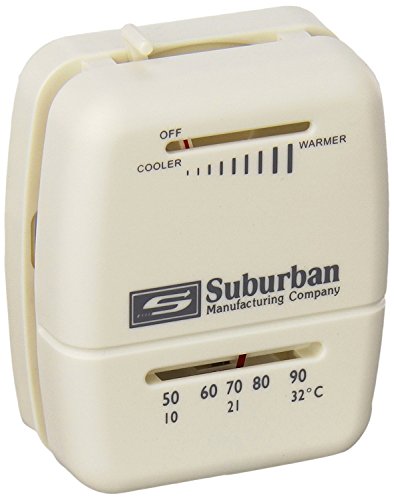 Suburban 161154 Wall Thermostat2.75 x 1.25 x 3.5 inches2.75 x 1.25 x 3.5 inches0.2 poundsCheck on Amazon
 94303382 RV Thermostat 12V3.14 x 2.16 x 1.18 inches3.14 x 2.16 x 1.18 inches0.22 poundsCheck on Amazon
 White-Rodgers Emerson M30 White Heat-Only Thermostat2 x 7 x 8.8 inches2 x 7 x 8.8 inches0.26 poundsCheck on Amazon


What's inside
- Start With the Appliances, Not the Thermostat
- The 12V DC Control Circuit Underneath Everything
- Analog, Digital, Programmable and Smart: Four Generations
- Single-Zone Simplicity Versus Multi-Zone Control
- Heat Pumps, Heat Strips and Furnaces: Three Ways to Warm a Cabin
- Wiring: R, C, W, Y, G and the O/B Question
- Replacing an Analog Thermostat on an Older Wall Box
- Freeze Protection and the Plumbing Behind the Walls
- Battery Drain, Boondocking and the Cost of Cleverness
- Troubleshooting Relays, Sensors and Ghost Behaviour
- Fan Control, Humidity and the Feel of the Air
- A Short Buying Checklist Drawn From the Manuals
- Seasonal Habits That Keep Control Honest
- Check prices on Amazon
- Closing Judgement
As an Amazon Associate I earn from qualifying purchases. This post may contain affiliate links at no extra cost to you.
Climate control inside a recreational vehicle is a negotiation between three machines that were often built by three different companies, and the small plastic box on the wall is where that negotiation either succeeds or falls apart. As an Amazon Associate we earn from qualifying purchases. Everything that follows is drawn from manufacturer documentation, wiring diagrams and service literature rather than from showroom impressions, because thermostat problems in a motorhome or travel trailer are almost never about comfort preferences. They are about compatibility, voltage and control logic, and those are questions with verifiable answers.
A house thermostat lives an easy life. It sits on an interior wall, it receives a steady supply of power from a mains transformer, and it talks to one furnace and one air conditioner that were installed by one contractor who followed one code. An RV thermostat gets none of that stability. The vehicle flexes as it travels, the wall behind the thermostat may be a thin sandwich panel with almost no insulation, the power supply is a 12V DC system that swings with battery state of charge, and the heating and cooling appliances above and below it may come from entirely separate manufacturers with separate ideas about how a control signal should look. A thermostat that behaves perfectly in a house can short-cycle a furnace in a fifth wheel, ignore a heat pump in a Class A, or drain a house battery bank during a quiet week of dry camping.
That is why the first question in this guide is never which thermostat has the nicest screen. The first question is which appliances the thermostat has to command. Dometic, Coleman-Mach and Suburban dominate the North American market between them, and each family carries its own control heritage. Dometic roof air conditioners and furnaces commonly expect a digital control system with a separate control board in the air conditioner plenum. Coleman-Mach equipment, built by Airxcel, has a long history of straightforward relay logic that many analog and digital wall thermostats can drive directly. Suburban furnaces appear under the floor of trailers from dozens of brands, and they ask for little more than a clean switched 12V signal, yet they are often paired with a roof unit from a rival maker. The thermostat has to satisfy every appliance in the chain, not just the one printed largest on the box.
Start With the Appliances, Not the Thermostat
Before comparing any wall units, write down the exact model numbers of the roof air conditioner and the furnace. The air conditioner model is usually on a label inside the return air grille or on the data plate visible once the interior shroud is removed. The furnace model is typically on a sticker on the blower housing, reachable through the exterior access panel or from inside a cabinet. Manufacturers publish compatibility charts against those model numbers, and data sheets list the control voltage, the maximum relay load and the supported operating modes for each pairing. A thermostat described as universal may still exclude specific control boards, specific heat pump revisions or specific two-stage furnaces, and the exclusion is always printed in the appliance documentation rather than on retail packaging.
Buyers should also note whether the roof unit is a heat pump, a straight cool unit with an electric heat strip, or a cooling-only unit. These three arrangements ask the thermostat for different outputs. A heat pump needs a reversing valve signal, conventionally carried on an O or B terminal depending on whether the valve energises in cooling or in heating. A heat strip needs a simple auxiliary heat call that often shares logic with the fan. A cooling-only unit leaves the heating side entirely to the furnace, which simplifies wiring but makes the changeover behaviour of the thermostat more important, because the thermostat alone decides which appliance answers a cold morning. Choosing a thermostat that lacks the heat pump output, or that cannot stage a heat strip separately from the furnace, produces a rig that cools well and heats badly.
The Dometic Family and Its Control Boards
Dometic systems illustrate why the wall unit cannot be judged alone. On many Dometic installations the thermostat is a low-current signalling device, and the real switching happens on a control board mounted in the roof unit. The wall thermostat sends coded requests along a small communication cable, and the board operates the compressor, the fan speeds and the furnace relay. Swapping in a generic household-style thermostat on such a system does not merely lose features; the roof unit may not respond at all, because there is no direct relay path for the generic unit to close. Dometic single-zone and multi-zone control systems each have their own thermostat generations, and the zone boards, dip switch settings and freeze sensors form one engineered chain. Documentation for these systems stresses matching thermostat, control kit and air conditioner model as a set.
Owners of older Dometic installations meet a second complication: earlier five-button and twelve-button comfort control systems communicate differently from the later capacitive touch thermostats. An upgrade may require a new control board in every roof unit on the vehicle, not just a new wall display. That cost is easy to miss when the thermostat itself looks like a modest purchase. The sensible sequence is to identify the control generation first, confirm board availability for each roof unit, and only then decide whether to stay within the Dometic line or rewire toward a third-party controller designed for that board family. Micro-Air and a few other specialists publish explicit lists of Dometic board revisions their thermostats can replace, and those lists deserve more trust than any generic claim of wide compatibility.
Coleman-Mach and the Relay Logic Tradition
Coleman-Mach equipment earned its following among technicians because much of it follows legible relay logic. Many Coleman-Mach roof units accept direct thermostat outputs for compressor, fan high, fan low and heat, which makes them friendlier to a wider range of wall thermostats, including many digital replacements for older analog sliders. Airxcel publishes thermostat compatibility by air conditioner model and by whether the unit carries a heat pump or heat strip, and the charts distinguish between thermostats that operate the fan automatically and those that give the owner manual fan control. That fan distinction matters in practice: in humid weather, running the fan continuously can re-evaporate moisture from the coil, while automatic fan operation keeps noise down at night.
Even inside this friendlier family, traps remain. Some Coleman-Mach heat pumps expect the thermostat to manage defrost behaviour in coordination with a control board, and some digital thermostats introduce a compressor delay that duplicates a delay already present in the roof unit, stretching the wait before cooling resumes. Owners also meet resistance-heat interlocks, where calling for the heat strip locks out the compressor, and a thermostat that sequences those calls poorly can leave the cabin cold while drawing heavy current. The lesson repeats across brands: relay logic is simpler than a communication bus, but it is still logic, and the thermostat is the component performing it.
Suburban Furnaces and the Two-Wire Reality
Suburban furnaces are the quiet constant in this market. A typical Suburban unit asks the thermostat for one thing: a switched 12V DC feed on its thermostat lead, after which its own board runs the blower purge, opens the gas valve, supervises ignition and shuts down safely if the sail switch or limit switch objects. Because the furnace manages its own safety sequence, almost any thermostat that can switch a modest DC load without excessive voltage drop can call for heat. That simplicity explains why furnace-only trailers have used simple mechanical thermostats for decades. It also explains a common diagnostic error: when a Suburban furnace fails to start, owners blame the wall thermostat, yet service literature points first to battery voltage at the furnace, the sail switch, and the condition of the ground connection.
The pairing problem arrives when a Suburban furnace shares a wall thermostat with a roof unit from Dometic or Coleman-Mach. The thermostat must then speak two dialects at once, driving the roof unit through its preferred scheme while giving the furnace a plain switched feed. Most integrated RV thermostats handle this by providing a dedicated furnace output, often labelled W or a furnace relay terminal, and the installation manuals show that output routed separately from the roof unit harness. When a replacement thermostat lacks a genuinely independent furnace output, installers sometimes improvise with relays, and improvised relay work on a gas appliance circuit is where careful owners slow down, read the furnace manual, and keep the safety chain exactly as the furnace maker designed it.
The 12V DC Control Circuit Underneath Everything
Residential thermostats usually switch 24V AC supplied by a furnace transformer. RV thermostats live on the 12V DC house system, and that difference shapes everything from relay ratings to battery anxiety. The control circuit draws power from the same battery bank that runs the lights, the water pump and the furnace blower. When the vehicle is plugged into shore power, the converter holds system voltage comfortably high. When the vehicle is dry camping on a cold night, battery voltage sags under load, and a thermostat whose electronics reset at low voltage can drop a heating call mid-cycle, leaving the furnace board to time out and the cabin to cool. Data sheets list the operating voltage range of the thermostat itself, and buyers who camp off grid should treat the low end of that range as a headline specification rather than fine print.
Voltage drop along the thermostat cable deserves equal attention. Builders often route long, thin conductors from the wall to the roof unit and down to the furnace. A marginal connection at a crimp or a wire nut adds resistance, and the relay coil or control board at the far end sees less than battery voltage. Intermittent faults that appear only when the blower runs, only on hot afternoons, or only when the battery is half discharged are classic voltage drop symptoms. Service guidance for both Dometic and Coleman-Mach systems repeatedly directs technicians to measure voltage at the appliance during a call, not at the battery at rest, because a system can show a healthy figure on a meter at noon and still starve a control board at midnight.
The thermostat also shares its supply with noisy neighbours. Water pumps, LED lighting drivers and inverter fans all put ripple and transients on the DC bus. Better RV thermostats tolerate that environment with filtered inputs and debounce logic that ignores brief signal chatter. Cheap replacements designed for benign bench conditions sometimes interpret noise as button presses or mode changes, producing the eerie complaint that the air conditioner changed its own setting at 3 a.m. Shielding and cable routing help, yet the deeper fix is a thermostat engineered for vehicle electrical systems, with published immunity to the voltage dips that accompany a furnace blower start or a compressor contactor pull-in.
Analog, Digital, Programmable and Smart: Four Generations
Analog Thermostats and the Wide Swing
The analog thermostat that shipped with millions of trailers uses a bimetal element or a mercury-free mechanical switch, often paired with a heat anticipator in heating mode. Its virtue is honesty: there is nothing to program, nothing to update and almost nothing to fail, and it draws no standby current at all. Its weakness is swing, the gap between the temperature at which it calls for heat and the temperature at which it stops. A wide swing means the cabin overshoots on mild days and undershoots on cold ones, so occupants feel a slow roller coaster rather than steady warmth. In cooling, the same looseness lets humidity climb between compressor cycles, because the coil dries out during long off periods and the cabin feels clammy even when the average temperature looks acceptable on paper.
Analog units also hide their setpoint behind a small lever and a printed scale that drifts from accuracy as the mechanism ages. Two trailers with identical levers at identical marks can hold cabins several degrees apart. For a weekend camper who lights the furnace twice a year, none of this matters much. For full-time occupants, for anyone protecting plumbing in freezing weather, and for owners whose pets stay inside during sightseeing days, the analog swing becomes the single strongest argument for an upgrade. The replacement decision should still respect the wiring: many analog installations use few conductors, and a digital upgrade may need a common power conductor that the original builder never ran.
Digital Thermostats and the One-Degree Standard
A digital thermostat measures temperature with an electronic sensor and switches outputs with relays or solid-state drivers under firmware control. The practical result is differential control near one degree Fahrenheit on many models, compared with the several-degree wander of a tired mechanical unit. Tighter control changes fuel use in ways owners can feel in the propane gauge: the furnace runs in shorter, more frequent cycles that hold the setpoint instead of blasting past it, and the air conditioner keeps the coil cold enough, often enough, to wring moisture from the air. Digital units also add readable displays, explicit mode indication and fault reporting on systems whose control boards can share error information with the wall unit.
Digital control brings digital failure modes. A failing sensor drifts rather than sticking, so the cabin is consistently three degrees colder than the display claims. Firmware may enforce compressor protection delays that puzzle owners used to instant response. Battery-backed memory usually preserves settings through power interruptions, but a thermostat powered from the house bank still goes dark when the bank is disconnected for storage, and some models wake up in a default mode that surprises the owner at the next trip. Reading the manual section on power loss behaviour is unglamorous and worthwhile, particularly for rigs stored with the battery switch off and then occupied quickly in extreme weather.
Programmable Schedules in a Vehicle That Moves
Programmable thermostats promise a warm cabin before waking and a cooler one during hiking hours, and in a stationary tiny house that promise holds. In a travelling RV the schedule collides with reality: time zones change, driving days replace camping days, and shore power appears and disappears. Owners who thrive with schedules are usually those parked seasonally, living on a routine, where a setback during work hours saves propane week after week. Owners who move every few days often abandon the schedule within a month and run the thermostat manually, which is not a failure of discipline but a mismatch between feature and lifestyle. A programmable model still earns its place if its manual mode is simple, because a schedule that fights its owner gets bypassed in ways that waste more energy than it saves.
One scheduling feature does translate well to vehicle life: adaptive recovery and vacation hold. A hold that keeps the rig just above freezing during a week away, then returns to comfort settings on a chosen date, protects plumbing without heating an empty cabin to living temperature. Likewise, a temporary override that expires at the next program period prevents the classic mistake of cooling an empty trailer all day because someone nudged the setpoint before breakfast. When comparing programmable models, buyers should check how many independent periods per day the firmware allows, whether heating and cooling carry separate schedules, and whether the clock keeps time through a battery disconnect or quietly resets to midnight.
Smart Thermostats, WiFi and Bluetooth Control
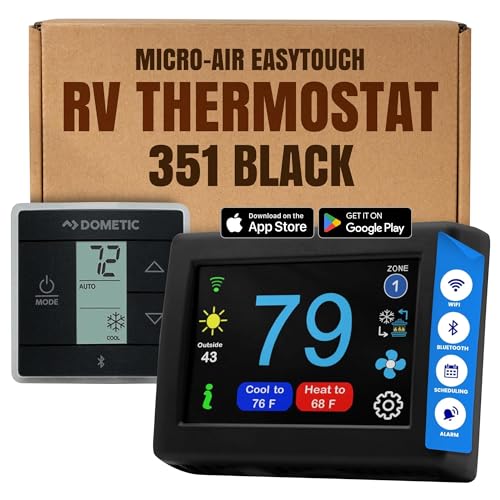
The smart category in the RV world is led by purpose-built replacements such as the Micro-Air EasyTouch line, which mirror the functions of specific factory thermostats while adding WiFi and Bluetooth control, touchscreen displays and remote temperature reporting. The value proposition differs from a smart home gadget. Remote access lets an owner check that the cabin stayed cool for a dog while the family tours a museum, and lets a winter caretaker confirm heat is alive in a stored rig without driving to the storage lot. Bluetooth control from the bed, without reaching a wall panel across a dark cabin, sounds trivial until the first frosty morning makes it feel essential. Manufacturers specify which factory systems each model replaces, down to board revisions, and that specificity is the correct way to shop this category.
Connectivity carries obligations. A WiFi thermostat in a rig that relies on campground networks inherits every weakness of those networks, so local control must remain complete when the internet disappears; any model that needs a cloud round trip to change the setpoint is disqualified for vehicle use. Owners who travel with their own hotspot will find that pairing the thermostat with the onboard network, covered in our guide to best routers for rvs, keeps remote checks working after the campground signal fades. Power draw also rises with radios and bright screens, a topic this guide returns to when discussing dry camping. Finally, app ecosystems age: a thermostat whose advanced features depend on a small company’s server deserves a clear-eyed look at how much function remains if that server ever goes quiet, and the honest answer should be nearly all of it.
Single-Zone Simplicity Versus Multi-Zone Control
A single-zone system treats the whole vehicle as one thermal space, with one sensor, one setpoint and one set of commands. That arrangement suits most travel trailers and smaller motorhomes, where air moves freely enough that the bedroom and the dinette rarely diverge for long. Single-zone thermostats are cheaper, simpler to wire and easier to replace, and their control boards carry fewer zone components to fail. The limitation appears on hot afternoons when sun load through a windshield cooks the front of a Class A while the rear bedroom stays comfortable; one sensor cannot satisfy both spaces, and the compromise setting leaves one end of the coach wrong all day.
Multi-zone systems divide the vehicle into areas, each typically with its own roof unit and its own temperature sensor, coordinated by one thermostat and a network of zone control boards. Large Class A coaches and high-end fifth wheels use two or three zones, sometimes with a single furnace ducted through the whole floor plan and assigned to one zone for control purposes. The thermostat polls each zone, runs each roof unit independently, and staggers compressor starts so the electrical system is not hit with simultaneous inrush. Owners gain even temperatures and the ability to cool only the bedroom at night, which can be the difference between sleeping and sweating when a campground pedestal limits total current.
Zone systems multiply the compatibility questions. Each roof unit needs its zone board addressed correctly, usually through dip switches that assign zone numbers and options such as furnace presence and freeze sensor behaviour. A replacement thermostat must speak the same zone protocol and respect the same addressing, or zones vanish from the display while the hardware sits healthy on the roof. Troubleshooting follows the chain: sensor, communication cable, board address, board power. A zone that reads an implausible temperature usually has a sensor fault or a sensor baking in direct sun through a window, not a thermostat failure, and shading or relocating the remote sensor restores sanity without touching the wall unit.
Heat Pumps, Heat Strips and Furnaces: Three Ways to Warm a Cabin
The heat pump in a roof unit is the same refrigeration circuit run in reverse, moving heat from outside air into the cabin. In mild weather, roughly down to the low forties Fahrenheit and sometimes lower on capable models, it heats efficiently and spares the propane supply. As outdoor temperature falls, capacity fades and defrost cycles interrupt output, and at some point the thermostat should hand heating duty to the furnace. Good RV thermostats manage that handover with an adjustable or fixed changeover threshold, and better ones bring the furnace in as assistance before the cabin drifts rather than after occupants complain. Owners who hear the heat pump labouring on a frosty morning while the furnace stays silent usually have a changeover setting, a sensor placement issue or a thermostat that never learned the furnace exists.
The electric heat strip is simpler: a resistance element in the air handler that warms the airstream while the fan runs. It takes the chill off a cool evening, costs nothing from the propane tank, and draws substantial current from shore power or a generator. Heat strips suit campgrounds with included electricity and weather that barely dips below sweater temperature. They are a poor answer to genuine cold, and a thermostat that offers heat strip mode should make the mode explicit, because owners have woken to a cold cabin after selecting what they believed was furnace heat and receiving only a gentle electric breeze. Mode labelling, in other words, is a safety feature as much as a convenience.
The propane furnace remains the heavy lifter. It heats regardless of outside temperature, runs from the battery and the propane supply without shore power, and ducts warm air through the floor where it also protects tanks and plumbing in heated underbellies. Its costs are fuel, noise and battery charge, since the blower is often the largest single DC load in the vehicle on a winter night. Thermostat behaviour shapes furnace life more than owners realise: short cycles stress ignition components and waste the purge energy of each start, while excessively long cycles overshoot and waste fuel as heat. A differential near one degree with sensible minimum run and off times, as digital thermostats provide, is the compromise furnace engineers design around.
Wiring: R, C, W, Y, G and the O/B Question
RV thermostat wiring borrows terminal letters from residential practice and then changes the voltages and sometimes the meanings, which is why colour alone should never be trusted. In many 12V systems, the R terminal carries the incoming 12V positive feed, and C or a ground terminal completes the circuit that powers the thermostat electronics. W calls for heat, conventionally the furnace. Y calls for the compressor. G calls for the fan, with some systems splitting fan duty into separate high and low speed outputs. O or B energises the reversing valve on a heat pump, and auxiliary terminals may drive a heat strip or a second stage. Installation manuals from each manufacturer print the terminal map for their own thermostat, and the map in hand always outranks memory, habit or the colours found in the wall.
Wire colours in production RVs are notoriously inconsistent. Builders pull whatever harness the line has that week, and previous owners may have extended or spliced runs with unrelated colours. The disciplined method is to photograph the old thermostat connections before touching a screw, label each conductor with its terminal letter rather than its colour, and verify the furnace and roof unit ends against their own wiring diagrams when anything looks doubtful. A conductor that served as a ground return in an analog installation may be repurposed in a digital one, and assuming continuity of meaning across a thermostat swap is how control boards get damaged. A multimeter check for the 12V feed and ground takes two minutes and prevents the most expensive category of mistake.
Heat pump owners must settle the O versus B question before first power-up. Some systems energise the reversing valve in cooling, others in heating, and a thermostat configured for the wrong convention will heat when asked to cool with perfect confidence. Manufacturers specify the convention in the roof unit manual, and thermostats expose it as a configuration option rather than separate terminals in many designs. The verification test is simple: call for cooling on a mild day and confirm cold air, then call for heat pump heat and confirm warm air, before trusting the system on a day when the answer matters. Skipping that test in spring and discovering the reversal in October is a rite of passage best left to other people.
Replacing an Analog Thermostat on an Older Wall Box
The classic upgrade path begins with a mechanical thermostat in a shallow wall recess, a handful of conductors, and an owner who wants one-degree control. The first check is conductor count. A digital thermostat needs continuous power, so the harness must offer both the 12V feed and a ground or common return at the wall. Many analog installations already have both, because the mechanical switch interrupted the positive feed while a return path existed for the anticipator or the system ground. Some do not, and the missing conductor must be run from the roof unit or the furnace compartment, a job that ranges from trivial in an open ceiling chase to miserable in a laminated wall. Wireless and battery-powered alternatives exist, yet a thermostat that depends on coin cells in a vehicle that freezes in storage invites a dead control at the worst moment.
The second check is load. Mechanical contacts tolerate sloppy current; electronic relays have ratings. Data sheets list maximum current per output, and the furnace, compressor contactor and fan circuits must each sit comfortably below the figure. Where a roof unit’s contactor coil draws near the limit, an interposing relay installed at the appliance protects the thermostat and is standard practice in the trade. The third check is physical: the new thermostat’s footprint against the old one’s shadow. Years of sun leave a pale outline on the wall panel, and a smaller replacement exposes it. Backing plates solve the cosmetic issue, and some replacement kits include them for exactly this reason.
Commissioning the new unit deserves the same care as wiring it. Set the mode configuration for the actual appliances present, confirm the fan behaves in both automatic and manual positions, run a full heating cycle and a full cooling cycle, and watch one complete shutdown of each. Furnace shutdown should include the blower cool-down period the furnace board controls; a thermostat that kills power mid-purge will confuse later diagnostics. Note the displayed temperature against a trusted thermometer placed at breathing height away from the wall, and apply the thermostat’s calibration offset if it offers one. That ten-minute ritual converts an installation from probably fine into known fine, and the notes taken during it become gold when something misbehaves a season later.
Freeze Protection and the Plumbing Behind the Walls
For owners who store or occupy an RV in cold country, the thermostat is part of the plumbing protection system. Water lines run through cabinets and under floors where cabin air barely reaches, and a setpoint that keeps the living space at a pleasant figure may still let a low point behind a drawer approach freezing during a windy night. Freeze protection strategy therefore combines a conservative setpoint with open cabinet doors, and on many rigs a furnace that ducts some heat into the underbelly only while it runs. A thermostat with a low-temperature alert, or a smart model that reports cabin temperature remotely, turns that strategy from hope into monitoring. The alert threshold should sit a few degrees above freezing at the sensor, because the coldest pipe is always colder than the wall where the sensor lives.
Some thermostats and control systems add a dedicated freeze sensor in the roof unit that protects the air conditioner’s own components and can force fan or heat behaviour in cold snaps. Zone boards in Dometic systems have used such sensors for years, and a replacement thermostat that ignores the freeze input can leave the roof unit behaving oddly in shoulder season. Owners should also plan for the power failure case: if shore power drops and the battery fades, heat stops, and the time available before pipes suffer depends on insulation and outside temperature. No thermostat solves that arithmetic, but one that logs or reports the loss of power buys the owner a chance to act, and a rig winterised properly needs no heroics from electronics at all.
Battery Drain, Boondocking and the Cost of Cleverness
Every feature on a modern thermostat sips power. The display backlight, the WiFi radio checking in, the Bluetooth beacon listening for a phone, the relays holding state: each draw is small, and together they run around the clock. Manufacturers specify standby consumption for better models, and the honest comparison is against the furnace blower, which dwarfs them all during a heating night. Still, a stored rig tells a different story. Across three weeks of storage, a modest always-on draw can pull a small battery bank down to the level where the furnace will not start on the first cold trip, which is why storage procedure should include either a true battery disconnect or a plan to maintain charge. Keeping a bank healthy with the approach described in best 12v solar trickle chargers suits rigs stored outdoors, while those stored near mains power often rely on the maintenance charging patterns compared in best 12 volt battery chargers.
During active dry camping, thermostat choices shape the night more than the thermostat’s own draw does. A wide analog swing lets the cabin cool deeply before the furnace fires, then overshoots, and the blower runs long and loud. A tight digital differential runs the blower in shorter bursts that many sleepers prefer, at similar total energy. A programmable setback trims the largest load of all by simply asking for less heat while everyone is under blankets. Owners nursing a tired bank through a cold snap sometimes stage their charging from a generator in the morning using equipment sized along the lines of best 10 amp battery chargers, then let the thermostat hold a modest setpoint overnight rather than pursuing daytime comfort figures. The pattern that fails is the opposite: a high setpoint, a wide swing, and a battery asked to fund both until it cannot fund either.
Troubleshooting Relays, Sensors and Ghost Behaviour
Relay trouble announces itself in a small vocabulary of symptoms. A relay that chatters during a call points to low control voltage, a failing coil or a thermostat output that cannot hold the load. A relay welded shut leaves a fan or a heat call running after the thermostat is satisfied, and the safe response is to cut power at the appliance breaker or fuse and treat the board as failed until proven otherwise. A relay that never pulls in, despite a clear call and healthy voltage at its coil, has simply reached the end of its mechanical life; relays are wear items with rated cycle counts, and a thermostat or board that has switched a furnace through ten winters has done real work. Clicking at the wall unit with no response at the appliance moves suspicion to the cable run and its splices.
Sensor faults are quieter. A thermostat that reports a plausible but wrong temperature will run the whole system faithfully toward the wrong target, so the complaint sounds like weak heating or weak cooling rather than bad sensing. Comparing the display against two independent thermometers at the same location separates sensor drift from genuine appliance shortfall. Placement explains many cases: a thermostat mounted above a television, beside a sunlit window, on a wall shared with a refrigerator compartment, or directly in the discharge path of a vent will read the microclimate of that spot with great precision and the cabin hardly at all. Relocating a sensor, or choosing a thermostat that accepts a remote sensor in a better position, fixes a category of problems that no amount of appliance service can touch.
Ghost behaviour, where modes change or setpoints wander without input, usually traces back to power quality, failing touchscreens or condensation inside the wall cavity rather than to anything mysterious. A capacitive screen damp with morning condensation can register touches that never happened. A thermostat sharing a circuit with a pump that browns out the supply can reboot into a default mode. The diagnostic habit that pays is to change one variable at a time and write down what happened: voltage at the thermostat during the fault, the exact mode shown, whether the furnace board logged a lockout. Guesswork replaces parts; notes replace the right ones.
Fan Control, Humidity and the Feel of the Air
Owners often judge a system by temperature alone, yet the fan settings on the thermostat decide how the cabin actually feels. Automatic fan operation runs the blower only during a cooling or heating call, which keeps noise down and saves battery charge. Continuous fan operation evens out temperature between rooms, filters the air through whatever media the return grille carries, and keeps a gentle movement that many people sleep better under. In cooling season, though, a fan that keeps blowing after the compressor stops pushes moisture back off the wet coil into the cabin, undoing part of the dehumidification the cycle just achieved. Coastal campers learn this quickly: the thermostat may hold the setpoint while the bedding still feels damp, and switching the fan back to automatic restores the dry feel within a day.
Fan speed selection adds another layer. Many roof units offer high and low speeds, and some thermostats expose both while others quietly fix the choice. Low speed on a mild night reduces noise to a murmur and still moves enough air across the coil. High speed on a brutal afternoon maximises capacity and helps a sun-baked cabin recover after a driving day. A thermostat replacement that silently drops a fan speed the old unit offered will be felt immediately, so buyers should compare fan behaviour line by line in the manuals, including whether the furnace blower and the roof fan can ever be commanded independently. That last point matters for owners who circulate warm air with the roof fan on low while the furnace heats, a trick that evens out floor-to-ceiling gradients in tall fifth wheels.
A Short Buying Checklist Drawn From the Manuals
Compatibility comes first, verified against appliance model numbers rather than brand names alone. Second comes the control method: direct relay drive, or communication with a board in the roof unit, and the thermostat must match the method the appliances use. Third is the mode list, confirming heat pump, heat strip, furnace and cooling outputs all exist if the rig carries all four. Fourth is power: the operating voltage range, the standby draw, and behaviour after a battery disconnect. Fifth is the sensor story, including calibration adjustment and remote sensor support where the wall location is compromised. Sixth is the human interface, because a thermostat that needs a manual to change the mode will be operated wrong by guests, by children and by tired owners at midnight.
Documentation quality is a legitimate buying criterion in this category. Manufacturers specify terminal maps, dip switch meanings, error code tables and changeover thresholds in their literature, and the brands that publish complete documents make ownership cheaper for a decade. A thermostat sold with a single folded sheet and no wiring diagram transfers the cost of every future question to a technician’s hourly rate. Buyers should also confirm what happens to settings when firmware updates arrive on connected models, whether the unit can be operated fully from its own screen when the phone app is unavailable, and how the maker handles replacement parts such as wall plates and sensors. None of these questions appear on a feature badge, and all of them decide satisfaction in year three.
Three Cabins, Three Different Answers
Consider a couple wintering in the desert Southwest, plugged in for months at a time. Their loads are mild heating at dawn, serious cooling by afternoon, and a heat pump that covers most of the season. For them, a digital thermostat with a well-managed heat pump changeover and a gentle schedule earns its keep, and propane use falls to a few furnace weeks a year. Now consider a hunter dry camping in late autumn, where the furnace is the only heat and the battery bank is the only grid. That owner needs tight differential control, a low setback for sleeping hours, minimal standby draw and no dependence on any network; a capable digital unit without connected features may serve better than a flagship smart model. Finally, consider a family in a large multi-zone coach touring humid summer country with a dog aboard. Zone control, remote temperature reporting and alerts move from luxuries to the core of the purchase, and the thermostat budget rightly grows to match what it protects.
Questions Owners Ask Before Replacing a Working Thermostat
Will a tighter thermostat save propane? Usually some, because overshoot is wasted fuel and a one-degree differential trims the overshoot that a worn mechanical unit allows, though insulation and weather dominate total consumption. Will a smart thermostat work without campground internet? The reputable vehicle-specific models keep full local control and treat the connection as an extra, but buyers should verify that claim in the manual rather than in marketing copy. Can one thermostat run a roof unit and a furnace from different brands? Frequently yes, provided the thermostat offers the control method the roof unit expects and an independent furnace output, which describes many integrated RV thermostats and explains their enduring popularity. Does a replacement need a technician? A like-for-like swap within the same control family is within reach of a careful owner with a camera, labels and a meter, while board changes, new cable runs and gas-adjacent wiring argue for professional hands.
One more question deserves a direct answer: should a working analog thermostat be replaced at all? If the rig is used mildly, stored kindly and occupied by people who enjoy its simplicity, the honest answer can be no. Upgrades earn their cost when swing causes discomfort, when freeze protection needs precision, when zones or heat pump logic are being mismanaged, or when remote awareness protects animals, plumbing or stored goods. Replacing a thermostat to gain a prettier screen, while the underlying control board and sensors stay tired, is the one purchase this guide argues against in every configuration.
Seasonal Habits That Keep Control Honest
A thermostat rewards a small amount of seasonal attention. At the start of cooling season, owners should run the air conditioner through a full cycle on a mild day, confirm the fan speeds respond, and clear the return air filter so the control system is judging a healthy appliance rather than a starved one. At the start of heating season, the same ritual belongs to the furnace: a full call for heat, a listen for the purge and ignition sequence, and a check that shutdown arrives because the setpoint was satisfied, not because a limit switch intervened. Catching a weak blower or a dirty filter in October, from a position of comfort, is a different experience from diagnosing the same fault during the first hard freeze with the cabin already cold.
Sensor honesty deserves a yearly glance as well. Dust the thermostat housing, keep its vents unobstructed, and compare its reading once against a reliable thermometer at the same height. Cabinets near the thermostat change how air reaches it; a new television, a relocated space heater or a curtain drawn across a nearby vent can all shift its microclimate and masquerade as equipment decline. Owners of connected models should also review alert settings after any phone change, because a temperature warning routed to a retired handset protects nothing. Finally, record the configuration in the rig’s notebook: mode settings, reversing valve convention, zone addresses, calibration offset and the date of any board replacement. The next owner, or the same owner three winters later, will read that page with gratitude.
Travel days create their own control questions. A cabin that heat-soaks during a summer drive needs a thermostat that tolerates a wide recovery without staging every output at once and tripping a pedestal breaker; staggered compressor starts in multi-zone systems exist for exactly this moment. In winter, a rig towed through freezing air arrives with cold-soaked walls, and the furnace will run long on the first evening no matter what the thermostat asks, which is normal behaviour rather than a fault. Slides that seal poorly, a door opened twenty times during setup, and wet gear drying in the living space all load the system in ways no specification covers. Judging a new thermostat by its first evening in extreme conditions is unfair to the equipment; judging it across a settled week, against the notes taken at commissioning, is how owners separate a genuine mismatch from the ordinary physics of a thin-walled home that travels.
Reading the Specification Sheet Like a Technician
Four figures on a thermostat data sheet predict most of ownership. The temperature differential states how far the cabin drifts around the setpoint, and smaller is steadier but cycles equipment more often. The relay or output rating states what each terminal can switch, and it should clear the appliance loads with room to spare rather than by a whisker. The operating voltage range states where the electronics stay sane, which matters every night the rig runs on battery alone. The sensor accuracy figure, often quoted within a degree or two, states how far the displayed number may sit from the truth before calibration. Buyers who line those four figures up across candidate models learn more in five minutes than a gallery of lifestyle photographs can offer, and they learn it in the manufacturer’s own words, which is where this guide began and where every compatibility question in this category properly ends.
Price belongs at the end of that comparison, not the beginning, and it should be weighed against the cost of the mistakes a wrong thermostat creates: a control board damaged by a miswired swap, a furnace locked out on a freezing night, a heat pump short-cycling itself toward an early compressor failure. Against those figures, the difference between a merely adequate thermostat and the correct one is small money. Owners who buy on compatibility first and features second rarely shop twice for the same vehicle, while owners who reverse the order often own two thermostats within a year, one of them in a drawer. The drawer unit is the true luxury purchase in this category, and it is the one this guide most hopes to help its readers avoid making.
Check prices on Amazon
Live listings for the shortlist in this guide are pulled from Amazon below, so prices and availability are always current at the moment you look.


Closing Judgement
The right RV thermostat is the one whose control logic matches the appliances already bolted to the roof and under the floor, whose power demands respect the battery bank, and whose interface the sleepiest person in the rig can operate correctly in the dark. Brand families matter because Dometic, Coleman-Mach and Suburban built different control traditions, and no specification sheet feature outranks the plain fact of speaking the correct dialect to a specific control board. Read the appliance manuals, photograph the wiring, verify each mode with a full cycle, and the small box on the wall becomes what it should have been from the factory: a quiet translator between the weather outside and the life going on inside, asking for attention perhaps twice a year and deserving, on those two occasions, to be believed without hesitation or a second thermometer held up beside it in suspicion.