What's inside
- Key Takeaways
- Quick Picks
- How Did We Choose These Picks?
- Read Speed, Write Speed and the Floor Beneath Both: What Do the Numbers Mean?
- Why Does the Reader Matter as Much as the Card?
- How Does Write Speed Change a Burst Photographer’s Day?
- How Do the Six Speed Cards Compare on the Figures That Matter?
- Who Actually Needs Speeds Like These — and Who Does Not?
- How Should You Test a Fast Card When It Arrives?
- How Should Fast Cards Be Handled to Keep Them Fast?
- What Mistakes Do Buyers Make When Shopping on Speed?
- Final Recommendation
- Frequently Asked Questions
- Related Guides
As an Amazon Associate I earn from qualifying purchases. This post may contain affiliate links at no extra cost to you.
gizmoverdict.com is reader-supported. When you buy through links on our site, we may earn an affiliate commission.
Where to buy: each card below links to its Amazon listing from the Quick Picks table and from its detailed review. Speed-class cards are sold in several capacities under one family name, so confirm the capacity in the listing matches the one named here — and if a figure in a listing differs from the figure quoted here, trust the listing in front of you, because manufacturers revise cards silently.
The best sd cards read write speed can offer are, almost without exception, UHS-II cards wearing V90 or V60 ratings — and understanding why those two facts travel together is the key to this entire category. Read speed and write speed are different talents. Read speed is how fast a card hands its contents to a computer: it governs offloads, imports and backups. Write speed is how fast a card absorbs what a camera produces: it governs burst depth, buffer clearing and whether high-bitrate video records without a tremor. The headline number on most packaging is a read figure, because it is the bigger one; the number that decides whether a shoot succeeds is usually the write figure, and the honest version of that is not a peak at all but a guaranteed floor — which is exactly what the V-ratings certify. V90 promises a sustained write of at least 90MB/s, V60 at least 60MB/s, under standardised conditions, for as long as the recording lasts.
The six cards below are the speed shelf’s serious residents: two SanDisk Extreme PRO UHS-II cards with stated reads of 310MB/s and 300MB/s, Lexar’s 2000x with V90 and 8K positioning, Sony’s TOUGH-G with both its read and write maxima printed in the title — a rarity worth honouring — ProGrade’s V90 Iridium from a maker that sells only professional media, and PNY’s V60 EliteX-PRO60 as the tier’s value door. Every figure quoted comes from the listing titles; where a title declines to state a peak, the spec box says so and the rating carries the argument. If your work is 8K video, long raw bursts, or offloads measured in hundreds of gigabytes against a deadline, this is your roundup.
Key Takeaways
- Read speed empties the card; write speed fills it. Cameras live on write performance, computers enjoy read performance, and the two figures are rarely equal.
- The V-rating is the only write figure that is a guarantee: V90 and V60 certify sustained minimum write speeds, while headline numbers describe peaks.
- Every pick here is UHS-II — the interface whose second row of contacts roughly doubles the bus ceiling — and it only delivers its pace in UHS-II hosts and readers.
- Sony’s TOUGH-G is the one title here that prints both its maximum read and maximum write figures outright.
- A fast card in a slow reader is a slow system: budget for the UHS-II reader that lets these cards show their stated pace at the offload.
Quick Picks
| Pick | Badge | Why it earns its place |
|---|---|---|
| SanDisk 128GB Extreme PRO UHS-II | Fastest stated read speed | Reads up to 310MB/s — the highest figure in this roundup — from SanDisk’s professional line. |
| Lexar 256GB 2000x SD | Best for 8K and bursts | 300MB/s stated reads with V90 and U3 ratings and 8K positioning, at a working 256GB. |
| ProGrade Digital V90 Iridium 256GB | Professional’s professional card | A V90 card from a maker that sells nothing but professional media, at 256GB. |
| Sony TOUGH-G 128GB UHS-II | Both speeds printed, toughest build | Max read 300MB/s and max write 299MB/s stated in the title, in Sony’s TOUGH shell, with V90. |
| SanDisk 256GB Extreme PRO UHS-II | Big-capacity flagship | The Extreme PRO UHS-II formula at 256GB, with reads stated up to 300MB/s. |
| PNY 256GB EliteX-PRO60 | Best V60 value | UHS-II with a V60 floor and 4K Ultra HD positioning at 256GB — the sensible step into the fast tier. |
How Did We Choose These Picks?
We chose by the write side first, because that is where speed stops being a convenience and becomes a capability. A card earns a place here by carrying a V90 or V60 sustained-write certification, or — in the SanDisk pair’s case — by belonging to the UHS-II professional line whose stated read figures top the category, with the understanding, stated openly in their reviews, that their titles print no V-rating. Read figures were the second criterion, capacity the third: the working sizes for high-bitrate video and burst photography cluster at 128GB and 256GB, and every pick sits in that band. Every number in this article is drawn from the pool listing titles, and titles that stay silent produce spec boxes that say so.
The field is deliberately all UHS-II. UHS-I’s bus ceiling sits far below these cards’ stated figures, so a roundup about the best read and write speeds that included UHS-I media would be comparing sprinters with joggers; the interesting contest is entirely inside the UHS-II generation, between V90 flagships, one V60 value card, and the different philosophies their makers print — or decline to print — on their titles. We also kept the makers professional: at these speeds and prices, the buyers are working photographers and videographers, and the six names here are the ones that show up in their bags.
One thing this roundup does not do is rank the cards by a single benchmark number, because the honest answer to “which is fastest” is “at what, measured how, in which host”. A card’s stated read peak, its guaranteed write floor and its sustained write across a full card are three different quantities, and different picks here lead on each. The reviews take them one at a time, and the comparison table keeps the three quantities in separate columns where they belong.
Read Speed, Write Speed and the Floor Beneath Both: What Do the Numbers Mean?
Begin with the bus. UHS-II adds a second row of contacts to the card, and with it a data path whose ceiling is roughly double the UHS-I generation’s — the headroom that makes stated read figures around 300MB/s possible at all. That ceiling is a property of the connection, shared by host and card: put a UHS-II card in a UHS-I camera or reader and it runs, perfectly happily, at UHS-I pace, its second row of contacts unemployed. Every figure in this roundup therefore carries an implicit condition — in a UHS-II host — and the first buying question is whether your camera and your reader both speak it. If either does not, you are shopping for margin and future-proofing, which can still be rational, but should be bought with open eyes.
Next, peaks versus floors. A stated maximum read or write speed is the best the card achieved under favourable conditions — typically large sequential transfers on a fresh card. Real work is less favourable: cards fill, controllers manage wear, temperatures rise, and files fragment. The V-rating system exists to certify the other end of the distribution: the slowest sustained write the card guarantees for video, standardised and testable. V90’s floor of 90MB/s is what an 8K camera actually leans on; the 300MB/s on the same card’s box is what your reader leans on at midnight. Confusing the two — expecting recording behaviour from a read peak, or offload behaviour from a write floor — is the category’s founding error, and most disappointed speed-card buyers have made one version of it.
A worked example fixes the relationships better than definitions do. Imagine a card whose box promises 300MB/s and whose V-rating is V90. The 300MB/s is what a nearly empty card, in a flagship reader, moving one enormous file, can touch — the offload of a day’s footage will live near it at the start and ease downward as the copy proceeds. The V90 is what the same card promises a camera at the end of a long recording, two-thirds full, on a warm afternoon: never below 90MB/s, sustained, for as long as the red light burns. Neither number is a lie; they are answers to different questions, asked by different halves of the workflow. The buyer’s skill — the entire skill this category demands — is knowing which question their own work is asking, and refusing to let the bigger number answer the smaller number’s question.
Sustained write across the whole card is the third quantity, and the least advertised. Some cards open at their peak and sag as they fill or warm; professional lines are engineered to hold their pace, which is why the word “professional” in a card’s name is a technical claim and not merely a pricing one. The makers represented here — SanDisk’s Extreme PRO line, Lexar’s 2000x series, Sony’s TOUGH-G, ProGrade’s Iridium — all stake their reputations on that sustained behaviour. Where a title gives us a number we quote it; where it gives us a rating we lean on it; and where it gives us neither, as with the SanDisk pair’s write side, the review says so and lets the line’s record speak.
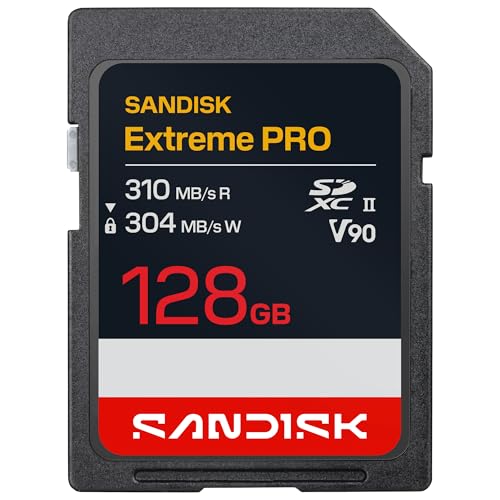
SanDisk 128GB Extreme PRO UHS-II — Fastest stated read speed
The highest read figure in this roundup belongs to SanDisk’s 128GB Extreme PRO UHS-II: up to 310MB/s, printed in the title. Read speed is the offload’s currency, and at this level a full 128GB card — a morning of high-bitrate video, a burst-heavy sports half — moves to a computer through a UHS-II reader in a handful of minutes, a pace that stops being a workflow step and becomes a non-event. For shooters whose turnaround is the product — wire photographers, same-day editors, anyone whose card must be back in a camera within the hour — that figure is not vanity; it is schedule.
Put the figure in a working frame and it sharpens further. A sports photographer on a two-body setup generates a card like this per body per half; the interval between the final whistle and the desk’s deadline is where agencies live, and a card that reads at the bus ceiling, through the reader the desk already owns, is quite literally the fastest legal advantage in the building. Wedding videographers feel the same figure at the other end of the emotional register: the card from the ceremony, copied and verified before the reception ends, means the footage exists twice before the dancing starts — a sentence every couple’s contract silently hopes is true.
The honest paperwork note: the title states no V-rating and no write figure for this card, and the spec box records that. The Extreme PRO UHS-II line is SanDisk’s flagship speed product and its professional standing is the evidence on the write side; buyers for whom a printed V90 guarantee is a contractual necessity — cinema work with specified media requirements, for instance — should look at the Lexar, Sony or ProGrade picks, whose titles carry the rating. Buyers who know the line and want the category’s highest stated read ceiling in a 128GB working size have found their card. Both readings of the same listing are rational; the difference is which document your workflow answers to.
- Capacity: 128GB SD, full-size
- Interface: UHS-II, per the listing title
- Stated read speed: up to 310MB/s
- Stated write speed: Not stated in the listing title — verify with SanDisk documentation
- Speed class ratings: Not stated in the listing title — verify with SanDisk documentation
Strengths
- The roundup’s highest stated read speed — offloads at the ceiling of the UHS-II bus.
- SanDisk’s flagship speed line, with the professional record that name carries.
- 128GB is the nimble working size for turnaround-driven shooters.
Trade-offs
- No V-rating or write figure is printed in the title, so its sustained floor is undocumented by the listing.
- Its read ceiling is only available through a UHS-II reader; a UHS-I reader halves the show.
- High-bitrate video at 128GB turns cards over quickly on long recording days.
Best for: turnaround professionals whose offload speed is part of the product they sell. Not suited for: camera contracts or media specifications that require a V-rating printed on the listing — three rivals here provide exactly that documentation.

Lexar 256GB 2000x SD — Best for 8K and bursts
Lexar’s 2000x is the most completely credentialed card in this roundup for camera-side work. The title states a 300MB/s read speed and prints the ratings that matter — V90 and U3 — alongside 8K positioning, at 256GB. Translate the stack: the V90 guarantees a sustained write floor in the class that high-bitrate 8K recording and long, deep raw bursts actually consume; the stated read figure puts its offload within a breath of the SanDisk’s ceiling; and 256GB gives those hungry formats room to work across a serious session rather than a taster. If a camera’s media specification sheet reads like a list of demands, this card’s title reads like the answers, in order.
The 2000x name is Lexar’s long-running flagship designation — the “x” is the old speed-multiple language the industry used before megabytes took over — and the line has been the company’s professional standard-bearer through several interface generations. That lineage matters in this tier because sustained behaviour is a controller-and-firmware discipline learned over product cycles, and the 2000x cards have been the vehicle for it. Between this and the Sony TOUGH-G, the other fully documented V90 here, the choice is capacity and build philosophy: Lexar offers 256GB and a conventional shell, Sony offers its sealed TOUGH construction at 128GB with both maxima printed. Working shooters will know which of those sentences describes their bag.
- Capacity: 256GB SD, full-size
- Interface: UHS-II, per the listing title
- Stated read speed: 300MB/s
- Ratings in title: V90, U3, 8K positioning
- Stated write speed: Not stated in the listing title — verify with Lexar documentation (V90 rating in title)
Strengths
- A V90 floor and a 300MB/s stated read in one title — both halves of the speed story documented.
- 256GB suits the formats its ratings are aimed at: 8K video and deep raw bursts.
- Lexar’s flagship line carries generations of professional sustained-write engineering.
Trade-offs
- Its peak write figure is not printed — only the V90 floor documents the write side.
- Flagship V90 pricing applies, and pairs for dual-slot cameras double it.
- All of its pace requires UHS-II hosts and readers to exist at all.
Best for: 8K videographers and burst-heavy stills shooters who buy on documented floors. Not suited for: a UHS-I camera owner, who would be paying for an interface generation their body cannot open.

ProGrade Digital V90 Iridium 256GB — Professional’s professional card
ProGrade Digital is the specialist of this roundup: a company founded by memory-industry veterans to sell professional camera media and nothing else, with no consumer line diluting the brief. Its Iridium card’s title is the tersest here — SDXC, UHS-II, V90, 256GB — and in this tier, terseness is a kind of confidence. The V90 rating is the whole specification a recording device leans on, certified and standardised; ProGrade’s reputation supplies the rest, including a refresh-and-health ethos the company builds around its media and its own reader ecosystem, aimed at shooters who manage cards as a fleet with a service life rather than as anonymous consumables.
There is a fleet-management philosophy bundled into this brand that deserves a paragraph of its own, because it represents where professional media is heading. Cards at this level increasingly ship as managed assets: health that can be checked, firmware that can be refreshed, a service life that can be monitored rather than guessed. The owner of a dozen ProGrade cards is running a small fleet with known ages and known condition, and when one card’s health report dims, it rotates out of A-camera duty before it can fail in it. That is a different relationship with media than the disposable-card era taught, and for shooters whose income rides on the media, it is plainly the right one — the card stops being a lottery ticket and becomes equipment, maintained like the lenses it serves.
Who buys this card? The working professional whose media budget is a business cost and whose failure budget is zero — the wedding shooter whose second body must not buffer-stall during the processional, the production company whose cards are logged by serial number. That buyer is not purchasing a peak figure; they are purchasing the probability distribution of a card’s worst day, from the maker whose entire existence is staked on it. The title’s silence on read and write peaks means offload planning leans on the UHS-II class rather than a printed number, and for this card’s intended owner that trade — floor guaranteed, peaks unadvertised — is not a compromise but the correct set of priorities, printed in the correct order.
- Capacity: 256GB SDXC, full-size
- Interface: UHS-II, per the listing title
- Ratings in title: V90
- Stated read speed: Not stated in the listing title — verify with ProGrade Digital documentation
- Stated write speed: Not stated in the listing title — verify with ProGrade Digital documentation (V90 rating in title)
Strengths
- A V90 guarantee from a maker devoted exclusively to professional camera media.
- 256GB working capacity sized for high-bitrate professional formats.
- A fleet-minded brand whose support and tools assume cards are managed assets.
Trade-offs
- Neither peak is stated in the title, so benchmark-led buyers have nothing to quote.
- Professional-only pricing, without a consumer tier to step down to in the same line.
- Its virtues are probabilistic and long-term — invisible in a first-week test.
Best for: working professionals who manage media as a fleet and buy worst-day insurance. Not suited for: a hobbyist chasing a headline number, who will find the stated figures of the SanDisk or Lexar picks more satisfying.

Sony TOUGH-G 128GB UHS-II — Both speeds printed, toughest build
Sony’s TOUGH-G does two things no other pick here attempts. First, its title prints both maxima — maximum read 300MB/s, maximum write 299MB/s — the fullest speed disclosure in the roundup, and a write peak within a whisper of its read peak, which tells you the card was engineered symmetrically rather than tuned for a flattering read number. Second, the TOUGH part is literal: this line is built as a sealed, one-piece body designed to shrug off the bending, dropping and water exposure that kill ordinary cards, for shooters whose media lives in weather and wreckage rather than in a studio drawer. Its ratings complete the sheet: V90 for the sustained floor, CL10 and U3 alongside, at 128GB.
There is a testing-culture point attached to this card that its owners repeat often: because both maxima are printed, the card can be held to account. A TOUGH-G that reads at a fraction of its stated figure in a proper UHS-II reader is a card with a story to tell its maker, and Sony’s professional support for this line is accustomed to exactly that conversation. Printed numbers create obligations; that is why so many titles avoid printing them, and why the ones that do print deserve the credit this review is giving. In a category built on the difference between promises and guarantees, a manufacturer that writes both numbers on the box has told you something about itself before the card ever enters a camera.
For the C100-class question — what does a speed card buy a working camera — the TOUGH-G’s answer is the most complete here: a guaranteed floor for the recording, a documented peak for the write bursts, a documented read for the offload, and a shell for the life in between. Its capacity is the smaller working size, which suits burst photographers and turnaround video work better than all-day 8K recording, and its price reflects both the engineering and the armour. If your cards have ever died by physics rather than by electronics — sat on, soaked, frozen into a bag’s lining — this is the pick that was designed by people who read your incident reports.
- Capacity: 128GB SDXC, full-size
- Interface: UHS-II, per the listing title (TOUGH-G series, SF-G128)
- Stated read speed: Max R300MB/S, per the listing title
- Stated write speed: Max W299MB/S, per the listing title
- Ratings in title: V90, CL10, U3
Strengths
- Both maximum read and maximum write are printed in the title — unique here.
- A V90 floor under the peaks, so the guaranteed and the advertised numbers coexist.
- The TOUGH sealed build addresses physical failure, the other way cards actually die.
Trade-offs
- 128GB is the compact tier for formats this fast; long 8K days will cycle it often.
- The armour and engineering price it at the top of the roundup’s range.
- Its write peak, however high, is still a peak — the V90 floor remains the recording guarantee.
Best for: outdoor and event professionals whose cards face weather, drops and deadlines together. Not suited for: a studio shooter whose media lives in a drawer, paying for armour it will never test.

SanDisk 256GB Extreme PRO UHS-II — Big-capacity flagship
The second SanDisk in this roundup is the first one’s larger sibling: the Extreme PRO UHS-II formula at 256GB, with read speeds stated up to 300MB/s. The pairing of that read ceiling with the bigger capacity is aimed at a specific working pattern — high-bitrate recording days that fill a quarter-terabyte and end against a deadline. A 256GB card that reads at UHS-II’s practical ceiling empties in a fraction of the time its UHS-I predecessors needed, and across a season of shoots that fraction compounds into days of working life returned. For the videographer whose media rotation is the schedule’s critical path, this is the roundup’s volume play.
Its paperwork mirrors its sibling’s: the title prints no V-rating and no write peak, so the write side of its story is carried by the Extreme PRO UHS-II line’s professional standing rather than by a certified floor in the listing. We flag that not as a disqualification but as the decision the buyer is actually making — documented guarantees live at the Lexar, Sony and ProGrade picks; the SanDisk pair offers the line’s record and the two highest stated read figures in the category. Shooters who have run Extreme PRO media for years will find that a perfectly sufficient brief. Shooters buying their first fast cards on specification should read both halves of this paragraph twice.
- Capacity: 256GB SD, full-size
- Interface: UHS-II, per the listing title
- Stated read speed: up to 300MB/s
- Stated write speed: Not stated in the listing title — verify with SanDisk documentation
- Speed class ratings: Not stated in the listing title — verify with SanDisk documentation
Strengths
- A 300MB/s stated read ceiling at the 256GB capacity high-bitrate days actually fill.
- The flagship line’s record stands behind its undocumented write side.
- Fewer, larger cards simplify rotation for solo shooters on long recording days.
Trade-offs
- No V-rating in the title, so media-spec contracts that name V90 point elsewhere in this list.
- A full 256GB card concentrates a full day’s footage until the offload verifies.
- Its advantages need a UHS-II reader to materialise; without one it offloads at UHS-I pace.
Best for: high-bitrate videographers who offload big cards against deadlines. Not suited for: workflows that need a certified sustained-write floor in writing — the V90 trio carries that documentation in full.

PNY 256GB EliteX-PRO60 UHS-II — Best V60 value
Not every fast-card buyer needs the V90 ceiling, and PNY’s EliteX-PRO60 exists for the large, sensible middle. Its title states the formula plainly: UHS-II, U3, a V60 rating, 4K Ultra HD positioning, 256GB. V60 certifies a sustained write floor of 60MB/s class — half of V90’s guarantee, and still more than the great majority of cameras recording 4K can consume, including the high-bitrate 4K modes that strain V30 media. For the shooter stepping up from UHS-I because a new body’s 4K bitrate demands it, or because burst clearing has become the bottleneck of a sports workflow, this card delivers the interface generation and a doubled video class at the tier’s friendliest price.
The honest boundary is 8K and the most extreme burst work, where V90’s floor is the specification and this card’s V60 is not a substitute — the Lexar and its V90 peers own that territory and price accordingly. Within its territory, the PNY’s case is completeness at value: UHS-II pace at the reader, a certified floor at the camera, and capacity that matches the formats it serves. It is also the natural second card for a V90 owner’s bag — the card for the second body, the locked-off angle, the day when the flagship pair is already committed — because a system built entirely of flagships is a system whose owner flinches at every purchase, and flinching owners under-buy spares.
- Capacity: 256GB SDXC, full-size
- Interface: UHS-II, per the listing title
- Ratings in title: U3, V60, 4K Ultra HD positioning
- Stated read speed: Not stated in the listing title — verify with PNY documentation
- Stated write speed: Not stated in the listing title — verify with PNY documentation (V60 rating in title)
Strengths
- A certified V60 floor on a UHS-II card at the tier’s value price.
- 256GB capacity matches the 4K workflows its rating serves.
- The rational second card in a V90 flagship’s bag, and a complete main card for most 4K bodies.
Trade-offs
- V60 is not V90: 8K and the heaviest burst specifications belong to the flagship trio.
- No peak figures are printed in the title, so offload pace is a class expectation, not a number.
- PNY’s professional-media profile is quieter than the specialist and flagship names here.
Best for: 4K shooters stepping into UHS-II, and flagship owners equipping second bodies. Not suited for: 8K recording or media contracts that specify V90 — buy the rating the work names.
Why Does the Reader Matter as Much as the Card?
Because a transfer is a chain, and a chain’s speed is its slowest link’s biography. The stated read figures in this roundup — 310MB/s, 300MB/s — assume a UHS-II reader, connected over a modern USB link, writing to a destination drive that can absorb the stream. Remove any one of those and the card’s ceiling becomes theoretical: a UHS-I reader caps every card here near the older generation’s pace; an elderly USB port caps it lower still; a nearly full laptop drive or a spinning portable disk can cap it lowest of all. Shooters who upgrade cards and feel nothing have usually upgraded one link of a four-link chain, and the diagnostic is simple — test the same card in a known UHS-II reader and watch the number change. The card was never the problem; the path was.
This is why several makers in this category sell readers alongside their flagship media, and why the professional habit is to buy the reader in the same order as the first UHS-II card. It is also why offload claims should always be read as system claims. When this guide says the Lexar’s stated 300MB/s read compresses an offload into minutes, the sentence’s silent partners are the reader, the cable, the port and the destination — all present, all modern. Budget the chain honestly and the speed tier delivers everything its boxes promise; starve any link and you have bought a sports car for a farm track, which is not the car’s fault and not the track’s — it is the pairing’s.
A subtler link in the chain is heat at the reader. Sustained transfers of hundreds of gigabytes warm both card and reader, and bargain readers throttle quietly when hot, turning a flagship’s stated pace into a first-ten-gigabytes party trick. A reader with a metal body and honest thermal design is unglamorous and decisive. Professionals who offload for a living learn this once, expensively, and then talk about readers the way they talk about tripods — as the invisible equipment that everything else stands on. If your offload station serves several cameras, label the reader’s cable and port as part of the station and never lend them casually; the chain you verified is the chain you own, and borrowed links unverify it silently.
How Does Write Speed Change a Burst Photographer’s Day?
Stand at the side of a pitch with a flagship body and the abstraction becomes physical. The camera fires at its maximum rate into its internal buffer — a reservoir that holds seconds of full-resolution raw files — and the card is the drain. While the buffer has room, the camera is unstoppable; when the buffer fills, the camera’s rate collapses to the card’s drain pace, and the photographer starts choosing moments instead of taking them. A faster sustained write does not change the camera’s headline frame rate; it changes how long the headline rate lasts and how quickly the camera is ready again — which, at the peak of the action, is the same thing as changing the photographs that exist. This is the workload where the difference between a V90 floor and a lesser card is measured not in megabytes but in the goal that was captured and the one that buffered.
Video shooters should translate the lesson rather than skip it, because their version of the buffer is the recording itself. A cinema camera does not pause politely when a card’s pace sags; it stops the take or, worse, flags an error after the performance has already happened. That asymmetry — stills lose frames, video loses moments — is why the video side of this industry built the V-rating system in the first place, and why a videographer reading a card’s title should read it from the rating outward, while a burst photographer reads it from the sustained behaviour the rating certifies. Same cards, same numbers, different first questions.
The same drain governs the smaller mercies of a working day: how quickly the camera lets you review after a burst, how soon the card can be pulled for the wire desk, how the second body keeps up when both are firing. Sports and wildlife professionals spec their media from the buffer backwards — how many frames must the card absorb, at what file size, with what recovery time — and the arithmetic lands, again and again, on the certified floor rather than the advertised peak. The V90 picks in this roundup are that arithmetic’s answer at SD format; the V60 PNY answers the same equation for bodies and bursts a class below, which describes a great many working cameras honestly.
How Do the Six Speed Cards Compare on the Figures That Matter?
| Card | Capacity | Stated read | Stated write | Guaranteed floor |
|---|---|---|---|---|
| SanDisk Extreme PRO 128GB | 128GB | 310MB/s | Not stated in title | Not stated in title |
| Lexar 2000x | 256GB | 300MB/s | Not stated in title | V90 |
| ProGrade Iridium | 256GB | Not stated in title | Not stated in title | V90 |
| Sony TOUGH-G | 128GB | 300MB/s max | 299MB/s max | V90 |
| SanDisk Extreme PRO 256GB | 256GB | 300MB/s | Not stated in title | Not stated in title |
| PNY EliteX-PRO60 | 256GB | Not stated in title | Not stated in title | V60 |
Keep the columns separate in your mind: stated peaks describe best-case transfers, the floor column describes the certified worst case, and professional buying weighs the floor first.
Who Actually Needs Speeds Like These — and Who Does Not?
Three workloads genuinely consume what these cards sell. The first is high-bitrate video: 8K recording and the richer 4K modes write sustained streams that sit at or beyond the V60 boundary, which is why V90 exists and why cameras that record those formats name it in their media requirements. The second is burst stills photography at full resolution: a flagship body firing long raw bursts fills its buffer in seconds and then lives or dies by how fast the card drains it — write pace, in that world, is frames, and frames are the difference between the peak of the action and the moment after it. The third is the offload as a professional deadline: hundreds of gigabytes that must move, verify and clear so the card can return to a camera, where stated read figures around 300MB/s compress an hour’s copying into minutes.
The honest middle deserves its paragraph too, because most real buyers live there. The enthusiast who has just bought a body with serious 4K modes and a genuine burst habit does need this tier — not necessarily its ceiling. Their camera’s manual will name a class, their bursts will feel the drain difference within the first outing, and their offloads, a few times a month, will repay a stated 300MB/s read in the currency of evenings not spent watching progress bars. For that buyer the V60 PNY is the entry ticket and the V90 trio is the upgrade path when the work grows teeth; buying the middle first is not settling, it is sequencing, and it leaves the reader — the chain’s other half — affordable in the same order.
Everyone else should hear the counter-case plainly, because this category’s marketing depends on them not hearing it. A camera recording modest-bitrate 4K or HD gains nothing from V90 over V30; a stills shooter who never bursts gains nothing from a fast drain; a hobbyist offloading a card a week gains minutes a month from a 300MB/s reader path. For those owners, the money parked in a flagship speed card would serve better as capacity, as a second card, or as the reader upgrade that their current cards have been waiting for. The picks in this roundup are excellent at their jobs; the discipline is matching the job to your own diary before paying for performance your camera cannot request.
How Should You Test a Fast Card When It Arrives?
Test the claim you bought. If the purchase was a V90 floor, the test is a recording: fill the card past half with your camera’s most demanding format in one continuous session, because sustained behaviour at depth is the certified property and the region where weak cards confess. If the purchase was offload pace, time a large, real copy — a full card of footage through your actual reader into your actual computer — rather than trusting a synthetic benchmark’s best run; the system you own is the system that matters, and its slowest member sets the pace. Run both tests in the card’s first days, while returning it is still a errand rather than an argument, and log the results with the card’s number if you run a fleet.
Two warnings belong with every home test. A card that benchmarks at its stated peak once, empty and cool, has demonstrated the peak and nothing else; the professional question is always the third run, the full card, the warm afternoon. And a card whose capacity verifies short — that fills before its labelled size, or whose test files corrupt on read-back — is not a slow card but a counterfeit until proven otherwise, whatever its packaging claims. Buy through the makers’ own listings, as linked here, test on arrival, and the speed shelf is an honest place; skip either step and it becomes a lottery with excellent graphic design. Record the test results somewhere durable — a note in the card case is enough — because a baseline written down turns next season’s vague feeling that a card has slowed into a comparison with evidence. That habit, multiplied across a kit, is what separates owners who discover failing media at a desk from owners who discover it on a job. The desk discovery costs a card; the job discovery costs the day’s irreplaceable frames, and occasionally the client who commissioned them. Test cheaply, test early, and let the results — not the packaging — graduate a card into trusted service. A card that has passed its arrival tests and settled into rotation has earned the only credential that finally matters in this category: a history, in your own cameras and your own reader, that you can point to, season after season, when someone asks why you trust it with the work that matters most.
How Should Fast Cards Be Handled to Keep Them Fast?
Speed is partly a property of the card and partly a property of its condition, and condition is the owner’s department. Format in the camera, not the computer, and format rather than delete: piecemeal deletion across a season leaves a card’s free space in fragments, and while modern controllers cope far better than their ancestors did, a card asked for sustained writes deserves the clean, sequential space a fresh format provides. Keep the card’s firmware-relevant habits boring — no exotic utilities, no partitioning experiments, no using the flagship as a general file shuttle between operating systems. A card that lives one life, in one kind of host, ages predictably; a card that has been everything to everyone carries a history no benchmark can summarise.
Rotation is the second half of care, and it is where the V60 value pick quietly strengthens a flagship system. Two cards alternating sessions each accumulate writes at half the rate, present a formatted spare at every moment, and give the owner a comparison when one card’s behaviour changes — the earliest diagnostic in media is “the other card doesn’t do that”. Log a fast card’s arrival test results and glance at them once a season; a card whose sustained pace has genuinely decayed is announcing its retirement in the only language it has, and hearing it early is the difference between replacing media and recovering footage. Keep fast cards in their cases rather than loose in the bag, too — the second row of contacts that makes UHS-II what it is deserves the same protection as a lens mount, and a card whose contacts are scratched by keys has been slowed by its owner, not by its maker. None of this is costly. All of it is the difference between owning speed and renting it until the first bad day.
What Mistakes Do Buyers Make When Shopping on Speed?
The founding mistake is reading the biggest number on the box as the card’s speed, full stop. That number is a read peak under ideal conditions; the camera in your hand cares about a sustained write floor it may not even print nearby. The second mistake is buying UHS-II media for a UHS-I camera and reader, then concluding the category is a scam when nothing speeds up — the card was never given its road. The third is the reverse snobbery: dismissing ratings as marketing and buying an unrated card for a camera whose manual names V90, then meeting the dropped frames that the rating system exists to prevent.
The quieter mistakes are systemic. Pairing a flagship card with a bargain reader and blaming the card. Running one fast card with no spare because the spare’s budget went into the flagship’s premium. Treating speed as a substitute for the offload-and-verify discipline that actually protects footage. Speed is a property of a system — camera, card, reader, computer, habit — and the buyers who get its worth are the ones who spec the whole chain and keep the paperwork honest at every link.
Final Recommendation
Buy the floor your camera names, then the read speed your schedule wants. For most speed-driven buyers, the Lexar 2000x is the complete answer — a V90 guarantee and a 300MB/s stated read at a working 256GB, documented in one title. The Sony TOUGH-G is the pick when the work is physical as well as fast, with both maxima printed and a shell built for abuse; the ProGrade Iridium serves the professional who buys worst-case insurance from a specialist and wants no other conversation. The SanDisk pair owns the stated-read summit — 310MB/s at 128GB, 300MB/s at 256GB — for turnaround workflows that trust the Extreme PRO line’s record on the write side. And the PNY EliteX-PRO60 is the tier’s honest value: V60 covers the 4K world completely, at a price that leaves budget for the UHS-II reader every card in this roundup deserves. Whichever pick you land on, order the reader in the same basket and test the pair together in the first week, while both are returnable and before either is trusted with paid work. Speed, bought this way — floor first, peaks second, system always — stops being a number on a box and becomes what it should have been all along: time, handed back to the person behind the camera.
Frequently Asked Questions
What is the difference between read speed and write speed?
Read speed is how fast data leaves the card — it governs offloading footage to a computer. Write speed is how fast data arrives — it governs recording and burst clearing in the camera. Cards are usually faster at reading than writing, which is why the advertised headline is almost always the read figure, and why the write side deserves its own scrutiny through V-ratings and stated write figures.
What does V90 actually guarantee?
A minimum sustained write speed of 90MB/s under the standard’s test conditions, maintained for the duration of a recording — a floor, not a peak. V60 guarantees 60MB/s on the same basis. For video, the floor is the figure the camera depends on; peaks describe what a card can touch briefly under ideal conditions, which is a different and less useful promise.
Will a UHS-II card work in my UHS-I camera?
Yes, in UHS-I compatibility mode — it will record and read perfectly well at UHS-I pace, with its second row of contacts unused. You gain engineering margin and a card ready for a future UHS-II body, but no speed today. If neither your camera nor your reader is UHS-II, a UHS-I card of the right V-class is usually the more rational purchase.
Why is my fast card slow to offload?
Because the card is only half the path. A UHS-I reader, an old USB connection or a slow destination drive will each cap the system far below the card’s stated read speed. The fix is a matched UHS-II reader on a modern port — after which the stated figures in this roundup become realistic expectations rather than box copy.
Do I need V90 for 4K video?
Most 4K recording sits comfortably within V60, and much of it within V30; V90 becomes necessary at 8K and at the highest-bitrate 4K modes some cameras offer. Your camera’s manual names the class its formats require — buy the class it names, with the PNY V60 as this roundup’s value answer for the 4K majority and the V90 trio for the formats that demand them.
How long do fast cards stay fast?
A professional card’s pace is a property of its controller and flash health, and it holds across the card’s service life when the card is treated properly — formatted in the camera, retired at its first unexplained error, and not run permanently brim-full. What degrades speed in practice is usually the system around the card: ageing readers, fragmented cards from piecemeal deletion, and counterfeits that were never fast to begin with.
Is a higher “x” rating the same as a higher MB/s figure?
They are two dialects for the same idea. The older “x” language — Lexar’s 2000x name is its surviving monument — multiplies the speed of an early CD drive, so 2000x corresponds to roughly 300MB/s, which is exactly the figure Lexar’s title also prints. Modern listings lead with MB/s; when both appear, they should agree, and the MB/s figure is the one to plan around.
Should I buy two fast cards or one fastest card?
Two fast cards, in almost every real workflow. A single flagship leaves the camera empty during offloads and the day hostage to one piece of flash; a pair — even a V90 main card with the V60 PNY as its partner — keeps a formatted spare in the bag and a rotation in the system. Speed tiers exist to be mixed intelligently across a kit, not to be concentrated in one heroic card.
Related Guides
Continue with our guides to the best SD cards for cinema cameras, UHS-I versus UHS-II explained for video shooters and the best microSD cards for action cameras.