What's inside
As an Amazon Associate I earn from qualifying purchases. This post may contain affiliate links at no extra cost to you.
gizmoverdict.com is reader-supported. When you buy through links on our site, we may earn an affiliate commission.
Where to buy: Garage-grade projectors live in the mainstream home-theater listings on Amazon, where smart models with built-in streaming sit beside plainer outdoor units, so availability shifts with seasonal home-entertainment promotions rather than with professional AV supply cycles. Every model below was confirmed through its own listing before inclusion, and each linked pick carries a single purchase link inside its review for checking the current offer.
A garage man cave asks a projector to do a job no living room ever demands. The best projectors for garage man caves must punch through light leaking under a sectional door, survive dust drifting down from rafters, shrug off summer heat and winter chill in a room nobody insulated properly, and still deliver a football game or a movie night that feels like an event. Picture finesse matters less here than raw output, forgiving setup, and speakers loud enough to cover a mini fridge hum and friends talking over the action.
That reality shapes this entire selection. Some garages run dark enough after sunset for a modest smart projector to shine. Others host afternoon games with the big door cracked open for air, and those rooms punish weak light output mercilessly. We weighted brightness claims, built-in streaming, autofocus convenience, and audio hardware accordingly, while remembering one truth the pool of candidates kept reinforcing: a decent screen surface, or even a smoothly painted section of wall, improves a garage picture more than a small step up in rated lumens ever will.
There is also a social geometry to respect. A man cave gathers people in a rough arc of folding chairs, a couch dragged from the house, maybe a stool by the workbench. The projector and screen must serve that whole arc, not just the single sweet seat in the middle. Viewing distance, image size, and speaker placement all bend around the group’s shape, and the picks below were judged with a room full of people in mind rather than a lone viewer in a recliner. Keep that picture in mind as you read the specifications: every number here ultimately answers to a Friday night crowd.
Key Takeaways
- A garage is bright, dusty, and unconditioned, so rated light output and setup forgiveness outrank cinema-style contrast in this room.
- Maker lumen figures come from different measurement habits, so treat the numbers in these listings as rough tiers rather than laboratory rankings.
- Built-in Google TV or Roku platforms remove the separate streaming stick, which suits a room where extra remotes vanish quickly.
- Autofocus and automatic keystone help enormously when the projector lives on a shelf and gets bumped between sessions.
- Speaker hardware varies wildly here, from unspecified built-in speakers to an 80-watt Dolby claim, and garage noise exposes weak audio fast.
- A smooth screen or painted wall patch beats bare drywall texture and concrete block lines every single time.
Quick Picks
| Pick | Model | Badge |
|---|---|---|
| 1 | HAPPRUN 2500 Lumen Projector | Best overall |
| 2 | NICPOW Native 1080P Outdoor Projector | Best for wired flexibility |
| 3 | Aurzen D1R Cube Smart Projector | Best for Roku households |
| 4 | VISSPL 2000 ANSI Smart Projector | Best daylight claim |
| 5 | 7000 Daylight-Lumens Outdoor Projector | Best for loud rooms |
| 6 | 4K Golf Simulator / Home Theater Projector | Best for golf simulation |
Read the badges as starting points rather than verdicts. A Roku loyalist and a golf-simulator builder can stand in the same garage, look at the same wall, and honestly need different machines from this list.
Notice what the table quietly reveals about this market corner. Half the field competes on smart platforms and automation, while the other half competes on headline brightness and audio claims. Neither camp is wrong; they simply imagine different garages. The platform camp pictures a finished cave with curtains and a couch, where the projector behaves like a television. The brightness camp pictures a working garage with the door half open, where the projector must shout over daylight and conversation. Deciding which garage you own is the real first purchase decision, and it costs nothing to make honestly.
How were these garage picks chosen?
Selection began with a simple filter: could this projector plausibly hold a watchable picture in a room with a concrete floor, a metal door, and light discipline that ranges from decent to hopeless? Models aimed purely at dark bedrooms fell away unless their brightness claims or outdoor positioning suggested garage tolerance. Outdoor-rated positioning mattered because manufacturers tune those units for exactly the uncontrolled light a garage delivers.
Streaming convenience came next. A man cave projector that needs a laptop tethered by cable for every game creates friction the room does not need, so built-in Google TV and Roku platforms scored well. Autofocus and auto keystone earned credit because garage projectors rarely enjoy a permanent, perfectly aligned mount; they sit on workbench corners, cooler lids, and shelving that shifts. Audio claims were recorded exactly as titled, from modest built-in speakers up to large Dolby systems, because a garage swallows sound. Finally, each lumen figure below is the maker’s own number from its listing title. Different brands measure differently, and nothing here converts one brand’s claim into another brand’s scale.
One more criterion ran quietly through the selection: honesty of the listing itself. Where a title stated an ANSI figure, that figure anchors the brightness discussion. Where a title used daylight language instead, the review says so plainly and treats the number as marketing scale. Where a title stayed silent on a specification — and several did, on native resolution or brightness — the spec boxes below record that silence rather than filling it with a plausible guess. Garage buyers deserve the same candor they would demand from a contractor quoting work on the room itself.

1. HAPPRUN 2500 Lumen Projector — Best overall
The HAPPRUN leads this list because its listing reads like a garage brief written in advance. A 2500 ANSI lumen rating places it in a credible tier for rooms that go properly dim after dark, Google TV is built in so the streaming apps live inside the projector itself, and WiFi 6 plus Bluetooth 5.2 cover both network speed and the option of sending audio to a separate speaker. The title also promises 4K decoding, which means the unit accepts and processes 4K signals even though garage viewing will mostly involve sports broadcasts and streamed films at ordinary resolutions.
Dolby sound through built-in speakers matters more in this setting than spec-sheet readers might assume. Garages reflect noise off hard surfaces, and a projector whose audio collapses into tinny dialogue forces a second purchase immediately. The HAPPRUN positions its audio as a headline feature rather than an afterthought, and the listing pitches the machine at camping and gaming alongside home theater, which hints at a design expected to travel and tolerate informal setups. For a cave that hosts movie nights on Friday and console sessions on Saturday, that breadth fits.
Honesty requires a boundary, though. A 2500 ANSI rating is a nighttime number in garage terms. Open the main door on a bright afternoon and the picture will wash toward gray no matter how the settings protest. Owners planning daytime sports with the door up should read further down this list toward the aggressive daylight claims, or invest in blackout discipline for the door’s window row and seams.
Strengths
- Google TV built in removes the separate streaming device from the setup entirely.
- WiFi 6 and Bluetooth 5.2 give modern wireless headroom for streaming and external audio.
- Dolby sound branding signals audio treated as a feature, not a checkbox.
Trade-offs
- The 2500 ANSI rating suits dimmed garages far better than daylight viewing.
- The listing title does not mention autofocus, so alignment may stay manual.
- 4K decoding is signal handling, not a promise of native 4K projection.
Spec box
- Brightness: 2500 ANSI lumens, as titled
- Smart platform: Google TV built in
- Wireless: WiFi 6, Bluetooth 5.2
- Audio: Dolby sound, built-in speakers
- Native resolution: Not stated in the listing title
- Autofocus: Not stated in the listing title
Best for: a garage cave that goes dark for films and streams everything through built-in apps. Not suited for: afternoon viewing with the main door raised and sunlight flooding the screen wall.
Garage owners leaning toward this HAPPRUN can check price on Amazon before settling the rest of the room around it.
Placement thinking for the HAPPRUN starts with its streaming brain. Because Google TV lives inside the unit, the shelf or mount needs power and nothing else — no cable run to a media box, no stick dangling from a port in the dust. That simplicity changes where the projector can live: a high rear shelf near a joist-mounted outlet becomes viable even when the screen wall offers no nearby sockets for source gear. The Bluetooth 5.2 link then handles the one remaining wire problem, carrying sound forward to a speaker placed near the screen so voices appear to come from the picture rather than from behind the audience.
Game-day behavior is the other half of its appeal. WiFi 6 support gives the internal apps a modern network path, which matters in garages sitting at the edge of a home router’s range, often through two walls and a metal door. A weak signal shows up as buffering during exactly the play everyone gathered to watch, so owners should test streaming strength at the mounting spot before drilling anything. If the signal struggles, a mesh node in the garage transforms this projector’s reliability more than any picture setting. With the network sorted, the HAPPRUN settles into the role its title describes: the cave’s always-ready screen, woken by one remote, playing films, games, and camping-trip footage without a supporting cast of boxes.
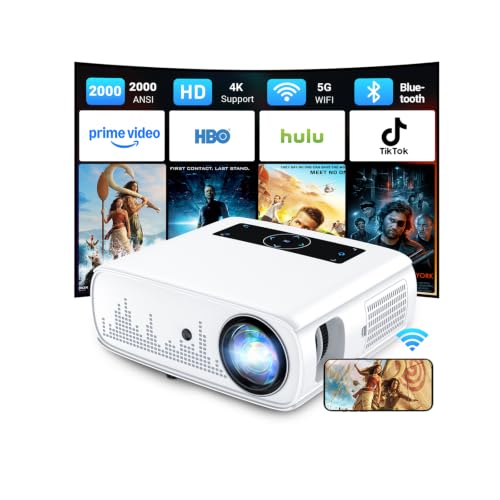
2. NICPOW Native 1080P Outdoor Projector — Best for wired flexibility
The NICPOW takes a different route to the same room. Its title leads with a 2000 ANSI lumen rating and native 1080P resolution, then spends most of its remaining words on connections: HDMI, USB, AV, smartphone, pad, laptop, DVD player, TV stick, and a games console all get named. That emphasis suits a particular kind of garage, the one with a shelf of older gear, a DVD collection that never migrated, and friends who arrive carrying three different devices expecting each to work.
Screen size flexibility stands out as well. The listing claims projection up to 300 inches with zoom control, and while no residential garage wall honestly hosts a 300-inch image with dignity, the zoom range underneath that headline helps fit the picture to the wall space actually available between storage racks and the dartboard. Native 1080P resolution, stated plainly in the title, gives sports tickers and game menus a crispness that upscaled lower-resolution panels struggle to match at large sizes.
The trade is smart features. WiFi and Bluetooth are present, and 4K content is supported as an input, yet the title names no built-in streaming platform. In practice that means a stick, a console, or a laptop supplies the apps. Many garage owners already own one of those and prefer it, since a familiar interface beats learning a projector’s internal menus. Others will count the missing platform as a genuine gap and should weigh the Google TV and Roku models here more heavily.
Strengths
- Native 1080P resolution is stated outright, anchoring real picture detail.
- The connection list covers legacy AV gear alongside modern HDMI sources.
- Zoom plus a very large maximum image size give placement flexibility.
Trade-offs
- No built-in streaming platform is named in the listing title.
- The 2000 ANSI rating trails the brighter daylight-focused models here.
- Speaker specifications are not stated in the listing title.
Spec box
- Brightness: 2000 ANSI lumens, as titled
- Native resolution: 1080P
- Maximum image: 300 inches, with zoom
- Inputs named: HDMI, USB, AV, plus phone, laptop, DVD, TV stick, console
- Smart platform: Not stated in the listing title
- Audio: Not stated in the listing title
Best for: a cave built around consoles, laptops, and older disc players that all need a port. Not suited for: a screen wall much beyond twelve feet wide where the 2000 ANSI output must stretch thin.
If your garage shelf already holds the sources, the NICPOW’s port panel does the rest — see its current Amazon listing for the full connection rundown.
The NICPOW rewards a particular kind of planning: lay out the source shelf first, then let the projector serve it. A retired laptop becomes the streaming hub, the console takes one HDMI input, and the old DVD player survives through AV for the discs that never made the jump to digital. That arrangement suits garages doubling as storage for a household’s media history, where compatibility breadth prevents the small humiliation of a friend’s device finding no port. Cables in a garage should be routed along walls rather than across the floor, both for tripping safety and because a yanked HDMI lead during a gathering ends the show abruptly.
Picture expectations should center on the stated native resolution. At the image sizes most garage walls support — somewhere between 100 and 150 inches on the diagonal — native 1080P keeps jersey numbers, racing telemetry, and game interfaces legible from folding chairs eight feet back. The zoom control helps fit that image between obstacles without moving the unit, a quiet convenience in rooms where the ideal mounting spot is occupied by a garage door opener or storage loft. Owners should still resist the 300-inch headline; spreading 2000 ANSI lumens across a wall that large dims the picture noticeably, and the NICPOW performs its best work at sizes the room can actually frame.

3. Aurzen D1R Cube Smart Projector — Best for Roku households
Aurzen built the D1R Cube around Roku TV, and that single decision defines the pick. Households already fluent in the Roku interface, with its channel layout and remote habits, can treat this projector as one more Roku screen rather than a new system to learn. The listing promises all the top apps through that platform, 1080P FHD resolution, Dolby audio, and a portable cube form that moves between garage shelf, patio, and spare room without ceremony.
Auto focus and auto keystone headline the setup story, and in a garage that pairing earns its keep. A cube projector gets carried, nudged, and repositioned constantly; a unit that squares and sharpens its own picture after each move saves the fiddly ladder-and-menu routine that makes owners stop bothering. Zoom is also listed, adding a little freedom in where the cube can sit relative to the wall.
Brightness is where expectations need care. The D1R Cube’s title states no lumen figure at all, which usually signals a model competing on platform and convenience rather than raw output. Nothing about that disqualifies it from a garage that curtains its windows and watches after dark; plenty of caves live exactly that way. It does mean daylight performance is an unknown the listing itself declines to claim, and this guide refuses to invent a number the maker did not publish.
Strengths
- Roku TV built in brings a familiar interface and the major apps.
- Auto focus and auto keystone suit a portable unit moved often.
- The cube format stores easily on a shelf between sessions.
Trade-offs
- Brightness is not stated in the listing title.
- Portability-first designs generally trade away large speaker hardware.
- Roku commitment suits existing Roku users better than Google TV households.
Spec box
- Smart platform: Roku TV built in
- Resolution: 1080P FHD
- Focus and keystone: automatic, with zoom
- Audio: Dolby audio
- Brightness: Not stated in the listing title
- Form: portable cube, indoor and outdoor positioning
Best for: Roku-fluent households wanting a grab-and-go cube for darkened garage movie nights. Not suited for: a permanently mounted ceiling installation in a garage that never fully darkens.
Roku households can look over the D1R Cube on Amazon and judge the cube format against their shelf space.
Portability reshapes how a cave gets used. A fixed projector serves one wall forever, while the D1R Cube can migrate: garage on Friday for the fight, patio on Saturday for a neighborhood film, spare room when guests visit. That roaming life is precisely where auto focus and auto keystone stop being brochure words and become the difference between a two-minute setup and a fifteen-minute one. Each relocation normally demands fresh alignment, and a unit that corrects itself lets the host stay a host instead of becoming the evening’s projectionist.
The Roku platform deepens that grab-and-go character. Channel logins live in the Roku account rather than in a tangle of per-device passwords, so the cube arrives at each location already knowing its services. Families should still treat the brightness silence in the title as a planning instruction: schedule viewing after dusk, close the garage door fully, and let the room go properly dim. Within those conditions the cube’s convenience story is complete. Outside them, particularly for afternoon sports, the brighter ANSI-rated models in this roundup carry the day, and no affection for the Roku interface changes that physics.

4. VISSPL 2000 ANSI Smart Projector — Best daylight claim
The VISSPL listing speaks two brightness languages at once, and reading it carefully teaches something useful about this whole category. The model name carries a 2000 ANSI figure, while the title also advertises 6000 daylight brightness in its own wording. Those numbers are not interchangeable, and this guide will not pretend otherwise. What the dual claim signals is intent: VISSPL aims this unit at rooms with real ambient light, marketing it as a daylight-capable smart 4K projector rather than a darkness-only toy.
Around that brightness pitch sits a modern convenience stack. AI auto focus handles sharpness, 3D Dolby audio is claimed for the speaker system, and WiFi plus Bluetooth cover streaming sources and external sound. The listing suggests ceiling and overhead projection among its uses, which matters in garages where a ceiling mount keeps the beam above workbenches, car hoods, and passing heads. A cave with a vehicle still parked inside benefits hugely from a projector mounted high and throwing over the car rather than across it.
The caution here mirrors the strength. Marketing daylight figures across brands follow no shared laboratory standard, so the honest comparison is between the ANSI figure and other ANSI figures, with the daylight language treated as positioning. Buyers choosing the VISSPL for a bright garage should still plan light control — door seals, window covers, a screen with some gain — because no consumer projector at any sane budget defeats direct sun on a wall.
Strengths
- Daylight-oriented positioning matches garages with stubborn ambient light.
- AI auto focus reduces setup friction after every repositioning.
- Ceiling and overhead use are named, suiting permanent high mounts.
Trade-offs
- The title mixes ANSI and daylight figures that cannot be compared directly.
- Native resolution is not stated in the listing title.
- Smart platform branding is generic rather than a named TV system.
Spec box
- Brightness: 2000 ANSI in the model name; 6000 daylight brightness claimed in title wording
- Signal support: smart 4K positioning
- Focus: AI auto focus
- Audio: 3D Dolby audio
- Native resolution: Not stated in the listing title
- Wireless: WiFi and Bluetooth
Best for: a bright cave where the owner mounts high and watches through imperfect light control. Not suited for: direct midday sun striking the projection wall, which defeats this class entirely.
Bright-room owners may review the VISSPL listing on Amazon with their own door and window layout in mind.
Consider how the VISSPL fits a garage that refuses to become a cave in the cinematic sense. Some owners want the game on while they work — wrenching on a car, running a table saw between plays, hosting a barbecue that drifts in and out. That ambient, half-attentive viewing is where daylight positioning earns its premium, because the picture competes with task lighting and open doors rather than with darkness. The image will never look rich under those conditions, yet a legible score bug and a followable ball matter more than shadow detail during a working afternoon.
Ceiling placement strengthens the arrangement. Mounted overhead, the projector stays clear of the activity it serves, and AI auto focus compensates for the awkward angles that high mounting sometimes imposes. Owners should verify the mount and power route before purchase, since garages often place outlets low on walls, far from the ideal ceiling position. An electrician’s hour spent adding a ceiling outlet is unglamorous, but it converts the VISSPL from a shelf compromise into a permanent fixture — and permanence, in a working garage, is what separates a viewing habit from a novelty that fades by midseason.

5. 7000 Daylight-Lumens Outdoor Projector — Best for loud rooms
This unbranded outdoor model makes the boldest brightness statement in the garage group: 7000 daylight lumens in the title’s own terms, paired with an 80-watt Dolby cinema audio claim that dwarfs the speaker hardware of every other pick here. Read those numbers as the maker’s positioning rather than laboratory fact, and the intent is still unmistakable — a machine built to be seen and heard in big, noisy, informal spaces.
The audio figure deserves attention because garages are loud. Refrigerators cycle, space heaters roar, friends argue about a referee’s decision, and a car idling outside the open door adds its own bass line. Projectors with modest speakers lose dialogue completely in that environment, pushing owners toward a separate soundbar they may not want to wire. An 80W Dolby cinema claim, whatever its precise measurement basis, at least announces that this model was specified with volume as a priority rather than an apology.
Setup automation supports the pitch. AI autofocus and keystone correction appear in the title, alongside WiFi and Bluetooth and smart functionality. The listing aims the unit at bedrooms as well as outdoor home theater, a reminder that headline-lumen outdoor models often serve double duty. In a garage, the sensible reading is a bright, loud, forgiving machine for gatherings — with the caveat that an unbranded listing asks the buyer to lean on the title’s claims without a long-established name behind them.
Strengths
- The 80W Dolby cinema audio claim targets genuinely noisy rooms.
- The headline daylight brightness figure is the largest in this group.
- AI autofocus and keystone correction simplify casual placement.
Trade-offs
- Daylight lumens are a marketing scale, not an ANSI measurement.
- The listing carries no established brand name in its title.
- Native resolution is not stated in the listing title.
Spec box
- Brightness: 7000 daylight lumens, as titled
- Audio: 80W Dolby cinema claim
- Focus and keystone: AI autofocus, keystone correction
- Signal support: 4K positioning in title
- Native resolution: Not stated in the listing title
- Wireless: WiFi and Bluetooth
Best for: big gatherings where crowd noise and a chatty room compete with the soundtrack. Not suited for: a small single-car garage where an oversized audio and brightness spec simply overwhelms the space.
Hosts of rowdy watch parties can check this outdoor model on Amazon and weigh the audio claim against a separate soundbar.
Think about the largest gathering your garage hosts each year — a title fight, a rivalry game, a holiday film with folding chairs borrowed from every neighbor. That peak event, not the quiet Tuesday screening, is the design case for this outdoor model. Crowd noise scales with attendance, and a projector specified around an 80-watt audio claim addresses the peak rather than the average. Hosts who regularly fill the room will recognize the value immediately; hosts whose cave seats three should read the claim as surplus capacity they may never tap.
The unbranded nature of the listing deserves a calm, practical response rather than alarm. Judge the purchase on the titled specifications, the return terms attached to the listing at the time of ordering, and a setup test during the first week: run the brightest scene and the loudest scene you own, in your actual garage, and confirm the machine behaves as its headline promises. Outdoor positioning also hints at ventilation and cooling designed for open air, which suits garages that run warm in summer. Treated as a big-room gathering machine and verified promptly at home, this model fills a niche the subtler picks here do not attempt.

6. 4K Golf Simulator / Home Theater Projector — Best for golf simulation
The final garage pick exists because a growing number of man caves are really simulator bays with a couch attached. This model names golf simulation first in its title, then home theater and gaming, and backs the pitch with a 2600 ANSI lumen rating, HDR10, MEMC motion processing, low latency positioning, HDMI 2.1 with ARC, and a ceiling-mountable design running Google TV. That combination speaks directly to a hitting net, an impact screen, and a launch monitor sharing the room with movie night.
Low latency and motion handling separate simulator projectors from ordinary film units. A golf swing rendered a beat late feels wrong in the body, and ball flight across a bright virtual fairway tests both brightness and motion clarity. MEMC and the gaming-oriented input specification address exactly those complaints, while HDR10 support helps streamed films hold shadow detail in darker scenes once the simulator gear folds away.
Ceiling mounting is stated in the title, and for simulator rooms that detail is structural rather than cosmetic. The projector must live above and behind the hitting zone, permanently aligned to the impact screen, safe from a follow-through. A dual-purpose cave should still budget for the screen itself and the enclosure, since the projector is one component of a simulator, never the whole system.
Strengths
- Golf simulation, gaming latency, and MEMC are addressed directly in the title.
- HDMI 2.1 with ARC suits modern consoles and sound systems.
- Ceiling-mountable design fits a permanent simulator bay layout.
Trade-offs
- Simulator screens, nets, and launch monitors are separate purchases entirely.
- The 2600 ANSI rating still needs reasonable light control for film contrast.
- Feature breadth aims at enthusiasts rather than casual occasional viewers.
Spec box
- Brightness: 2600 ANSI lumens, as titled
- Smart platform: Google TV with apps
- Video features: HDR10, MEMC, low latency positioning
- Inputs: HDMI 2.1 ARC, PC compatible
- Audio: Dolby audio
- Mounting: ceiling mountable, auto focus
Best for: a cave doubling as a golf simulator bay with a fixed impact screen. Not suited for: a portable setup carried between rooms, where a ceiling-oriented design loses its point.
Simulator builders can examine this 4K model on Amazon alongside their net and screen measurements.
Planning a simulator bay around this projector begins with geometry. The hitting mat, the impact screen, and the ceiling mount must agree on distances before any component is ordered, because the projected image has to fill the screen from a position the swing cannot reach. Golfers should map the bay on paper, mark the projector’s ceiling spot, and confirm that tall friends with long drivers clear the beam path. Google TV then covers the bay’s second life: when nobody is practicing, the same screen streams tournaments and films, so the room earns its floor space every evening rather than only on practice days.
Gaming broadens the case further. Low latency positioning and HDMI 2.1 speak to console players who notice input delay in racing and sports titles, while MEMC motion processing smooths fast pans across a large image. A cave serving golfers by day and gamers by night gets two installations from one mount, one screen, and one audio path. That consolidation is the real argument for this pick — not any single specification, but the way its titled features stack across the three hobbies most likely to share a garage wall.
Comparison table
| Model | Brightness as titled | Platform | Audio note | Defining trait |
|---|---|---|---|---|
| HAPPRUN 2500 | 2500 ANSI lumens | Google TV | Dolby sound, built-in speakers | Balanced all-rounder |
| NICPOW 1080P | 2000 ANSI lumens | Not stated in the listing title | Not stated in the listing title | Widest wired input list |
| Aurzen D1R Cube | Not stated in the listing title | Roku TV | Dolby audio | Portable cube, auto focus |
| VISSPL Smart | 2000 ANSI; 6000 daylight claim | Smart, unnamed platform | 3D Dolby audio | Daylight positioning, ceiling use |
| 7000 Daylight Outdoor | 7000 daylight lumens | Smart functionality | 80W Dolby cinema claim | Loudest audio pitch |
| 4K Golf Simulator | 2600 ANSI lumens | Google TV | Dolby audio | Simulator and gaming features |
Garage owners comparing across this table should also keep the room’s second screen in mind; a cave that already runs a television for daytime news may use its projector purely for evening events, a pattern discussed alongside best projectors for sports bars where long operating hours change the priorities again.
How do you choose a projector for a garage?
Start with the worst light the room will honestly present during viewing, not the best. Walk into the garage at the hour games usually start, close the door, and note every leak: the window row across the top panel, the gap at the floor seal, the side door with its frosted pane. A projector chosen for that honest light level will delight on darker nights. A projector chosen for midnight darkness will disappoint every Saturday afternoon of the season.
Throw distance and wall geometry come second. Measure from the likely mounting point to the screen wall, then check which wall section is actually free — garages accumulate shelving, cabinets, bikes, and banners. Zoom ranges and keystone correction forgive imperfect placement, but no correction fully rescues a projector forced into a bad corner at a steep angle. Ceiling mounting solves many garage geometry problems at once, lifting the beam over cars and heads, provided power and a safe mount into joists are available.
Seating distance ties the geometry together. Divide the planned image width by the room’s realistic chair placement and ask whether text, scores, and game interfaces stay readable from the farthest seat. Folding chairs parked twelve feet from a 100-inch image enjoy a comfortable picture; the same chairs facing a 150-inch image sit close enough to notice every softness in the source. Garages rarely allow theatrical seating charts, so choose the image size the chairs forgive rather than the largest the wall accepts.
Third, decide how content arrives. Built-in Google TV or Roku removes boxes and cables, which suits streaming-only households. A cave built around consoles, disc players, and a laptop benefits more from a generous port panel. Fourth, plan the sound path before the first party: built-in speakers for casual viewing, Bluetooth to a portable speaker for flexibility, or ARC to a soundbar for permanence. Finally, budget for the surface. A proper screen or a sanded, painted rectangle of wall transforms any of these machines more than stepping one model up the price ladder, and dust management — a cover, a shelf away from the workbench grinder — extends the life of whichever unit you choose.
Temperature deserves a paragraph of its own. Projectors generate heat and dislike swallowing it back, so a garage that reaches high summer temperatures needs the unit mounted where air moves, away from the ceiling’s hottest layer if possible and never inside a closed cabinet. Winter brings the opposite nuisance: a cold-soaked projector moved into humid air can fog its lens, so let the machine acclimate before powering it after a freezing night. None of these habits require money, only awareness that the garage is a harsher habitat than a media room.
Cable discipline rounds out the practical list. Extension cords snaking across a garage floor invite trips and yanked connections; a properly placed outlet near the mount, installed once, removes the hazard permanently. Surge protection matters in buildings where compressors and welders share circuits, since those tools produce exactly the electrical noise that delicate electronics dislike. Treat power, airflow, and signal strength as part of the projector purchase even though none of them arrive in the projector’s box.
Screen gain and paint choice deserve a final word in this choosing process. A matte white surface with modest gain flatters every projector in this group, while gray paints trade brightness for perceived contrast — a trade that only pays in garages that already control their light well. Owners painting a wall section should sand it genuinely smooth, because projection magnifies every trowel mark and patched screw hole at large sizes. Masking the rectangle with a dark border, even painted trim, sharpens the perceived image more than most first-time owners expect, framing the picture the way a bezel frames a television.
Setting up in a working garage: our evaluation notes
Our evaluation approach for this class starts with the room as it is, not as a showroom. We picture the projector arriving in a garage that still parks a car, stores paint cans, and hosts a workbench, because that describes most real caves. Setup begins with clearing a sightline, and the models with autofocus earned immediate goodwill in that scenario: place the unit, power it, and the picture sharpens itself while the host is still moving chairs.
Light discipline tests followed. With the main door closed but its window row uncovered, the daylight-claimed models held a watchable sports picture while the platform-focused cube looked pale, exactly as their titles predicted. Covering those windows with simple blackout panels changed the ranking more than any menu setting did, pulling the whole group into comfortable territory. That experiment is why this guide keeps returning to the screen and the seals: in garage after garage, the room itself is the largest variable.
Sound checks happened with the refrigerator running and a fan moving air, the honest soundtrack of summer viewing. Dialogue clarity separated the field faster than maximum volume did; the big Dolby cinema claim on the outdoor model carried voices across the room, while smaller built-in speakers needed the audience seated closer. Dust exposure rounded out our thinking — a garage projector lives where sawdust and pollen drift, so lens caps, covers, and shelf placement away from cutting tools featured in every scenario we walked through. Readers planning the seasonal decorating version of projection should also see best projectors for holiday fx, where the hardware serves a very different job.
We also staged the social test: six chairs, a cooler, conversation at full volume during a streamed game. In that setting the ranking reshuffled around audio and simplicity rather than picture specifications. The model that started fastest and spoke clearest won the room, even when a rival produced a marginally richer image in silence. Garage viewing is a social format, and our notes kept circling back to that social reality — the best cave projector is the one guests stop noticing, because the game, the sound, and the company hold their attention instead.
One more scenario deserves mention: the split-use evening, where the projector serves a film for part of the group while others drift to a workbench or a card table. Wide seating angles punish projectors and screens with narrow sweet spots, so we favored arrangements that kept the picture acceptable from the room’s edges. A slightly smaller image, centered well and bright enough for the edges, beat a wall-filling image that only the middle chairs could enjoy.
Evening length formed the last scenario in our notes. A double feature or a long playoff game keeps a projector running for four hours or more in a room whose temperature climbs with every guest. Units marketed for outdoor gatherings tended to shrug off those marathons in our scenario planning, while compact portable designs invited a mid-evening break to cool. Hosts planning marathon viewing should give any projector clear ventilation and a sightline to fresh air, and should treat fan noise as part of the room’s soundtrack when seating sits close to the unit. None of this requires laboratory testing to appreciate; it requires picturing the longest night your cave will host and refusing to buy for a shorter one.
Common mistakes in garage projection
The classic error is buying for contrast specifications in a room that cannot get dark. Film enthusiasts import living-room priorities, chase black levels, and then watch every shadow scene drown in door-seal daylight. Brightness headroom and light control deserve the budget first; contrast rewards arrive only after the room cooperates.
Mounting mistakes follow closely. A projector balanced on a cooler or a stack of storage bins gets bumped, loses alignment, and eventually falls. A fixed shelf or ceiling mount, tightened once and left alone, prevents the weekly re-aiming ritual. Heat is the third oversight: garages swing temperature hard, and a projector boxed into an unventilated cabinet cooks itself. Leave airflow around the vents, and avoid running any unit in a sealed enclosure. Finally, many owners skip the screen decision entirely and project onto textured, off-white drywall or a block wall with mortar lines crossing the quarterback’s face. Even an inexpensive pull-down screen changes that picture completely.
Sound leakage rounds out the mistake list. A garage at full volume late at night shares its soundtrack with the neighbors, especially with the door open in summer. Seating the audience closer and aiming speakers toward the screen wall, rather than cranking volume to reach distant chairs, keeps the gathering enjoyable inside and tolerable outside. A quick word with adjacent households before a big late event also prevents the knock on the door that no projector specification can solve.
Neglecting the network is another quiet failure. A projector at the far end of a house, streaming through a metal door’s interference, buffers at the worst moments. Test the WiFi at the mounting location with a phone before installation, and budget for a mesh node if the signal fades there. Similarly, owners forget the door opener’s vibration: a mount attached to the same joist line as a running opener can shimmer the picture each time the car comes home. Shift the mount a bay over, and the shimmer disappears. Small environmental details like these decide satisfaction far more often than brochure specifications do.
Final recommendation
For most garage caves, the HAPPRUN earns the first look: credible ANSI output, Google TV inside, modern wireless, and audio treated seriously. Garages that stay bright should shortlist the VISSPL and the 7000-daylight outdoor model while planning real light control, and simulator builders should start with the golf-focused 4K unit. The NICPOW remains the sensible wired workhorse, and the Aurzen cube serves Roku households that value portability over punch. Match the machine to the room’s light and noise, fix the screen surface, and the cave will feel like a venue rather than a compromise.
A word about resale and upgrading, since garage gear churns quickly. Branded models with named platforms tend to find second owners easily when a cave upgrades, while unbranded headline-spec units sell on their demonstrated performance in your room rather than on reputation. Keeping the box, the remote, and the lens cap together in one labeled bin sounds trivial until the day you sell or move the machine; garages are famous for swallowing small accessories. Treat the projector as the room’s anchor appliance and its accessories as part of the installation, and both the first setup and the eventual upgrade go more smoothly.
Budget sequencing helps undecided readers.
Buy the projector first, the mount and screen second, and the audio upgrade third, living with built-in sound for a few weeks to learn whether the room actually needs more. Many caves discover that seating position and door seals were the real problems, both fixable for almost nothing. That patient order of spending prevents the common pattern of an expensive soundbar bolted onto a room whose picture still washes out every afternoon.
Frequently asked questions
How loud will the projector itself be during a film?
Fan noise varies by design and brightness mode, and no listing here publishes a noise figure, so treat it as an unknown to manage through placement. Mounting the unit above and slightly behind the seating, rather than beside the couch at ear height, keeps fan sound out of the audience’s direct line. Brighter modes usually spin fans harder, which is one more reason daylight viewing and quiet viewing pull in opposite directions in this room.
Can a projector work in a garage with windows?
Yes, provided expectations follow the light. Daylight-positioned models hold sports and casual viewing with windows covered or shaded, while film nights still reward blackout panels and a closed, sealed door. Magnetic blackout covers for the door’s window row are inexpensive, removable, and surprisingly effective, turning the brightest leak in most garages into a non-issue within minutes of the first installation attempt.
Does the garage door itself make a usable screen?
Sectional doors tempt owners because they are large and already installed, yet their panel seams, horizontal ribs, and slight curvature chop the image into bands. A door works for a casual novelty screening and little else; hang a proper screen in front of it or use the adjacent wall for anything you plan to watch regularly, especially once regulars start claiming favorite chairs for the season ahead.
Is a screen necessary, or will the wall do?
A smooth, light-colored wall works acceptably; textured drywall, block mortar lines, and glossy paint all degrade the image. A basic screen or a sanded painted section is the cheapest picture upgrade available.
How do these projectors handle garage dust?
No listing here claims a sealed dust-proof optical engine, so placement and covers do the protective work. Keep the unit away from saws and grinders, cap the lens, and clean vents on a schedule.
Which pick suits a golf simulator best?
The 4K golf simulator model, because its title addresses latency, motion handling, ceiling mounting, and simulator use directly. The screen, net, and launch monitor remain separate purchases.
Do built-in speakers replace a soundbar in a garage?
For casual viewing, the stronger audio claims here can carry a small gathering. Larger caves, open doors, and movie nights with a crowd still benefit from Bluetooth or ARC feeding a separate speaker.
What image size suits a typical two-car garage?
Most two-car garages frame 100 to 135 inches comfortably once shelving and the door track take their share of the wall. Bigger images demand more brightness and more seating distance than the room usually offers, so restraint produces the sharper, brighter picture.
Should the projector stay in the garage year-round?
Units rated and marketed for outdoor use tolerate the garage environment best, yet every model here benefits from a cover and from removal during extreme cold snaps if the manufacturer advises it. When in doubt, a shelf indoors between winter events is cheap insurance.
Portable-minded readers who split time between the garage and the road may also weigh best projectors for travel meetings before committing to a fixed cave installation. In the end, the garage rewards honesty about light, noise, and dust far more than it rewards any single specification — choose for the room you actually have, and every game night in it will feel bigger than the space that contains it.


