What's inside
- Key Takeaways
- Quick Picks
- How We Chose These Picks
- Why Do Student Pilots Start With Passive Headsets?
- What Plugs, Switches, and Mono/Stereo Settings Should You Understand?
- How Should a Headset Fit for Pattern Work in August?
- Own Headset or School Loaner: When Does Buying Pay?
- What Radio Habits Does a Good Headset Support?
- How Do You Care for a Headset That Lives in a Flight Bag?
- What Changes on Solo Day and Checkride Day?
- After the License: Renting, Passengers, and the Second Headset
- Winter Flying, Summer Flying: Does the Season Change the Choice?
- The Six Student-Pilot Headsets, Reviewed
- How Do You Test a Headset Before You Commit to It?
- Six Student Headsets, One Training Cockpit: The Comparison
- What Headset Mistakes Do Student Pilots Make?
- What Does the Headset Budget Look Like Across a Whole Training Course?
- Final Recommendation
- Frequently Asked Questions
- Related Guides
As an Amazon Associate I earn from qualifying purchases. This post may contain affiliate links at no extra cost to you.
gizmoverdict.com is reader-supported. When you buy through links on our site, we may earn an affiliate commission.
Where student pilots buy headsets: the six below are sold on Amazon under the exact titles we verified, and each linked name opens that listing. Aviation gear hides among lookalike intercom and racing headsets online, so shop by the model names here and confirm the words “general aviation” and the dual plugs in any title you land on.
The best headsets for fixed wing student pilots are almost never the best headsets in aviation, and that is precisely the point. A student pilot’s headset has a defined, temporary job: survive the training years — the borrowed-airplane intercoms, the instructor’s voice competing with a hard-working trainer engine, the sweaty summer pattern work — while costing a fraction of the active-noise-reduction flagships your instructor probably wears. Five of the six picks here are passive headsets, quieting the cockpit the honest way with sealed ear cups and rated attenuation. The sixth adds Bluetooth as a step toward the connected cockpit. All six speak the same plug language, because in general aviation the plugs are destiny.
That language is the GA dual-plug standard: two plugs, one for the microphone and one for the headphones, fitting the panel jacks of the trainers students actually fly. Every pick in this guide is a GA-plug headset — several say so in their titles outright — which means every one of them will plug into the school Cessna or Piper without adapters, dongles, or prayer. If you remember nothing else from this guide, remember to verify those plugs on anything you buy elsewhere; the aviation world contains helicopter plugs, military plugs, and panel-powered plugs that look similar in photographs and fit nothing in your trainer.
The student’s other realities shape the rest of the judging. Training flights are short but intense, often in heat, with the headset going on and off between maneuvers and briefings. Gel ear seals recur across these titles because they seal around sunglasses and stay bearable in a sun-baked cockpit. Noise-canceling microphones recur because the instructor and the tower must hear your words, not your engine. And headset bags recur because a student’s headset lives in a flight bag, under books and kneeboards, in a car trunk — a harder life than any hangar shelf. Judge each pick against that life, not against a brochure.
Key Takeaways
- Student flying is passive-headset territory: five of six picks quiet the cockpit with sealed cups and rated passive reduction, at student-appropriate commitment.
- GA dual plugs are non-negotiable — every pick here uses them, so each one fits the school trainer’s panel without adapters.
- Stated ratings, as titled: 24dB NRR on the KORE P1 and 23 dB on the ASA HS-1A; several others describe passive reduction without a title figure, and this guide leaves those unquantified.
- Gel ear seals appear across the list because trainers are hot, sunglasses are universal, and a broken seal is lost protection.
- Every pick carries a noise-canceling microphone in its title — in a trainer, being understood by the tower matters as much as hearing it.
- Buy for the training years and let the ANR flagship be a graduation decision, when you know your flying will continue.
Quick Picks
| Pick | Badge | Why it is here |
|---|---|---|
| KORE P1 GA Headset | The student-named benchmark | A passive headset titled for student pilots with a 24dB NRR, noise-canceling mic, GA dual plugs, and a headset bag in the brief. |
| ASA AirClassics HS-1A | The flight-training institution | ASA’s essential aviation headset with 23 dB of stated noise reduction, a noise-canceling mic, and stereo/mono flexibility from the training-materials institution. |
| KA-1 GA Headset | Gel seals and a bag | A passive GA headset with gel ear seals, mono/stereo compatibility, an adjustable headband, and a headset bag in its title. |
| AIRVOICE Pilot Headset (PNR) | The lightweight flight-school pick | A passive headset for flight school students with a hi-fi ultra-lightweight neodymium speaker and SNR hearing protection in its title. |
| SVXSODA GA629B Aviation Headset | The full accessory kit | A student and flight-school headset with twin plugs, gel ear muffs, a custom-fit headband, a full accessory kit, and a bag. |
| Rugged Radios RA210-BT Bluetooth Aviation Headset | The Bluetooth step-up | A GA dual-plug headset adding Bluetooth audio to gel seals and a noise-canceling mic — the connected-cockpit taste of things to come. |
How We Chose These Picks
The pool was filtered on the student brief itself. A pick had to be a general-aviation headset with GA plugs, passive-first noise reduction, and a noise-canceling microphone stated in its title — the three things a trainer cockpit actually demands. Active-noise-reduction flagships were excluded by design, not by quality: they are the graduation purchase, and a guide for students that leads with them has misunderstood its reader’s budget and stage. One Bluetooth model was kept as the deliberate step-up, because students increasingly train with tablet apps whose audio cues they want in their ears.
Claims discipline runs through the spec boxes as it does across this site. Where a title prints a number — the KORE’s 24dB NRR, the ASA’s 23 dB — the review uses it. Where a title says “passive noise reduction” and stops, the review says the figure is not stated rather than borrowing a number from a sibling model or a seller’s bullet points. In aviation, of all places, numbers should mean what they say.
Why Do Student Pilots Start With Passive Headsets?
Passive noise reduction is exactly what it sounds like: no electronics, no batteries, just ear cups engineered to seal sound out, rated by how much they attenuate. Its virtues map perfectly onto student life. It cannot run out of battery on the ramp before a checkride. It costs a fraction of active systems, which matters when the same wallet is paying for flight hours by the tenth of an hour. It is mechanically simple in an environment — the flight-school fleet — where gear gets borrowed, dropped, and left in hot cockpits. And its performance is honest and sufficient: a trainer cockpit is loud, and a well-sealed passive headset brings that loudness down to a level where instruction and radio work proceed comfortably.
Active noise reduction, which adds electronic cancellation on top of the passive seal, is genuinely better in absolute terms — and genuinely a later purchase. The classic student arc is to train on a solid passive headset, solo, pass the checkride, and then, knowing flying will continue, graduate to ANR with the Lightspeed Sierra class as the traditional step-up example. That sequence spends the big money after the commitment is proven, and it leaves the passive headset with a second career: it becomes the passenger headset, the spare, the one you lend without anxiety. Nothing in this guide is wasted by being outgrown.
There is one more student-specific argument: consistency. You will train in several airframes with several intercoms, and your own passive headset is the constant in that rotation. The school’s loaner headsets vary in fit, hygiene, and repair; your own arrives fitted to your head, with your mic position learned, every single lesson. Instructors notice the students who remove equipment from the list of variables.
What Plugs, Switches, and Mono/Stereo Settings Should You Understand?
The GA dual plugs deserve a closer look, because they are the student’s first piece of aviation hardware literacy. The larger plug carries the headphones; the smaller carries the microphone. They are not interchangeable, they are not the same as a helicopter’s single plug or a military connector, and the panel in front of you has two jacks waiting for exactly them. Every pick here is titled or described with GA dual plugs — the KORE and the Rugged Radios say it in so many words — and that shared standard is what makes this a list of six real options instead of six compatibility gambles.
Mono and stereo sound like hi-fi talk and are actually intercom talk. Many trainer intercoms and radios deliver mono audio; some newer setups deliver stereo. A headset locked to one can sound wrong — audio in a single ear — on the other, which is why stereo/mono compatibility or a switch recurs across these titles: the ASA, the KA-1, and the SVXSODA all state it. As a student rotating through a fleet, that flexibility is not a luxury; it is the difference between hearing the tower in both ears in every airplane and troubleshooting audio at 3,000 feet in one of them.
Volume controls follow the same fleet logic. Airplane intercoms vary in output, instructors vary in mic technique, and a headset with its own volume adjustment lets you balance a quiet instructor against a loud tower without touching the panel. None of the titles here make volume a headline, so treat it as a full-listing check — and whatever headset you choose, learn its controls on the ground, where fumbling is free.
How Should a Headset Fit for Pattern Work in August?
Training concentrates discomfort the way it concentrates everything else. The cockpit of a trainer parked on summer asphalt is an oven with wings; your first twenty hours will include more sweating in a headset than any airline passenger ever does. Fit decisions that seem minor in an air-conditioned shop — clamp force, cushion material, headband padding — become the difference between a lesson spent learning and a lesson spent enduring. This is the practical context behind the gel ear seals named in the KA-1, SVXSODA, and Rugged Radios titles: gel conforms around sunglasses arms and seals without the hard pressure of stiff foam, and it stays more comfortable as temperatures climb.
The seal is also the protection. Passive attenuation lives or dies at the cushion’s contact with your head, and sunglasses — non-negotiable in a bright cockpit — break that contact at the temples unless the seals are compliant enough to close around the arms. When you first fit any pick here, wear your actual flying sunglasses, seat the cups, and move your jaw and head as you will in a scan; a seal that survives the ground rehearsal usually survives the flight. If a headset only seals on a bare head in a quiet room, it does not seal in an airplane.
Microphone fit is the other half. The boom should park the mic close to the corner of your mouth and stay there through head turns — you will be looking over both shoulders in the pattern — and through the headset coming on and off between lessons. A boom that drifts teaches you to shout or to mumble, and both habits will be corrected by your instructor at the cost of lesson time. Set the boom once, firmly, and check it in the preflight the way you check the fuel caps: as ritual, not as hope.
Own Headset or School Loaner: When Does Buying Pay?
Most flight schools will lend or rent you a headset, and for the first lesson or two that is the correct arrangement — find out whether flying itself agrees with you before the gear spending begins. The buying moment arrives quickly after, usually by the third or fourth lesson, when the arithmetic and the experience align: rental fees accumulate toward a purchase, the loaner fleet’s fit lottery has annoyed you at least once, and your own headset’s consistency starts to look like the training aid it genuinely is. Every pick in this guide is priced by the market as a student purchase — this guide prints no prices, but the category’s shape is plain — and a passive headset bought early in training will serve every lesson through the checkride and beyond.
Buy once, with the fleet in mind. The right student headset is the one that works in every airframe your school flies, which is why the GA plugs and mono/stereo flexibility matter more than any comfort flourish. It should also be a headset you are willing to keep as your passenger and spare unit for years, because that second career is where its value finishes paying out. The KA-1 and SVXSODA titles, with their bags and accessory kits, are speaking directly to this ownership pattern: carry it protected, keep its parts together, hand it to your first passenger with pride.
Talk to your instructor before ordering if you can. Instructors have watched hundreds of students’ gear choices succeed and fail, and they know the local fleet’s intercom quirks — the one airplane with the quiet panel, the jack that eats plugs. Five minutes of that counsel is worth more than five hours of review-reading, this guide cheerfully included.
What Radio Habits Does a Good Headset Support?
A headset cannot teach radio work, but it can refuse to hinder it. The noise-canceling microphones across this list exist so that your transmissions carry your voice forward and leave the engine behind; the tower’s recording of you should sound like a pilot, not a lawnmower with opinions. Speak across the mic rather than into it, at a natural volume, and let the noise canceling do its side of the bargain. Students who shout into a trainer mic distort themselves into unintelligibility with the best equipment in the world hanging off their ears.
Hearing clearly is the other half of the radio art, and it is where a personally fitted headset quietly outperforms the loaner pool. Instructions in a busy pattern come once, fast, with your call sign attached to other people’s traffic too. The student who hears the whole transmission the first time — because the seal was right, the volume was set, and both ears were in the game — is the student whose instructor stops repeating and starts teaching. Set the intercom and radio volumes on the ground run-up, not in the climb, and treat any in-flight audio confusion as a reason to ask for a repeat rather than to guess: “Say again” is a professional phrase, and your headset’s job is to make sure you rarely need it.
Bluetooth, in the Rugged Radios pick, adds the modern layer: tablet apps that announce traffic, airspace, and checklist prompts can speak into your ears alongside the radio. Used with discipline — alerts configured sparingly, entertainment left on the ground — it is a genuine training aid. Used as a music service at pattern altitude, it is a distraction wearing a feature’s clothing, and most instructors will have a view about it. Ask yours before the first flight with it paired.
How Do You Care for a Headset That Lives in a Flight Bag?
The bag in so many of these titles is not packaging; it is the care plan. A headset carried loose in a flight bag gets its boom bent by kneeboards, its cord pinched by zippers, and its ear seals scarred by chart clips. In its bag, the same headset survives semesters of this. Make the bag the ritual: headset off, cord loosely coiled the way it naturally falls, boom parked, bag zipped, every time, including the tired drive home after the checkride prep flight when rituals feel optional.
Cord care is the quiet second half. Aviation cords fail at the strain reliefs and at the plugs, from being yanked out of panels by their cables and wound tight around the headset like a garden hose. Pull plugs by their barrels. Coil with slack. Keep the headset out of the trunk on the hottest weeks if you can, because parked-car heat ages seals and plastics faster than flight hours do. Gel seals deserve a wipe after summer lessons; sweat is a solvent with a schedule.
Finally, test before the lesson, not during it. A headset check belongs in your preflight habits — plug in during run-up, confirm sidetone and both ears, confirm the mic with the instructor or a radio check. A fault discovered on the ground costs a swap to the school’s loaner and a repair at leisure. A fault discovered at the hold-short line costs the lesson’s momentum, and occasionally the lesson.
What Changes on Solo Day and Checkride Day?
The first solo rewrites the headset’s job description. The instructor’s voice — half the audio environment you trained in — is suddenly on the ground, and the cockpit holds only you, the engine, and the tower. Students are often surprised how loud their own breathing becomes and how much of their confidence was borrowed from the right seat. A familiar, well-fitted headset is a genuine steadiness aid that morning: it is the one piece of the training environment that comes with you unchanged. This is a concrete argument for owning your headset well before solo, so its fit and sound are muscle memory by the day everything else changes.
The checkride adds an examiner, a stranger whose voice and mic technique you have never heard, in the right seat. Your headset’s volume range and clarity stop being comforts and become examination conditions: you must hear a soft-spoken examiner’s instruction the first time, at climb power, without asking for repeats that read as uncertainty. Test your headset in the weeks before with different instructors and passengers if you can, so its behavior with unfamiliar voices is known territory. And bring the school’s loaner as a silent backup in the flight bag — examiners respect preparation, and a headset failure handled in thirty seconds is a story about your professionalism rather than your luck.
Both days reward the same unglamorous preparation: fresh familiarity with your own controls, a boom position you can find blind, and a preflight headset check performed like a ritual rather than a hope. The equipment will not fly the maneuvers for you. It can, however, refuse to become one of the day’s problems, which on solo and checkride mornings is a contribution out of all proportion to its price.
After the License: Renting, Passengers, and the Second Headset
The private pilot certificate converts your student headset into the senior member of a growing fleet. Rental airplanes come with the same intercom lottery as school fleets, and your own headset remains the constant. Your first passengers, meanwhile, need headsets too — and here the student purchase pays its second dividend, because the headset you trained on becomes the passenger headset the day your ANR upgrade arrives, or serves your passenger while you keep flying it and rent theirs. Either way, a well-kept passive GA headset never really retires; it gets promoted to hospitality duty.
Briefing passengers includes the headset, a detail new pilots fumble. Show them the fit, the boom’s distance from the mouth, and the push-to-talk reality that the whole cabin hears everything — before engine start, while voices are calm and the intercom is quiet. A passenger whose mic sits under their chin will be inaudible; a passenger who does not know their breathing is broadcast will be embarrassed at 4,000 feet. Thirty seconds of ground instruction, delivered kindly, is the difference between a guest who feels like crew and one who feels like cargo.
Keep the student headset’s bag, seals, and cord in good order through this second career, because passengers judge the whole airplane by the equipment you hand them. A clean, well-kept headset with fresh-feeling seals tells a nervous first-time flyer that this pilot maintains things. That impression is worth more than the headset ever cost.
Winter Flying, Summer Flying: Does the Season Change the Choice?
Summer has dominated this guide’s comfort discussion because training concentrates there, but winter writes its own footnotes. Cold stiffens every material: foam seals that conformed in July sit harder in January until the cockpit warms, and gel seals earn a second appreciation for staying pliable longer. In unheated hangars, a headset stored in the airplane overnight starts the flight at ambient temperature against your ears — bring it home, or arrive early enough for it to warm in the cabin. None of this changes which pick to buy; it changes how the pick you bought asks to be kept.
Winter also layers clothing into the fit equation. Beanies and headset bands negotiate badly; the common solution is the headset over a thin skull cap or the hood kept down in the cockpit, with the seal checked after every layer is final. Scarves near booms muffle microphones. The preflight fit check matters more in January than in June precisely because there are more textiles conspiring against the seal.
What does not change with the seasons is the discipline: fit deliberately, check in run-up, store in the bag. A student who builds those rituals in the first ten hours owns a headset that serves in every month the training calendar contains — and training calendars, as every student learns, contain more months than the brochure suggested.
The Six Student-Pilot Headsets, Reviewed

KORE P1 GA Headset — The student-named benchmark
The KORE P1 states its entire brief in its title: a general aviation headset for student pilots with 24dB NRR passive noise reduction, a noise-canceling mic, mono operation, acoustic ear cups, GA dual plugs, and a headset bag. That is the checklist this guide would have written, item for item, and the P1’s willingness to print its rating — 24dB NRR — puts it at the quantified end of this list, a decibel above the ASA’s stated figure within the same rating language. KORE built its name in exactly this student niche, and the P1 is its thesis statement.
Mono deserves its honest sentence: many trainer intercoms are mono systems, and a mono headset matches them without fuss, but a student who later flies stereo-equipped airplanes may eventually want the flexibility other picks here state outright. For the training years themselves, in the fleet most students actually meet, the P1’s spec reads like a school supply list completed. The bag in the title closes the ownership loop this guide keeps emphasizing. If you want the pick that was designed, named, and rated for exactly your next two hundred landings, this is the benchmark the others are chasing.
- Noise reduction: 24dB NRR passive noise reduction, per the listing title
- Microphone: noise-canceling mic
- Audio: mono, acoustic ear cups
- Plugs: GA dual plugs
- Included in title: headset bag
- Ear seals: Not stated in the listing title — verify with the maker’s documentation
Strengths
- The only title here that names student pilots and prints its NRR together.
- Top stated passive rating in this guide’s list.
- Bag included in the brief, matching real flight-bag life.
Trade-offs
- Mono audio where several rivals state stereo/mono flexibility.
- Ear seal material is not stated in the title.
- Student-focused design means an eventual ANR graduation still awaits.
Best for: the committed student who wants the purpose-built, rated benchmark for training.
Not suited for: a pilot already flying stereo panels who wants one headset forever.
Begin the comparison with the benchmark — open the KORE P1’s Amazon listing and check its seal and volume details against your school’s fleet.

ASA AirClassics HS-1A — The flight-training institution
ASA — Aviation Supplies & Academics — is the name on the textbooks, syllabi, and logbooks of American flight training, and the AirClassics HS-1A is its headset: durability in the title’s first breath, 23 dB of noise reduction, a noise-canceling mic, stereo/mono flexibility, and the self-description “essential aviation headset.” There is a institutional logic to choosing it that students feel even if they cannot articulate it: the company that wrote your ground school also made your headset, and flight schools stock ASA gear the way kitchens stock salt.
The stereo/mono flexibility is the working feature to notice, because it answers the fleet-rotation problem directly — this headset will sound right in the mono trainer and the stereo one alike. Its stated 23 dB sits a decibel below the KORE’s paper figure, a difference no real cockpit will let you hear past the seal’s quality, and the HS-1A’s durability framing speaks to the loaner-adjacent life of student gear. For the student who values the institution’s ubiquity — replacement parts, school familiarity, a model instructors recognize on sight — the ASA is the conservative, defensible choice in this list.
- Noise reduction: 23 dB noise reduction, per the listing title
- Microphone: noise-canceling mic
- Audio: stereo/mono
- Framing: durability; essential aviation headset
- Plugs: Not stated in the listing title — verify with the maker’s documentation
- Bag: Not stated in the listing title — verify with the maker’s documentation
Strengths
- From the institution that supplies flight training itself.
- Stereo/mono flexibility suits rotating school fleets.
- Durability is the headline, matching student gear’s hard life.
Trade-offs
- Plugs and bag are not stated in the title and need confirming.
- A decibel below the KORE on the paper rating.
- Utilitarian brief; no comfort flourishes are claimed.
Best for: students who want the school-recognized standard and fleet flexibility.
Not suited for: a buyer who needs every detail confirmed by the title alone.
If your flight bag already carries ASA books, the HS-1A’s Amazon listing is the natural next read — confirm its plugs there before ordering.

KA-1 GA Headset — Gel seals and a bag
The KA-1’s title reads like a student’s wish list answered in order: a general aviation headset for pilots with mono and stereo compatibility, passive noise reduction, a noise-canceling microphone, gel ear seals, an adjustable headband, and a headset bag. The gel seals are the comfort headline this guide has been setting up — in the hot trainer, around the sunglasses, across the two-hour lesson, gel is the material that keeps a passive seal honest. The adjustable headband extends the same courtesy to fit, and the bag completes the ownership kit.
What the title withholds is a decibel figure, and the review respects that: the KA-1 claims passive noise reduction without quantifying it in the lines we verified, so it cannot be ranked against the KORE’s 24 or the ASA’s 23 on paper. What it offers instead is the most completely stated comfort-and-compatibility package in the list. For the student whose lessons are long, whose cockpit is hot, and whose head has rejected stiffer headsets, the KA-1’s priorities may be worth more than a printed number. Confirm the rating in the full listing if the figure matters to your school’s requirements.
- Noise reduction: passive noise reduction (figure not stated in the listing title)
- Microphone: noise-canceling microphone
- Audio: mono and stereo compatibility
- Ear seals: gel ear seals
- Fit: adjustable headband; headset bag included in title
- Plugs: GA headset (plug style to confirm in full listing)
Strengths
- Gel seals answer the hot-cockpit, sunglasses-wearing reality directly.
- Mono/stereo compatibility covers the whole school fleet.
- Bag and adjustable fit complete the student ownership package.
Trade-offs
- No decibel figure in the title for rating comparisons.
- Plug wording in the title is less explicit than some rivals’.
- Comfort-first brief; no electronic features of any kind.
Best for: long, hot lessons where seal comfort decides whether the headset stays on.
Not suited for: a buyer whose school requires a stated NRR figure on paper.
Comfort-led and fleet-flexible — view the KA-1’s Amazon listing to confirm its rating and plug details in full.
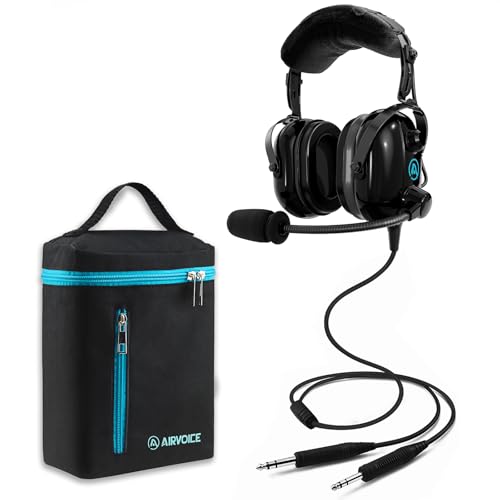
AIRVOICE Pilot Headset (PNR) — The lightweight flight-school pick
The AIRVOICE entry aims its title at the flight school gate: a PNR aviation headset for flight school students, a general aviation headset with SNR hearing protection, a hi-fi ultra-lightweight neodymium speaker, and a noise-canceling microphone. Two of those phrases deserve translation. PNR is passive noise reduction, the family this whole guide is built on. SNR is the European-style rating language — and the title gives no number beside it, so this guide reports the framing and flags the figure as unstated, rather than converting or inventing one.
The lightweight speaker is the pick’s personality. Training sorties are short, but students wear headsets through briefings, preflights, and debriefs as well, and a headset that disappears on the head lowers the day’s total friction. “Hi-fi” in an aviation title should be read as clarity ambition rather than concert-hall promise — what a student needs from a speaker is speech intelligibility against engine noise, and a light, clear driver serves exactly that. For the flight-school student who tried on the fleet’s loaners and found them all heavy, the AIRVOICE is the deliberate alternative, with its figures to be confirmed in the full listing before a school-standard purchase.
- Noise reduction: PNR (passive), SNR hearing protection framing — figure not stated in the listing title
- Speaker: hi-fi ultra-lightweight neodymium speaker
- Microphone: noise-canceling microphone
- Stated audience: flight school students; general aviation
- Plugs: Not stated in the listing title — verify with the maker’s documentation
- Bag: Not stated in the listing title — verify with the maker’s documentation
Strengths
- Lightweight brief suits the full training day, not just the flight.
- Student and flight-school purpose stated outright.
- Noise-canceling mic keeps the student’s half of the radio bargain.
Trade-offs
- No numeric rating in the title, in either rating system.
- Plugs and accessories must be confirmed in the full listing.
- Lightweight builds ask for gentler handling in the flight bag.
Best for: students whose first complaint about loaners was their weight.
Not suited for: a school purchase that needs printed specifications per unit.
If lightness is your brief, read the AIRVOICE listing on Amazon closely and confirm plugs and rating before it joins your flight bag.

SVXSODA GA629B Aviation Headset — The full accessory kit
The SVXSODA GA629B arrives as a kit in the fullest sense in this guide: an aviation headset for student pilots and flight schools with mono and stereo twin plugs, a noise-canceling mic, gel ear muffs, a full accessory kit, a custom-fit headband, and a headset bag. Where other titles make you assemble the ownership story, this one ships it. For a flight school equipping several students — or a student who wants every part of the system in one order — that completeness is the product.
Twin plugs stated as mono and stereo cover the fleet question, gel muffs cover the August question, and the custom-fit headband speaks to the reality that students’ heads and hairstyles vary more than a single fixed band assumes. The rating figure, once again, is not in the title, and the flag below says so; schools with a paper requirement should confirm it in the full listing. Judged on what is stated, the GA629B is the list’s maximalist: not the highest printed number, but the most complete box, and for group purchases the box’s completeness often decides.
- Plugs: mono and stereo twin plugs, per the listing title
- Microphone: noise-canceling mic
- Ear muffs: gel ear muffs
- Included in title: full accessory kit, custom-fit headband, headset bag
- Stated audience: student pilots and flight schools
- Noise figure: Not stated in the listing title — verify with the maker’s documentation
Strengths
- The most complete kit story in the guide — accessories, bag, and fit included.
- Gel muffs and twin-plug flexibility answer the two big student questions.
- Flight schools can standardize a whole class on one box.
Trade-offs
- No stated decibel figure in the title.
- Kit maximalism may duplicate accessories a student already owns.
- A newer name beside institutions like ASA and KORE.
Best for: flight schools and students who want the entire system in a single purchase.
Not suited for: minimalists who prefer to assemble their own accessories.
Buying for a class or a complete one-order kit? The GA629B’s Amazon listing details every accessory its title promises.

Rugged Radios RA210-BT Bluetooth Aviation Headset — The Bluetooth step-up
Rugged Radios comes from the motorsport and off-road intercom world, and the RA210-BT carries that DNA into the cockpit: a Bluetooth aviation headset with dual GA plugs, for pilots, students, and flight schools, with noise reduction, Bluetooth audio, gel ear seals, a noise-canceling mic, and a headset bag. It is this guide’s step-up pick — still a passive-style GA headset at its core, but with a wireless audio channel layered on for the tablet era of training, when the app on the yoke mount has things to say about traffic and airspace.
The Bluetooth discipline described earlier in this guide applies in full: configure alerts sparingly, keep entertainment on the ground, and clear the arrangement with your instructor before the first paired flight. Within that discipline, the RA210-BT previews the connected cockpit a new pilot will inhabit for the rest of their flying life, and its gel seals and bag keep the student fundamentals intact. Its title states no decibel figure, so the flag stands; what it sells is not a number but a bridge — from the training cockpit you are in to the equipped cockpit you are headed for.
- Plugs: dual GA plugs, per the listing title
- Wireless: Bluetooth audio
- Noise reduction: stated as noise reduction (figure not in the listing title)
- Ear seals: gel ear seals
- Microphone: noise-canceling mic; headset bag included in title
- Stated audience: pilots, students, and flight schools
Strengths
- Bluetooth brings training-app audio into the headset alongside the radio.
- Gel seals and a bag keep the student ownership basics covered.
- A bridge product toward the connected cockpit, on standard GA plugs.
Trade-offs
- No stated decibel figure in the title.
- Bluetooth features need instructor agreement and careful configuration.
- Motorsport-bred styling and build may feel different from aviation-native rivals.
Best for: tech-forward students training with tablet apps and instructor blessing.
Not suited for: schools that keep cockpits deliberately unconnected.
If your training already lives partly on a tablet, examine the RA210-BT’s Amazon listing and discuss its Bluetooth use with your instructor before the first flight.
How Do You Test a Headset Before You Commit to It?
Borrow the school’s fleet experience first: if your school stocks or students around you own any model in this guide, ask to wear one on a lesson. Failing that, the driveway test still tells you most of what matters — fit it over your flying sunglasses, wear it for twenty minutes with a podcast playing, work the boom through its range, and notice where pressure announces itself. Discomfort that whispers at minute twenty will be speaking firmly at lesson-hour two, in heat, with an engine added.
Then read the full listing for the facts the titles leave open — this guide has flagged them per pick — and match the plug description against a photograph of your school’s panel. If a school requires a stated rating or supplies a gear list, put that document beside the spec boxes here and check the two against each other line by line. The purchase that survives both the head test and the paper test is very unlikely to be the purchase you regret.
Finally, plan the return window honestly. Buy early enough in your training that a headset which fails the real cockpit — the seal that will not survive your sunglasses, the boom that drifts in the pattern — can be exchanged while the lesson calendar still has slack. The worst headset purchase is not the imperfect one; it is the unexaminable one, bought the night before the checkride.
Six Student Headsets, One Training Cockpit: The Comparison
| Pick | Rating as titled | Seals | Deciding detail |
|---|---|---|---|
| KORE P1 | 24dB NRR | Not stated in title | Student-named benchmark with bag and GA dual plugs |
| ASA AirClassics HS-1A | 23 dB | Not stated in title | Training institution’s durability-first standard |
| KA-1 | Passive, figure not stated | Gel | Gel seals, adjustable band, bag, mono/stereo |
| AIRVOICE (PNR) | SNR framing, figure not stated | Not stated in title | Ultra-lightweight speaker for flight-school days |
| SVXSODA GA629B | Figure not stated | Gel muffs | Full accessory kit with twin plugs |
| Rugged Radios RA210-BT | Figure not stated | Gel | Bluetooth audio on dual GA plugs |
What Headset Mistakes Do Student Pilots Make?
Buying the flagship ANR headset before the first solo. It is not that the flagship is bad — it is that its price, measured in the flight hours it displaces, buys capability a student cannot yet use and delays the purchase that actually matters, which is more time in the airplane with an instructor beside you. The training years are passive years. Spend the difference on flight time, and graduate to active cancellation when the license is in your wallet.
Ignoring plug standards. A headset that does not end in GA dual plugs does not fit your trainer, whatever its other virtues. Photograph your school panel’s jacks and compare before any purchase.
Tolerating a broken seal. Sunglasses, hair, and a loose fit all leak the protection you paid for. Fit with your flying glasses on, and reseat until the seal survives a head-turn.
Letting the boom drift. Check it the way you check the mixture and the primer — by touch, in sequence, every flight — because a microphone found by habit is a microphone that stays found when the pattern gets busy and your hands are otherwise employed. A wandering microphone makes you mumble or shout, and instructors will spend your paid lesson time correcting audio instead of flying. Set it firmly, check it in run-up.
Carrying the headset loose in the flight bag. It takes one crushed boom in a zipper to teach this lesson permanently; the students who skip the tuition are the ones who watched it happen to someone else’s headset first. Booms bend and cords pinch among kneeboards and books. The bag in these titles is equipment, not packaging — use it every time.
Pairing Bluetooth entertainment into a training flight. App alerts with discipline, music never. Clear any connected setup with your instructor before the first flight, not after the first distraction.
What Does the Headset Budget Look Like Across a Whole Training Course?
Without printing prices — listings move and this guide does not fix numbers in print — the shape of the spending is worth understanding. A student headset from this list costs, in the market’s usual terms, the equivalent of a small number of flight hours. That comparison is the honest one, because flight hours are the currency of training: every purchase is really a decision about how many hours it defers. By that measure the passive headset is one of training’s cheapest comforts — a few hours’ worth of money for equipment that attends every single hour — while the ANR flagship costs several times more hours for a benefit a student will mostly appreciate later, in longer cross-country flying.
The rental comparison sharpens the point. Schools that rent headsets by the lesson are selling you the same headset many times over across a forty-hour course. Buying early converts that drip into an asset with a second career. Buying late converts it into a souvenir. The middle path — borrow for the discovery lessons, buy once the commitment is real — is the one this guide’s structure assumes, and it is why the picks here are judged as multi-year possessions rather than course consumables.
Final Recommendation
For most students, the decision is refreshingly small. Take the KORE P1 if you want the rated, student-named benchmark with its bag and plugs stated outright; take the ASA HS-1A if the training institution’s standard and stereo/mono flexibility suit your school’s fleet. Choose the KA-1 when gel-seal comfort in a hot cockpit is the deciding sense, the SVXSODA when a complete kit in one box serves a class or a first purchase best, and the AIRVOICE when every loaner you tried felt like a brick. Let the Rugged Radios RA210-BT be the considered step toward the connected cockpit, with your instructor’s agreement in hand. Then go fly: the best headset for a student pilot is the one that disappears under the lesson, so the only voice in your ears is the one teaching you to fly — and, not long after, so the only voices in your passengers’ ears are yours, calm and clear, on the first flight of the rest of your flying life, with the training years folded neatly into the bag beside you and the tower’s voice as familiar as your own name.
Frequently Asked Questions
When should a student buy their own headset?
After the first few lessons confirm that flying agrees with you — typically by lesson three or four, when rental costs begin their march toward a purchase price and the loaner fleet’s fit lottery has made its case. Your own headset then serves every remaining lesson with one fit, one mic position, one less variable.
Will these headsets work in any training airplane?
They are built for the general-aviation standard: GA dual plugs and, on several picks, mono/stereo flexibility for different intercoms. That covers the mainstream trainer fleet. Confirm against your school’s specific airplanes — and any unusual panel — before the first lesson with a new headset.
Is 24dB noticeably better than 23 dB?
On paper the KORE states one more decibel than the ASA; in a cockpit, the seal’s quality will decide what you actually experience, and a well-fitted 23 can out-perform a poorly fitted 24. Treat the figures as orientation and the fit as the verdict.
Can I use one of these as a passenger headset later?
That is the classic second career for a student headset, and a good reason to buy a solid one now. Your future passengers get a real GA headset, and you get the ANR upgrade you deferred — the fleet grows the way fleets should.
What about helicopter or airliner ambitions?
Different plug and system standards live in those worlds, and a headset bought for fixed-wing training should be judged on the training years alone. If your path changes, the passive GA headset remains useful for general-aviation flying and passengers; cross the next standard’s bridge when you reach it.
Should I buy two headsets at once for a passenger?
Not during training. Your passenger era begins after the checkride, and by then your needs will be clearer — many pilots upgrade to ANR and demote the student headset to passenger duty, which solves the second-headset question with yesterday’s purchase. Buying a pair of student headsets on day one spends passenger money before you have passengers.
How long will a student headset last?
With bag storage, sane cord handling, and seals wiped and eventually replaced, years — comfortably past the license and into its passenger career, and often long enough to be handed to the next student in the family with the flight bag stories still in it. The failure points are the cord’s strain reliefs and the seals, in that order, and both are habits more than fate.
Related Guides
Headsets for high-stakes listening appear across the site. For the dispatch floor’s version of the same discipline, see best headsets for 9 1 1 dispatchers. For rated protection with music in a very different machine, read best bluetooth headsets for mowing, and for the worship platform’s headworn microphones, try best headsets for house of worship.


