What's inside
- Key Takeaways
- Quick Picks: The Best Mirrorless 4/3 Cameras
- How were these six bodies chosen from the system’s long catalogue?
- Why does a smaller sensor keep winning arguments it supposedly lost?
- Comparison Table
- How do you build a Micro Four Thirds kit without wasting the format’s point?
- Which errors do 4/3 buyers repeat most?
- How does the crop factor change the way you think about lenses?
- What does sharing a mount between two brands actually feel like in ownership?
- How do wildlife and sports photographers make this format punch upward?
- What does a working video kit in this format actually contain?
- Final Recommendation
- Frequently Asked Questions
- Related Guides
As an Amazon Associate I earn from qualifying purchases. This post may contain affiliate links at no extra cost to you.
gizmoverdict.com is reader-supported. When you buy through links on our site, we may earn an affiliate commission.
Where to buy: Each camera below links to its own verified listing, and every specification quoted comes straight from the listing title, which you can read for yourself at the top of the listing page. One clarification before the shopping starts: in this keyword, 4/3 means Micro Four Thirds, the lens system shared by Panasonic and OM SYSTEM — and only camera bodies are picks here, never lenses sold on their own.
The best mirrorless 4/3 cameras defend the oldest idea in mirrorless photography: that a smaller sensor, honestly embraced, buys a smaller and lighter complete system, and that the complete system is what a photographer actually carries into the world. Micro Four Thirds is the original mirrorless mount, shared by two manufacturers across two decades, and its catalogue is the deepest of any small system — bodies at every level, lenses from pocketable primes to serious telephotos, all of it sized for the bag rather than the studio shelf. This guide gathers six verified bodies that show the system’s full range in this generation: a video flagship, a stills flagship, a travel body with a remarkable kit lens, a professional veteran, a streaming-capable classic and the presenter’s compact that keeps reappearing across this roundup because the system keeps finding work for it.
A note on the name, because it confuses newcomers and the confusion is avoidable. The 4/3 in the keyword refers to the sensor format’s heritage name; the living system is Micro Four Thirds, and every pick below is a body built for that mount. Lenses for the system are magnificent and numerous, but they are not picks in this guide — a lens cannot take a photograph by itself, and a body list that pads itself with glass has stopped answering its keyword.
Key Takeaways
- Micro Four Thirds is one mount shared by Panasonic and OM SYSTEM, so lenses cross between the brands represented here.
- The Panasonic G9II title states a 25.2 megapixel sensor with phase hybrid autofocus, the system’s stills flagship specification.
- The OM-5 Mark II kit pairs its 20.4 megapixel body with a 14-150mm lens, the widest single-lens range in the group.
- The GH7 and GH5M2 carry the system’s video heritage; the GH5M2 title states live streaming and unlimited recording.
- The G100 is the system’s presenter compact, with a built-in microphone and the hybrid stabilization described honestly below.
- Every pick trades sensor size for system size; the guide judges that trade on carrying reality, not on sensor ideology.
Quick Picks: The Best Mirrorless 4/3 Cameras
| Camera | Badge | Why it earns its place |
|---|---|---|
| Panasonic LUMIX G9II | The stills flagship | 25.2 megapixel sensor with phase hybrid AF and powerful stabilization stated in the title, the system’s stills summit. |
| Panasonic LUMIX GH7 | The video flagship | Micro Four Thirds body whose title leads with enhanced video speed, quality and end-to-end workflow. |
| OM SYSTEM OM-5 Mark II kit | The traveller’s system | 20.4 megapixel sealed body with 5-axis stabilization and the 14-150mm all-in-one lens in the box. |
| OM SYSTEM Olympus OM-D E-M1 Mark III | The professional veteran | Body-only professional-tier OM-D, the working photographer’s established tool in this mount. |
| Panasonic LUMIX GH5M2 | The streaming classic | 20.3 megapixel body stating live streaming, 4K 10-bit video and unlimited recording in its title. |
| Panasonic LUMIX G100 | The presenter’s compact | Lightweight body with built-in microphone and 12-32mm lens, the system’s smallest complete filming kit. |
How were these six bodies chosen from the system’s long catalogue?
The gate was the mount itself: Micro Four Thirds bodies only, verified as listings with titles recorded. That sounds obvious and excludes more than expected — the system’s lenses, however excellent, are not bodies; cameras from the format’s earlier Four Thirds DSLR era are not mirrorless; and compact cameras with fixed lenses wearing similar badges are not system bodies. What survived the gate is the mount’s current spine, two brands deep.
Within the spine, the screens rewarded range and honesty. Range, because a system guide should show the mount’s whole argument — video flagship to presenter compact — rather than six near-identical mid-tier bodies. Honesty, because this site quotes specifications from titles and flags silence: the G9II’s title is a specification sheet, the E-M1 Mark III’s title is a name and a colour, and the guide treats that difference as information rather than embarrassment.
The final screen was the carrying test. Micro Four Thirds justifies itself in the bag, so each pick was imagined as a working kit — body, the lens it will actually wear, a spare battery — and weighed in the imagination against the APS-C and full-frame kits elsewhere in this lineup. Every pick here wins that imagined weighing for some photographer, which is precisely the system’s thesis: there is no universally correct sensor size, only the size whose complete kit you will actually carry up the hill.
Why does a smaller sensor keep winning arguments it supposedly lost?
Because the argument was never really about sensors. It is about the total mass and volume of a working kit, and on that measure the format’s physics are undefeated: for a given angle of view and aperture, a smaller sensor’s lenses can be smaller, and across a three-lens kit the savings compound from noticeable to decisive. The photographer who walks, cycles, climbs or simply commutes with a camera feels those savings in the shoulder by noon. The photographer whose work is a studio or a car boot never feels them at all, which is why the format debate generates such sincere disagreement — both sides are reporting their own days accurately.
The sensor’s costs are equally real and belong in the same paragraph. A smaller sensor gathers less total light, so its high-ISO files carry more noise and its depth of field at a given aperture runs deeper; the melted-background portrait style costs faster, more expensive glass here than on full-frame. Dynamic range in the hardest light is a step behind the biggest sensors. None of this is hidden by the system’s defenders who know their own work; it is priced into their choice, the way a cyclist prices in the hills.
What the format buys with those costs, beyond size, is reach and resilience. The crop factor turns modest telephotos into long ones for wildlife and sport, the deep lens catalogue includes weather-sealed options at unusually sane prices, and the two-brand mount means a body’s lenses survive a change of brand loyalty. The six picks below distribute those virtues differently — the flagships maximise capability, the OM-5 maximises mobility, the G100 maximises simplicity — and the guide’s job is to make the distribution legible rather than to crown the format in the abstract.
One more piece of evidence deserves its sentence, because it is the kind that ends arguments at kitchen tables: longevity. This mount has outlived several rival systems launched with larger sensors and louder marketing, and photographers who bought into it a decade ago are still buying lenses for it today — including, in several cases, the very lenses their first bodies wore. A format’s survival is not a specification, but for a buyer committing a decade of purchases to a mount, it behaves like the most important one, and on that measure the smallest system in this selection is also, quietly, the most proven.

Panasonic LUMIX G9II — The stills flagship
The G9II’s title states the specification that rewrites this system’s stills story: a 25.2 megapixel sensor with phase hybrid autofocus, supported by powerful image stabilization and a brief the title itself phrases as high-speed performance and mobility. Phase hybrid autofocus is the headline a Micro Four Thirds stills shooter has waited a generation for — focus that commits decisively on moving subjects, the birds and athletes and children whose motion the system’s compact telephotos were always ready for, waiting only for the body to keep up. With this pick, the body keeps up.
The 25.2 megapixel figure matters in this format more than raw numbers suggest. It is the resolution that lets the wildlife shooter crop into the frame the crop factor already tightened, and the landscape shooter print at sizes that end the sensor-size argument at the gallery wall. Paired with the stated stabilization, it makes the G9II the system’s most complete stills instrument: the body a photographer chooses when the format is the point and compromise is not.
Its costs are the flagship costs, translated into this system: it is the heaviest commitment among these six, body-only in this listing, and its capabilities exceed what a casual owner will touch. Against the GH7 it trades video-first design for stills-first design; against the OM-5 it trades mobility for muscle. The stills-led photographer who has chosen Micro Four Thirds deliberately — for the lenses, the reach, the carrying — will find in the G9II the body the system has been promising them, with the autofocus finally worthy of the glass.
One ecosystem note completes the case: because the mount is shared, this Panasonic body accepts the OM SYSTEM lenses in the next sections and the entire back-catalogue of both brands. A flagship purchase inside a shared mount is insured by the other brand’s shelves, an arrangement no single-brand system in this roundup can offer.
- Sensor: 25.2MP, per the listing title
- Autofocus stated in title: Phase Hybrid AF
- Stabilization stated in title: powerful image stabilization (sensor-shift class)
- Brief stated in title: high-speed performance and mobility
- Video figures: Not stated in the listing title — verify with Panasonic documentation
- Configuration: body only
Strengths
- Phase hybrid AF transforms the system’s moving-subject stills
- Highest resolution in this group for cropping and printing
- Shared mount insures the purchase across two brands’ lenses
Trade-offs
- Flagship commitment within the segment
- Body-only listing leaves the lens budget alongside
- Capability exceeds a casual owner’s actual brief
Best for: a buyer seeking the Micro Four Thirds stills flagship for wildlife and action. Not suited for: a buyer requiring a complete kit in one box at an entry pitch.
Birders should linger over this pick’s arithmetic a moment longer. The format’s crop means the affordable telephoto zooms in this catalogue frame like lenses twice their length on a full-frame body, and phase-driven autofocus is precisely the technology that makes those framings usable on a moving subject rather than merely possible on a perched one. The G9II is where the system’s long-standing promise to wildlife photographers — reach without the porter’s fee — finally gains the focusing to match the framing.
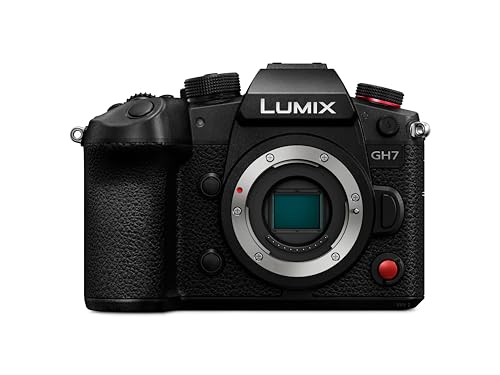
Panasonic LUMIX GH7 — The video flagship
The GH7’s title announces its priorities in the order a filmmaker would choose: a Micro Four Thirds camera with enhanced video speed and quality, and workflows optimized from shooting to post-production. The GH line is the reason this format has a video reputation at all — the bodies that taught a generation of independent filmmakers that a small sensor in a serious video body beats a large sensor in a casual one — and the GH7 is that line’s current flagship, the camera the system’s video faithful upgrade toward.
The workflow phrase in the title deserves unpacking, because it is the least decorative claim a video body can make. Professional video is a pipeline: capture formats that editing systems digest without transcoding, colour that grades predictably, media and power arrangements that survive a shooting day. A body designed around that pipeline saves its owner hours weekly, which is a more serious specification than any resolution figure. The title does not enumerate the pipeline’s components, and this guide leaves their specifics to Panasonic’s documentation — but the intent is printed where buyers can see it, and it is the intent the GH name has always stood for.
For stills, the GH7 remains a fully serious Micro Four Thirds body sharing the mount’s entire lens catalogue, which is the hybrid shooter’s quiet advantage: one kit, two crafts, no adapter compromises. Against the G9II it cedes the stills flagship’s autofocus headline; against the GH5M2 below it represents the current generation against a beloved classic. The filmmaker whose work is delivered, graded and billed should start the system’s shortlist here.
There is also a longevity argument specific to this line. GH bodies are bought by working videographers and kept for years, supported by a deep accessory ecosystem of cages, rigs and audio gear sized for the format. A body that joins an ecosystem of working tools ages differently from a body that joins a shelf of gadgets, and the GH7’s title, with its workflow language, is speaking to exactly the buyers who know the difference.
- Format stated in title: Micro Four Thirds mirrorless
- Video stated in title: enhanced video speed and quality
- Workflow stated in title: optimized from shooting to post-production
- Sensor resolution: Not stated in the listing title — verify with Panasonic documentation
- Stabilization: Not stated in the listing title — verify with Panasonic documentation
- Configuration: body only
Strengths
- The system’s video flagship with workflow as its stated brief
- Full access to the shared mount’s lens catalogue
- Deep professional accessory ecosystem for rigs and audio
Trade-offs
- Stills-led buyers are better served by the G9II
- Key figures require manufacturer verification
- Professional video tier pricing within the system
Best for: a buyer seeking the Micro Four Thirds flagship for delivered video work. Not suited for: a buyer requiring the system’s strongest stills autofocus headline.
Sound is the GH line’s unspoken curriculum, and this body’s ecosystem reflects it: the format’s small rigs balance on small gimbals, its bodies pair with compact microphones without toppling, and its accessory shelves are stocked by two decades of working videographers solving exactly those problems. A filmmaker assembling a one-bag production kit discovers that every component in the bag was designed by someone who had carried the previous version up the same stairs.

OM SYSTEM OM-5 Mark II kit — The traveller’s system
This kit is the format’s thesis sold in one box: a 20.4 megapixel body with 4K video, 5-axis image stabilization and IP53 weather sealing, wearing the M.Zuiko Digital ED 14-150mm F4.0-5.6 II lens. That lens is the story. Its range runs from wide interiors to a telephoto reach that, on this sensor, frames like a far longer lens on a full-frame body — one lens for the whole journey, sealed to match the body, sized for the day bag. Travellers who have watched a two-lens kit spend a holiday in the hotel safe will understand exactly what this box is promising.
The body’s stated facts complete the travel brief rather than decorating it. The stabilization covers the dusk walk and the handheld interior where tripods are forbidden. The sealing covers the weather that travel actually includes. The Four Thirds format keeps the whole assembly — body, all-in-one lens, spare battery — at a weight that survives a full day on a shoulder without negotiation. This is the pick from the small-camera guide’s family, and in this company it plays the same role at system scale: the camera most likely to be present, which is the first virtue every other virtue depends on.
The all-in-one lens carries the honest trade of its kind: a zoom spanning that range concedes aperture and the last measure of optical refinement to the primes and shorter zooms in the catalogue. The kit’s design anticipates the concession gracefully, because the mount’s affordable primes are the natural second purchase, and the body’s stabilization serves them all. Buy the kit for the journey, add the prime for the evenings, and the system grows the way travel photographers actually grow it.
Against the G9II and GH7, this kit is the anti-flagship: less capability per body, more photography per trip. Against its own body-only sibling elsewhere in this lineup, the kit’s lens makes it the complete purchase. For the traveller, it is the easiest recommendation in this guide to defend with a straight face and a light bag.
- Sensor: 20.4MP Four Thirds, per the listing title
- Lens included: M.Zuiko Digital ED 14-150mm F4.0-5.6 II, per the listing title
- Video stated in title: 4K
- Stabilization stated in title: 5-axis image stabilization
- Weather sealing stated in title: IP53
- Configuration: camera and lens kit
Strengths
- One sealed lens covers the entire travel range
- Stabilization and sealing stated in the title
- Lightest complete flagship-adjacent kit in the group
Trade-offs
- All-in-one zoom concedes aperture to the system’s primes
- Smaller sensor trails larger formats in the dimmest light
- Capability sits a tier below the two flagships
Best for: a buyer seeking one sealed, stabilized kit for whole journeys. Not suited for: a buyer requiring flagship autofocus or the fastest native apertures.
There is a packing-list test this kit passes that its flagship rivals should envy: body, lens, batteries, cards, cloth and charger inside a sling that airlines count as a personal item. Whole photography trips — the kind measured in countries rather than weekends — have been shot on kits of exactly this shape, and the photographs did not know they were supposed to be compromised. Presence and completeness, again, outrank specification in the field.

OM SYSTEM Olympus OM-D E-M1 Mark III — The professional veteran
The E-M1 Mark III’s title is the shortest in this guide — a name, the word body, the colour black — and the guide treats it the way it treated the other silent listings in this guide: as a verification assignment attached to a serious machine. The OM-D E-M1 line is this mount’s professional tier, the bodies working photographers in the system have carried through seasons of paid assignments, and the Mark III is that line’s established generation: the camera as tool, bought for grip, stamina and a control layout that professional hands memorise.
What can be said from evidence rather than reputation? The body is sold body-only, in black, under the OM SYSTEM Olympus naming that marks the system’s transition era, and it mounts the shared Micro Four Thirds catalogue — the deepest small-system shelves in photography, including the professional telephotos this line was built to drive. Everything else a buyer needs — sensor figures, stabilization rating, sealing grade, video specification — lives in the manufacturer’s documentation, and a professional-tier purchase deserves the professional-tier diligence of reading it.
Why include a veteran in a current-generation guide at all? Because established professional bodies occupy a value position newcomers miss: their prices have settled to what the tool is worth rather than what the launch demanded, their behaviour is documented by years of working owners, and their accessories and batteries circulate everywhere. For the photographer entering this system to work — events, nature, documentary — the E-M1 Mark III is the pick whose cost is the most honest and whose ceiling is proven rather than promised.
Its natural buyer already owns, or is about to own, the system’s lenses; the body-only listing is a feature for that buyer and a warning for the kit-seeker, who should take the OM-5 kit above instead. Judged as what it is — the working veteran of a working system — it holds its place in the six without apology.
- Configuration stated in title: camera body only, black
- Mount: Micro Four Thirds, per the OM-D product line
- Sensor resolution: Not stated in the listing title — verify with OM SYSTEM documentation
- Stabilization: Not stated in the listing title — verify with OM SYSTEM documentation
- Video capability: Not stated in the listing title — verify with OM SYSTEM documentation
- Weather sealing: Not stated in the listing title — verify with OM SYSTEM documentation
Strengths
- Professional-tier body at a settled, generation-mature pitch
- Drives the system’s professional telephoto catalogue
- Behaviour documented by years of working owners
Trade-offs
- Listing title states almost no specifications
- Established generation rather than the current design
- Body-only sale presumes lenses already owned or budgeted
Best for: a buyer seeking a proven professional body inside the Micro Four Thirds system. Not suited for: a buyer requiring a complete kit and title-stated specifications.
Working owners describe this line’s bodies with a word rarely applied to cameras: furniture. Not as an insult — as the compliment paid to equipment that is simply there, session after session, holding the settings it was left with and asking nothing. A professional body that becomes furniture has achieved the final stage of tool design, and a buyer entering the system for paid work is buying precisely that unglamorous reliability, at a generation-settled price.

Panasonic LUMIX GH5M2 — The streaming classic
The GH5M2’s title is a small masterpiece of honest specification: a 20.3 megapixel Micro Four Thirds camera with live streaming, 4K 4:2:2 10-bit video, unlimited recording and 5-axis image stabilization, each claim printed where a buyer can weigh it. Read together, those phrases describe a very specific working life — the creator or institution that films long, streams live, and cannot have a camera stop mid-sentence. Unlimited recording is the unglamorous specification that separates event and streaming tools from highlight cameras, and this title states it outright.
The streaming brief deserves its moment, because it is the one video job where the camera is infrastructure. A body that streams directly, records without a session limit, and stabilizes its own footage covers the church service, the lecture series, the small studio’s weekly programme — work where reliability outranks every creative specification. The GH5M2 built its reputation in exactly that employment, and its place in this guide is the system’s reminder that video heritage includes dependability as well as cinema.
Against the GH7, it is the previous generation’s answer at a gentler pitch: less current, less costly to enter, and still specified beyond most rivals’ promises. Against the G9II, it trades the stills flagship’s autofocus story for the streamer’s toolkit. A buyer running live, long, schedule-bound video will read this title the way an electrician reads a wiring diagram — with recognition and relief.
As a stills body it remains a 20.3 megapixel Micro Four Thirds camera with stated stabilization and the whole shared catalogue behind it, which makes it the hybrid bargain of the six for the owner whose filming is scheduled and whose photography is everything else.
- Sensor: 20.3MP Micro Four Thirds, per the listing title
- Video stated in title: 4K 4:2:2 10-bit, unlimited recording
- Streaming stated in title: live streaming capability
- Stabilization stated in title: 5-axis image stabilization
- Configuration: body only
Strengths
- Most completely stated video specification in the group
- Unlimited recording suits events and streaming duty
- Previous-generation pitch for a professional toolkit
Trade-offs
- Previous generation beside the GH7’s current design
- Stills-led buyers are better served by the G9II
- Body-only listing leaves the lens as a second decision
Best for: a buyer seeking a streaming and long-form video body inside the system. Not suited for: a buyer requiring the current flagship’s stills autofocus.
Institutions form this pick’s second constituency: the school with a weekly assembly to stream, the small museum recording its talks, the sports club filming its own matches for the players to study. For those buyers the GH5M2’s stated combination — streaming, unlimited recording, stabilization, a shared lens mount — reads as a facilities specification rather than a creative one, and facilities specifications are where reliability is purchased on purpose. It is an honourable way for a camera to spend its life.

Panasonic LUMIX G100 — The presenter’s compact
The G100 closes the six as the system’s smallest complete argument. Its title states a lightweight 4K camera for photo and video with a built-in microphone, the Micro Four Thirds mount, a 12-32mm lens in the kit and 5-axis Hybrid I.S. — and that last phrase receives the same honest treatment here as in the stabilization guide: the G100’s stabilization is a hybrid of electronic correction and lens-based help, not the sensor-shift mechanism of the OM-5 or the GH5M2. For this body’s brief, the distinction is a footnote rather than a flaw, but the guide prints it because the guide always prints it.
The brief itself is the solo presenter, and no body in this system serves it more directly. The built-in microphone addresses the presenter’s voice without a rig; the 12-32mm kit lens keeps the whole outfit at coat-pocket scale; the lightweight body rides a small tripod or a shelf without negotiation. Teachers, reviewers, demonstrators and coaches film entire careers on cameras of exactly this shape, and the G100 is the shape’s current Micro Four Thirds expression.
Its system membership is the sleeper virtue. Unlike the fixed-lens compacts it competes with for the presenter’s desk, the G100 is a mount body: when the presenter’s ambitions grow — a wider lens for a smaller room, a faster lens for a dimmer one — the catalogue is already there, shared with every other pick in this guide. It is the only presenter compact in this selection that is also the first rung of a serious system ladder.
Stills buyers should weigh it last among the six, and video presenters should weigh it first among the affordable ones; that spread is not indecision but accuracy. The G100 is the specialist at the system’s small end, and specialists are ranked by the sharpness of their fit to their brief.
- Format stated in title: Micro Four Thirds, with 12-32mm lens
- Video stated in title: 4K, for photo and video
- Audio stated in title: built-in microphone
- Handling stated in title: lightweight camera
- Stabilization stated in title: 5-axis Hybrid I.S. — electronic plus lens-based, NOT sensor-shift
- Configuration: camera and lens kit
Strengths
- Smallest complete filming kit in the system
- Built-in microphone serves the solo presenter directly
- A real mount body, so the kit can grow with its owner
Trade-offs
- Hybrid stabilization sits below the sensor-shift picks
- Presenter-first design gives stills specialists less
- Smallest sensor files in a group already built on a small sensor
Best for: a buyer seeking the system’s compact body for presenting and teaching on video. Not suited for: a buyer requiring sensor-shift stabilization and flagship stills performance.
One honest limit completes this pick’s portrait: the G100’s ceiling is the presenter’s room. Owners whose filming graduates to cinematic ambitions — shallow focus, elaborate rigs, cinema lenses — will graduate to the GH bodies in this same guide, and the G100 will retire to the second-camera role it also serves well. A system that contains both the first rung and the destination is doing its members a kindness that fixed-lens rivals cannot.
Comparison Table
| Camera | Sensor (per title) | Headline brief | Stabilization (per title) | Configuration |
|---|---|---|---|---|
| Panasonic LUMIX G9II | 25.2MP | Stills flagship, phase hybrid AF | Powerful IS, stated | Body only |
| Panasonic LUMIX GH7 | Not stated in title | Video flagship, workflow | Not stated in title | Body only |
| OM SYSTEM OM-5 Mark II kit | 20.4MP | Travel system | 5-axis, stated; IP53 sealing | Kit with 14-150mm |
| OM SYSTEM E-M1 Mark III | Not stated in title | Professional veteran | Not stated in title | Body only |
| Panasonic LUMIX GH5M2 | 20.3MP | Streaming and long-form video | 5-axis, stated | Body only |
| Panasonic LUMIX G100 | Not stated in title | Presenter compact | 5-axis Hybrid I.S., stated | Kit with 12-32mm |
How do you build a Micro Four Thirds kit without wasting the format’s point?
Start from the bag, not the catalogue. Decide the largest bag the kit may occupy — a coat’s worth, a daypack’s top half, a small sling — and let that volume govern every purchase, because the format’s entire advantage evaporates the day the kit graduates to the rolling case. Within the volume, the classic architecture is one versatile zoom for the day and one fast prime for the evening, a pairing the OM-5 kit in this guide nearly completes in its own box. Add reach only when your subjects prove they live at a distance, and add width only when your rooms prove they are small; the catalogue will tempt you with both on the first afternoon, and the bag is the discipline that answers temptation.
Buy across the brands without anxiety. The shared mount means an OM SYSTEM body can wear Panasonic glass and the reverse, and the used market treats the catalogue as one shelf. That interoperability is the system’s founding promise and it still holds: check each lens’s stabilization behaviour with your body where the pairing matters, since the two brands coordinate body and lens correction with slightly different philosophies, but shop the whole shelf as your own.
Finally, protect the system’s resale logic. Micro Four Thirds equipment circulates briskly among travellers, birders and video shooters, and a kit bought sensibly — mainstream lenses, boxes kept, bodies unmarked — holds its value as a going concern. Owners who treat the kit as a system rather than a pile of purchases find that upgrading inside the format costs less than the spec sheets suggest, because the old kit is always somebody else’s perfect travel answer.
There is a subtler kit discipline specific to this format: resist the telephoto temptation until the wide end is honest. New owners, intoxicated by the crop factor’s reach, buy long glass first and discover their rooms, streets and family frames are all too tight, shot from doorways and across gardens. The system’s wide and standard lenses are its daily bread, and its telephotos are its dessert; owners who eat in that order stay in the format for decades, while the dessert-first owners conclude wrongly that the system itself was impractical and leave, selling their long lenses to the patient at a discount the patient quietly enjoys.
Which errors do 4/3 buyers repeat most?
The first error is apologising for the sensor and then buying against the apology — choosing the format for its size and immediately mounting the largest lenses in the catalogue, arriving at a kit no smaller than the APS-C outfit it replaced. The format rewards coherence: small bodies, small lenses, small bags, all the way down. Buyers who keep the faith get the system they were promised; buyers who hedge get two systems’ costs and neither’s benefit.
The second error is shopping for lenses as if they were picks in a body guide — collecting glass before owning the body and the brief it serves. This guide lists bodies only, deliberately, because the system’s correct order of operations is body, kit lens, evidence, then glass. The catalogue is deep enough to reward patience and to punish impulse with duplication.
The third error is ignoring the two-brand reality when checking features. Stabilization coordination, lens corrections and firmware behaviours differ in detail between Panasonic and OM SYSTEM equipment, and a cross-brand pairing should be verified for the specific features the buyer depends on rather than assumed identical. The mount is shared; the fine print is brand property, and reading it is the small tax on a large freedom.
The last error is judging the format by its loudest critics and loudest fans rather than by a carried weekend. Rent or borrow a body and one small zoom, carry it for two days of your real life, and count the photographs that exist because the kit was present. That count, and not any forum’s verdict, is the format’s true specification. The same experiment disciplines every other claim in this guide, which is why the guide keeps returning to carried reality as its court of final appeal: a camera system’s worth is measured in photographs that exist, and photographs exist in proportion to presence, and presence is the one quantity the smallest complete system in photography has never once lost an argument about, in twenty years of being argued with. Arguments about formats are, in the end, arguments about days — about where a photographer goes, how far they walk when they get there, and what their shoulders report at the end of it — and days are not settled by charts, however beautifully the charts are drawn or however loudly they are quoted in the comments beneath them. The six bodies above were chosen to serve real days of every common kind — the shoot, the stream, the journey, the assignment, the lesson — and a buyer matching the body to the day, rather than to the argument, will find the format’s reputation for quiet competence entirely deserved, season after season, bag after bag, lens after patient lens, without ever once needing to be rescued from a bag left behind at home, in a cupboard, in another town entirely.
How does the crop factor change the way you think about lenses?
Every focal length in this system frames like a lens twice as long on a full-frame camera, and the sooner a new owner internalises that doubling, the sooner the catalogue starts making sense. The wide lenses are wider than their numbers suggest in spirit — they are the system’s street and interior tools. The standard primes are portrait lenses in waiting. The modest telephoto zooms are wildlife instruments. Owners who translate before they shop buy the right lens the first time; owners who shop by the numbers printed on larger-format reviews buy a shelf of near-misses.
The doubling cuts the other way for depth of field, and the honest guide repeats the trade until it sticks: at the same aperture and the same framing, this format renders deeper focus than full-frame. Portraitists compensate with faster primes, which the format sells small and sharp; landscape and documentary photographers accept the depth as a gift, because their genres want the world in focus from foreground to horizon and this sensor gives it to them at apertures where larger formats are still compromising. One format’s limitation is, with complete sincerity, another genre’s feature.
There is a discipline dividend as well. A system whose lenses are small enough to carry three of them teaches its owner to change lenses and think in focal lengths, where a heavier system teaches its owner to zoom from one spot and think in convenience. Neither education is worthless, but they produce different photographers, and the Micro Four Thirds graduate is recognisable by the habit of moving — toward the subject, around the subject, into the picture rather than merely aiming at it.
What does sharing a mount between two brands actually feel like in ownership?
It feels like a larger shop with two shopkeepers. The catalogues overlap in the middle — both brands sell fine standard zooms and fast primes — and specialise at the edges, where one brand’s professional telephotos and the other’s video-oriented glass give the combined shelf a breadth neither would sustain alone. Firmware philosophies, colour science and handling differ by brand, so the owner’s loyalty forms around the body in their hands while their lens shelf stays gloriously neutral. Selling a body and keeping the lenses, even across the brand line, is a normal transaction in this system and a small crisis in most others.
The arrangement also disciplines both makers. A body that disappoints its owners sends them to the other brand’s bodies without costing them their lenses, which is a competitive pressure single-brand systems never feel at the mount level. Owners benefit from that pressure in firmware updates, in lens pricing, and in the simple knowledge that their investment is not a hostage. Two decades in, the shared mount remains the format’s most radical idea, and its most practical one.
For the buyer reading this guide as a first step, the practical translation is short: choose the body by the craft you lead with — stills, video, travel, streaming, presenting — and let the lens shelf be a commons. The six bodies above are six doors into one house, and the house is larger than any of its doors suggests.
How do wildlife and sports photographers make this format punch upward?
They start with the format’s gift and refuse to apologise for it: reach per unit of weight and money that no larger system matches. A telephoto zoom that a full-frame shooter would need a monopod and a mortgage for is, in this system, a hand-holdable day lens — and hand-holdable means present, and present means pointed at the bird when it moves. The G9II’s phase hybrid autofocus exists to complete that sentence, and the OM bodies’ stabilization exists to hold the frame steady while it happens. Technique does the rest: fieldcraft, patience, and knowing the subject’s habits, the ancient currencies that no sensor size has ever devalued.
They also shoot to the format’s strengths in light. Bright and overcast days are this sensor’s home ground, where its files are clean and its depth of field forgiving; the golden edges of the day are managed with the faster lenses the system sells at sane prices, and with the discipline of positioning — getting closer rather than cropping harder, letting behaviour come to the photographer. The wildlife photographers who thrive in Micro Four Thirds are disproportionately the ones who were field naturalists first, and the format rewards that ordering of skills.
And they print. The final answer to the sensor argument in wildlife work is a print on a wall, judged by viewers who do not know or care what made it, and this system’s files — stabilised, tightly framed, taken from positions a heavier kit never reached — print with complete conviction at the sizes walls actually hold. The format’s defenders learned long ago to let the wall do the arguing.
What does a working video kit in this format actually contain?
Less than the catalogues want you to believe. A GH body or the GH5M2, one versatile zoom for the general work, one fast prime for the dim and the deliberate, a microphone that suits the room, and media and power enough for the day’s full length rather than its planned length. The format’s smallness compounds here as it does in stills: the gimbal that balances these bodies is a smaller gimbal, the tripod is a lighter tripod, and the whole production fits the car boot’s corner instead of commanding the car. Independent filmmakers built this system’s video culture on exactly that arithmetic, one small bag at a time.
The presenter’s version of the kit is smaller still — the G100, its kit lens, a modest light, and a room treated kindly — and it is worth noticing that the same mount serves both ends of that ambition without an adapter or an apology. A creator can begin on the presenter’s compact and graduate to the flagship with every lens still fitting, which is the system’s quiet answer to the upgrade question that strands so many beginners on orphaned mounts.
Audio deserves the kit list’s final word, because video audiences forgive soft pictures sooner than bad sound. The G100’s built-in microphone is this guide’s only stated in-camera answer; every other pick expects the filmmaker to add a microphone, and the budget for one belongs in the kit plan from the first day, ahead of the second lens and far ahead of the cage.
Final Recommendation
Choose by craft. The stills photographer should take the Panasonic G9II and its phase hybrid autofocus; the filmmaker should take the GH7 and its workflow brief; the traveller should take the OM-5 Mark II kit and travel lighter than every rival at the airport. The working professional entering the system on a settled budget should take the E-M1 Mark III and verify it like a professional; the streamer should take the GH5M2 and its unlimited recording; the presenter should take the G100 and start filming this week. Two decades into the mirrorless era, the smallest complete system in photography is still making its original argument — that the best sensor is the one inside the camera you carried — and these six bodies are its current, convincing evidence.
Frequently Asked Questions
What does 4/3 mean in this keyword, exactly?
It refers to Micro Four Thirds, the mirrorless lens system and sensor format shared by Panasonic and OM SYSTEM. The name descends from the format’s heritage, and the living system is the mount every pick in this guide uses. Only bodies for that mount are listed here; lenses for the system, however good, are not camera picks and were excluded on principle.
Can Panasonic and OM SYSTEM lenses really be mixed?
Yes — that interoperability is the mount’s founding design. A Panasonic body accepts OM SYSTEM lenses and the reverse, across the current catalogue and a long back-catalogue. Fine details such as how body and lens stabilization coordinate can differ by pairing, so verify the specific combination for the features you depend on, but the shelf as a whole belongs to owners of either brand.
Is the smaller sensor a problem for low light and portraits?
It is a trade, honestly priced. High-ISO files carry more noise than larger formats, and background separation at a given aperture is gentler, so portraitists buy faster primes — which this system sells in unusually compact forms. In exchange the complete kit is dramatically smaller and lighter. Photographers whose work is dim and shallow should weigh larger formats; photographers whose work is carried should weigh this one.
Which of these is the best single purchase for a beginner entering the system?
The OM-5 Mark II kit, because it is complete: a stabilized, sealed body and a lens covering the whole travel range, in one box, on the shared mount. The G100 is the gentler-priced alternative for a video-led beginner. The flagships and the veteran are better second bodies than first ones, bought once the beginner’s own photographs have named the specialism.
Why is the G100’s stabilization described differently from the others?
Because it is different. The G100 uses a hybrid design — electronic correction combined with the lens’s own stabilization — rather than moving its sensor, and its title says so in the words Hybrid I.S. This guide distinguishes the mechanisms wherever they appear, because they behave differently for stills in dim light, and a buyer comparing this system deserves the distinction in plain sight.
Is Micro Four Thirds a safe system to buy into now?
By the measures that matter to an owner, yes. Both manufacturers continue to release bodies and lenses for the mount — several picks in this very guide are current-generation products — the back-catalogue is the deepest of any small system, and the used market is liquid enough that an owner can enter and exit without punishment. A system’s safety is not a promise about forever; it is a judgement about the depth of the present, and the present here is deep, active and shared between two committed makers.
Which brand within the system should a stills photographer favour?
Let the current bodies answer rather than the histories. Panasonic’s G9II states the system’s strongest stills specification in this guide, phase autofocus included, while OM SYSTEM’s bodies state the traveller’s and the professional’s cases with sealing and stabilization across the range. Because the lenses cross freely, the choice is reversible in a way other systems do not permit: buy the body that suits this year’s craft, and let the lens shelf stay above the rivalry.
Related Guides
The rest of this roundup keeps meeting this system’s cameras in other roles: the small-camera guide weighs the OM-5 as a daily carry, the stabilization guide separates its sensor-shift bodies from its hybrid one, and the budget guide prices its entry kits. Continue with the best small mirrorless cameras with viewfinder, mirrorless cameras with image stabilization on a budget and the best mirrorless cameras under 1000 dollars before you choose your mount.
Related guides
- Best Basic Phones Camera Buyers Can Trust: Flip Phones and Simple Handsets That Still Take a Photograph
- Best Sony Full Frame Cameras for Astrophotography: Sensitivity vs Resolution
- Best Affordable Android Tablets: Five True Android Slates and One Fire OS Specialist, Clearly Labelled
- Best 400 FPS High Speed Cameras: The Honest Truth About Burst Slow Motion


