What's inside
- Where to buy
- Key Takeaways
- Quick Picks
- How did we choose these machine learning laptops?
- What should you look for in the best laptops for machine learning and coding?
- How do you choose between a gaming laptop, a workstation and the cloud?
- The six picks in detail
- How do the gaming route and the workstation route compare?
- How do you set up a new laptop for machine learning work?
- What mistakes do buyers make in this category?
- What does a week of real ML work actually ask of these machines?
- How should students of machine learning read this guide?
- What about inference, deployment and the edge?
- Why does the driver deserve a section of its own?
- How long will a machine in this category stay relevant?
- Final Recommendation
- Frequently Asked Questions
- Related Guides
As an Amazon Associate I earn from qualifying purchases. This post may contain affiliate links at no extra cost to you.
gizmoverdict.com is reader-supported. When you buy through links on our site, we may earn an affiliate commission.
Where to buy
The best laptops for machine learning and coding are separated by two figures — graphics memory and system memory — and both are verified here before any verdict is offered. Each machine below is tied to a single checked listing, and the configuration printed on that page is the one being judged — a discipline that matters acutely in this category, where the same model name can hide different graphics memory, and graphics memory is half the subject of this entire guide. Match the processor, the GPU, the memory and the storage in each pick’s spec list against the listing before ordering. Where a listing’s title is truncated or its graphics line is not stated, the pick’s section says so and tells you what to confirm, because in machine learning an assumed specification is a wrong specification.
The search for the best laptops for machine learning and coding is really two searches sharing a keyboard, and this guide keeps them separate in its head even where the picks overlap. Coding, as the companion guide in this series argues at length, is a memory-and-keyboard occupation that almost any professional laptop serves well. Machine learning is a graphics occupation with a hard physical gate: the model must fit in the GPU’s memory, on hardware running the CUDA software ecosystem that the field’s frameworks are built on, or the work does not happen locally at all. That is why this guide is organized around VRAM and CUDA rather than around processor badges, and why it speaks in class terms — what fits in an eight-gigabyte card, what the workstation route adds, what the cloud rents you instead — and never invents training speeds or tokens-per-second figures for machines it is describing from listings. Anyone who prints you a precise benchmark for a laptop they configured from a web page is selling you a number, not knowledge.
The honest fork in this market has two prongs, and the six picks divide along it cleanly. Four are gaming laptops carrying RTX graphics — the Katana, the G16, the Strix and the Aurora — and they are the value route to a CUDA GPU: the same silicon classes the field trains on, wrapped in machines built for cooling and priced by a competitive consumer market. Two are mobile workstations, Lenovo’s ThinkPad P1 Gen 9 and HP’s ZBook Studio G11, and they are the stability route: professional drivers, certification programmes and, in the ZBook’s case, an RTX 1000 Ada professional card, bought by practitioners whose work answers to clients, compliance or simply a lower tolerance for surprise. Neither prong is the correct one in the abstract. They are answers to different questions about where a reader’s models live and who pays when a driver misbehaves, and the guide’s verdicts are written to locate each reader on their own side of the fork. Books, sleeves and courses filled the search results for this keyword; none is a laptop, and none appears as a pick.
Key Takeaways
- VRAM is the gate: the eight-gigabyte class shared by the RTX gaming picks fits small and medium models, fine-tuning and inference, and defines what local work is possible.
- The MSI Katana A15 AI is the value summit for local ML, pairing an RTX 4070 with thirty-two gigabytes of system memory behind a QHD screen.
- The Dell G16 trades system memory for the guide’s most serious sustained-power design, a consideration its section weighs openly for coding-heavy buyers.
- The two RTX 5060 machines, from ASUS and Alienware, are the newer-generation route into the same eight-gigabyte class with modern platforms around it.
- The workstation pair — ThinkPad P1 Gen 9 and ZBook Studio G11 — sell driver stability, certification and professional support rather than raw CUDA value.
- Cloud GPU rental is the real alternative to every pick here, and for bursty or very large training it often wins; this guide treats it as the baseline each laptop must justify itself against.
Quick Picks
| Pick | Badge | Why it earns its place |
|---|---|---|
| MSI Katana A15 AI RTX 4070 | Best Value for Local ML | An RTX 4070 and thirty-two gigabytes of memory make it the most complete local training package here. |
| Dell G16 7630 RTX 4070 | Best Sustained Power | An HX processor and a 240Hz QHD+ chassis for long training runs, with a memory caveat weighed in its section. |
| ASUS ROG Strix G16 RTX 5060 | Best New-Generation Gaming Route | Current-generation RTX graphics and an HX processor in a sixteen-inch performance chassis. |
| Alienware 16 Aurora RTX 5060 | Best Polished New-Generation Pick | The RTX 5060 class in Alienware’s refined sixteen-inch design with a 1600p display. |
| Lenovo ThinkPad P1 Gen 9 | Best Workstation for Professionals | A 4K-class screen, thirty-two gigabytes and the ThinkPad workstation programme for client-facing ML work. |
| HP ZBook Studio G11 | Best Certified Graphics Route | An RTX 1000 Ada professional GPU with workstation drivers for stability-first practitioners. |
How did we choose these machine learning laptops?
We began at the gate every local ML workload must pass: a CUDA-capable GPU with enough memory to hold the work. That single test explains the guide’s shape. It admitted the four RTX gaming machines, whose eight-gigabyte-class cards define the local envelope for most practitioners — model development, fine-tuning of small and medium models, inference, and the data-science notebook life — and it admitted the two workstations on their different merits, professional graphics and driver programmes for readers whose constraint is not the model but the environment it must run in. It excluded the entire integrated-graphics world, however excellent for coding, because a guide to this keyword that recommends a machine with no CUDA path has not understood its own title.
Around the gate, we judged the coding half of the title with the seriousness it deserves, since these machines will spend most of their hours in editors, terminals and browsers. System memory matters twice here — once for the development stack, and again because data pipelines stage their work in RAM before the GPU ever sees it — which is why the sixteen-gigabyte configurations among the gaming picks carry explicit caveats in their sections while the thirty-two-gigabyte machines are praised by name. Screens were judged for the notebook-and-code life: resolution for dense plots and split editors, size for the long sessions that training runs impose on the human waiting beside them. Cooling was judged as a training specification, because a GPU that throttles in hour two of a run has quietly renegotiated the machine’s specification.
Finally, we held every pick against the alternative that disciplines this whole category: renting the GPU from a cloud provider. A laptop must justify itself against that baseline in a specific reader’s arithmetic — how often they train, how large their models are, how much they value the work happening locally, privately and without a meter running. The how-to-choose section further down does that arithmetic in the open. A guide that pretends the cloud does not exist is a sales document; this one would rather lose some readers to a rented GPU honestly than win them for a laptop their workload will outgrow by spring.
What should you look for in the best laptops for machine learning and coding?
Graphics memory first, because it is the only specification in this guide that behaves like a wall rather than a slope. A model, its optimizer state and its activations occupy VRAM together, and when the total exceeds the card, training does not slow down — it stops, or resorts to offloading tricks that tax the work heavily. The eight-gigabyte class, shared by the RTX 4070 and RTX 5060 laptop cards in this guide, is a real and useful envelope: it fits the small and medium models most practitioners actually develop, fine-tunes larger ones with parameter-efficient methods, runs inference generously, and hosts the entire learning and prototyping life of the field. Workstation buyers should note the ZBook Studio’s RTX 1000 Ada carries six gigabytes as listed, a professional card whose value is its driver programme rather than its capacity, and size their expectations accordingly. Above the local envelope entirely sit the large training runs, and those belong — on any honest accounting — to the cloud section of this guide.
System memory forms the second barrier, and buyers under-read it because the GPU takes the headlines. Data is prepared on the CPU: loaded, cleaned, tokenized, augmented and batched in RAM before the GPU is fed, and a pipeline starved of system memory turns an expensive graphics card into a waiting room. Thirty-two gigabytes, fitted to the Katana and both workstations, is the comfortable figure for serious local work. Sixteen, fitted to the G16, the Strix and the Aurora, serves coding and lighter ML pipelines honestly and will be felt by data-heavy workflows — a caveat this guide prints in each of those sections rather than discovering on the reader’s behalf. Because gaming laptops sometimes allow memory expansion where workstations and thin machines vary, the listing’s configuration deserves the verification this guide keeps prescribing.
The processor and cooling form the third consideration, as a pair. Data loading is CPU work, and the HX-class processors in the G16 and the Strix exist to keep the GPU fed and the notebook responsive during it. Cooling decides whether any of the paper specifications survive contact with an overnight run: chassis size, fan design and power limits separate machines that hold their performance from machines that visit it, and the sixteen-inch gaming chassis in this guide are, as a class, more honest sustained performers than thin designs with the same chips. Screens and keyboards close the sheet with the coding half’s familiar virtues — resolution for notebooks and editors side by side, a keyboard that survives the documentation and debugging that surround every model — and on those axes the workstations, particularly the P1 Gen 9’s high-resolution panel, make their quieter case.
One more specification deserves its sentence because the field runs on it: software compatibility is not a feature to verify later. The frameworks that dominate practice — PyTorch, TensorFlow, the Hugging Face ecosystem — are built first for CUDA, and every pick in this guide was admitted because it stands inside that ecosystem rather than adjacent to it. That is the entire ballgame for local work, and it is why an otherwise superb laptop with the wrong graphics lineage is not a pick here at any price.
How do you choose between a gaming laptop, a workstation and the cloud?
Run your own workload through three questions. First: how large is the largest model you genuinely train or fine-tune, and how often? If it fits the eight-gigabyte class and the training is a weekly habit, a local gaming laptop repays its purchase in convenience, privacy and the absence of a meter, and the Katana pattern — strong card, full memory — is the shape to buy. If the honest answer is that your serious runs are large and occasional, the cloud’s rented accelerators, with memory measured in multiples of any laptop’s, will beat every pick in this guide on capability per occasion, and the laptop’s job reduces to the coding and experimentation that precede the run — a job the sixteen-gigabyte picks do well.
Second: who else has a claim on your machine’s behaviour? Practitioners inside firms, consultancies and regulated work inherit requirements a gaming laptop cannot answer — certified configurations, managed drivers, support contracts, security postures — and for them the workstation prong is not a luxury but the admission ticket, with the ZBook’s professional graphics programme and the P1’s enterprise lineage as the relevant specifications. Third: where does the work physically happen? Training is patient work that tolerates a desk-bound machine; coding and presenting are travelling work. The guide’s picks were chosen so that each prong contains a machine that can carry both halves of the title in one bag, because most readers, whatever their answers, are still one person with one laptop.
Notice what the three questions never ask: which machine is fastest in the abstract. In this category the abstract is a trap, because the fastest local answer is routinely the wrong one — too little VRAM for the real model, too little stability for the real client, too much money for a workload the cloud serves better twice a year. The right machine is the one whose envelope your actual work fits inside with room to grow, and the sections below are written to measure envelopes rather than to crown champions.
The six picks in detail

MSI Katana A15 AI RTX 4070 — Best Value for Local ML
The Katana is the machine this guide expects the most readers to buy, because it assembles the local-ML specification without a wasted line: an AMD Ryzen 9-8945HS, an NVIDIA GeForce RTX 4070 laptop GPU in the eight-gigabyte class, thirty-two gigabytes of DDR5 system memory and a terabyte of storage, behind a 15.6-inch QHD display at 165Hz, with MSI’s Cooler Boost 5 cooling named in the listing. Read that as a pipeline rather than a list. The Ryzen 9 prepares data at a pace that keeps the GPU fed; the thirty-two gigabytes stage serious datasets without rationing; the 4070 does the CUDA work inside the envelope this guide has described; and the cooling exists to make sure hour three of a run resembles hour one.
Its character is value in the honourable sense — a gaming chassis whose budget went to the components the workload reads, rather than to the thinnest profile or the richest materials. The QHD panel serves the coding half well, with room for a notebook, an editor and a plot in honest conversation. Nothing in its specification asks for an apology, and its caveats are the class’s own: the eight-gigabyte envelope is a real envelope, the chassis is a gaming design with a gaming design’s manners, and the machine’s professional-support story is a consumer one. For the independent practitioner, the researcher and the serious learner, those caveats are the right price for the most complete local training package in this guide.
- Chip: AMD Ryzen 9-8945HS
- Graphics: NVIDIA GeForce RTX 4070 laptop GPU, 8GB class
- Memory: 32GB DDR5
- Storage: 1TB SSD
- Display: 15.6-inch QHD, 165Hz
- Cooling: Cooler Boost 5
Strengths
- The complete local-ML specification with no weak line
- Thirty-two gigabytes stages data the way serious pipelines expect
- Cooling designed for the sustained runs training actually is
Trade-offs
- The eight-gigabyte VRAM envelope bounds model size, as everywhere here
- Gaming design language and consumer support story
- Fifteen inches is the guide’s smaller canvas for notebook work
Best for: independent practitioners and researchers training locally every week. Not suited for: regulated environments or models beyond the local envelope.

Dell G16 7630 RTX 4070 — Best Sustained Power
The G16 is built around a single conviction: that performance held is worth more than performance promised. Its listed configuration pairs an Intel Core i9-13900HX — a flagship HX processor — with an RTX 4070 carrying eight gigabytes of GDDR6, a terabyte of storage and a sixteen-inch QHD+ display running at 240Hz with a 3ms response, in a chassis sized for the cooling that sustained training and heavy data work demand. For the practitioner whose runs are long and whose data pipelines are CPU-hungry, this is the gaming prong’s most serious instrument: the HX chip keeps the card fed, and the big chassis keeps both honest across the hours that separate real training from a benchmark’s sprint.
The caveat is printed in the same size as the praise: sixteen gigabytes of system memory, half the Katana’s figure, in a guide that has argued system memory is the pipeline’s second gate. The honest reading is workload-dependent. A practitioner whose data is modest, whose models are the work and whose coding is a single stack will rarely feel it. A practitioner staging large datasets locally, or running the full container-and-browser breadth of modern development beside their notebooks, will feel it weekly — and should either confirm the listing’s expansion possibilities with a professional’s care or take the Katana’s complete specification instead. The G16 is a specialist’s pick: magnificent where its strength lies, candid where it does not.
- Chip: Intel Core i9-13900HX
- Graphics: NVIDIA GeForce RTX 4070, 8GB GDDR6
- Memory: 16GB DDR5 — read the caveat in this section
- Storage: 1TB SSD
- Display: 16-inch QHD+ 240Hz, 3ms
- Role: sustained power for long runs
Strengths
- HX processing keeps data pipelines and the GPU equally fed
- A big chassis whose cooling sustains training performance
- The finest high-refresh QHD+ panel among the gaming picks
Trade-offs
- Sixteen gigabytes of system memory is the guide’s tightest working figure
- Size and weight anchor it to a desk by preference
- Its panel’s speed is a gaming virtue ML does not use
Best for: long-run trainers with modest data staging and heavy compute. Not suited for: data-heavy pipelines or breadth-first development stacks.

ASUS ROG Strix G16 RTX 5060 — Best New-Generation Gaming Route
The Strix represents the newer generation of the gaming route, and its configuration should be read as the class’s current shape: an Intel Core i7-14650HX, an NVIDIA GeForce RTX 5060 in the same eight-gigabyte VRAM class as the 4070 machines, sixteen gigabytes of DDR5 memory and a terabyte of fourth-generation storage behind a sixteen-inch FHD+ 16:10 display at 165Hz. The HX processor matters to this guide’s readers in the familiar way — data preparation and a responsive system under load — while the newer GPU generation brings the current CUDA platform and its efficiency improvements to the same local envelope the guide has been describing.
Its honest position is beside the Katana rather than above it. The envelope is the same size; the platform is newer; the system memory, at sixteen gigabytes, asks the same question the G16 asks, and data-heavy readers should answer it the same way. What the Strix adds is the ROG line’s performance-chassis seriousness and a 16:10 screen shape that returns vertical room to notebooks and code — a small, daily kindness. Buyers choosing between the generations should let the memory figure and their data habits arbitrate, because in this category the newest card and the fullest pipeline are different virtues, and only one of them is scarce.
- Chip: Intel Core i7-14650HX
- Graphics: NVIDIA GeForce RTX 5060, 8GB class
- Memory: 16GB DDR5
- Storage: 1TB Gen 4 SSD
- Display: 16-inch FHD+ 16:10, 165Hz
- Role: the current-generation gaming route
Strengths
- Current-generation CUDA platform in a serious performance chassis
- HX processor serves data work and system responsiveness
- The 16:10 panel returns working room to notebooks and editors
Trade-offs
- Sixteen gigabytes repeats the pipeline caveat of the G16
- Its screen resolution is outranked by the QHD picks
- New-generation positioning rarely flatters the value argument
Best for: buyers who want the current platform for a long tenure. Not suited for: data-heavy local pipelines on a strict memory budget.
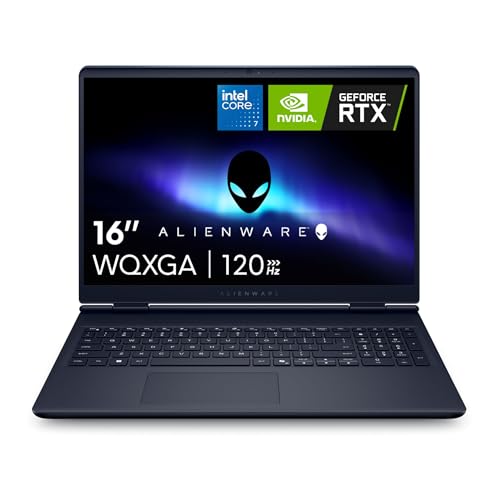
Alienware 16 Aurora RTX 5060 — Best Polished New-Generation Pick
The Aurora is the gaming route wearing its best suit. Alienware’s sixteen-inch design pairs an Intel Core 7 240H with an RTX 5060 in the eight-gigabyte class, sixteen gigabytes of DDR5 memory and a terabyte of storage, behind a 2560 by 1600 display at 120Hz in the taller 16:10 shape. That panel is the pick’s distinguishing grace for this guide’s readers: sharper than the Strix’s screen, sized for notebooks and editors in genuine split-screen conversation, and a daily pleasure during the long human hours that surround a model’s training — the data cleaning, the error analysis, the documentation — which is, in truth, most of machine learning as it is practised.
Its processor tells the counter-story honestly. The Core 7 240H is an H-series chip rather than the HX class fitted to the Dell and the ASUS, which means a step less sustained multi-core appetite for the heaviest data preparation, in exchange for a machine that is generally the more civilized traveller of the gaming four. Sixteen gigabytes of system memory repeats the guide’s standing caveat for data-heavy pipelines. Read the Aurora, then, as the balanced new-generation pick: the same VRAM envelope, the finest screen among the gaming machines for the coding half of the title, and a processor trade that readers with modest data staging will never notice and readers without it should not accept.
- Chip: Intel Core 7 240H
- Graphics: NVIDIA GeForce RTX 5060, 8GB class
- Memory: 16GB DDR5
- Storage: 1TB SSD
- Display: 16-inch 2560 x 1600, 120Hz, 16:10
- Role: the refined all-round new-generation pick
Strengths
- The gaming prong’s best screen for notebooks and code
- Current-generation CUDA in a polished, traveller-friendly design
- A balanced specification with no theatrical extremes
Trade-offs
- H-series processor concedes sustained data work to the HX picks
- Sixteen gigabytes carries the guide’s standing pipeline caveat
- Alienware polish is priced into the proposition
Best for: practitioners who split their life evenly between ML and coding. Not suited for: the heaviest local data preparation on a daily basis.

Lenovo ThinkPad P1 Gen 9 — Best Workstation for Professionals
The P1 Gen 9 opens the workstation prong, and its listing tells the professional story in the professional order: a sixteen-inch 4K UHD+ IPS display rated at 800 nits, a Series 3 Intel Core Ultra X7 368H processor, thirty-two gigabytes of memory and a terabyte of storage, in the ThinkPad P1 line that has carried mobile-workstation credentials for years. The screen is the first thing a client-facing practitioner should notice, because ML work is presented as often as it is computed — plots, dashboards and results reviewed in bright rooms — and 800 nits of high-resolution panel is a presentation instrument as much as a working one. The thirty-two gigabytes answer the pipeline question in full.
Two disciplines of honesty apply to this pick. Its listing’s graphics description is truncated in the source material this guide works from, so the exact GPU configuration must be confirmed on the listing itself before purchase — and in a workstation, that confirmation should extend to the configuration’s place in the vendor’s professional programme for your frameworks and tools. What can be said from the listing and the line’s character is the workstation proposition itself: professional drivers, certification discipline and a support story built for people whose compute is billable. Buyers whose constraint is the environment rather than the envelope will recognize their machine. Buyers shopping purely for local CUDA value should compare the Katana’s candour before paying the workstation premium.
- Chip: Intel Core Ultra X7 368H, Series 3
- Memory: 32GB
- Storage: 1TB SSD
- Display: 16-inch 4K UHD+ IPS, 800 nits
- Graphics: workstation class — confirm exact GPU on listing
- Role: the professional’s presenting and computing instrument
Strengths
- A 4K-class, high-brightness screen for work that is presented
- Full thirty-two gigabytes for pipelines without rationing
- Workstation programme, build and support behind the work
Trade-offs
- Graphics configuration must be verified, not assumed
- The workstation premium buys environment, not envelope
- Its screen’s appetite shortens unplugged working time
Best for: consultants and professionals whose ML work faces clients. Not suited for: pure local-training value seekers.

HP ZBook Studio G11 — Best Certified Graphics Route
The ZBook Studio closes the guide with the workstation argument in its purest form. Its listed configuration is complete and specific: an Intel Core Ultra 7 165H, thirty-two gigabytes of DDR5 memory, a terabyte of storage, a sixteen-inch FHD+ display — and an NVIDIA RTX 1000 Ada professional GPU with six gigabytes of its own memory. That graphics line must be read the way this guide has taught: the Ada card’s six gigabytes are a smaller envelope than the gaming picks’ eight, and its presence here is not about capacity. It is about the professional driver programme, the certified configurations and the stability posture that HP’s ZBook line sells to engineering and data organizations — the environment in which models must simply run, on the day, in front of the people paying for them.
For the right reader that trade is not a compromise but the entire point. A practitioner fine-tuning modest models inside a firm’s managed environment, where an uncertified driver is a compliance conversation and a failed run is a meeting, gets more from this machine’s manners than from two extra gigabytes they rarely fill. A practitioner whose work is personal, experimental and envelope-hungry gets the opposite answer from the same page, and should buy the Katana with this guide’s blessing. The ZBook Studio is the fork in this market made metal: stability as a specification, priced like one, and worth it precisely to the readers who already know why.
- Chip: Intel Core Ultra 7 165H
- Graphics: NVIDIA RTX 1000 Ada workstation GPU, 6GB
- Memory: 32GB DDR5
- Storage: 1TB SSD
- Display: 16-inch FHD+
- Role: the certified, stability-first route
Strengths
- Professional Ada graphics with the certified driver programme
- Full memory and storage in a genuinely portable workstation
- Support and stability posture for managed environments
Trade-offs
- Six gigabytes of VRAM is the guide’s smallest envelope
- Its display is out-resolved by the P1 and the gaming QHD picks
- Value seekers pay for manners they may never need
Best for: practitioners in managed, client-accountable environments. Not suited for: envelope-hungry independent training work.
How do the gaming route and the workstation route compare?
| Pick | Route | GPU memory class | System memory | Defining virtue |
|---|---|---|---|---|
| MSI Katana A15 AI | Gaming value | RTX 4070, 8GB class | 32GB | Complete local training package |
| Dell G16 7630 | Gaming value | RTX 4070, 8GB GDDR6 | 16GB | Sustained HX power |
| ASUS ROG Strix G16 | Gaming value | RTX 5060, 8GB class | 16GB | Current-generation platform |
| Alienware 16 Aurora | Gaming value | RTX 5060, 8GB class | 16GB | Best gaming-prong screen |
| ThinkPad P1 Gen 9 | Workstation | Workstation class, verify | 32GB | 4K-class presenting screen |
| HP ZBook Studio G11 | Workstation | RTX 1000 Ada, 6GB | 32GB | Certified driver programme |
The route column is the first sort, because it decides what kind of promise the machine is making: envelope for the money, or environment for the money. The system-memory column is the second sort, and it divides the gaming prong into the Katana’s completeness and the other three’s shared caveat. Read those two columns honestly and the rest of the table becomes taste — screens, size, generation — which is a legitimate way to finish a decision whose fundamentals have already been faced.
How do you set up a new laptop for machine learning work?
Build the environment in the order that lets each layer vouch for the next. Begin with the operating system and the vendor’s graphics driver, installed deliberately and then left alone — driver churn is the hobbyist’s tax on this category, and a working CUDA stack is an asset to be frozen, not a subscription to be renewed weekly. Install your Python environment manager next, and create a fresh environment per project from the first day, because ML dependencies age at different speeds and the practitioner who isolates them never faces the afternoon where one project’s upgrade uninstalls another’s livelihood. Then install the frameworks, and run the smallest possible verification: a script that reports the GPU’s name, its memory and a trivial tensor operation succeeding on it. That thirty-second ceremony, performed before any real work, converts a pile of installations into a known-good instrument.
Data deserves its own pass. Decide where datasets live — internal storage for the active ones, since a terabyte fills with surprising speed once image corpora and checkpoints accumulate — and set your notebooks and scripts to paths that will survive the project’s growth. Configure checkpointing in your training scripts as a default rather than an inspiration: runs are long, laptops are mortal, and the difference between a power cut as an anecdote and as a catastrophe is whether the last hour’s weights were written down. Finally, connect the machine to its second life: the cloud account, the remote repository, the experiment-tracking habit, so that the first run that outgrows the local envelope has somewhere rehearsed to go. The best local setup is the one that treats the cloud as a colleague rather than as a defeat.
Close with the human settings. A colour-accurate, sufficiently large view of your notebooks; a keyboard layout your debugging fingers already know; a backup of the environment files that would let you rebuild the machine’s software self in an afternoon. Models can be retrained. Environments, undocumented, have a way of becoming archaeology.
What mistakes do buyers make in this category?
The first mistake is reading the GPU’s name and not its memory: two cards can share a badge’s glamour while their VRAM decides entirely different envelopes, and in this category the memory figure is the specification. The second is starving the pipeline — pairing a strong card with sixteen gigabytes of system memory and a data habit that needed thirty-two — then blaming the card for a waiting room the buyer built. The third is benchmarking by folklore: importing training-speed claims from desktops, other configurations or other model sizes, and purchasing against numbers that were never measured on anything resembling the machine or the work.
Fourth is ignoring the cloud in both directions — refusing it on principle and buying a laptop for two enormous runs a year, or surrendering to it entirely and paying rent forever for daily work a local card would have absorbed. Fifth is buying the workstation for its badge or refusing it for its price, without asking the only question that decides the prong: who answers when the environment misbehaves, and what is that answer worth in your working life? Sixth is forgetting the coding half of the title — the keyboard, the screen, the thousand hours in notebooks and terminals — for a machine chosen entirely by its accelerator. A laptop for machine learning and coding is two tools in one chassis, and every mistake on this list is a way of buying only one of them.
What does a week of real ML work actually ask of these machines?
Follow a practitioner through a week and the specifications sort themselves by hour. Monday is data: a corpus downloaded, inspected, cleaned and argued with, in notebooks that hold samples in memory while plots render beside the code. System memory and screen rule the day, and the thirty-two-gigabyte picks with their larger, sharper panels — the Katana, the P1 — do their quiet best work here, while the sixteen-gigabyte machines ask their owner to stage data in pieces, a discipline some pipelines accept gracefully and others resent. Nothing about Monday touches the GPU, which is precisely the point: a machine bought for its accelerator spends most of its life doing everything else.
Wednesday is training, the day the purchase was for. A run that occupies the card for hours, checkpoints writing, logs accumulating, the practitioner reading papers in the browser fleet the system memory also holds. Cooling becomes the specification with a vote, and the big gaming chassis — the G16 above all — justify their bulk in the only currency that matters at hour six: the same pace as hour one. Thursday is evaluation and error analysis, a notebook day again, plots and samples and the slow human work of understanding what the model learned. Friday is the demo, where the workstation prong collects its rent: the P1’s bright 4K-class screen in a client’s room, the ZBook’s unruffled managed behaviour in a firm’s environment, the gaming machines presenting perfectly well and dressed, as ever, for a different party.
No single day crowns a winner, which is the week’s lesson. The Katana never has a bad day. The G16 owns Wednesday and negotiates Monday. The workstations own Friday and pay for it in envelope. A buyer who knows which day their own week is longest has already chosen, and the detailed sections exist to confirm the choice rather than to make it.
How should students of machine learning read this guide?
Students meet this category at its most forgiving moment, because the work of learning the field — the courses, the classic datasets, the small models that teach the large ideas — fits inside the local envelope with room to spare, and the cloud’s free and rented tiers stand behind it for the assignments that do not. A student does not need the guide’s ceiling; a student needs a machine whose coding half is excellent, whose GPU is genuinely CUDA, and whose purchase leaves budget for the courses, the books and the time that actually constitute an education. The gaming prong’s value machines answer that description exactly, and the Katana’s completeness makes it the natural recommendation for a serious student’s one big purchase.
The traps for students are the category’s traps in miniature. Buying VRAM folklore — a card chosen for its name’s glamour in a configuration whose memory belongs to a lesser tier — is the first. Starving the pipeline to afford the badge is the second. And the third is buying for the researcher they intend to become in three years, at prices that consume the resources those three years require. The field’s own pedagogy is the better guide: start with the smallest machine that runs the real work, learn where its walls are by touching them, and let the next purchase be an informed one. Every expert in this field has a story about the modest GPU that taught them the fundamentals. None of them wish they had started with less learning and more hardware.
What about inference, deployment and the edge?
Not all machine learning is training, and the practitioners whose work is inference — running trained models, building applications on them, deploying to products — should read this guide’s envelope talk in a different light. Inference is generally the lighter direction: a model that needed a data centre to train may run happily in the eight-gigabyte class, and the local machine becomes a development and testing instrument for systems that will live elsewhere. For those readers the gaming prong’s value argument strengthens further, the workstations’ stability argument stays exactly as strong as their clients make it, and the coding half of the title — the application code around the model, which is most of the work — reclaims its share of the decision.
Edge deployment adds one more consideration this guide would be incomplete without: the laptop as a simulator of constrained hardware. Practitioners building for devices, appliances and embedded targets often develop on a strong machine and validate on weak ones, and a laptop whose GPU can be limited, profiled and reasoned about is a better laboratory than one that simply overwhelms the target’s constraints into invisibility. None of the picks was chosen for this niche, and all of them can serve it; the reader in this line of work should weight the development environment’s maturity — drivers, tooling, community — above the last increment of local power, which is one more way of arriving at this guide’s oldest sentence: measure your own work first, and let the machine be the answer to a question you can actually state.
Why does the driver deserve a section of its own?
Because in this category the driver is not plumbing; it is the border between the machine you bought and the software the field actually runs. The CUDA ecosystem’s frameworks are compiled, tested and supported against specific driver generations, and the practitioner’s lived experience of a laptop is substantially the experience of that border holding — environments installing cleanly, notebooks finding the card, runs surviving the night. Gaming machines ride the consumer driver branch, updated frequently and aimed at the newest titles; for most independent ML work that branch is entirely satisfactory, and its cadence is a fair trade for the gaming prong’s value. Workstations ride the professional branches, updated with a conservatism that managed environments prize, which is the ZBook’s whole argument stated at the level of a single component.
The practical advice is identical on both prongs and worth more than a processor tier: once your stack works, freeze it with intention. Update drivers and frameworks on your schedule, between projects, with the previous environment preserved — never ambiently, never the night before a deadline, never because a dialog suggested it. More ML productivity has been lost to a cheerful mid-project update than to any limitation of the hardware in this guide, and the loss is always the same shape: an afternoon of archaeology in package versions, performed while a run should have been training. The machine’s job is to be boring underneath the work. Keeping it boring is the owner’s, and it is the cheapest expertise in the entire field.
How long will a machine in this category stay relevant?
The honest answer divides the machine in two. Its coding half ages at the profession’s usual gentle pace: editors, terminals and browsers will run on these processors for many years, and the thirty-two-gigabyte machines will feel professionally adequate long after their accelerators are antiques. Its ML half ages at the field’s pace, which is faster — model architectures grow, the fashionable sizes inflate, and the envelope that fits this year’s practice will fit a smaller share of next year’s. That asymmetry is an argument for the guide’s central discipline rather than against any pick: buy the envelope your current work needs with modest headroom, expect the ML half to define the machine’s front-line life, and plan for the machine’s long second career as a superb coding laptop when the frontier has moved on.
It is also the final argument for the cloud partnership this guide keeps recommending. A local machine bought for the everyday, inside a practice that rents the exceptional, does not need to chase the frontier to remain useful; its relevance is renewed by the work it absorbs daily rather than by the size of the largest model it can hold. The practitioners who replace laptops in frustration are usually those who bought one machine to be both the everyday and the exceptional, and discovered — at the frontier’s usual address, mid-project — that it could only be one. Buy the everyday well. Rent the exceptional without guilt. That division of labour is the closest thing this fast-moving category has to a permanent truth.
Before ordering any pick here, perform the verification this guide has prescribed in its sleep: open the listing, find the graphics line, and read its memory figure aloud. Then find the system memory figure and do the same. Those two numbers, confirmed with your own eyes against the spec lists printed in this guide, are worth more than every other sentence in the category combined — including, the guide freely admits, its own. Configurations drift between a guide’s writing and its reading, sellers reorganize their pages, and the envelope you think you bought is only ever the envelope the listing actually describes. Thirty seconds of reading is the cheapest insurance in machine learning, a field not otherwise famous for cheap insurance.
And when the machine arrives, spend its first evening on the verification ceremony the setup section describes — driver confirmed, environment built, the GPU reporting its name and memory to a script that asks politely — while the return window is open and the old machine is still within reach. A laptop for this work proves itself against your smallest real training run or it does not, and that knowledge, bought for one evening, is the foundation every later project quietly stands on.
Keep the environment files — the exact package lists, the driver version, the notes from that first evening — in the project repository itself, where a future rebuild, a future colleague or a future you, six months older and mid-deadline, can find them without archaeology. In a field that documents its models so carefully, the machine that trained them deserves one honest page of the same care.
The field will keep moving while you read this guide — new cards, new model sizes, new folklore about both — and the discipline underneath it will not move at all: know your workload’s size, know your environment’s demands, buy the envelope that fits the first and the manners that satisfy the second. A reader who finishes these pages able to state those two things in one sentence each no longer needs the guide’s rankings, which is the most useful thing a guide in this category can possibly arrange.
Trust the spec list over the headline, the workload over the ranking, and the rehearsal over the review — including this one. The machines above are good. The method is the part that stays good.
Final Recommendation
Buy the MSI Katana A15 AI if your work is local, weekly and yours: it is the complete envelope at the value prong’s best assembly, and it will teach you more about your models than any purchase in this guide. Choose the Dell G16 when your runs are long and your data is light, the Strix when you want the current platform’s tenure, and the Aurora when the coding half of your life deserves the gaming prong’s finest screen. Cross to the workstations when the environment itself is the requirement — the P1 Gen 9 for the professional whose work is presented as much as computed, the ZBook Studio when certified drivers and managed stability are the actual specification — and keep the cloud in the picture throughout, renting the runs that outgrow every laptop honestly rather than pretending any chassis here is a data centre. Machine learning rewards the practitioners who measure their own work before they measure a machine; buy the envelope your models actually live in, with room for the ones they are becoming, and the laptop will disappear into the research — which is where every discovery in this field has ever been made, on hardware nobody was thinking about at the time.
Frequently Asked Questions
Is eight gigabytes of VRAM enough for machine learning?
For a large and genuine share of practice, yes. The eight-gigabyte class shared by this guide’s RTX gaming picks develops and trains small and medium models, fine-tunes larger ones with parameter-efficient techniques, and runs inference comfortably. It is not enough for training large models from scratch or for the biggest fine-tuning jobs, and no laptop in this guide pretends otherwise — those workloads belong to multi-GPU desktops or the cloud. The envelope is a working envelope; the professional skill is knowing your models’ size before you buy its walls.
Why does this guide never quote training speeds?
Because a training speed is a property of a model, a dataset, a batch configuration and a software stack meeting on one specific machine, and any single figure printed without all of that context is marketing wearing a lab coat. What can be stated honestly is class behaviour: which envelope a card’s memory defines, which chassis sustains its performance, which pipeline a memory figure feeds. Readers who need a number for their exact workload should run their smallest real training script on a candidate configuration — the field’s equivalent of a test drive, and the only benchmark that has ever mattered.
Should I buy a gaming laptop or a workstation for ML?
Follow the constraint that actually binds you. If it is the model’s size and your budget — the common case for independent practitioners, researchers and learners — the gaming prong delivers the CUDA envelope at the value the market’s competition creates, and the Katana is its fullest expression here. If the binding constraint is the environment — certified drivers, managed support, client accountability — the workstation prong is not an indulgence but the requirement, and the ZBook Studio and P1 Gen 9 answer it in their different accents. Neither answer shames the other; they are different professions sharing a keyword.
When does renting a cloud GPU beat buying any of these?
When the work is large, bursty or rare. Training runs that exceed the local envelope, experiments that need many accelerators at once, and the twice-a-year enormous job all rent better than they buy, because the cloud’s memory and parallelism have no laptop equivalent. The reverse is equally true: daily development, fine-tuning and inference at laptop scale repay a local card quickly in convenience and in freedom from a running meter. Most serious practitioners end up with both — a local machine for the everyday and a cloud account for the exceptional — and this guide’s picks were chosen to be the local half of that partnership.
How much system memory do I need alongside the GPU?
Thirty-two gigabytes is the comfortable figure for serious local pipelines, because data is staged, cleaned and batched in system memory before the GPU is fed, and modern development stacks consume their own share beside it. Sixteen gigabytes — fitted to three gaming picks here — serves coding and lighter pipelines honestly, and those sections say so with their caveats attached. If your datasets are large and local, let the memory column arbitrate your choice among the gaming picks; it is the difference between a GPU that works and a GPU that waits.
Related Guides
Practitioners equipping the rest of their setup can browse onward to best affordable laptops for coding and programming, best architect laptops and best affordable music production laptops.


