What's inside
- Key Takeaways
- Quick Picks
- How Did We Judge Fit Without a Measuring Tape?
- The Four Fit Factors, Explained Like a Tailor Would
- Six Headsets Fitted, One Head at a Time
- How Do the Six Fit the Same Large Head?
- Which Fit Mistakes Do Larger-Headed Buyers Keep Making?
- How Should You Run an Honest Fit Trial at Home?
- Glasses, Hats and Hair: The Fit Variables Nobody Lists
- Why Hour Three Is the Only Honest Reviewer
- The Shared-Headset Household, Revisited From the Big-Head Side
- What to Do When Even the Big-Head Picks Feel Small
- A Fitting-Room Checklist to Run Before You Commit
- Sound Still Matters, Once the Fit Is Settled
- The Economics of Finally Fitting
- Final Recommendation
- Frequently Asked Questions
- Related Guides
As an Amazon Associate I earn from qualifying purchases. This post may contain affiliate links at no extra cost to you.
gizmoverdict.com is reader-supported. When you buy through links on our site, we may earn an affiliate commission.
Where to buy: Follow the Amazon link for any pick to reach its listing, and if a listing states a weight, you will find it quoted in that pick’s review here, because in this category grams are a fit specification.
The best headsets for people with big heads are chosen by a criterion the rest of the headphone world treats as an afterthought: geometry. If you have a larger head, you already know the litany. Headbands extended to their last click and still tight. Earcups that hover at the edge of your ears instead of around them. A clamp that feels fine in the shop and becomes a headache by the second hour. None of those failures is about sound, and no amount of driver quality compensates for a frame that was dimensioned for somebody else. So this guide judges six gaming headsets the way a tailor would: headband extension and how the load is carried, clamp force, the size and depth of the earcup opening, and weight where a listing honestly states it. Where a listing gives no size data at all, this guide will say so, and rest its judgement on the design and the weight rather than inventing measurements nobody published.
One design in the line-up deserves an early explanation because it solves the problem by a different mechanism. The Logitech G733 carries its weight on a suspension strap, a soft band that cradles the crown and stretches as the outer frame extends, so a larger head gets more strap rather than simply more pressure. Sliding-arm headsets, which make up the rest of the guide, extend their arms and ask the pads and clamp to absorb the difference. Neither philosophy is automatically superior; they distribute the same physics differently, and heads have opinions about which distribution they prefer. By the end of this guide you will know which philosophy to try first, and how to test any headset’s fit in a single honest session.
Key Takeaways
- Extension range, clamp force and earcup opening decide fit for larger heads; sound quality only matters once those three pass.
- A suspension headband, as on the Logitech G733, spreads weight across a strap instead of concentrating it through a padded band.
- Weight figures are quoted only where listings state them, such as the Razer BlackShark V2 X at 240 grams in its title.
- Deep, roomy earcups matter as much as headband reach, because ears that fold or press will end a session early.
- Where a listing publishes no fit measurements, judge by design, weight and a disciplined home trial, not by hope.
- A headset that fits a big head at hour one can still fail at hour three, so the trial must be long to mean anything.
Quick Picks
| Pick | Badge | Why it earns its place |
|---|---|---|
| HyperX Cloud III | Roomy wired flagship | Memory foam, a durable frame and USB-C, USB-A and 3.5mm reach in HyperX’s comfort-led flagship design. |
| Logitech G733 | Suspension-strap answer | A wireless headset whose suspension headband carries weight on a stretchy strap, with Blue VO!CE microphone technology. |
| Logitech G432 | Wired all-rounder | 50mm drivers, DTS Headphone:X 2.0 and USB or 3.5mm connection in a generously proportioned wired frame. |
| Razer BlackShark V2 X | 240-gram light frame | TriForce Titanium 50mm drivers and noise-isolating earcups in a frame whose listing weight is just 240 grams. |
| Ozeino Gaming Headset | Wide-fit value | An over-ear multi-platform design with 7.1 surround presentation, a noise-cancelling mic and LED styling in white. |
| BENGOO G9000 | Household workhorse | Soft memory earmuffs and broad console compatibility in the long-running budget design many families start with. |
How Did We Judge Fit Without a Measuring Tape?
Honesty about evidence comes first in a category drowning in vague comfort claims. Most listings publish no headband extension figure and no earcup dimensions, and this guide refuses to fabricate them. Instead, each pick was assessed on what can legitimately be known: its structural design, sliding arms against suspension strap, its stated weight where one exists, its cushion material, and the accumulated shape of its reputation among larger-headed owners. Where the evidence is design alone, the review says the fit evidence is the design and the weight, in those words or close to them, so you can weigh the claim properly.
Sound and microphone quality were not ignored, merely demoted to their correct rank. A headset that fits can be EQ’d, positioned and forgiven; a headset that hurts cannot be anything but returned. Connection breadth mattered as a practical bonus, since a larger-headed gamer often shares machines with family and cannot be choosy about ports. And every verdict below is written for the reader in the title, not for the average head the industry designs around, because that reader has been an afterthought in enough buying guides already.
The Four Fit Factors, Explained Like a Tailor Would
Extension range is the obvious one: how far the headband or its arms will travel before they run out of clicks, and, just as important, how the headset behaves at full extension. Some frames reach far but concentrate all their remaining clamp at the jaw when stretched; others stay composed. Suspension designs sidestep the question partly, because the strap’s elasticity is the extension, accommodating size by stretching rather than by sliding. When you try any headset, extend it fully before judging, since a larger head will live near the end of the range where manners matter most.
Clamp force is the squeeze, and it trades against stability and isolation. Too little and the headset wanders when you look down; too much and the temples pay by the hour. Larger heads experience a given clamp more strongly, because the frame is flexed wider to admit them, which is why a headset praised as gentle by average-headed reviewers can feel like a vice to you. Earcup opening and depth complete the picture: the cup must clear the whole ear without folding its edge, and the driver must sit far enough away that your ear does not press the inner surface, a contact that grows from awareness to ache across a long session. Weight is the multiplier on all of it, which is why a stated figure like 240 grams is genuinely useful information rather than trivia.
Six Headsets Fitted, One Head at a Time

HyperX Cloud III — Roomy wired flagship
The Cloud line built HyperX’s name on comfort, and the Cloud III’s listing describes a wired gaming headset for PC, PlayStation and Xbox generations with USB-C, USB-A and 3.5mm connectivity, memory foam and a durable frame. For a larger head, the relevant story is the combination of that durable frame’s generous proportions with cushions that yield where they meet you. Memory foam earns its place in this category specifically: it compresses at pressure points rather than arguing with them, so a wide head gets a seal without a fight, and the frame’s sturdiness means the extension you set in the morning is the extension you still have at night.
Durability is a fit feature in disguise for big-headed owners. A headset worn near full extension stresses its sliders and band more than one worn mid-range, and flimsy frames develop creaks and cracks exactly there. The Cloud III’s build reputation suggests it tolerates that life, and its three connection routes mean it can be the household’s one serious headset rather than a per-console compromise. The listing gives no weight or dimension figures, so the fit evidence here is the design and the Cloud family’s comfort record, stated plainly as this guide promised.
Sound and voice follow the flagship script: a clear presentation for games and an ultra-clear 10mm microphone, as the listing describes it, for the calls and parties at the other end of the cable. Its compromises are the wired tether and a presence on the head that is substantial rather than featherweight; nobody will mistake it for the 240-gram Razer. For a larger-headed player who wants one well-made wired headset and is tired of frames that feel borrowed from a smaller species, this is the guide’s first fitting.
- Connections: USB-C, USB-A and 3.5mm, per the listing
- Cushions: memory foam that yields at pressure points
- Frame: durable build suited to life near full extension
- Evidence note: no published dimensions, judged on design and record
Strengths
- Memory foam and a sturdy frame suit wide heads worn at extension.
- Three connection routes cover PC and both console families.
- Build quality tolerates the extra stress big-head use applies.
Trade-offs
- Wired only, so sofa distance is not its natural habitat.
- A substantial feel that the lightest picks here avoid.
- No stated weight or measurements to verify before a trial.
Best for: larger-headed players wanting a durable, roomy wired flagship for desk and console alike. Not suited for: anyone who needs wireless freedom or the absolute lightest frame on their crown.

Logitech G733 — Suspension-strap answer
The G733 is the guide’s alternative mechanism, and it deserves the fullest explanation. Logitech’s listing describes a Lightspeed wireless gaming headset with a suspension headband, a Blue VO!CE microphone and PRO-G audio, compatible with PC, PlayStation and Switch. A suspension design hangs the headset’s weight from a soft, elastic strap that rests across your crown, while the rigid outer frame floats around it. Extend the headset for a larger head and the strap stretches to meet you, distributing pressure along its length instead of concentrating it at the two points where a conventional band’s padding ends. Many big-headed players who have failed with every sliding-arm design find this mechanism is the first that forgets their size entirely.
Wireless freedom compounds the comfort story, because a cable’s tug is a fit force too, dragging lightly at one earcup all session. The G733 removes it, and its overall design language is youthful and light in spirit, with colour and lighting that not every buyer will want and every buyer can judge from the photographs honestly. Blue VO!CE processing gives streamers and party players microphone tools beyond the ordinary, shaping a voice for an audience rather than merely transmitting it.
The strap mechanism has its own maintenance truth: elastic ages, and a strap that has stretched for years may eventually sit looser than it did, which owners counter by treating it gently and keeping it out of heat. The fit evidence here is the mechanism itself and the headset’s design intent, since the listing states no weight in its title. If conventional headsets have always felt like a compromise negotiated at your temples, this is the pick to try first, because it does not negotiate; it suspends.
- Headband: suspension strap that stretches to carry the load
- Connection: Lightspeed wireless for PC, PlayStation and Switch
- Microphone: Blue VO!CE processing for shaped, broadcast-leaning voice
- Evidence note: fit judged on the suspension mechanism and design
Strengths
- The strap spreads weight in a way padded bands cannot imitate.
- No cable drag quietly pulling at one side all evening.
- Scales to larger heads by elasticity rather than by last clicks.
Trade-offs
- Elastic straps age and can loosen over years of use.
- Its playful styling and lighting will not suit every desk.
- Wireless means a battery habit the wired picks never impose.
Best for: larger-headed players whom every conventional band has disappointed and who play on PC, PlayStation or Switch. Not suited for: Xbox-focused players, or anyone who prefers a rigid band’s familiar, fixed feel.
Logitech G432 — Wired all-rounder
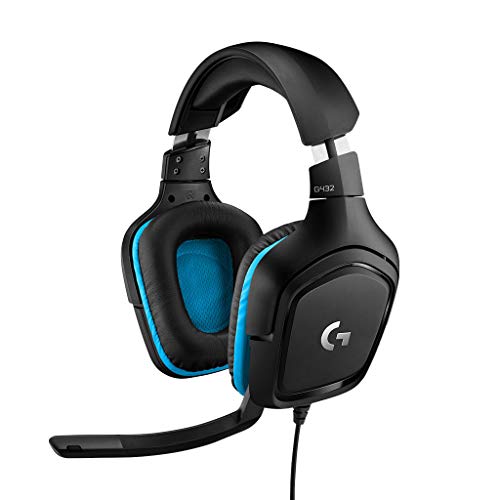
The G432 is the G733’s wired, conventional-band cousin in spirit: a Logitech design with 50mm audio drivers, DTS Headphone:X 2.0 surround presentation, a flip-to-mute microphone and both USB and 3.5mm connection, described as PC compatible in its listing. Its proportions are those of a full-size gaming headset rather than a compact one, which is precisely why it appears in this guide; larger frames tend to offer larger cups and more travel before the clicks run out, and the G432’s generation of Logitech design was built roomy. The fit evidence is that design and the model’s full-size architecture, since its listing publishes no dimensions for us to quote.
The dual connection is a practical blessing for a shared household. USB brings the surround processing and the cleanest route on a PC, while the 3.5mm plug walks the headset to a controller or a handheld without ceremony. Flip-to-mute remains the most civilised mute gesture in gaming, and on a headset that may serve a teenager’s PC and the family console in the same day, that simplicity prevents the classic broadcast accident. Sound leans toward the spacious presentation its surround branding promises, flattering big game worlds.
Against the G733 it gives up the suspension miracle and the wireless life, and its conventional band will concentrate pressure the ordinary way, so very large heads should trial it across a long session rather than a short one. Against the Cloud III it trades some build luxury for Logitech’s sound processing and price position. It is the guide’s sensible middle: full-size, flexible, honest about being a band-and-arms design, and roomy enough to deserve its audition.
- Drivers: 50mm, with DTS Headphone:X 2.0 presentation
- Connections: USB for PC features, 3.5mm for everything else
- Microphone: flip-to-mute boom, raised means silent
- Evidence note: full-size design is the fit evidence; no dimensions published
Strengths
- Full-size proportions give larger heads a fairer starting point.
- Two connection routes cover desk and controller without adapters.
- Surround presentation flatters open-world and cinematic games.
Trade-offs
- A conventional band cannot match the G733’s strap for weight spread.
- Wired life, with the cable’s small constant presence.
- Very large heads must verify comfort over hours, not minutes.
Best for: PC-centred players with larger heads who want one flexible wired headset for desk and console. Not suited for: those who have already learned that only a suspension strap keeps them comfortable.

Razer BlackShark V2 X — 240-gram light frame
Razer’s listing does this guide a rare kindness: it prints the weight. The BlackShark V2 X is described as a wired gaming headset with TriForce Titanium 50mm drivers, a HyperClear cardioid microphone, noise-isolating earcups and a weight of 240 grams, for PC, PlayStation and Switch among its platforms. For a larger head, 240 grams is not a statistic; it is the difference between a headset whose clamp you notice and one whose total presence stays polite through a long evening, because every gram multiplies whatever pressure the fit creates. Lightness is this pick’s fit argument, and unlike most, it can be read in the title.
The esports shape helps in a subtler way. The BlackShark line was designed for players who wear a headset as professional equipment for hours daily, so its cups and band aim for an even, unremarkable pressure rather than a plush first impression that fades. Noise-isolating earcups give passive quiet when the seal is complete, and the cardioid microphone keeps a player’s voice disciplined in a shared room. A large head at full extension will still test the frame’s manners, but it will test them carrying less mass than almost anything else here.
Its trade is luxury. The materials and padding are functional rather than indulgent, the design is wired-only through its 3.5mm connection, and players who equate comfort with deep memory foam may find the Razer’s approach austere at first contact. Give it the long trial this guide keeps prescribing, because its virtues are hour-three virtues. For the big-headed player whose past headsets all became headaches by weight as much as by squeeze, this is the most interesting audition in the line-up.
- Weight from the listing: 240 grams, the lightest figure stated here
- Drivers: TriForce Titanium 50mm
- Microphone: HyperClear cardioid, favouring voice over room
- Earcups: noise-isolating design in an esports frame
Strengths
- Stated low weight reduces the total pressure a large head endures.
- Esports tuning aims for even pressure across very long wear.
- Cardioid microphone keeps callouts clean in shared rooms.
Trade-offs
- Padding is functional rather than plush at first touch.
- Wired only, through the universal 3.5mm plug.
- Full-extension manners still need a personal long trial.
Best for: larger-headed players whose discomfort has always been as much about weight as about width. Not suited for: shoppers who want deep, soft cushions to make the first impression for them.
Ozeino Gaming Headset — Wide-fit value
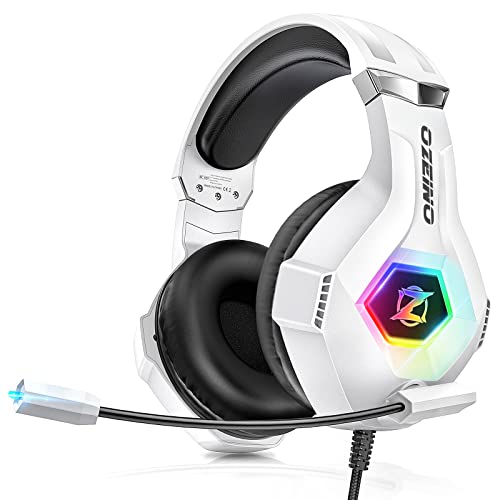
Ozeino’s entry speaks the language of the value gaming shelf fluently: an over-ear headset for PC, PlayStation and Xbox generations including Series X/S, plus Switch, laptop and mobile, with 7.1 surround sound presentation, a noise-cancelling microphone and LED light styling, in white. For this guide’s reader, the pertinent facts are the over-ear architecture and the generous, full-size proportions typical of this class, which give larger ears and wider heads a more plausible home than compact designs do. The fit evidence is the design and the class, honestly stated, since the listing publishes no weight or dimensions to verify.
Multi-platform generosity is the second virtue. A headset that plugs into everything in the house gets used for everything in the house, and the Ozeino’s platform list reads like a census of a real family’s hardware. The surround presentation widens games agreeably, the microphone’s noise cancelling refers, as this family of guides always clarifies, to your outgoing voice rather than to silence at your ears, and the LED styling will delight the buyer it delights and can be ignored by everyone else in the room, since the wearer never sees it.
Value designs ask for calibrated expectations in materials and refinement, and this one is no exception: plastics feel like their price, and the sound will not trouble the flagships. But fit is partly democratic. A roomy, inexpensive frame that a big head can actually wear comfortably will beat a luxurious frame that cannot be worn at all, every single session, and that arithmetic earns the Ozeino its place and its audition.
- Fit architecture: full-size over-ear design in white
- Platforms in the listing: PC, PlayStation, Xbox generations, Switch and more
- Audio presentation: 7.1 surround processing for games
- Evidence note: judged on design and class; no published measurements
Strengths
- Roomy over-ear proportions at a gentle price of entry.
- Connects to nearly every gaming device a household owns.
- A comfortable fit here beats an unwearable luxury elsewhere.
Trade-offs
- Materials and finish feel like the value tier they are.
- No stated weight or size data to check in advance.
- LED styling is a taste that will not be universal.
Best for: larger-headed players on a budget who need one headset for many machines. Not suited for: buyers seeking flagship materials or verified fit measurements before ordering.

BENGOO G9000 — Household workhorse
The G9000 has been the first gaming headset in countless households, and its listing describes a stereo design for PlayStation and Xbox controllers, PC and Nintendo platforms, with a noise-cancelling microphone, LED light, 7.1 surround sound language and soft memory earmuffs. Those soft memory earmuffs are its fit credential in this guide: generous, yielding cushions around the ears forgive a wide head’s pressure points better than thin pads do, and the model’s full-size family proportions have accommodated a generation of growing teenagers, which is its own kind of field data. As ever here, the fit evidence is the design and those cushions, the listing offering no dimensions to quote.
Breadth is the G9000’s second language. It has connected to controllers and computers across two console generations, survived being the spare, the sibling’s, the one that lives in the drawer for a guest, and its price has always made that rough democracy possible. The microphone serves party chat adequately, the surround language describes its processing rather than a speaker array, and the LED glow marks it unmistakably as a product of gaming’s exuberant school of design.
Nobody should mistake it for a flagship, and this guide will not: build, sound refinement and longevity all sit at the household tier, and a serious adult player with a large head will find the Cloud III or the G733 a better long-term answer. But as the headset a family buys to discover whether a young player even likes headsets, or as the roomy spare that rescues a evening when the main headset fails, the G9000’s cushions and ubiquity keep earning their keep.
- Cushions: soft memory earmuffs, forgiving at pressure points
- Compatibility: PlayStation, Xbox controllers, PC and Nintendo platforms
- Microphone: noise-cancelling boom for party and game chat
- Evidence note: fit rests on cushion design and full-size proportions
Strengths
- Soft, generous cushions are kind to wide heads and big ears.
- Works across the household’s whole museum of consoles.
- The natural spare, starter and sibling headset of this guide.
Trade-offs
- Build and sound refinement sit firmly at the household tier.
- No published fit measurements to confirm beforehand.
- Serious players will outgrow it and should budget accordingly.
Best for: families and first-time buyers wanting a roomy, forgiving headset that fits many heads and machines. Not suited for: committed players seeking a multi-year flagship with premium materials.
How Do the Six Fit the Same Large Head?
| Headset | How it carries weight | Stated weight | Connection |
|---|---|---|---|
| HyperX Cloud III | Padded band, durable sliding frame | Not stated in listing | USB-C, USB-A, 3.5mm |
| Logitech G733 | Suspension strap across the crown | Not stated in listing | Lightspeed wireless |
| Logitech G432 | Conventional band, full-size frame | Not stated in listing | USB and 3.5mm |
| Razer BlackShark V2 X | Light esports band and arms | 240 grams, per listing | 3.5mm wired |
| Ozeino Gaming Headset | Full-size over-ear value frame | Not stated in listing | Wired, multi-platform |
| BENGOO G9000 | Padded band, soft memory earmuffs | Not stated in listing | Wired, controller friendly |
The stated-weight column is deliberately full of gaps, because honesty about missing data is part of this guide’s service. Only Razer prints its figure in the title, and the others ask to be judged on mechanism and trial. The carrying column is therefore the one to study: strap against band, light against substantial, cushion-led against frame-led. Your head has a preference among those philosophies even if you have never had the vocabulary for it, and one long session per finalist will reveal it.
Which Fit Mistakes Do Larger-Headed Buyers Keep Making?
Judging fit in the first five minutes stands first, because almost every headset is charming for five minutes. The verdict lives at hour two and beyond, under your own glasses, in your own warm room, during the kind of session you actually play. Second comes buying by driver size or feature list and treating fit as a detail, an ordering of priorities this guide exists to reverse. Third, many larger-headed buyers never extend a headset fully during trial, then discover at home that the last click was the one they needed and it was already spent.
Fourth, ears get forgotten in favour of the crown, although a cup that folds an ear’s edge will end more sessions than any headband ever has. Fifth, buyers assume one failed headset condemns a whole mechanism, when the G733’s strap and a sliding band are different answers that deserve separate trials. Sixth, and most quietly, people keep a headset that hurts because returning feels like fuss, then slowly stop playing the long games they love. A poor fit is not a character test. Send it back and try the other philosophy.
How Should You Run an Honest Fit Trial at Home?
Extend the headset fully first and note how many clicks, if any, remain; a larger head should not need the absolute end of travel with nothing in reserve. Centre the cups so your whole ear sits inside without folding, then wear your glasses if you use them, because the trial must include the arms’ pressure to mean anything. Play for at least two hours across one sitting, ideally the longest session you normally take, and check in with yourself at thirty-minute marks: crown, temples, jaw, ear edges, neck. Discomfort that grows is data; discomfort that fades as you adjust is also data, of a kinder kind.
Move your head the way games make you move it, down at a second screen, up at a door, sideways at a conversation, and notice whether the headset wanders or holds. Take it off at the end and look for the honest evidence: deep marks, a tender spot, a headache’s first whisper. Then decide without sentimentality, because the return window is the larger-headed buyer’s best friend and the industry’s sizing habits are not your fault. The right headset from this guide will pass that evening so completely that the trial itself becomes forgettable.
Glasses, Hats and Hair: The Fit Variables Nobody Lists
Glasses are the silent partner in every fit story. Their arms pass exactly where earcups seal and where clamp applies its force, so a headset that is gentle bare-headed can become a slow vice over frames, especially thick ones. Larger heads already flex a frame wider, leaving less forgiveness for the extra millimetres a glasses arm adds. If you wear glasses for gaming, the trial must include them, and cushion materials that yield locally, memory foam above all, earn their premium in that single interaction. Some players keep a dedicated, slimmer pair of frames for long sessions, a trick worth more than many upgrades.
Hair changes fit more than the industry admits. Thick or long hair worn under a band adds circumference, shifts the cups’ landing zone and can break a seal that a bare head enjoys, while a shaved head feels every texture a band offers. Hats are simply incompatible with over-ear headsets in any serious session, whatever the photographs of streamers suggest. None of this is vanity; it is the physical interface between you and the product, and a buyer who accounts for their real head, hair, glasses and all, will choose better than one who shops for an idealised version of themselves.
Why Hour Three Is the Only Honest Reviewer
Comfort science has an inconvenient property: pressure discomfort accumulates on a curve that barely exists in the first twenty minutes. Blood flow, heat and the small muscles of the jaw all cast their votes slowly. That is why showroom impressions and short review sessions mislead larger-headed buyers more than anyone, because their margins are thinner from the first minute; a frame at its extension limit on a big head begins the evening already flexed, already clamping harder, already warmer. The only test that respects the physics is duration, in your chair, with your games, at your room’s temperature.
There is a corollary worth stating kindly: discomfort is information, not weakness. A player who removes a headset at hour two has not failed the product; the product has failed the player’s geometry. The industry’s habit of designing for a statistical middle means the edges of the distribution must be their own advocates, extending fully, trialling long, returning without apology. This guide was written in that spirit, and its recommendations are ordered to give an edge-of-the-chart head the best first audition, not the average head another pleasant afternoon.
The Shared-Headset Household, Revisited From the Big-Head Side
A headset shared between a larger-headed player and the rest of the family lives a harder life than a personal one. Its sliders travel their full range daily, its strap stretches and recovers, its cushions meet different glasses, different hair, different ideas of care. Durability stops being an abstract virtue in that house and becomes the product, which is why the Cloud III’s frame and the BENGOO’s replaceable-by-price philosophy both make sense as shared purchases in different budgets. Mark your setting, a notch count or a strap position, so each user can restore their fit in seconds rather than renegotiating it nightly.
There is also a case for secession. A larger-headed player in a sharing household often ends up with the headset at everyone else’s setting, quietly enduring a fit tuned for a smaller skull. A personal headset, kept at your extension and nobody else’s, is not selfishness; it is the recognition that fit is personal in a way that a shared television never has to be. If the budget allows one indulgence in a gaming setup, a big-headed player’s own, correctly fitted headset is among the wisest places to spend it.
What to Do When Even the Big-Head Picks Feel Small
Sometimes the honest answer is that a category has not caught up with a particular head, and the correct response is strategy rather than surrender. Start with the suspension mechanism if you have not tried it, since it changes the physics rather than the dimensions. Consider wearing the headset slightly further back or forward than habit dictates, because crown anatomy varies and a centimetre of position can move a pressure point entirely. Rotate cushions, keep them clean and supple, and replace them when they collapse, since a tired cushion steals depth that a large ear was counting on.
If a headset remains unwearable, return it and say why, in the review, in the feedback, in the plainest language. Makers learn the edges of their market from the people who live there, and every specific account of a band that ran out of travel teaches the next design team something a sales figure cannot. The larger-headed community’s collective fit knowledge, shared in forums and families, is already the best sizing database in existence. Add your data point to it and the next buyer’s trial gets shorter.
A Fitting-Room Checklist to Run Before You Commit
Extend fully and count what remains. Seat the cups and check both ears in a mirror for folding. Add glasses and play something familiar for two hours without adjusting anything except volume, because constant adjustment hides the verdict. Note the first place that complains and the hour it complained at. Remove the headset and inspect for marks that linger. Sleep on the decision if the return window allows, because a head that remembers tenderness the next morning has voted more honestly than any evening enthusiasm.
Score the finalists on that checklist and the winner is rarely the one with the longest feature list. It is the one your head forgot, in the session where the game was good enough to test it properly. That forgetting is the product this entire category is really selling to a larger-headed buyer, and every pick above, at its best, is capable of delivering it.
Sound Still Matters, Once the Fit Is Settled
It would be a poor guide that fitted your head and bored your ears, so let the record show that these six were not chosen by tape measure alone. The G432’s surround presentation and the Ozeino’s widen the stage of big games in ways that reward a comfortable listener who can finally stay for the whole session. The Cloud III and the BlackShark bring the driver pedigrees of serious gaming lines, 50mm class hardware tuned by people who outfit competitors, and the G733’s PRO-G audio keeps music and dialogue honest when the headset moonlights away from games. Fit gets the first vote in this guide because without it nothing else is audible for long, but it does not get the only vote.
Microphones follow the same order of operations. A boom you can position without disturbing a carefully won fit is worth more than a theoretically superior capsule on a headset you keep reseating. Flip-to-mute designs shine here again, because the gesture does not ask you to press anything against the frame that is balancing on your crown. When you trial, include one party session in the test, and judge the whole system, ears, voice and forgettability together, the way you will actually live with it.
The Economics of Finally Fitting
Larger-headed buyers often spend more across five years than average-headed ones, not on luxury but on churn: the headset that almost fitted, the second that fitted in the shop, the third bought in hope. A disciplined trial culture breaks that cycle, and a single correct purchase, even at the Cloud III’s or G733’s level, is cheaper than the archaeology of almosts. Keep the packaging until the long trial is done, buy from sellers whose returns are painless, and treat each returned misfit as tuition rather than failure, because it taught you which mechanism your head rejects.
There is a resale and hand-me-down grace note too. A headset that did not fit you may fit a smaller-headed family member perfectly, and several picks here, the BENGOO above all, were born for that second life. The household that circulates its near-misses instead of binning them ends up with a drawer of correctly fitted spares for every head it contains, which is a genuinely happy ending for a category that began in frustration.
Final Recommendation
Start your fitting with the mechanism that matches your history. If padded bands have always concentrated their weight into one sore point, try the Logitech G733 and its suspension strap first. If you want a substantial, durable wired frame with forgiving foam, the HyperX Cloud III is the flagship fitting, while the Razer BlackShark V2 X suits the head whose enemy has been weight itself, all 240 stated grams of it. The G432 covers the PC-centred middle, and the Ozeino and BENGOO bring roomy comfort to gentler budgets and busier households. Whichever name you choose, let a long, honest trial have the final word, because a headset that fits your head will be loved at hour three, and hour three is where gaming actually lives.
Frequently Asked Questions
How can I tell if a headset will fit before ordering?
Only partly — a shortlist can narrow the field, not settle it. Look for the mechanism, suspension strap against sliding arms, any stated weight such as the Razer’s 240 grams, cushion material and full-size proportions, then accept that the decisive evidence is a long home trial within the return window. Listings that publish no measurements, which is most of them, should be bought from sellers whose returns you trust.
Is a suspension headband really different from a padded one?
Yes, mechanically. A padded band rests the headset’s weight on the band’s cushion at the crown, with clamp doing much of the holding. A suspension strap, like the G733’s, hangs the weight from a stretchy strap that spreads contact across the head and extends by stretching, so larger heads are accommodated by the strap’s give rather than by running out of clicks. Heads that hate pressure points often prefer it immediately.
Do bigger headsets always fit bigger heads?
No. External bulk can hide a small earcup opening or a short band, which is why this guide separates the four fit factors instead of trusting overall size. A lighter, well-shaped frame like the BlackShark can out-fit a heavier, larger-looking rival. Judge by extension behaviour, cup opening and a real trial, not by how imposing the product photograph looks.
Why do my ears hurt when my head feels fine?
Because ear fit and head fit are separate problems. A cup can be too shallow, letting your ear press the inner surface, or too narrow, folding the ear’s edge, while the band above feels perfect. Memory foam and roomy openings, as on the Cloud III and the BENGOO’s earmuffs, address exactly that layer. If the crown is happy and the ears are not, change cup style before changing brands entirely.
Should I size up to a headset with more features to get a better fit?
Not automatically. Features and fit travel separately, and the roomy value picks in this guide prove that a gentle price can still buy a generous frame. Spend first on the mechanism and cushions that suit your head, then on the sound and microphone refinements you will actually use. A comfortable mid-range headset worn nightly beats a flagship worn reluctantly, in fit as in everything else.
Can I stretch a tight headset to make it fit?
Gently, sometimes, by leaving it expanded over a stack of books overnight, a folk remedy that can ease a band’s initial clamp by a small margin. It will not add extension travel that the sliders do not have, it will not deepen a shallow cup, and it should never be forced to the point of creaking. Treat it as a finishing touch on a near fit, not as a rescue for a wrong one, and keep it inside the return window in case the verdict stays no.
Why do manufacturers not publish head size ranges?
Partly habit and partly fear: heads are three-dimensional, hair and glasses rewrite the numbers, and a published range invites returns when a buyer’s experience disagrees. The result is the evidence gap this guide has flagged in review after review. Until the industry improves, the buyer’s defences are mechanism knowledge, stated weights where they exist, community reports from similarly sized heads and the disciplined long trial.
Is wireless or wired better for a large head?
Neither inherently, but wireless removes the cable’s small sideways drag, which a borderline fit notices more than a comfortable one, and the G733 pairs that advantage with the suspension strap. Wired designs answer with zero battery anxiety and, in the Razer’s case, the lowest stated weight here. Choose by mechanism first and by cable second, and your head will thank you in the correct order.
What if my child is the one with the growing, larger head?
Buy for adjustability and price before prestige, because the head in question is a moving target and the headset will be outgrown, dropped and borrowed in the meantime. The roomy value picks here, Ozeino and BENGOO, forgive that life while still giving a bigger young head a fair fit today. Revisit the fitting every school year or so, the way you revisit shoe size, and promote them to a flagship like the Cloud III when their gaming and their growth both settle down.
How do I know whether it is the band or the cups failing me?
Localise the complaint. Ache across the crown or at the band’s ends points to the carrying mechanism and its extension; ache at the temples points to clamp; ache at the ears themselves, edges or the surface facing the driver, points to cup opening and depth. Each diagnosis has a different cure in this guide, strap, lighter frame, or roomier cushions respectively, and naming the culprit precisely is what turns a frustrating return into an educational one.
Should I mention fit when I review a headset for other buyers?
Please do, and be specific: your head’s rough size if you know it, whether you wore glasses, how far the band was extended and at what hour any discomfort began. Vague praise helps nobody at the edges of the size chart, while one precise paragraph from a fellow large-headed owner is worth a page of specifications. This corner of the market runs on such generosity, and every honest data point shortens the next person’s search, possibly by one whole returned headset.
What is the one-sentence version of this guide?
Choose the mechanism your head prefers, strap or band, respect the few honest numbers the listings give, above all the Razer’s stated 240 grams, and let a two-hour trial in your own home cast the deciding vote that no photograph, feature list or reviewer, including this one, can cast on your behalf. Everything else here is the working-out of that sentence, pick by pick and factor by factor.
And when the trial finally succeeds, what does it feel like?
Uneventful, which is the miracle. The headset goes on, the game loads, and somewhere around the second hour you realise you have not thought about your head, your ears or the equipment since the first minute, possibly for the first time in your gaming life. That absence is what you were shopping for through every returned box and every hopeful order. When you find it, in whichever of these six designs provides it, keep the cushions fresh, note the model somewhere safe, and enjoy the long sessions that were always supposed to be yours.
One last practical tip before ordering?
Order one finalist at a time rather than a pile, because a pile invites a rushed comparison on a single evening, and this category punishes rushed evenings more than any other in this cluster of guides. Give the first candidate its full two-hour trial on a normal gaming night. Only if it fails, and you can name the failing factor in the language of this guide, band, clamp, cup or weight, should the second candidate be ordered, because then you will be shopping with a diagnosis instead of a hope, and diagnoses converge where hopes wander.
Does head size affect which microphone position works best?
Indirectly, yes. A headset worn at full extension angles its boom slightly differently than the designers’ mid-range assumption, so a larger-headed wearer should check the boom’s aim in a mirror or a test recording rather than trusting its factory bend. A few millimetres of adjustment, made once, restores the geometry the microphone was tuned for, and party chat clarity improves out of proportion to the effort, which is the fitting story of this whole guide told in miniature.
What should I keep from the box for the headset that finally fits?
Keep the receipt and the packaging until well past the trial, then keep one thing more: a note, in your phone or on paper in the drawer, recording the model, the extension setting you settled on and the date the cushions were new. When the cushions tire in a year or two, that note turns a vague memory of comfort into a restorable specification, and if the model is ever replaced, it gives its successor a standard to be judged against from the very first evening.
Is there a best time of day to judge a fitting?
Evening, counterintuitively, because that is when you will actually play, when the room is warmest, when you are tiredest and when a marginal fit shows its true colours fastest. A headset approved at ten in the morning in a cool room has passed an easier exam than the one your life will set it. Schedule the decisive trial for your real gaming hour, with your real session length, and its verdict can be trusted in a way no morning impression ever should be.
Final encouragement for the hard-to-fit?
Your head is not the problem to be solved; it is the specification to be met, and the six designs in this guide, between their straps, foams, light frames and roomy value shapes, meet more specifications than this category has ever offered at once. Somewhere in that spread is an evening where the hardware disappears and only the game remains. Keep trialling until you find it, because everyone deserves that evening, at whatever size their head happens to be.
What about travelling with a headset that finally fits?
Protect it like the hard-won thing it is. A headset whose fit you searched months for should travel in a case or at the centre of soft luggage, never crushed at the bottom of a bag where a band can be bent out of the shape your head finally agreed with. On arrival, check the extension setting against the note you kept, because travel has a talent for resetting sliders and straps to somebody else’s geometry, and the first evening of a trip is the wrong time to renegotiate a fitting you had already won. Treat the case as part of the headset itself, bought once and used for years, because a frame this personal deserves better than the bottom of a rucksack and the company of a leaking water bottle.
Related Guides
The same head may also need best xbox one game headsets for console nights and best headsets for gaming nintendo switch for the portable side of life. For the desk that starts your day, best work from home headsets with mic applies the same comfort-first thinking to calls.



[…] curiosity travels further from the sofa. Players whose heads defeat ordinary frames should read best headsets for people with big heads before ordering anything at […]