What's inside
- Where to buy
- Key Takeaways
- Quick Picks
- How We Chose These Picks
- Best Battery Powered Projectors: The Six Picks in Detail
- Comparison Table
- What can battery projectors not do?
- How should you read battery and brightness claims?
- Internal battery or power bank: which architecture wins?
- What should travel with a portable projector?
- How do you run a perfect outdoor movie night on battery power?
- What Are the Most Common Mistakes?
- What else should you know before choosing?
- Final Recommendation
- Frequently Asked Questions
- Related Guides
As an Amazon Associate I earn from qualifying purchases. This post may contain affiliate links at no extra cost to you.
gizmoverdict.com is reader-supported. When you buy through links on our site, we may earn an affiliate commission.
Where to buy
The best battery powered projectors below come from the Amazon listing linked on each pick’s name, and with portable models the listing’s exact variant matters, because storage, colour and bundled accessories change between near-identical pages. Buy the named listing, read its battery and brightness claims as the seller’s own figures, and note the one honourable exception in this guide: the Aurzen pick has no internal battery at all and runs from a USB-C power bank, a fact stated wherever it appears.
Cutting the cord changes what a projector is for. A battery model turns a garden fence into a cinema, a tent wall into a story screen and a ceiling into a planetarium for a child who refuses to sleep. The trade is written into the physics: batteries store limited energy, so this class swaps the brightness of mains models for freedom, and every pick here must be judged by how gracefully it makes that swap rather than by standards borrowed from living-room machines.
Two honesty rules govern everything below. First, battery-life and brightness figures are the sellers’ own claims, gathered under ideal conditions that a windy garden at dusk will not reproduce. Second, the brightness numbers mix measurement standards, with some listings quoting ANSI lumens and others quoting figures on no stated standard at all, so a larger number from one brand may describe a dimmer real image than a smaller ANSI figure from another. This guide flags that problem once here and then compares classes and designs rather than pretending the numbers are laboratory truth.
The exception proves the category’s shape. The Aurzen Roku TV D1R Air has no internal battery; it is a USB-C powered projector designed to run from a power bank, and this guide includes it, clearly labelled as the power-bank route, because for some buyers a swappable external battery beats a sealed internal one. It will never be described as battery-powered in these pages. Everything else here carries its battery inside, ready to be charged, carried and forgiven for the compromises portability demands.
Key Takeaways
- The XGIMI Vibe One is the polished all-rounder, with Google TV, licensed Netflix and JBL sound per its listing.
- The Wanbo ToGo Pro claims an ultra-long 3.5-hour battery in its listing, the endurance headline of the class.
- The Aurzen D1R Air has NO internal battery; it runs from a USB-C power bank, by design.
- Brightness claims mix ANSI and unstated standards, so compare designs, not bare numbers.
- No pick here can fight daylight; this class owns the dusk and the dark.
Quick Picks
| Pick | Badge | Why it earns its place |
|---|---|---|
| XGIMI Vibe One | Polished all-rounder | Built-in battery, Google TV with licensed Netflix, JBL sound and auto focus in one tidy object. |
| Wanbo ToGo Pro | Endurance headline | A claimed 3.5-hour battery, Google TV 14, native 1080p and a fully sealed optical engine for outdoor life. |
| AKASO Mini DLP Projector | Pocket-sized traveller | A pocket-sized DLP design with a rechargeable battery, HDMI and WiFi, and stereo speakers. |
| HOTPEAK Mini Projector with Battery | Rotating stand design | 300 ANSI lumens as listed, a rechargeable battery and a 270-degree rotating body for ceiling aiming. |
| CAMWORLD Mini Projector with Battery | Auto-keystone rotator | 300 ANSI lumens as listed, auto keystone and a 220-degree rotating body with a rechargeable battery. |
| Aurzen Roku TV D1R Air | Power-bank route, no internal battery | Native 1080p and Roku TV built in, powered over USB-C from a power bank you supply and can swap. |
How We Chose These Picks
We judged portability as a system: battery endurance as claimed, the charging route, weight and shape implied by each listing’s design, and the smart platform that decides whether a phone is needed at all. A projector with a licensed streaming platform inside it is a complete evening in one object; a model that mirrors a phone is a different, also valid, tool. The listings’ own claims were recorded as claims, with battery hours read as best-case figures that real brightness settings will shorten.
Brightness was handled with deliberate suspicion. Where a listing states ANSI lumens, that figure carries a defined standard behind it; where it does not, the number is atmosphere rather than evidence. We therefore weighted design facts that cannot be inflated: native resolution as listed, sealed optical engines that resist dust, rotating stands that aim the picture without props, and speaker arrangements that decide whether a Bluetooth speaker must travel too.
We excluded mains-only mini projectors wearing portable styling, and power banks themselves, which are accessories. The six survivors each offer a credible cord-free evening: five with internal batteries of varying ambition, and the Aurzen as the openly labelled power-bank alternative for buyers who prefer their energy source swappable, shareable with a phone and replaceable when it ages.
Best Battery Powered Projectors: The Six Picks in Detail

XGIMI Vibe One — Polished all-rounder
The Vibe One is what happens when a serious projector maker takes the battery class seriously. Its listing promises a built-in battery behind a native 1080p image, Google TV with licensed Netflix, JBL sound and auto focus, and that combination answers the four questions every portable session asks: what are we watching, how does it sound, how long will it run and who is going to focus it in the dark. One object answering all four is the entire appeal of this category, delivered without asterisks.
Licensed Netflix deserves emphasis because unlicensed portable projectors often stream through clumsy workarounds that sour an evening. Here the platform is official, the remote is the interface, and a garden film night starts at the press of a button. The battery’s endurance remains a seller’s-conditions figure, as with every pick, and brightness belongs to dusk and darkness rather than afternoon. Within those honest borders, this is the most complete portable projector in the guide.
- Native resolution: 1080p per the listing
- Battery: built-in, per the listing
- Streaming platform: Google TV, Netflix licensed
- Sound: JBL sound per the listing
- Focus: auto focus fitted
- Finish of linked listing: Cloud Ash
Strengths
- Licensed Netflix removes the casting workaround dance
- JBL sound carries a film without a second speaker
- Auto focus suits impromptu setups on uneven ground
Trade-offs
- Battery evenings are still finite evenings
- Brightness belongs to the portable class, not the living room
- One colour listing is linked; variants are separate listings
Best for: buyers wanting one complete, civilised portable cinema. Not suited for: daylight viewing or very large outdoor screens.
Charge it fully before the day you need it, because a battery projector at half charge is a promise half kept. Download the evening’s film over home Wi-Fi in advance if the app allows, set the unit on a stable surface at screen height, and let auto focus do its work after the projector settles, not while a helpful guest is still carrying it across the lawn.

Wanbo ToGo Pro — Endurance headline
Endurance is the ToGo Pro’s headline and its listing states it without blushing: an ultra-long battery claimed at 3.5 hours, which in the real world of portable projection is the difference between a film and a film plus its encore. A long feature with room to spare changes how a group uses a projector, from a novelty that dies at the climax to a cinema that finishes what it starts. Read the figure as a best case, run sensible brightness, and the margin remains meaningful.
The fully sealed optical engine is the quieter virtue, aimed at the dust that outdoor and travel use guarantee. Sealed optics keep the image free of the specks that plague open designs after a season of gardens and campsites. Google TV 14 and 32GB of storage complete a specification that treats downloading films for off-grid evenings as a normal activity rather than a hack, which, for a projector named ToGo, is exactly the right set of priorities.
- Battery claim: ultra-long 3.5 hours per the listing
- Native resolution: 1080p per the listing
- Platform: Google TV 14
- Storage: 32GB per the listing
- Optics: fully sealed optical engine per the listing
Strengths
- Longest battery claim in this guide
- Sealed engine shrugs off outdoor dust
- Current Google TV version with onboard storage
Trade-offs
- Battery claim is a best-case seller figure
- Outdoor brightness still belongs to the evening
- Storage size matters only if you download heavily
Best for: long film nights and double features away from sockets. Not suited for: buyers wanting the smallest possible pocket unit.
Build the off-grid habit: download before departure, charge to full, and pack the charging cable anyway, because plans change and a borrowed socket at a campsite office is a battery top-up waiting to happen. Outdoors, place it on the most stable surface available and re-check focus after the ground settles; sealed optics resist dust, not gravity.

AKASO Mini DLP Projector — Pocket-sized traveller
The AKASO mini is the projector as hand luggage: a pocket-sized DLP unit, nicknamed the cookie projector in its own listing for its compact round form, with a rechargeable battery, stereo speakers and both HDMI and WiFi routes into it. Its natural habitat is the hotel room ceiling, the small meeting across town and the child’s bedroom wall, places where a modest image delivered anywhere beats a magnificent image delivered nowhere.
Honesty about scale is this pick’s price of admission. A body this small carries a small battery and a modest light output, so its evenings are intimate ones, and its listing’s 1080p support describes the signals it accepts rather than a promise of full HD native detail. Judged as a traveller rather than a cinema, it is charming and capable; judged as a garden party centrepiece, it would be set up to fail by the person doing the judging.
- Form: pocket-sized DLP projector
- Battery: built-in rechargeable battery
- Signal: supports 1080p input per the listing
- Connections: HDMI and WiFi
- Audio: stereo speakers built in
Strengths
- Genuinely pocketable travel companion
- HDMI covers laptops and sticks without fuss
- Stereo speakers built into a tiny body
Trade-offs
- Small body means modest brightness by physics
- 1080p is supported input; manage native expectations
- Battery life suits a film, not a festival
Best for: travellers and presenters who pack light. Not suited for: garden cinemas for a crowd.
Travel with its cable and a short HDMI lead in the same pouch, because a pocket projector separated from its charger is a paperweight with potential. In hotel rooms, the ceiling is usually the best screen and the bed the best seat; set the unit on the nightstand, mirror or connect the phone, and let the small perfect evening assemble itself.

HOTPEAK Mini Projector with Battery — Rotating stand design
The HOTPEAK’s party trick is mechanical: a body that rotates through 270 degrees, so the same unit that faces a wall can tilt up and paint the ceiling without a stack of books or a tripod. Its listing states 300 ANSI lumens, and the ANSI part matters, because it anchors the figure to a recognised standard in a class where unstandardised numbers float freely. With a rechargeable battery inside, the ceiling cinema needs no cable across the bed, which is precisely the scenario this design was drawn for.
Its listing also says 4K supported, and this guide translates that phrase wherever it appears in this class: the projector can accept and decode a 4K signal, while the picture it shows is built from its native resolution, with 1080p support also listed. That is not a criticism unique to this model; it is the class’s dialect, and buyers who learn to read it stop being disappointed by arithmetic they were never actually promised.
- Brightness: 300 ANSI lumens per the listing
- Battery: rechargeable, built in
- Connections: WiFi 6 and Bluetooth 5.4 per listing
- Signal: 4K supported, 1080p supported, per listing
- Body: rotates 270 degrees per the listing
Strengths
- Rotating body aims at walls or ceilings without props
- ANSI-stated brightness figure aids honest comparison
- Modern WiFi 6 and Bluetooth versions on board
Trade-offs
- 4K supported means input decoding, not native 4K
- 300 ANSI is a dusk-and-darkness figure
- Unbranded listing; support expectations should stay modest
Best for: bedroom ceilings and casual movie nights. Not suited for: buyers expecting native 4K or daylight performance.
Ceiling projection asks for a stable base more than any accessory: place the unit on a solid nightstand or shelf, rotate to the ceiling, and set keystone before the audience assembles. Pair a Bluetooth speaker placed near the viewers rather than beside the projector, because sound should live where the ears are, and this model’s Bluetooth provision makes that easy.

CAMWORLD Mini Projector with Battery — Auto-keystone rotator
The CAMWORLD mini occupies the same cheerful territory as the HOTPEAK, a rechargeable 300 ANSI projector on a rotating body, and differentiates itself with auto keystone: set it down at an imperfect angle and it squares its own picture. Its rotation runs to 220 degrees in its listing’s figures, enough for wall and ceiling work, and the combination suits rooms where the projector appears for film night and returns to a drawer afterwards, set up by whoever arrives first.
As with its rival, the listing’s 4K supported wording means the unit decodes a 4K input rather than projecting native 4K, and the honest working expectation is a bright, friendly image for casual viewing. Between this and the HOTPEAK, the choice is a matter of small preferences: auto keystone’s convenience against a wider rotation range, Bluetooth versions a step apart. Either delivers the essential miracle, a film appearing on a surface that was blank a minute earlier, with no cable to the wall.
- Brightness: 300 ANSI lumens per the listing
- Battery: rechargeable, built in
- Correction: auto keystone per the listing
- Connections: WiFi 6 and Bluetooth 5.2 per listing
- Body: rotates 220 degrees per the listing
Strengths
- Auto keystone squares casual setups quickly
- Rotating body covers wall and ceiling duty
- ANSI-stated figure keeps expectations honest
Trade-offs
- 4K supported is input decoding, not native 4K
- Rotation range is narrower than its HOTPEAK rival
- Unbranded listing with modest support expectations
Best for: casual rooms where setup speed beats ceremony. Not suited for: precision installations or bright spaces.
Let the auto keystone work, but give it a fighting chance: place the unit roughly square and level, and let correction handle the remainder rather than aiming from an extreme angle. Correction spends image edges, so the closer the placement is to honest, the more picture survives. Charge it after each use rather than before the next, and the battery will always be a pleasure instead of an errand.
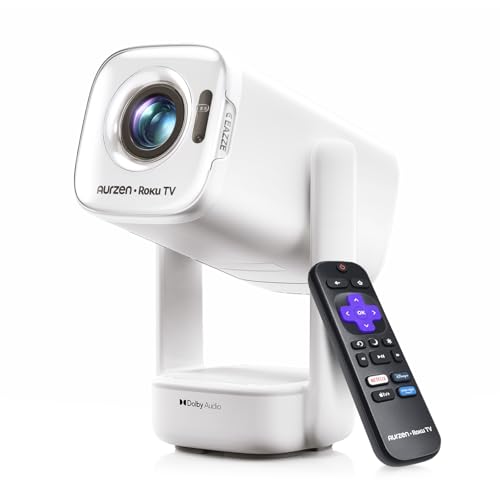
Aurzen Roku TV D1R Air — Power-bank route, no internal battery
This pick must introduce itself with its defining fact: the Aurzen D1R Air has no internal battery. It is a USB-C powered projector, designed to run from a power bank, and it appears in a battery guide because that architecture is a legitimate answer to the same problem. A power bank can be swapped mid-evening, shared with a phone, replaced when it ages and chosen in whatever capacity the trip demands, none of which a sealed internal battery permits.
The projector half of the bargain is strong: native 1080p per its listing and Roku TV built in, a platform many households already know from their televisions, with WiFi and Bluetooth alongside. The system to evaluate is projector plus bank together, their combined weight, combined cost and combined runtime. Buyers who already own a healthy power bank for travel may find this the smartest route in the guide; buyers who own none must count the bank as part of this pick’s true price of entry.
- Battery: NONE inside; USB-C powered, power bank supported
- Native resolution: 1080p per the listing
- Platform: Roku TV built in
- Connections: WiFi and Bluetooth
- Colour of linked listing: white
Strengths
- Swappable power banks mean unlimited spare evenings
- Roku TV is a friendly, familiar platform
- A failed battery never bricks the projector itself
Trade-offs
- No internal battery, so a power bank is required kit
- Total runtime depends entirely on the bank you bring
- Cable to the bank remains, even if the wall socket does not
Best for: campers and travellers who already carry power banks. Not suited for: anyone wanting a battery inside the projector itself.
Pair it with the largest power bank you are willing to carry, and test the full runtime at home before a trip depends on it, because bank capacities are quoted in their own optimistic dialect too. Keep the USB-C cable short and rated for the power involved, coil a spare bank beside the projector for long evenings, and the swappable system will outlast every sealed rival in this guide.
Comparison Table
| Pick | Badge | Best for |
|---|---|---|
| XGIMI Vibe One | Polished all-rounder | buyers wanting one complete, civilised portable cinema |
| Wanbo ToGo Pro | Endurance headline | long film nights and double features away from sockets |
| AKASO Mini DLP Projector | Pocket-sized traveller | travellers and presenters who pack light |
| HOTPEAK Mini Projector with Battery | Rotating stand design | bedroom ceilings and casual movie nights |
| CAMWORLD Mini Projector with Battery | Auto-keystone rotator | casual rooms where setup speed beats ceremony |
| Aurzen Roku TV D1R Air | Power-bank route, no internal battery | campers and travellers who already carry power banks |
What can battery projectors not do?
Daylight. That sentence deserves its own short section, because it is the expectation that disappoints more buyers than any other. A battery stores a finite amount of energy, and converting it to light bright enough to fight the sun would drain it in minutes. These projectors own the evening: dusk gardens, dark tents, bedroom ceilings and blackout dens. A buyer who plans around that truth will be delighted; a buyer who fights it will be shopping again by July.
Scale is the second limit. Portable brightness spread across a vast outdoor screen thins into politeness, so the class rewards modest image sizes viewed from modest distances. A six-foot image on a fence, watched from eight feet away, looks like cinema. The same projector stretched across a barn wall looks like a memory of cinema. Keep the picture sized to the machine and the magic survives intact.
How should you read battery and brightness claims?
Battery hours are measured by sellers at the settings most flattering to endurance, usually gentle brightness with local content, so treat the claimed figure as the ceiling of a range your real evening will sample lower down. Streaming over WiFi, higher brightness and Bluetooth audio all spend the same stored energy. The practical habit is to plan the film, not the marathon, and to keep the charging cable in the bag for the socket nobody expected to find.
Brightness claims divide by standard. ANSI lumens follow a defined measurement, and the listings that state them, such as the 300 ANSI figures here, give you a comparable anchor. Listings quoting bare lumens or light-source lumens are describing something larger and less useful. When two projectors both state ANSI figures, compare them directly; when only one does, trust the stated one and treat the other as an unknown quantity wearing a number as a costume.
Internal battery or power bank: which architecture wins?
The internal route, five of this guide’s six picks, wins on simplicity: one object, one charger, nothing to forget. Its weakness arrives years later, when the sealed battery ages and the projector’s portable life shortens with no remedy. The Aurzen’s power-bank route inverts both facts: slightly more to carry and connect, but the energy source is replaceable, upgradeable and shared with the rest of your travel kit.
The honest answer depends on the diary. Occasional garden films favour the sealed simplicity of the XGIMI or Wanbo. Regular camping, festival and travel use favours the Aurzen’s swappable system, where a second bank is a longer evening rather than a longer wait. Neither architecture is the future of the other; they are two good answers to two different patterns of life.
What should travel with a portable projector?
A short kit list multiplies the class’s pleasure: the charging cable, obviously, plus a compact tripod or stable mini stand, a cloth for dew, and a downloaded film for the places where signal goes to die. A small Bluetooth speaker earns its place for groups larger than a couple, placed near the audience. For the Aurzen, the power bank and its cable are not accessories but half the product, and they travel in the same bag or the evening does not happen.
Screens travel worst of all, so improvise like a local: a pale fence, a sheet pulled genuinely taut, a garage door, a tent’s inner wall. The class’s forgiving nature is its charm, and a slightly imperfect surface under a dark sky beats a perfect screen in a bright room every time. Pack light, aim at dusk, and let the setting do the production design.
How do you run a perfect outdoor movie night on battery power?
Scout the site before dark: where the projector sits, what it aims at, where the audience gathers and where the dew will fall. Set the screen surface first, a fence, sheet or wall, and place the projector at the distance its lens needs for that width, on the most stable object in the garden. A wobbling table writes its autobiography across the picture all evening, so stability outranks height.
Charge everything that afternoon, download the film while the house WiFi is strong, and pair the Bluetooth speaker before the audience arrives, because pairing menus by torchlight are nobody’s favourite opening act. Start the film at true dusk rather than sunset’s afterglow; twenty patient minutes buy a dramatically better picture from the same battery.
Run the brightness the night actually needs. Full power into a dark garden wastes endurance on light nobody required, and the eco or standard modes of this class exist precisely for this calculation. Keep the charging cable coiled beside the projector anyway; a found socket or a power bank turns the second half of a double feature from a gamble into a plan.
End the night like a projectionist: let the unit cool, wipe dew before it goes into its bag, and charge it the next morning rather than the next month. Batteries remember neglect, and the owner who tops up promptly is the owner whose projector still delivers a full film, years later, on the first warm evening of spring.
What Are the Most Common Mistakes?
- Planning a garden screening for a bright afternoon and blaming the projector for physics.
- Comparing a bare-lumen claim against an ANSI figure as if they shared a standard.
- Calling the Aurzen battery-powered when its design is USB-C power-bank power, stated on its listing.
- Reading 4K supported as native 4K on the mini models that decode the signal.
- Streaming over weak garden WiFi instead of downloading the film at the kitchen table.
- Storing the projector discharged for a season, then mourning its shortened battery.
Storage and downloads deserve planning on the smart models. The Wanbo’s listed 32GB fills faster than a film lover expects once applications and a small offline library move in, so curate the downloads like a traveller packs: the certain film, the backup film and the children’s emergency programme. Streaming-first owners can ignore storage entirely, provided their evenings happen within reach of trustworthy WiFi.
Tripods and mounts for this class should match its spirit: light, quick and forgiving. A small tripod with a standard thread, where the model offers one, turns any surface into a projection booth and any ceiling into a screen. Check the chosen model’s underside and listing for its mounting provision before assuming, because pocket designs differ, and a projector balanced on a paperback is a projector negotiating with gravity.
Cold weather shortens battery evenings measurably, a fact winter campers learn once. Keep the projector and any power bank warm until showtime, inside a coat or a sleeping bag’s foot, and the same charge lasts noticeably longer. The Aurzen’s architecture helps here too, since a warm spare bank can wait in a pocket while the first does its duty in the cold.
A portable screen is worth buying only when the same venue repeats: the garden every Friday, the caravan awning, the village hall. A modest pull-up or tripod screen transforms the picture’s perceived brightness by giving it a proper surface and border. For roaming use, the world’s pale walls outperform any screen left at home, and the class’s charm is precisely that it travels without furniture.
Group size should steer the pick more than specifications do. Two people on a bed need the AKASO’s intimacy; eight neighbours in a garden need the XGIMI’s sound and the Wanbo’s endurance, plus a Bluetooth speaker for the back row of deckchairs. Count the audience honestly, including the neighbours who will inevitably drift over, and buy for the crowd you actually host.
Charging standards are converging on USB-C across this class’s smaller models, which quietly simplifies travel: one capable charger can serve phone, projector and bank in rotation. Check the chosen listing’s charging input and wattage appetite before a trip, pack one strong charger instead of three weak ones, and the whole cinema’s energy system fits in a washbag.
When a sealed battery finally ages, the projector is not necessarily finished. Many owners retire such a unit to mains-powered duty in a den or a child’s room, where its portability is no longer needed and its picture still pleases. Planning that second life at purchase time softens the architecture debate: the sealed models retire to a socket, while the Aurzen simply gets a new bank and carries on travelling.
The class will keep improving its batteries, but its physics will not repeal themselves. The wise buyer therefore purchases for this summer’s evenings rather than a future specification, chooses the design that fits the household’s real habits, and spends the difference on a better screen surface and a speaker. Projectors come and go; well-run movie nights become family institutions.
Children understand this category faster than adults. A ceiling turned into a drifting story screen, a tent wall showing a film during a storm, a garden fence premiering a birthday slideshow: these are the uses that justify the class’s compromises without argument. The rotating mini models earn their keep in exactly these rooms, where aiming flexibility matters more than any figure in a specification table.
Sound outdoors behaves differently from sound indoors, with no walls to help and a breeze to compete. The XGIMI’s JBL provision and the class’s general Bluetooth support exist because a projector’s small speakers thin out quickly in open air. Place whatever speaker you use near the audience, low and central, and even a modest unit will sound like part of the film rather than a radio in another garden.
Dew is the outdoor projector’s quiet enemy, arriving on lenses and electronics as the night cools. A simple cover during pauses, a cloth for the lens and a rule against leaving the unit out overnight keep the machine honest for years. The Wanbo’s sealed optics address dust rather than moisture, and no pick here claims weatherproofing, so treat them all as fair-weather friends.
For presenters, the battery class offers a peculiar freedom: a pitch or a lesson delivered anywhere, from a café wall to a site cabin, without negotiating for sockets. The AKASO’s pocketable size serves that life best. Keep the deck downloaded, the battery charged and expectations about room light realistic, and the smallest projector in the bag becomes the one that saves the meeting nobody planned.
Finally, notice how this class changes buying psychology. A mains projector is furniture, bought rarely and judged harshly. A battery projector is closer to a picnic: judged by the evenings it creates. Choose the one whose compromises match your favourite kind of evening, and you will forgive its limits every time the opening credits roll across a surface that was never meant to be a screen.
What else should you know before choosing?
The psychology of the battery gauge deserves respect, because it shapes the evening as surely as the picture does. A projector whose remaining charge is visible invites the group to relax into the film; one that hides its state breeds a low anxiety that surfaces at every quiet scene. Learn your own model’s gauge behaviour at home, where the stakes are a paused film rather than a ruined party, and you will plan outdoor evenings with the calm of a projectionist who has run the reel before.
Weight and shape decide whether a portable projector is actually portable in a given household. The pocketable AKASO disappears into a jacket; the larger smart models travel in a bag with intent. Both are portable, but they answer different invitations: the spontaneous one and the planned one. A household honest about which invitations it accepts will choose correctly, while a household buying for imaginary spontaneity ends up with a capable machine that never leaves the shelf.
The screen question outdoors has a folk wisdom worth recording: the best surface is the one already there. A pale garage door, a smooth fence, the side of a caravan, a bedsheet tensioned between two poles with the wind considered. Each has hosted more premieres than any commercial screen. The projector’s job is to be ready when the surface presents itself, charged and downloaded, and that readiness is a habit of the owner rather than a feature of the machine.
Children’s sleepovers have quietly become this class’s proving ground, and they reward the rotating minis disproportionately. A ceiling of drifting cartoons above a floor of sleeping bags is a memory manufactured on demand, and the setup takes minutes with no cable across the room for small feet to find. Parents should still own the brightness expectations: a darkened room, a modest image, and content chosen for the ceiling’s wide, gentle canvas rather than for fine detail.
For the travelling professional, the class offers a different dignity: the presentation that happens anywhere. A charged mini projector turns a café wall, a site cabin or a client’s own spare room into a venue, freeing the presenter from the tyranny of the borrowed screen that may not exist. The AKASO’s pocket scale serves that life, provided the deck is downloaded, the room can be dimmed and the expectations are those of a working tool rather than a cinema.
Battery care across a winter of disuse decides whether the second summer resembles the first. The owners who keep their projectors half-charged in a cool drawer, and run them for an evening every month or two, meet spring with a battery still capable of a full film. The owners who store a flat battery in a hot loft meet a machine that has quietly retired. The Aurzen’s replaceable-bank design forgives even this, which is its deepest argument.
Do not underestimate the social value of the second power source. A household with a power bank habit, banks charged for phones and travel, owns the Aurzen’s fuel already, and a spare bank beside the projector converts the evening’s only anxiety into a non-event. Sealed-battery owners can imitate the peace of mind with the charging cable and a known socket. Either way, the projectionist who has planned the energy is the one the audience never has to think about.
Picture expectations should be set by the first successful evening, not by the showroom. Owners who begin with a modest image in true darkness learn what their machine does beautifully, and every later success feels like abundance. Owners who begin by stretching the picture across a barn in twilight learn disappointment that no later evening fully erases. The class rewards the modest beginning so reliably that this guide suspects the first evening, more than the model, decides the owner’s lasting opinion.
A small tripod changes a mini projector’s life more than any other accessory, giving it a stable, aimable home on any surface and freeing the picture from the tyranny of stacked books. Where the chosen model offers a tripod thread, the accessory costs little and travels in the same bag. Where it does not, a beanbag or a clamp mount improvises honourably. Stability, as this guide keeps insisting across categories, is image quality by another name.
Sound for a crowd deserves one more pass. Beyond about six viewers, every pick here benefits from a separate speaker, and the Bluetooth provisions across the class make that addition painless. Place the speaker centrally, near the screen or the audience’s middle, and keep its volume in the hands of one appointed person. Outdoor cinema fails socially when three people adjust three devices; it succeeds when one calm operator runs the whole small show.
The download habit separates veterans from beginners more clearly than any purchase. Veterans treat the evening’s content as cargo: chosen at home, downloaded over strong WiFi, tested for thirty seconds, and carried into the field like the film reels of another century. Beginners stream hopefully into weakening signal. Every smart pick here, and the Aurzen’s Roku platform too, supports the veteran’s method, and adopting it costs nothing but forethought.
Think about the morning after when choosing where the projector lives. A machine stored with its cable, in its bag, in the same cupboard as the picnic blanket, will be invited out constantly. A machine stored in pieces across three rooms will be invited rarely and assembled resentfully. Portability is a storage system as much as a specification, and the households that use this class most are the ones that made leaving easy.
There is a temptation to buy the largest battery claim as insurance against every scenario. The Wanbo’s endurance headline is genuinely useful for long evenings, but insurance has a premium in size and in the charging time a big battery demands. The household that watches single films on a patio may be better served by a smaller, readier machine. Buy the endurance your evenings actually consume, with a margin for the encore, and no more.
Finally, let the class be what it is at the end of the evening: a small machine that turned an ordinary wall into the best seat in an imaginary house. Its compromises are the price of that trick, and they are fair. The owners who thrive with these projectors are the ones who stopped comparing them to the living-room flagship and started comparing evenings: this one, with the fence and the people and the charged little box, against the evening that would otherwise have been television.
A portable projector’s first evening should be treated as a rehearsal with an audience of friends rather than a premiere with critics. Run it at home, on the wall it will see most, with the content it will show most, and learn its gauge, its fan and its focus behaviour while the stakes are a paused film. Owners who rehearse own a calm machine; owners who premiere own a small anxiety that follows the projector from garden to garden for no reason the hardware caused.
The ceiling deserves its own technique note. Ceiling projection flatters the rotating minis, but the picture’s keystone and the audience’s necks both prefer the unit placed near the bed’s middle height and aimed with the gentlest angle that fills the space. A ceiling image that is too large forces viewers to scan like spectators at a tennis match. Modest size, square geometry and a brightness set for sleepiness beat spectacle when the screen is above the pillows.
For campers, the projector competes for pack space with items that keep people warm, fed and dry, and it should earn its place accordingly. The AKASO’s pocket scale wins that argument in a rucksack; the larger smart models win it in a car boot where space is cheaper. Let the vehicle choose the projector class, and the trip will never resent the cinema for displacing the kettle, which is the fastest way a beloved gadget becomes a left-behind one.
Power banks themselves have a etiquette in this ecosystem: they should be charged, labelled with their capacity and stored with their cables, because a bank borrowed for a phone at noon is a film cancelled at nine. Households running the Aurzen route should dedicate a bank to the projector in spirit, even if it occasionally serves elsewhere, and mark it accordingly. Small disciplines like this are the entire difference between a system and a pile of compatible objects.
The class has a quiet educational life worth honouring. A battery projector turns a classroom without a screen, a scout hall or a grandparent’s kitchen into a place where photographs, maps and stories can be shared at a size everyone can see. The presenters in those rooms care about setup speed and legibility, not cinema, and the simple models here serve them beautifully. Not every projector evening is entertainment; some are family history at four feet wide.
Weather forecasts belong in the outdoor planning ritual alongside the charge check. A clear, still evening flatters every pick here; a breezy one tests the sheet screen’s tension and the audience’s commitment. Veterans choose the film after choosing the evening, keep a shorter backup programme for a night that turns, and treat a postponed screening as a rain check rather than a failure. The projector will keep; the audience’s goodwill is the resource to protect.
Do not let the projector be the household’s only clock-watcher. Downloading a film with a known running time, matched to the battery’s honest endurance, is a kinder plan than streaming an open-ended series until the gauge decides the ending. The Wanbo’s claimed endurance stretches that planning furthest among the sealed models, and the Aurzen abolishes it entirely for the price of a second bank. Either way, the ending should belong to the story, not the battery.
Aging owners and young owners use this class differently, and both uses are honourable. The young take it to fences and festivals; the settled take it to ceilings and grandchildren. The rotating minis serve the second life as faithfully as the first, which is why this guide refuses to treat them as toys. A projector that manufactures a grandchild’s memory of a film above the spare bed has justified itself beyond any specification’s power to measure.
Close the season, whenever yours ends, with the small ceremony this class deserves: a full charge, a lens wiped, cables coiled with the unit, and a note of anything that misbehaved while the memory is fresh. The next season then begins with a machine that is ready and an owner who remembers. Battery projectors reward that rhythm more than any other category in this guide, because their whole value is being ready at the exact moment an evening asks for them.
There is a small etiquette to borrowing light from a battery: the owner who brings the projector brings the evening, and the guests owe the machine their patience with its rituals, the dusk start, the modest screen, the speaker placed just so. Households that run these nights well develop a gentle choreography around the little box, and newcomers learn it by watching. That choreography, more than any model choice, is what makes portable cinema feel like an institution rather than a demonstration of somebody’s new purchase.
The class also asks its owners to become minor meteorologists of their own gardens: where the dew forms first, which wall keeps the day’s warmth, how the light falls in the last hour. Those observations, gathered across a summer, make each screening better than the last with the same equipment. It is a rare category of technology that improves through its owner’s attention to the weather, and that relationship, unhurried and slightly romantic, is precisely what its buyers were purchasing all along.
If a single sentence could protect every buyer in this category, it would be the one this guide has circled repeatedly: size the evening to the machine. A film that fits the battery, a screen that fits the brightness, an audience that fits the sound. Within those fits, every pick here delivers something close to wonder. Outside them, even the finest model is set up to be blamed for arithmetic it never promised to defeat, and the disappointment belongs to the plan rather than the projector.
Ownership of this class also changes how a household thinks about electricity itself, in a small and pleasant way. A charged projector is stored weather: energy gathered quietly at noon, spent as light at dusk. Families who run these evenings often become connoisseurs of that exchange, charging from habit, planning around the gauge without thinking, and treating a full battery the way sailors treat a fair tide, as something to be used gratefully while it is going their way.
So the last judgement is not between these six machines at all, but between the evenings they make possible and the evenings that would happen without them. A fence that becomes a premiere, a ceiling that becomes a story, a tent that becomes a cinema in the rain: the class trades in transformations, priced in lumens it cheerfully admits are modest. Buy the transformation your household will actually perform, keep the little machine charged, and the rest, as every projectionist knows, is simply waiting for dark.
Final Recommendation
Choose the architecture before the model. Sealed and simple points to the XGIMI Vibe One for polish or the Wanbo ToGo Pro for endurance; tiny and travelled points to the AKASO; ceiling-aiming rotators from HOTPEAK and CAMWORLD cover the bedroom ceiling with cheerful ease; and the Aurzen’s power-bank system, honestly labelled as battery-free, suits the traveller whose energy already lives in a bag. Every one of them trades brightness for freedom at a fair rate of exchange.
Wait for dusk, size the picture to the machine, and these small projectors stop feeling like compromises at all. A film on a fence with the people you like, powered by nothing but a charged box and a warm evening, has a glamour no specification sheet has ever captured. Charge it tonight; the garden is already a cinema waiting for dark.
Frequently Asked Questions
How long will a battery projector really run?
Plan around a full feature film from a full charge at sensible brightness, and treat claims beyond that, such as the Wanbo’s listed 3.5 hours, as best-case figures that gentle settings may approach. Streaming, high brightness and cold nights all shorten the evening. The power-bank route changes the maths entirely: the Aurzen runs as long as the banks you bring, swapped in seconds.
Can a battery projector work in daylight?
Not in any way that will make you happy, and this guide will not pretend otherwise. The class is engineered for dusk and darkness, where its modest output looks rich. For a daytime garden party, show the photos on a television, and save the projector for the moment the light goes, when it will look like a magic trick instead of a compromise.
What does 300 ANSI lumens look like in practice?
On a modest screen in a dark room, it looks like a proper film: defined, colourful and entirely watchable, which is why ANSI figures are the class’s honest currency. Stretched huge or asked to fight ambient light, the same output thins quickly. Keep the image sized to the machine, as this guide keeps advising, and 300 ANSI lumens will not feel like a small number.
Is the Aurzen really a battery projector?
No, and it is included precisely to make that distinction useful. The D1R Air has no internal battery; it runs from a USB-C power bank. That makes it the swappable-energy option beside the sealed models, ideal for travellers who already carry banks. If your requirement is a battery inside the projector itself, choose any of the other five picks and leave the Aurzen to the campers.
Can these projectors play from a phone?
Most can, by casting, mirroring or a cable, and the models with full smart platforms, the XGIMI, the Wanbo and the Roku-driven Aurzen, often need no phone at all beyond setup. Downloading content to the projector or phone before leaving strong WiFi is the traveller’s habit that separates smooth evenings from buffering circles under the stars.
How do I keep the battery healthy?
Avoid storing the projector empty or in heat, top it up after use, and run it through a full evening regularly rather than letting it sleep for a year. Batteries age fastest when neglected at the extremes. The power-bank route sidesteps the issue elegantly, since a tired bank is replaced in isolation while the projector itself carries on regardless.
Related Guides
Keep exploring: start with best android wifi projectors for its neighbouring angle, continue to best business projectors for a contrasting room, and finish with best church projectors before the first warm evening arrives.


