Our Top Picks


What's inside
- Nikon D500 memory cards: two slots, two formats, one clear shortlist
- Why the card matters as much as the camera
- Understanding bus speed: UHS-I and UHS-II in plain language
- The shortlist in detail
- SanDisk 128GB Extreme PRO UHS-I — the balanced D500 starting point
- SanDisk 256GB Extreme PRO UHS-I with QuickFlow — double capacity for longer days
- Lexar 128GB SILVER PRO UHS-II V60 — stepping up to the D500’s faster SD interface
- SanDisk 256GB Extreme PRO UHS-I — the faster-writing 256GB SanDisk option
- Lexar 128GB SILVER UHS-I — a straightforward V30 card for everyday D500 work
- SanDisk 128GB Extreme PRO UHS-II V60 — SanDisk’s faster-interface option
- SanDisk 512GB Extreme PRO UHS-I — maximum SD capacity in this shortlist
- Nikon XQD 64GB — the card for the D500’s second slot, not an SD card
- Speed classes, video classes, and what the markings guarantee
- How to choose capacity without overbuying or running short
- Care, formatting, and backup habits that protect your images
- Who should buy which kind of card
- Final thoughts
- Check prices on Amazon
- Disclosure
As an Amazon Associate I earn from qualifying purchases. This post may contain affiliate links at no extra cost to you.
Nikon D500 memory cards: two slots, two formats, one clear shortlist
The Nikon D500 asks more of its memory cards than most cameras ask of theirs, because it was built for speed: fast bursts, demanding subjects, and owners who shoot sport, wildlife and action as a matter of routine. It also has a layout that confuses first-time buyers, with two slots that take two different formats. One slot takes SD cards and is compatible with UHS-II. The other slot takes XQD cards. This guide keeps that distinction clear from start to finish, covering seven SD cards for the first slot and one XQD card, presented honestly as an XQD card, for the second.
That structure shapes how the shortlist should be read. The SD cards compete with each other on bus, class, capacity and published speed figures. The XQD card does not compete with them at all; it complements them. A D500 owner might use both slots together, use one slot alone, or start with SD and add XQD later. All three approaches are legitimate. If you are still mapping capacities, start with our overview best 128 gb sd cards and then return to the detailed sections here.
A note on method, because it affects how much trust the numbers deserve. Every speed, class and capacity figure in the product sections comes from the published product title for that card. Industry background — what UHS-I means, what a video class is for, how capacity planning works — is explained in general terms that apply across the SD standard. Nothing has been borrowed from a different card, a different capacity in the same family, or a review of a product that is not on this list.
Video deserves a mention in the introduction because it changes card priorities. The D500 records 4K UHD video, and sustained writing matters for video in a way that a single still frame never reveals. Cards whose titles name 4K and carry a V30 or V60 class are speaking directly to that use. Stills-only shooters can weight burst behaviour and offload speed more heavily; hybrid shooters should read both sets of markings before choosing.
Why the card matters as much as the camera
A memory card looks like a simple accessory, but for the Nikon D500 it is part of the image pipeline. Every frame the sensor captures has to be written somewhere, quickly and reliably, before the next frame can clear the buffer. When the card cannot keep up, bursts slow down, video can stop, and offloading a full card at the end of a day takes far longer than it should. Choosing well is therefore not about chasing the largest number printed on a label. It is about matching the bus, the speed class, and the capacity to the way the body actually writes data.
Our research for this guide started with the product titles published by the manufacturers and sellers, because those titles state the bus, the class ratings, and the headline read and write figures in a consistent way. Where a title does not state a figure, this guide does not invent one. That restraint matters. A card can be excellent for stills and ordinary for long video takes, or fast to read on a computer and only moderate to write in camera, and those differences only become clear when the published figures are read carefully and in context.
There is also a reliability side that rarely appears in marketing copy. Cards are handled, swapped in cold weather, carried in pockets, and written and erased thousands of times. Good habits help any card last longer: format in the camera you will use, avoid filling a card completely during an important shoot, keep a spare in a case rather than loose in a bag, and copy files to two places before you format and reuse the card. No brand name removes the need for those habits.
Understanding bus speed: UHS-I and UHS-II in plain language
The letters and numbers on an SD card describe two different things that are easy to confuse. The bus describes the electrical interface between card and host. UHS-I is the long-established single-row interface found in most cameras and readers. UHS-II adds a second row of contacts and can move data much faster, but only when both the card and the device reading or writing it support that second row. Put a UHS-II card in a UHS-I slot and it still works, simply at UHS-I behaviour. Put a UHS-I card in a UHS-II slot and it also works, limited by its own interface.
That backwards compatibility is reassuring for buyers. It means the cards in this guide can be used across bodies, readers, and computers without fear of a physical mismatch, because the SD form factor itself is unchanged. What changes is the ceiling. If your workflow involves copying large folders of raw files or long video clips to a computer, a faster bus paired with a matching reader shortens that wait in a way you feel every single day. If you mostly shoot smaller sets of images, the same upgrade may be barely noticeable.
Read speed and write speed also need to be separated. Read speed governs how quickly files leave the card, most visibly during offload and review. Write speed governs how quickly the camera can push new data onto the card, which affects burst depth and video stability. Product titles in this guide state both figures for many cards, and the honest way to compare them is like for like: write against write, read against read, and never assume a high read figure implies an equally high write figure.
The shortlist in detail
Each card below has its own section, written around the figures and markings in its published product title. Read the sections for the roles that match your shooting, and use the background sections around them to interpret the numbers rather than simply ranking cards by the largest figure on the front of the pack.
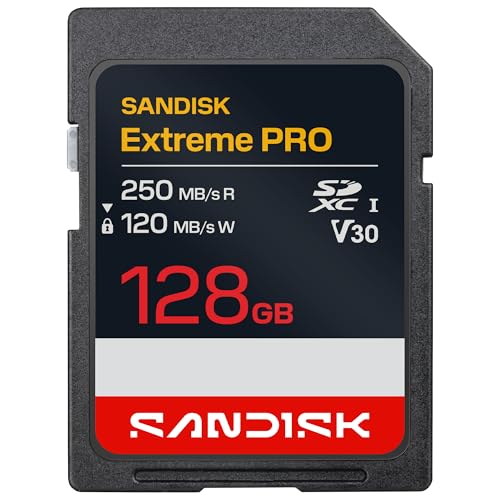
SanDisk 128GB Extreme PRO UHS-I — the balanced D500 starting point
This SanDisk Extreme PRO card offers 128GB of capacity on the UHS-I bus. For the Nikon D500, the appeal starts with fit and role: it suits the SD slot as an everyday primary card for stills, bursts and 4K video. The published title is the source for every figure in this section, so the discussion stays grounded in what the maker actually claims for this exact card rather than in assumptions borrowed from a different capacity or a different product line.
On speed, the title states up to 250MB/s read speeds and up to 120MB/s write speeds. Read those figures the right way round. The read figure shapes how the card feels after the shoot, when folders are copying and thumbnails are rendering. The write figure, where stated, shapes how the card feels during the shoot, when bursts need somewhere to go and video needs a steady destination. A card whose two figures are balanced suits mixed work; a card tilted toward reading suits photographers whose bottleneck is the evening offload rather than the moment of capture.
The class markings in the title, V30, U3 and C10, with 4K UHD and Full HD named in the title, tell you about sustained behaviour rather than momentary peaks. That distinction is easy to overlook and important in practice, because a long video clip or a long burst is a sustained event. When you compare this card with the others in this guide, compare class with class first and headline speed second, and you will reach a more honest ranking for the kind of shooting you actually do.
On the D500 specifically, a UHS-I card like this one does not exploit everything the SD slot can offer, because that slot is compatible with the faster UHS-II standard. That is not a flaw in the card; it is a positioning point. Many D500 owners shoot in a way that never troubles the difference, especially in single-shot and short-burst work, and for them the money saved against a UHS-II card can fund a second card for the bag. Judge it as a strong UHS-I option, not as a failed UHS-II one.
SanDisk 256GB Extreme PRO UHS-I with QuickFlow — double capacity for longer days
This SanDisk Extreme PRO card doubles the capacity of the first pick to 256GB while staying on UHS-I. For the Nikon D500, the appeal starts with fit and role: it suits D500 owners who shoot long events, travel days or video-heavy sessions and want fewer card changes. The published title is the source for every figure in this section, so the discussion stays grounded in what the maker actually claims for this exact card rather than in assumptions borrowed from a different capacity or a different product line.
On speed, the title states up to 200MB/s read speeds and up to 140MB/s write speeds, with SanDisk QuickFlow Technology named in the title. Read those figures the right way round. The read figure shapes how the card feels after the shoot, when folders are copying and thumbnails are rendering. The write figure, where stated, shapes how the card feels during the shoot, when bursts need somewhere to go and video needs a steady destination. A card whose two figures are balanced suits mixed work; a card tilted toward reading suits photographers whose bottleneck is the evening offload rather than the moment of capture.
The class markings in the title, V30, U3 and C10, with 4K UHD named in the title, tell you about sustained behaviour rather than momentary peaks. That distinction is easy to overlook and important in practice, because a long video clip or a long burst is a sustained event. When you compare this card with the others in this guide, compare class with class first and headline speed second, and you will reach a more honest ranking for the kind of shooting you actually do.
The interesting comparison here is against the 128GB UHS-I card above. The headline read figure is lower on this larger card while the stated write figure is higher, which is a perfect illustration of why capacity siblings in one family should never be assumed identical. Read each capacity on its own published figures. For a D500 owner whose pain point is running out of space rather than clearing the buffer, that trade will often be the right one.
Lexar 128GB SILVER PRO UHS-II V60 — stepping up to the D500’s faster SD interface
This Lexar SILVER PRO card brings the UHS-II bus and a V60 video class to a 128GB capacity. For the Nikon D500, the appeal starts with fit and role: it is aimed at D500 owners who want the SD slot working on its faster interface for bursts and quicker offloads. The published title is the source for every figure in this section, so the discussion stays grounded in what the maker actually claims for this exact card rather than in assumptions borrowed from a different capacity or a different product line.
On speed, the title states 280MB/s read, as stated in the title; the title does not state a write figure in the text supplied for this guide, so none is claimed here. Read those figures the right way round. The read figure shapes how the card feels after the shoot, when folders are copying and thumbnails are rendering. The write figure, where stated, shapes how the card feels during the shoot, when bursts need somewhere to go and video needs a steady destination. A card whose two figures are balanced suits mixed work; a card tilted toward reading suits photographers whose bottleneck is the evening offload rather than the moment of capture.
The class markings in the title, V60, U3 and UHS-II, with 4K named in the title and compatibility with Canon, Sony and Nikon stated by the maker, tell you about sustained behaviour rather than momentary peaks. That distinction is easy to overlook and important in practice, because a long video clip or a long burst is a sustained event. When you compare this card with the others in this guide, compare class with class first and headline speed second, and you will reach a more honest ranking for the kind of shooting you actually do.
The V60 marking is the headline for video shooters, because it speaks to sustained writing at a higher class than the V30 cards around it. For stills shooters, the UHS-II interface is the headline, provided the reader used at the computer also supports UHS-II; otherwise the offload advantage shrinks at the desk even though the in-camera behaviour is unchanged. Pairing card and reader is part of buying any UHS-II card, and this one is no exception.
SanDisk 256GB Extreme PRO UHS-I — the faster-writing 256GB SanDisk option
This SanDisk Extreme PRO card is a second 256GB UHS-I option in the range, distinguished by its published figures. For the Nikon D500, the appeal starts with fit and role: it suits D500 owners who want generous capacity and the stronger stated write figure among the UHS-I cards here. The published title is the source for every figure in this section, so the discussion stays grounded in what the maker actually claims for this exact card rather than in assumptions borrowed from a different capacity or a different product line.
On speed, the title states up to 250MB/s read speeds and up to 170MB/s write speeds. Read those figures the right way round. The read figure shapes how the card feels after the shoot, when folders are copying and thumbnails are rendering. The write figure, where stated, shapes how the card feels during the shoot, when bursts need somewhere to go and video needs a steady destination. A card whose two figures are balanced suits mixed work; a card tilted toward reading suits photographers whose bottleneck is the evening offload rather than the moment of capture.
The class markings in the title, V30, U3 and C10, with 4K UHD and Full HD named in the title, tell you about sustained behaviour rather than momentary peaks. That distinction is easy to overlook and important in practice, because a long video clip or a long burst is a sustained event. When you compare this card with the others in this guide, compare class with class first and headline speed second, and you will reach a more honest ranking for the kind of shooting you actually do.
Placed beside the other 256GB SanDisk in this guide, this card shows why two listings that look alike at a glance deserve separate sections. The stated read and write figures differ, and for burst-heavy sport or wildlife work with the D500, the write figure is the one that will be felt first. If your sessions are lighter, the difference may never show; if your buffer fills regularly, it is exactly the kind of difference worth paying attention to.
Lexar 128GB SILVER UHS-I — a straightforward V30 card for everyday D500 work
This Lexar SILVER card is a 128GB UHS-I model positioned for general camera use. For the Nikon D500, the appeal starts with fit and role: it fits the D500 owner who shoots a mix of stills and 4K clips and wants a recognised name without stepping up to UHS-II. The published title is the source for every figure in this section, so the discussion stays grounded in what the maker actually claims for this exact card rather than in assumptions borrowed from a different capacity or a different product line.
On speed, the title states 225MB/s read, as stated in the title; no write figure is stated in the title text supplied, so this section does not invent one. Read those figures the right way round. The read figure shapes how the card feels after the shoot, when folders are copying and thumbnails are rendering. The write figure, where stated, shapes how the card feels during the shoot, when bursts need somewhere to go and video needs a steady destination. A card whose two figures are balanced suits mixed work; a card tilted toward reading suits photographers whose bottleneck is the evening offload rather than the moment of capture.
The class markings in the title, V30, U3 and UHS-I, with 4K named in the title and compatibility with Canon, Sony and Nikon stated by the maker, tell you about sustained behaviour rather than momentary peaks. That distinction is easy to overlook and important in practice, because a long video clip or a long burst is a sustained event. When you compare this card with the others in this guide, compare class with class first and headline speed second, and you will reach a more honest ranking for the kind of shooting you actually do.
Cards like this one live or die by consistency rather than by a single headline. The V30 class gives video shooters a clear sustained-writing reference point, and the 128GB capacity is large enough for a substantial day while still encouraging a sensible nightly offload routine. In a two-card rotation for the D500’s SD slot, a dependable card of this type is often the one that ends up used most, simply because it is always in the bag and always ready.
SanDisk 128GB Extreme PRO UHS-II V60 — SanDisk’s faster-interface option
This SanDisk Extreme PRO card moves to UHS-II at 128GB and adds the higher video class. For the Nikon D500, the appeal starts with fit and role: it is built for D500 owners who shoot demanding bursts or video and want both figures, read and write, stated in the title. The published title is the source for every figure in this section, so the discussion stays grounded in what the maker actually claims for this exact card rather than in assumptions borrowed from a different capacity or a different product line.
On speed, the title states up to 280MB/s read speeds and up to 150MB/s write speeds. Read those figures the right way round. The read figure shapes how the card feels after the shoot, when folders are copying and thumbnails are rendering. The write figure, where stated, shapes how the card feels during the shoot, when bursts need somewhere to go and video needs a steady destination. A card whose two figures are balanced suits mixed work; a card tilted toward reading suits photographers whose bottleneck is the evening offload rather than the moment of capture.
The class markings in the title, V60, U3 and C10, with 6K and 4K UHD named in the title, tell you about sustained behaviour rather than momentary peaks. That distinction is easy to overlook and important in practice, because a long video clip or a long burst is a sustained event. When you compare this card with the others in this guide, compare class with class first and headline speed second, and you will reach a more honest ranking for the kind of shooting you actually do.
Having both a read and a write figure published makes comparison unusually straightforward here. Against the Lexar UHS-II card above, the capacities and read figures align closely while the class markings and stated write information differ in presentation, so the choice between them can rest on brand preference, reader pairing and availability through reputable sellers. On the D500, either UHS-II card uses the SD slot as it was designed to be used; this one does so with SanDisk’s Extreme PRO naming and a clearly stated write ceiling.
SanDisk 512GB Extreme PRO UHS-I — maximum SD capacity in this shortlist
This SanDisk Extreme PRO card is the largest SD card in this guide at 512GB, on the UHS-I bus. For the Nikon D500, the appeal starts with fit and role: it suits travel, multi-day events and video-heavy D500 work where swapping cards is impractical. The published title is the source for every figure in this section, so the discussion stays grounded in what the maker actually claims for this exact card rather than in assumptions borrowed from a different capacity or a different product line.
On speed, the title states up to 250MB/s read speeds and up to 170MB/s write speeds. Read those figures the right way round. The read figure shapes how the card feels after the shoot, when folders are copying and thumbnails are rendering. The write figure, where stated, shapes how the card feels during the shoot, when bursts need somewhere to go and video needs a steady destination. A card whose two figures are balanced suits mixed work; a card tilted toward reading suits photographers whose bottleneck is the evening offload rather than the moment of capture.
The class markings in the title, V30, U3 and C10, with 4K UHD and Full HD named in the title, tell you about sustained behaviour rather than momentary peaks. That distinction is easy to overlook and important in practice, because a long video clip or a long burst is a sustained event. When you compare this card with the others in this guide, compare class with class first and headline speed second, and you will reach a more honest ranking for the kind of shooting you actually do.
A card this large changes your habits whether you intend it to or not, so plan the backup routine before the first trip rather than after it. Offload in sections, verify as you go, and resist treating half a terabyte of capacity as a reason to carry a week’s images on one card with no copy elsewhere. Used with that discipline, the capacity is liberating: long days, remote locations and mixed stills-and-video assignments all become simpler when space stops being a concern. Readers comparing capacities across the range may also find our guide best 512 gb sd cards useful alongside the 128GB overview mentioned earlier in this article.
Nikon XQD 64GB — the card for the D500’s second slot, not an SD card
This Nikon card is an XQD card, a different format entirely from every SD card above it. For the Nikon D500, the appeal starts with fit and role: it belongs in the D500’s XQD slot, alongside an SD card in the other slot, for overflow, backup or separation of file types depending on how the body is configured. The published title is the source for every figure in this section, so the discussion stays grounded in what the maker actually claims for this exact card rather than in assumptions borrowed from a different capacity or a different product line.
On speed, the title states 440MB/s read and 400MB/s write, as stated in the title. Read those figures the right way round. The read figure shapes how the card feels after the shoot, when folders are copying and thumbnails are rendering. The write figure, where stated, shapes how the card feels during the shoot, when bursts need somewhere to go and video needs a steady destination. A card whose two figures are balanced suits mixed work; a card tilted toward reading suits photographers whose bottleneck is the evening offload rather than the moment of capture.
The class markings in the title, the XQD format’s own performance figures, rather than SD bus or SD video classes, which do not apply to this format, tell you about sustained behaviour rather than momentary peaks. That distinction is easy to overlook and important in practice, because a long video clip or a long burst is a sustained event. When you compare this card with the others in this guide, compare class with class first and headline speed second, and you will reach a more honest ranking for the kind of shooting you actually do.
Presenting this card correctly matters. It will not fit the SD slot, it is not a faster kind of SD card, and it should never be bought as a substitute for one. Its value is as the partner format the D500 was designed around: two slots, two formats, and a workflow that can use them together. XQD also requires a compatible reader at the computer, different from an SD reader, so budget and bag space for that reader belong in the same decision. For D500 owners who have only ever used the SD slot, this card is the honest way to explore the second slot without any confusion about what it is.
Speed classes, video classes, and what the markings guarantee
Alongside bus speed, SD cards carry class markings that describe minimum sustained performance rather than peak bursts of speed. Class 10, written as C10 in several titles here, has long been the baseline for full HD recording. The UHS Speed Class, shown as U1 or U3, raises that floor, with U3 intended for more demanding recording. The Video Speed Class, shown as V30 or V60, speaks directly to sustained video writing, with the number indicating the class level in the naming scheme used by the SD Association.
For a stills photographer, these markings are a useful safety net rather than the whole story. A card can carry a strong video class and still differ from another card with the same class in burst behaviour, because cameras write in patterns that differ from a steady video stream. For a videographer, the video class is often the first marking to check, because a dropped recording is far worse than a slower offload. In both cases, buying a card whose class comfortably covers your recording format is wiser than buying exactly at the minimum and hoping conditions stay ideal.
Capacity interacts with class in a practical way. A larger card invites longer sessions and fewer swaps, which reduces the chance of losing a small card in the field, but it also concentrates more images on one piece of media. Many photographers prefer two medium cards to one very large card for important work, rotating them so that a single failure cannot take the whole day. Others prefer the simplicity of one large card for travel. Neither approach is wrong; the right choice depends on how you back up and how you work.
File system naming follows capacity. Cards up to 32GB are generally SDHC, while larger cards are SDXC, a distinction you will see in some product titles in this guide. Modern bodies handle SDXC without difficulty, but very old devices may not, which is why the smallest card in the second of these two guides is discussed honestly as a legacy option rather than as a general recommendation for everyone.
How to choose capacity without overbuying or running short
Capacity planning starts with your file sizes, not with a marketing chart. Raw stills, high-resolution JPEGs, and 4K video clips consume space at very different rates, and a card that feels generous for a weekend of JPEG stills can disappear in an afternoon of video. Think in sessions: how much do you normally shoot between offloads, how often can you realistically copy files, and what happens if a session runs long. Buying for the long session, with a spare in the bag, is the calm approach.
There is a cost angle too, expressed without quoting any figures here because prices move constantly and this guide does not print static prices. Larger and faster cards generally cost more than smaller and slower ones from the same family, so the saving from stepping down a size can fund a second card, a better reader, or a protective case. A balanced kit often matters more than a single flagship card. Two good cards beat one excellent card and no backup at all.
Consider also how you archive. If you offload nightly to a laptop and a portable drive, medium capacities rotate comfortably. If you travel for a week without a computer, larger capacities or more cards become necessary, and labelling them by day helps you keep track of what has and has not been copied. Small habits, like turning a copied card face down in its case, prevent the sickening moment of formatting the wrong card.
For the Nikon D500, the shortlist in this guide deliberately spans a wide capacity range, from modest cards suited to a single session through to large cards intended for long days and travel. That spread is intentional. Readers do not all shoot the same subjects, and a guide that only listed the largest cards would fail the many photographers whose needs are simpler and whose budgets are better spent elsewhere in their kit.
Care, formatting, and backup habits that protect your images
Format every new card in the camera that will use it before its first real session. Formatting in camera aligns the file system with that body’s expectations and gives you a clean starting point, and it is also the moment to confirm the card is recognised at its full capacity. If a card reports an unexpected capacity or produces an error at this stage, set it aside and do not trust it with work that matters.
During a shoot, avoid swapping cards with wet or dirty hands, keep contacts clean and dry, and store removed cards in a hard case. Heat matters as well: a card left on a hot dashboard ages faster than one kept in a shaded bag. None of this is glamorous advice, but card failures in the field are far more often about handling and age than about the logo on the front.
Back up as if the card will fail, because one day a card will. Copy to a computer, then to a second location, and only format after you have opened a sample of files from the copy and confirmed they are intact. Cloud storage can be that second location for JPEGs on the road, while raw archives usually wait for a proper drive at home. The exact system matters less than having one and following it when you are tired at the end of a long day.
Who should buy which kind of card
If you shoot short bursts, single frames, and mostly JPEG files with the Nikon D500, a well-regarded UHS-I card with a solid class rating will feel entirely adequate, and your money may work harder spent on a second card for rotation. If you shoot long bursts, raw files, or sustained video, write performance and video class move to the front of the decision, and stepping up within this shortlist is justified by the work itself rather than by specification envy.
If offload time is your main frustration, look first at read performance and at your reader. A fast card copied through a slow reader or an old hub will disappoint, while the same card in a matching modern reader can transform an evening of copying into a short break. Diagnose the whole chain before replacing a card that may not be the bottleneck.
If you run an older body alongside a newer one, keep compatibility in mind and label cards by intended use. A modest card that suits the older body perfectly can live with it permanently, while your faster cards stay with the body that can exploit them. That simple separation reduces swaps, reduces wear, and makes it obvious which card to reach for in a hurry.
Final thoughts
There is no single best card for every owner of the Nikon D500, and this guide has deliberately avoided pretending otherwise. What there is, instead, is a set of well-documented options that divide cleanly by bus, by class, by capacity, and by role. Match those four things to your subjects, your sessions, and your backup habits, and any card on this shortlist can serve you well.
Re-read the product sections with your own shooting in mind, note which published figures actually matter for that shooting, and ignore the rest. Specifications are tools for decision-making, not a scoreboard. The photographer who understands why they chose a card will always work more calmly than the one who simply bought the largest number they could find.
Photographers who also use smaller cards in other devices sometimes ask about application-class markings, and our explainer best a2 sd cards puts those markings in context without changing anything about the full-size cards recommended here for the D500.
The same card-buying discipline travels well to other devices, which is why readers who also fly drones may want to compare these choices with our separate roundup best dji drone sd cards before building a shared card kit for camera and drone alike.
Check prices on Amazon
Live listings for the shortlist in this guide are pulled from Amazon below, so prices and availability are always current at the moment you look.


Disclosure
This article contains affiliate links. If you buy through a link on this page, this site may earn a commission, at no extra cost to you. Product information in this guide is based on published manufacturer and seller material, including the product titles cited for each card, together with general information about the SD and XQD standards. This site does not test products directly, and no hands-on use is claimed or implied. Specifications and availability can change, so please confirm the details on the product page before you buy, and check that the format — SD or XQD — matches the slot you intend to use.