What's inside
- Key Takeaways
- Quick Picks
- How Did We Decide Which Cards Truly Belong in a Board-Power Guide?
- Why Does the Slot Itself Set a Hard Ceiling of 75 Watts?
- Which Machines Gain the Most From a Slot-Powered Card?
- How Should a Listing Prove Its Power Story Before You Trust It?
- What Happens to Heat and Noise When a Card Lives on Slot Power?
- The Six Board-Power Picks in Detail
- Which of These Six Spends the Slot’s 75 Watts Most Cleverly?
- How Long Will a Slot-Powered Card Stay Useful?
- How Do You Fit a Board-Power Card Into a Slim Prebuilt Desktop?
- What Mistakes Ruin a Board-Power Purchase?
- Final Recommendation
- Frequently Asked Questions
- Related Guides
As an Amazon Associate I earn from qualifying purchases. This post may contain affiliate links at no extra cost to you.
gizmoverdict.com is reader-supported. When you buy through links on our site, we may earn an affiliate commission.
Where to buy: Each of the six cards below links to its Amazon listing, and each link was checked against the manufacturer’s own product naming before it earned a place here. Read the power notes under every pick before ordering, because a card sold for a small case sometimes still expects a cable the case’s power supply does not have.
The best graphics cards that take board power solve a problem that has nothing to do with frame rates. Inside a slim office desktop, a refurbished workstation or a home-theatre PC, the power supply often offers no spare PCIe power cable at all, and sometimes no spare wattage worth the name. The only electricity available to a graphics card in such a machine is whatever travels up through the PCIe slot itself, a ceiling of 75 watts set by the slot standard. A card designed for that ceiling drops in, draws everything it needs from the motherboard, and turns a machine with no gaming or display ambitions into one with real outputs and real acceleration.
That ceiling shapes everything about the six cards gathered here. None of them chases flagship performance, because flagship performance cannot live on 75 watts. Instead they divide into honest camps: display cards that give an old desktop modern ports, low-profile cards that fit half-height brackets in small-form-factor cases, one workstation card carrying a surprising amount of memory, and one genuine gaming card that squeezes modern ray-tracing silicon into the slot-power envelope. Where a listing title states a wattage or states plainly that no power cable is required, this guide says so. Where a title stays silent on power delivery, the spec box under that pick says that too, in plain words, because guessing about electricity is how builds go wrong.
One clarification belongs at the front. Board power describes how a card is fed, not how strong it is, and the two ideas are often confused in listings that borrow each other’s vocabulary. A card can be low profile and still demand a cable; a card can be full height and still live entirely on the slot. This guide sorts by the electrical fact first and treats size as the second question, because a card that fits the case but cannot be powered helps nobody, while a card that can be powered and almost fits invites a bracket swap rather than a return.
Key Takeaways
- Board power means the card draws everything through the PCIe slot, whose standard ceiling is 75 watts, with no auxiliary cable involved.
- Two picks state their slot-power design outright in the listing title, at 65 watts and 70 watts respectively.
- Three picks leave power delivery unstated in the title, and their spec boxes flag that silence instead of papering over it.
- Low-profile brackets dominate this category, so case height matters as much as wattage when choosing.
- The strongest gaming silicon here is a 6GB RTX-class card; the largest memory belongs to a 16GB workstation card.
- A card carrying a 6-pin connector in its listing does not belong in this category at all, however small the card itself looks.
Quick Picks
| Pick | Badge | Why it earns its place |
|---|---|---|
| SPARKLEVGA RX6500M 8GB GDDR6 Low Profile Single Slot Graphics Card | Stated 65W slot rating | The listing spells out 65W slot power with no external supply, plus HDMI 2.1 and DisplayPort 1.4a in a 22mm-thick frame. |
| BRE NUC GUNNIR Intel Arc Pro B50 16G Low Profile Graphics Card | Most memory without a cable | A 16GB workstation card whose title states 70W and no power cable required, with PCIe 5.0 and 8K support. |
| MAXSUN AMD Radeon RX 550 4GB Low Profile Small Form Factor Video Graphics Card | Proven low-profile all-rounder | A 4GB GDDR5 card in half-height form with HDMI and DisplayPort, though its title leaves power delivery unstated. |
| ZyzsAI GTX 1050 4GB Low Profile Graphics Card | Half-height and cable-free by title | The listing states no external power in so many words, wrapped around GTX 1050 silicon and 4GB of memory. |
| msi Gaming GeForce GT 1030 4GB DDR4 Graphics Card | Single-fan entry card | MSI’s low-profile GT 1030 with 4GB of DDR4, DisplayPort and HDMI, and a small single fan for tight cases. |
| maxsun GeForce RTX 3050 6GB Graphics Card | Strongest gaming silicon here | A slim low-profile RTX 3050 with 6GB of GDDR6 and HDMI 2.1, the performance ceiling of this roundup. |
How Did We Decide Which Cards Truly Belong in a Board-Power Guide?
The first filter was the category’s definition. A card belongs here when its design centres on power drawn through the slot rather than through a cable from the power supply. Listings that state a wattage under the slot ceiling, or state directly that no external power is needed, passed that filter on their own words. Listings from card families built around slot power but silent on the point in the title itself were kept only with the silence flagged, because a reader planning a build around a weak power supply deserves to know which claims are printed and which are merely customary.
The second filter was physical. Board-power cards overwhelmingly serve small machines, so low-profile brackets, single-slot frames and half-height designs carried real weight in the selection. A card can respect the wattage ceiling and still fail the build by standing too tall for a slim case or by blocking the neighbouring slot that a capture card or network card already occupies. Dimensions printed in a title were treated as part of the pick’s evidence, not as decoration.
The third filter was honesty about tier. Slot power caps what a GPU can do, and this guide refuses to dress entry silicon in flagship language. Each pick is placed on the ladder it actually occupies: display duty, light gaming, workstation memory, or the one card here that plays modern games credibly. A reader finishing this page should know exactly which rung each card stands on and what stepping up or down changes.
A fourth consideration ran underneath the other three: the age and support horizon of each design. A card bought for a workhorse machine should still be receiving driver attention, and its outputs should speak the standards current monitors expect. That is why HDMI 2.1 and DisplayPort 1.4a appearances were noted wherever titles printed them, and why the guide distinguishes between a card that is old but serviceable and a card whose outputs belong to a retired era of displays. The six survivors of those filters are not the six most powerful cards that fit a slot; they are the six whose claims, dimensions and tiers a reader can plan around without crossed fingers.
Why Does the Slot Itself Set a Hard Ceiling of 75 Watts?
A PCIe x16 slot is an electrical contract as much as a data connection. The standard reserves a defined power budget for cards seated in the slot, delivered through the connector’s pins at voltages the motherboard’s traces are built to carry. Card designers treat that budget as the whole allowance for a board-power design: the GPU core, the memory, the voltage regulation losses and any fan all eat from the same 75-watt plate. That is why every genuine board-power card is frugal by construction, and why the fan on the one actively cooled pick here is a small single unit rather than a gaming shroud.
The ceiling explains the shape of the whole category. Memory capacity can grow, because modern GDDR chips sip power, which is how a 16GB workstation card appears in this guide at a stated 70 watts. Raw shader throughput cannot grow the same way, because arithmetic at high clocks is where watts actually go. So board-power cards compete on efficiency, outputs and fit rather than on brute force, and the interesting question for each pick becomes how cleverly it spends a fixed allowance.
It also explains the failure mode to avoid. A power supply in a slim prebuilt desktop might be rated at 180 or 240 watts for the entire machine. Adding a card that expects a 6-pin cable fails twice over: the cable does not exist, and the supply’s headroom was never sized for a hungry GPU anyway. Cards in this guide exist precisely for those machines, and the discipline of the category is that the slot budget and the supply budget are the same conversation.
Which Machines Gain the Most From a Slot-Powered Card?
The clearest winners are the off-lease office desktops sold in enormous numbers by the big PC makers. These machines arrive with competent processors, adequate memory and storage, and integrated graphics as their one glaring weakness — a single ageing display output, no support for a second monitor at a decent resolution, and video decode handled by silicon designed when streaming resolutions were lower. A slot-powered card corrects every one of those weaknesses in a ten-minute installation, and the machine’s second life as a home office workstation, a family computer or a media hub begins from that moment.
Home-theatre PCs form the second natural home. A living-room machine values quiet, cool operation and modern HDMI behaviour above raw speed, and a card drawing its whole budget through the slot produces heat a small case can shed without theatrical fan noise. Paired with a current HDMI output, such a card gives an older system the display handshake and video formats a modern television expects, including smooth high-resolution playback that integrated graphics of a certain age handle with visible strain.
The third home is the small workstation that grew by accretion. A designer’s compact tower or an engineer’s desk machine often has a capable processor and a power supply chosen for the original configuration, with no thought given to a later GPU. When the work changes — a second and third monitor, a CAD package, a local model to experiment with — the slot-powered card is the upgrade that does not demand the machine be rebuilt around it. That is the thread connecting every pick in this guide: capability added inside an envelope the machine already provides.
A fourth setting deserves mention because it is growing: the repurposed machine handed down. A desktop retired from an office becomes a child’s homework computer, a workshop reference screen, a spare machine for guests. Each of those second careers is limited first by graphics — an old output that will not drive the available monitor, a desktop that stutters through ordinary video. A slot-powered card is the cheapest dignity such a machine can be given, and the installation is gentle enough to be a teaching moment rather than a repair bill.
How Should a Listing Prove Its Power Story Before You Trust It?
Read a listing the way an electrician reads a panel schedule: the claim has to be written down. The strongest evidence is a number, a wattage printed in the title or the specification table, sitting under the slot ceiling. The next strongest is a direct statement — “no external power”, “no power cable required” — which settles the cable question even without a figure. Below that sits inference from the card family, which is where this guide stops cooperating: families contain variants, variants contain surprises, and a surprise involving electricity and a weak power supply is the expensive kind.
The physical evidence corroborates the written kind. Photographs of the card’s top edge show whether a 6-pin or 8-pin socket interrupts the line of the board; a genuine board-power design has a clean edge, because there is nothing to plug in. Dimensions tell the companion story — a card engineered for slot power is almost always engineered for small cases too, in low-profile or slim form. When the words, the wattage and the photographs all agree, the listing has proved its story. When any leg of that tripod is missing, the manufacturer’s documentation for the exact model number is the court of appeal, and it answers quickly.
Apply the same scepticism in reverse to marketing that leans on the word “low power” without numbers. Low is a comparison, not a specification, and a card described that way may still expect a cable its seller considered unremarkable. The category’s genuine members can prove themselves in watts and in the absence of a socket; hold every listing to that standard and the shortlist writes itself.
What Happens to Heat and Noise When a Card Lives on Slot Power?
Heat is wattage wearing another name, and a card capped below 75 watts produces at most 75 watts of it — a quantity a small case can move with modest airflow. This is the quiet arithmetic behind the category’s good manners. Conventional gaming cards convert several hundred watts into exhaust that a case must evacuate; a board-power card asks the case to handle roughly the heat of a bright lamp, distributed along a low-profile board. Slim desktops with a single case fan, machines that would throttle or roar under a gaming card’s exhaust, absorb a slot-powered card without any change in character.
Noise follows the same curve. Five of the six picks here cool themselves with small fans or, in the wider family of such designs, with heatsinks alone, and a fan moving air for a sub-75-watt card spins gently because the job is gentle. The actively cooled picks in this roundup use single small fans sized to their envelope rather than the multi-fan shrouds of gaming hardware. For a media PC in a living room or a workstation under a desk, that restraint is not a compromise; it is the feature. The machine stays the machine it was, only more capable.
There is a maintenance corollary worth knowing. Small fans and compact heatsinks live close to dust, and a slim case’s restricted airflow deposits it efficiently. A board-power card asks for a brief cleaning once or twice a year — a can of air across the heatsink fins, a check that the little fan spins freely — and repays that small attention with stable temperatures indefinitely. Owners of passive-leaning small systems already know this rhythm; the card simply joins it.
The Six Board-Power Picks in Detail

SPARKLEVGA RX6500M 8GB GDDR6 Low Profile Single Slot Graphics Card — Stated 65W slot rating
Most listings in this category make the reader work to confirm the one fact that matters. This one prints it in the open: 65W, slot-powered, no external power. That single line of the title does more for a small-case builder than any benchmark chart, because it converts the purchase from a hope into a specification. The card underneath the claim is a low-profile, single-slot design measuring 170 by 69 millimetres and 22 millimetres thick, dimensions the title also states, so both halves of the fit question — electrical and physical — are answered before the box is opened.
The silicon is an RX 6500M-class GPU paired with 8GB of GDDR6 memory, a laptop-derived design point that explains the frugality: mobile GPUs are engineered around strict power envelopes, and that heritage shows in the 65W figure. Outputs run to HDMI 2.1 and DisplayPort 1.4a with support for up to two displays, which suits the card’s natural homes — a compact desktop driving a 4K monitor for work and media, a small living-room machine, or an older tower gaining modern display standards without a power-supply transplant. Treat it as a display and light-duty card rather than a gaming purchase, and its priorities make complete sense.
There is also a thermal argument for this design. Sixty-five watts spread across a low-profile board is heat a slim case can exhaust without drama, and the card’s modest appetite leaves the rest of a small power supply’s budget for the processor and drives it was originally sized around. In a refurbished office machine, that balance matters more than any single specification: the upgrade succeeds when nothing else in the system has to change to accommodate it, and on the evidence of its own title, nothing else does.
- Memory: 8GB GDDR6
- Power: 65W slot-powered, no external power, as stated in the listing title
- Outputs: HDMI 2.1 and DisplayPort 1.4a, up to 2 displays
- Form factor: low profile, single slot, 170x69mm, 22mm thick
Strengths:
- The power claim is explicit and quantified, the clearest statement of board-power design in this roundup.
- HDMI 2.1 and DisplayPort 1.4a bring current display standards to machines built before them.
- A 22mm-thick single-slot frame leaves the neighbouring slot free for another card.
Trade-offs:
- Two displays is the ceiling, so multi-monitor desks should look at other categories entirely.
- The mobile-derived GPU is tuned for efficiency, not for demanding game settings.
- SPARKLEVGA is a small brand, so support runs through the seller rather than a large vendor network.
Best for: a buyer seeking a stated, verified slot-power rating for a slim desktop gaining modern outputs. Not suited for: a desk built around three or more monitors.

BRE NUC GUNNIR Intel Arc Pro B50 16G Low Profile Graphics Card — Most memory without a cable
Sixteen gigabytes of memory on a card that never touches a power cable would have sounded like a misprint a few generations ago. The GUNNIR-built Intel Arc Pro B50 states its terms directly in the title: 70W, no power cable required, in a single-slot low-profile workstation frame. That combination redraws what a slot-power card can be asked to do. Large texture sets, dense CAD assemblies, local AI experimentation and memory-hungry professional applications all fail on small-memory cards in a way no clock speed fixes, and this pick attacks exactly that failure while respecting the strictest power budget in the guide.
The rest of the title reads like a workstation checklist rather than a gaming pitch: PCIe 5.0, 8K support, two HDMI 2.1 ports and one DisplayPort 2.1. Intel’s Arc Pro line is aimed at professional drivers and certified application behaviour, and the B50’s slot-powered design targets the small-form-factor workstations that populate engineering offices and studios — machines with capable CPUs, modest power supplies and no appetite for a rebuild. Slotted into such a machine, this card is less an upgrade than a change of profession for the whole computer. The honest caveat is ecosystem maturity: Intel’s discrete graphics drivers have improved rapidly but remain the youngest of the three major vendors, so a workflow built on a very specific legacy plugin deserves a compatibility check first.
Consider what the memory buys in practice. A visualisation artist opening a scene that spills past 8GB on a lesser card watches the application swap, stutter or refuse; on 16GB the same scene simply opens. A developer testing a mid-sized model locally, a video editor stacking effects on high-resolution footage, a data worker holding a large frame in GPU memory — each hits the capacity wall long before the clock-speed wall. This pick is the only one in the guide that moves the capacity wall out of the way entirely, and it does so while asking the power supply for nothing beyond the slot.
- Memory: 16GB GDDR6
- Power: 70W, no power cable required, as stated in the listing title
- Interface: PCIe 5.0
- Outputs: 2x HDMI 2.1 and 1x DisplayPort 2.1, 8K support
- Form factor: single slot, low profile, small-form-factor design
Strengths:
- Memory capacity double or quadruple the rest of this guide, at a stated 70W.
- Current-generation outputs, including DisplayPort 2.1, on a card for older-style small cases.
- Workstation positioning suits professional applications better than gaming silicon repurposed for the desk.
Trade-offs:
- Intel’s driver ecosystem is the youngest here, and niche professional plugins deserve a check before purchase.
- Three display outputs trail the four-port cards found in multi-monitor categories.
- The BRE NUC branding is an unfamiliar channel name for many buyers, so warranty terms deserve a read.
Best for: a buyer seeking workstation memory capacity inside a small case with no spare power cable. Not suited for: a gaming-first build measuring value purely in frame rates.

MAXSUN AMD Radeon RX 550 4GB Low Profile Small Form Factor Video Graphics Card — Proven low-profile all-rounder
The RX 550 has spent years as the default answer to a plain question: an older desktop needs a real display output, a second monitor, or light gaming life, and the case is a half-height small-form-factor box. MAXSUN’s version states its physical case clearly — low profile, small form factor, ITX-friendly — and pairs the GPU with 4GB of GDDR5 on a 128-bit bus, with HDMI and DisplayPort outputs and DirectX 12 support over a PCI Express x16 3.0 interface. As a specification for office work, media playback and older or lighter games, that remains a coherent and honest package.
The transparency duty falls on power. This listing’s title does not state a wattage and does not state that no external power is required, so this guide does not claim either. The RX 550 family is conventionally associated with slot-powered designs, but convention is not a specification, and variants exist across brands. When the entire reason for shopping this category is a power supply with no spare cable, the power arrangement should be verified in MAXSUN’s documentation for this exact card before ordering. With that check done, the pick stands on its long track record: this GPU generation is understood, its drivers are mature, and its limits are known quantities rather than surprises.
Its working life divides neatly into three jobs. On an office desk it drives a pair of displays with the smoothness integrated graphics of its era could not manage. In a media role it handles high-definition playback and streaming without troubling the processor. And for games it covers the back catalogue and the lighter current catalogue at modest settings, which for a family machine or a second PC is often precisely the assignment. A pick does not need to be new to be correctly placed; it needs to match the work, and this one’s match has been demonstrated in a great many small desktops.
- Memory: 4GB GDDR5, 128-bit bus
- Power: Not stated in the listing title — verify with MAXSUN documentation
- Interface: PCI Express x16 3.0, DirectX 12
- Outputs: HDMI and DisplayPort
- Form factor: low profile, small form factor
Strengths:
- A mature, well-understood GPU generation with stable drivers for everyday work.
- Half-height design fits the slim desktops that dominate this category’s audience.
- GDDR5 memory gives it more bandwidth than the DDR4-based entry cards.
Trade-offs:
- Power delivery is unstated in the title, an extra verification step for cable-free builds.
- Two named outputs limit elaborate monitor arrangements.
- The architecture’s age shows in modern games, which sit beyond its comfortable reach.
Best for: a buyer seeking a half-height card for office displays and light gaming in a small desktop. Not suited for: a build that requires the power arrangement confirmed from the listing alone.

ZyzsAI GTX 1050 4GB Low Profile Graphics Card — Half-height and cable-free by title
Where the MAXSUN listing leaves the power question open, this one closes it in the title itself: PCIe x16, no external power. That phrase is the whole reason the card appears in this guide, and it arrives attached to GTX 1050 silicon with 4GB of memory in a half-height, low-profile frame built for small-form-factor desktops. The GTX 1050 generation earned its reputation in exactly this niche — prebuilt office towers with weak power supplies were transformed into respectable esports and family gaming machines by this class of card — and the formula has not stopped working for the games of that era and lighter current titles.
The title also promises 4K video card duty, which describes the card’s second job: display output and video playback for a compact media or office machine. ZyzsAI is not a household brand, and the listing’s brevity means details such as the exact output arrangement are thinner than the bigger vendors provide; that is the trade made for a value-positioned card from a small label. What is stated is stated plainly, though, and the statement that matters most for this category — no external power — is right there in the product name rather than buried in a specification table three clicks deep.
The use case writes itself. Somewhere there is a slim brand-name desktop, bought for office work, and its owner has discovered that its integrated graphics cannot run the games on the household’s list. The power supply inside offers no cable and no headroom for a conventional card. This pick is the standard rescue for that exact machine: seat it, install the driver, and the desktop’s ceiling rises from no games to a large and enjoyable library of them. Cards earn reputations by solving a recurring problem cleanly, and the problem this one solves recurs in millions of homes.
- Memory: 4GB (type not stated in the listing title)
- Power: no external power, as stated in the listing title
- Interface: PCIe x16
- Duty named in title: 4K video output
- Form factor: low profile, half height, for small-form-factor desktops
Strengths:
- The cable-free claim is explicit in the title, removing the category’s central uncertainty.
- GTX 1050 silicon remains genuinely capable for esports titles and older games.
- Half-height framing suits the slim prebuilt desktops this category serves.
Trade-offs:
- The small brand’s listing is sparse, leaving output details to be confirmed on the product page.
- Memory type goes unstated in the title, a detail worth confirming before purchase.
- Current demanding games exceed what this generation of silicon offers.
Best for: a buyer seeking a title-confirmed cable-free card to wake up a slim prebuilt desktop. Not suited for: a shopper expecting big-vendor documentation and support channels.
msi Gaming GeForce GT 1030 4GB DDR4 Graphics Card — Single-fan entry card
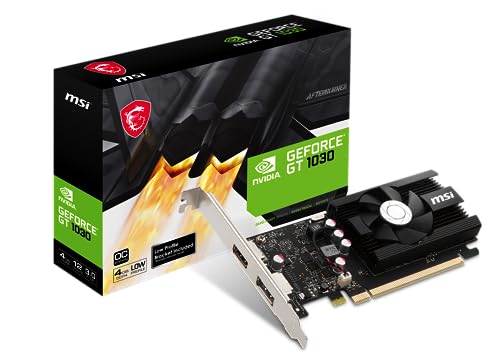
MSI’s GT 1030 is the establishment name in this guide: a low-profile card from one of the largest graphics brands, built around NVIDIA’s entry GT 1030 GPU with 4GB of DDR4 memory on a 64-bit bus, DisplayPort and HDMI outputs, HDCP support and DirectX 12. The title’s own words include “Single Fan OC”, which marks this as the one actively cooled pick in the roundup — a small fan rather than a passive heatsink, factory overclocked within its modest envelope. For a media PC or an office desktop, the GT 1030’s real work is hardware video decode, smooth desktop composition across two displays, and silence-adjacent operation in a case with little room.
Two honest notes belong with this pick. The first is memory: DDR4 on a 64-bit bus is markedly slower than the GDDR5 fitted to other GT 1030 variants, so this card’s comfort zone is display duty and video rather than gaming, whatever the “Gaming” word in the branding suggests. The second is power: the title does not state a wattage or a cable arrangement, so the spec box records that silence and the verification duty sits with MSI’s documentation for the GT 1030 4GD4 LP OC. Judged on what it is — a big-brand, low-profile display card with a small fan keeping its cool in cramped cases — it fills its rung of the ladder properly.
The fan deserves its own sentence of defence. Passive designs depend on case airflow that slim desktops frequently do not have, their interiors being exercises in cable origami around a single small fan. A modest blower of the card’s own guarantees the GT 1030 its cooling regardless of the case’s shortcomings, at a noise level that office and media work will not notice. For a card whose job is to disappear into a machine and be forgotten, that self-sufficiency is a genuine virtue, and it is why this actively cooled variant earns its place in a guide otherwise populated by designs that sip power quietly.
- Memory: 4GB DDR4, 64-bit bus
- Power: Not stated in the listing title — verify with MSI documentation
- Cooling: single fan, factory overclocked (OC)
- Outputs: DisplayPort and HDMI, HDCP support, DirectX 12
- Form factor: low profile
Strengths:
- MSI’s brand backing brings proper documentation, driver pages and warranty channels.
- A small active fan copes better with stuffy, airflow-starved cases than a passive sink.
- DisplayPort plus HDMI covers the two connectors most desks actually use.
Trade-offs:
- DDR4 memory narrows this variant to display and video duty rather than games.
- Power delivery goes unstated in the title, so cable-free planning needs a documentation check.
- The fan, however small, is a moving part a passive card does not have.
Best for: a buyer seeking a big-brand low-profile display card for a warm, cramped case. Not suited for: a gaming upgrade, where the DDR4 memory gives the game away.

maxsun GeForce RTX 3050 6GB Graphics Card — Strongest gaming silicon here
Every category has a ceiling pick, and this is it: an RTX 3050 with 6GB of GDDR6, carrying NVIDIA’s Ampere architecture, ray-tracing hardware and DLSS upscaling into a slim low-profile frame for small-form-factor machines. The title describes a card built for gaming PCs in miniature — PCI Express 4.0, HDMI 2.1 and DisplayPort 1.4a — and the 6GB variant of the RTX 3050 is the generation’s efficiency-trimmed model, the one designed down toward slot-power envelopes rather than up toward flagship wattage. In a compact case, DLSS matters as much as raw throughput, because upscaling is performance bought with intelligence instead of electricity.
The category discipline still applies, and it applies here in writing: this listing’s title does not state a wattage and does not state a power-cable arrangement. The 6GB RTX 3050 design is widely built as a slot-powered card, but this guide grades listings on their own words, so the spec box flags the silence and the check belongs with maxsun’s documentation for this exact slim model before a cable-free build is planned around it. That single verification done, the pick’s proposition is the strongest in the roundup — modern games at sensible settings, in a machine whose power supply could never feed a conventional gaming card.
Place it against the rest of the ladder to see the gap. The display-class picks modernise a desktop; this one changes what the desktop is for. Ray-traced lighting in supported titles, DLSS lifting frame rates at a given resolution, current drivers optimised for current releases — the full modern gaming stack, delivered in a slim frame through a slot-powered design philosophy. It remains a card of sensible settings rather than ultra presets, and honesty requires saying so. But the distance between “cannot play” and “plays well at sensible settings” is the largest distance in this entire category, and this pick covers it.
- Memory: 6GB GDDR6
- Power: Not stated in the listing title — verify with maxsun documentation
- Interface: PCI Express 4.0
- Outputs: HDMI 2.1 and DisplayPort 1.4a
- Form factor: slim low profile, for small-form-factor builds
Strengths:
- RTX silicon brings DLSS and ray tracing to a class of machine that normally gets neither.
- 6GB of GDDR6 is proper gaming memory, not a display card’s compromise.
- Slim low-profile framing keeps it compatible with the small cases this category serves.
Trade-offs:
- Power delivery is unstated in the title, so the cable-free check is mandatory homework.
- It is the performance ceiling of a low ceiling; high-refresh and 4K gaming live elsewhere.
- maxsun’s support footprint is smaller than the largest vendors’ networks.
Best for: a buyer seeking genuine modern gaming inside a small case with a modest power supply. Not suited for: a high-refresh-rate build chasing flagship frame rates.
Which of These Six Spends the Slot’s 75 Watts Most Cleverly?
| Pick | Memory | Power evidence in title | Outputs named | Frame |
|---|---|---|---|---|
| SPARKLEVGA RX6500M | 8GB GDDR6 | 65W slot-powered, no external power | HDMI 2.1, DP 1.4a, up to 2 displays | Low profile, single slot, 22mm thick |
| GUNNIR Arc Pro B50 | 16GB GDDR6 | 70W, no power cable required | 2x HDMI 2.1, 1x DP 2.1 | Low profile, single slot |
| MAXSUN RX 550 | 4GB GDDR5 | Not stated in the listing title | HDMI, DisplayPort | Low profile, SFF |
| ZyzsAI GTX 1050 | 4GB | No external power | Not itemised in the listing title | Low profile, half height |
| MSI GT 1030 | 4GB DDR4 | Not stated in the listing title | DisplayPort, HDMI | Low profile, single fan |
| maxsun RTX 3050 | 6GB GDDR6 | Not stated in the listing title | HDMI 2.1, DP 1.4a | Slim low profile |
Read across the power column and the roundup’s honesty structure shows itself: two cards prove the category claim in their own titles, one states the cable-free fact without a wattage, and three ask for a documentation check. Read down the memory column and the ladder appears — 4GB display-class cards at the base, 6GB and 8GB in the middle, and the 16GB workstation outlier at the top, spending its allowance on capacity rather than clocks.
How Long Will a Slot-Powered Card Stay Useful?
Longer than its modest specification suggests, because the jobs these cards do age slowly. A display card’s assignment — driving monitors, decoding video, composing a desktop — changes at the pace of display standards, not at the pace of game releases. A card carrying HDMI 2.1 and DisplayPort 1.4a today will handshake happily with monitors sold for years to come, and the workstation pick’s 16GB of memory addresses a constraint that grows more relevant as local AI tools spread, not less. Buying at the efficient end of the market has always been a wager on the workload’s stability, and office, media and professional display workloads are among the most stable in computing.
The honest limit sits at the other end of the ladder. A gaming ambition grows: the library expands, the monitor upgrades, the settings creep upward, and a card bought at the category’s ceiling meets that growth sooner than a conventional gaming card would. The RTX 3050 pick has DLSS as its pressure valve, stretching its useful gaming life by rendering smarter rather than harder. The display-class picks have no such valve and need none, because nobody’s spreadsheet doubles in graphical ambition between versions. Match the card to the workload’s rate of change, and a slot-powered purchase stays useful for the whole life of the machine it rescues.
There is a final, practical longevity point. These cards are standard PCIe devices with standard drivers, so when the host machine eventually retires, the card can migrate — into a test bench, a spare-parts build, a relative’s desktop. Hardware bought for a strict envelope tends to fit many envelopes afterwards, and a card that asks only for a slot and 75 watts will find a second home more easily than almost any other component in the machine.
How Do You Fit a Board-Power Card Into a Slim Prebuilt Desktop?
Start with the case open and a ruler in hand. Measure the bracket height the case accepts — full-height or half-height — and the length available before the card meets a drive cage or the front panel. Low-profile cards usually ship with both brackets in the box, but “usually” is a word to confirm on the listing rather than assume at the workbench. Check also what sits in the neighbouring slot; a single-slot card preserves it, while a thicker cooler quietly annexes it.
Next, confirm the power story with the machine’s own evidence. Read the power supply’s label for its total rating, and look inside for any loose PCIe power cable — its absence is the normal state of these machines and the entire premise of this category. For picks whose titles state the arrangement, the listing and the machine now agree. For picks whose titles stay silent, take the extra few minutes with the manufacturer’s documentation; a card returned because of an unverified assumption costs more time than the check ever would.
Installation itself is the gentle kind of upgrade. Power the machine down, seat the card firmly until the slot latch engages, swap the bracket first if the case is half-height, and connect the displays to the new card’s outputs rather than the motherboard’s — the classic mistake that leaves a new GPU idle while the integrated graphics do the work. Install the vendor’s current driver, set the display refresh rate the monitor actually supports, and the job is done. No cable routing, no power-supply swap, no drama: that restraint is the category’s whole charm.
Two refinements separate a tidy installation from a merely working one. First, enter the machine’s BIOS or UEFI settings if the displays stay dark, and confirm the primary graphics adapter is set to the PCIe slot rather than locked to integrated graphics; most boards switch automatically, but older office machines sometimes hold their original setting with bureaucratic stubbornness. Second, once the driver is in, visit the display settings and arrange the monitors in their physical order, matching resolutions and refresh rates per screen rather than accepting a mirrored default. Ten extra minutes at this stage is the difference between an upgrade that feels finished and one that nags at its owner daily.
Finally, give the card a supervised first evening. Play the video, open the game, run the workload the card was bought for, and listen. A healthy installation is boring: no fan grinding, no display flicker, no driver resets. Any of those symptoms at this stage points back to seating, drivers or the power verification skipped earlier — all fixable on day one, all more annoying on day thirty.
What Mistakes Ruin a Board-Power Purchase?
The first mistake is buying by silhouette. A small card with a 6-pin connector in its listing is not a board-power card, whatever its dimensions suggest; some low-profile gaming models carry exactly that connector, and they belong to a different shopping list with a different power conversation. The second mistake is the mirror image: assuming every card in a familiar family shares one power design. Variants differ between brands and sometimes within a brand’s own range, which is why this guide grades each listing on its own title and flags silence instead of smoothing it over.
The third mistake is ignoring the bracket. A full-height card ordered for a half-height case is a return waiting to happen, and low-profile packaging deserves a check for the slim bracket in the box. The fourth is expecting the category to be something it is not: these cards transform display capability and light-duty performance, and only the top pick here plays modern games with conviction. Buying a display-class card for a gaming ambition produces a disappointment that was printed in the specification all along.
A fifth mistake hides in the power supply’s fine print. A supply’s headline wattage describes the whole unit, but the processor, drives and motherboard draw from the same total, and a machine already running close to its limit — a heavily populated office tower, for instance — has less headroom than the label suggests. Slot-powered cards ask for little, yet “little” is not “nothing”, and a system that shuts down under load after an upgrade is usually reporting arithmetic, not a faulty card. The sixth mistake is subtler: daisy-chaining adapters to reach an old monitor’s only input, then blaming the card for a flickering picture. Modern outputs expect modern cables; give the new card a direct connection and judge it on that.
Final Recommendation
Choose by evidence first and ambition second. When the listing must prove the power claim on its own words, the SPARKLEVGA RX6500M and the GUNNIR Arc Pro B50 state their wattage and their cable-free design outright, and the B50’s 16GB of memory makes it the roundup’s professional standout. The ZyzsAI GTX 1050 states its cable-free design plainly for the slim prebuilt gaming revival. The MAXSUN RX 550 and MSI GT 1030 are the mature display-class options, and the maxsun RTX 3050 6GB is the performance ceiling — with the shared homework that their titles leave power delivery to be verified in documentation before a cable-free build depends on it.
Match the pick to the machine’s actual assignment and the choice simplifies. A display problem wants a display card, and paying for gaming silicon to run a second spreadsheet monitor wastes the budget the category exists to protect. A memory problem wants the B50 and nothing else here. A gaming problem inside a sealed slim case wants the RTX 3050 after its documentation check, or the GTX 1050 for the older library. The discipline of board power is that the constraint comes first and the card second; every recommendation above was ordered by that discipline.
Seventy-five watts turns out to be a surprisingly generous budget when a card spends it on the right things — memory, modern outputs, an honest fit — and every pick above spends it deliberately rather than apologising for the limit.
Frequently Asked Questions
What does it mean for a graphics card to take board power?
It means the card draws all of its electricity through the PCIe slot on the motherboard instead of through a separate power cable from the power supply. The slot standard sets the budget, so board-power designs are built frugal from the start, and they suit machines whose supplies offer no spare cable and little spare wattage.
How many watts can a PCIe slot actually supply?
The x16 slot’s standard budget is 75 watts, and every card in this category is designed against that ceiling or below it. Two picks here state their draw directly — 65 watts and 70 watts — which is the clearest evidence a listing can offer. Cards that need more than the slot provides are exactly the ones carrying auxiliary connectors.
Can a board-power card run modern games?
One pick here genuinely can: the RTX 3050 6GB brings modern architecture and DLSS upscaling to sensible settings at mainstream resolutions. The GTX 1050 pick handles esports titles and older games well. The remaining cards are display and workstation designs, and expecting modern gaming from them misreads their purpose. The dividing line is architectural generation more than price: a recent efficient GPU spends the slot budget on far more frames than an older design given the same watts.
Why do some listings in this guide not state the power arrangement?
Because titles are written by sellers, not by standards bodies, and some sellers lead with form factor instead. Where a title stays silent, this guide prints the silence in the spec box rather than filling it with the card family’s usual reputation. The manufacturer’s documentation for the exact model settles the question in minutes. Treat that check as part of the purchase for the three flagged picks, the same way a bracket measurement is part of the purchase for any low-profile card.
Will a low-profile card fit a full-height case?
Generally yes, because low-profile cards typically include a full-height bracket in the box or mount directly with the bracket fitted. The reverse journey fails: a full-height card cannot squeeze into a half-height case. Confirm the included brackets on the listing before ordering for a slim machine.
Do these cards need a new power supply?
No — avoiding that purchase is the category’s reason to exist. A machine with a modest supply and no spare PCIe cable is the natural home for a board-power card. The sensible checks are the supply’s total rating, the case’s bracket height and, for the titles that stay silent on power, a short read of the maker’s documentation.
What should be checked again a month after installing one?
Three small things. Confirm the driver is still current, because the first months of a card’s life in a machine are when vendors issue the fixes that matter. Glance at temperatures under the usual workload, since a slim case’s dust accumulates faster than a tower’s. And verify the displays still wake cleanly from sleep on every output in use — the one behaviour that occasionally drifts after operating-system updates, and the easiest to correct while the installation is still fresh in memory.
Related Guides
Power is only one of the constraints a small case imposes. Readers working through the same build may also find our guides to the best single slot graphics cards, the best passively cooled graphics cards and the best graphics cards for machine learning useful next steps.