What's inside
- Key Takeaways
- Quick Picks
- How Did We Divide This Guide Between Portable and Fixed Speakers?
- What Should a Garage Gym Speaker Survive?
- How Much Loudness Does a Garage Gym Actually Need?
- What Do Dust, Cold and Heat Do to a Speaker Over Years?
- Which Garage Gym Speaker Setup Fits Your Space?
- How Do You Set Up Sound in a Garage Gym Without Ruining It?
- What Mistakes Do Garage Gym Speaker Buyers Keep Making?
- What Does Stereo Actually Add Inside a Concrete Box?
- How Do You Run a First Session to Judge a New Speaker Honestly?
- How Should You Count the True Cost of Each Format?
- Final Recommendation
- Frequently Asked Questions
- Related Guides
As an Amazon Associate I earn from qualifying purchases. This post may contain affiliate links at no extra cost to you.
gizmoverdict.com is reader-supported. When you buy through links on our site, we may earn an affiliate commission.
Where to buy: Each of the six speakers below links to its own Amazon listing, and every figure quoted in this guide — wattage, playtime, water rating — comes straight from that listing’s title. No prices and no star ratings are printed anywhere in this guide; check the listing itself for the current figure before ordering.
A garage gym asks more of a speaker than a kitchen counter ever will. The best garage gym speakers have to shout over a fan, a rattling barbell and a roll-up door, survive chalk dust and the odd splash from a water bottle, and keep playing through a two-hour session without a cable snaking across the lifting platform. The six picks in this guide split cleanly into two camps that solve that problem in opposite ways. Three are portable Bluetooth jobsite speakers — the ANCOON, the DEWALT ToughSound Pro and the Qozybuds — built to be carried in, set on a bench or stuck to a steel rack, and carried out again. The other three — the KICKER KB6B pair, the Pyle wall-mount pair and the Herdio wired pair — are fixed installations: speakers screwed to a wall or joist once, wired once, and left there for years.
That split is the real decision in this category, and it should be made before wattage enters the conversation. A portable speaker suits a garage that still parks a car at night, a rented space where drilling into studs is off the table, or a training setup that moves between the driveway and the back garden. A fixed pair suits a dedicated gym bay: no battery to charge, no Bluetooth pairing ritual before a session, and stereo imaging that stays put because the speakers stay put. Neither camp is better in the abstract. The sections below treat them as separate tools and judge each pick against the job its design actually signed up for.
One caution before the picks: peak wattage figures in this category are marketing numbers, not measurements. An 80W peak claim and a 22W claim from two different brands cannot be compared as if they were weighed on the same scale, and this guide does not pretend otherwise. Playtime hours, water-resistance ratings and the connection method in each title are the harder facts, and those are what the verdicts lean on.
Key Takeaways
- Decide portable versus fixed first: the ANCOON, DEWALT and Qozybuds travel with you, while the KICKER, Pyle and Herdio pairs mount to the building and stay there.
- The two 80W (Peak) portables — ANCOON and Qozybuds — both carry an IPX6 rating and TWS pairing, but differ sharply on playtime: 20 hours against 30 hours in their titles.
- The DEWALT ToughSound Pro trades raw output (22W) for an IP67 dust-and-water rating, a magnetic body and Auracast, making it the rack-side companion rather than the room-filler.
- Both wired pairs and the Bluetooth Pyle pair are sold as pairs for true stereo; the portables are single units that need a second identical unit for TWS stereo.
- Fixed speakers remove charging from your routine entirely, but the KICKER and Herdio pairs are wired designs that depend on a separate amplifier or receiver you supply.
Quick Picks
| Pick | Badge | Why it earns its place |
|---|---|---|
| ANCOON Speakers Bluetooth Wireless (Blue) | The jobsite all-rounder | 80W (Peak) output, 20 hours of playtime, IPX6 sealing and TWS pairing in a carry-anywhere box aimed squarely at workshops and garages. |
| DEWALT Heavy Duty Magnetic ToughSound Pro Bluetooth Speaker | Sticks to the rack | A 22W magnetic speaker with an IP67 rating and up to 14 hours of runtime that clamps onto steel gym equipment instead of occupying floor space. |
| KICKER KB6B 2-Way Full Range Indoor Outdoor Speakers (Pair) | The permanent wired pair | A weatherproof pair with 6.5-inch woofers and horn tweeters, built to be mounted once and driven by your own amplifier for years. |
| Qozybuds Bluetooth 6.0 Speaker (Red) | The marathon battery | 80W (Peak) output with 30 hours of working time, IPX6 sealing, TWS pairing and RGB lights for long sessions away from a socket. |
| Pyle 6.5-Inch Wall Mount Waterproof Bluetooth Speaker System | Mounted, but wireless-fed | A wall-mount pair with Bluetooth and a built-in digital amplifier, so the speakers stay fixed while the music arrives without speaker cable runs from a receiver. |
| Herdio 6.5 Inch 400W Outdoor Speakers Wired Waterproof (Pair) | The high-output wall pair | A wired, waterproof wall-mount pair carrying a 400W title rating, aimed at larger garages where a separate amplifier already lives. |
Read the table as a map of two territories rather than a league ladder. The top three rows and the bottom three rows answer different questions, and the detailed reviews below keep that border visible.
How Did We Divide This Guide Between Portable and Fixed Speakers?
The shortlist started from a simple observation about how garage gyms actually get used. Roughly half of them are multi-purpose spaces — a car sleeps there, tools share the walls, the rack folds away — and in those spaces any speaker that cannot be moved in ten seconds becomes an obstacle. The other half are committed gym rooms wearing a garage door as a souvenir, and in those spaces a portable speaker is a compromise: its battery becomes one more thing to manage, and its sound fires from wherever it happened to be left, usually a corner of the floor.
So the six places were split evenly. Three portables earned their spots on a combination of stated playtime, stated water resistance and pairing options, because those are the three things that decide whether a portable survives garage duty. Three fixed pairs earned theirs on mounting format and drive requirements: two wired pairs that lean on an amplifier you own, and one Bluetooth pair with its amplifier built in, which bridges the camps. Within each camp the picks were then spread by scale — a compact magnetic unit, two full-size portables, two mid-size wall pairs and one higher-output wall pair — so that a small single-bay garage and a three-bay workshop both find a proportionate option.
Everything quoted about a pick traces back to its listing title. Where a title is silent on a detail a garage gym cares about — a charging time, a bracket type, a Bluetooth version — the spec box under that pick says so plainly instead of filling the gap with a guess.
What Should a Garage Gym Speaker Survive?
Garages are hostile in specific, predictable ways. Chalk and sawdust drift into every grille. Temperature swings from near-freezing mornings to hot afternoons stress batteries and adhesives. Water arrives as splashes rather than rain: a knocked bottle, a mop bucket, a pressure washer used carelessly nearby. The IP ratings in the titles speak to that third threat. IPX6, carried by the ANCOON and the Qozybuds, means protection against powerful water jets; the DEWALT’s IP67 goes further, adding complete dust sealing and immersion resistance. The fixed pairs describe themselves as weatherproof or waterproof in their titles, language aimed at outdoor mounting that translates well to a damp garage wall.
Volume is the other survival trait, and it is about tone as much as loudness. A speaker that must be run at its absolute limit to be heard over a fan distorts, and distorted music at 6 a.m. is a special kind of misery. Headroom — output in reserve — is why the larger portables and the wall pairs exist. Place any of them closer to the lifting platform, or mount a pair at ear height on either side of it, and the same perceived loudness arrives at a calmer, cleaner setting on the volume dial.

ANCOON Speakers Bluetooth Wireless (Blue) — The jobsite all-rounder
The ANCOON is the portable in this guide that reads most like it was designed for exactly this room. Its title stacks the garage-relevant claims in a row: 80W (Peak) output with an emphasis on bass, 20 hours of playtime, an IPX6 waterproof rating, and an explicit jobsite framing that names the workshop and the garage as home territory. In practice that combination means a single box that can sit on the workbench end of the gym, play loudly enough to cover a platform session, and shrug off the splash and dust environment without a protective case or a second thought.
Bass deserves a sentence of its own, because garage gyms are bass-hungry spaces. Concrete floors and bare walls reflect treble efficiently and swallow low frequencies, and training music tends to lean on low-end drive. A portable that advertises bass emphasis in its title is at least aiming at the right problem. Position still matters more than specification: the ANCOON will sound fuller a foot out from a wall than stranded in the middle of the floor, and fuller still on a solid bench rather than a hollow storage bin that buzzes along in sympathy.
Daily handling matters with a box of this size, and the jobsite format earns its name in the small moments: carried one-handed between bench and platform, set down on concrete without ceremony, wiped clean of chalk with the same rag that cleans the bar. A speaker that demands gentleness will be resented by the third week of a training block; a speaker built for work sites absorbs the routine and disappears into it, which is precisely what gym equipment should do.
The TWS feature in its title is the upgrade path. One ANCOON is a mono point source; two, paired through True Wireless Stereo, become a genuine stereo pair that can flank a rack. That matters in a wide garage where a single box leaves the far side under-served. It also means the first purchase does not lock you into mono forever — the second unit can arrive a season later and the system grows without replacing anything.
- Output: 80W (Peak), with bass emphasis stated in the title
- Playtime: 20 hours stated in the title
- Water resistance: IPX6 waterproof stated in the title
- Pairing: TWS stated in the title — a second identical unit enables stereo
- Format: portable jobsite speaker, blue finish
- Charging time: the title gives no figure, so plan around the 20-hour reserve rather than a quick top-up
Strengths
- The title’s jobsite framing is honest positioning: this is a work-space speaker first, and its IPX6 sealing matches garage splashes and dust.
- Twenty hours of stated playtime covers a full week of hour-long sessions between charges.
- TWS gives a real stereo upgrade route without abandoning the first unit.
Trade-offs
- Peak wattage is a ceiling figure, not a continuous rating, so judge loudness by placement and headroom rather than the number alone.
- As a single portable box it fires from wherever it sits; a fixed pair will always image more predictably.
- No wall-mount option is described in the title, so permanent installation is not its game.
Best for: a shared garage-and-gym space where the speaker must earn its bench room daily and clear out when the car comes home.
Not suited for: a dedicated gym room ready for drilled, wired, forget-about-it sound.

DEWALT Heavy Duty Magnetic ToughSound Pro Bluetooth Speaker — Sticks to the rack
The DEWALT ToughSound Pro solves the placement problem with a magnet. Its title leads with the magnetic heavy-duty build, and in a garage gym that single trait changes the daily routine: the speaker clamps to a power rack upright, a steel shelf edge or the side of a tool cabinet at ear height, off the floor, out of the chalk dust drift line, and pointed at the lifter rather than at a wall. Floor space in a garage gym is sacred — it belongs to the platform, the bench and the deadlift jack — and a speaker that consumes none of it has an advantage no wattage figure can match.
The output figure is modest on paper: 22W. Read that in context. This is a near-field speaker, designed to play a metre or two from the listener, and at that distance 22W is ample for training volume with headroom to spare. What it will not do is fill a three-bay workshop from one corner, and its review here does not ask it to. The title’s IP67 rating is the strongest environmental claim in this guide — dust-tight and immersion-resistant — which suits a speaker that may live permanently in an unheated, unsealed building.
Two quieter title features round it out. Auracast, the broadcast Bluetooth mode, points toward linking with other Auracast-capable speakers so one phone can feed several units around a larger space. EQ modes let the tonal balance be adjusted from the speaker’s own controls — useful when a podcast between sets wants a different balance from a playlist during them. Runtime is stated at up to 14 hours, the shortest in this guide, which fits its role: it plays hard for a session, then tops up from a socket it probably sleeps beside.
- Output: 22W stated in the title
- Mounting: magnetic body stated in the title — clings to steel racks and cabinets
- Water and dust resistance: IP67 stated in the title
- Runtime: up to 14 hours stated in the title
- Linking: Auracast stated in the title; EQ modes also stated
- Bluetooth version: Not stated in the listing title — verify with DEWALT documentation
Strengths
- Magnetic mounting puts sound at ear height with zero drilling, zero brackets and zero floor footprint.
- IP67 is the toughest environmental rating among the six picks, portable or fixed.
- EQ modes acknowledge that speech and music want different balances in a reflective concrete box.
Trade-offs
- At 22W it is a near-field companion; a big garage will outgrow it as the only speaker.
- Fourteen hours is a working week of short sessions, not a month — charging stays on the routine list.
- The magnet needs ferrous steel to grip; aluminium racking and wooden shelves give it nothing to hold.
Best for: rack-side listening in a compact gym, where the speaker lives on the upright and the floor stays clear for lifting.
Not suited for: filling a large multi-bay garage from a single position.
KICKER KB6B 2-Way Full Range Indoor Outdoor Speakers (Pair) — The permanent wired pair
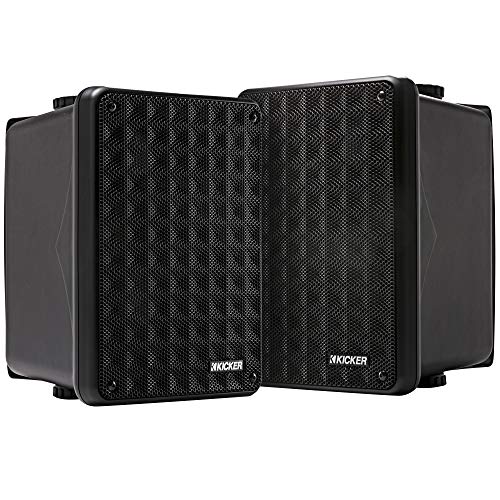
The KICKER KB6B pair is the old-school answer: two passive, weatherproof boxes with 6.5-inch woofers and 2×5-inch horn tweeters, sold as a pair, meant to be mounted and wired and then ignored for years. KICKER’s title names patio, garage and poolside duty in one breath, which tells you the intended life — semi-outdoor, temperature-cycled, occasionally hosed-down surroundings. In a dedicated garage gym, that translates to speakers mounted high in opposite corners or flanking the platform wall, aimed down at the training area, delivering true stereo from fixed positions every single session with no pairing step and no battery anxiety.
The horn tweeter is the detail worth understanding. Horn-loaded tweeters project high frequencies directionally and efficiently, which in a large reflective garage means vocals and cymbal detail arrive at the platform with less help from the volume control. The 6.5-inch woofer in a sealed weatherproof enclosure will not produce subwoofer depth — no speaker in this guide does — but a pair of them, mounted near walls that reinforce low frequencies, gives training music the body it needs.
Because the KB6B pair is wired and passive in design, it depends on an amplifier or receiver between your phone and the speakers. That is a cost and a wiring job, and this guide counts it openly as the price of the format. It is also the format’s strength: the amplifier can be upgraded, repaired or replaced without touching the speakers, a Bluetooth receiver can be added to the amp for wireless feeding, and the speakers themselves have no battery to age and no electronics to obsolesce. Of the six picks, this pair has the longest plausible service life in the building.
- Configuration: pair of 2-way speakers stated in the title
- Drivers: 6.5-inch woofer and 2×5-inch horn tweeter stated in the title
- Environment: weatherproof indoor/outdoor design stated in the title
- Connection: wired — a separate amplifier or receiver is required to drive the pair
- Colour: black finish stated in the title
- Power handling figure: Not stated in the listing title — verify with KICKER documentation
Strengths
- True stereo from day one, from two fixed positions that never wander between sessions.
- Nothing to charge and nothing to pair; the system is ready the moment the amplifier wakes.
- Weatherproof construction shrugs off the garage’s dust, damp and temperature swings.
Trade-offs
- An amplifier or receiver is a separate purchase and a separate shelf resident.
- Speaker cable must be run to both mounting points, which means ladders, clips and an afternoon.
- Moving the sound to the driveway or garden is not an option; the pair belongs to the room.
Best for: a permanent gym bay with an amplifier already in the picture, or planned alongside the speakers.
Not suited for: rented garages, folding-rack setups, or training that migrates outdoors in summer.

Qozybuds Bluetooth 6.0 Speaker (Red) — The marathon battery
The Qozybuds enters the same jobsite arena as the ANCOON — same 80W (Peak) output claim, same IPX6 waterproofing, same TWS pairing — and then wins two specific arguments. The first is stamina: 30 hours of working time in its title, half again the ANCOON’s figure, which for a speaker that lives in a garage means charging becomes a monthly event rather than a weekly one. Forgotten charging cables are the number-one reason portable gym speakers sit silent, and a 30-hour reserve forgives a great deal of forgetfulness.
The second argument is the connection: Bluetooth 6.0, the newest Bluetooth generation named in any title in this guide. A current-generation radio generally means a steadier link through a building full of steel and a phone that may be sitting on a charger across the room, plus more efficient power use feeding that long runtime. Treat the version number as a supporting detail rather than the headline — the headline is that this speaker is built to be left in the garage, played daily, and charged rarely.
Consider also where a speaker like this sleeps. A 30-hour unit invites being left in the garage permanently, which is convenient and mostly harmless, but the battery will thank its owner for a shelf on the house-side wall rather than a perch above the door where summer heat pools. Kept kindly, a battery of this size should hold its stamina across several training years; kept in the hottest corner of the building, it will fade sooner, and the fade shows up first as sessions that end a song early.
The RGB lights in its title will divide the room. In a garage gym they are pure theatre: colour washing across a dark early-morning session. Some lifters will love that; others will switch the lights off once and forever, and the speaker’s value does not depend on them. The red finish makes the same point — this is a portable that expects to be seen, carried and used hard in work spaces, with the workshop and garage named in its title alongside outdoor use.
- Output: 80W (Peak) stated in the title
- Working time: 30 hours stated in the title — the longest portable runtime in this guide
- Water resistance: IPX6 waterproof stated in the title
- Connection: Bluetooth 6.0 stated in the title
- Pairing: TWS stated in the title — a second identical unit enables stereo
- Extras: RGB lights stated in the title
Strengths
- Thirty hours between charges removes the most common portable-speaker failure mode: the flat battery at session start.
- Bluetooth 6.0 is the most current radio named in any of the six titles.
- Matches the ANCOON’s output and water rating while adding half again the playtime.
Trade-offs
- RGB lighting is decoration a work-focused garage may never use.
- Like every portable here, stereo requires buying a second unit for TWS.
- Its sound still fires from a single movable point, so imaging changes with wherever it was last set down.
Best for: daily training in a garage where the charging cable lives somewhere else entirely and sessions run long.
Not suited for: a finished gym room where fixed stereo imaging matters more than portability.

Pyle 6.5-Inch Wall Mount Waterproof Bluetooth Speaker System — Mounted, but wireless-fed
The Pyle system is the bridge between the two camps, and for many garages it will be the sweet spot. The speakers mount to the wall like the KICKER and Herdio pairs — a 6.5-inch pair in weather-resistant housings — but the signal arrives by Bluetooth and the amplification is a digital amplifier built into the system itself, both stated in its title. That combination deletes the two biggest friction points of the wired pairs: no receiver to buy and house, and no long speaker-cable runs from a central amp, because the amplification lives with the speakers.
What remains is a power question rather than a signal question. A built-in amplifier needs mains power at the speaker location, so installation planning shifts from cable routing to socket hunting — an exterior-rated outlet near the mounting point, or an electrician’s visit if none exists. In garages with sockets up the walls for tools and chargers, that is often a trivial constraint; in older garages with a single outlet by the door, it shapes where the pair can live.
Day to day, the appeal is routine-free stereo. The pair hangs in fixed positions, wakes, connects to a phone over Bluetooth, and plays — the experience of a portable with the permanence of an installation. The title’s waterproof and weather-resistant language suits the same damp, dusty building the other fixed pairs serve, and Pyle’s long history in budget installed audio means mounting hardware conventions here are well-trodden. For a garage gym that wants mounted sound without building a small hi-fi system around it, this is the shortest path.
- Configuration: wall-mount speaker pair, 6.5-inch, stated in the title
- Amplification: built-in digital amplifier stated in the title — no separate receiver required
- Connection: Bluetooth stated in the title
- Environment: waterproof speakers in weather-resistant housings stated in the title
- Installation: wall mounting; mains power needed at the speaker position for the built-in amplifier
- Bluetooth version: Not stated in the listing title — verify with Pyle documentation
Strengths
- Fixed stereo positions with portable-style Bluetooth convenience and no receiver purchase.
- Built-in amplification collapses the parts list to speakers, mounts and a power point.
- Weather-resistant housings suit unheated garages through winter and summer alike.
Trade-offs
- Mains power at the mounting point is mandatory, which can dictate placement.
- If the built-in amplifier ever fails, the repair involves the speaker unit rather than a swap of a separate amp.
- Bluetooth range to a wall-mounted pair still obeys physics; a phone at the far end of a long garage may test it.
Best for: a committed gym bay seeking mounted stereo without a receiver, cable runs or a hi-fi shelf.
Not suited for: garages with one distant socket and no appetite for electrical work.

Herdio 6.5 Inch 400W Outdoor Speakers Wired Waterproof (Pair, Black) — The high-output wall pair
The Herdio pair is the heavy artillery of the fixed camp. Its title leads with a 400W rating for the 6.5-inch wired pair — a figure to read as the pair’s stated power handling class rather than a promise of a specific loudness, but a clear signal of intent: these are wall speakers aimed at bigger, louder spaces, with the patio, garage and covered deck named as their territory. In a double or triple garage converted to a gym, where a single portable strains and even a modest wall pair can sound thin, a higher-output pair driven by a capable amplifier is the proportionate answer.
The construction language in the title — wired, waterproof, wall mount — describes the same ownership pattern as the KICKER pair: install once, wire to an amplifier, and let the system become part of the building. The bass emphasis in the title is worth noting for training use; low-frequency weight is what makes music feel physical in a large concrete space, and a pair of 6.5-inch drivers near wall surfaces gets reinforcement from the room itself. Mounting height and toe-in will shape the result more than any amplifier setting, so the installation afternoon deserves care: ear height at the platform, angled inward, cables clipped neatly out of barbell range.
Choosing between the Herdio and KICKER pairs comes down to the amplifier story and the size of the room. The Herdio’s higher stated rating pairs naturally with a stronger amplifier and a larger space; the KICKER’s horn tweeter projects detail efficiently in mid-size garages. Neither pair forgives a weak amplifier, and both reward a decent one for years. If the garage already hosts a receiver for outdoor speakers, the Herdio pair can join that system as the gym zone and inherit its sources for free.
- Configuration: wall-mount speaker pair, 6.5-inch, stated in the title
- Rating: 400W stated in the title for the pair
- Connection: wired — driven by an amplifier or receiver supplied separately
- Environment: waterproof design stated in the title
- Character: powerful bass emphasis stated in the title
- Colour: black finish stated in the title
- Sold as: 1 pair stated in the title
Strengths
- The highest stated output class in this guide, sized for large converted garages.
- Wall mounting plus wall reinforcement gives training music physical low-end weight.
- Joins an existing amplifier system as a zone instead of demanding a new ecosystem.
Trade-offs
- Needs an amplifier with enough genuine output to honour the pairing, which raises the total system cost.
- Wired installation is permanent; rearranging the gym means re-mounting and re-cabling.
- In a small single garage, its capacity is simply more than the room can use.
Best for: a large multi-bay garage gym with an amplifier on hand and volume demands to match.
Not suited for: small spaces, temporary setups, or any gym that must pack away.
How Much Loudness Does a Garage Gym Actually Need?
Less than the marketing suggests, and more than a pocket speaker offers — the honest answer sits between, and it depends on three variables: the size of the space, the noise floor of the session, and the distance between speaker and lifter. A running fan, a treadmill motor and plates sliding onto a bar all raise the floor that music must clear. In a single garage with the speaker a few metres away, even the DEWALT’s 22W near-field output clears that floor comfortably. In a double garage with the speaker at the far wall, distance eats output quickly — sound loses energy with every metre — and the larger portables or a wall pair earn their keep.
Distance is the variable owners most often misjudge, because it punishes quietly. Doubling the distance from a speaker does not halve the drama in an obvious way; it thins the sound, pushes the listener to raise the volume, and the raised volume then distorts at the speaker and fatigues the ear. The cheapest loudness upgrade in any garage gym is therefore not a bigger speaker but a closer one: the magnetic DEWALT riding the rack upright, a portable on the bench beside the platform, or wall speakers mounted flanking the lifting area rather than decorating the far wall. Every pick in this guide becomes effectively louder when its owner spends five minutes on placement.
There is also a social ceiling. Garages share walls, fences and early mornings with neighbours, and bass travels through structure in a way treble does not. A system with headroom played at moderate level sounds better and travels less than a small system at its ragged edge, because the ragged edge is mostly distortion, and distortion is mostly high-frequency harshness that carries. Choosing one size up and running it calmly is the neighbourly configuration as well as the musical one.
What Do Dust, Cold and Heat Do to a Speaker Over Years?
A garage is a slow stress test. Summer heat in an uninsulated building can push internal temperatures high enough to age lithium batteries faster, which is the portable camp’s long-term tax: a battery speaker stored fully charged in a hot garage will lose capacity sooner than the same speaker kept in a hallway. Winter cold does the opposite damage in the short term — a battery played from near-freezing delivers less of its stated playtime until it warms. None of this disqualifies the portables; it argues for small kindnesses, like storing the speaker on an interior wall shelf rather than above a sun-baked door, and charging it in the house during the coldest weeks.
Dust works on everything. Chalk dust is fine, alkaline and mobile; it settles into grilles and ports and, over seasons, into any unsealed seam. The DEWALT’s IP67 dust-tight rating is the strongest defence named in this guide, and the fixed pairs’ weatherproof housings are sealed against the same drift by design. A soft brush across the grilles every few months is the whole maintenance ritual for any of the six; speakers are among the lowest-maintenance objects in a gym, far behind the barbell they accompany.
The fixed pairs age differently: no battery to fade, but connections to watch. Speaker cable terminations in a damp building can oxidise over years, showing up as crackle before failure; a re-strip and re-tighten during a spring clean restores them. The Pyle pair’s built-in amplifier adds electronics to that ageing picture, trading the wired pairs’ near-immortality for its receiver-free convenience — a fair trade for most owners, and one to make with open eyes.
Which Garage Gym Speaker Setup Fits Your Space?
| Pick | Type | Stated output | Stated endurance | Linking |
|---|---|---|---|---|
| ANCOON (Blue) | Portable jobsite | 80W (Peak) | 20 hours playtime; IPX6 | TWS with a second unit |
| DEWALT ToughSound Pro | Portable magnetic | 22W | Up to 14 hours; IP67 | Auracast |
| KICKER KB6B | Fixed wired pair | No figure given in the title | Weatherproof; no battery | Stereo pair by wiring |
| Qozybuds (Red) | Portable jobsite | 80W (Peak) | 30 hours working time; IPX6 | TWS with a second unit |
| Pyle Wall Mount System | Fixed Bluetooth pair | Built-in digital amplifier | Waterproof; mains powered | Stereo pair by design |
| Herdio Wall Pair | Fixed wired pair | 400W (pair) | Waterproof; no battery | Stereo pair by wiring |
The pattern in the table is the pattern of the whole category: endurance figures belong to the portables, permanence belongs to the wall pairs, and no single row wins both columns. Choose the column your routine can least afford to lose.
How Do You Set Up Sound in a Garage Gym Without Ruining It?
Start with placement before volume. For a portable, elevate it: a bench, a plyo box or a shelf at waist-to-head height will always outperform the floor, where sound fires into shins and gets absorbed by mats. Keep it a short distance from the wall behind it for low-end support, and out of the direct line of chalk dust from the platform. For the DEWALT, the magnet makes placement an experiment you can repeat daily — try the rack upright nearest the platform first, at head height, angled toward the lifter.
For a fixed pair, mount at or slightly above ear height where you stand to lift, toe both speakers inward toward the platform, and keep them symmetric: equal distances to the listening spot are what make stereo imaging snap into focus. Run cable along joists and down corners, clipped and clear of the door track and any barbell path. Before the final screws go in, play a familiar track and walk the room; garages have dead corners and boom spots, and ten minutes of listening beats a season of regret.
Sound-check with the door in both positions, because a garage changes character completely between them. Door closed, the room is a reflective box that flatters bass and traps volume; door open, half the low end walks out into the street and the speaker must work harder for the same effect at the platform. A setup balanced with the door shut can sound thin with it open, and the reverse balance can boom unpleasantly on a winter morning session. Most garage gyms train in one dominant configuration — know yours, tune for it, and accept the compromise in the other rather than chasing a balance that serves neither.
Whatever the format, set a volume ceiling that respects the neighbours and your own hearing. If intelligible conversation at arm’s length is impossible for a full session, the level is a loan your ears repay later. Use the speaker’s headroom to keep the sound clean at moderate levels rather than spending it all on maximum loudness.
What Mistakes Do Garage Gym Speaker Buyers Keep Making?
The classic error is shopping by the largest wattage number on the box. Peak figures are not comparable across brands, and a well-placed 22W near-field speaker will satisfy its owner longer than an 80W (Peak) box stranded behind a car. Placement and fit-for-routine decide satisfaction; the number is a rough size class at best.
The second error is ignoring the charging routine when choosing a portable. A speaker with a brilliant specification and a flat battery is silent, and garages are where charging discipline goes to die. Long stated playtime — the Qozybuds’ 30 hours is the extreme here — is a genuine feature in this room, not a spec-sheet decoration. The mirror-image error is buying a portable for a permanent gym: the fixed pairs exist precisely because some rooms should graduate from battery management.
The third error is forgetting the amplifier when budgeting for wired pairs. The KICKER and Herdio pairs are speakers only; the amplifier, the cable and the mounting hardware complete the system, and a budget that ends at the speakers ends mid-installation. Finally, there is the stereo misunderstanding: a single TWS portable is mono until its twin arrives, so a stereo experience from the portable camp means planning for two units from the start.
What Does Stereo Actually Add Inside a Concrete Box?
A garage is an acoustically rude room: parallel hard walls, a concrete slab, a metal door that behaves like a drum skin. In such a room, mono from a single point can sound perfectly satisfying during a working set, because attention is on the bar, not the soundstage. Stereo earns its place in the margins of the session — the warm-up, the accessory work, the stretching at the end — when the listener is stationary and facing the speakers, and the width of a well-made recording becomes part of the pleasure of the room. It also earns its place at lower volume: a stereo pair spread across a wall fills the space evenly at levels where a single point source must be turned up to reach the corners, and even coverage at moderate level is the configuration neighbours forgive.
The routes to stereo in this guide differ in commitment. The fixed pairs are stereo by construction, with positions chosen once and imaging that never drifts. The Pyle pair adds Bluetooth feeding to that permanence. The portables reach stereo only in pairs of identical units — TWS for the ANCOON and Qozybuds, Auracast broadcast for the DEWALT’s ecosystem — which means the stereo decision for a portable owner is really a budget decision made in two instalments. There is no shame in the instalment plan; there is only a trap in buying a single portable while imagining its sound as the paired sound, because mono from one box is a different, narrower experience.
One more placement truth applies to every format: symmetry beats power. Two modest speakers at equal distances from the platform will image better and satisfy longer than one powerful speaker off to a side, because the brain reads lopsided arrival times as a defect no equaliser can repair. When in doubt, spend the next unit of money on the second position, not on a louder first one.
How Do You Run a First Session to Judge a New Speaker Honestly?
Give any new arrival a fair trial before forming the verdict that sticks. Charge a portable fully first — a half-charged battery tells you nothing about stamina — then run one complete, ordinary session: the fan on, the usual playlist, the speaker in its intended position rather than a flattering one. Note the volume setting that felt right during working sets; if that setting sits near the top of the range, the speaker is undersized for the room no matter how good it sounded in a quiet unboxing test, because ordinary sessions only get louder from there.
Test the awkward moments too. Walk to the far corner with a kettlebell and check whether the sound thins into background mush. Take the phone call that interrupts every third session and see how the speaker handles the switch. For a TWS-capable portable, decide during that first week whether the stereo upgrade is a genuine plan or a pleasant fiction — the answer shapes whether a second unit joins the rack or the money goes toward a fixed pair later. For wall speakers, live with the mounted positions for several sessions before declaring the installation finished; a pair moved once, early, is a success story, while a pair endured in the wrong spot for years is a slow regret.
How Should You Count the True Cost of Each Format?
The sticker on the box is only the first line of each format’s ledger, and comparing formats fairly means reading the whole page. A portable’s ledger is short: the speaker, perhaps a second unit later for stereo, and eventually — years out — a battery that no longer holds its youthful stamina. There is no installation labour, no accessories beyond a charging cable, and the asset stays liquid: it can move to the garden, the driveway or a friend’s workshop whenever the gym does not need it. For a household still deciding whether the garage gym is a permanent institution, that flexibility is worth money, because a portable bought for a gym that dissolves in a year simply becomes the household’s outdoor speaker.
A wired pair’s ledger runs longer and must be read before ordering, not discovered during installation. The speakers themselves are only the headline; beneath sit the amplifier or receiver, enough speaker cable to reach both mounting points with slack to spare, the mounts or brackets if they are not in the box, and the fixings appropriate to the wall material. An electrician joins the ledger if the mounting wall lacks a power point for a powered design like the Pyle system. None of these lines is extravagant, but together they can rival the speakers’ own cost, and the owner who budgets for all of them in advance installs once, calmly, instead of pausing mid-project with a ladder under one arm.
Against that, the fixed formats repay their ledger across a longer horizon. There is no battery replacement waiting in year four, no charging routine taxing attention every week, and the per-session cost of a system used five times a week for a decade falls to nearly nothing. The honest comparison is therefore not portable-cheap versus fixed-expensive; it is portable-flexible versus fixed-committed, priced across the years each will actually serve. A gym in its trial season should buy flexibility. A gym with a platform bolted down and a calendar full of sessions has already answered the question, and its money works harder in the walls than on the bench.
One final accounting note applies to the stereo question. Two portables bought a season apart feel cheaper than a fixed pair bought at once, yet the totals often converge — and the fixed pair arrives with mounting permanence the portables never claim. Lay the two ledgers side by side before assuming the instalment plan is the economical one; sometimes it is, sometimes it merely feels that way, and the difference is a pair of speakers’ worth of surprises.
Final Recommendation
For most garage gyms, the honest answer divides by how permanent the gym is. In a space that still serves cars, tools and storage, take the Qozybuds for its 30-hour stamina and current Bluetooth, or the ANCOON if the second-unit TWS stereo path matters more than the extra hours; add the DEWALT ToughSound Pro instead if the speaker’s true home is the rack itself and floor space is priceless. In a gym that has fully claimed its bay, mount the Pyle pair for receiver-free stereo, or wire the KICKER pair for detail and longevity, stepping up to the Herdio pair when the room is large and an amplifier already waits. A garage gym is a room that rewards commitment in iron and in audio alike, so pick the speaker format that matches the commitment you have actually made to the space — and the music will still be playing, session after session, long after the new-equipment excitement has faded.
Frequently Asked Questions
Can one portable speaker really cover a whole garage gym?
For a single or double garage, yes, provided it is elevated and reasonably central. The 80W (Peak) portables here are sized for work spaces; difficulties start in very large or divided garages, where a TWS second unit or a fixed pair covers the far corners more evenly.
What does IPX6 or IP67 actually protect against in a garage?
IPX6 covers powerful water jets — splashes, spray and careless hosing. IP67 adds complete dust sealing and short immersion resistance. Neither rating is about steam rooms or pressure washers at point-blank range, but both comfortably exceed the splash-and-dust reality of a training garage.
Do the wired wall pairs include an amplifier?
The KICKER KB6B and Herdio pairs are wired speakers that need a separate amplifier or receiver. The Pyle pair is the exception in this guide: its title states a built-in digital amplifier, so it needs mains power and a Bluetooth source rather than a receiver.
Is TWS the same as stereo?
TWS — True Wireless Stereo — is the mechanism that delivers stereo from two portable units: pair two identical speakers and one takes the left channel, the other the right. A single TWS speaker on its own plays mono, which is why the fixed pairs, stereo by construction, hold an imaging advantage.
Should the garage gym speaker live in the garage all year?
Mostly yes, with one seasonal exception. The fixed pairs are built for permanent residence and should never move. The portables tolerate garage life well, but during the coldest weeks a battery speaker keeps more of its stated playtime when it sleeps in the house between sessions, and during a heatwave the same courtesy applies in reverse. Treat the speaker like the other battery tools in the building: stored charged, stored dry, and brought inside when the weather turns theatrical.
Can a jobsite speaker double as the household’s outdoor speaker?
Yes — that dual life is the portable camp’s hidden value. The ANCOON and Qozybuds titles both name outdoor and workshop use alongside the garage, and the DEWALT’s rugged rating suits garden and site work equally. A fixed pair can never moonlight; a portable earns its keep in two postings, which softens the arithmetic of buying the larger model.
Where should a fixed pair be mounted for lifting?
At or just above standing ear height, symmetric around the platform, toed inward. Symmetry matters more than any single measurement: equal distances from each speaker to your lifting position are what lock the stereo image in place.
Related Guides
Training at home reaches beyond one room, and the neighbouring categories reward the same portable-versus-fixed thinking: our guide to workshop and jobsite audio setups applies it to benches and tools, the outdoor patio speaker roundup covers the spaces beyond the garage door, and the home gym equipment essentials list rounds out the room itself.


