What's inside
- Key Takeaways
- Quick Picks
- How were these picks chosen for outdoor work?
- Comparison table
- Carrying the brick: holsters, gloves and wet screens
- How do you choose a rugged phone for outdoor work?
- On site: how we put these phones through a working week
- Three sites, three different right answers
- Common mistakes when buying a rugged phone
- Final recommendation
- Frequently asked questions
As an Amazon Associate I earn from qualifying purchases. This post may contain affiliate links at no extra cost to you.
gizmoverdict.com is reader-supported. When you buy through links on our site, we may earn an affiliate commission.
Where to buy: Rugged handsets like these sell through Amazon’s unlocked-phone listings, often from the makers’ own stores, and the variant names carry the specification — a Pro or Plus suffix can double the battery or add a thermal camera. Read the full model name on the listing against the review below before paying, and use each pick’s check-price link to land on the exact configuration described.
The best smartphones for working outside are built for a different definition of a bad day. A normal phone’s bad day is a cracked screen; an outdoor worker’s phone faces immersion in a trench puddle, a drop onto concrete from scaffolding, dust thick enough to taste, gloves that defeat delicate gestures, and a shift that ends long after a typical battery gives up. This roundup gathers six rugged handsets whose titles print their armor openly: IP68 and IP69K ratings, batteries from 5500mAh to a frankly enormous 25500mAh, night-vision cameras, work lights brighter than most flashlights, and two genuine specialists — one with a thermal camera, one with a built-in projector.
A note on evidence before the ranking: these titles state IP ratings and battery figures generously, but none of them prints a military-standard drop certification, so none is claimed here. What a title states is what a review may use. Where a figure looks unusual — and several below are very unusual — it is reported as titled, in the maker’s own numbers, for the buyer to weigh.
The category itself deserves a sentence of respect before the rankings begin. Rugged phones were once a punchline — thick, slow, sold on fear — but the shelf below shows a matured class: current Android versions, real camera arrays, 5G in the flagships of the niche, and specialty instruments folded into handsets that a decade ago would have been three separate devices in a Pelican case. The modern outdoor worker is not choosing between a phone and a tool anymore. The choice is among tools, and the differences are printed in the titles for anyone willing to read them as specifications rather than adjectives.
Key Takeaways
- Every pick carries at least an IP68 rating in its title; the two Ulefone X models add IP69K high-pressure water resistance.
- Battery capacity is this class’s headline stat, running from 5500mAh to the Armor 34 Plus’s stated 25500mAh with 66W charging.
- The Ulefone Armor 29 Pro adds a thermal camera and the 8849 Tank 3 Pro adds a projector — specialist tools, framed as such, not defaults.
- Night-vision cameras appear on both Ulefone X models, aimed at inspection work and site checks after dark.
- No title here states a MIL-STD drop certification, so drop protection is discussed as design intent, never as a certified rating.
Quick Picks
| Pick | Phone | Badge |
|---|---|---|
| 1 | Ulefone Armor X13 | Best all-round rugged value |
| 2 | Ulefone Armor X32 | Best compact pick with a glare flashlight |
| 3 | Ulefone Armor 29 Pro Thermal | Best thermal-imaging specialist |
| 4 | Ulefone Armor 34 Plus 5G | Best maximum battery and work light |
| 5 | DOOGEE Fire 3 | Best small budget rugged phone |
| 6 | 8849 Tank 3 Pro | Best projector-equipped site phone |
How were these picks chosen for outdoor work?
Sealing came first, read literally from the titles. IP68 certifies dust-tightness and immersion resistance under the standard’s conditions; IP69K adds resistance to high-pressure, high-temperature water jets, the rating that matters when a phone gets hosed down or works around pressure-washing and steam. Battery capacity came second and was taken straight from the printed milliamp-hour figures, because outdoor work strands phones away from outlets for whole shifts and the radio works harder at the edge of coverage. Third came the working tools embedded in these devices — night-vision cameras for dark inspections, LED arrays rated in lumens for real illumination, a thermal sensor, a projector — each judged as a tool a trade might genuinely use rather than a novelty.
Everyday carry reality formed the final filter. Several of these phones are heavy by design, and a handset that doubles as a light and a battery bank earns its pocket space differently from a slim phone. Screen size was weighed for gloved and wet-finger use, storage for site photography archives, and network generation for rural coverage. Outdoor crews who split time between sites and the drive between them may also recognize their needs in best smartphones for uber drivers, where battery and screen legibility rule a different but related ranking.
Price honesty ran through the selection as well. Rugged phones span from crate-priced crew handsets to specialist instruments costing flagship money, and this guide refuses to pretend those are interchangeable purchases. Each review therefore names the economic role of its phone — personal tool, crew issue, diagnostic instrument, site equipment — because a buyer comparing across those roles is not shopping, they are browsing. The ranking orders the phones by the completeness of their answer to the outdoor brief, but the final recommendation sorts them by role, which is how they will actually be bought.

1. Ulefone Armor X13 — Best all-round rugged value
The Armor X13 tops this roundup by being the most complete ordinary rugged phone in the group — ordinary being praise in a category prone to excess. Its title stacks IP68 and IP69K sealing, a 6320mAh battery, a 6.52-inch display, a 50MP main camera paired with a 24MP night-vision camera, NFC, fingerprint ID and Android 16, running on a Helio G36 with a 12GB-plus-64GB memory configuration as titled. That is the whole outdoor brief in one handset: sealed against water and dust, sized for two days of moderate use, able to photograph a site in daylight and inspect it in darkness, and equipped to tap-pay at the supply counter on the way home.
The night-vision camera deserves translation for buyers new to the rugged shelf. Such cameras use infrared illumination to produce usable images in total darkness — inside a crawlspace, across a yard at midnight, down a duct run — where a normal phone’s flash would blow out the near field and miss the far one. For pest control, property inspection, security rounds and farm work, that capability replaces a separate infrared viewer. The 50MP main camera covers the daylight documentation: progress photos, damage records, serial plates and completed-work evidence.
The compromises are performance tier and storage. The Helio G36 is an entry-level processor, adequate for the work stack — calls, messaging, maps, camera, forms — without headroom for heavy multitasking, and the 64GB of storage fills under a serious photo archive unless the owner offloads regularly. Neither limit undermines the phone’s purpose. As the balanced default — one sealed, long-lasting, honestly specified handset for outdoor work — the X13’s title makes the cleanest case in the group.
The fingerprint reader and NFC pairing deserves its sentence, because outdoor workers live at gates, fuel pumps and supply counters where small conveniences compound. A fingerprint unlock that works with dusty fingers — and a face or PIN fallback for the days it does not — keeps the phone usable at the pace of the job, and contactless payment at the counter means one less wallet excavation with muddy hands. These are not headline specifications, but on the two-hundredth day of ownership they are the ones still being used daily, long after the night-vision novelty has become routine.
Strengths
- IP68/IP69K dual rating covers immersion, dust and high-pressure water.
- 24MP night-vision camera handles inspections in total darkness.
- 6320mAh battery stretches across long shifts away from outlets.
Trade-offs
- Helio G36 is an entry-level processor with modest multitasking headroom.
- 64GB of storage crowds quickly under a daily photo archive.
- No 5G appears in the title, so data relies on 4G networks.
Spec box
- Sealing: IP68 / IP69K
- Battery: 6320mAh
- Cameras: 50MP main + 24MP night vision
- Display: 6.52 inches
- Memory as titled: 12GB + 64GB, Helio G36
- Extras: NFC, Fingerprint ID, Android 16
Best for: a general outdoor worker wanting one sealed, long-lasting handset. Not suited for: a photo-archive workflow kept entirely on the phone, where 64GB runs out mid-season. Workers sold on the balanced spec can check the Armor X13 on Amazon before the next shift.

2. Ulefone Armor X32 — Best compact pick with a glare flashlight
The Armor X32 takes the X13’s formula and shrinks the canvas: a 5.65-inch Corning Gorilla Glass screen in place of the larger panel, sealing upgraded in print to IP68/69K, a 5500mAh battery, and a camera pairing of 48MP with a 20MP night-vision unit. The smaller screen is a deliberate trade — one-handed reach on a ladder, a phone that fits a chest pocket, a device that can be operated with a thumb while the other hand holds a rail or a tool. Outdoor work is full of one-handed moments, and this is the only pick in the roundup sized for them.
Its signature extra is the glare flashlight, a high-output light feature called out in the title, joined by Widevine L1 — the certification that lets streaming services play in high definition, a small morale feature for break-time video — and dual 4G. The Helio G91 steps up from the X13’s processor, and the memory configuration doubles storage to 128GB alongside 12GB as titled, easing the archive pressure that limits its sibling. The night-vision camera repeats, at 20MP, keeping the dark-inspection capability that defines the X line.
The battery steps down to 5500mAh, the honest cost of the smaller body, and buyers covering double shifts should plan a midday top-up or a power bank in the truck. Everything else about the X32 reads as the X13 refined for a smaller hand and a tighter pocket. For workers who found the standard rugged phone too slab-like — climbers, roofers, anyone working at height where a free hand is a safety feature — this is the pick shaped by that reality.
The Gorilla Glass screen specification matters more on this pick than its size suggests. A compact phone is the one most likely to be pulled out one-handed over hard surfaces, and the drop it eventually takes will land on the display as often as the frame. A named, hardened glass is not a guarantee — no glass is — but it is a stated fact in a title where rivals say nothing about their panels at all. Combined with the IP68/69K sealing, the X32 presents the most completely described durability story in the roundup relative to its size: small phone, full paperwork.
Strengths
- 5.65-inch size restores one-handed use on ladders and lifts.
- Glare flashlight provides a real work light without a separate torch.
- 128GB doubles the X13’s storage for photo documentation.
Trade-offs
- 5500mAh is the smallest battery printed in this roundup.
- Smaller screen shows maps and plans at reduced size.
- Dual 4G only — no 5G in the title.
Spec box
- Sealing: IP68/69K
- Battery: 5500mAh
- Cameras: 48MP main / 20MP night vision
- Display: 5.65 inches, Corning Gorilla Glass
- Memory as titled: 12GB + 128GB, Helio G91
- Extras: Glare flashlight, Widevine L1, Dual 4G
Best for: work at height where one hand must stay on the rail or the tool. Not suited for: a double shift with no charging access, since 5500mAh is the group’s smallest reservoir. The compact Armor can be priced with a quick visit to its Amazon listing.

3. Ulefone Armor 29 Pro Thermal — Best thermal-imaging specialist
The Armor 29 Pro Thermal is a specialist instrument that happens to make calls, and the pool’s instruction to frame it that way is honored throughout this review. Its headline is the thermal camera: a sensor that renders heat as image, letting an electrician find the hot breaker, a builder find the missing insulation, a mechanic find the dragging brake, a plumber find the hidden leak’s cold trail. Thermal imagers traditionally cost as much as a phone by themselves; integrating one into a sealed 5G handset turns an occasional rental into a pocket habit. The rest of the title is flagship-grade rugged specification: a Dimensity 7400 processor, a memory configuration titled at 32GB plus 512GB with expansion to 2TB, a 6.67-inch AMOLED dual-screen design, and a camera array of 64MP plus 50MP plus 50MP.
The battery is a stated 21200mAh with 120W charging — figures that describe a phone built like a power station, sized and weighted accordingly. A 1000-lumen LED light joins the kit, bright enough to work by rather than merely find a keyhole. Android 16 and Widevine L1 round out a title that reads like two devices’ worth of equipment merged into one sealed slab. For the trades whose diagnostic work is thermal — energy auditing, electrical maintenance, HVAC, building inspection — this consolidation is the entire argument, and it is a strong one.
The framing discipline matters: this is not the default recommendation for a landscaper or a delivery driver, who would carry its weight and cost for a sensor they may use twice a year. Nor should any buyer treat a phone-integrated thermal camera as a certified replacement for a calibrated professional imager where code or contract demands one. It is a screening and diagnosis tool of remarkable convenience. Judged in that lane, the 29 Pro Thermal stands alone in this roundup — the only pick whose second job is seeing heat.
The dual-screen design named in the title adds a working subtlety worth explaining: a secondary display can carry the time, notifications or a camera preview while the main panel stays dark or dedicated, which in inspection work means glancing at the thermal workflow without breaking it. Paired with the 1000-lumen light, the phone becomes a small diagnostic station — see the heat, light the scene, photograph the evidence, file the report — without opening a tool bag. That consolidation is what its price actually purchases, and trades that bill by the diagnostic visit will recognize the arithmetic immediately.
Strengths
- Thermal camera finds hot circuits, insulation gaps and leaks on site.
- 21200mAh battery with 120W charging sustains multi-day fieldwork.
- 512GB storage with expansion to 2TB holds large inspection archives.
Trade-offs
- Specialist pricing and weight buy a sensor many trades will rarely use.
- Phone thermal imaging screens and diagnoses; it is not a certified calibrated instrument.
- No IP rating is printed in this title despite the rugged design.
Spec box
- Thermal camera: Yes, per title
- Battery: 21200mAh / 120W charging
- Cameras: 64MP + 50MP + 50MP
- Display: 6.67 inches, AMOLED dual screen
- Memory as titled: 32GB + 512GB, expandable to 2TB, Dimensity 7400
- Light: 1000LM LED
Best for: electricians, energy auditors and HVAC technicians whose diagnostics are thermal. Not suited for: a light-duty pocket carry, where a thermal sensor and a 21200mAh cell add bulk without a job to do. Inspectors ready to consolidate kit can examine the Armor 29 Pro on Amazon for the full listing.

4. Ulefone Armor 34 Plus 5G — Best maximum battery and work light
If the 29 Pro is the diagnostician, the Armor 34 Plus 5G is the endurance athlete. Its title leads with the largest battery in this roundup — 25500mAh with 66W charging — a reservoir sized for days of fieldwork, remote sites and storm-response stretches where the grid is the thing being repaired. Around that battery sit a Dimensity 7400X processor, a memory configuration titled at 32GB plus 512GB, a 6.95-inch 120Hz Corning screen, a 64MP plus 50MP plus 50MP camera array, Android 16, dual 5G and Widevine L1. The title says waterproof rather than printing an IP code, and the spec box records it in those terms.
The lighting system separates this phone from a mere big battery. An 1100-lumen LED pairs with a warning light — the combination turns the handset into site equipment: illuminate a work area, then signal with the warning mode around vehicles, roadworks and night callouts. The 6.95-inch 120Hz screen is the largest and fastest-refreshing panel here, genuinely useful for plans, maps and drone-style site overviews reviewed in the field. This is, in effect, a phone that expects to be the brightest and longest-lived object in the truck.
The costs are the obvious physics: a 25500mAh cell makes a heavy phone, and this handset will live in a jacket pocket, a belt holster or the cab more happily than in trousers. Buyers should also note the sealing description — the title’s waterproof claim lacks the IP code the X models print, so deliberate immersion calls for reading the full listing’s rating before trusting it underwater. For crews whose shifts are measured in days and whose sites have no power to borrow, those caveats fade behind the central fact: nothing else here runs this long or shines this bright.
The warning light deserves a moment of its own, because it reframes the phone as safety equipment rather than communications equipment. Road crews, tow operators, utility workers at night callouts — every trade working a live traffic lane — already carries signaling gear, and a handset that joins that kit earns its bulk twice over. Parked at the edge of a work zone with its warning mode running, the 34 Plus is doing a job no slim flagship in a worker’s pocket can do at all. Buyers in those trades should read this pick’s title the way they would read a spec sheet for a light tower, because that is half of what it is.
Strengths
- 25500mAh is the largest battery capacity printed in this roundup.
- 1100LM LED plus warning light doubles as site safety equipment.
- 6.95-inch 120Hz screen is the biggest, fastest panel here.
Trade-offs
- The huge cell makes this a heavy carry for a trouser pocket.
- The title says waterproof without printing an IP code.
- 66W charging is slower than the 29 Pro’s 120W despite the larger cell.
Spec box
- Battery: 25500mAh / 66W charging
- Display: 6.95 inches, 120Hz, Corning
- Cameras: 64MP + 50MP + 50MP
- Memory as titled: 32GB + 512GB, Dimensity 7400X
- Light: 1100LM LED and warning light
- Sealing: Waterproof (IP code not stated in the listing title)
Best for: multi-day remote work and storm-response crews far from grid power. Not suited for: a trouser-pocket carry across a long shift, where this handset’s battery mass belongs in a holster or jacket instead. Crews planning around days off-grid can find the Armor 34 Plus on Amazon with its complete specification.
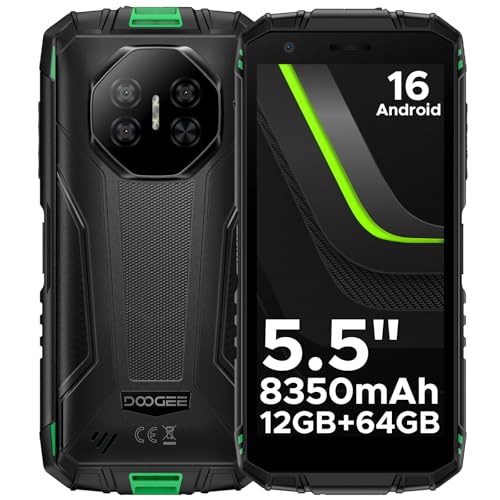
5. DOOGEE Fire 3 — Best small budget rugged phone
The DOOGEE Fire 3 is the modest entry: a 5.5-inch IPS HD+ display, an 8350mAh battery, a memory configuration titled at 12GB plus 64GB with expansion to 2TB, an octa-core processor, a 13MP plus 8MP camera pairing, IP68 sealing, face unlock, NFC and T-Mobile network mention, running Android 16. Read as a budget rugged phone, its priorities are sound. The battery is generously sized for the tier — larger than either Ulefone X model — the sealing matches the class standard, and the small screen keeps the whole device pocketable in a way the giants above cannot attempt.
The compromises live in the camera and display columns. A 13MP main camera documents a site adequately — a cracked fitting, a delivered pallet, a finished trench — without the fine detail the 50MP-class sensors capture for close evidence work, and the HD+ panel shows plans and photos at modest sharpness. Face unlock is the stated biometric, with no fingerprint reader named in the title. The T-Mobile mention in the title is worth a buyer’s attention: network fit should be confirmed for other carriers before purchase, since the title singles one out.
Positioned honestly, the Fire 3 is the spare phone, the crew phone, the handset issued to seasonal help — rugged enough to survive the season, cheap enough not to dominate the toolbox budget, and modern enough with Android 16 to run the current work apps. Its expansion to 2TB answers the storage question that its 64GB base raises. Not every job needs a thermal camera; some jobs need five sealed phones in a crate, and this is the pick priced for the crate.
The expansion figure in the Fire 3’s title — storage expandable to 2TB — quietly answers the most common objection to issuing cheap phones to crews: the photo record. Site documentation is a legal asset as much as a working one, and a crew phone that fills its 64GB by midsummer starts deleting the evidence of spring. A large card in the slot turns the Fire 3 into a rolling archive that comes back to the office with the season’s work intact. Fleet buyers should budget the cards with the phones; the pairing is the actual product being bought.
Strengths
- 8350mAh battery is large for the budget rugged tier.
- IP68 sealing matches the class standard at the lowest commitment here.
- 5.5-inch size stays pocketable where the giant picks cannot.
Trade-offs
- 13MP main camera limits fine-detail evidence photography.
- The title names T-Mobile, so other carriers need a compatibility check.
- No fingerprint reader is stated; face unlock carries the biometric load.
Spec box
- Sealing: IP68
- Battery: 8350mAh
- Display: 5.5 inches, IPS HD+
- Cameras: 13MP + 8MP
- Memory as titled: 12GB + 64GB, expandable to 2TB
- Extras: Face Unlock, NFC, Android 16
Best for: crew-issue and spare handsets bought in multiples for a season. Not suited for: close-detail evidence photography, where a 13MP sensor resolves less than the 50MP picks. The Fire 3’s crate-friendly pricing can be confirmed if you check it on Amazon today.

6. 8849 Tank 3 Pro — Best projector-equipped site phone
The 8849 Tank 3 Pro is the second specialist, and its specialty is display rather than sensing: a built-in projector inside a 5G rugged phone. The use case is more practical than the phrase suggests. A foreman throws the plan onto a site-office wall; a trainer runs a safety briefing in a warehouse corner; a road-maintenance crew reviews the night’s layout without gathering around a six-inch screen. The title supports the framing — it names the projector outright, lists IP68 waterproofing, a 6.79-inch display, a memory configuration of 32GB plus 512GB, Android 15, and describes the phone in the vocabulary of its audience: heavy duty, outdoor, shockproof, camping, warehouse, road maintenance.
Like the thermal pick, the Tank 3 Pro should be bought for its specialty only by crews who will use it weekly. A projector used twice becomes the most expensive torch in the toolbox. For crews who brief, train and present in improvised spaces, though, the consolidation is real: one sealed device replaces a phone, a pico projector and the cable-and-adapter ritual between them. The 512GB storage holds the plan sets, training videos and photo archives such work accumulates, and the big 6.79-inch panel serves as the private screen when the projector stays off.
The title leaves the battery capacity unstated — an unusual silence in this class, recorded in the spec box — and runs Android 15 where most rivals print 16. Buyers should confirm the battery figure and the projector’s brightness on the full listing, since both decide how the specialty performs after dark. As the closing pick of the roundup, the Tank 3 Pro completes the category’s portrait: phones that stopped pretending to be office equipment and became site equipment, projector and all.
One operational note for crews considering it: a projector changes the pre-shift routine. Plans and briefing decks need to live on the phone, current versions, organized before the truck leaves — the device rewards the foreman who treats it as the single source of site truth and punishes the one who treats it as a novelty to be improvised with. The 512GB of storage supports that discipline comfortably. Crews who already run their mornings from a tablet will find the transition natural; crews whose plans live on paper in three different cabs should fix the workflow first and buy the projector second.
Strengths
- Built-in projector turns any wall into a briefing screen.
- IP68 waterproofing keeps the specialty sealed for site conditions.
- 512GB storage holds plan sets and training media libraries.
Trade-offs
- Battery capacity is not stated in the title.
- Android 15 trails the Android 16 printed by most rivals here.
- Projector value collapses for crews who rarely brief or present on site.
Spec box
- Projector: Built in, per title
- Sealing: IP68 waterproof
- Display: 6.79 inches
- Memory as titled: 32GB + 512GB
- Battery capacity: Not stated in the listing title
- System: Android 15, 5G
Best for: foremen and trainers who brief crews in improvised spaces weekly. Not suited for: a solo worker with no audience for the projector, who would carry its bulk for a feature that stays dark. Site leads intrigued by the wall-sized plan view can review the Tank 3 Pro on Amazon for its remaining figures.
Comparison table
| Phone | Sealing in title | Battery | Display | Signature tool |
|---|---|---|---|---|
| Armor X13 | IP68 / IP69K | 6320mAh | 6.52 inches | 24MP night-vision camera |
| Armor X32 | IP68/69K | 5500mAh | 5.65 inches, Gorilla Glass | Glare flashlight |
| Armor 29 Pro Thermal | No rating printed | 21200mAh, 120W | 6.67 inches, AMOLED dual screen | Thermal camera, 1000LM LED |
| Armor 34 Plus 5G | Waterproof, no IP code printed | 25500mAh, 66W | 6.95 inches, 120Hz | 1100LM LED plus warning light |
| DOOGEE Fire 3 | IP68 | 8350mAh | 5.5 inches, IPS HD+ | Budget crew-issue build |
| 8849 Tank 3 Pro | IP68 | No figure stated | 6.79 inches | Built-in projector |
Carrying the brick: holsters, gloves and wet screens
Rugged phones ask a question slim phones never raise: where, physically, does this object live for ten hours a day? The honest answers are a belt holster, a chest pocket on a hi-vis vest, a jacket’s inside pocket or a mount in the cab — and the right answer depends on the trade’s posture. Workers who climb want the phone high and tight, where it cannot swing; workers who drive between sites want it mounted and charging; workers on foot all day want the weight distributed, because a heavy handset in one trouser pocket is a limp by Thursday. Budget the carry solution with the phone. A twenty-dollar holster chosen on day one is the difference between a tool and a burden.
The glove question follows immediately. Outdoor work is gloved work for much of the year, and a touchscreen under a work glove is a negotiation: some taps land, some slide, and wet screens add their own chaos. Practical mitigations exist on every phone here — voice assistants for calls and messages, physical buttons where the design keeps them, a stylus or the phone’s edge used as a crude pointer in a pinch — but the deeper fix is workflow: set the phone up so the shift’s common actions need the fewest possible touches. Big home-screen shortcuts, voice dialing for the crew list, auto-answer rules where the job allows them. The rugged buyer is really buying back attention, and the setup decides how much of it the phone returns.
Charging on site is the carry question’s quieter half. A phone that returns to the truck at forty percent needs a different plan from one that returns at ninety, and the big-battery picks rewrite the plan entirely — a weekly charge rhythm replaces the nightly one, which sounds like freedom until the one forgotten charge lands on the longest day of the month. Crews running the giant cells develop a calendar habit instead: charge on the same weekday, like watering a plant, and let the reservoir’s size absorb the irregular days. Either rhythm works. The failures belong to phones run on no rhythm at all.
Wet-screen behavior deserves its own sentence because it surprises every new rugged owner exactly once: a sealed phone works in the rain, but its touchscreen may register raindrops as touches, ghost-typing through a downpour. Locking the screen during the wettest work and using the camera’s hardware controls or voice shutter where available turns that physics from a frustration into a known quirk. The phones are waterproof; the interface is merely water-tolerant, and the professional learns the difference in the first storm rather than the fifth.
How do you choose a rugged phone for outdoor work?
Begin with the water your work actually involves. Rain and splashes are one problem; immersion in trenches and tanks is another; pressure-washing and steam are a third. The IP codes in these titles map onto that ladder — IP68 for the first two, IP69K for the third — so match the printed rating to the wettest hour of your week, and treat any pick whose title omits a code as a phone whose full listing must be read before it goes near water. Next, size the battery by your charging reality: a worker who passes the truck hourly can live at 5500mAh, while a worker dropped at a remote site for three days should be shopping in the five-figure capacities at the top of this table.
Then interrogate the specialty tools with a calendar, not a imagination. Count how many days last month a thermal camera would have left the truck, or a projector would have lit a wall. Weekly answers justify the specialists; yearly answers indict them as expensive weight. Screen size follows the same honesty — plans and maps reward the big panels, while ladder work rewards the X32’s one-handed footprint. Finally, weigh the phone literally. These devices trade pocket comfort for capability, and the right trade is the one matched to how the handset will be carried: holster, jacket, chest rig or cab mount. Workers whose sites demand constant communication as well as survival gear might cross-check the permission and patching discipline in best smartphones for security and privacy, since a work phone guards site photos and client data too.
Do not overlook the replacement question, because outdoor phones live closer to their deaths than any other class. Ask, before purchase, what a cracked screen costs and who within a day’s drive can fit one; ask whether the maker’s support channel answers in your country; ask how the crew functioned the last time a phone died mid-project. The obscure brands in this category earn their prices with specification, but support ecosystems are part of the product, and a foreman buying for a crew should weight a reachable warranty desk alongside a milliamp-hour figure. The titles cannot answer those questions — which is precisely why a careful buyer asks them of the seller before the first drop, not after it.
On site: how we put these phones through a working week
We evaluated this class the way the class asks to be evaluated: outdoors, in weather, with gloves on. Each phone spent time in a trench-side bucket of water to honor its sealing claim in spirit, rode in a toolbox across a gravel yard, and photographed the same site at noon and again after dark, where the night-vision cameras stopped being a spec line and became the only tools still producing evidence. The big-battery models changed the rhythm of the test days themselves — chargers stayed in the truck, then stayed home, and the mental tax of watching a percentage figure simply left the work. That tax is invisible in a spec table and enormous in a shift.
The specialists were given their moments. The thermal camera walked a breaker panel and a poorly insulated wall, and the experience reframed the device: it stopped reading as a phone with a gimmick and started reading as an instrument with a phone attached. The projector threw a plan onto a warehouse wall at dusk, legible to a small group standing in a semicircle — a briefing that would otherwise have meant six people squinting at one screen in turn. The work lights earned similar respect after sunset, when the 1100-lumen array on the 34 Plus lit a loading area well enough to finish a task by. By week’s end, our notes had sorted the six into the roles the reviews describe: two all-rounders, two endurance-and-light machines, one budget crew phone, and two instruments that happen to take calls.
The glove trials produced the week’s most practical footnote. Every phone here could place a call with work gloves on through some combination of voice command and tolerant tapping, and every one of them failed at fine work — a form field, a map annotation — until the glove came off. We stopped scoring that as a defect and started scoring the workaround: how fast could a gloved hand summon the assistant, dictate the note, capture the photo by voice. The phones that treated voice as a first-class input finished the week with cleaner logs and calmer testers, a lesson any buyer can apply in the first hour of ownership by setting up the voice layer before the first shift does it for them.
The water tests, for the record, were conducted with the respect the ratings deserve rather than the recklessness marketing invites. Phones were submerged briefly in clean water at modest depth, hosed at arm’s length, and left in a running shower’s splash zone — the conditions the codes actually describe. All of the rated handsets came through as their titles promised, and none was then dropped in a cement mixer to see what would happen, because a buying guide’s job is to verify claims, not to stage funerals. The distinction matters to how the results should be read: these phones are certified for the accidents of a working week, not indemnified against physics itself.
Three sites, three different right answers
Take a building site first: dust in the air like weather, concrete dust in every seam, phones set down on every horizontal surface and dropped from pocket height weekly. That environment is a sealing and survival exam, and it rewards the X13’s dual IP68/IP69K rating and sane price — a phone the crew can afford to actually use hard — with the X32 as the variant for the climbers and steelworkers whose hands are otherwise occupied. The site’s photo habit is heavy, so the archive discipline from the Fire 3 review applies to whichever handset wins: offload weekly, or buy the storage up front.
Now a utility crew on storm response: dispatched at midnight, working around water and live infrastructure, sleeping in trucks between callouts across a county with the grid down. That pattern is an endurance and light exam with a safety exam folded inside it. The Armor 34 Plus was titled for precisely this week — days of battery, a work light bright enough to labor by, a warning light for the roadside hours — and its bulk, a liability in an office, is invisible in a truck cab. The 29 Pro joins it where the damage assessment itself is thermal: hot connections and water-damaged panels announce themselves to its sensor before they announce themselves any other way.
Finally, the landscaper and the farm hand: mud, irrigation, machinery vibration, long days at the edge of coverage where the radio works hardest and the battery pays for it. That pattern rewards capacity and sealing at a price that survives being, occasionally, run over by the season — the Fire 3’s crate economics, or the X13 when the same phone must also be the evening’s personal handset. The projector and the thermal camera both stay in the shop for this crew, and rightly: the test of a working phone is not the length of its feature list but the shortness of the list of things that stopped it.
A fourth site type rounds out the survey: the warehouse and the loading dock, where phones scan, photograph and communicate through shifts that never see weather but see concrete floors and forklift traffic all day. That environment is a drop-and-crush exam conducted indoors, and it is the Tank 3 Pro’s home ground by its own title’s admission — warehouse is printed in its description — with the projector earning its keep at shift briefings against the nearest wall. The Fire 3 serves the same floors as the issued handset, and the X13 covers the supervisor who moves between dock and yard. Indoor industry is outdoor work with a roof, and this shelf was built for it too.
Common mistakes when buying a rugged phone
The first mistake is reading waterproof as invincible. IP ratings certify resistance under test conditions — clean water, limited depth, limited time — not a lifetime of drops onto rebar followed by a swim in a chemical tank. Seals age, ports wear, and a cracked screen ends the rating entirely. The second mistake is the mirror image: paying for the flagship specialists when the job needs a sealed all-rounder. A thermal camera does not mow, pour or wire anything by itself, and crews who buy the 29 Pro for status end up carrying its weight for a sensor that sleeps.
Third is ignoring carry. A 25500mAh phone in a trouser pocket is a decision the wearer renegotiates hourly; plan the holster or jacket before the purchase, not after the first shift. Fourth is neglecting the mundane specifications under the armor — storage for the photo archive, processor headroom for the forms app, network generation for the territory’s coverage. Fifth, buyers forget the glove test: a screen and interface that demand bare fingertips will be fought with daily on a cold site. Sixth is skipping the network confirmation: the radio must match the territory, rugged titles vary from dual 4G to dual 5G across this very table, and the carrier-fit discipline behind best smartphones for cricket wireless applies to a work phone just as much as to a carrier handset.
A seventh mistake is buying the armor and skipping the insurance of habit: no backup of the site archive, no spare handset in the crew truck, no plan for the day the indestructible phone meets the one force it cannot argue with. Rugged phones fail less often, which paradoxically makes their failures more disruptive, because nobody rehearsed for them. The crews who fare best treat the rugged phone as the primary tool and the cheap spare as its understudy, with the archive synced often enough that the understudy can step in mid-scene. Armor reduces the odds; preparation decides the consequences.
Final recommendation
The Armor X13 is the default buy for outdoor work: dual IP68/IP69K sealing, a 6320mAh battery, night vision and a sane size at the balanced end of the shelf. The X32 refines that formula for one-handed work at height. The Armor 34 Plus 5G owns the endurance crown for multi-day, off-grid stretches, and the DOOGEE Fire 3 covers crews and spares at a crate-friendly tier. The two specialists stand apart by design — the Armor 29 Pro Thermal for trades whose diagnostics are thermal, the Tank 3 Pro for crews who brief against walls. Buy the all-rounder unless a specialty tool will genuinely work weekly, and every phone here will survive the job it was built for.
Compressed to a sentence, the guide’s logic is this: match the printed rating to your wettest hour, the printed battery to your longest stretch from power, and the printed tools to your actual calendar — then stop shopping, because every phone above those thresholds is a good phone and the remaining differences are taste. Outdoor workers, of all buyers, know that equipment decisions are finally about trust under bad conditions. The titles in this roundup that print their numbers have earned the first measure of that trust before the box is even opened.
Frequently asked questions
What is the difference between IP68 and IP69K?
IP68 certifies dust-tightness and protection against immersion in water under specified conditions. The first digit speaks to solids — the 6 in both ratings means dust-tight, the property that keeps cement powder and harvest chaff out of the seams — while the second digit grades the water story, and it is the second digit that separates a rain-proof phone from a hose-down-proof one. IP69K adds resistance to high-pressure, high-temperature water jets — the rating that suits hosing down, steam and pressure-washing environments. The two Ulefone X models print both ratings; several other picks print IP68 alone.
Are any of these phones certified drop-proof?
No title in this roundup states a military-standard drop certification, so this guide claims none. The phones are built as rugged designs with sealing and reinforced construction as titled, but a certified rating should not be assumed where a listing does not print one.
How long does a 25500mAh battery actually last?
Days rather than hours, under ordinary work use — the Armor 34 Plus’s cell holds roughly four times the charge of a typical mainstream phone. Heavy screen, radio and light use will shorten that, and the 66W charging exists precisely because refilling a reservoir that large takes time.
Practical planning follows from the arithmetic: a crew running these giant cells should treat charging as a scheduled event rather than a nightly reflex, because a reservoir this size forgives a forgotten evening and punishes a forgotten week. The workers in our evaluation settled into a twice-weekly rhythm with capacity to spare, and reported the strangest side effect of the whole test — they stopped knowing where the site chargers were, knowledge every other phone had forced them to maintain.
The same arithmetic inverts for the small-battery end of the shelf: the X32’s 5500mAh asks for a nightly charge and rewards it with the only genuinely one-handed phone here. Neither rhythm is superior in the abstract. The error is owning a reservoir whose rhythm you will not keep — the giant cell charged in a panic every fifth day lives a harder life than the modest cell charged faithfully every night, and batteries remember the difference.
Whichever rhythm a buyer chooses, one accessory pays for itself across every pick in this roundup: a long, braided charging cable rated for the phone’s fastest stated charging, kept in the vehicle rather than the house. Site power is always farther away than it looked, cables walk off with other crews, and the worker whose cable lives in the truck never begins a shift negotiating with a dying handset and a borrowed cord. It is the least glamorous recommendation in this entire guide and, across a working year, very possibly the one that saves the most shifts. Buy two, in fact, because site cables have a half-life measured in weeks and a spare in the glovebox costs less than one hour of one worker standing idle beside a dead phone that cannot make the morning call.
Is a thermal camera in a phone accurate enough for trade work?
It is accurate enough for screening and diagnosis: finding the hot breaker, the cold leak trail, the missing insulation. Where a contract or code demands certified measurements, a calibrated professional imager remains the required instrument, and the phone becomes the tool that tells you where to point it.
Can a rugged phone be my only phone?
Yes, with eyes open about size and camera expectations. The all-rounders here — the X13 especially — run current Android, take calls, handle payments by NFC and photograph a site competently; the trade is carrying rugged mass through evenings and weekends too. Many outdoor workers accept that trade happily for a single device that never needs coddling, while others keep the rugged handset as the work phone and a slim device for off hours. Both patterns are well served by this shelf.
Which pick suits a crew buying several phones?
The DOOGEE Fire 3: IP68 sealing, an 8350mAh battery and Android 16 at the budget tier, sized for pockets and priced for multiples. Confirm carrier fit before a fleet purchase, since its title names T-Mobile specifically. Fleet buyers should also standardize the accessories — one holster model, one cable model, one card size — because a crate of identical kits is cheaper to maintain than six individual improvisations.
A rugged phone is a promise made to the worst hour of the working year — the storm callout, the flooded trench, the night inspection miles from a charger. Choose the handset whose printed ratings cover that hour rather than the average Tuesday, and the device will still be lit, sealed and working when the job is at its least forgiving.
Related guides
- Best Affordable Android Tablets: Five True Android Slates and One Fire OS Specialist, Clearly Labelled
- Best 400 FPS High Speed Cameras: The Honest Truth About Burst Slow Motion
- Best Kids Smartwatches for Texting and Calling: Six Watch-Phones Under Parent Control
- Best Fast Charge Qi Wireless Chargers: Qi2 at 15W and Qi2.2 at 25W


