What's inside
- Key Takeaways
- Quick Picks
- How We Chose These Picks
- How Should You Weigh Looks Against Speed and Size?
- How Do the Six Compare Side by Side?
- How Do You Choose a Portable Drive That Looks Right and Works Right?
- How Do You Carry and Care for a Portable Drive?
- What Mistakes Do Looks-Led Buyers Keep Making?
- How Does a Portable Drive’s Design Age Over Years of Travel?
- How Does a Portable Drive Fit a Presenting Life?
- What Role Does the Cable Play in a Drive’s Design?
- How Should a Portable Drive Be Packed Into a Working Bag?
- What Does a Drive’s Design Say at Work?
- How Do You Retire a Portable Drive Gracefully?
- Final Recommendation
- Frequently Asked Questions
- Related Guides
As an Amazon Associate I earn from qualifying purchases. This post may contain affiliate links at no extra cost to you.
gizmoverdict.com is reader-supported. When you buy through links on our site, we may earn an affiliate commission.
Where to buy: Each drive below is a complete portable drive linking to its own listing, and every design and specification claim here traces back to words in that listing’s title — a discipline that matters doubly in a guide about looks, because photographs flatter everything. Where a title names a material or a colour, this guide discusses it; where a title is silent about the shell, the review says so and judges the drive on its stated facts instead.
The search for the best protable ssds aesthetics — portable, in the spelling the technology uses — begins from an honest premise: a portable SSD is the one storage device that lives in public. It sits on the café table beside the laptop, it appears in the presenter’s hand, it rides in the photographer’s pocket and the consultant’s blazer, and it is seen, handled and judged in a way no internal drive ever is. Choosing one partly for its design is not vanity; it is the same reasoning that chooses a notebook’s cover or a watch’s case, applied to the object a working life carries most.
But aesthetics, handled responsibly, has rules, and this guide’s rule is strict: design claims come from listing titles or they do not appear. From the six titles here, the honest harvest is this — a metal body on the Vansuny, aluminium in iron gray on the Transcend ESD265C, a Titan Gray finish on the Samsung T7, an IP65 water and dust rating shaping the Amazon Basics drive’s sealed look, and two drives, the WD My Passport SSD and the Crucial X9, whose titles say nothing about their shells at all. Those silences are printed in the spec boxes, not filled with adjectives, because a guide about appearances should be the last place where appearances are invented.
One exclusion frames the set. Empty enclosures — the handsome empty shells sold for a drive you supply yourself — crowd this search, and they are not picks here, because an enclosure is a promise of storage rather than storage. Every pick below is a complete portable drive, ready to carry files the day it arrives, and judged on the complete object’s design: its material where stated, its size class, its connection, and the way its stated facts add up to something you would be pleased to put on the table.
Key Takeaways
- Design judgements here come only from titles: metal on the Vansuny, aluminium in iron gray on the Transcend, Titan Gray on the Samsung T7.
- Two titles — WD’s My Passport SSD and Crucial’s X9 — state nothing about the shell, and their reviews judge them on speed, capacity and connection instead.
- Stated speeds span 430MB/s to 2000MB/s across the set, each quoted from its own title and none borrowed between picks.
- Capacities run 250GB to 1TB; the 256GB and 250GB drives suit a curated carry, the terabyte drives a working library.
- Empty enclosures are not picks; every drive here arrives complete and ready to use.
- A portable drive’s looks matter most where it works in public — but the cable, the capacity and the backup plan still outrank the finish.
Quick Picks
| Pick | Badge | Why it earns its place |
|---|---|---|
| Vansuny 250GB Portable SSD | The Metal Carry | A metal body stated in the title, USB 3.1 Gen2 at 430MB/s; the pocket drive whose material is its headline. |
| Amazon Basics Portable SSD 1TB | The Sealed Performer | 2000MB/s stated with IP65 water and dust resistance; the fastest title here wearing a weather-sealed design. |
| Transcend ESD265C 500GB | The Aluminium Slim | Aluminium in iron gray at 1050MB/s over Type C; the set’s most completely described finish. |
| WD My Passport SSD 256GB | The Quiet Pocket Drive | Up to 540 MB/s over USB 3.1 from a long-running portable line; its title leaves the shell undescribed. |
| Samsung T7 1TB Titan Gray | The Grey Standard | Titan Gray named in the title, up to 1,050MB/s over USB 3.2 Gen 2, a terabyte aboard. |
| Crucial X9 1TB | The Unassuming Terabyte | Up to 1050MB/s over USB-C with a title that talks specification, not styling. |
How We Chose These Picks
The set was built to test a thesis: that a portable drive can be chosen for design without surrendering rigour, provided the design evidence is held to the same standard as the speed evidence. So the filter required complete drives from makers with support operations, stated connections and speeds in their titles, and — where the guide discusses looks — a material or colour the title itself names. Six drives passed, and they divide instructively: three with design facts in their titles, one whose design fact is a sealing rating, and two whose titles are pure specification, retained deliberately so the guide can demonstrate how to judge a drive handsomely when the listing refuses to describe its face.
That last discipline deserves emphasis, because the temptation in an aesthetics guide is to describe every product’s photograph. Photographs are marketing’s home ground: lighting, angles and retouching can make any shell look considered. Titles, by contrast, are commitments. When Transcend prints “Aluminum” and “Iron Gray”, those words are part of what is being sold and can be held against the parcel that arrives. When a title prints nothing about the shell, the honest review covers the drive’s stated virtues and leaves its face to the buyer’s own eyes on the listing page. This guide holds that line in every review below.
Performance was kept in proportion throughout. A portable drive’s stated speed governs how a working day feels — the ingest, the handover, the backup before the train — and the set spans 430MB/s to a stated 2000MB/s, a range wide enough that design should be the tiebreaker between drives of suitable pace, not a substitute for pace. The verdicts therefore name, for each pick, the carrier it suits: the pocket, the presentation bag, the photographer’s field kit, the desk that travels.
How Should You Weigh Looks Against Speed and Size?
Begin with the unglamorous order: capacity for the library, connection for the machines you plug into, speed for the size of file you move, and design as the quality that decides between the survivors. That order sounds like it demotes aesthetics to a tiebreaker, and in a sense it does — but a tiebreaker between near-equal drives is exactly where design belongs, and in this set the survivors are near enough that the tiebreaker does real work. A drive carried daily is handled thousands of times; the material in the hand and the finish on the desk are not decorations on the purchase, they are the purchase’s daily texture. The reviews below therefore give each drive’s stated design facts a full hearing, after its stated working facts have earned it the hearing.

Vansuny 250GB Portable SSD — The Metal Carry
The Vansuny’s title ends on its material — “Metal” is the last word the listing offers before it breaks off — and for this guide that single word is a feast. A metal shell changes a pocket drive’s whole character: it feels cool and dense in the hand, it shrugs off the scuffs that make plastic look tired within a season, and it reads, on a table, as an instrument rather than an accessory. At 250GB with USB 3.1 Gen2 and a stated 430MB/s, the drive around that shell is a curated carry rather than a library — the presentation, the portfolio, the current project’s working set — and the pairing is coherent: a small, beautiful object for the files that travel to be seen.
Judged as a workhorse it asks the usual questions of its class. The stated speed is the set’s most modest, adequate for documents, photographs and presentations, and not the tool for shuttling video rushes. The capacity is the set’s joint-smallest, which confines it to owners whose travelling set is genuinely curated. But those are specifications, and this pick’s argument is that for the right carrier the specification is sufficient and the material is the delight. A consultant whose drive appears in client meetings, a photographer whose pocket drive is handled daily — for them, the metal body is not the garnish on the purchase. It is the purchase, with a competent drive inside it.
- Capacity: 250GB, as stated in the listing title
- Connection: USB 3.1 Gen2, as stated in the listing title
- Stated speed: 430MB/s, as stated in the listing title
- Shell: metal, as stated in the listing title
Strengths
- A metal body stated in the title — the material that ages most gracefully in a pocket.
- A coherent proposition: curated capacity, adequate stated pace, distinguished shell.
- The drive most likely in this set to be complimented on a table, which is the guide’s brief.
Trade-offs
- The set’s most modest stated speed; bulk video work belongs with faster picks.
- 250GB confines it to a curated travelling set, not a library.
- The title breaks off at its material claim, so finer design details await the listing page itself.
Best for: a professional carrying a portable drive that works in public and is handled daily, seeking a metal-bodied curated carry.
Not suited for: a videographer moving rushes, where stated pace and capacity both point elsewhere in this set.

Amazon Basics Portable SSD 1TB — The Sealed Performer
The fastest title in this guide belongs to its most utilitarian badge: Amazon Basics, 1TB, 2000MB/s speeds, USB 3.2 Gen 2, IP65 water and dust resistance. That last fact is its design story, and it is a genuine one. An IP65 rating describes a sealed object — a drive built to keep weather and grit out — and sealed objects have a recognisable aesthetic: few seams, no ornament, a form that follows its protection. On a building site, a boat, a field survey or a festival production, that sealed plainness is not the absence of design. It is design doing its oldest job, which is fitness for the life the object will actually lead.
The stated 2000MB/s doubles the next fastest titles here, and paired with a terabyte it makes this the set’s field-work answer: ingest the cards, back up the day, and let the weather do what it wants. No material is named in the title, so this guide claims none; the shell’s virtues are the ones the rating certifies rather than the ones a photograph suggests. For the desk-bound aesthete it may read as plain. For the carrier whose drive lives outdoors, it is the only pick in the set whose looks and whose survival are the same feature.
- Capacity: 1TB, as stated in the listing title
- Connection: USB 3.2 Gen 2, as stated in the listing title
- Stated speed: 2000MB/s, as stated in the listing title
- Protection: IP65 water and dust resistance, as stated in the listing title; shell material not stated in the listing title
Strengths
- The set’s highest stated speed by a wide margin, at a full terabyte.
- IP65 sealing gives its plain design a functional elegance and a field-ready constitution.
- A complete working title: capacity, pace, connection and protection all stated.
Trade-offs
- No material or colour is named; buyers choosing by finish must judge from the listing itself.
- Its sealed, utilitarian look serves the field better than the boardroom table.
- The stated peak needs a host port that can feed it to be more than a headline.
Best for: field and outdoor work seeking the fastest stated drive in a weather-sealed terabyte.
Not suited for: a buyer choosing primarily by finish and material, which this title declines to describe.

Transcend ESD265C 500GB — The Aluminium Slim
If this guide has a cover star, it is the drive whose title does the most descriptive work: Transcend ESD265C, 500GB, 1050MB/s, Aluminum, Type C, Iron Gray. Material and colour are both committed to print, and together they describe a recognisable object — a slim aluminium drive in a dark grey finish, the portable-storage equivalent of a well-cut grey jacket. Aluminium in this role is not merely pretty: it is the material of thin, rigid shells, and a drive built from it can be genuinely pocketable in a way chunkier designs are not, while the iron gray finish hides the micro-scratches of travel better than bright colours do.
The working facts support the styling. A stated 1050MB/s over a Type C connection is the modern mainstream at full strength — fast ingests, quick handovers — and 500GB is the considered traveller’s capacity: the current projects, the portfolio, the working library, without the archive. Transcend’s long presence in portable storage stands behind the ESD line’s support material. Of the six picks, this is the one where the design brief and the specification brief are in complete agreement, and its verdict writes itself: the drive for a carrier seeking an object on the table that looks like the work is under control.
- Capacity: 500GB, as stated in the listing title
- Connection: Type C, as stated in the listing title
- Stated speed: 1050MB/s, as stated in the listing title
- Shell: aluminium, iron gray, as stated in the listing title
Strengths
- The set’s most completely described finish: material and colour both stated in the title.
- Aluminium construction suits a genuinely slim, pocketable form.
- Full mainstream pace at a stated 1050MB/s over Type C.
Trade-offs
- 500GB is a working set, not an archive; the library lives elsewhere.
- A light finish shows its virtues best when kept reasonably clean, like any good jacket.
- A terabyte of carry points to the T7 or the X9 below.
Best for: a design-conscious professional seeking a slim aluminium drive in a sober finish for daily public carry.
Not suited for: an archive-sized travelling library, where the terabyte picks carry the day.

WD My Passport SSD 256GB — The Quiet Pocket Drive
The My Passport name has been on portable drives longer than most of this set’s makers have sold them, and its title here is a study in understatement: WD, 256GB, My Passport SSD, external portable drive, USB 3.1, up to 540 MB/s. Not one word about the shell. This guide therefore does something an aesthetics article must be willing to do — it declines to describe the drive’s appearance, notes the title’s silence in the spec box, and judges the pick on the considerable merits its title does state.
Those merits are a pocketable capacity from a line built entirely around portable storage, a stated pace adequate for the document-and-photograph traffic that is most portable drives’ real work, and Western Digital’s support depth behind a component that will be plugged into other people’s computers in other people’s offices. There is a design argument available even here, made honestly: a drive from a long-running portable line tends toward the unobtrusive, because its makers know it will live in pockets and presentation bags rather than on a pedestal. But that is inference about a family, labelled as such, and the buyer choosing this pick for its face should do the choosing with their own eyes on the listing. Its face, whatever the listing shows, arrives with the set’s most experienced portable pedigree behind it.
- Capacity: 256GB, as stated in the listing title
- Connection: USB 3.1, as stated in the listing title
- Stated speed: up to 540 MB/s, as stated in the listing title
- Shell: Not stated in the listing title — judge the finish from the listing itself
Strengths
- A portable-only product line with a long public record in exactly this role.
- A stated pace well matched to document and photograph carry.
- Western Digital’s support scale behind a drive that travels between machines.
Trade-offs
- The title describes no material or finish, so the aesthetics judgement is entirely the buyer’s own.
- 256GB is a curated carry; libraries need the terabyte picks.
- Its stated speed sits mid-set; bulk movers will feel the difference.
Best for: a traveller seeking a pocket drive from a veteran portable line, content to judge its looks from the listing page.
Not suited for: a purchase that asks the guide — or the title — to settle the design question on the buyer’s behalf.
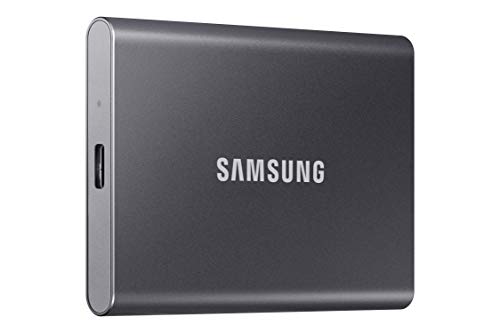
Samsung T7 1TB Titan Gray — The Grey Standard
The T7’s title performs a small act of confidence: among its specifications it names its colour. Titan Gray is not a specification, and Samsung prints it anyway, because for this drive the finish is part of the product’s identity — a sober, metallic grey that has become the default silhouette of the modern portable SSD in offices everywhere. At 1TB with USB 3.2 Gen 2 and a stated up to 1,050MB/s, the working facts match the presentation: this is the drive that appears on the table in client meetings, in lecturers’ kits and in journalists’ pockets, and its grey is the colour of not having to think about it.
That ubiquity is itself an aesthetic property worth naming. Some objects look right by standing out; the T7 looks right by belonging — to the laptop’s own palette, to the desk’s, to the bag’s. A terabyte aboard ends the capacity conversation for most carriers, the stated pace is the mainstream’s full strength, and Samsung’s support depth covers the ownership years. If the Transcend is this set’s tailored jacket, the T7 is its grey flannel standard: less individual, more universal, and chosen by a carrier seeking the design question answered once, well, and permanently.
- Capacity: 1TB, as stated in the listing title
- Connection: USB 3.2 Gen 2, as stated in the listing title
- Stated speed: up to 1,050MB/s, as stated in the listing title
- Finish: Titan Gray, as stated in the listing title; shell material not stated in the listing title
Strengths
- A named finish in the title — Titan Gray — at a full terabyte.
- Full mainstream stated pace over the current USB generation.
- The portable market’s most established silhouette, with support depth to match.
Trade-offs
- Its material is not stated in the title; only the colour is committed to print.
- Ubiquity cuts both ways: it will match every desk and distinguish none.
- Field work that calls for sealing points to the IP65 pick above instead.
Best for: a professional seeking the definitive grey terabyte for daily public carry and client-facing work.
Not suited for: a brief that calls for a drive standing out, or for one rated for weather and rough handling outdoors.

Crucial X9 1TB — The Unassuming Terabyte
The X9’s title talks like an engineer: Crucial X9, 1TB, portable SSD, up to 1050MB/s, USB 3.2, USB-C, external solid state drive — and then breaks off, mid-word, before any word about design. It is the set’s second silent shell, and the review follows the same honest protocol as the WD’s: the finish is the buyer’s to judge from the listing, and the pick stands or falls on its stated facts. Those facts are strong ones. A terabyte at a stated 1050MB/s over USB-C is the modern portable mainstream complete, from a maker whose storage support operation is among the industry’s deepest.
There is, though, a legitimate design reading of a specification-first product, and it is this: the X9 is pitched at the carrier who treats a portable drive as infrastructure. Its aesthetics, such as the listing presents them, are the aesthetics of the unremarkable — an object bought to be used hard, plugged into everything, and replaced without ceremony when its years are served. In a guide about looks, that stance deserves its representative, because a great many real buyers hold it, and hold it rationally. Pair it with the household’s backup plan, carry it without anxiety, and let the Transcend and the T7 fight for the table’s compliments; the X9 will be in the bag, full of the library, doing the job.
- Capacity: 1TB, as stated in the listing title
- Connection: USB 3.2, USB-C, as stated in the listing title
- Stated speed: up to 1050MB/s, as stated in the listing title
- Shell: Not stated in the listing title — judge the finish from the listing itself
Strengths
- A full terabyte at the mainstream’s stated pace over USB-C.
- Crucial’s support depth behind a drive bought to be used without ceremony.
- A complete working specification in the title; nothing about the job is ambiguous.
Trade-offs
- No design facts in the title at all; the aesthetics-led buyer gets no guidance from it.
- The title itself is truncated in the listing, so finer details await the product page.
- It makes no sealing or material claim to compete with the set’s described finishes.
Best for: a carrier seeking a workhorse terabyte whose virtues are all in its specification.
Not suited for: a buyer choosing a drive as a designed object, who should take the described finishes above.
How Do the Six Compare Side by Side?
| Drive | Capacity | Stated speed | Design fact in title | Character |
|---|---|---|---|---|
| Vansuny Portable SSD | 250GB | 430MB/s | Metal body | The distinguished pocket carry |
| Amazon Basics Portable SSD | 1TB | 2000MB/s | IP65 sealed | The field performer’s plain strength |
| Transcend ESD265C | 500GB | 1050MB/s | Aluminium, iron gray | The tailored slim drive |
| WD My Passport SSD | 256GB | Up to 540 MB/s | Not stated | The veteran line’s quiet carry |
| Samsung T7 | 1TB | Up to 1,050MB/s | Titan Gray finish | The grey standard at a terabyte |
| Crucial X9 | 1TB | Up to 1050MB/s | Not stated | The specification-first workhorse |
The design column is the table’s lesson: three drives commit a material or colour to print, one commits a sealing rating, and two commit nothing — and the guide’s confidence in describing each drive’s looks follows that column exactly, neither further nor shorter.
How Do You Choose a Portable Drive That Looks Right and Works Right?
Sequence the decision the way the guide has modelled it. Capacity first, from the travelling library’s real size: the curated carry lives at 250GB to 500GB, the working library at 1TB, and confusing the two produces either a beautiful drive that is always full or a capacious one bought for a pocket that never fills it. Connection second: USB-C hosts are now the default audience, and every pick here speaks some generation of USB, but the stated pace only materialises when the host’s port can feed it — the Amazon Basics drive’s 2000MB/s headline in particular deserves a host check before it decides a purchase.
Speed third, matched to the file sizes of the carrier’s actual week. Presentations, documents and photographs forgive the set’s modest figures entirely; video and disk images do not, and the stated numbers in the titles — 430, 540, 1050, 2000MB/s — divide the set into those two worlds cleanly. Only then, with the working specification settled, should design cast its vote, and by then the vote is usually between two or three survivors whose stated finishes can be compared like with like: metal against aluminium, grey against grey, sealed against slim.
And keep one proportion in view throughout: the cable. A portable drive’s daily elegance is half its own and half its cable’s — the length that reaches the port without draping, the connector that matches both ends of the journey. No title in this set describes its cable, so the point is raised here as a buyer’s check on the listing page rather than a claim about any pick: the most beautiful drive in the world looks foolish dangling from a port by an awkward lead, and the fix costs less than any other upgrade in this guide.
How Do You Carry and Care for a Portable Drive?
A portable drive’s enemies are mundane: the drop, the crush, the cable yanked at an angle, the bag’s damp corner. The carrying habits that defeat them are equally mundane. Give the drive its own pocket or sleeve so keys and coins do not engrave it — a courtesy owed doubly to the described finishes in this set, whose whole point is arriving unmarked. Coil its cable loosely rather than wrapping it tight around the shell, a habit that fatigues both the cable and the finish it rubs against. Eject it properly before unplugging, every time, because a filesystem interrupted mid-write does not care how handsome its drive is.
At the desk, the habits continue. Let a metal or aluminium shell do its quiet thermal work unobstructed rather than buried under papers during a long copy. Keep the drive’s firmware and the host’s drivers in the same twice-a-year glance these guides recommend for all storage. And maintain the discipline that makes a portable drive a tool rather than a talisman: it is a copy, never the only copy. The library it carries should exist somewhere else as well, because the most elegant object in the bag is still an object in a bag, subject to everything bags are subject to.
Owners who keep these habits find their drives age the way good luggage ages — scuffed at the corners of a life well travelled, sound in every way that matters. Owners who do not, discover that neither aluminium nor sealing nor a famous nameplate negotiates with gravity. The care is the design’s second half, supplied by the buyer.
What Mistakes Do Looks-Led Buyers Keep Making?
The first is judging from the photograph alone — the error this guide’s title-only rule exists to prevent — because listing photography is lit, angled and retouched to a standard no parcel maintains. Judge the finish from the stated material and colour, and treat photographs as illustrations of shape, not evidence of quality. The second mistake is the mirror image: dismissing design entirely and buying a specification, then carrying for years an object that irritates the hand and the eye daily. Both errors are failures of proportion, and the sequence in the choosing section is the cure for each.
Third, buyers mistake an empty enclosure for a drive — the exclusion this guide opened with — seduced by a beautiful shell that arrives holding nothing. Fourth, they buy the fastest stated figure for a host port that cannot feed it, and blame the drive for the negotiation. Fifth, they let the portable drive become the library’s only home, converting a design choice into a data risk. And sixth, they forget the cable, the sleeve and the eject button, the unglamorous trio that decides whether the beautiful object stays beautiful. Aesthetics, properly understood, includes the whole artefact and its whole life — which is why this guide has insisted on discussing both.
How Does a Portable Drive’s Design Age Over Years of Travel?
Materials keep their promises differently, and the titles here let the point be made from evidence. Metal and aluminium shells — the Vansuny’s and the Transcend’s stated constructions — tend to age by polishing at the edges and gathering fine scratches that read as patina, the way a good instrument case does. A sober colour like the T7’s Titan Gray or the Transcend’s iron gray hides the process longest, which is a practical argument for grey that has nothing to do with fashion. A sealed drive like the Amazon Basics pick ages by indifference: its design never promised beauty, so travel cannot take any away, and its fifth year looks like its first.
The silent-shell drives age unrecorded, which is its own small lesson. An owner choosing the WD or the Crucial for their stated virtues will judge their fifth years by those virtues — still quick enough, still capacious enough, still supported — and the finish will have become whatever the road made of it, unmourned either way. There is no wrong way to age among these, provided the expectation was set at purchase. The disappointment cases are always the mismatched ones: the fashion purchase asked to be a field tool, the field tool asked to grace a boardroom. Match the object’s stated character to the life it will lead, and time treats all six of these kindly.
How Does a Portable Drive Fit a Presenting Life?
Consider the presenter, whose drive has the most public job in this guide. It travels in a blazer or a slim bag, emerges in rooms where first impressions are being formed about everything at once, and connects — this is the part nobody rehearses — to other people’s machines, in front of an audience, under time pressure. For that life, a portable drive’s design virtues are specific: a shell that looks deliberate rather than incidental, a size that sits flat and still on a lectern, a connection that mates with the room’s laptop without a ceremony of adapters. The Transcend’s aluminium slimness and the T7’s grey universality serve this life precisely, because both read as equipment chosen by a professional rather than equipment that happened to be in the drawer.
The presenting life also punishes two failures that have nothing to do with looks and everything to do with why looks must never be bought alone. The first is the drive that arrives nearly full, so the day’s deck must be negotiated onto it in the corridor; the capacity discipline of the choosing section exists for that corridor. The second is the drive carrying the only copy, so that a lost bag becomes a lost quarter’s work; the backup rule exists for that bag. A presenter’s drive should be the most replaceable object they carry — a beautiful, capacious, well-backed-up copy of things that live safely elsewhere — and judged by that standard, its beauty is not indulgence but professionalism: it signals that the person presenting has their material, and themselves, in order.
There is a final presenting detail, small enough to be overlooked and regular enough to matter: the drive will be handed to other people. Technicians, hosts, colleagues will hold it, plug it, pass it back. An object that feels well-made in a stranger’s hand does quiet reputational work in that moment, the same work done by a firm handshake or a clean slide. It cannot be specified in a title, but it can be chosen for — in materials that feel like something, in finishes that arrive unmarked — and it is the most human argument in this entire guide for taking a portable drive’s design seriously.
What Role Does the Cable Play in a Drive’s Design?
Every photograph of a portable drive commits the same polite fiction: the cable is absent, or arranged in a sculptural curve no desk sustains. In life, the cable is half the object’s presence — the part that drapes, tangles, reaches or fails to reach — and a guide about how these drives look owes it a section, with the honesty caveat stated once: no title in this set describes its cable, so what follows is buyer’s method, not product claim. Check the listing for what is included, its length and its connectors at both ends, because those three facts decide whether the drive sits elegantly beside the laptop or dangles from its port like a Christmas ornament.
Length is a genuine design variable. A short cable keeps a drive tidy on a desk and in a photograph, and strands it when the port is on the far side of a large laptop or the back of a desktop under the desk. A long cable reaches everything and drapes over everything. Experienced carriers solve the dilemma outside the product entirely, with a second cable bought for the bag — one short, one long — which is the cheapest aesthetic upgrade available to any pick in this set and the one most likely to be noticed daily. Connector discipline matters as much: a drive and cable that match the host at both ends, without adapters, preserve the clean line the drive’s designer intended and the buyer paid for.
Care closes the section. Cables fatigue where they bend at the connector, and a fraying cable makes a fine drive look neglected before it makes it unreliable. Replace a tired cable without sentimentality; it is the one part of a portable drive’s appearance that is consumable, and treating it as such keeps the whole artefact — drive, cable, sleeve — looking like the considered object the buyer chose on the first day.
How Should a Portable Drive Be Packed Into a Working Bag?
The bag is a portable drive’s true environment, and its design either survives the bag or does not. The principles are few and physical. Separation first: the drive rides in its own pocket, sleeve or compartment, away from the keys, coins and tools that engrave shells and the adapters that scratch finishes — the described finishes in this set, aluminium and grey alike, keep their looks exactly as long as this rule is kept. Pressure second: a drive packed under a full water bottle or a stack of hardback books lives a compressed life, and while solid state storage tolerates pressure better than any spinning ancestor, its connector and shell are still physical things with physical limits.
Temperature and damp form the third principle. A bag left in a hot car or a wet hallway is an environment no rating in this guide was designed around — even the IP65 pick’s sealing addresses splashes and dust, not afternoons in a sauna of a boot — and the habit of carrying the drive on the person, in the blazer or the hand luggage, rather than in the checked or abandoned bag, protects both the object and the data in a single gesture. The fourth principle is the oldest in these guides: the bag is losable, so its contents must be copies. Pack the drive as if the bag will one day not come home, because one day a bag does not, and the drive packed on that assumption is a disappointment where the other kind is a disaster.
None of this requires equipment beyond a sleeve and a habit. It is the unglamorous half of portable aesthetics — the half that decides how the object looks in year three rather than in the listing — and it is entirely within the buyer’s control, which is more than can be said for most of what this guide has discussed.
What Does a Drive’s Design Say at Work?
Objects at work are read the way handwriting once was: unfairly, instantly and with real consequences for how their owners are regarded. A portable drive is a peculiarly legible object because it is chosen — nobody is issued one by fate — and because it appears at moments of professional exposure, the handover, the presentation, the client visit. The reading it invites is not about expense. A modest drive, clean, cabled neatly and arriving with room on it, reads as competence; an expensive one, scuffed, tangled and full, reads as its opposite. Design in this arena is therefore less about the object purchased than about the state it is kept in, which returns the subject, once again, to the habits sections of this guide.
There is a collective version of the same point for teams. A production company, a consultancy or a photography studio that standardises its field drives gains more than a bulk discount: it gains a recognisable kit, drives that can be told apart at a glance by colour or label, cables that always match, and a handover ritual that strangers to the team can follow. The T7’s ubiquity serves exactly this standardisation in many real teams, and its Titan Gray becomes, in effect, a uniform. Uniforms are an aesthetic decision too — the decision that the work, not the equipment, should be the individual thing in the room.
None of this should be inflated. Nobody wins a client because of a solid state drive, and a guide that claimed otherwise would forfeit its credibility on every other page. But the small signals accumulate in working life, and a drive is one of the few that is entirely within its owner’s control. Choose it deliberately, keep it well, and let it say the one true sentence available to it: that the person carrying it has their material in order.
How Do You Retire a Portable Drive Gracefully?
Portable drives retire more often than internal ones, because their lives are harder and their capacities are outgrown in public. The graceful retirement has three steps, and the first is the migration: the library moves to the successor, verified file by file at the level of the folders that matter, while the old drive still works perfectly — retirements arranged from strength, not from failure, are the only calm kind. The second step is the decision about the old drive’s next role, and portable drives have honourable second careers: the backup that lives in a drawer, the handover drive for large files, the relative’s first portable storage, each role matched to a capacity that was generous once and is adequate still.
The third step is the one most often skipped, and it matters most for the drives in this guide precisely because they travelled. A portable drive has been plugged into other people’s machines in other people’s offices; its contents are a map of its owner’s working life. Before it changes hands — sold, given, recycled — it should be wiped by the maker’s secure route, not merely emptied by deletion, because deletion on flash storage is a promise the hardware does not keep. The wipe is the final act of ownership, and doing it properly is the difference between retiring a tool and scattering an archive.
Handled this way, a portable drive’s whole biography is coherent: chosen from stated facts, carried with care, backed up without exception, and closed with its contents deliberately erased. The aesthetics that opened the guide turn out to have been the first chapter of a longer virtue — attention — and attention, paid at the beginning, the middle and the end of an object’s life, is the closest thing consumer technology has to elegance.
One closing proportion is worth stating before the verdict, because aesthetics guides rarely state it: the drive will be looked at for seconds and used for years. That is not an argument against choosing it beautifully — the seconds recur daily, in rooms that matter — but it is an argument for the order this guide has kept throughout, in which the working facts earn the hearing and the finish casts the deciding vote between drives that have earned it. A purchase made in that order satisfies both the eye and the calendar, and it is the only order in which a guide about appearances can honestly claim to have served its reader rather than its subject. The reader who follows it will end up carrying an object that was chosen the way it will be used — attentively, daily, and in the open — which is, in the end, the whole of what good design asks of the person who buys it. Keep the sleeve, keep the backup, keep the cable honest, and the object will keep its side of the bargain for the whole of its travelling life. That reciprocity — care given, service returned — is the quiet contract underneath every durable object a person carries. Honour it, and even a pocket drive becomes a small lesson in keeping things well over years of daily travel.
Final Recommendation
Let the stated finishes lead where they speak. For the daily public carry, the Transcend ESD265C is this set’s most complete answer — aluminium, iron gray, full mainstream pace — with the Samsung T7 as the terabyte alternative in its definitive Titan Gray. The Vansuny’s metal body serves the curated pocket carry whose owner values the object itself; the Amazon Basics drive takes the field, where its IP65 sealing and the set’s fastest stated figure make its plainness a virtue. And the two silent titles close the guide with its method intact: the WD My Passport SSD and the Crucial X9 are strong portable drives whose looks their listings leave to your own eyes, and they should be bought — if they are bought — for the considerable virtues their titles do state. A portable drive is the rare component that is also an accessory; choose it with both halves of that identity in view, and it will earn its place in the bag every day it travels.
Frequently Asked Questions
How do I keep a light-coloured or metal finish looking new?
Give the drive its own sleeve or pocket so keys and coins cannot engrave it, wipe it occasionally with a dry soft cloth, and coil its cable loosely instead of wrapping it around the shell, where grit in the cable’s weave acts as sandpaper over a season. Aluminium and metal finishes forgive more than most, and grey finishes like Titan Gray and iron gray hide the micro-marks of travel longest — but every finish in this set stays handsome in proportion to the separation it is given in the bag.
Does a metal portable SSD perform better than a plastic one?
A metal shell’s advantages are tactile and thermal rather than electronic: it feels denser, resists scuffs, and can help shed heat during long copies. The drive’s stated speed comes from its electronics and connection, not its case. In this set the metal Vansuny actually carries the most modest stated figure, which is the honest relationship between material and pace — choose metal for the hand and the ageing, not for speed.
Why do two picks have no design description?
Because their listing titles state none. The WD My Passport SSD and Crucial X9 titles give capacity, connection and speed but no material or colour, and this guide does not invent descriptions from photographs. Judge those two drives’ finishes with your own eyes on their listing pages, and their specifications from the titles quoted here.
What does IP65 mean for the Amazon Basics drive?
It is a sealing rating stated in the title: the drive is built to resist dust and water ingress to that standard, which suits field, site and outdoor work. It shapes the design too — a sealed object has few openings and a plain, purposeful form. It does not make the drive indestructible, and drops and crushing remain the owner’s problem, as with every pick here.
Is 250GB enough for a portable drive?
For a curated travelling set — the current projects, the portfolio, the presentation shelf — yes, and the two smallest picks here are built for exactly that discipline. For a working library or a backup role, take a terabyte. The deciding evidence is your current travelling folder’s size, projected forward, with the same headroom habit this guide recommends for every drive: keep a fifth clear.
Can I build a prettier drive with an empty enclosure instead?
You can assemble one, and handsome enclosures exist — but an enclosure is not a drive, which is why none appears as a pick here. The assembled route makes you responsible for the pairing, the thermals and the support. Every pick in this guide arrives as a complete, warranted object whose stated facts describe the whole thing you carry.
Which pick suits a photographer’s field kit?
Two answers divide by condition. In controlled conditions, the Transcend’s aluminium slimness and stated 1050MB/s suit the pocket-and-ingest rhythm of a shoot day at 500GB. In weather, the Amazon Basics drive’s IP65 sealing and terabyte at a stated 2000MB/s take the kit. The T7 is the middle answer — a terabyte, Titan Gray, and the market’s most familiar silhouette.
Related Guides
Complete the storage picture with our guides to internal NVMe drives across the generations, the 500GB to 1TB M.2 band for single-slot machines, and reviving an older computer with a small SATA drive.