What's inside
- Key Takeaways
- Quick Picks
- How Did We Choose the Best High Heat SD Cards for Hot, Always-Writing Duty?
- What Does Heat Actually Do to a Memory Card?
- Industrial or High Endurance: What Do the Title Words Promise?
- Why Does This Guide Print No Temperature Range for Any Pick?
- Which Devices Live Hot Enough to Need This Category?
- How Does Loop Recording Turn Endurance Into Arithmetic?
- How Do the Six Cards Compare Side by Side?
- How Should You Set Up and Schedule a Card in a Hot Device?
- How Do You Inspect a Card That Lives in the Heat?
- What Mistakes Cook Cards and Lose Footage?
- Final Recommendation
- Frequently Asked Questions
- Related Guides
As an Amazon Associate I earn from qualifying purchases. This post may contain affiliate links at no extra cost to you.
gizmoverdict.com is reader-supported. When you buy through links on our site, we may earn an affiliate commission.
Where to buy: Each card below links to a verified Amazon listing, and this guide quotes only what those listings’ titles actually state. That discipline matters doubly in this category, because heat ratings are the easiest specification in the card world to imply and the hardest to find printed — and, as the section on temperature figures explains, not one title in this set prints a number.
The search for the best high heat sd cards usually begins after a failure: a dash cam that recorded nothing during the one journey that mattered, a card pulled from a sun-baked car in August and found corrupted, a security camera at a hot site whose footage ends in June. Heat is the slow enemy of flash memory. A card on a windshield lives through cabin temperatures no desk drawer ever reaches, cycling between cold dawns and fierce midday soak, writing continuously the whole time. Ordinary consumer cards are simply not built or tested for that life, and their failures arrive quietly, as missing files rather than dramatic smoke.
The six picks here divide by the language of their titles into two families. Three carry the words Industrial Grade or Industrial in the title — Viofo’s pair and the Miofive — words makers use for cards aimed at embedded, automotive and surveillance duty. Three carry High Endurance positioning, including a Kingston card from an explicitly Industrial line in full-size SD format and a SanDisk endurance card that is the mainstream benchmark of the category. That split, industrial versus endurance, is the real decision in this guide, and it is made from title language alone because that is the evidence a buyer can actually inspect.
One honesty note belongs at the front. Operating temperature ranges — the minus-forty-to-eighty-five figures of engineering datasheets — appear in none of these six titles. This guide therefore claims no temperature range for any pick, and instead shows you exactly where those figures live and how to verify them before a card is trusted to a hot enclosure. Any guide that prints precise thermal limits for cards whose listings omit them is inventing its authority.
Key Takeaways
- Heat kills cards quietly through missing files and corruption, most often in dash cams parked in the sun.
- Three picks carry Industrial wording in their titles; three carry High Endurance positioning, and the distinction is explained from that title language.
- No title in this set states an operating temperature range, so no range is claimed for any pick here.
- Five picks are microSD cards aimed at dash cams; one, the Kingston, is a full-size industrial SD card for embedded and legacy slots.
- Endurance in a hot, always-writing device is a replacement-schedule question as much as a purchase question.
- Capacity needs are modest in loop recording; write endurance and heat tolerance decide survival.
Quick Picks
| Pick | Badge | Why it earns its place |
|---|---|---|
| VIOFO 512GB Industrial Grade microSD | Largest industrial pick | Industrial Grade wording with the biggest capacity here, for long retention in a dash cam. |
| VIOFO 128GB Industrial Grade microSDXC | Industrial at event size | The same industrial positioning at the capacity most dash cams actually cycle through. |
| Kingston Industrial SD 8GB | Full-size industrial card | An industrial-line, full-size SD card with stated U3 V30 A1 classes for embedded slots. |
| ROVE Industrial 256GB Micro SD | Industrial with reader bundle | Industrial wording and 256GB, with a USB 3.0 reader named in the listing for quick offloads. |
| Miofive 128GB Industrial Grade Micro SD | Dash-cam specialist | Industrial Grade endurance positioning from a dash cam maker, at the category’s standard size. |
| SanDisk 256GB High Endurance microSD | Mainstream endurance benchmark | The endurance line from the biggest name in the category, with adapter included in the listing. |
How Did We Choose the Best High Heat SD Cards for Hot, Always-Writing Duty?
The first filter was vocabulary with meaning. Cards entered this set only when their titles carried one of two explicit signals: industrial positioning, which makers reserve for ranges designed and tested for harsh embedded environments, or high-endurance positioning, which signals flash and firmware chosen for relentless rewriting. A plain consumer card with neither signal, however fast, had no business in a guide about heat and endurance, because speed was never the failure mode being solved.
The second filter was duty match. Five of the six picks address the dash cam and surveillance world directly in their titles, because that is where high heat and continuous writing meet in ordinary life: a camera behind a windshield, in a parked car, in the sun. The sixth, Kingston’s full-size industrial card, serves the other hot habitat — embedded devices, kiosks, industrial controllers and older equipment with full-size slots in warm enclosures — where the same physics applies behind a panel instead of a windshield.
The third filter was a refusal. Any temptation to rank these cards by a temperature range was set aside, because no title here states one. Instead the picks are ranked by the strength of their title evidence, their capacity fit for loop recording, and their makers’ specialisation. Where the actual thermal figures are needed — and for a genuinely hot installation, they are — the guide explains how to pull them from the maker’s datasheet and what to compare when they get there.
Capacity was judged by loop-recording logic rather than by the usual bigger-is-better instinct. A dash cam overwrites its oldest footage continuously, so capacity buys retention time, not total storage: how far back the loop reaches before the present overwrites the past. The spread here, from the Kingston’s deliberately small 8GB for embedded logging up to 512GB for long-retention dash cam use, reflects that logic honestly.
A word about what was excluded, since exclusions reveal a guide’s standards. Standard consumer microSD cards — including excellent fast ones designed for phones and drones — were left out entirely, however attractive their speeds, because their titles claim nothing about endurance or industrial construction and this category’s failures are endurance failures. High-heat buying that starts from a speed chart ends with a fast card dying on schedule; starting from positioning and documentation ends with a card that is still recording in its third summer.
What Does Heat Actually Do to a Memory Card?
Start with the environment, because it is harsher than intuition suggests. A parked car’s cabin in summer sun can climb far beyond the day’s outdoor temperature, and a dash cam sits at the worst seat in that cabin: high on the windshield, in direct sun, generating its own operating warmth while writing without pause. The card inside experiences that peak daily, then cools overnight, then repeats. Thermal cycling — the expansion and contraction of materials across thousands of hot-cold swings — stresses solder joints, contacts and the card’s own layered construction in ways a stable desk environment never does.
Inside the flash itself, heat accelerates the physics of forgetting. Flash cells store data as trapped charge, and charge leaks faster when hot; retention margins that look generous at room temperature shrink in a heat-soaked device, particularly on cells already worn by heavy rewriting. A dash cam card lives at the intersection of both insults: maximum write wear and maximum temperature, applied simultaneously, for years. That intersection is the entire reason endurance and industrial product lines exist.
The failure signature matters for how owners respond. Heat-and-wear failures rarely announce themselves with a dead card on day one. They arrive as a corrupted clip, a gap in a journey’s recording, a camera that reports card errors on hot afternoons and behaves on cool mornings. Owners who wait for total failure before replacing a card will, by definition, discover the failure on the footage that mattered. The working defence is scheduled replacement, covered later in this guide, and choosing a card whose design brief matches the environment in the first place.
Cold deserves a footnote so the picture stays honest. The same windshield that bakes in August can sit below freezing in January in northern climates, and flash memory generally tolerates cold storage better than cold writing under load. Industrial product families are designed across both ends of that swing, which is another reason their datasheets publish a range rather than a single impressive number. A card chosen for a hot climate that also survives winter cycling without complaint is simply a card whose range was read before purchase — the ritual this guide keeps recommending.
Industrial or High Endurance: What Do the Title Words Promise?
Industrial, in card language, describes a product family engineered for embedded and harsh-environment deployment: wider design margins, components selected for temperature resilience, and testing regimes aimed at devices that run unattended for years inside other machines. When a title says Industrial or Industrial Grade, the maker is claiming that design brief. It is a claim about construction and testing philosophy rather than a single measurable figure, which is precisely why the actual operating range still needs confirming in the datasheet before a card is sealed into a hot enclosure.
High Endurance describes a different emphasis: flash memory and firmware chosen to survive a very large number of write cycles, aimed at devices that record continuously — dash cams, security cameras, body cameras. Endurance cards are the mainstream answer to the rewriting problem, and the better ones are also built with hot cabins in mind, but the title words promise write stamina first. A card can be high-endurance without being an industrial product, and the distinction decides which pick fits which device.
Reading the six titles in this guide with those definitions produces a clean map. The two Viofo cards and the Miofive claim industrial grade outright and aim at dash cams; the ROVE claims industrial wording with a bundle aimed at car use; the Kingston is an industrial-line card that happens to wear its full specification — UHS-I, U3, V30, A1 — in its title; and the SanDisk is the endurance specialist, from the maker whose endurance line defined the mainstream category. Choose industrial for hostile enclosures and embedded duty, endurance for the family dash cam, and verify thermal figures either way.
Why Does This Guide Print No Temperature Range for Any Pick?
Because none of the six listing titles states one, and the discipline of this guide is that specifications come from evidence a buyer can check. Temperature ranges are real, published figures — they live in manufacturer datasheets, where a card’s operating and storage ranges are printed alongside its endurance ratings. The correct pre-purchase ritual for a hot installation is short: open the maker’s datasheet for the exact model, find the operating range, and compare it against the environment the card will actually endure, remembering that a windshield in summer is a far harsher address than the weather report suggests.
That ritual matters because the cost of guessing wrong is asymmetric. A card whose true range covers the environment will serve for years; a card guessed into an enclosure beyond its design brief will fail on the hottest week of the year, which is also the week unattended equipment is least supervised. Two minutes with a datasheet converts that gamble into an engineering decision, and no summary table — including the one in this guide — should be allowed to substitute for it.
The same logic applies to endurance hours and write-cycle claims, which likewise live in documentation rather than in these titles. This guide’s spec boxes therefore separate what each title proves from what each buyer should verify, pick by pick. Treat the verify lines as the most useful sentences in those boxes: they are the difference between a card bought on evidence and a card bought on adjectives.
Which Devices Live Hot Enough to Need This Category?
The dash cam is the ambassador, but the habitat is wider. Trail and security cameras mounted on sunlit walls bake through every afternoon. Vehicle telematics boxes sit under dashboards in commercial fleets parked on open lots. Kiosks, vending controllers and ticketing machines hold their storage inside sealed cabinets that behave like ovens by midday. Agricultural and construction equipment carries logging hardware through dust and heat that would embarrass a family car. In every case the pattern is identical: a small flash card, a hot box, and a write workload that never asks permission.
Home equipment joins the list more often than owners expect. A security camera above a south-facing door, a video doorbell in full sun, a garage-based recorder in a metal-roofed outbuilding — all of them push a card’s environment well past the conditions a consumer card was validated under. The giveaway question is simple: if you touched the device’s housing at three on a summer afternoon, would you flinch? If yes, its card lives in this guide’s territory, whatever the device is called.
Recognising the habitat matters because the purchase logic inverts there. In a cool, occasionally-written device, almost any reputable card is fine and speed is a pleasant luxury. In a hot, always-written one, the hierarchy flips: positioning and endurance first, documented thermal range second, capacity third, and speed a distant fourth. Owners who keep shopping by the cool-device hierarchy in a hot device are the ones whose footage develops mysterious gaps every August.
How Does Loop Recording Turn Endurance Into Arithmetic?
A loop-recording device writes its card full, then overwrites the oldest material forever. That means the card’s total lifetime write volume is not a guess but a multiplication: the device’s daily data rate times the days in service. A dash cam writing tens of gigabytes a day accumulates in a year what a camera card might write in a decade. Endurance engineering is the maker’s answer to that multiplication — flash and controllers chosen so the arithmetic stays survivable for years rather than months.
Capacity enters the same equation from the kind side. A larger card in loop service spreads those writes across more flash cells, so each cell endures fewer cycles for the same recorded hours. This is the one sense in which size genuinely helps survival in a hot dash cam: not by tolerating heat, but by diluting wear. It is also why the replacement interval for a small card in heavy service should be shorter than for a large one doing the same job.
The practical translation is a maintenance number an owner can actually hold: pick the card by positioning, pick the size by retention, then set the replacement interval by mileage and climate rather than by waiting for symptoms. Symptoms, in this category, are just failures that have started introducing themselves politely.

VIOFO 512GB Industrial Grade High Endurance microSD Card — Largest industrial pick
Viofo builds dash cams, and this card is its industrial-grade answer to the environment those cameras live in: a microSD card whose title pairs Industrial Grade with High Endurance and a very large 512GB capacity. The pairing of the two claims is the substance of the pick. Industrial positioning speaks to construction for harsh duty; endurance speaks to surviving the rewrite cycle of a camera that never stops writing; and the capacity stretches the loop’s memory from hours into days of retained driving.
That retention is the practical gift. A dash cam’s loop overwrites its oldest files, so capacity decides how far into the past the camera still remembers. With 512GB aboard, an incident noticed days later — the scrape discovered in a car park, the near-miss a passenger mentions at the weekend — still exists on the card instead of having been overwritten by Tuesday’s commute. For commercial drivers and families sharing one car across many journeys, that long memory is the feature the whole purchase is really about.
The title states neither a speed class nor a temperature range, and this guide claims neither on its behalf. Viofo’s own documentation carries both, and a buyer installing this card in a genuinely punishing environment — a vehicle that lives outdoors in a hot climate — should read the operating range there before the first summer. Within the evidence available, the card’s industrial and endurance claims, from a maker whose cameras create the very conditions in question, make it the flagship pick of this set.
Fleet operators will read this pick at a different scale, and it holds up there too. A vehicle fleet standardising on one industrial card across dozens of dash cams gains uniform behaviour, uniform replacement intervals and a single datasheet to file against the fleet’s operating conditions. The 512GB size suits fleets whose vehicles return to base weekly rather than nightly, because the loop still holds the whole tour when the card is finally pulled.
It also suits the set-and-forget owner best when paired with a calendar habit: a card this capacious invites long service, and long service in a hot windshield deserves a planned replacement interval rather than an open-ended one. Buy it for the retention, schedule its retirement by the season count, and the card’s size becomes a virtue instead of an excuse to forget it exists.
- Capacity: 512GB
- Positioning: Industrial Grade, High Endurance — the title states both
- Intended device: Dash cam, per the title
- Speed class: Not stated in the listing title — verify with Viofo documentation
- Operating temperature range: Not stated in the listing title — verify with Viofo documentation
Strengths
- Industrial and endurance claims combined in one title
- 512GB stretches loop retention across days of driving
- Made by a dash cam manufacturer for its own environment
Trade-offs
- Speed class absent from the title
- Thermal range must be confirmed in documentation
- Large capacity can encourage open-ended service life
Best for: a dash cam in a hot-climate vehicle, retaining days of loop footage between reviews
Not suited for: an embedded enclosure whose thermal limits must be certified from a packet

VIOFO 128GB Industrial Grade High Endurance microSDXC Card — Industrial at event size
The same industrial-grade, high-endurance positioning as its larger sibling, at the 128GB capacity most dash cams cycle through comfortably. For the typical two-channel dash cam recording daily driving, 128GB holds a generous stretch of journeys before the loop turns over, and the card’s design brief — industrial construction for the windshield environment — matches the job without paying for retention most owners will never scroll back to.
There is a replacement-economics argument for this size that deserves air. Endurance in continuous service is consumed over time, and a card at this capacity costs less to treat as a scheduled consumable: replace it on a planned interval, keep the retired card as an emergency spare, and the dash cam always runs on fresh media. Owners who buy the largest card often resist replacing it precisely because it was the expensive one; the 128GB size removes that psychological friction from the maintenance schedule.
As with its sibling, the title offers no speed class and no temperature figure, so both belong on the documentation checklist before installation in an extreme environment. The microSDXC designation in the title confirms the card’s family and file-system expectations, which any modern dash cam handles natively. Judged on its stated claims, this is the balanced industrial pick: the right positioning, at the size the average windshield actually needs.
Two-channel cameras recording front and rear views write considerably faster than single-channel units, and this size handles that doubled appetite without the loop shrinking to a single day. Owners who add a rear camera later often discover their original card’s retention has quietly halved; starting at 128GB with industrial positioning leaves headroom for exactly that upgrade path.
It is also the sensible first card for an owner upgrading from whatever consumer card came to hand when the dash cam was fitted. The swap is five minutes, the formatting happens in the camera, and from that day forward the recording chain’s weakest link has been replaced with a component designed for the exact heat and rewrite pattern that destroyed the old one’s reliability.
- Capacity: 128GB
- Positioning: Industrial Grade, High Endurance — per the title
- Card family: microSDXC, per the title
- Intended device: Dash cam, per the title
- Operating temperature range: Not printed in the title — check Viofo documentation
Strengths
- Industrial positioning at the category’s standard size
- Affordable to treat as a scheduled replacement
- Direct upgrade path from consumer cards in dash cams
Trade-offs
- Retention measured in days less than the 512GB pick
- No speed class printed in the title
- Thermal figures live in documentation only
Best for: a daily-driven dash cam in a sun-exposed car on a planned replacement cycle
Not suited for: a vehicle requiring a week of retained footage between reviews
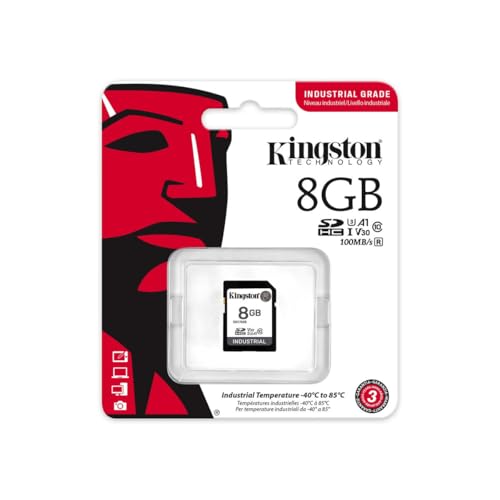
Kingston Industrial SD Card (SDIT/8GB) — Full-size industrial card
This pick breaks the set’s pattern deliberately: a full-size SD card, from Kingston’s Industrial line, at a small 8GB capacity, with the most complete specification title of the six — up to 100MB/s, High Endurance, UHS-I with U3, V30 and A1 classes all printed. Its habitat is not the windshield but the enclosure: industrial controllers, kiosks, point-of-sale hardware, medical and test equipment, and older devices whose full-size slots sit inside warm cabinets and plant rooms where consumer cards quietly give up.
The small capacity is a clue to the intended work, not a shortcoming. Embedded devices log, buffer and boot; they do not hoard video. Eight gigabytes of industrial-grade, endurance-rated storage is a deliberate engineering choice for equipment that writes modest amounts relentlessly in warm places, and the stated A1 class speaks to the application responsiveness such devices need. Buying this card for a camera would miss its point entirely; buying it for the equipment it describes is exactly right.
Kingston’s industrial pedigree carries weight in this niche, where buyers spec components for machines expected to run unattended for years and where a card failure means a service visit rather than a swapped spare. The title still omits a temperature range — the datasheet for the SDIT line is where that figure must be confirmed against the enclosure’s actual conditions — but of all six picks, this one’s documentation trail is the one industrial buyers will find most familiar.
Procurement for equipment like this runs on documentation, and the SDIT model code in the title is the thread to pull: it identifies the exact industrial variant whose datasheet carries the operating range, endurance figures and ordering details a maintenance department files. Consumer cards rarely offer that traceability; industrial lines exist because some buyers cannot accept its absence.
For owners of legacy equipment in hot locations, it also solves a format problem the microSD picks cannot: many industrial and older devices accept only full-size SD media, and adapters have no place inside a sealed enclosure expected to run for a decade. A native full-size industrial card is not a nostalgic choice in that world; it is the only correct one.
- Capacity: 8GB
- Format: Full-size SD card
- Read speed: Up to 100MB/s, per title
- Classes: UHS-I, U3, V30, A1 — the title states them
- Operating temperature range: Not printed in the title — check Kingston’s SDIT documentation
Strengths
- Industrial line built for embedded, unattended duty
- Most complete class specification in this set
- Native full-size format for legacy and industrial slots
Trade-offs
- 8GB is useless for video retention
- Thermal range still requires the datasheet
- Specialist card, not a general-purpose spare
Best for: embedded and industrial equipment with full-size slots in warm enclosures
Not suited for: a dash cam or any device that records hours of video
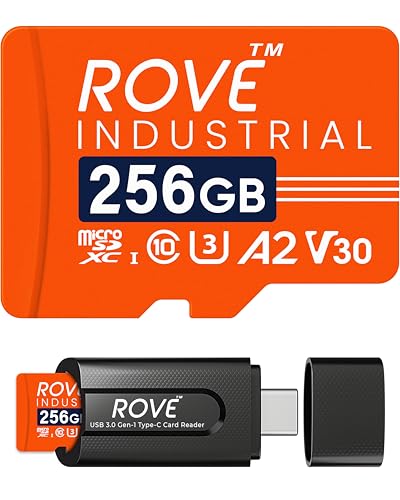
ROVE Industrial 256GB High Endurance Micro SD Card — Industrial with reader bundle
ROVE sells dash cams to the mainstream car market, and its Industrial card pairs industrial wording with high-endurance positioning at 256GB — the middle capacity of this set, and arguably its sweet spot, with retention measured across many journeys and no forced step up to the largest card here. The listing also names a USB 3.0 card reader in its title, a bundle detail worth reading correctly: the reader is an included accessory for moving footage to a computer, not a separate recommendation, and its presence makes the same-evening review habit easier to keep.
That habit is where this pick quietly shines. Endurance cards fail gradually, and the earliest evidence lives in the footage itself — a glitch here, a truncated clip there. A reader in the box lowers the friction of pulling the card and actually looking, which turns inspection from a chore into a two-minute routine at the desk. Cards that get inspected get replaced on time; the bundle serves the maintenance schedule, not just the unboxing.
The title states no speed class and no thermal figure, so the same documentation discipline applies as with the Viofo pair: ROVE’s own materials carry the operating range, and a buyer in a genuinely extreme climate should confirm it there. What the title does establish — industrial positioning, endurance intent, generous capacity, car-camera pedigree — covers the mainstream hot-car use case completely.
The 256GB size also fits the holiday pattern neatly: a two-week road trip recorded daily, reviewed on return, with the loop still holding the first days when the family gets home. Retention that survives a whole trip turns the dash cam from an incident recorder into a travel archive, and several owners will find that is the footage they actually rewatch.
For a family car running a ROVE camera, there is an ecosystem tidiness to choosing the same maker’s card: one support door to knock on when the camera reports a media error, and no ambiguity about whether the card was ever intended for the device. That tidiness has practical value when troubleshooting happens in a driveway rather than a workshop.
- Capacity: 256GB
- Positioning: Industrial, High Endurance — per the title
- Bundled item: USB 3.0 card reader named in the title
- Speed class: Not stated in the listing title — verify with ROVE documentation
- Operating temperature range: Not stated in the listing title — verify with ROVE documentation
Strengths
- Industrial endurance positioning at a mid-large capacity
- Included reader encourages regular footage inspection
- Same-maker pairing with ROVE dash cams simplifies support
Trade-offs
- No class or thermal figure in the title
- Reader is an accessory, not part of the card’s endurance
- Less retention than the 512GB Viofo pick
Best for: a family dash cam set up for generous retention and easy footage review
Not suited for: a certified industrial installation specced from datasheets alone

Miofive 128GB Industrial Grade Micro SD Card — Dash-cam specialist
Miofive’s entry repeats the set’s most reassuring title pattern — Industrial Grade, High Endurance, dash cam named outright — at 128GB, the capacity around which the dash cam market has standardised. There is value in that orthodoxy. A card sized to the category’s norm is the easiest to replace on the road, the easiest to reason about in retention terms, and the size around which camera makers tune their loop and file-splitting behaviour.
The maker matters here as with the Viofo pair: Miofive designs dash cams, so its card is specced by a company whose own products create the heat-and-rewrite environment the card must survive. When a camera maker puts its name on media, it is underwriting the combination with its own support reputation, and owners of Miofive cameras gain the same single-door troubleshooting benefit described for the ROVE pick.
The familiar gaps apply: no speed class and no temperature range appear in the title, and both should be confirmed in Miofive’s documentation before the card is trusted to an extreme installation. For the ordinary hot car — which is, to be clear, already an extreme environment by consumer-card standards — the title’s industrial-grade endurance claim is the relevant evidence, and it is stated plainly.
New drivers and rideshare work are its other natural habitats. A card recording a learner’s every lesson, or a working driver’s every shift, accumulates hours at a pace family motoring never reaches, in a car that sits in the sun between fares and lessons. Industrial-grade positioning at a rotation-friendly size is precisely the specification that workload writes for itself.
Consider this the rotation-friendly pick. At 128GB and mainstream positioning, buying two and alternating them at each inspection spreads wear across both cards and guarantees a known-good spare is always in the glovebox. In continuous-recording duty, a maintained pair of good cards beats a single heroic card every season of the year.
- Capacity: 128GB
- Positioning: Industrial Grade, High Endurance — the title states both
- Intended device: Dash cam, per the title
- Speed class: Absent from the title — confirm through Miofive documentation
- Operating temperature range: Absent from the title — confirm through Miofive documentation
Strengths
- Industrial-grade claim from a dash cam maker
- Standard capacity simplifies replacement and rotation
- Pairs naturally into a two-card maintenance system
Trade-offs
- Title omits speed class and thermal figures
- Retention shorter than the larger picks
- Newer name than the category’s oldest brands
Best for: a dash cam run on a two-card rotation in a sun-exposed vehicle
Not suited for: long-retention recording between monthly reviews

SANDISK 256GB High Endurance microSD Card + Adapter — Mainstream endurance benchmark
SanDisk’s High Endurance card is the reference point against which this whole category is usually measured, and its title is refreshingly plain: 256GB, High Endurance, microSD, with an adapter included. No industrial wording — and that absence is itself information. This is the endurance specialist for the mainstream: flash chosen and rated for the relentless rewriting of dash cams and home security cameras, sold by the maker with the deepest flash pedigree in the set, without claiming the embedded-industry brief the Viofo, ROVE, Miofive and Kingston cards claim.
For the typical hot car, that brief is usually enough. The failure mode of a family dash cam is overwhelmingly write wear compounded by heat, and an endurance-rated card from a top-tier maker addresses it directly, with the support network and documentation quality that make verification easy. The 256GB capacity gives the loop a long memory, and the included adapter serves the card’s second life in full-size slots and readers around the house.
The honest boundary is the one the title itself draws: an installation that is genuinely industrial — sealed enclosures, plant environments, certified operating ranges — belongs with the industrial picks and their datasheets instead. SanDisk’s documentation will state this card’s operating range, and it should be read before any extreme deployment, but the card’s positioning is endurance for recording devices, and judged on that positioning it is the most proven name in this guide.
Home security duty deserves its sentence as well. A camera watching a drive or a garden writes through every hour of daylight-triggered motion, often from a housing baking on a sunlit wall, and its footage is wanted exactly when something has gone wrong. An endurance card from a maker of this standing is the calm, default answer for that post.
It is also the pick most likely to be bought correctly by a non-specialist. There is no class arithmetic to perform and no exotic vocabulary to decode; the name states the job. For a relative’s car, a first dash cam, or a home security camera on a sunny wall, that clarity prevents the most common purchasing error in the category, which is fitting a fast consumer card and discovering endurance the hard way.
- Capacity: 256GB
- Positioning: High Endurance — the title states it
- Included item: Adapter named in the title
- Speed class: Not printed in the title — check SanDisk documentation
- Operating temperature range: Not printed in the title — check SanDisk documentation
Strengths
- Endurance line from the category’s biggest maker
- 256GB gives the loop a long memory
- Clear positioning a non-specialist can buy correctly
Trade-offs
- No industrial claim for certified enclosures
- Thermal range requires the documentation
- Adapter adds a contact layer best avoided in-camera
Best for: mainstream dash cams and home security cameras in hot spots
Not suited for: an industrial enclosure with an industrial-rating requirement
How Do the Six Cards Compare Side by Side?
| Card | Capacity | Format | Title positioning | Stated classes |
|---|---|---|---|---|
| VIOFO Industrial Grade 512GB | 512GB | microSD | Industrial Grade, High Endurance | Not in title |
| VIOFO Industrial Grade 128GB | 128GB | microSDXC | Industrial Grade, High Endurance | Not in title |
| Kingston Industrial SDIT | 8GB | Full-size SD | Industrial, High Endurance | U3, V30, A1 |
| ROVE Industrial 256GB | 256GB | Micro SD | Industrial, High Endurance | Not in title |
| Miofive Industrial Grade 128GB | 128GB | Micro SD | Industrial Grade, High Endurance | Not in title |
| SanDisk High Endurance 256GB | 256GB | microSD + adapter | High Endurance | Not in title |
Notice what the table cannot show: a temperature column, because no title supplies the figures for one. That empty column is the most honest part of this comparison, and the datasheet check it points to is a genuine step in buying for heat, not a formality. Read the table instead for what it does prove: positioning, format and the one fully-specified card, the Kingston, whose classes suit an entirely different habitat from the five dash cam cards around it.
How Should You Set Up and Schedule a Card in a Hot Device?
Format the card in the device that will use it, then record a full test journey or a full day of surveillance before trusting the installation. Check the footage end to end — beginning, middle and the most recent files — because a card that writes its first hour badly has told you everything at no cost. Only after that shakedown does the card graduate to carrying footage that matters, and the shakedown date becomes day one of its logged service life.
Then put replacement on the calendar rather than on a hunch. Continuous dash cam duty in a hot climate consumes endurance at a pace that makes annual replacement a sane default for high-mileage vehicles, with inspection at every season change: pull the card, review recent footage, look for gaps, glitches or camera-reported errors, and shorten the interval at the first symptom. Retired cards are not waste; demote them to low-stakes duty in cool devices and keep the hot slots filled with fresh media. A household running several hot devices will find a single shared replacement month — every card inspected, the oldest replaced — easier to keep than six separate anniversaries nobody remembers.
Heat management around the device helps the card as well. A sunshade when parked, a camera position that catches some airflow, and avoiding leaving the device recording for days in a sealed, baking vehicle all shave the peaks the card must survive. None of these habits substitutes for the right card, but each one stretches whichever card is fitted.
Parking-motion features deserve a specific mention, because they extend the card’s working day into the vehicle’s parked hours and often into the hottest, stillest air the cabin ever holds. An owner who enables parking surveillance should shorten the card’s replacement interval accordingly and favour the industrial-positioned picks, since the card is now doing oven duty as well as driving duty. The feature is valuable; it simply bills the card for the privilege, and the bill should be budgeted knowingly.
How Do You Inspect a Card That Lives in the Heat?
Inspection is a five-minute ritual with a card reader and a screen. Pull the card during a routine moment — a fuel stop on a long trip, the first weekend of a new season — and open the footage at three points: the oldest file the loop still holds, a file from the middle of the card’s recent life, and the newest recording. Play each for half a minute. Smooth playback at all three points is a healthy card’s signature; stutter, corruption or a missing stretch at any point is the card asking to be retired while it is still asking politely.
Check the loop’s memory while you are there. Note the date of the oldest retained file and compare it with what the card’s capacity should hold at the device’s settings. A loop that has silently shortened — remembering three days where it once remembered six — can signal failing cells being quietly mapped out of service. The camera will not announce this; only the arithmetic does, which is why the check belongs in the ritual rather than in a troubleshooting session after an incident.
Finish by formatting the card in its device before returning it, and log the date and the card’s number in whatever notebook or phone note tracks the vehicle or the equipment. That tiny archive converts every future question — how old is this card, when did it last pass inspection — from archaeology into a lookup. In hot-duty recording, the logbook is a component of the system, as real as the card itself.
What Mistakes Cook Cards and Lose Footage?
The founding mistake is fitting a fast consumer card because it was fast. Speed classes say nothing about surviving years of rewriting in a hot cabin, and consumer cards in dash cams fail on exactly that schedule — gradually, then on the important journey. The second mistake is trusting adjectives over documentation for genuinely hot installations: an enclosure build deserves datasheet figures, and a title that omits them is an instruction to go and read them, not to assume the best.
The third mistake is set-and-forget ownership. A card can be the right card and still be a worn card eighteen months later; owners who never inspect footage discover wear from the one clip that is missing. Related to it is the oversized-card trap, where a huge card’s cost makes its owner reluctant to retire it on schedule. Endurance is a consumable with a gauge, and the gauge is time in service under heat, not the card’s price or size.
A fourth mistake is mixing the maintenance populations: pulling the good card from the family car to rescue a forgotten trail camera, then refitting whichever card comes to hand. Hot-duty cards should be a closed fleet, numbered and logged, swapped only within their own rotation. The moment cards drift between hot and cool duty at random, the logbook stops meaning anything and the replacement schedule dissolves into guesswork again.
Finally, beware counterfeit and no-name endurance claims in this category above all others.
The entire value of these picks is invisible engineering — flash grade, controller behaviour, testing — and invisible engineering is exactly what a fake cannot be checked for at the kitchen table. Buy from sellers who stand behind the product, and treat a too-cheap industrial claim as a claim about marketing rather than about silicon.
Final Recommendation
Sort by habitat first. For a dash cam in a hot car, the industrial-grade Viofo pair and the Miofive carry the strongest title claims for the environment, with capacity choosing between them: 512GB for long retention, 128GB for a planned replacement rhythm. The ROVE adds a reader that makes inspection easy at 256GB, and the SanDisk High Endurance remains the mainstream benchmark for owners whose heat problem is a family car rather than an industrial site. For embedded and legacy equipment in warm enclosures, the Kingston Industrial is the only pick speaking that language natively, in the full-size format those slots require.
If the budget forces an order of operations, spend first on the device that records the material you could least afford to lose — usually the car that carries the family — and let cooler, lower-stakes devices inherit the retired cards as the rotation cascades down. That cascade is the quiet economy of endurance media: a card too old for a windshield in July is still perfectly serviceable in a cool indoor camera, and deliberate rotation gets years of honest work from every purchase.
Whichever card goes in, verify its operating range in the maker’s datasheet, format it in its device, test it at full length, and write its replacement date somewhere you will actually see it. Heat does not negotiate and wear does not announce itself; the owners whose footage survives August are the ones who treated a small card in a hot box with engineering respect from the day it was fitted.
Frequently Asked Questions
Why does no card here list a temperature range?
Because none of the six listing titles prints one. Operating ranges are published in manufacturer datasheets, and this guide points you there rather than inventing figures. For a hot installation, that datasheet check is a real step, not a disclaimer. Look for two numbers while you are there: the operating range, which governs the card at work, and the storage range, which governs it at rest in the same hot place.
Is an industrial card always better than a high endurance card?
No. Industrial positioning targets harsh embedded environments and unattended duty; high endurance targets relentless rewriting in recording devices. A family dash cam is usually served completely by the endurance brief, while a sealed industrial enclosure deserves the industrial one. The overlap between the two briefs is large, which is why several picks in this guide carry both phrases in their titles; the difference shows at the extremes of heat and service life.
How often should a dash cam card be replaced in a hot climate?
Plan on roughly annual replacement for high-mileage vehicles in serious heat, with footage inspections at each season change. Any sign of gaps, glitches or card errors moves the replacement to today. Lower-mileage cars in milder regions can stretch the interval, but the inspection rhythm should stay, because the calendar is a blunt instrument and the footage itself is the precise one.
Can I use the Kingston 8GB card in a dash cam?
It would fit only full-size slots, which dash cams do not have, and 8GB would loop over within a short drive. It is an embedded-equipment card; the microSD picks are the dash cam answers. Its presence in this guide is for the kiosks, controllers and legacy machines that share the same hot-box problem through a different slot.
Does a bigger card survive heat better?
Capacity alone does not change heat tolerance, though a larger card spreads writes across more cells in loop use. Construction and positioning — industrial or endurance engineering — are what answer heat; size answers retention. Buy size for the footage window you need and positioning for the climate you have, and keep the two decisions separate in your head even when they arrive in the same box.
Can a card recover after overheating?
Sometimes a heat-stressed card will mount and read again once cool, and its files may copy off intact. Treat that as a rescue, not a recovery: copy everything, retire the card from hot duty, and do not let a lucky afternoon talk you into trusting it with the next incident. Demote it to a cool, low-stakes device if it behaves there, and mark it clearly so it never migrates back into the heat by accident.
What is the first sign a hot-climate card is wearing out?
Gaps in footage, corrupted clips and camera card-error messages on hot days are the classic trio. Treat any of them as a replacement order, not a warning to monitor. A card that recovers its manners on a cool evening has not healed; it has simply returned to conditions where its remaining margin is enough, and the margin will be thinner next month.
Related Guides
Build out the rest of the hot-car setup with these companions: best dash cams for hot climates, best dash cam hardwire kits and best home security cameras for sunny walls.


