What's inside
- Where to buy
- Key Takeaways
- Quick Picks: Six Machines a Teacher Can Actually Run
- How did we choose printers that survive a school timetable?
- How do the six classroom printers compare side by side?
- What should a teacher check before the first class print?
- How many printers does a class actually need?
- Which filaments belong in a school store cupboard?
- How should schools organise supervision and student technicians?
- How should a school timetable printer access across classes?
- What does a sensible school spares and safety kit contain?
- How do you grow a printing fleet from one machine to a department?
- What mistakes do schools make when buying their first printers?
- Final Recommendation
- Frequently Asked Questions
- Related Guides
As an Amazon Associate I earn from qualifying purchases. This post may contain affiliate links at no extra cost to you.
gizmoverdict.com is reader-supported. When you buy through links on our site, we may earn an affiliate commission.
Where to buy
The best 3 d printers of classrooms are not simply home machines parked on a school desk, because a classroom asks questions a hobby bench never does. Who supervises the hot end when thirty students want a turn? How long does a jammed nozzle stay jammed before a technician visits? Can a teacher with no printing background clear a failed job, reload filament and restart a queue between two lessons? Those operational questions shaped every choice in this guide, and they explain why raw print speed, the number hobbyists chase first, barely features in our reasoning here.
A school printer lives a harder life than a home printer in almost every measurable way. It runs during other people’s lessons, gets moved between rooms on trolleys, survives curious fingers near moving parts, and prints whatever a class of beginners designs, including models with impossible overhangs and walls thinner than the nozzle itself. Reliability under that abuse matters more than peak quality on a perfect day. A machine that finishes ninety-five ordinary jobs in a row teaches more than a temperamental machine that produces one spectacular print and three afternoons of troubleshooting.
Safety in this guide means practical, everyday supervision sense rather than anything medical. Heated nozzles and beds deserve respect and clear rules, moving gantries should stay behind a teacher’s line of sight during lessons, and filament belongs in school-approved materials such as PLA for general classwork. Enclosed machines earn extra credit with younger pupils because a closed door keeps hands away from heat and motion, while open machines earn their place through visibility, since students learn a great deal from watching layers form when they can do so from a safe distance.
Fleet thinking runs through the whole list. Most schools end up owning several printers rather than one flagship, because thirty students sharing a single build plate means most of them watch instead of make. Two or three dependable mid-range machines teach more per term than one premium unit, and identical models simplify everything from spare nozzles to the laminated instruction card taped beside each machine. Every pick below was judged partly on how gracefully it multiplies: could a department run three of these without tripling the teacher’s workload?
Six machines made the final list, all of them verified listings with official imagery available, and they span the realistic school budget shapes: an easy starter machine, a colour-capable combo, a fully enclosed workhorse for shared spaces, a budget Creality with automatic probing, a very large machine for design-and-technology projects, and a compact delta that suits demonstration desks and tight prep rooms. Read the picks as roles within a fleet rather than rivals for a single crown, because that is how schools actually buy.
One more lens shaped the shortlist: the school calendar itself. Printers in education live by terms, with frantic project weeks, quiet assessment weeks and long holidays when machines sit in cooling classrooms. A school machine must restart gracefully after the summer, forgive the first-week rush when every class wants it at once, and keep its calibration manners when the heating comes on and the room changes character. Several fine home printers fell away under that calendar test, and the six that remain passed it in the judgement of how their designs treat neglect, interruption and return.
Key Takeaways
- Supervision practicality outranks print speed for schools: enclosed or calm, predictable machines teach more per term than fast, fussy ones.
- Identical models multiply well, since shared spares, shared slicer profiles and one instruction card per room cut teacher workload sharply.
- PLA is the sensible default classroom filament, being forgiving to print, widely stocked and free of the fussier ventilation demands of engineering materials.
- Automatic bed probing removes the single most common beginner failure, which matters when the operator changes every forty-five minutes.
- Budget for several mid-range machines before one flagship, because queue length, not resolution, decides how much hands-on time students get.
Quick Picks: Six Machines a Teacher Can Actually Run
| Pick | Badge | Why it earns its place |
|---|---|---|
| Bambu Lab A1 | Easiest First School Printer | Arrives nearly ready to print, calibrates itself, and forgives beginner slicing errors better than anything else at its level. |
| Creality Ender 3 V3 SE | Budget Fleet Builder | CR Touch automatic levelling at an entry price point lets a school buy three queues instead of one. |
| Bambu Lab P1S Combo | Enclosed Shared-Space Pick | A closed chamber plus AMS colour handling suits libraries, shared prep areas and younger pupils. |
| Bambu Lab A1 Combo | Colour for Open Classrooms | AMS lite brings multi-colour printing to the A1’s easygoing platform for supervised secondary classes. |
| Anycubic Kobra 3 Max V2 | The Big-Project Machine | A verified 420x420x500 build volume serves design-and-technology coursework that outgrows desktop plates. |
| Monoprice Mini Delta v2 | Demonstration Desk Curiosity | Delta kinematics in a small footprint make it a captivating, portable demonstrator rather than a queue machine. |
How did we choose printers that survive a school timetable?
We started from the verified printer pool available to this site and filtered it through a school day rather than a hobby weekend. Any machine whose everyday operation depends on patient manual bed tramming lost ground immediately, because a classroom cannot spare a teacher’s free period for feeler gauges. Machines with automatic probing, guided calibration or a reputation for arriving nearly ready to print rose accordingly, and the final six all clear that bar in one form or another.
Enclosure and footprint were scored as supervision features, not luxuries. A closed chamber keeps younger pupils’ hands away from hot, moving parts and steadies temperatures for taller prints, while a compact open machine can still earn a place when its role is demonstration, where visibility is the lesson. We also weighed how a machine behaves when thirty different slicer profiles attack it across a term: models with strong default profiles and forgiving first layers forgive student slicing mistakes that would end a lesson on a fussier printer.
Running a fleet shaped the last filter. Spare parts commonality, filament loading that a trained student technician can perform, and controls simple enough to explain on one laminated card all counted heavily. A school buying three units needs the fourth purchase, the spares box, to stay cheap and obvious. Machines that demand proprietary consumables or unusual tools for routine nozzle swaps were marked down, however impressive their showcase prints looked.
Finally, we kept the list honest about scale. One pick is deliberately oversized for design-and-technology coursework where build volume is the curriculum, and one is deliberately small for prep rooms and demonstration carts. The middle four are the fleet backbone most schools should price first. No prices or ratings appear anywhere in this guide, because school procurement compares quotes through its own channels; what matters here is which machine fits which classroom job.
Budget conversations in schools have one more wrinkle worth naming: grants and departmental funds often arrive as a single year’s money that cannot be carried forward, which tempts departments into one large, impressive purchase. Resist the shape of the money and buy the shape of the teaching instead, several machines, spares and filament, because a fleet bought with expiring money keeps teaching for years, while a flagship bought with the same money keeps queuing for just as long.
Procurement officers reading over a teacher’s shoulder deserve one direct paragraph. Every machine in this list was chosen to minimise the hidden costs schools actually pay: staff time in troubleshooting, technician visits for faults a probe prevents, replacement purchases after a fragile first year, and the quiet cost of a room that stops booking the printer at all. Judge the quotes you gather against those hidden lines, not against the purchase line alone, and the fleet arithmetic in this guide will hold in your spreadsheet as firmly as it holds in the classroom. The cheapest printer a school can own is the one still teaching in its fifth year, and all six machines here were picked with that fifth year in view.

Bambu Lab A1 — Easiest First School Printer
The A1 earns the opening slot because it behaves the way a busy teacher needs a machine to behave on a wet Tuesday in November. It arrives largely assembled, runs its own calibration routines, and produces a respectable first print with remarkably little human interpretation. For a department buying its very first printer, that calm temperament matters more than any specification, because the first term decides whether staff see the machine as a teaching tool or as another broken promise gathering dust beside the interactive whiteboard.
In class, the A1’s strengths show up as recovered lesson time. Automatic flow and levelling checks absorb the small errors that student-prepared files always contain, and the quick-swap nozzle design means a blockage cleared by a trained sixth-form technician takes minutes rather than a maintenance ticket. The open frame keeps the printing visible for demonstrations, so a teacher can gather a group around it and narrate layer adhesion in real time, with the standing rule that watching happens from behind the desk line and nobody reaches toward a moving gantry.
As a fleet purchase the A1 multiplies gracefully. Three identical units share one slicer profile set, one spares drawer and one training session, and a student who learns the routine on the machine by the window can run the machine in the next room without relearning anything. Filament changes are simple enough to delegate to supervised student technicians, which quietly teaches responsibility alongside design skills. Schools wanting colour work later can step up to the Combo version reviewed below while keeping the same basic operating habits across the fleet.
Term-time rhythm suits this machine particularly well. After a holiday it re-earns its calibration without a staff refresher course, and its first print of September is rarely the sacrifice that older school printers demanded. Departments also report, in the informal currency of staffroom conversation, that it is the machine new colleagues volunteer to use, which matters more than it sounds: a fleet grows around the machine people are not afraid of, and fearlessness, in a busy school, is a specification.
- Type: open-frame FDM, sold as ready-to-use for beginners
- Calibration: automatic routines including bed levelling checks
- Nozzle: quick-swap design for fast blockage clearing
- Filament: single spool in this configuration
- Role in fleet: first purchase and general classwork backbone
Strengths
- Calibration handles itself, so lessons start printing instead of troubleshooting
- Forgiving first layers rescue imperfect student slicing
- Simple filament loading that supervised students can learn
Trade-offs
- Open frame means heat and motion stay visible and reachable, so supervision rules matter
- Single-colour output unless the school steps up to the Combo
- Popular model, so term-time demand can stretch delivery windows
Best for: Departments buying a first printer, primary and lower-secondary classes, and any fleet that values calm setup over spectacle.
Not suited for: Unsupervised younger-pupil rooms where an enclosed chamber is the safer default, or classes needing multi-colour output from day one.

Creality Ender 3 V3 SE — Budget Fleet Builder
Every school fleet conversation eventually reaches the arithmetic of queues, and the Ender 3 V3 SE is the machine that changes that arithmetic. Its verified listing highlights CR Touch automatic levelling, which removes the manual tramming ritual that made earlier budget Enders a hobbyist’s rite of passage and a teacher’s time sink. A department can realistically field several of these for the cost of one premium enclosed unit, and several queues are worth more, pedagogically, than one beautiful queue that thirty students photograph instead of use.
The trade a school accepts here is involvement. The Ender rewards a department with one enthusiast on staff, someone who enjoys tightening, tweaking and teaching the machine itself as part of the curriculum. Older students can genuinely learn printer mechanics on this platform: how a probe maps a bed, why a first layer squishes, what a worn nozzle does to walls. In a design-and-technology classroom that transparency is a feature, turning maintenance into assessed practical skill rather than downtime.
Fleet discipline matters more with this pick than with the Bambu machines. Standardise one slicer profile per material, keep a labelled spares kit for each room, and resist the temptation to modify the machines mid-year, because three differently modified Enders are three different printers wearing the same badge. Run stock, run identical, and the V3 SE becomes the dependable mule of the fleet: not the machine for the open-evening showcase, but the one that quietly prints thirty keyrings, thirty phone stands and thirty iterations of a bridge project without complaint.
Consider the Ender as the fleet’s teaching engine in a second sense: it produces technicians. A department that runs several Enders can run a genuine maintenance curriculum alongside them, bearing checks, belt tension, probe care, firmware updates performed deliberately and logged. Students who complete that curriculum leave with employable intuitions about machines in general, far beyond printing. No other pick in this list turns its own upkeep into assessed learning so naturally, and for vocationally minded departments that may outweigh every other row in the comparison table.
- Type: open-frame FDM from Creality’s Ender line
- Levelling: CR Touch automatic bed probing, per the verified listing
- Assembly: partial self-assembly, suitable as a supervised student project
- Filament: single spool, standard 1.75 mm materials
- Role in fleet: multiplying queues on a tight budget
Strengths
- Automatic probing removes the classic budget-printer chore
- Fleet arithmetic is unbeatable for class sets
- Mechanics stay visible and teachable for older students
Trade-offs
- Asks more of staff know-how than the self-calibrating rivals
- Open frame again demands clear supervision habits
- Consistency depends on the school standardising profiles and spares
Best for: Secondary design-and-technology departments, tight budgets needing several machines, and classes where maintaining the printer is part of the lesson.
Not suited for: Primary classrooms wanting appliance-like simplicity, or departments with no staff member willing to own basic upkeep.
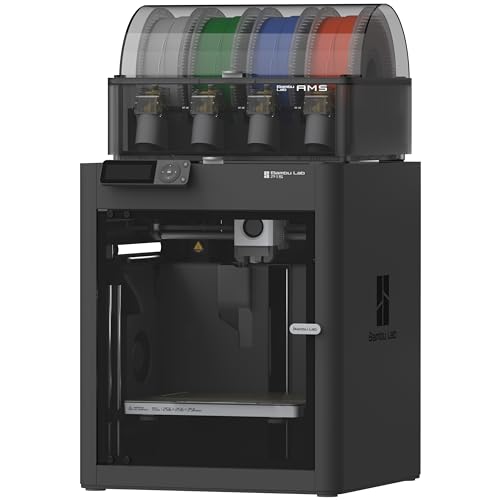
Bambu Lab P1S Combo — Enclosed Shared-Space Pick
The P1S Combo is the pick we would place where supervision is thinnest and the audience is youngest: the school library corner, the shared prep room, the primary classroom where a closed door between small hands and hot moving parts is worth real money. The enclosure is not a styling choice. It steadies the printing environment, muffles the machine’s working sounds to a level a reading corner can tolerate, and turns the printer into a cabinet appliance that a teacher can start, close and monitor rather than guard.
The Combo part of the name brings the AMS filament system, which feeds multiple colours and handles changes automatically. For school display work that changes the creative brief entirely: house-colour trophies, colour-coded revision aids, geography models with blue rivers that are actually blue. Multi-colour printing wastes some filament on changeover purges, a point covered in depth in the companion multi-filament guide, and teachers should plan purge costs into project budgets rather than discovering them mid-term.
Within a fleet, treat the P1S Combo as the supervised-showcase and shared-space unit rather than the volume mule. Its enclosed workflow suits jobs started by staff and collected later, and its colour ability reserves it for work that genuinely benefits. Pairing one P1S Combo with two or three simpler machines gives a department range: queues on the open machines for everyday iterations, the enclosed colour machine for final pieces and for rooms where an open gantry would be the wrong idea entirely.
The enclosed machine also earns marks as the fleet’s diplomatic asset. It is the printer a school can site in a reception-adjacent innovation corner or a library visible to visiting parents, printing quietly behind its door while the open machines do their noisier work elsewhere. First impressions recruit governors, sponsors and next year’s intake, and a calm, enclosed, colour-printing machine makes the department’s argument before a word is spoken. Budget holders deciding between this and a third open machine should weigh that public-relations shift honestly alongside the queues.
- Type: enclosed FDM with chamber door and panels
- Filament system: AMS included in Combo configuration for multi-colour work
- Calibration: automatic routines in the Bambu workflow
- Placement: suited to libraries and shared rooms
- Role in fleet: enclosed, colour-capable showcase and young-pupil machine
Strengths
- Enclosure separates pupils from heat and motion by design
- AMS colour handling opens display and coding-by-colour projects
- Quieter, tidier presence suits shared school spaces
Trade-offs
- Colour changeovers consume purge filament that budgets must absorb
- Enclosed workflow hides the mechanics some lessons want to show
- Costs more per queue than the open fleet builders
Best for: Primary schools, libraries, shared prep rooms and any space where an enclosed machine is the responsible default.
Not suited for: Departments whose main need is maximum parallel queues for large classes on a fixed grant.

Bambu Lab A1 Combo — Colour for Open Classrooms
Where the P1S Combo encloses its colour work, the A1 Combo keeps everything in the open and adds the AMS lite feeder beside the printer. For a supervised secondary classroom that combination is attractive: students can watch filament paths, see exactly which spool feeds which layer, and connect the physical swap to the colours they assigned in the slicer. Colour stops being software magic and becomes plumbing they can follow with a finger in the air, which is often the moment the whole process clicks for a class.
The practical cautions are about tidiness and throughput rather than quality. Four spools beside an open printer need a defined home, ideally a labelled rack the class resets at the end of each lesson, because a term of casual spool handling ends in tangles that eat lesson openings. Multi-colour jobs also run longer and shed purge material at every change, so a teacher planning thirty identical colour models should prototype one, weigh the purge honestly and decide whether the colour earns its time before committing the fleet.
Positioned against its own sibling, the A1 Combo is the colour machine for rooms with confident supervision, while the P1S Combo serves rooms where the enclosure itself is the point. Against the rest of this list it is the creativity upgrade: the machine a department adds in year two, once queues run smoothly on plainer units and a teacher wants house colours, coded parts and display pieces that make visitors ask which printer did that. It keeps the A1 family’s self-calibrating manners, so adding colour does not mean adding a new maintenance language for staff to learn.
One scheduling insight governs this machine’s classroom life: colour jobs belong at the end of the queue, not the start. A class that prints its plain iterations first, proves the geometry, and only then commits the best version to a colour run learns production sequencing in its bones and keeps purge waste proportional to pride. Teachers who timetable that way find the Combo’s colour feels generous rather than expensive, because nearly every swap serves a model that has already earned the right to be colourful.
- Type: open-frame FDM with external AMS lite feeder
- Filament: multi-spool automatic feeding and colour changes
- Calibration: automatic routines shared with the A1 platform
- Footprint: printer plus side rack space for spools
- Role in fleet: colour creativity unit for supervised rooms
Strengths
- Visible filament paths turn colour changes into a teachable mechanism
- Shares operating habits with the plain A1 for mixed fleets
- Automatic feeding removes mid-print spool babysitting
Trade-offs
- Open frame plus external spools needs tidy, supervised storage
- Colour jobs take longer and generate purge waste
- Not the enclosure answer for very young pupils
Best for: Supervised secondary art and design classes wanting colour without a new platform to learn.
Not suited for: Rooms where loose spools and open gantries would outnumber the adults present.

Anycubic Kobra 3 Max V2 — The Big-Project Machine
Most classroom printing is small: brackets, keyrings, gears, name plates. Then a design-and-technology course reaches the project term, and suddenly a group needs a chair joint at full scale, an architectural model that reads across a room, or a prosthetic-hand prototype that fits an actual hand. The Kobra 3 Max V2 exists for that term. Its verified listing states a 420x420x500 build volume, which moves whole categories of coursework from scaled-down apology to full-size artefact, and that change alters what teachers can set as briefs.
A machine this size changes room planning as much as project planning. It needs a dedicated, stable bench rather than a trolley, clearance for its moving bed, and a supervising adult who treats its longer prints as scheduled events rather than background noise. Big prints fail big when they fail, consuming an evening of filament, so the working rule for this machine is prototype small, slice carefully, and commit once. Students learn genuine production judgement from that discipline: scale models first, material estimates in writing, then the large run.
No school should build its whole fleet from machines like this, and this guide does not suggest it. The Kobra’s role is the department’s heavy lifter, booked the way schools book a kiln or a laser cutter, with a calendar on the wall and a teacher’s signature for overnight-scale jobs. Bought in that spirit it is transformative for exactly the students who have outgrown desktop plates; bought as a general classwork machine it would be bench space and budget spent on volume that ninety percent of lessons never touch.
Risk management deserves a paragraph on a machine whose prints can run so long. Schools should treat its biggest jobs the way they treat kiln firings: a named adult owns the booking, the file is checked by a second pair of eyes, and the first hour, where most large-print failures announce themselves, happens while someone is still in the building. With that protocol the Kobra’s scale becomes a curriculum asset rather than an insurance conversation, and the department gains the kind of flagship capability that wins exhibition space and open-evening crowds.
- Type: large-format open FDM
- Build volume: 420x420x500, per the verified listing
- Placement: fixed bench with bed-travel clearance
- Workflow: booked, supervised large jobs rather than open queues
- Role in fleet: design-and-technology project machine
Strengths
- Full-scale coursework becomes possible without splitting models
- Teaches production planning through supervised booking
- One machine covers the oversize briefs for a whole department
Trade-offs
- Bench footprint and bed travel rule out trolley use
- Failed large prints waste serious filament and time
- Oversized for the small parts that dominate classwork
Best for: Design-and-technology departments with project coursework at full scale and a bench to dedicate.
Not suited for: General class sets, small prep rooms, or any fleet buying its first machine.

Monoprice Mini Delta v2 — Demonstration Desk Curiosity
The Mini Delta v2 closes the list as the specialist: a small delta printer whose three arms dance around the build plate in a way that stops passing students mid-corridor. Delta kinematics move differently from the Cartesian gantries above, with the effector gliding on three coordinated towers, and watching it work teaches an intuitive lesson about coordinate geometry that a worksheet struggles to deliver. As a demonstration and enrichment machine, perched on a science-department desk or carried to a primary partner school for a morning, it earns its keep through fascination.
Honesty about limits matters with a machine this characterful. The build area is small, delta calibration confuses beginners in ways Cartesian machines do not, and this is not the printer to carry a class set of thirty identical parts. A department that buys it as its only machine will feel those limits within a fortnight. A department that buys it as the second or third machine, the travelling showpiece that recruits next year’s design students at open evening, will find it punches far above its footprint.
Supervision notes are simple: the moving arms are exposed, so the same stand-back rules apply as with any open machine, and its small parts suit short, watched prints rather than unattended long ones. Keep it printing little gears, vases and calibration curiosities that finish inside a lesson, let students time the arms and sketch the geometry, and reserve production work for the fleet backbone. Every department benefits from one machine whose job is wonder; this is the most affordable wonder on the list.
The delta also moonlights as the fleet’s most honest calibration teacher. Because its geometry is visibly different, students cannot coast on Cartesian assumptions; they must think about what levelling and motion actually mean, with three towers negotiating every position. A teacher who runs one lesson comparing the delta’s dance with a gantry machine’s march gives a class more mechanical insight than a unit of worksheets, and the machine’s modest appetite for filament keeps that lesson cheap to repeat for every group in the year.
- Type: delta-kinematics FDM, compact footprint
- Build area: small, suited to short demonstration prints
- Portability: light enough for inter-school visits
- Calibration: delta geometry, best handled by a confident teacher
- Role in fleet: demonstration, enrichment and recruitment showpiece
Strengths
- Mesmerising motion teaches coordinate geometry by example
- Portable enough for outreach and open-evening duty
- Small prints finish inside a single lesson
Trade-offs
- Small build area rules out class production work
- Delta calibration is the least beginner-friendly here
- Exposed moving arms need the usual stand-back discipline
Best for: Science and maths enrichment, open evenings, and departments wanting a portable demonstrator.
Not suited for: Any school buying a sole machine for class sets of parts.
How do the six classroom printers compare side by side?
| Pick | Type | Standout trait | Watch out for |
|---|---|---|---|
| Bambu Lab A1 | Open FDM | Self-calibrating, beginner-proof setup | Open frame needs supervision rules |
| Creality Ender 3 V3 SE | Open FDM | CR Touch probing at fleet-friendly cost | Needs an enthusiast on staff |
| Bambu Lab P1S Combo | Enclosed FDM + AMS | Enclosure plus automatic colour feeding | Purge waste on colour jobs |
| Bambu Lab A1 Combo | Open FDM + AMS lite | Colour with visible, teachable plumbing | Spool storage discipline required |
| Anycubic Kobra 3 Max V2 | Large FDM | 420x420x500 verified build volume | Demands a dedicated bench |
| Monoprice Mini Delta v2 | Delta FDM | Delta motion as a teaching spectacle | Tiny build area, quirky calibration |
Read the comparison table as a staffing chart rather than a league table. The A1 and the Ender both serve as queue machines, but they ask different things of staff: the Bambu calibrates itself and suits departments without a resident enthusiast, while the Creality rewards the department that has one and wants students to learn the machine as well as use it. Neither answer is wrong; the wrong answer is buying the enthusiast’s machine for a department with no enthusiast, or the appliance for a teacher who wanted a teaching aid.
The two Combo machines divide by room rather than by quality. Enclosure decides where a printer may responsibly live, and colour decides what it should be fed. A primary school should start from the P1S Combo row and work backwards to budget; a secondary school with strong supervision can take the A1 Combo’s openness as a teaching asset. The Kobra and the Mini Delta sit at opposite ends of the size argument, and both are second purchases: one for the term when projects outgrow plates, one for the evenings when the department needs an audience.
A word on the two Bambu siblings sharing this table, since schools will ask why both appear. They share a calibration philosophy and an operating language, which is precisely why a mixed fleet of the two works: staff learn one dialect and speak it to an open machine in the workshop and an enclosed machine in the library. Fleets built on one dialect, whichever models compose them, consistently out-teach fleets assembled from whichever machines were on offer in a given month.
What should a teacher check before the first class print?
Run the machine yourself, start to finish, before any student touches it. Load filament, slice a file you designed, print it, remove it, and write down every moment you hesitated, because each hesitation becomes a line on the instruction card your classes will use. Teachers who skip this rehearsal discover the quirks publicly, mid-lesson, with thirty witnesses and a queue forming. An hour of private practice converts the printer from a risk into a routine, and the card you write during it, laminated and fixed beside the machine, becomes the department’s shared memory when supply staff or new colleagues run sessions.
Check the unglamorous infrastructure too. The printer needs a stable surface that does not wobble when a class leans on the bench, a socket that is not shared with the kettle circuit of the staffroom, and a home for filament away from classroom damp and direct sun. Decide where finished prints go, where failed prints go, and who empties the purge and offcut bin, because a classroom printer generates a small, constant stream of plastic housekeeping that becomes a mess only when nobody owns it.
Finally, rehearse the failure conversation. A print will detach, spaghetti will happen, and the class will watch how an adult responds. Having spare nozzles, a scraper, and a calm script ready, this is normal, here is what we learn from it, turns the inevitable failure into the most honest engineering lesson of the term. Departments that treat failures as curriculum keep printing; departments that treat them as embarrassments quietly stop booking the machine.
How many printers does a class actually need?
Work backwards from hands-on minutes rather than from budget. If a lesson gives each student ten minutes of design time and prints run twenty minutes each, one machine serves a fraction of a class per lesson, and most students become spectators of their own project. Two or three mid-range machines change the social physics completely: groups rotate through designing, slicing and printing within the same double lesson, and the queue becomes a scheduling puzzle students can help solve instead of a bottleneck they resent.
Identical machines beat a mixed fleet at this scale. One profile set, one spares box, one instruction card and one training conversation cover the whole fleet, and a machine down for a nozzle swap does not strand a class because its siblings speak the same language. Mixed fleets have their place in year three, when a department adds a big machine or a colour machine for range, but the foundation should be boringly uniform.
Phase the purchase if the grant demands it. One machine this term teaches the department its real usage patterns: which year groups print most, which projects overrun, where the machine should live. That evidence makes the second purchase smarter than any review can, and it spreads the training load across terms instead of landing three new machines on one exhausted teacher in September.
Which filaments belong in a school store cupboard?
Stock PLA first, in a handful of colours including the school colours, and let it carry ninety percent of classwork. PLA prints at forgiving temperatures, sticks and releases predictably, and asks the least of ventilation arrangements, which keeps the practical safety conversation simple: hot parts are hot, hands stay clear, prints cool before handling. Add a spool or two of PETG when older students need tougher functional parts for outdoor or load-bearing projects, and treat anything beyond that as a specialist purchase justified by a specific course, supervised by staff who have researched its handling requirements.
Buy filament the way schools buy paper: standardised, labelled and reordered before it runs out. One diameter, reputable suppliers, each spool dated and stored dry in a sealed box with its desiccant. Most mysterious print failures in schools trace back not to machines but to a forgotten spool that spent a humid summer on a windowsill. A termly stock check, owned by a named person or a trusted student technician team, prevents the Monday-morning discovery that the cupboard holds four colours of almost-nothing.
How should schools organise supervision and student technicians?
The departments that get the most from these machines almost always run a student technician scheme. A small team of trained, badged students handles loading, queueing and first-line checks under staff oversight, which multiplies the printer’s supervised hours without multiplying staff workload. Training those technicians is itself rich curriculum: calibration, file preparation, fault logging and the discipline of signing work in and out. It also creates the culture that keeps machines alive, because students who maintain a printer treat it as theirs.
Write the supervision rules once, visibly and positively. Prints are started by trained people, hands stay outside the frame while parts move, hot ends are assumed hot, and finished prints cool before removal. Post the rules at the machine, teach them in the first session, and enforce them with the same calm consistency as any workshop rule. Schools already know how to run rooms with soldering irons and band saws; a 3D printer asks for a lighter version of the same professional habits.
Assessment deserves a place in this planning too, because printing produces evidence that examiners and moderators love: iteration. A student whose bracket failed twice and succeeded on the third attempt, with each version kept and labelled, has documented engineering judgement more convincingly than any polished final piece alone. Departments should build that keeping into the routine, a labelled shelf or photographed log of versions beside each project, so the fleet’s output becomes the course’s portfolio. The printers then stop being merely tools for making assessed work and become instruments of assessment themselves, recording the drafts that grades are honestly made of, term after term, class after class.
How should a school timetable printer access across classes?
Treat the fleet like the science department treats its best microscopes: a booking grid, a named owner per slot and a rule that the machine is left as it was found, bed clean, filament loaded, queue card updated. A shared calendar, even a paper one on the wall beside the machines, prevents the double-booking and queue-jumping that sour staff goodwill faster than any breakdown. Departments that publish the grid visibly also discover their real demand pattern within a term, which is the evidence base for the next purchase.
Build the timetable around print durations rather than lesson boundaries. Short jobs belong in the gaps between classes and in supervised lunchtime clubs; long jobs belong in the booked, watched windows. A simple house rule, nothing over two hours without a booking and a named adult, keeps the fleet’s work flowing while preventing the orphaned overnight print that fails at hour three and greets the morning as sculpture. Students absorb genuine operations thinking from watching such a system run, which is curriculum wearing an apron.
What does a sensible school spares and safety kit contain?
One labelled box per room covers nearly every ordinary incident: spare nozzles in the machine’s own fitting, a scraper, side cutters for support removal, a brass brush, cleaning supplies for beds, and the laminated card with the loading routine and the fault script. Add a small stock of the fleet’s standard filament in the house colours and a logbook, paper or digital, where every fault and fix is written in a line. That logbook becomes the department’s memory when staff change, and it converts anecdotes about reliability into evidence when budget season asks hard questions.
The safety half of the kit is mostly words and habits rather than objects: the posted rules at each machine, the cool-before-touching discipline for finished prints, a defined stand-back line for demonstrations, and a routine for clearing failed prints that assumes parts may still be warm. Schools already maintain this culture for far more dangerous equipment; extending it to printers costs one inset session and a term of calm consistency, after which the fleet runs on the same professional habits as the rest of the workshop.
How do you grow a printing fleet from one machine to a department?
Grow by evidence, one term at a time. The first machine’s logbook, kept honestly, tells the department which year groups print, which projects overrun and where queues form, and that evidence should write the second purchase order. Most departments discover their second machine should be a twin of the first, because the queue, not the catalogue, is what needs feeding. Twins share everything, and a fleet of twins with a logbook is a system, while a miscellany of exciting machines is a hobby that happens to live in a school.
Add specialisation only when a named course demands it, in writing, with a teacher attached. The big machine arrives when the design course’s projects outgrow plates; the colour machine arrives when a curriculum unit is planned around it; the delta arrives when an enrichment lead wants it for outreach. Each specialist enters with an owner, a timetable slot and a purpose, which is why specialist machines in healthy departments are the busiest in the building rather than the most photographed. Growth by demand feels slower than growth by enthusiasm and ends, two years later, considerably larger.
Finally, plan the fleet’s old age while it is young. Machines will graduate from front-line queues to club duty, spare-parts donors and loan stock for partner primaries, and a department that expects those graduations keeps records and spares that make them graceful. The fleet is a small institution, and institutions thrive on exactly the virtues schools teach: records, routines, named responsibilities and respect for tools. A department that runs its printers that way is teaching engineering before the first file is even sliced.
One practical footnote for the timetable: keep a printed fault card at each machine with three columns, what you see, what to try, and when to stop and fetch the owner. Most classroom print faults surrender to the middle column in under five minutes, and the third column protects machines from enthusiastic rescue attempts that turn a clog into a casualty. The card costs one laminated sheet and saves, across a year, more teaching time than any specification compared in this guide.
What mistakes do schools make when buying their first printers?
Buying one premium printer instead of several adequate ones is the classic first error, because it optimises the showcase print while starving the class of hands-on time. Thirty students learn from queues, rotations and second attempts, none of which a single flagship can provide. Spread the budget across identical mid-range machines first, then add the specialist.
Skipping the staff rehearsal is the second error. A printer that arrives, gets unboxed by a technician and meets its first class untested will teach the department its quirks in public. One teacher-hour of private practice, ending in a laminated instruction card, prevents most of the incidents that give school printing a bad name.
Treating filament as an afterthought causes a third of all school printing grief. Unlabelled spools, damp storage and a cupboard of nearly empty reels guarantee failed first layers on the morning a class needs them. Standardise the material, store it dry, date every spool and reorder on a termly rhythm.
Placing an open printer where supervision is thinnest inverts the logic of this whole guide. Open machines belong in watched rooms with trained routines; enclosed machines belong in libraries, corridors of learning and primary spaces. Match the machine to the room’s adult coverage, not to the room’s available shelf.
Finally, schools often forget the second year. Nozzles wear, beds scar, spares vanish into drawers. A fleet plan that budgets a modest annual sum for consumables and keeps a labelled spares box per room will still be printing in year three, while the fleet bought as a one-off event slowly cannibalises itself into a single working machine and a cupboard of donors.
Final Recommendation
Match the machine to the room and the roster before matching it to any specification sheet. Start a general fleet with the self-calibrating calm of the Bambu Lab A1, or with several Ender 3 V3 SE units where budget and staff enthusiasm point that way. Put the enclosed P1S Combo where younger pupils and shared spaces need the door, add the A1 Combo when colour becomes a curriculum goal rather than a novelty, book the Kobra 3 Max V2 for the big project term, and let the Mini Delta recruit next year’s makers at open evening.
Whichever combination a school chooses, the pattern that predicts success is dull and repeatable: identical machines, rehearsed staff, labelled filament, written rules and a student technician team that treats the fleet as its own. Get those five habits right and even the humblest printer on this list will out-teach a flagship running on hope. The best classroom printer is ultimately the one still printing, cheerfully and safely, in the last week of term.
Start where your school actually stands: one room, one named owner, one machine from this list matched to that room’s supervision, and a logbook opened on the first day. Everything else in this guide, the fleets, the specialists, the colour and the scale, grows from that unglamorous beginning more reliably than from any grand launch.
Frequently Asked Questions
Can younger primary pupils use these printers safely?
Yes, with the ordinary workshop habits schools already teach: adult-set rules, supervised starts, hands kept clear of moving and heated parts, and prints left to cool before handling. The enclosed P1S Combo suits the youngest settings best because its door separates pupils from the mechanism by design, while open machines belong in rooms where an adult’s attention is part of the timetable rather than an interruption to it.
Is PLA the only filament a school should buy?
PLA should be the default and will carry the overwhelming majority of classwork, from models to mechanisms. PETG earns a place for older students building tougher functional parts. Beyond those two, each new material should arrive with a specific course need and a staff member who has read its handling guidance, rather than as a speculative cupboard filler.
How long do classroom prints usually take?
Small classwork pieces such as keyrings, brackets and name plates commonly finish inside a lesson or two, while larger project parts run for hours and belong in the booked, supervised category. Teachers quickly learn to design briefs around the clock: parts sized to finish within available supervised windows, printed in batches across the fleet rather than as one heroic overnight run.
What breaks most often on a school printer?
Nozzle blockages, tired build surfaces and damp filament account for most school downtime, and all three yield to routine: spare nozzles in a labelled box, beds cleaned and replaced on schedule, spools stored sealed and dry. The machines on this list were chosen partly because their routine parts are ordinary and their loading procedures can be taught to student technicians.
Should a school buy an enclosed or open printer first?
Follow the room, not the brochure. A first printer destined for a primary classroom, library or shared space should be enclosed; a first printer for a supervised secondary workshop can be open, cheaper per queue and easier to teach around. Many departments end with both, using each where its design makes supervision easiest.
Who should own the printers inside a school?
One named member of staff should own the fleet the way a librarian owns the library, with student technicians as the working team and the owner as the final word on purchases, rules and repairs. Fleets owned by everybody are maintained by nobody, and the difference shows within two terms: the owned fleet has a logbook, a spares box and a booking grid, while the communal fleet has a rumour that one of the machines worked in October.
Related Guides
Classroom printing connects to wider making topics covered elsewhere on this site, including filament-only buying advice and miniature-focused machines for art departments. best 3d filament printers best 3d printers to print miniatures best affordable home printers
Related guides
- Best 1440p 165Hz Monitors: One Native 165Hz Pick, Three 180Hz Upgrades, an Overclock Headline and a 160Hz Ultrawide
- Best 13×19 Professional Printers
- Best 3rd Party MacBook Chargers: 96W-Class Alternatives, the 100W Cable Rule, and the Apple Benchmark
- Best Built PC: Six Prebuilt Gaming PCs Judged on Parts, Power and Upgrades


