Our Top Picks




What's inside
- The Standard’s radio link: Wi-Fi where its siblings used Lightbridge
- Parabolic reflectors: the slip-on first step
- Replacement panel and patch antennas: higher gain, opened shells
- Active boosters: amplification and its obligations
- Realistic expectations: fields, suburbs and the two unequal links
- Reading DJI GO’s signal evidence before and after a modification
- Safety systems and the discipline of staying in sight
- Fitment across the Phantom 3 line: Standard, SE and the Lightbridge models
- A selection checklist: mounting style, weight, case and appetite for intervention
- Worked link figures: what a decibel buys at 300, 600 and 1,000 metres
- Fitting, aiming drills and living with the hardware afterwards
- Buying extenders second-hand for a discontinued aircraft
- Check prices on Amazon
- Disclosure and a closing note
As an Amazon Associate I earn from qualifying purchases. This post may contain affiliate links at no extra cost to you.
Within the Phantom 3 family, the Standard occupied the entry rung, and its specification sheet explained the saving in a single line that owners came to know by heart. The Advanced and Professional carried DJI’s Lightbridge transmission system, a purpose-built digital link with kilometres of rated reach. The Standard sent its control commands and its live picture over ordinary Wi-Fi instead, the same family of radio technology that serves a living-room router, and that substitution defined both the aircraft’s attractive price and the complaint that followed it from forum to forum for the whole of its production life: the picture froze, pixelated or vanished at distances its more expensive siblings crossed without drama.
Antenna extenders exist because that complaint has a specific physical shape. The Standard’s weakness was rarely its camera, its motors or its battery. It was the link budget between a small radio in the aircraft and a controller whose single visible antenna had to serve a connection that Lightbridge machines handled with a more sophisticated radio chain. When a signal fades with distance, one legitimate remedy is to stop radiating energy in directions where no aircraft will ever be, and to concentrate the transmitted and received energy along the line the pilot actually cares about. Reflectors, replacement panel antennas and amplified boosters are three escalating ways of doing exactly that, at three very different levels of cost, complexity and commitment.
This guide treats those three families in ascending order of intervention, because the right choice for a given owner is usually the mildest one that solves the actual problem. A pilot whose picture breaks up at 400 metres over open farmland has a different problem from a pilot flying at the edge of a housing estate saturated with domestic routers, and both differ from the pilot who simply enjoys modifying equipment. Matching the remedy to the interference environment, rather than to the largest number printed on a packaging card, is the thread that runs through every section that follows.
Owners who are still deciding whether a second-hand Standard deserves accessories at all may want the broader entry-level landscape in best affordable drones with cameras for context, since the money spent across several link upgrades can approach the price difference that once separated the Standard from its Lightbridge siblings on the used market.
The Standard’s radio link: Wi-Fi where its siblings used Lightbridge
The Phantom 3 Standard’s controller communicates with the aircraft over a 2.4 gigahertz Wi-Fi link that carries both directions of traffic in one system. Uplink packets bear the stick commands, mode changes and camera settings. Downlink traffic bears telemetry and the live video feed, which the controller relays to a phone or tablet running the DJI GO application, itself connected to the controller by a short-range Wi-Fi hop or cable depending on configuration. Every element of what the pilot sees and commands therefore depends on a protocol designed for offices and cafés, contending in an environment it was never optimised for, against routers, wireless cameras and the access points of every house along the street.
DJI’s own figures put the Standard’s maximum transmission distance at about 1 kilometre under FCC conditions in unobstructed terrain, with the CE figure for regions applying European limits rated lower, at roughly half that distance, because permitted effective radiated power differs between regulatory regimes. Those headline numbers assume a clear line of sight, a controller antenna oriented favourably, low local interference and a fully charged aircraft. They describe the edge of a test field more faithfully than the edge of a suburb. Owners comparing their experience with the brochure should first ask which regulatory mode their aircraft is operating in, since a machine that has applied CE limits will surrender its picture hundreds of metres earlier than an identical machine under FCC settings, with no fault present on either side.
The controller’s antenna arrangement explains why orientation matters so much on this model. A single external antenna rises from the controller body, a compact omnidirectional radiator whose donut-shaped pattern throws energy sideways in every compass direction while sending comparatively little straight up or along its own axis. Held naturally, with the antenna vertical and the aircraft out in front, the geometry is favourable. Tilt the antenna forward, point its tip at the aircraft or let it droop against the phone mount, and the link loses margin that no menu setting can restore. Many first reports of disappointing range trace back to nothing more exotic than an antenna aligned with its own null, which is also why the cheapest extender, a reflector, can appear to perform miracles: it disciplines a pattern that was wasting most of its energy on the sky, the ground and the pilot’s own abdomen.
Frequency behaviour adds a second layer. The 2.4 gigahertz band offers a limited set of non-overlapping channels, and in dense housing those channels carry overlapping domestic networks whose traffic peaks in the evening, precisely when recreational flying often happens. The aircraft and controller negotiate within that crowded space without the frequency agility or the robust coding that Lightbridge brought to the same airspace. An extender cannot create a clean channel where none exists; it can only raise the wanted signal above the interference floor by gathering more of it and radiating more of the reply in the useful direction. That distinction governs every realistic expectation later in this guide.
The aircraft end of the link deserves mention because extenders modify only the ground end. The Phantom’s own antennas sit in its landing gear legs, small radiators with their own orientation sensitivities as the airframe banks, yaws and pitches. A turn that presents the gear legs edge-on to the controller, or a descent behind the bulk of the battery and body, can cost several decibels that no ground-side reflector was ever going to recover. Pilots diagnosing a weak link should therefore note whether dropouts correlate with aircraft heading; a link that fails in one orientation and recovers in another is describing airframe shadowing, not raw distance, and the cure is a change of heading or altitude rather than a larger panel.
Parabolic reflectors: the slip-on first step
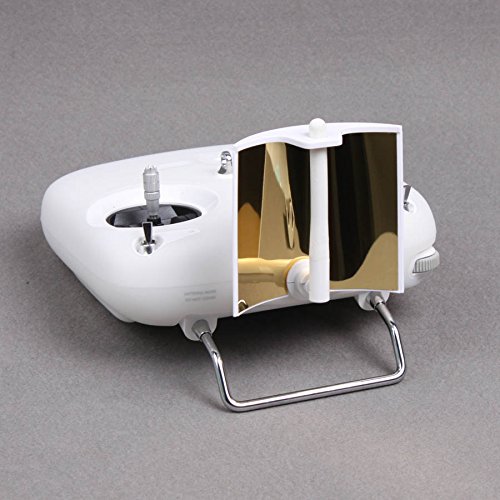
The parabolic reflector is the extender most Standard owners meet first, usually as a pair of curved metalised panels, and on this single-antenna controller as one panel shaped to cradle the antenna’s base. It slides down over the stock antenna in seconds, requires no tools, no opening of the controller shell and no electrical connection of any kind, and it lifts off just as quickly at the end of a session. Underneath that simplicity sits genuine antenna engineering. A paraboloid surface reflects radio waves arriving from its focal region into a roughly parallel beam, and in reverse it gathers incoming waves from the front and concentrates them toward the antenna sitting near the focus. Energy that the bare antenna would have sprayed behind the pilot is redirected forward, toward the only place the aircraft can be.
Typical reflectors for this class of controller advertise gains in the region of 6 to 9 dBi in the favoured direction, figures that should be read as directional improvement rather than as a promise of multiplied distance. Radio range does not scale linearly with decibels; in free space, an extra 6 dB of link margin corresponds to roughly a doubling of distance before the same signal threshold is reached, and real terrain taxes that ideal heavily. The honest summary is that a reflector commonly converts a marginal 500 metre suburban link into a workable one and stretches open-field flights by a worthwhile margin, while transforming nothing about the interference environment waiting at the far end.
The trade attached to that gain is aim. A reflector makes the controller directional in a way the stock antenna never was, so the pilot’s hands become part of the antenna system for the entire flight. The controller must stay pointed at the aircraft, not approximately, not at the horizon where the aircraft was a minute ago, but at its present position, updated as it moves across the sky. Flights that wander laterally, orbits around a point of interest and any manoeuvre that takes the aircraft behind the pilot all punish a reflector user with sudden picture breakup that a stock antenna would have survived. Experienced owners develop a slow, deliberate stance, rotating the whole body rather than flicking the wrists, and they treat a helper calling the aircraft’s position as a genuine aid on long straight legs.
Fit and finish separate the reflectors that work from the ornaments. The panel must sit at the designed distance from the antenna element, because the focal geometry is the entire mechanism; a reflector that wobbles on a loose mount or sits a few millimetres off its intended position still looks convincing while delivering a fraction of its potential. Wind catches the panel like a small sail, and a gusty day adds a tremor to the pilot’s aim that shows up directly in link quality. Folding and flat-pack variants trade a little rigidity for a controller case that still closes, a bargain most owners accept gladly. Surface material matters less than surface continuity: a smooth, uncreased reflective face performs its geometry, while a panel creased from being stuffed into a flight bag scatters the very waves it was bought to organise.
Because a reflector touches nothing electrical, it carries no warranty consequence, no regulatory consequence and no resale consequence, and it can be lent, borrowed or discarded without ceremony. That reversibility is precisely why it belongs at the head of the queue for any Standard owner whose flights are limited by distance over open ground. It is also the diagnostic baseline for everything stronger: if careful aiming with a reflector produces no improvement at all on a familiar route, the limiting factor is probably interference or airframe shadowing rather than controller radiation, and spending more on the controller side will disappoint in proportion to its price.
Replacement panel and patch antennas: higher gain, opened shells
The second family replaces the radiating element instead of assisting it. A panel or patch antenna is a flat assembly whose radiating surface is engineered to launch a focused beam, and kits for the Phantom 3 Standard controller typically present a rectangular panel that mounts on the controller’s face or in place of the stock antenna, connecting to the radio board inside by short coaxial leads. Advertised gains commonly run from about 10 dBi into the mid-teens for larger panels, with the beam narrowing as the gain climbs: where a reflector still forgives twenty degrees of sloppy aim, a high-gain panel may hold its advantage inside a cone of similar width and fall off steeply outside it.
Installation is the dividing line of the whole product category. Fitting a panel means opening the controller, disconnecting the stock antenna’s miniature coaxial connector from the radio board, seating the replacement leads without pinching them under the shell, and closing a case that was assembled with no expectation of being reopened by its owner. The miniature connectors involved are rated for a small number of mating cycles and reward patience with magnification and plastic tools; a lead torn from its socket converts an afternoon upgrade into a repair. Every owner contemplating this family should read the distinction plainly: reflectors and other clip-on aids form the non-invasive group, reversible in seconds, while panel swaps form the invasive group, reversible in principle and fiddly in practice.
Warranty follows that line exactly. A manufacturer or retailer examining a controller with an opened shell, disturbed seals and third-party coaxial leads has solid ground to decline coverage for radio faults, and on a discontinued model the practical question becomes whether any service channel exists at all. Owners of Standards bought new old stock or under any remaining retailer warranty should weigh a reflector’s smaller gain against the panel’s larger one with the warranty document open on the table. Owners of well-used machines with no coverage left are making a simpler calculation, and for them the panel’s performance per unit of money is often the strongest in this entire guide.
Panel selection has its own internal traps. The connector gender and cable routing must match the Standard controller specifically, a requirement explored in the fitment section below, because the Phantom 3 range’s controllers look alike in photographs while differing in their radio boards. Polarisation should match the aircraft’s antenna behaviour as closely as the kit designer managed, and published gain figures deserve scepticism when no beamwidth is quoted beside them, since a panel claiming very high gain with a very wide beam is claiming a geometry that physics declines to supply. Weight accumulates at the worst possible place, ahead of the pilot’s wrists, and a large panel flown for twenty minutes teaches its owner more about forearm fatigue than any specification table.
Dual-element panels add a refinement worth understanding. Some kits present two patches intended to serve the link’s spatial diversity, giving the radio two differently positioned views of the incoming wave so that a fade in one path need not end the conversation. On the single-visible-antenna Standard controller, such kits route internally to the board’s antenna connections as designed by the kit maker, and their advantage appears most clearly in environments with reflections from buildings, vehicles and water, where a single path flickers as the aircraft moves through interference patterns in the air itself.
Active boosters: amplification and its obligations
The third family stops rearranging the signal and starts enlarging it. An active booster is a small amplifier inserted between the controller’s radio and its antenna, raising the transmitted power on the uplink and, in bidirectional designs, applying low-noise amplification to the returning downlink as well. The unit carries its own battery or draws from a dedicated pack, adds a power switch and charging routine to the pre-flight ritual, and announces itself in the equipment list as the first accessory that can fail in a new way mid-session: a booster with a flat battery may pass a weakened signal or none at all, depending on its internal design, turning a routine flight home into an exercise in return-to-home faith.
The engineering appeal is real. Amplification attacks the link budget from both ends at once, and in open country a well-matched booster behind a directional panel produces the longest Standard links in owner communities. The same combination in a suburb raises the pilot’s transmission above the neighbourhood noise while doing nothing to quiet that noise, and the downlink, which is usually the first casualty on this aircraft, gains only from the receive-side amplification and the antenna’s directionality. Boosters also interact with mismatch: an amplifier feeding a poorly matched antenna wastes its output as heat and can behave unpredictably, which is why reputable kits specify the antenna pairing they were measured with.
Regulation enters here as information every buyer should hold, stated generally because limits differ by jurisdiction and change over time. Radio rules govern effective radiated power, and an amplifier combined with a high-gain antenna can carry a station beyond the limits that the original certified equipment was approved under, in some regimes shifting legal responsibility for the transmission onto the operator. Aviation rules sit on top of radio rules and, in most jurisdictions, independently require the aircraft to remain within the pilot’s direct sight, a ceiling that no link budget can raise. An owner does not need a lawyer to fly a Phantom responsibly, but an owner fitting an amplifier should at least know which of their national limits the combination approaches, and should treat any seller promising unlimited legal range as a source of entertainment rather than information.
Practical ownership details round out the picture. Booster batteries age on the shelf as surely as flight batteries, and a unit stored discharged for a winter may greet spring with a fraction of its capacity. Heat is the other companion: amplifiers working hard on a summer afternoon in direct sun can thermally throttle or shut down, and mounting one where the pilot’s hand blocks its vents is an own goal designed into many tidy installations. For most Standard owners, the booster is the last step in a sequence, justified only after a reflector has proved the route is limited by link margin rather than interference, and after a panel has delivered whatever directionality the airframe’s own antennas can exploit.
Realistic expectations: fields, suburbs and the two unequal links
Open country is the extender’s native habitat. Over farmland, moorland or a calm coastline, with the aircraft above the clutter and the controller aimed steadily, a reflector typically adds a few hundred metres of dependable picture to a Standard that previously frayed at its rated edge, and a panel can push the comfortable working distance toward the aircraft’s practical battery limit. The gains feel almost honest there because the free-space relationship between decibels and distance is allowed to operate with few deductions. Pilots flying such terrain should still remember that the rated kilometre was measured in conditions resembling their field, so improvements begin from a truthful baseline rather than from a disappointed one.
The suburb taxes every family of extender at a higher rate. Two dozen domestic networks within earshot of the launch point raise the interference floor, and the aircraft’s downlink, radiating modest power from small leg antennas, must compete with all of them at the controller’s receiver. Directional antennas help twice in this environment, once by gathering the wanted signal and once by rejecting interference arriving from behind and beside the pilot, which is why a panel can transform a housing-estate flight out of proportion to its headline gain. Even so, a route that crosses a dense estate at low altitude may never become reliable at any accessory budget, because the aircraft eventually sits inside other people’s radio territory with buildings carving the path into reflections. Altitude, within the local rules, often buys more link than hardware does, since a modest climb lifts the path over rooftops and their contents.
The asymmetry between control and picture deserves its own emphasis, because it surprises nearly every new owner. The uplink carrying stick commands is a trickle of small packets that can survive astonishingly poor conditions through retries, while the downlink carries a continuous video stream measured in megabits that degrades visibly the moment the margin thins. Extenders therefore characteristically extend the distance at which the aircraft remains controllable far beyond the distance at which its picture stays watchable, and DJI GO will report the video link’s complaints long before the control link is in danger. Judging an extender by the first frozen frame understates what it bought; judging it by the last telemetry update overstates what a pilot can use. The working range of the combination, for any honest purpose, is the distance at which the picture remains good enough to fly the shot that justified the flight.
Battery and weather impose the final ceiling, indifferent to radio success. A Phantom 3 flight battery delivers roughly twenty-odd minutes of mixed flying in mild conditions, less in cold air, and a prudent reserve for the return leg means the usable outbound leg is measured in single-digit minutes. At the aircraft’s cruising pace, that arithmetic caps practical distance well before a boosted link does, and a headwind on the return converts optimism into a forced landing with arithmetic precision. Range records set with a tailwind home are a genre of their own; working pilots plan around the wind they will meet coming back, at the altitude they will actually use, with the battery temperature they actually have.
Media and memory intersect with range planning in one practical way: a long flight that ends in a forced landing is also a recording at risk, which is why card choice and formatting discipline from guides such as best dji drone sd cards belong in the same flight bag conversation as antennas, especially for owners flying older airframes whose batteries and cards are ageing together.
Reading DJI GO’s signal evidence before and after a modification
DJI GO presents the link’s health in pieces, and an owner comparing an extender against the stock setup should gather all of them rather than relying on the single signal icon beside the battery gauge. The application exposes a channel view in the transmission settings that graphs interference across the 2.4 gigahertz band, with a stability indicator and a distance scale that colours regions by how much noise the link is sensing. A channel display crowded with tall interference near the operating channel explains a short link more eloquently than any forum post, and it also tells the pilot whether the day’s problem is geography or hardware: the same field can be quiet at dawn and hostile at dusk as domestic networks wake up.
Warnings in the application form the second evidence stream. A weak signal or weak transmission alert marks the downlink thinning in real time, while a strong wind warning belongs to a different ledger entirely, reminding the pilot that the aircraft is spending battery and tilt margin to hold position, information that belongs in the range calculation even though it says nothing about radio. Compass and GPS alerts likewise sit outside the antenna question. The discipline is to log each category separately after a flight rather than merging them into a general feeling that the aircraft struggled, because only the radio entries can testify about an extender.
A defensible comparison method uses the aircraft’s own recorded numbers on a route the pilot already knows. Choose a straight, familiar line over safe ground, flown at a fixed altitude on a calm day, and note the distance at which the first weak-signal alert appears, the distance at which the picture first breaks into blocks, and the distance at which telemetry freezes, all with the stock antenna and a steady aim. Repeat the identical line at a similar hour with the reflector fitted, then again, on another comparable day, with any stronger modification. Flight logs retained by the application preserve distance, altitude and warning timestamps, so the comparison can be assembled at a desk afterwards rather than scribbled on a landing pad. Three repetitions of each configuration smooth out the band’s daily mood, and a modification that cannot beat the stock setup’s median figures on that route has been measured, not maligned.
Two measurement courtesies keep the numbers honest. The controller’s aim must be equally disciplined in every run, since a reflector compared against a carelessly held stock antenna is being credited with the pilot’s attention rather than its own geometry. Battery state should also be matched, because a link flown late on a tired aircraft battery competes with shortened patience and earlier return decisions. Owners who keep those two variables steady usually find their results less spectacular than packaging claims and more repeatable, which is the exchange that useful evidence always offers.
The channel graph has one more use beyond comparison day. Surveying a new flying site before takeoff, watching which channels carry the tallest interference and how the stability reading behaves over a minute on the ground, predicts the flight’s radio weather while the aircraft is still safe to walk away from. A site whose graph is saturated at ground level will not improve with altitude as quickly as a merely busy one, and relocating the launch point a field away can change the interference geometry more than any accessory in the bag. Owners who fly the same few sites learn their signatures the way sailors learn a harbour’s moods.
Safety systems and the discipline of staying in sight
Every Standard already carries the correct answer to a lost link, provided its owner configured that answer on the ground. The failsafe behaviour on signal loss can be set to return-to-home, to hover or to land, and for any flight where an extender tempts the aircraft toward distance, return-to-home is the setting that matches the intention. Its altitude deserves deliberate choice rather than acceptance of a default: the return path is flown straight, in whatever wind is present, over whatever stands between the aircraft and home, so the set altitude must clear the tallest obstacle on plausible return lines, trees and masts included, while remaining within the local ceiling rules. A return altitude chosen for a flat field will not serve a valley site, and reviewing it belongs in the same pre-flight minute as checking the home point recording.
The return itself consumes the battery the outbound leg was supposed to leave behind, which closes the loop with the range discussion. An extender that persuades a pilot to spend the reserve is not extending the aircraft’s working range at all; it is borrowing from the emergency fund and calling the loan a capability. Prudent operators decide the turnaround battery figure before takeoff, honour it when the picture still looks inviting, and let the link outrange the plan rather than the reverse. Return-to-home also depends on GPS health, so a site with poor satellite geometry under trees or beside structures weakens the very safety net that distance flying leans on, another entry in the site survey that costs nothing to make.
Visual line of sight is the rule that quietly governs the entire subject. In most jurisdictions a recreational or commercial operator must keep the aircraft where it can be seen directly, unaided except by ordinary corrective lenses, well enough to judge its orientation and surroundings. A Phantom at 800 metres is a speck whose heading cannot be read by eye, which means the legal working range of the aircraft is, for most pilots, shorter than even the stock radio link. Extenders earn their place inside that boundary: they turn a marginal, breakup-prone 400 metre picture into a solid one, they rescue links in interference, and they add margin that absorbs a banked turn or a gusty aim. Used that way, as margin rather than as licence, they make flying safer and more pleasant at the distances the rules already allow.
Spotters extend the pilot’s awareness without extending the legal definition of sight, and on long straight legs a second person calling the aircraft’s drift, altitude and the approach of birds, masts or other aircraft is worth more than another decibel. The spotter arrangement also disciplines the reflector and panel user, whose attention is partly claimed by aiming the controller; a voice reporting that the aircraft has drifted left of the expected line corrects the beam before the picture announces the error. Crewed flying of that modest kind is the culture from which the hobby’s safety record is built, and no accessory purchase substitutes for it.
Fitment across the Phantom 3 line: Standard, SE and the Lightbridge models
The Phantom 3 family’s shared styling is a trap for accessory buyers, because three different radio systems hide inside near-identical shells. The Standard’s controller serves the Wi-Fi link described throughout this guide. The Phantom 3 SE, a later regional variant, also used a Wi-Fi-based link with its own controller arrangement and different rated distances, and its internals and antenna connections are not interchangeable with the Standard’s merely because the aircraft resemble each other on a shelf. The Advanced and Professional controllers serve Lightbridge, a different transmission system with different boards, different antenna arrangements and no need for most of the products in this guide at all.
Accessory listings exploit that confusion with photographs of generic Phantom controllers and compatibility lines that name the whole range. The buyer’s defence is specificity: a panel or booster kit for the Standard should name the Standard alone, or name it explicitly among a list whose other members the seller can explain. Connector types inside the controller, the number of antenna leads and the mounting geometry all follow the radio board, so a kit described as fitting every Phantom 3 ever made is describing a hope. Reflectors are the forgiving exception, since a curved panel that cradles one antenna stem cares mainly about the stem’s diameter and position, yet even there a reflector shaped for a twin-antenna Lightbridge controller will sit wrongly on the Standard’s single stem and focus its energy somewhere unhelpful.
Verification before purchase takes three small forms. The controller’s own model identification, printed on its labelling, should be matched against the kit maker’s stated controller model rather than against the aircraft’s marketing name. Photographs of the kit installed, ideally in owner documentation rather than studio renders, should show the same shell contours, phone mount and antenna base as the buyer’s own unit. Finally, the seller’s returns position should be established in advance for the common case in which a kit arrives fitting a sibling model beautifully and the Standard not at all. Owners of the routers and networking gear that share these frequencies will recognise the pattern from guides such as best 11ac long range routers, where headline compatibility likewise dissolves into specific hardware revisions on close reading.
A second-hand caution completes the fitment picture. Controllers circulate independently of aircraft on resale markets, and a Standard aircraft bundled with a mismatched controller from another variant may bind partially, behave oddly or refuse the link altogether. An owner inheriting such a pairing should resolve the controller’s identity before diagnosing range, because an extender fitted to the wrong radio is an ornament with excellent specifications. The aircraft’s own firmware family and the controller’s must also correspond to the same product, a check the application surfaces in its device information screens.
A selection checklist: mounting style, weight, case and appetite for intervention
Begin with the mounting question, because it eliminates half the catalogue in one step. If the controller must remain unopened, the choice narrows to reflectors and any genuinely external clip-on aids, and the remaining decision is among panel sizes, folding behaviour and mount security. If opening the controller is acceptable, panels enter with their gain advantage, and the decision shifts to connector confidence, the owner’s comfort with miniature coaxial fittings and the availability of a workspace where a dropped shell screw is an inconvenience rather than a disappearance. Boosters stand behind a second gate: they should only be considered once the antenna side is settled, since amplification fitted ahead of a poor antenna spends money heating a mismatch.
Weight and balance form the second filter, and they are felt rather than read. A large panel plus a booster plus its battery can add several hundred grams ahead of the wrists, on a controller already carrying a phone or small tablet at the top of its mount. Twenty minutes is a long time to hold a lever. Owners with any wrist or shoulder complaint should handle the assembled weight before committing, or choose the reflector whose grams barely register. The carrying case casts the deciding vote more often than marketing expects: a fixed panel that no longer fits the moulded case will be left at home on exactly the trips where it was wanted, while a folding reflector that lives in the case flies every time. Storage for the aircraft’s other consumables competes for the same foam, a packing puzzle familiar to anyone who has balanced cards, batteries and cables along the lines discussed in best affordable wifi extenders for home networking kits that promise more than their boxes hold.
The final filter is the owner’s honest appetite for intervention, stated before purchase rather than discovered mid-installation. There is no shame in the non-invasive ceiling; a reflector fitted carefully and aimed well captures a large share of the available improvement for a Standard flown in open country, and it preserves the controller for resale, warranty and lending. The invasive path suits owners who keep aircraft for years, enjoy bench work and fly often enough from interference-heavy ground that a panel’s rejection of off-axis noise pays its rent monthly. Boosters suit a smaller circle still: methodical pilots with disciplined battery routines, a clear view of their local radio rules and routes whose limitation has been proven, by the comparison method in this guide, to be link margin and nothing else.
Whichever family is chosen, the purchase is best closed with the comparison route already in mind. An extender evaluated on its first flight, against memory and mood, will be believed or doubted for the wrong reasons. The same extender flown against recorded stock figures, on a known line, at a matched hour, becomes a measured component of a known aircraft, and that is the standard of evidence a discontinued, much-loved machine deserves from the owners keeping it in the air.
Worked link figures: what a decibel buys at 300, 600 and 1,000 metres
Free-space path loss gives the discussion hard numbers to lean on. At 2.4 gigahertz, the loss between two antennas grows with the square of distance: roughly 80 dB at 100 metres, about 89.5 dB at 300 metres, close to 95.5 dB at 600 metres and approximately 100 dB at the rated kilometre, before a single tree, wall or damp hillside has taken its share. Each doubling of distance costs 6 dB, which is the same figure quoted earlier for a reflector’s typical gain, and that symmetry is the cleanest way to understand what any extender can and cannot promise. A modification worth a genuine 6 dB at both ends of the conversation can, in empty air, hold the same signal quality at twice the range. A modification worth 6 dB in a brochure, measured under conditions the seller chose, may be worth 2 dB on a controller in a pilot’s hands, and 2 dB buys roughly a quarter more distance, not a transformation.
At 300 metres over a playing field, a stock Standard in FCC mode usually holds a serviceable picture with margin to spare, and the extender’s contribution shows up not as survival but as smoothness: fewer macroblock smears when the aircraft yaws, less hesitation in the feed when the pilot’s aim wanders, and headroom that absorbs the dip when the airframe banks its leg antennas away from the controller. Pilots who fly mostly at this distance are buying insurance with a reflector, and insurance should be priced accordingly, which is to say cheaply.
At 600 metres the arithmetic tightens. The path has taken its extra 6 dB compared with the 300 metre case, domestic interference near the launch point has not diminished, and the downlink from the aircraft’s small antennas reaches the controller weakened while the neighbourhood’s routers arrive at full strength. This is the distance at which panel directionality earns its installation effort in built-up areas, because rejecting interference from behind the pilot can improve the signal-to-noise ratio by more than the panel’s forward gain figure suggests. It is also the distance at which aim discipline stops being a virtue and becomes a specification: a beam held ten degrees off the aircraft at 600 metres is a beam delivering its advantage to an empty parish of sky.
At 1,000 metres, the rated edge under FCC conditions, every decibel in the system is spoken for. The stock link in genuinely open terrain may still function, which surprises owners who met the model through its suburban reputation, while the same kilometre across a town is a fantasy regardless of accessories, because the path crosses hundreds of competing transmitters and the Fresnel zone, the ellipsoid of space the signal effectively occupies, is intersected by roofs, trees and terrain for most of its length. Keeping half of that zone clear is a useful field rule: at the midpoint of a 1 kilometre 2.4 gigahertz path, the zone’s radius is roughly nine metres, so a route that grazes a woodland canopy or a warehouse roof is not a line-of-sight path in radio terms even when the pilot can see the aircraft’s strobe. Extenders cannot widen that corridor; only altitude and route choice can.
Antenna height at the ground end belongs in the same worked example. Raising the controller from waist height to the top of a car roof or a small mast changes the geometry over ground reflections and local clutter, and on flat terrain it can recover several decibels that would cost real money to buy in amplifier form. Pilots are understandably reluctant to fly from a ladder, yet the modest version of the trick, standing on high ground rather than in the dip beside the car park, is free, legal in every regime and older than radio itself. Site selection is the zeroth extender, and it should be exhausted before the first accessory is unwrapped.
Fitting, aiming drills and living with the hardware afterwards
A reflector fitting session takes less time than the flight that follows it, and it still rewards method. The panel should be seated with the antenna element centred in its cradle, checked from the side so that any tilt is visible, and given a gentle twist test to confirm the mount grips firmly enough to survive a gust without rotating. Owners who mark the seated position with a faint pencil line on the antenna stem gain a two-second visual check for the rest of the season: line hidden means seated, line showing means the panel has crept upward during transport and its focus has wandered with it. The phone or tablet mount should be adjusted after the panel is fitted, not before, because the panel changes where the pilot’s thumbs and the cable naturally rest.
Aiming can be practised without burning a flight battery. With the aircraft powered on the ground at the far end of a field, telemetry connected and motors off, the pilot can walk the controller through slow arcs and watch the signal readouts rise and fall as the beam crosses the aircraft’s position, building a physical memory of how narrow the useful cone feels in the hands. Repeating the drill with the stock antenna restores a sense of how forgiving the original pattern was, and the contrast between the two is the entire reflector experience compressed into five minutes. Pilots who skip the drill tend to learn the same lesson at altitude, where the tuition is charged in anxiety.
Panel installations have their own aftercare. The coaxial leads inside a modified controller should be regarded as permanent residents: reopening the shell repeatedly to swap between panel and stock configurations consumes the connectors’ limited mating life and invites the pinched cable that announces itself as an intermittent link weeks later. Owners who anticipate wanting both configurations are better served by a second controller, a realistic option given how inexpensively Standard controllers circulate second-hand, than by a single shell opened monthly. A modified controller should also be labelled, on its underside, with the date of modification and the kit fitted, a courtesy to its next owner and a reminder to its current one when troubleshooting begins a year later.
Storage shapes longevity for all three families. Reflectors stored flat under pressure in a flight case crease along their curve and lose the geometry that justified them, so they travel best in the case’s lid pocket or in a rigid sleeve. Panels should not bear the controller’s weight in a packed bag, since a cracked patch substrate can look perfect while radiating poorly. Boosters ask the most: their batteries prefer storage at partial charge, away from the heat of a car boot in summer, and a booster retrieved after months should be charged and bench-checked with the aircraft on the ground before it is trusted at distance. A pre-season ritual covering all three, reflector surface wiped, panel mounts checked for play, booster battery cycled and controller firmware left exactly as it was if the link already behaves, takes an hour and returns a season of uneventful links.
Rain closes the practical survey. None of the common extenders is a sealed marine instrument; a reflector shrugs off drizzle that would soak a panel’s mounting foam and find the seams of a booster case, and a controller under a jacket with only its antenna assembly exposed is a workable improvisation for a single short flight home. Owners flying in maritime climates should weigh that unglamorous fact alongside gain figures, because the flight that matters is occasionally the one conducted in weather that was not in the forecast at takeoff.
Buying extenders second-hand for a discontinued aircraft
Because the Phantom 3 line has been out of production for years, a large share of extenders now changes hands used, and the used market has its own inspection grammar. Reflectors should be examined against a straight edge and a bright light: hairline creases across the reflective face, crazing in a plastic substrate and mounts stretched by a previous owner’s thicker antenna stem all reduce performance in ways a photograph conceals. A reflector that has lived in a case with loose batteries often carries a constellation of small dents, each one trivial, together amounting to a surface that scatters as much as it gathers. Panels deserve a closer look at their coaxial leads and connectors under magnification, since a lead repaired with enthusiasm and solder can present a resistance the radio notices even when the joint looks tidy, and any panel sold without its mounting hardware should be priced as a project rather than a purchase.
Boosters carry the deepest second-hand risk because their condition hides inside a battery and an amplifier stage that cannot be assessed from the case. A seller who can demonstrate the unit powering up, charging to its indicator’s satisfaction and passing a ground-range walk test with a Standard on the bench is offering evidence; a seller offering only assurances is offering a lottery ticket with a switch on it. Owners should also confirm that the booster’s specified frequency range covers the 2.4 gigahertz band the Standard actually uses, since visually identical units were sold for other bands and other aircraft, and a booster built for a different allocation is not a bargain at any price. Finally, discontinued status cuts both ways in the buyer’s favour: patient shoppers can often assemble the full ladder, reflector first and panel later, for less than a single new panel kit once cost, which makes the staged approach this guide recommends cheaper to follow now than when the aircraft was current.
Check prices on Amazon
Live listings for the shortlist in this guide are pulled from Amazon below, so prices and availability are always current at the moment you look.


Disclosure and a closing note
Readers should know that certain links leaving this page carry an affiliate arrangement covering drone accessories of the kind surveyed above; a purchase made after following one returns a commission to this publication, the amount charged to the reader does not change because of it, and the arrangement plays no part in the order in which reflectors, panels and boosters were weighed against each other here.
For the Standard, the fitting epitaph for every range argument is a tape measure laid on the pilot’s own field: the best extender is the one whose gains still show at the exact fence line where your picture used to dissolve, on the evenings when the neighbourhood’s routers are all awake at once.