What's inside
- Key Takeaways
- Quick Picks
- How Did We Choose These 24×36 Printers?
- What Actually Changes When a Printer Reaches 24 Inches?
- Which 24×36 Printers Earned a Detailed Look?
- Roll or Cut Sheets: Which Feeding Style Fits Your Work?
- What Does Ink Really Cost at This Size?
- How Do the Six Compare Side by Side?
- What Should You Check Before Ordering a 24-Inch Machine?
- Which Driver Settings Matter Most at Full Size?
- How Do You Get Clean Full-Size Prints, Step by Step?
- What Mistakes Do First-Time Wide-Format Buyers Make?
- How Should You Set Up the Corner Where the Plotter Lives?
- Who Should Skip 24 Inches Entirely?
- Final Recommendation
- Frequently Asked Questions
- Related Guides
As an Amazon Associate I earn from qualifying purchases. This post may contain affiliate links at no extra cost to you.
gizmoverdict.com is reader-supported. When you buy through links on our site, we may earn an affiliate commission.
Where to buy: Genuine 24-inch machines are sold through office-equipment and graphics suppliers as often as through general retailers, and several picks below are discussed without a store link because our verified pool holds no honest listing for them. The one linked model is clearly labelled as a smaller step-down, so check the printable width on any listing before money changes hands.
The best 24×36 printers solve a very specific frustration: a drawing, poster, or plan that refuses to shrink. Twenty-four by thirty-six inches is ARCH D in North American drafting language, the sheet size that architectural plans, engineering drawings, site maps, and full-bleed posters are drawn for. Print one at reduced scale and dimensions get misread, line weights blur together, and revision clouds hide in the fold. Print it at size and the sheet on the wall matches the file on the screen, which is the entire point.
Honesty about this category matters more than usual, so here it is early. True 24-inch machines are professional equipment. They arrive on pallets or in boxes two people should carry, they drink ink from cartridges sized for production rather than occasional use, and most of them live in architecture practices, construction trailers, GIS departments, sign shops, and university print rooms. A home buyer who simply wants bigger photographs usually belongs one size down, and this guide says so plainly instead of pretending otherwise.
Five of the six picks below are therefore presented as prose-only buying guidance, organised by the jobs they suit: technical line work, mixed office output, photographic posters, and scan-and-print workflows. The sixth pick is the honest escape hatch, a 13×19 desktop machine from our verified pool for readers who discover, midway through this guide, that their real ceiling is a large photograph rather than a full-size plan set.
Key Takeaways
- ARCH D output means 24×36 inches at full scale, the working size for architectural and engineering plan sets.
- Technical plotters and photographic wide-format printers are different tools that happen to share a width.
- Roll feeding, a built-in cutter, and stand design shape daily life with these machines as much as print quality does.
- Ink system design, not headline hardware, dominates the long-term cost of owning any 24-inch printer.
- Scanning built into a multifunction model changes site workflows, because marked-up drawings can be captured where they are reviewed.
- Anyone whose largest real job is a poster photograph should price the 13×19 desktop class before committing to a floor-standing machine.
Quick Picks
| Pick | Badge | Why it earns a place |
|---|---|---|
| Canon imagePROGRAF TM-240 | Best for Busy Plan Rooms | A technical plotter tuned for fast, clean line work and posters from the same roll. |
| HP DesignJet T650 24-inch | Best Compact Office Plotter | Small-footprint 24-inch printing aimed at studios that cannot spare a dedicated print room. |
| Epson SureColor T2170 | Best Desktop-Adjacent 24-inch | A restrained, quiet design for offices where the plotter shares space with people. |
| Canon imagePROGRAF PRO-2600 | Best for Photographic Posters | A graphics-focused 24-inch machine built around colour fidelity rather than drafting speed. |
| HP DesignJet T830 Multifunction 24-inch | Best Print-and-Scan Workflow | Printing plus large-format scanning in one unit for markup-heavy construction work. |
| Epson Expression Photo HD XP-15000 | Best Step-Down Alternative | Prints up to 13×19 inches on a desk, for readers whose posters never truly needed 24 inches. |
How Did We Choose These 24×36 Printers?
We started from the sheet, not the brand. Any machine on this list had to handle 24-inch media as a native width, through roll feed, cut-sheet feed, or both, because a printer that reaches 24×36 only through awkward workarounds will be hated by whoever operates it. Models that top out at 17 inches were excluded from the main five no matter how good they are, since recommending them under this keyword would be a bait-and-switch.
Within the true 24-inch class we separated two families that marketing often blurs. Technical plotters optimise for line accuracy, monochrome speed, and economical ink use on plain bond paper. Graphics machines optimise for colour gamut, smooth gradients, and performance on coated photo media. Both print a 24×36 sheet; they simply disagree about what that sheet usually contains. Our picks cover both families deliberately, and each pick states its family in plain language.
Workflow features carried real weight. An automatic cutter sounds trivial until someone trims forty sheets by hand. A stand with a catch basket sounds optional until finished prints land on a dusty floor. Integrated scanning earned the T830 its place because construction markups are a genuine daily task, not a spec-sheet decoration. Conversely, we ignored headline resolution numbers almost entirely, because at normal viewing distance for a plan or poster, paper choice and file quality matter far more.
Finally, we applied a truth-in-listing rule that shaped this whole article. Our verified pool contains no genuine 24-inch machine, so the five real plotters are discussed without purchase links rather than dressed up with links to unrelated products. The single linked pick is a desktop wide-format photo printer, labelled as a step-down in its badge, its section heading context, and its verdict, so no reader can mistake it for a 24-inch device.
We also weighted the ownership literature of each family: the recurring themes in long-term user reports, service experiences, and the complaints that repeat across years. At this size a printer is a five-to-ten-year relationship, and the machines that age gracefully share habits: available parts, stable drivers across operating-system updates, and media and ink that remain stocked long after launch. A spectacular first month followed by orphaned supplies is a bad purchase at any speed, so longevity evidence counted alongside output quality in every pick above.
What Actually Changes When a Printer Reaches 24 Inches?
Scale changes the failure modes first. A letter-size misprint costs a sheet; a 24×36 misprint costs a noticeable piece of a roll, several minutes of print time, and sometimes the confidence of the person who sent it. Operators learn to preview carefully, to confirm the roll width loaded matches the job, and to keep the first metre of every new roll for test plots. Shops that print plans all day build these habits into routine, and the machines below reward that discipline with predictable output.
Scale also changes where the printer lives. A 24-inch plotter on its stand occupies roughly the footprint of a small desk, needs clearance in front for the basket and above for roll loading, and wants a floor that does not wobble when the carriage sweeps. Site trailers manage this by dedicating a corner; home offices usually cannot, which is another reason the step-down pick exists. Measure the room, the doorway, and the turning space on the stairs before ordering anything in this class.
Media handling becomes a skill of its own. Rolls curl, and a 24×36 sheet fresh off a roll wants to scroll itself back up on the meeting table. Decurling by reverse-rolling, weighting corners, or choosing cut sheets for presentation copies are ordinary tricks of the trade. Heavier coated stocks feed differently from bond, and most plotters ask the operator to declare media type so ink limits and drying behaviour match the paper. Skipping that declaration is the quiet cause of many muddy posters blamed on the machine.
There is a social change too, easy to miss until you have lived with one of these machines. A full-size plotter becomes a gathering point. People review drawings standing around the basket, mark corrections on the sheet itself, and argue productively over something everyone can see at once, instead of passing a laptop around a table. Several offices told us the plotter improved their coordination meetings more than their printing, which sounds like a joke until you watch a team catch a coordination clash between two trades because both finally saw the same wall-sized drawing at the same moment.
Archiving changes as well. Flat files and plan chests re-enter the furniture conversation, because a practice producing ARCH D sheets needs somewhere honest to keep the current set, the superseded set, and the as-builts. Digital files remain the record, but paper sets in active use deserve flat, labelled storage rather than a growing roll collection behind a door. Budget a plan chest or at least wide flat drawers into the project, and the print corner will stay an asset instead of slowly becoming a paper avalanche with a power cord.
Which 24×36 Printers Earned a Detailed Look?
Canon imagePROGRAF TM-240 — Best for Busy Plan Rooms
The TM-240 represents Canon’s current thinking about the technical plotter: a 24-inch machine aimed at offices that alternate between CAD drawings and presentation material without wanting two devices. Its design brief shows in the details that matter at volume. Roll loading is straightforward, the control panel speaks in job terms rather than error codes, and the machine is built to sit on its stand in a working room rather than hide in a server closet. For a practice issuing drawing sets against deadlines, that everyday temperament is the product.
Line quality is the reason this family exists, and the TM-240’s output on plain bond is crisp in the way reviewers of drawings actually judge: small annotation text stays legible, parallel hatch lines do not merge, and revision clouds print as deliberate marks instead of grey smudges. Colour work is competent rather than lush. Site photos and rendered elevations look presentable on coated stock, though a photographer would notice the difference against the PRO-2600 below within seconds.
Running one teaches a useful rhythm. Keep bond loaded for the daily traffic of check plots and issued sets, and treat coated media as a deliberate changeover rather than a casual swap, because the machine prints best when its media settings match what is actually on the roll. Ink comes in cartridges sized for production environments, which suits a plan room and would be an extravagant commitment for a household. Offices stepping up from a 17-inch desktop unit consistently report the same surprise: the plotter is not the bottleneck, the reviewing habit is, because full-size sheets invite full-size scrutiny.
Consider how the machine behaves during the worst hour of the month, the submission crunch. Jobs queue from several workstations, a roll runs out mid-set, and someone discovers a plotting error on sheet nineteen of twenty-two. The TM family’s job management, straightforward roll swap, and consistent reprint behaviour turn that hour into an inconvenience rather than a crisis. Practices that bill by the deadline should weigh that temperament heavily, because a plotter earns its keep precisely when the office is least patient with it.
- Format: 24-inch technical plotter, roll and cut-sheet capable
- Family: Technical line work with presentation colour
- Placement: Floor stand with output basket
- Typical media: Bond, coated, and poster papers
- Operator style: Shared office device, queue-driven work
Strengths
- Clean, confident line reproduction on inexpensive bond paper.
- Handles the plan-plus-poster mixture most small practices actually print.
- Stand-and-basket arrangement keeps large sheets off the floor.
Trade-offs
- Colour output serves presentations, not gallery ambitions.
- Production-sized ink cartridges punish very occasional users.
- Needs a permanent floor corner, not a shelf.
Best for: Architecture and engineering offices printing ARCH D sets daily. Not suited for: Photographers chasing exhibition colour, or anyone short on floor space.
HP DesignJet T650 24-inch — Best Compact Office Plotter
HP built the T650 for a recognisable modern problem: the studio that needs full-size plans but works out of a converted warehouse corner, a shared office, or a project room that doubles as meeting space. It is among the least intimidating 24-inch plotters to live with, designed to be set up quickly, driven from the same software habits as an office printer, and fed with either rolls or sheets depending on the job. That accessibility is a deliberate engineering choice, and smaller practices feel it immediately.
The T650’s character is convenience-first. Automatic switching between roll and sheet feeding means a single ARCH D sheet can be printed without unloading the roll, a small mercy that occurs surprisingly often when a client asks for one presentation copy. Output quality on technical work is entirely respectable: lines are dark, fills are even, and colour graphics read clearly across a meeting table. It is not the fastest plotter in this guide, and in a high-volume reprographics setting that would matter; in a ten-person studio it rarely does.
Ownership suits offices whose printing arrives in bursts around submissions and permits. Between bursts the machine waits quietly without demanding the feeding schedule of a production device, though like every inkjet it prefers regular exercise to long abandonment. HP’s software ecosystem will feel familiar to anyone already running HP office printers, shortening the training curve for staff who rotate through plotting duty. Buy it as the office appliance it wants to be, and it satisfies; buy it expecting repro-shop throughput, and the mismatch is on the brief, not the machine.
There is also a staffing argument in its favour. In a small studio, the person plotting at 6 p.m. is often the person who drew the sheet at noon, and a machine that behaves like familiar office equipment removes the specialist gatekeeper from that loop. Drawings get checked more often when checking is easy, and the T650’s low-friction operation quietly raises the number of check plots a team produces. That behavioural effect, invisible on a spec sheet, is worth real money in avoided site errors.
- Format: 24-inch plotter with roll and sheet feeding
- Family: Technical printing for small teams
- Placement: Stand or sturdy table, office-corner friendly
- Typical media: Bond, coated, presentation papers
- Operator style: General office staff, occasional specialists
Strengths
- Approachable setup and operation for non-specialist staff.
- Roll-to-sheet flexibility handles one-off presentation copies gracefully.
- Footprint respects small studios and shared project rooms.
Trade-offs
- Throughput trails dedicated plan-room machines at deadline peaks.
- Photo output is presentable rather than refined.
- Sheet feeding large media still demands a careful, two-handed operator.
Best for: Small studios and project offices adding their first 24-inch capability. Not suited for: Reprographics volumes or fine-art poster production.
Epson SureColor T2170 — Best Desktop-Adjacent 24-inch
Epson’s T2170 approaches the 24-inch problem from the direction of restraint. It is a comparatively quiet, tidy machine that can sit on a substantial desk or its optional stand, aimed at offices where the plotter shares air with people on phone calls. Architects working from small suites, surveyors, real-estate development teams, and school district offices are its natural constituency: users who need genuine ARCH D output a few times a week and refuse to reorganise the room around it.
The printing itself reflects Epson’s long investment in its PrecisionCore technology, producing fine lines and dense blacks that serve both drawings and the occasional infographic poster. Where the T2170 earns affection is in the small courtesies: a clear touchscreen, sensible paper handling for its size, and noise behaviour that does not announce every plot to the whole office. A drawing emerging quietly beside a working desk changes how often people print check plots, and more check plots mean fewer expensive mistakes discovered on site.
There are boundaries to respect. This is not the machine for a trailer issuing sets in the rain-season rush, nor for a poster business. Its virtues compound at moderate volume, where its calm manners and small footprint keep it welcome. Epson’s ink arrangement suits that pattern, with cartridge sizes that make sense for steady-but-not-constant use. For the solo practitioner who has been taping together tiled letter sheets or paying a print shop per plan, the T2170 is often the exact moment in-house plotting becomes sane.
Do the arithmetic that brings most buyers here. Outsourced plan printing charges per sheet, adds travel or courier time, and imposes the shop’s hours on your deadlines. A practitioner issuing even a modest stack of ARCH D sheets each month watches the T2170’s running costs undercut that arrangement while returning evenings previously spent driving across town. The machine does not need to be the best plotter in this guide to be the right purchase; it needs to be the one whose size, noise, and appetite match a small practice’s actual week.
- Format: 24-inch plotter, desk or stand placement
- Family: Technical printing, moderate volume
- Placement: Office-friendly, comparatively quiet operation
- Typical media: Bond, coated, film and presentation stocks
- Operator style: Individual practitioners and small teams
Strengths
- Quiet, tidy presence suited to shared working rooms.
- Fine line detail holds small annotation text clearly.
- Desk placement option softens the space commitment.
Trade-offs
- Moderate-volume design shows its limits at submission crunches.
- Poster colour is capable, not its reason for existing.
- Desk use still requires a genuinely sturdy, deep surface.
Best for: Solo practitioners and small offices printing plans weekly. Not suited for: High-volume site trailers or poster-production businesses.
Canon imagePROGRAF PRO-2600 — Best for Photographic Posters
Everything the technical plotters treat as secondary, the PRO-2600 treats as the mission. This is Canon’s 24-inch graphics machine, built for photographers, galleries, design studios, and marketing departments whose 24×36 sheets are posters, exhibition prints, and proofs where a blocked shadow or a banded sky is a failed job. Its multi-ink design exists to render gradients smoothly and hold colour relationships that a four-ink technical plotter simply approximates.
Working with a graphics machine changes the conversation from speed to media. The PRO-2600 rewards buyers who develop a small library of papers: a luster stock for general posters, a matte fine-art paper for exhibition work, perhaps canvas for a specific product line. Each pairing of ink and paper has a personality, and the printer’s colour management tooling is there to make those pairings repeatable. Studios that standardise on two or three stocks and profile them carefully get the famous wide-format result: prints that look intentional rather than merely large.
The costs of this fidelity are real and should be budgeted with open eyes. A many-ink system means more cartridges to stock, and large photographic prints consume ink at a rate that shocks people arriving from document printing. Print speed is measured in craftsmanship, not pages per minute. None of that is a flaw; it is the price of the category. What the PRO-2600 offers in exchange is the ability to sell or hang a 24×36 print without apology, which for its intended buyers settles the argument.
Buyers should also understand the proofing discipline this class expects. A 24×36 exhibition print is proofed first as a strip or a reduced section at final resolution, checking shadow detail and sharpening on the chosen paper before the full sheet is committed. The PRO-2600 supports that workflow gracefully, and photographers who adopt it find their waste rate falling sharply. Those who insist on printing full sheets blind will fund their education in discarded media, a tuition every wide-format studio pays exactly once.
- Format: 24-inch graphics printer, roll and sheet
- Family: Photographic and fine-art production
- Placement: Studio floor stand
- Typical media: Photo, fine-art, canvas, poster stocks
- Operator style: Colour-managed workflow, profiled media
Strengths
- Gradient smoothness and colour fidelity suited to exhibition work.
- Handles a broad library of photo and fine-art media.
- Produces saleable 24×36 posters without outsourcing.
Trade-offs
- Many-cartridge ink system demands stock and budget discipline.
- Deliberate pace compared with technical plotters.
- Overkill, in every dimension, for plan printing.
Best for: Photographers and studios selling or exhibiting large prints. Not suited for: CAD plan production or casual poster dabbling.
HP DesignJet T830 Multifunction 24-inch — Best Print-and-Scan Workflow
The T830 starts from an observation about construction work: drawings do not only flow outward from the office. They come back covered in red pencil, coffee rings, and decisions made standing up. A 24-inch multifunction machine that can scan those marked-up sheets where they are reviewed, then print the revised set from the same footprint, collapses a round trip that otherwise involves a tube, a car, and a day. That loop is the T830’s reason for being, and busy general contractors organise real processes around it.
As a printer it behaves like a member of HP’s technical family, producing dependable line work and serviceable colour on the papers site offices actually stock. The scanner is the differentiator: wide sheets feed through for capture to common destinations, letting a foreman’s markup become an emailed record before lunch. Ruggedness is part of the pitch as well, since HP markets this line toward environments rougher than a carpeted office, and the machine’s enclosed, tidy build suits a trailer or site cabin better than an exposed desktop unit would.
Choosing the T830 is really choosing a workflow, so audit yours honestly. If marked-up drawings currently travel, get lost, or get photographed crookedly on phones, the scan function will pay for its keep in recovered clarity. If your team works purely from digital files and never handles paper markups, the same money buys a faster or cheaper print-only plotter and the scanner becomes furniture. The buyers who love this machine can point to a specific weekly ritual it improved; buyers without that ritual should pick a sibling instead.
Picture the ritual concretely. A superintendent walks a floor with a printed set, marks corrections in red, returns to the cabin, scans the sheet, and emails it to the design team before the next coordination call. Under the old arrangement those marks were photographed at an angle, re-drawn from memory, or couriered at the end of the week, and each translation lost information. The T830 removes the translation steps, and on a long project the accumulated clarity is worth more than any single specification on its datasheet.
- Format: 24-inch multifunction plotter with wide scanning
- Family: Technical printing plus document capture
- Placement: Stand unit for office or site cabin
- Typical media: Bond and coated papers; paper markups for scanning
- Operator style: Construction and facilities teams
Strengths
- Scanning closes the markup loop inside one footprint.
- Dependable technical output for sets and check plots.
- Build and enclosure suit rougher site environments.
Trade-offs
- Scanner premium is wasted on purely digital workflows.
- Graphics colour remains presentation-grade only.
- Largest and most committed footprint in this guide.
Best for: Contractors and facilities teams living in paper markups. Not suited for: Digital-only studios or photo printing.
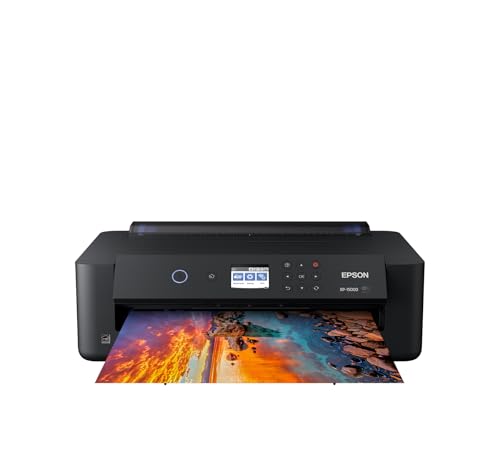
Epson Expression Photo HD XP-15000 — Best Step-Down Alternative
Read this heading twice: the XP-15000 does not print 24×36. It prints up to 13×19 inches, and it sits in this guide because a large share of people searching for 24×36 printers are actually chasing a feeling, big photographs on the wall, rather than a drafting requirement. For that reader, this desktop machine delivers most of the joy at a fraction of the space, cost, and commitment, and pretending otherwise to fill a table would be dishonest merchandising.
As a photo printer it is genuinely capable. Its six-ink approach, including red and grey inks in Epson’s Claria Photo HD set, is designed for smooth tonal transitions in skin and sky, and its borderless output at 13×19 makes a framed print that fills a normal room’s wall honestly. A rear specialty feed handles thicker art papers and card, so the machine serves Etsy-style sellers and camera-club exhibitors as happily as families printing the occasional hero shot from a holiday.
The step-down bargain cuts both ways, and the verdict below is blunt about it. If your work involves plans, patterns, or posters specified at 24×36 by someone else, this printer cannot help you, full stop. If your work is photographs you control, the question becomes whether a 13×19 print, well shot and well framed, satisfies the wall in question. Very often it does, and the money and floor space saved can go toward paper, framing, and actually taking more photographs.
Ownership is refreshingly domestic. The XP-15000 connects like a normal home printer, sips ink in cartridge quantities a household budget recognises, and can be carried by one person to a different room when life rearranges itself. None of the five machines above it in this guide can say any of that. Its presence here is a reminder that the best printer for a stated size and the best printer for a real life are sometimes different machines, and the honest guide names both.
- Format: Desktop photo printer up to 13×19 inches
- Family: Photographic, six-ink dye system
- Placement: Desk, home office, studio bench
- Typical media: Photo papers, matte art media, card
- Operator style: Individual photographers and sellers
Strengths
- Beautiful borderless photo output at its true maximum size.
- Desk footprint and household-friendly ownership pattern.
- Specialty rear feed welcomes thicker creative media.
Trade-offs
- Cannot print 24×36 under any setting or workaround.
- Cartridge ink economics suit photos, not document volume.
- No roll feeding, scanning, or plan-room features.
Best for: Photographers whose largest honest need is 13×19. Not suited for: Anyone with an actual 24×36 requirement.
Roll or Cut Sheets: Which Feeding Style Fits Your Work?
Roll feeding is the native language of the 24-inch class. A roll holds the equivalent of dozens of ARCH D sheets, loads once, and lets the machine cut each print to length, which suits plan sets and poster runs where consecutive jobs share a width. The economics favour rolls too, since roll media generally costs less per square foot than pre-cut sheets of the same stock. The compromises are curl, storage, and commitment: a loaded roll is one paper type at a time, and a half-used roll of expensive photo media ties up money on the spindle.
Cut sheets answer with flexibility. A stack of 24×36 sheets in three different stocks can sit beside the machine, letting an operator alternate between bond and coated work without unloading anything. Sheets lie flatter than roll output, which matters for presentation copies handed over in the same hour they are printed. The costs are handling and price: large sheets are awkward to load singly, attract dust and fingerprints, and carry a per-sheet premium that volume users feel quickly.
Most offices settle into a hybrid rhythm the machines above all support. The roll carries the daily standard stock, bond for technical shops or a house photo paper for studios, while cut sheets handle exceptions, tests, and special media. When you evaluate a specific model, check how gracefully it switches between the two, because that transition, repeated weekly for years, is where ownership satisfaction is quietly decided. A machine that makes the swap painful will end up dedicated to whichever source was loaded first, and half its flexibility will exist only in the manual.
What Does Ink Really Cost at This Size?
Wide-format ink economics confuse newcomers because the cartridge prices look alarming while the per-print costs can be entirely reasonable. A 24×36 sheet covers six square feet. A line drawing on bond inks a tiny fraction of that area, so a plan set costs little in ink even from expensive cartridges. A full-bleed photographic poster inks nearly every square inch, and the same cartridge suddenly produces a modest stack of prints. Both statements describe the same machine; the work, not the hardware, sets the bill.
This is why honest guides refuse to quote a single cost-per-print figure for the category. Instead, estimate from your own mix. Count a month of real jobs, separate them into line work, mixed graphics, and full-coverage images, and let a supplier price that basket against each machine you are considering. Suppliers do this arithmetic routinely, and a reluctance to do it tells you something about the supplier. Also ask about ink used in cleaning and calibration, a real but modest overhead that belongs in any honest estimate.
Cartridge size strategy follows from the same count. High-volume plan rooms should buy the largest cartridges their machines accept, because the per-millilitre price improves with size and changeovers interrupt deadlines. Low-volume users face the opposite logic: a huge cartridge is a large sum of money evaporating slowly on a shelf, and smaller sizes keep the commitment proportionate. The T2170 and T650 buyer profiles usually land in the second camp, the TM-240 and PRO-2600 profiles in the first, and matching cartridge size to genuine volume is the simplest money decision in this entire guide.
Paper, finally, is the consumable nobody budgets dramatically enough. A poster shop’s media bill can rival its ink bill, and a plan room that upgrades from bargain bond to a brighter, heavier stock will see both better-looking sets and a noticeably larger paper invoice. Sample before you standardise: a short roll or a sheet pack of any candidate stock, printed with your real files, teaches more than a pallet bought on a datasheet’s promise.
How Do the Six Compare Side by Side?
| Pick | True 24-inch? | Family | Scans? | Home of the workflow |
|---|---|---|---|---|
| Canon imagePROGRAF TM-240 | Yes | Technical | No | Plan room |
| HP DesignJet T650 | Yes | Technical | No | Small studio |
| Epson SureColor T2170 | Yes | Technical | No | Quiet office |
| Canon imagePROGRAF PRO-2600 | Yes | Graphics | No | Photo studio |
| HP DesignJet T830 MFP | Yes | Technical MFP | Yes | Site cabin |
| Epson XP-15000 | No, 13×19 max | Photo desktop | No | Home desk |
What Should You Check Before Ordering a 24-Inch Machine?
Begin with the delivery route, a step buyers skip until a pallet is in the rain. Plotter boxes are long; measure door widths, corridor corners, lift interiors, and stair turns between the street and the printer’s final corner. Confirm whether the stand ships in the same box or separately, and whether your supplier offers inside delivery. More than one office has owned a plotter that lived in a hallway for a week while facilities solved geometry.
Next, cost the consumables as a system. Ask which ink cartridges the machine uses, what sizes exist, and whether your expected volume matches the economical size or strands you buying small cartridges forever. Price the papers you will actually load: bond for plans, a coated stock for presentations, photo media if graphics matter. Add a spare roll and a maintenance allowance to the first-year budget. The hardware quote is the beginning of the money conversation, not the end of it.
Software deserves a test, not a brochure. Send your real files: the PDF plan set with layered line weights, the poster with a gradient sky, the spreadsheet exported from your actual application. Plotter drivers differ in how they handle vector line merging, transparency, and colour conversion, and a file that prints beautifully from one ecosystem can emerge muddy from another. Any serious supplier or showroom will run your file; their willingness is itself diagnostic.
Finally, plan the human system. Who loads rolls, who orders ink, who clears the cutter jam at 4 p.m. before a 9 a.m. submission? Wide-format machines fail socially before they fail mechanically, usually by becoming one departed employee’s mystery box. A laminated card on the wall covering media changes, ink swaps, and the support number will repay its trivial effort within the first month.
Service access belongs on that checklist too. Ask who repairs the machine locally, what a typical response time looks like, and whether a service contract makes sense at your volume. A plotter is a single point of failure for every deadline that depends on it, and the time to learn that the nearest technician is a week away is before the purchase order, not during submission week. Offices with truly immovable deadlines sometimes keep a relationship with a local print shop as overflow insurance, which is not disloyalty to the machine but ordinary risk management.
Which Driver Settings Matter Most at Full Size?
Three settings decide most of what a visitor notices in a finished sheet. The first is the quality mode, which trades carriage passes against banding risk and speed. Line work on bond tolerates the faster modes happily, because thin marks on a matte surface hide a multitude of sins. Photographic gradients expose everything, and the slower modes earn their time on any sheet destined for a frame or a client wall.
The second is colour handling: whether the application, the driver, or the printer itself converts the file’s colours for the loaded paper. Pick one authority per workflow and write it on the wall card, because double management, where both application and driver adjust, is the classic recipe for posters that emerge mysteriously dark or magenta. Technical offices printing from CAD should confirm how their application exports PDFs for plotting, since line-weight mapping and monochrome-versus-colour decisions often live in that export dialog rather than in the plotter’s own settings.
The third is the unglamorous matter of margins and scaling. Plotters cannot print to every edge of a roll the way photo printers borderlessly cover a sheet, and a drawing scaled to ninety-eight percent to fit a printable area is a drawing whose scale bar now lies. Set the job to actual size, confirm the printable-area warning dialogs rather than dismissing them, and check the printed scale bar against a ruler on the test sheet. That thirty-second check protects every measurement anyone later takes from the paper.
How Do You Get Clean Full-Size Prints, Step by Step?
Start at the file. Confirm the document page size is genuinely 24×36 rather than a letter page scaled by hope, and embed or outline fonts so the plotter is not substituting typefaces. For drawings, check that line weights are assigned in the source application; a plotter reproduces the file it receives, including every hairline set to a width thinner than ink can hold on bond paper.
At the machine, load media deliberately. Seat the roll squarely, let the printer detect and confirm width, and select the media type that matches the actual stock. Run the built-in calibration or alignment routine whenever you change paper families, not just when output looks wrong. Print a single test sheet at full size and inspect it under the room’s real lighting: read the smallest annotation, check a long diagonal for stepping, and look across large fills for banding while the sheet is still on the basket.
Measure twice in the software before you print once in the world. Rotate the preview, zoom to the title block, read the revision number aloud against the transmittal, and confirm the sheet count matches the set index. These clerical seconds feel tedious exactly until the first time they catch a superseded drawing on its way to a contractor, after which nobody in the office skips them again. Full-size printing rewards a checklist culture, because the cost of every error is printed at the same generous scale as the work itself.
Handle the finished sheet like the deliverable it is. Let inkjet output dry flat before rolling or stacking, especially on coated media where a premature fingerprint becomes permanent. Roll prints with the image outward around a tube for transport, label the roll with project and date in pencil on the reverse margin, and store flat work in a plan chest rather than leaning it, because a 24×36 sheet develops a memory for every bad posture you teach it.
What Mistakes Do First-Time Wide-Format Buyers Make?
Underestimating the room is the classic opener. The printer fits, technically, but the basket cannot open, the roll loads against a wall, and the operator trims sheets balanced on a chair. Walk the space with a tape and a cardboard outline before purchase, including the human space in front of the machine, and the purchase will feel boring in the best way.
A second recurring error is buying the graphics machine for plan work or the plotter for photography, seduced by whichever demo print was on display. The two families overlap at the level of a spec sheet and diverge at the level of a thousand sheets. Match the machine to the pile of work you actually produce in a month, counted honestly, not to the most glamorous single job of the year.
New owners also starve the machine of routine. Inkjet plotters that sit idle for weeks wake up grumpy, needing cleaning cycles that spend the ink the owner was saving. A small weekly test plot, even a single check sheet, keeps nozzles honest and surfaces problems while they are still cheap. Assign that ritual to a person and a calendar, not to good intentions.
The last mistake is skipping the total-cost conversation until the first ink order. Cartridges for production machines are priced like production supplies, and a finance department surprised by them becomes an enemy of the print room. Share the running-cost estimate at purchase time, in writing, and the machine will be judged on its output rather than relitigated at every reorder.
One more quiet mistake deserves naming: letting the plotter become a storage shelf. Large flat top surfaces attract drawing tubes, samples, and laptops, and every object parked on the machine risks a spill, a blocked vent, or a scratched cover that houses precision parts. The print corner rules should include a boring sentence, nothing lives on the plotter, enforced kindly and constantly, because wide-format machines repay tidiness with years of uneventful service.
How Should You Set Up the Corner Where the Plotter Lives?
Treat the plotter’s corner as a small workstation rather than a parking spot. The operator needs a surface beside the machine for the sheet currently being checked, a place for the roll in waiting that keeps it off the floor, and light good enough to judge colour and line quality without carrying prints across the building. A spare-roll rack or even a clean vertical bin, a flat table at comfortable height, and a task lamp transform the quality-control moment from a squint into a system.
Power and network deserve the same forethought. Put the machine on a circuit that is not shared with the kettle or the space heater, connect it by wired network where possible so large plot files are not hostage to a busy wireless channel, and keep its supply shelf stocked by rule: when the second-to-last roll or cartridge is opened, the replacement is ordered. Stock-outs at this format cannot be solved by a trip to a general retailer, because 24-inch media is specialist stock with delivery times attached.
Dust is the slow enemy. Construction-adjacent offices should keep the plotter covered when idle and its media stored in bags or boxes, since gritty dust on a roll’s surface prints as defects and abrades its way into mechanisms. A weekly wipe of the exterior and the paper path area, done while the test plot runs, is the entire maintenance religion most offices need beyond the machine’s own routines.
Who Should Skip 24 Inches Entirely?
Plenty of readers, and naming them is a service. If your large prints are photographs for your own walls, printed a few times a year, a local print service or the XP-15000 will make you happier than a floor-standing machine ageing in the corner. If your documents are spreadsheets and posters that read perfectly well at 17 inches, the tabloid class covered in our related guides costs less in every dimension. If your plans arrive from consultants and leave to contractors without your office ever issuing a set, you may need a good viewer and a plan table more than a plotter at all.
The buyers who should not skip are equally clear. Offices issuing ARCH D sets weekly, studios selling large prints, and site teams trapped in markup round trips will recover a 24-inch machine’s cost in saved outsourcing, saved travel, and saved misunderstandings. The test is frequency with stakes: large sheets, produced often, whose errors are expensive. Two of those three conditions justify a serious look; all three justify the purchase outright.
Final Recommendation
For most offices arriving at this keyword with real plans to print, the Canon imagePROGRAF TM-240 is the balanced answer: proper ARCH D output, line work you can issue, and manners suited to a working plan room. Small studios short on space should look hard at the HP DesignJet T650 or the Epson SureColor T2170 depending on whether flexibility or quiet matters more, while teams drowning in paper markups will get the most from the T830’s scanning loop. Photographers should separate their decision entirely and choose between the PRO-2600’s genuine 24-inch artistry and the XP-15000’s honest desktop compromise. A plan set issued at full scale, read around a table without a single squint or apology, is one of those quiet professional pleasures that justifies every inch of floor the machine occupies.
Frequently Asked Questions
Is 24×36 the same as ARCH D?
Yes. ARCH D is the North American architectural sheet designation for 24 by 36 inches, and the two terms are used interchangeably by architects, suppliers, and printer makers. Metric projects occasionally specify A1 instead, which is close in spirit but not identical in dimensions, so a roll-fed machine that can cut custom lengths handles both worlds more gracefully than a sheet-only arrangement ever will in a mixed practice. Its larger sibling, ARCH E, measures 36 by 48 inches and requires a 36-inch machine, so confirm which size your project standards actually specify before shopping.
Can a 24-inch plotter print smaller sizes economically?
It can print them, and roll nesting lets several smaller sheets share one cut length, which softens the waste. Even so, using a plotter as your everyday letter printer is poor economics and worse ergonomics. Most offices keep a standard office printer for documents and reserve the wide machine for work that needs the width.
Do I need a stand, or can a plotter sit on a table?
Some 24-inch models, the T2170 among them, are designed to work from a sufficiently deep and sturdy desk. Others expect their stand, which also provides the basket that catches finished sheets. A 24×36 print emerging with nowhere to land will land on the floor, so treat the stand and basket as part of the machine rather than an accessory.
How long does a 24×36 print take?
It depends on the family and the content: a technical line drawing on bond is a matter of a short wait, while a full-coverage photographic poster at quality settings is a deliberate, slower process. Judge any machine by a test of your own file rather than by brochure timings, which are measured under conditions chosen to flatter.
Can these machines print banners longer than 36 inches?
Roll-fed models generally can produce longer output, since the roll is continuous and the cutter decides where a job ends, within each model’s stated limits. Banner work is a legitimate use for events and site signage, but check the specific machine’s maximum length and your application’s tiling or banner settings first. Also remember that very long prints need somewhere clean to land while they dry.
What paper should I stock first?
Start with the bond roll your daily work needs and one coated stock for presentations or posters, then learn both thoroughly before expanding the library. Two papers you understand beat six papers you guess at, because media settings, drying behaviour, and colour response all become predictable with repetition.
How do I store rolls and finished prints?
Keep rolls upright or suspended in their boxes, away from sunlight and damp, and let a cold roll acclimatise in the room before loading so condensation does not reach the paper surface. Finished prints belong flat in drawers or rolled image-outward around a tube for short trips. Never store valuable sheets leaning against a wall for weeks; the resulting curl and edge damage cannot be ironed out by optimism or by weights.
Related Guides
Readers weighing the step-down route often continue with our wide-format desktop coverage in best 13×19 photo printers for home studios, while offices comparing running costs across sizes may find best 11×17 printers for tabloid documents useful, and teams standardising a whole print room can round out the picture with best laser printers for small offices. See also 3 d printers of classrooms.
Related guides
- Best 4K UHD HDR HDMI Extenders: 4K60, Long-Run and 4K120 Kits Compared
- Best 25–35 Inch Monitors With Lowest Display Lag: An Honest Ranking Without Invented Numbers
- Best Enterprise SATA SSDs: Endurance Classes, Power-Loss Protection and Fleet Sense
- Best Color Product Label Printers: Six Desktop Machines for Short-Run Product Labels



[…] below this class is covered in the best 16×20 printers, the full-width shelf is surveyed among the best 24×36 printers, and square-format specialists should see the best 12 x 12 pigment photo […]