Our Top Picks
 DJI Neo 2 Motion Fly More Combo WithDJI Neo 2 Motion Fly More Combo6.74 x 5.8 x 1.59 inches0.3 poundsCheck on Amazon
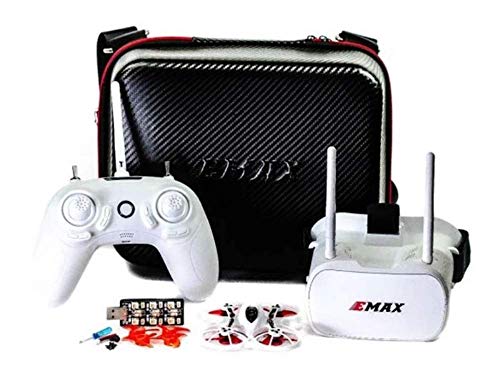 Tiny Hawk RTF Micro Indoor Racing Drone with693 cubic inches11 x 9 x 7 inches2.65 poundsCheck on Amazon


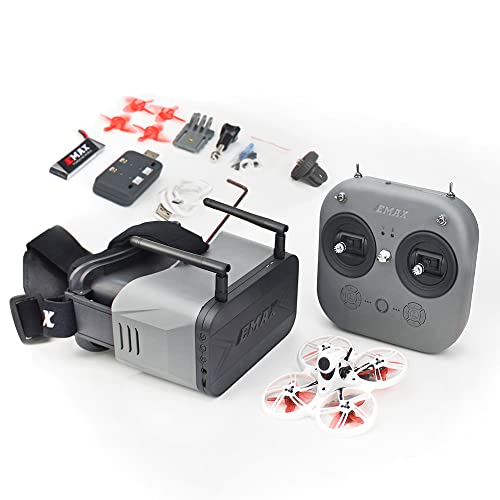
What's inside
- What a ready to fly set actually puts in the box
- Analog video: cheap, light, and honest about its limits
- Digital video: HDZero, Walksnail, and DJI compared
- The whoop class: 65 and 75 millimetre aircraft
- Brushed hearts and brushless upgrades
- Toothpicks and cinewhoops: the 2 to 3 inch step
- Radio links: ELRS against the older FrSky world
- The transmitter itself: gimbals, switches, and growth room
- Batteries: single cell, two cell, and the connector question
- The simulator apprenticeship
- Registration, weight, and the rules in outline
- The upgrade path: what grows and what gets replaced
- Checking a kit before money changes hands
- First flights, first crashes, and staying in the hobby
- Matching the set to the pilot
- Goggles in detail: screens, antennas, and the onboard recorder
- Rates, camera angle, and flight modes translated
- Check prices on Amazon
- A short word on spare parts budgeting
As an Amazon Associate I earn from qualifying purchases. This post may contain affiliate links at no extra cost to you.
What a ready to fly set actually puts in the box
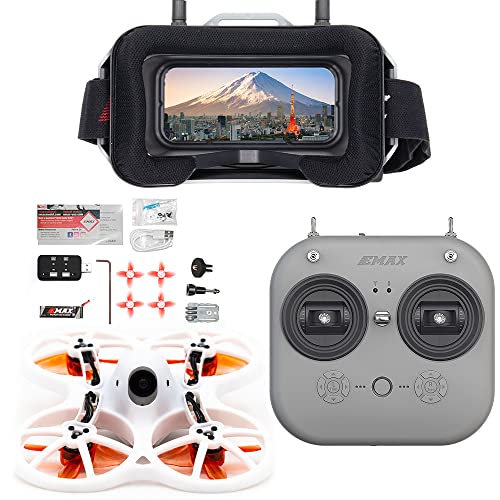
A beginner FPV set, usually labelled RTF for ready to fly, promises that one carton contains the three machines that must agree with each other before anything leaves the ground: the drone itself, a pair of video goggles, and a radio transmitter. The drone carries a camera and a video transmitter, abbreviated VTX, which broadcasts the camera picture. The goggles receive that broadcast and show it to the pilot in something close to real time. The transmitter sends control commands through its own separate radio link, and a small receiver aboard the drone listens for them. When all three speak compatible languages, the buyer charges batteries, binds the link, and flies.
That completeness is the entire appeal, and also the entire trap. A kit assembled around a weak radio or an orphaned video format can fly beautifully on its first weekend and still become a dead end by the third month, when the owner wants a better aircraft and discovers that nothing in the box talks to anything outside it. Judging a set therefore means judging three purchases wearing one price tag’s clothing, and the sections below take them one at a time: video system first, because it locks the goggles; airframe second, because it decides where and how the beginner may practise; radio third, because it quietly governs range, reliability, and every future model the pilot will ever bind.
Beneath the three headline components, the box should also contain the unglamorous items that determine whether the first week is fun or frustrating. Expect several flight batteries rather than one, a charger suited to them, spare propellers in both rotation directions, a propeller removal tool, spare canopy or frame hardware on whoop kits, a neck strap or at least a lanyard anchor for the transmitter, and printed or linked binding instructions specific to the firmware versions inside. A set missing half of that list is not cheaper; it merely defers its costs into the first fortnight of ownership, one small parcel at a time.
Finally, understand the phrase bind and fly’s absence here. RTF means the factory has already bound the transmitter to the drone’s receiver and set the VTX to a legal channel, so the pairing work is done. That convenience is worth real money to a first time pilot who has never seen a binding plug, a bind button sequence, or a configurator screen. It also means the buyer should verify, before paying, that the binding can be repeated after a firmware update wipes it, because sooner or later every owner meets that screen at a kitchen table with a manual open beside a cooling soldering iron.
Analog video: cheap, light, and honest about its limits
Analog FPV video is a direct descendant of broadcast television practice. The camera produces a composite signal, the VTX modulates it onto a 5.8 gigahertz carrier, and the goggles demodulate whatever arrives, interference and all. Its virtues are latency measured in the low tens of milliseconds or less, featherweight cameras and transmitters that suit tiny aircraft, and a graceful failure mode: as range stretches, the picture fills with static and rolling lines long before it vanishes, giving the pilot a readable warning to turn home. Its vice is resolution. An analog picture carries roughly the detail of an old security camera, and distant branches, wires, and gate edges can hide inside its softness until they are close.
For a beginner flying a small whoop around a living room or a garden, analog’s softness matters surprisingly little. The obstacles are near, large, and slow, and the aircraft itself is too light to travel far before the battery calls it home. Analog goggles in RTF boxes are usually compact box goggles with a single screen and a Fresnel lens, modest in clarity yet light on the face and forgiving of spectacle wearers when the focal adjustment allows it. Their receivers commonly include a diversity option on better sets, using two antennas and selecting the cleaner signal moment by moment.
Analog also keeps the whole ecosystem inexpensive to repair. Cameras, VTX boards, and antennas for analog aircraft exist in enormous variety because the standard has been stable for years, and a crashed whoop rarely needs a proprietary part flown in from a single vendor. The pilot who expects to crash weekly, which is the correct expectation, should price that repairability honestly. A video system that forgives both the wallet and the workbench has a genuine claim on a beginner’s first season.
The honest ceiling arrives when the pilot graduates to faster outdoor flying, where reading terrain at speed through static becomes the limiting skill rather than stick control. At that point analog has still done its job: it taught the fundamentals at low cost, and the goggles from a good kit often continue serving as a spectator or backup display. Buying analog first is not buying wrong. It is renting competence cheaply, with the option to keep the equipment in a supporting role afterwards.
Digital video: HDZero, Walksnail, and DJI compared
Digital FPV systems encode the camera picture and transmit it as data, which buys clarity at the price of complexity, weight, and a failure mode that freezes or pixelates instead of snowing gently. Three ecosystems dominate beginner conversations. DJI’s system, sold across several hardware generations, delivers a polished, high definition picture with strong penetration through light obstacles and a large installed base, but it ties the pilot to DJI air units and goggles, and its latency rises as signal quality falls because the system works to preserve the picture.
HDZero takes the opposite philosophical position. It transmits an uncompressed style digital signal with fixed, very low latency that racers prize, accepting a picture that breaks up with coloured digital noise at the edge of range rather than smearing smoothly. Its cameras and VTX boards are light enough for small aircraft, including serious whoops, which makes it the digital option most friendly to the tiny end of the hobby. A beginner who already knows racing is the destination may reasonably start here, provided the kit’s goggles and VTX are current hardware rather than early stock being cleared.
Walksnail, built by Caddx, positions itself between those poles, with a detailed picture, a growing range of air units including light models for small drones, and goggles that have steadily improved in comfort and receiver performance. Its moonlight camera variants are known for usable pictures in dim conditions that would defeat many rivals. For cinewhoop style flying, where the picture is half the point, Walksnail kits deserve a close look, while remembering that its ecosystem is younger and its second hand market thinner than the alternatives.
The governing rule is that digital ecosystems do not interoperate. DJI goggles cannot receive a Walksnail transmission; an HDZero VTX will not pair with either rival’s display. A beginner choosing a digital RTF set is therefore choosing a video nationality for years, because every later aircraft must carry a compatible air unit or the goggles must be replaced. Analog, by contrast, is a single shared standard. This is why so many instructors steer first time buyers toward either analog or the digital system flown by the local club whose members can actually help them at the field.
| Video system | Picture character | Latency behaviour | Typical beginner fit |
|---|---|---|---|
| Analog 5.8 GHz | Soft, standard definition, static at range | Very low and consistent | Whoops, low cost learning, easy repairs |
| HDZero | Sharp 720p class, digital breakup at edge | Very low and fixed | Racing minded pilots, light digital aircraft |
| Walksnail | Detailed, strong low light options | Low, varies modestly with signal | Cinewhoop and scenic flying |
| DJI | Polished high definition, strong penetration | Rises as signal weakens | Pilots committed to that ecosystem |
Pilots researching camera drones rather than FPV kits will find a neighbouring survey useful for contrast, since it treats photography first and piloting second: best affordable drones with cameras shows how different the priorities become when the camera stops being merely the pilot’s eyes.
The whoop class: 65 and 75 millimetre aircraft
A whoop is a tiny quadcopter whose propellers turn inside full circular ducts, named for the frame style that made indoor FPV practical. The ducts guard the blades, the walls, the furniture, and the pilot’s fingers in roughly that order of frequency. Whoops are measured by motor to motor diagonal in millimetres, and the two sizes that dominate beginner kits are 65 and 75. Both fly from single cell batteries, both weigh far below any registration threshold discussed later, and both can be flown through a house at walking pace without endangering anything more precious than a lampshade’s dignity.
The 65 millimetre whoop is the indoor specialist. Its propellers, typically 31 millimetres across, sip current and produce a gentle thrust that suits small rooms, low ceilings, and pilots still learning that the throttle stick is not a light switch. Flight times cluster around three to four minutes on a 260 to 300 milliamp hour cell when flown calmly. Outdoors, the 65 is a fair weather toy in the strict sense: a breeze that an adult barely notices will carry it across a garden and pin it against a fence, because its disc loading and reserve thrust leave nothing spare for fighting wind.
The 75 millimetre whoop trades a little indoor delicacy for real outdoor ability on calm mornings. Its 40 millimetre propellers move noticeably more air, its motors are stronger, and it carries a 450 to 550 milliamp hour cell for flights approaching four to five minutes of mixed flying. Indoors it remains docile at low throttle, though its extra momentum makes door frames arrive sooner. Many instructors quietly regard the 75 as the better single purchase for a beginner without a large indoor space, because it covers the house adequately and the garden genuinely.
Frame construction separates durable kits from disposable ones. A good whoop frame is a single moulded piece in a resilient plastic that flexes on impact and springs back, with a canopy that shields the camera and flight controller stack. The ducts themselves are sacrificial; they deform to absorb crashes that would otherwise bend motor shafts. When comparing sets, look for a frame with replaceable canopy, a battery bay that grips the cell without a rubber band improvisation, and motor plugs that allow a motor swap without soldering, because the first motor failure should be a five minute lesson rather than the end of the aircraft.
Brushed hearts and brushless upgrades
The cheapest whoops still use brushed motors, in which tiny brushes carry current to a spinning commutator. Brushed motors are inexpensive, smooth at very low speed, and simple to drive, but the brushes wear physically, performance fades across the motor’s life, and a set of four may need replacement after a season of regular flying. Their sizes are given as coreless dimensions such as 6 by 15 or 7 by 16 millimetres, and their speed is quoted in kilovolts like their brushless cousins, though the numbers are not directly comparable in feel.
Brushless motors dispense with brushes entirely, switching current electronically through windings in the stator while permanent magnets spin around or inside them. They last for years of crashes that do not bend their shafts, deliver stronger and more consistent thrust, and dominate every kit above the lowest price tier. Their naming encodes stator diameter and height, so an 0802 motor has an eight millimetre stator diameter and a two millimetre stator height, while a 0702 is a smaller, lighter unit for the lightest 65 millimetre builds. Higher KV figures mean more revolutions per volt, suiting smaller propellers on single cell power.
For a beginner choosing a set, brushless is the recommendation that survives contact with reality, even when the brushed kit undercuts it noticeably. The saving evaporates into replacement motors and declining performance, while the brushless aircraft flies the same in month six as in week one. The exception is the genuinely tentative buyer, unsure whether FPV will hold their interest past a month, for whom a brushed kit functions as an inexpensive trial. Even then, the trial teaches slightly muted throttle behaviour that must be partly unlearned when upgrading, a small but real cost.
Motor plugs deserve a sentence of their own. Tiny whoop motors connect through miniature JST style plugs that can loosen after repeated crashes, producing an intermittent twitch that beginners misdiagnose as a flight controller fault. A kit whose motors are soldered directly removes that failure point but complicates replacement. Either approach is defensible; what matters is that the buyer knows which one is inside the box before the first intermittent fault sends them searching forums at midnight.
Toothpicks and cinewhoops: the 2 to 3 inch step
Beyond whoops, beginner kits branch into two outdoor families built around propellers of two to three inches. A toothpick is an ultralight open frame aircraft, named for its spindly arms, designed to fly like a much larger machine while staying quiet, gentle on impact, and frequently below the 250 gram threshold even with its battery. Toothpicks carry no propeller guards, so they belong outdoors over grass, away from people, and in the hands of a pilot who has already learned basic orientation on something ducted.
A cinewhoop keeps the ducts of its smaller cousins but grows to roughly two and a half or three inches, adds a mount for a small action camera on larger variants, and prioritises smooth, protected flying near subjects. Its ducts make it the tool for slow passes through doorways, around workshops, and along garden paths where a bare propeller would be irresponsible. The price of that protection is weight and noise: a cinewhoop works its motors harder to lift its own guards, flies shorter on the same energy, and announces itself with a distinctive ducted whine.
As a first and only aircraft, the whoop still wins for most people, because it can be flown daily indoors regardless of weather, and daily practice is what actually builds a pilot. Toothpick and cinewhoop kits make their strongest case as the RTF purchase for a beginner who has already spent simulator hours, owns a garden or a quiet field, and knows the indoor phase would bore them within a fortnight. Several sets bundle a 75 millimetre whoop with an upgrade path into this class through the same radio and goggles, which is the pattern to look for: the airframe may be outgrown, but the ground equipment should not be.
Propeller size interacts with noise and neighbourliness in ways beginners underestimate. A three inch aircraft at full throttle is audible across a small park, while a whoop indoors is quieter than a hair dryer on its low setting. Flying locations impose their own etiquette, and a kit that can be practised at home at nine in the evening will accumulate more pilot skill by spring than a louder machine that only flies on free Sunday mornings. Choose the aircraft that fits the calendar and the postcode, not merely the imagination.
Readers drawn to the cinewhoop’s camera carrying role often end up comparing standalone cameras as well, and a current roundup can help there: best 1080p action cameras covers the recording side that an FPV camera alone does not satisfy.
Radio links: ELRS against the older FrSky world
The control link is the least visible and most consequential part of any set. ExpressLRS, almost always shortened to ELRS, is an open source radio system operating mainly on 2.4 gigahertz, with a 900 megahertz variant in some regions, built around modern LoRa style modulation. It achieves remarkable range and penetration for its power, refreshes control data at packet rates up to 500 hertz on the faster modes, and has become the default receiver standard across new aircraft from tiny whoops upward. A kit whose transmitter and receiver both speak ELRS plugs its owner into the hobby’s current mainstream, with replacement receivers available everywhere and binding knowledge shared by every club.
FrSky’s ACCST protocols, chiefly D8 and D16, powered the previous generation of beginner kits and still fly perfectly well at park distances. Their receivers are common, their behaviour is understood, and a used market full of compatible aircraft exists. The limitations are strategic rather than immediate: range and interference rejection trail ELRS, firmware fragmentation between regional and international versions has confused owners for years, and new aircraft now commonly launch with ELRS as the only receiver option. A beginner buying FrSky today should do so knowingly, usually because the kit is heavily discounted or because an existing transmitter at home already speaks it.
Other names appear on boxes and deserve translation. FlySky’s AFHDS protocols serve some inexpensive kits adequately at short range. Spektrum’s DSMX appears in sets aimed at the aeroplane world. TBS Crossfire and its successor Tracer are premium long range systems that rarely appear in true beginner bundles. None of these is a defect in itself; the question is always whether the protocol has a future fleet. A transmitter that binds only to its own kit’s receiver is a consumable. A transmitter speaking ELRS is infrastructure.
Range claims on packaging should be read with a pilot’s scepticism. Open field line of sight figures measured with high antennas say little about flying behind trees at head height, where multipath reflections and foliage absorption govern the link. ELRS’s practical gift to beginners is not headline distance but margin: the link stays solid through the scruffy, obstacle rich environment of gardens and sports fields where new pilots actually fly, and its telemetry can report link quality back to the transmitter so the pilot learns the limits gradually instead of discovering them in a failsafe tumble.
The transmitter itself: gimbals, switches, and growth room
Kit transmitters range from gamepad shaped units with simple gimbals to full size radios with hall effect sensors and colour screens. Gamepad styles suit the whoop class well; they are light, familiar to anyone who has held a console controller, and small enough to travel in the same bag as the aircraft. Their gimbals, usually potentiometer based, can develop centre jitter after heavy use, and their switch count limits the extra functions, such as turtle mode activation or VTX adjustments, that a growing pilot eventually wants at their fingertips.
Hall effect gimbals, which sense stick position magnetically without contacting parts to wear, appear in better kit radios and in the standalone transmitters discussed later. They hold calibration, feel consistent across seasons, and justify their cost over years. Spring tension and stick length adjustment matter more than most listings admit, because a pilot flies with their thumbs or with a pinch grip, and the two styles prefer different stick heights and tensions. A transmitter that allows those adjustments will fit its owner longer than one sealed at the factory’s idea of average hands.
Two switches are the practical minimum beyond the arm switch: one to select flight mode, since beginners benefit enormously from a stabilised angle mode before graduating to full manual acro, and one for turtle mode, which flips a crashed whoop upright by briefly reversing selected motors. A beeper or lost model function earns its keep the first time an aircraft disappears into long grass with its battery still connected. Radios that expose these through a simple, documented switch layout save their owners an evening of configurator archaeology.
Internal charging by USB, a battery that lasts a flying day rather than an hour, and a module bay or at least ELRS built in at a sensible output power complete the sensible specification. Output power deserves one clarification: regulatory ceilings differ by region, and more milliwatts do not linearly buy more range, because range grows with the square root of power at best. Antenna quality and receiver sensitivity, both strong points of current ELRS hardware, matter at least as much as the transmitter’s headline output figure.
Batteries: single cell, two cell, and the connector question
Whoops fly on lithium polymer cells counted in series. A 1S battery is a single cell at a nominal 3.7 volts, or 3.8 volts for the high voltage LiHV variants that dominate the class, charged to 4.35 volts. A 2S pack stacks two cells for a nominal 7.4 volts and suits larger toothpicks and cinewhoops that need the voltage for bigger motors. Capacity in milliamp hours, discharge rating, and weight trade against each other in every pack, and for a whoop the weight term dominates: a heavier battery that adds thirty seconds of flight may still fly worse, because the aircraft spends its extra energy lifting the battery itself.
The connector is where beginner kits quietly diverge, and it deserves more attention than the box art gives it. The older PH2.0 connector, a small two pin plug, served the class for years but is now recognised as a bottleneck: its pins develop resistance and voltage sag under the current a modern brushless whoop demands, shortening flights and softening punch as the connector ages. The BT2.0 connector, designed specifically for this application, carries current with far less sag, survives more mating cycles, and has become the standard to look for on 1S aircraft and batteries alike. A kit still shipping PH2.0 is not unusable, but its owner should expect to migrate connectors eventually, soldering iron in hand.
Grown up packs for 2S and larger aircraft use the XT30 connector, a compact member of the XT family with a balance lead alongside for the charger. Whatever the connector, the discipline is identical: charge on a non flammable surface, never leave charging packs unattended, retire any pack that puffs, smells sweet, or comes down hot and sagging, and store packs near storage voltage, around 3.8 volts per cell, rather than full or empty. Lithium polymer care is the one part of this hobby where casualness has consequences beyond a broken toy, and good kits say so plainly in their manuals.
Count the batteries in the box before valuing the set. A whoop flies for roughly three to five minutes per pack, so a single battery means a flying session of four minutes followed by forty minutes of charging, an arrangement that teaches nothing except patience. Four to six packs, flown in rotation with a parallel or multi port charger refilling the flown ones, turn the same afternoon into genuine practice. Sets that include a charger handling several 1S packs at once, ideally with a storage charge mode and individual cell display, are worth a clear premium over sets that include a single USB dongle charger and call the matter settled.
The simulator apprenticeship
Every experienced pilot gives the same first instruction, and every beginner wants to skip it: spend your first hours in a simulator. FPV simulators run on an ordinary computer, accept the kit’s transmitter as a USB controller on most current radios, and teach the single unnatural skill the hobby demands, which is coordinating throttle, yaw, pitch, and roll while the world tilts through the camera. Crashes in a simulator cost a keystroke. The same crashes outdoors cost propellers, canopies, and occasionally the aircraft, and they teach more slowly because each one ends the flight that contained the lesson.
Two or three evenings of simulator practice change the first real flight beyond recognition. The newcomer who has internalised keeping the nose down slightly while turning, and who can catch a descent with throttle before the ground arrives, will bring a whoop home intact from its first battery. The newcomer who skipped the simulator will spend that battery learning the same facts at higher cost and will likely meet the failsafe, the roof, or the pond that the simulator would have introduced them to harmlessly. Angle mode on the real aircraft softens the transition further, but it cannot install reflexes that were never built.
Simulator choice matters less than transmitter choice. Several respected options exist across computer platforms, some specialised for racing gates, others for freestyle flow around buildings and trees, and at least one well regarded free option lowers the barrier to the price of a download. What matters is that the simulated rates and camera angle can be set near the real aircraft’s, so the hands learn one machine rather than two. Setting the real whoop’s camera tilt and rates to match the simulator, rather than the reverse, is the trick experienced instructors pass on quietly.
There is also a social dimension to those first weeks. Local flying groups and online communities for each major kit are full of configuration files, binding walkthroughs, and photographs of correct antenna placement posted by owners who solved the same puzzles last season. A beginner flying a mainstream set inherits that library. A beginner flying an obscure bundle owns their problems alone. When two kits look equal on specifications, the one with the larger, more documented owner community is usually the better school.
High frame rate recording is a separate rabbit hole from the pilot’s live view, yet the two are often confused at purchase time, so this explainer may save a misdirected order: best 120fps cameras deals with capture rates for finished footage rather than the feed in the goggles.
Registration, weight, and the rules in outline
Regulation varies by country and changes over time, so this section offers orientation rather than legal advice, and every pilot should read their own aviation authority’s current pages before flying outdoors. The recurring theme across jurisdictions is the 250 gram threshold. Aircraft below that weight, including battery, are treated as the lowest risk category almost everywhere: in the United States they are generally exempt from recreational registration when flown purely for fun, while in the United Kingdom and the European Union the lightest category still carries operator registration duties in many cases, with camera equipped aircraft attracting obligations even at toy like weights.
Whoops sit so far below the threshold that they are effectively unregulated as aircraft in most places, which is another argument for starting tiny. A 75 millimetre whoop with its battery weighs roughly thirty grams. Even a cinewhoop with an action camera aboard usually remains under 250 grams, deliberately, because designers know the threshold sells aircraft. When comparing kits, treat a stated all up weight under that line as a genuine feature, and be suspicious of bundles whose camera or battery options quietly push the total across it.
Beyond registration, the universal rules are common sense written into law: keep the aircraft within visual line of sight of a responsible observer where required, stay below the altitude ceiling that local rules set, keep away from airports, emergency operations, crowds, and other people’s privacy, and never fly over roads or gatherings of people who have not consented to be overflown. FPV flying specifically often requires a spotter who watches the real aircraft while the pilot watches the screen, because goggles remove the peripheral awareness that ordinary line of sight flying relies on. A beginner who flies with a spotter from day one builds legal habits and gains a second pair of eyes for finding downed aircraft in grass.
Insurance through a national model flying association is inexpensive in many countries and is bundled with membership that also brings site access and instruction. Joining before the first outdoor flight is one of the few purchases in this hobby that every veteran endorses without argument. It also answers the registration and identification questions with current, local guidance, which ages better than any printed summary, including this one.
The upgrade path: what grows and what gets replaced
A well chosen RTF set is a platform, not a cul de sac. The natural growth sequence runs like this. First come consumables and spares: propellers by the dozen, extra batteries, a better multi port charger, and a spare canopy or frame. Then comes a second aircraft on the same radio and video standards, perhaps a toothpick for the park once the whoop has taught its lessons. Later, when the pilot’s ambitions outgrow box goggles, come better goggles within the same video ecosystem, or a receiver module that lets premium goggles display the older standard as well.
The transmitter decision inside the kit determines whether that sequence flows or stalls. A kit radio speaking ELRS with reasonable gimbals can remain the pilot’s main transmitter through several aircraft, and even budget gamepad radios in that ecosystem bind happily to future models. A proprietary radio binds the owner to one manufacturer or to nothing at all. Similarly, analog goggles with an AV input or a module bay can accept external receivers and even serve digital pilots as a second screen, while sealed, single purpose goggles retire completely the day the pilot changes systems.
Standalone transmitters are the upgrade most pilots eventually make, and knowing that in advance reframes the kit purchase. The kit radio becomes the travel and loaner unit, the one handed to a curious friend at the park, while a full size radio with hall gimbals, a module bay, and model memories measured in dozens becomes the daily instrument. Because ELRS receivers are inexpensive and standardised, that migration costs the price of the radio alone. In a proprietary ecosystem, migration can mean rebuying receivers for every aircraft, which is the hidden tax that cheap kits levy on their most successful owners, the ones who stay in the hobby.
Sensor ambitions belong on this roadmap too, since pilots who fall for cinematic flying soon ask about larger camera sensors and image quality, a topic surveyed in depth elsewhere: best 1 cmos sensor cameras explains what that sensor class buys in finished footage.
Checking a kit before money changes hands
Begin with the inventory, literally. Photograph or list everything the listing promises: aircraft, goggles, transmitter, batteries and their count, charger type, spare propellers in both clockwise and counter clockwise forms, tools, cables for charging and for computer connection, and any included carrying case. Sets photographed with six batteries and shipped with two are a recurring complaint in owner communities, and the time to discover the discrepancy is before purchase, in the listing’s fine print, rather than at the unboxing.
Next, identify the VTX precisely. Its model and firmware generation decide which goggles features work, whether output power settings comply with local rules, and whether the unit can be updated. Some digital VTX units shipped in bundles have run older firmware that lacks features advertised for the system generally, and updating them can require a specific cable and a computer utility that the buyer should download and inspect before the parcel arrives. For analog sets, confirm the VTX offers the standard forty channel arrangement across the five common bands rather than a restricted subset, because flying with others means agreeing on a channel at the field, not at the workbench.
Receiver firmware deserves the same scrutiny on ELRS kits. ELRS binding depends on a binding phrase set through a small web interface the receiver itself hosts, or on the traditional bind button sequence for equipment without that setup. A kit that arrives pre bound still deserves a rehearsal: the owner should know how to rebind before a field day forces the lesson. Sellers who document the exact receiver model, its firmware major version, and whether the transmitter’s internal module matches it are sellers who understand their own product, and that understanding correlates strongly with kits that work out of the box.
- Confirm the video system and exact goggle model, not just the brand family.
- Verify the radio protocol in writing, with ELRS preferred for a new purchase.
- Count batteries in the written specification and check their connector type.
- Look for BT2.0 rather than PH2.0 on single cell whoop equipment.
- Ensure spare propellers for both rotations are listed in the box contents.
- Check whether the transmitter works as a USB controller for simulators.
- Confirm the VTX channel set and that its firmware can be updated.
- Read the stated all up weight with battery against the 250 gram line.
First flights, first crashes, and staying in the hobby
The first real flying session should be boring by design. A large, soft, empty space, a calm hour of the day, batteries charged and marked so flown and fresh packs never mix, and a spotter if the local rules or simple prudence suggest one. Fly the first pack in angle mode at gentle throttle, learning how the whoop drifts, how it yaws, and how the goggles’ picture relates to the sounds the motors make. Land deliberately several times rather than once heroically at the end, because landing on purpose, at a chosen spot, is itself a core skill that only repetition builds.
Crashes will distribute themselves across a predictable anatomy. Propellers bend and nick first, which is why they are sold in bags. Canopies crack at their mounting points. A motor that takes a direct hit may develop a bent shaft that announces itself as a new vibration and a hot bell after flights that used to leave it cool. The flight controller, protected at the centre of the frame, survives almost everything a whoop can meet indoors. Post crash discipline is simple: disarm, inspect before rearming, straighten or replace any propeller that touched anything, and never fly a pack that was crushed or punctured in the impact, however healthy it looks.
Turtle mode deserves a practice session of its own on grass, because the first time it is needed the aircraft is upside down somewhere awkward and the pilot is flustered. Knowing that the mode requires a moment of stillness, that it fails gracefully on soft ground that swallows the ducts, and that a long stick or a walk is sometimes the honest solution, all belong to the beginner’s education. So does the beeper routine and the habit of noting, before every takeoff, which way home lies from the aircraft’s perspective rather than the pilot’s chair.
Progress in this hobby arrives in plateaus separated by sudden clarifications. A pilot who cannot complete a circuit of the garden in week one will slalom the furniture in week four, and the variable that explains the difference is almost never equipment. It is accumulated minutes of controlled flight, gathered in short daily sessions that a home friendly whoop makes possible and a large aircraft forbids. That is the deepest argument for the humble RTF whoop set: it converts spare minutes into skill, in any weather, in ordinary rooms, at a cost per crash measured in pocket change.
Matching the set to the pilot
Different beginners should buy differently, and honest self knowledge is worth more than any single recommendation. The apartment dweller with no garden should take the 65 millimetre brushless whoop kit with BT2.0 batteries, analog or HDZero video, and as many batteries as the box can be persuaded to hold. The suburban beginner with a lawn and a park nearby should look at the 75 millimetre class on ELRS, which will fly the house in winter and the garden in summer without apology to either. The aspiring filmmaker should accept the cinewhoop’s weight and noise, choose the digital system whose picture they prefer, and budget for the action camera as a planned second purchase rather than a surprise.
The racer in embryo, identifiable by the fact that they have already watched championship footage repeatedly, should weight latency and parts availability above picture beauty, which points toward HDZero or analog and toward the whoop size their local club races, because a class with other pilots in it teaches faster than any solitary practice. The returning aeroplane modeller, finally, may already own a capable transmitter; for them the smartest set may be no set at all, but a bind and fly aircraft plus goggles, and the kits in this guide still serve them as a map of which video and receiver standards the components should follow.
One population should wait rather than buy: anyone whose interest depends entirely on automated flight, waypoint missions, and a camera that flies itself. FPV sets are manual aircraft with a live video feed, closer in spirit to a bicycle than to a chauffeur. That is their joy and their demand. The beginner who wants the bicycle will find, in a carefully chosen box containing a small ducted aircraft, an honest radio, and goggles that speak a living standard, the beginning of a skill that compounds for years, long after the first frame has been retired to a shelf and the first transmitter has become the spare that teaches friends.
How the lights stay on at this publication, briefly and plainly: As an Amazon Associate, the site earns from qualifying purchases that readers complete after following a link, and that income funds the research time behind guides of this kind. Every specification discussed above was drawn from manufacturer documentation and protocol references rather than from any retailer’s summary, and readers comparing kits should always confirm firmware versions and box contents against the maker’s own pages before ordering, because bundles change quietly between production runs and a careful buyer catches the difference while it is still only a line of text on a screen.
Goggles in detail: screens, antennas, and the onboard recorder
Box goggles dominate beginner sets because they are affordable to make well: one screen, one lens, and a housing that holds both at the correct distance from the eyes. Their specifications repay reading. Screen resolution on analog sets matters less than brightness and size, since the incoming signal is standard definition regardless, while digital sets benefit directly from higher panel resolution. Field of view, quoted in degrees, describes how large the picture appears; a very wide field feels immersive yet pushes information toward the edges of vision, while a narrower field keeps the whole scene readable at a glance, which many beginners prefer while their eyes are still learning where to look.
Fit is a specification no sheet captures. Goggles that leak light at the nose, press on spectacle frames, or fog within minutes will be flown reluctantly, and reluctance is the enemy of practice. Foam faceplates in two thicknesses, an adjustable strap that does not rely on the battery’s weight for balance, and ventilation that actually moves air all separate the sets owners keep from the sets owners replace by spring. Buyers who wear glasses should check the stated diopter adjustment range or the room allowed for frames, because a dioptre dial that ends before their prescription does is not a minor inconvenience but a grounded pilot.
Antennas are the goggles’ ears, and the pairing supplied in the box shapes real world reception more than receiver brand names do. A common and sensible arrangement combines one omnidirectional antenna, which hears equally in all directions for nearby flying, with one directional patch antenna that concentrates sensitivity forward, where the aircraft usually is. Antenna connectors matter for the future: the standard SMA and RP-SMA fittings, irritatingly similar yet incompatible without adapters, decide whether the thriving aftermarket of antennas fits the goggles at all. Checking the connector type before purchase prevents a small, stupid, and entirely avoidable disappointment.
Nearly all modern goggles include a DVR, a digital video recorder that saves the received feed to a memory card. Beginners should value this feature beyond its novelty. The recording is the flight’s black box: it shows exactly where the picture broke up before a crash, which gate was missed and by how much, and, most practically of all, the last clear view of the landscape when an aircraft goes down in long grass, turning a hopeless search into a walk to a recognisable tree line. Recording every flight costs nothing but card space and repays the habit the first time it is needed.
Rates, camera angle, and flight modes translated
Three settings govern how an FPV aircraft feels, and beginner kits differ in how mercifully they preset them. Rates describe how aggressively the aircraft rotates in response to stick movement, expressed as degrees per second at full deflection, with additional shaping from parameters that soften response near the stick’s centre. Low, gentle rates with generous centre softening suit a new pilot, because most early overcorrections happen near the middle of the stick travel. Kits that arrive with a dedicated beginner rate profile already loaded, selectable from the transmitter or the configurator, save their owners from the discouraging first flights that unfiltered racing rates produce.
Camera angle, the upward tilt of the camera relative to the frame, quietly sets the aircraft’s natural cruising speed. A whoop’s camera tilted only slightly invites slow, level exploration, because the pilot must hold the nose down to see where level flight is going. A steep tilt, thirty degrees or more, makes forward speed feel normal and hovering feel like staring at the ceiling. Beginners should start near the shallow end, ten to fifteen degrees on a whoop, and add tilt only when they find themselves constantly pushing the nose down to achieve a comfortable pace. Adjustable canopies that change angle without tools make this progression a thirty second experiment rather than a workshop session.
Flight modes complete the trio. Angle mode limits how far the aircraft can tilt and returns it to level when the sticks centre, which makes it the natural schoolroom. Horizon mode allows full flips while still levelling gently near centre stick, a transitional curiosity most pilots pass through briefly. Acro, also called manual or rate mode, removes the limits entirely: the aircraft holds whatever attitude the sticks command and keeps rotating while a stick is held, which is the mode in which FPV truly flies and the mode the simulator exists to teach. A good beginner kit makes angle mode excellent rather than treating it as a grudging concession, because months of a pilot’s life will be spent there.
These settings live in the flight controller’s firmware, most commonly Betaflight across this class of aircraft, and a USB cable in the box is therefore not an accessory but a key. Through the configurator, owners adjust rates, set the arm switch and mode switches, name their model, and back up the entire configuration before experimenting. That backup habit deserves emphasis: a saved configuration file turns any later mistake, update mishap, or replacement board into an inconvenience measured in minutes. Kits whose manufacturers publish the factory configuration file for download earn a mark of seriousness that glossy packaging cannot imitate.
Master these quiet settings and the humble boxed set stops feeling like a compromise bought for its price, becoming instead what its designers intended: a small, complete school of flight that fits on a kitchen table, survives its own lessons, and leaves its graduate ready to choose every future aircraft with the calm judgement of someone who has already learned, propellers spinning a metre away, exactly how the sky responds to a thumb’s smallest intention.
Check prices on Amazon
Live listings for the shortlist in this guide are pulled from Amazon below, so prices and availability are always current at the moment you look.

FPV Drone Setup for Beginners: Build, Configure, Tune, and Fly Your First FPV Quadcopter Safely

A short word on spare parts budgeting
Ownership costs after the purchase follow a rhythm every veteran recognises, and planning for it protects the beginner’s enthusiasm from unpleasant surprises. Propellers are consumed steadily and should be bought in generous bags, because a pilot with no spare blades is a pilot whose session ends at the first fence post. Batteries age with cycles and calendar alike, and replacing packs gradually spreads that cost into background noise. One spare motor and one spare canopy per aircraft cover most crash damage that propellers do not absorb. Taken together, these consumables amount to a modest annual tithe on the original purchase, and the pilot who expects it simply enjoys the flying, while the pilot who does not mistakes normal wear for betrayal by the kit that started everything.


