Our Top Picks
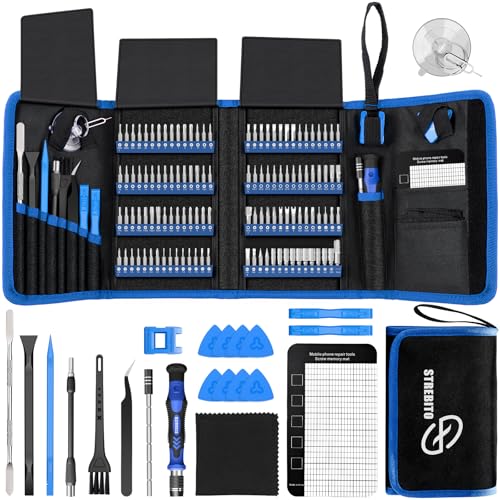 STREBITO Electronics Precision Screwdriver Sets 142-Piece with 1201428.66 x 5.51 x 1.57 inches1.8 poundsCheck on Amazon
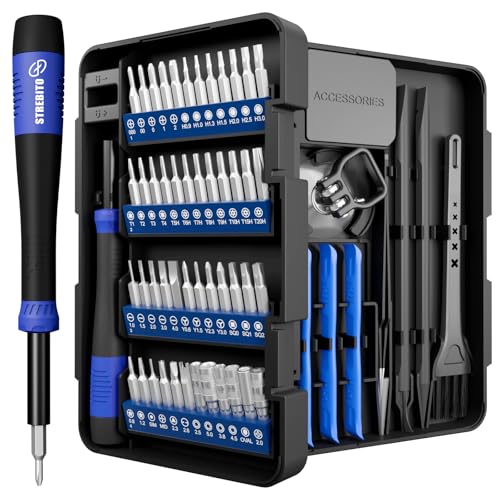 STREBITO Precision Screwdriver Set 64-piece with Torx64 in 17.87 x 6.3 x 0.74 inches0.73 poundsCheck on Amazon


What's inside
- What a technician’s kit must actually cover
- The bit taxonomy that decides whether a kit fits your work
- Driver design: where control actually comes from
- Bit steel: S2, chrome-vanadium, and the meaning of wear
- ESD discipline: the invisible half of the kit
- Pry tools: nylon, metal, and knowing which surface forgives
- Tweezers, suction, and the handling of small things
- The kit classes, from pen drivers to full bench sets
- Organisation and case design for field work
- What to add separately, because no kit includes everything
- Buying by work type: three honest profiles
- When screws fight back: damage control and extraction
- Batteries, live boards, and the safety margins
- Maintaining the kit itself
- A short pre-purchase checklist
- Kit economics: bundles, singles, and the cost of a missing bit
- Check prices on Amazon
- A note on rack, enterprise, and older hardware
As an Amazon Associate I earn from qualifying purchases. This post may contain affiliate links at no extra cost to you.
A computer technician’s tool set succeeds or fails on fasteners measured in millimetres and mistakes measured in stripped screw heads. The work looks gentle compared with automotive or construction trades, yet the tolerances are tighter, the screws are softer, and the cost of one slipped bit can be a scratched logic board or a cracked phone screen. A good kit therefore is not a pile of bits in a folding case; it is a matched system of driver handles, bit steel, prying instruments, and electrostatic protection chosen for the devices a technician actually opens. Desktop towers, thin laptops, tablets, phones, and games consoles each impose their own fastener standards and opening rituals, and a set that ignores any one of them sends its owner hunting for a separate tool mid-repair. This guide explains the bit taxonomy that matters, the driver and steel engineering behind the bits, the discipline of electrostatic discharge control, and the differences between the kit classes on sale, so that a buyer can match a set to bench work, field work, or home building with clear eyes.
The guidance that follows rests on manufacturer specification sheets, published repair documentation for major device families, and the electrostatic control standards maintained by industry bodies, together with the accumulated field reports of working repair technicians. Where a dimension or size range appears, it reflects the documented fastener standards used across device categories rather than the peculiarities of a single model, and class-level descriptions are labelled as such. As an Amazon Associate we earn from qualifying purchases. That disclosure belongs at the front because the recommendations here are organised by work type rather than by brand, and the reader should be able to trust that the taxonomy, not a commission, decided what counts as essential.
What a technician’s kit must actually cover
Desktop work is the forgiving end of the trade. A tower case opens with large Phillips screws, a motherboard mounts on standoffs with the same, and the most exotic fastener a builder normally meets is a small hex standoff or a thumbscrew designed for fingers. The tools earn their keep through reach, magnetism, and comfort rather than exotic bit shapes: a full-size driver that seats fully in a case screw, a magnetic tip that holds a screw over a motherboard tray, and nut drivers for standoffs. Laptop servicing tightens every requirement. Screws shrink to a few millimetres in length, thread into brass inserts or directly into magnesium and plastic bosses that crack under excess torque, and hide under rubber feet and along seams that must be pried without leaving witness marks. A kit aimed only at desktops, with bits too coarse and pry tools too crude, will damage the first thin laptop it meets.
Phone and tablet work sits adjacent to computer repair and arrives on the same bench more often every year, because customers treat every glass rectangle as the same category of problem. These devices introduce the smallest fasteners in the field, proprietary screw heads designed to discourage opening, adhesive-bonded screens that yield to heat, picks, and suction rather than to any screwdriver, and ribbon cables that tear if a pry tool travels a millimetre too far. A technician who accepts phones needs the precision end of the bit range and a set of non-marring opening tools, while a technician who declines them can skip the tiniest sizes without loss. Games consoles form a further edge case, secured with tamper-resistant Torx variants and, on older Nintendo hardware, the distinctive Gamebit heads discussed later. The honest way to shop is to list the device families you genuinely service, then audit a kit’s contents against that list, because coverage you never use is weight you always carry.
The bit taxonomy that decides whether a kit fits your work
Phillips remains the backbone of computer hardware, in sizes from the large number 2 found on case screws and power supplies down through number 1 and number 0 to the number 00 and 000 sizes used inside laptops and phones. The trap in this family is its near-twin, the Japanese Industrial Standard cross head, which looks identical to Phillips at a glance but has a flatter point and different flank angles; a Phillips bit in a JIS screw cams out under torque and chews the head, a common hidden cause of the stripped screws blamed on cheap steel. Quality electronics kits now commonly include JIS-profile bits or ground their Phillips bits to a compromise profile, and technicians who service Japanese-made laptops and cameras should treat that detail as a genuine specification rather than trivia. Pozidriv, marked by additional tick lines between the cross arms, appears in some European hardware and deserves the same respect: the wrong cross bit in the wrong cross recess is the single most frequent source of fastener damage in the whole trade.
Torx is the second pillar, and its range for electronics work runs from about T15 at the larger end down through T10, T9, T8, T6, and T5 to the tiny T4 and T3 sizes found in phones and slim laptops. Hard drive mounting, laptop chassis assembly, and many console shells rely on Torx because its six-lobed recess transmits torque without the cam-out behaviour designed into Phillips. Tamper-resistant Torx adds a central pin in the screw head, requiring a matching hole in the bit, and appears on consoles and some external enclosures specifically to slow down opening; a kit without the security variants leaves those devices closed. Buyers should confirm that a set’s Torx run covers the full span rather than clustering in the middle, because the missing size is invariably the one a particular laptop base panel uses. Hex bits, flat blades in narrow widths, and small nut drivers round out the conventional families, with nut drivers earning special mention for motherboard standoffs and the hex screws that secure serial and video port brackets.
Pentalobe, Tri-point, and the proprietary frontier
Apple’s Pentalobe screws, a five-pointed flower profile produced in a small series of sizes for phones and laptop base panels, exist for one reason: to keep ordinary Torx bits out. A technician servicing Apple hardware has no workaround short of owning the correct bits, and forcing a substitute destroys the screw head in a way that makes later correct removal far harder. Tri-point, often labelled Y-type and found in sizes such as Y0.6 and Y1, secures internal components in several phone families and in Nintendo handhelds, where it guards battery and board screws behind the outer shell. Tri-wing, a related but distinct three-bladed profile, appears on some consoles and chargers. These proprietary and semi-proprietary heads share a buying implication: they cannot be improvised, they are cheap to include at manufacture and expensive to source singly later, and their presence or absence in a kit’s bit list is a clean, checkable fact that separates electronics kits designed by people who open modern devices from generic precision sets relabelled for the purpose.
The Gamebit deserves its reputation as the classic edge case. Older Nintendo consoles and cartridges use inverted external security screws, commonly in 3.8mm and 4.5mm sizes, that no ordinary socket or driver engages; a dedicated Gamebit socket is the only civilised way in. Most computer technicians will never need one, which is exactly why it illustrates the right buying principle: edge-case bits should be bought for a known workload, not for completeness. A field technician for a school district gains nothing from Gamebit sockets, while a retro-console repair hobbyist needs them before almost anything else. The same logic applies to standoff bits for specific phone models, to the mid-size security hex variants in network hardware, and to the occasional Bristol or spline profile in vintage equipment. Audit your device list, buy the taxonomy it demands, and let the remaining slots in the case stay empty without anxiety.
Driver design: where control actually comes from
The handle matters as much as the bit because nearly every failure in precision work is a failure of torque judgement, not of steel. A well-designed precision driver has a rotating cap at its end that rests in the palm or under a fingertip, letting the user apply steady downward pressure with one part of the hand while the fingers spin the barrel with the other. Better caps turn on a bearing or a polished swivel surface, so pressure stays constant and the bit does not wobble in the recess as it turns; a fixed cap forces the user to regrip, and every regrip is an opportunity for the bit to lift and skate across the screw head. Handle diameter is a deliberate compromise: slim barrels suit the smallest screws and allow fine finger control, while slightly swollen handles give the grip needed for T10 and larger fasteners without inviting the user to apply wrench-like force. Knurling or a soft overmould keeps the handle from rotating in a warm palm during a long disassembly.
Magnetic bit retention is the second design pillar. Most precision drivers hold bits with a small magnet in the socket, strong enough to keep a bit from falling out when the driver points downward and, as a valuable side effect, magnetising the bit itself so it can lift and place tiny screws. The magnet’s strength is a balance: too weak and bits drop into chassis recesses, too strong and removing a bit becomes a two-handed tug that jars the work. Some handles add a mechanical detent or an O-ring for security, and full-size drivers for desktop work often use a standard quarter-inch hex socket compatible with the vast ecosystem of power-tool bits, which lets a technician move a favourite bit between the hand driver and a low-torque electric driver. Electric screwdrivers deserve a caution of their own: they save real time on long case screws and repetitive bench work, but their torque, even at minimum settings, can exceed what a plastic laptop boss tolerates, so disciplined shops reserve them for removal and for the largest fasteners, finishing every small screw by hand where fingertips can feel the thread seat.
Torque limits and the feel of a seating screw
Small fasteners fail in two directions. Under-tightened screws back out under vibration and thermal cycling, leaving a laptop hinge loose or a drive free to chatter in its bay. Over-tightened screws strip the plastic boss they thread into, crack a magnesium frame ear, or snap outright, leaving a headless stud that turns a routine job into an extraction exercise. The correct endpoint is a tactile event: resistance rises sharply as the screw head seats against its surface, and the skilled hand stops within a fraction of a turn past that rise. Handle design supports that skill by keeping the driver’s axis aligned with the screw, because a wobbling bit disguises the torque signal under a grinding sideways noise. Technicians who service the same models repeatedly develop model-specific judgement, knowing that one maker’s base screws seat softly into plastic while another’s bite firmly into metal inserts. No kit can supply that judgement, but a kit with a smooth swivel cap, a true-running socket, and bits that fit their recesses precisely lets the judgement develop, while a sloppy kit teaches its owner to distrust every signal the screw sends back.
Bit steel: S2, chrome-vanadium, and the meaning of wear
Two alloys dominate bit making, and their difference is practical rather than mystical. S2 tool steel, a silicon-manganese shock-resisting alloy, is the premium choice for small precision bits because it combines high hardness with enough toughness to resist snapping when a tiny tip is stressed sideways. Chrome-vanadium steel, the familiar alloy of sockets and spanners, is slightly softer and more forgiving, entirely adequate for larger bits, and cheaper to produce, which is why mixed kits often pair chrome-vanadium full-size bits with S2 precision bits or use chrome-vanadium throughout at lower prices. Hardness figures in manufacturer data typically place quality precision bits in the high fifties on the Rockwell C scale, and that hardness is what keeps a T5 tip’s lobes crisp through hundreds of screws instead of rounding into a shape that slips. Heat treatment matters as much as alloy choice: a badly tempered S2 bit can be brittle, while a well-made chrome-vanadium bit outlasts a careless S2 one, so steel type is a useful first filter rather than an absolute verdict.
Wear announces itself gradually and should be read early. A healthy bit seats in its recess with no perceptible rock, engages fully, and turns the screw from the first application of torque. A worn bit rocks slightly, needs extra downward pressure to stay engaged, and begins to leave bright witness marks on screw heads before it starts stripping them outright. The correct response is replacement, not persistence, because a worn bit damages every screw it touches and converts future services of the same machine into extraction jobs. Precision bits are consumables with long lives, not lifetime artefacts, and professional kits treat the common sizes, Phillips 00, T5, T6, and Pentalobe for the phone sizes, as stock to be refreshed. Buyers should check whether a kit’s maker sells individual replacement bits in the common sizes; a set whose bits cannot be replaced piecemeal forces a whole-kit purchase when one small tip tires, which is poor economics disguised as a low initial price. Storage contributes to longevity too, since bits rattling loose against each other in a pouch dull their edges faster than bits held in individual moulded slots.
ESD discipline: the invisible half of the kit
Electrostatic discharge is the failure mode that leaves no mark and sends no warning. A technician walking across a dry office floor can accumulate a charge of thousands of volts, far above the threshold at which a discharge becomes perceptible, while modern integrated circuits can be damaged by discharges an order of magnitude smaller than anything a human can feel. The damage takes two forms: immediate failure, which is at least honest, and latent weakening, in which a component survives the bench and fails weeks later in the customer’s hands, generating the most corrosive kind of warranty dispute. Standards published by the ESD Association, including the widely referenced ANSI/ESD S20.20 framework, organise protection around a simple principle: keep every conductive element in the work area at the same electrical potential, and give accumulated charge a controlled, high-resistance path to ground so it drains slowly and safely rather than arcing in a spark.
The wrist strap is the emblematic tool of that discipline. A coiled cord connects a snug wrist band through a resistor, conventionally around one megohm, to a ground point, draining charge continuously while the resistor limits current to safe levels in the unlikely event of contact with a live conductor. The strap only works when worn correctly, in skin contact, with the cord actually attached, which is why experienced shops pair straps with dissipative bench mats that ground the work surface itself and provide a forgiving landing for components. A dissipative mat, characterised by surface resistance in the static-dissipative range defined by industry standards, bleeds charge away at a controlled rate instead of letting an insulating desktop accumulate it or a bare metal bench dump it in one fast event. Kits contribute to this system through ESD-safe handles, moulded from dissipative polymers so the tool in your hand does not become the charged object hovering over the board. A technician can own an excellent strap and mat and still defeat both by picking up a fully insulating plastic-handled driver, which is why the handle material belongs in a kit’s specification list rather than its marketing adjectives.
Field work complicates the discipline without excusing it. A helpdesk technician at a user’s desk rarely has a mat or a verified ground point, and honest practice adapts: power the device down, unplug it, touch the metal chassis to equalise potential before handling boards, keep components in their shielding bags until the moment of installation, and avoid working on carpet in dry winter air when alternatives exist. Portable ESD kits, folding mats with snap-fitted ground cords and a strap in a pouch, exist precisely for this setting and weigh little in a field bag. The point to carry into the buying decision is that ESD protection is a system of habits supported by a few inexpensive artefacts, and a tool set that includes dissipative handles, a strap, and a place to keep both is buying its owner the raw materials of the habit. Around equipment that must stay live for diagnosis, the same discipline counsels extra care rather than abandonment, since a grounded technician is safer for the board and for themselves than an ungrounded one in every scenario the standards contemplate.
Pry tools: nylon, metal, and knowing which surface forgives
Opening a modern device is a prying task punctuated by screws, and the pry tools divide by hardness for a reason. Nylon spudgers, the flat black sticks of the repair world, flex before they gouge, sacrifice themselves before they short a battery terminal, and can lever a connector or ease a seam while leaving the surrounding plastic unmarked. Their tips deform with use, which is a feature: a spudger that has gone soft is telling you it absorbed forces that would otherwise have scarred the device. Metal spudgers and thin steel opening tools occupy the opposite pole, sliding into seams too tight for nylon, surviving forces that would snap plastic, and demanding respect in return, because a metal tool near a lithium battery can puncture the pouch or bridge contacts with consequences far beyond cosmetics. The working rule is graduated escalation: begin with the softest tool that fits the seam, move to firmer plastic, and reserve metal for seams that defeat both, with the battery disconnected and its location known before any metal goes inside the device.
Opening picks, thin triangular pieces of plastic in the style popularised by dedicated repair suppliers, do a different job from spudgers. A pick slides along a seam and holds it open behind the advancing tool, slicing adhesive as it travels and preventing the case from snapping shut on your progress, which matters most on tablets and phones where adhesive runs the full perimeter. Guitar-pick thickness is the working analogy, and sets of picks in graded thicknesses let a technician match the tool to the gap. Suction handles complement picks on glass panels, giving a controlled lifting force that opens a hairline gap for the first pick without flexing the panel against a hard edge. The halberd and blade-style opening tools in some kits, shaped to cut adhesive in corners, are specialists for particular tablet families. A kit’s pry section should therefore be judged by coverage of roles, soft lever, firm lever, seam holder, adhesive cutter, lifter, rather than by the raw count of plastic shapes in the tray, because three tools that share one role leave the other roles unfilled.
Tweezers, suction, and the handling of small things
Tweezers are the technician’s second pair of fingers, sized for the screws and connectors that fingers cannot isolate. The useful variety spans fine straight tips for placing a 3mm screw into a recessed hole, angled tips for lifting a ribbon cable connector by its edges, and blunt wide tips for handling a coin-cell battery without deforming it. ESD-safe tweezers, either dissipative-coated or made from suitable alloys, belong in the same conversation as dissipative handles, since a charged tweezer tip touching a board pad is a discharge path like any other. Magnetic behaviour is a genuine design choice: slightly magnetic tips help retrieve a dropped screw from a chassis corner, while fully non-magnetic tweezers are preferred around sensitive components and when placing screws that must release cleanly. Reverse-action tweezers, which grip when released, hold a connector or a screw without constant finger pressure during a long alignment. Kits that include one tweezer are making a gesture; kits that include two or three distinct tip geometries are equipping the bench.
Cable handling separates careful technicians from fast ones. Ribbon cables and their zero-insertion-force connectors fail when pulled by the cable instead of released at the latch, and the correct tools are fingernails, a spudger tip under the connector body, or tweezers on the reinforced pull tab some cables provide. Coaxial antenna leads in laptops and phones pop off their board sockets with a gentle lever under the connector head, never by tugging the wire, which separates the crimp invisibly and produces an intermittent wireless fault that haunts later diagnosis. A small parts tray, ideally magnetic for steel screws and compartmented for mixed fasteners, belongs in this section of the kit even though it turns no screw, because the discipline of laying screws in removal order, sometimes on a sketched outline of the device, is what makes reassembly a procedure instead of a puzzle. Technicians who service varied models also keep a notebook or phone photograph habit for screw maps, since two screws differing by a millimetre in length can look identical in a tray while only one of them is safe to return to a given hole; the longer one, driven into a short boss, can dimple or crack the surface on the far side, a classic and entirely preventable injury to a laptop lid.
The kit classes, from pen drivers to full bench sets
The compact pen-style driver is the smallest complete answer to the problem: a slim aluminium handle, a rotating end cap, and a handful of double-ended or stored-in-handle bits covering the sizes its owner meets daily. These tools live in a shirt pocket or laptop bag, weigh almost nothing, and suit the technician whose work is ninety percent two or three fastener types, such as the fleet standard laptop’s T5 base screws and Phillips internals. Their limits are structural: a short bit list, a handle too slim for stubborn fasteners, and no pry tools, tweezers, or ESD provisions beyond the handle itself. As a second kit carried everywhere, the pen driver is excellent; as a shop’s only kit, it is an apology waiting for its occasion. Buyers should check how the bits are retained and whether the cap stays closed in a pocket, because a pen driver that sheds its bits into a bag lining has failed at its one job, which is being there, complete, when a quick opening is needed.
The mid-size electronics kit, often marketed with counts in the dozens and built around one precision handle plus a flexible extension and a tray or wallet of bits, is the class most buyers should study hardest. The familiar 64-in-1 style sets, counting each bit once, typically span the full taxonomy described earlier: cross heads down to the smallest sizes, Torx with security variants, Pentalobe, Tri-point, hex, nut drivers in the small range, and a few exotics, accompanied by basic pry tools, tweezers, and a suction cup. Quality inside this class varies enormously while the bit lists look identical on paper, so the discriminating questions concern steel, bit fit, handle bearing quality, and case construction rather than coverage. A flexible extension shaft, included in many of these sets, reaches screws set at awkward angles inside desktop cases and earns its slot honestly. This class serves the hobbyist builder completely and the working technician well, provided the individual bits prove true to size, a point buyers can verify cheaply with a known-good screw from their own hardware before trusting the set to a customer’s machine.
The full bench kit, in the class defined by comprehensive repair suppliers and exemplified by the Pro Tech style of toolkit, treats the driver set as one organ in a larger body. Alongside a full bit library and both precision and full-size handles, these kits package a complete pry and opening suite, multiple tweezer geometries, ESD strap and sometimes a mat interface, suction tools, a magnetic parts tray, cable and connector handling aids, and occasionally a digital multimeter or a heat-resistant work surface in expanded editions. The case becomes a workstation in a roll or a rigid organiser, designed to open flat on the bench with every tool visible in its place. The price reflects the completeness, and the justification is professional: a bench that bills by the job cannot pause a repair because a Tri-point bit or a replacement spudger is across town. For a repair shop, this class is not extravagance but inventory, and its cost should be compared against the price of one botched screen replacement rather than against the price of a pocket driver. A technician building a home bench for personal machines will rarely need this tier on day one, though many arrive there eventually, one separately purchased tool at a time, usually at greater total expense than the kit would have cost.
Organisation and case design for field work
A kit’s case decides whether the kit survives its owner. Bench cases can be large, rigid, and laid out like a shadow board, every tool with a printed or moulded home so a missing piece announces itself before the lid closes. Field cases face harder physics: they are dropped, rained on, wedged under seats, and opened one-handed on the floor beside a desk, so they need latches that cannot burst open in a bag, bit retention that survives being shaken, and a layout that works in poor light. Roll-up fabric organisers trade rigid protection for compactness and silence, suiting the technician who moves between offices; hard cases suit the technician whose kit rides in a vehicle with other cargo. Bit rails and magnetic strips inside a case speed the mid-job bit change, while deep individual slots protect bit edges and make an empty slot obvious during the pack-up check. That pack-up check is a professional ritual worth designing for: leaving a bit inside a customer’s desktop or a spudger under a desk is the sort of small failure that colours a whole reputation, and a case that makes completeness visible at a glance is a genuine work tool, not packaging.
Weight and duplication shape the field strategy further. Many experienced field technicians maintain two kits deliberately: the comprehensive bench set that never travels, and a curated field subset containing the bits their supported fleet actually uses, the two most-worn pry tools, tweezers, a strap, and a folding mat. The subset is cheaper to replace if lost, faster to audit, and lighter across a long day of site visits. Building the subset from the bench kit’s spares keeps bit quality consistent between the two. The peripherals around the repair deserve the same curatorial attention as the tools themselves; a field bag that also holds a compact monitor for headless diagnostics, chosen along the lines compared in the guide to best 1080p 21 inch monitors, reflects the same philosophy of carrying only what the supported work demands. Organisation, in short, is not tidiness for its own sake but the mechanism by which a technician guarantees, at the moment a seam resists or a screw rolls away, that the right instrument is present, findable, and in working order.
What to add separately, because no kit includes everything
A digital multimeter is the first separate purchase most technicians should plan, because diagnosis divides faults into power, signal, and logic, and only the multimeter speaks for the first category. Continuity mode confirms whether a cable, fuse, or board trace is intact; voltage measurement verifies that a power supply delivers its nominal rails and that a laptop adapter outputs what its label promises; resistance checks expose shorted lines before power is applied to a repaired board. A basic auto-ranging meter with a continuity buzzer covers computer work comfortably, since the trade rarely needs laboratory precision, and fine test leads or needle probes reach board points that chunky crocodile clips cannot. Thermal paste is the second staple: any repair that separates a heatsink from a processor or graphics chip destroys the original thermal interface, and reassembly demands fresh compound, applied sparingly after the old residue is cleaned away, because a heatsink remounted on dried, disturbed paste will run measurably hotter than it did before the repair.
Isopropyl alcohol, in high concentration, is the cleaning agent behind that process and several others: it dissolves old thermal compound, lifts flux residue and light corrosion, dries without leaving conductive films, and is safe on most board surfaces when used with the power off and allowed to evaporate fully. Cotton swabs, lint-free wipes, and a soft brush complete the cleaning kit, while a can of compressed air, used in short upright bursts, clears heatsink fins and fan blades that a brush cannot reach. Compressed air policy deserves one sentence of discipline in any shop: hold fan blades still while blowing them, because a free-spinning fan can overspeed its bearing and act as a small generator feeding voltage back into its header. Cable ties, spare case screws, standoffs, and a tube of thread-locking compound rated for small fasteners round out the consumables drawer. None of these items belongs inside a bit kit’s case, yet a technician who owns a superb kit and none of them will stall on the most ordinary jobs, which is why buying advice that stops at the kit itself quietly misleads.
Buying by work type: three honest profiles
The helpdesk field technician services a known fleet under time pressure, often on the customer’s floor, and needs speed, portability, and the ESD basics more than encyclopaedic coverage. The right purchase is a mid-size kit with verified bit quality in the fleet’s actual sizes, a pen driver for the bag’s outer pocket, a folding ESD mat and strap, and a hard case that audits itself at a glance. Peripheral choices follow the same fleet logic: a technician who spends the day at desks benefits from knowing the pointing devices their users prefer, a topic the comparison of best ambidextrous mouse covers for shared workstations, and from keeping users’ audio setups simple, as the overview of best 2 0 computer speakers explains for basic desk sound. Exotic bits can wait at the bench for the rare device that needs them. What this profile cannot economise on is the strap-and-mat habit, because fleet work means touching other people’s machines daily, and a latent discharge failure in a fleet of hundreds becomes a pattern with a name attached.
The repair-shop bench technician faces the opposite distribution: unknown devices, unknown histories, and a reputation staked on returning every machine whole. This profile justifies the full bench class of kit, duplicate bits in the fastest-wearing sizes, both nylon and metal pry suites, the multimeter and cleaning consumables within arm’s reach, and a parts-tray system that scales from a phone to a full tower disassembly. A bench that also builds gaming machines for customers will find its screwdriver work interleaved with peripheral advice, and the analysis in best gaming mouse illustrates the level of component detail those customers expect a shop to command. The bench profile should also budget for scheduled replacement of bits, spudgers, and picks as consumables, line items that separate a professional operation from a talented amateur one. Time is the bench’s currency, and every element of the full kit, from the bearing swivel cap to the labelled bit rail, is a small purchase of minutes across thousands of screws.
The hobbyist builder occupies the happiest ground, working on their own machines at their own pace, able to learn each technique on hardware whose loss would sting rather than litigate. A solid mid-size kit covers this profile almost completely: the full bit taxonomy for the occasional console or phone job, one good precision handle, basic pry tools for the first laptop upgrade, and tweezers for the inevitable dropped screw. Money saved against the bench class is better spent on the multimeter and cleaning supplies, which teach diagnostic habits that outlast any single build, and on one genuinely comfortable full-size driver for case work. The hobbyist’s ESD needs are real but modest, met by a strap, a habit of touching the chassis first, and components kept in their bags until installation. Growth from this profile is organic: the first time a repair stalls for want of a tool, that tool joins the kit with its purpose proven, and a collection assembled that way, one justified piece at a time, tends to fit its owner better than any single box bought in advance of experience.
When screws fight back: damage control and extraction
Every experienced technician eventually meets a screw that a previous hand has already ruined, and the response separates methodical work from improvisation. The first moves are conservative: seat the correct bit fully, apply firm downward pressure, and turn slowly, because many apparently stripped heads still hold enough profile to release under perfect engagement. A thin sheet of rubber or a latex glove fingertip laid over the recess can fill the slack in a worn head and restore grip for one careful attempt. The next step up is a slightly larger bit of a related profile, a Torx bit in a worn hex recess being the classic substitution, tapped gently into place and turned under heavy pressure. Beyond that point lie the extractors: left-hand drill bits and spiral screw extractors sized for small fasteners, which demand a steady hand and a willingness to sacrifice the screw completely. Each escalation trades the fastener’s survival for the device’s, and the ordering matters, because jumping straight to drilling destroys options that patience would have preserved.
Prevention is cheaper than every one of those remedies, and most prevention lives in habits a kit can support but not enforce. Screws removed from a device go into the parts tray in order, never onto the bench surface where a sleeve sweeps them into oblivion. Bits are inspected under the bench lamp at the start of a job, not after the first head rounds. The driver stays perpendicular to the screw, since an angled bit concentrates force on one flank of the recess and manufactures the very damage extraction later treats. When a screw resists beyond expectation, the correct move is to stop and ask why: thread-locking compound, corrosion, a left-hand thread on a fan or older fitting, or a screw of the wrong length forced into the hole by a previous repair all announce themselves as abnormal resistance. Forcing through that resistance converts information into damage. Shops that log the models which use thread-locker on hinge screws save their future selves repeated lessons, and that small documentation habit, like the screw map, belongs to the invisible half of the toolkit that no manufacturer can sell.
Batteries, live boards, and the safety margins
Lithium batteries have changed the risk profile of device opening more than any fastener standard. A pouch cell punctured by a metal spudger can vent hot gas and ignite, and a battery connector shorted by a careless tool can destroy a board in a silent instant. The working rules follow directly: disconnect the battery as the first internal step whenever the design allows it, before memory, storage, or any other component is disturbed, and reconnect it last during reassembly. Pry near a battery with nylon, never with steel, and treat a swollen battery as a hazmat problem rather than a repair step, since a distended pouch is a cell whose internal layers are already compromised and whose outer pouch resists the very flexing that removal requires. Heat used to soften adhesive should be moderate and moving, applied to the case or glass rather than concentrated on the cell beneath. These are not exotic precautions; they are the ordinary grammar of modern repair, and a kit supports them by including the nylon tools, the suction lifters, and the fine tweezers that make battery-first disassembly practical instead of theoretical.
Live diagnosis imposes a complementary set of margins. Some faults only appear under power, and a technician measuring voltages on an open, running machine works one-handed where possible, keeps the free hand away from the chassis, insulates probe tips except at their very points, and remembers that the primary side of a power supply holds mains potential and stored charge even after unplugging. Power supply units are the standing exception to the open-everything ethos: their internal capacitors can retain a dangerous charge, their service information is limited, and the professional consensus treats a failed unit as a replaceable module rather than a bench project for all but specialists with isolation equipment. A tool kit contributes to safety here mostly through insulated handles and through the discipline of a tidy bench, where a loose screw cannot roll into a live supply and a metal ruler cannot bridge a pair of terminals. Safety, like ESD control, is a system property that tools support and habits decide.
Maintaining the kit itself
Tools that maintain machines also need maintaining, on a schedule light enough to actually happen. Bits benefit from a wipe and a glance at their tips whenever a job ends, with worn examples retired to a marked container rather than returned to the rail where they will ambush the next repair. A drop of light oil on a driver’s swivel bearing restores the smooth rotation that torque judgement depends on, and a magnetiser-demagnetiser block, a small accessory many kits include, lets a technician refresh a bit’s magnetism or strip it away for work near components where a clinging screw would be a nuisance. Spudgers and picks are consumables by design; a bench that orders them in small batches never faces the temptation to keep using a splintering nylon stick that sheds fragments into a device. Case hinges, latches, and foam inserts deserve an annual inspection, because a case that spills its contents once inside a customer’s premises costs more reputation than the case is worth. Even the ESD strap has a service life and a verification method: strap testers exist as simple pass-fail stations, and shops that check straps periodically discover failed cords and corroded snaps that visual inspection misses entirely.
A short pre-purchase checklist
Before money changes hands, a buyer can settle most of the questions this guide raises with a fifteen-minute audit. List the device families you service and mark the fastener families each one demands, then read the kit’s bit list against that map, size by size, including the security Torx variants and the proprietary heads. Confirm the bit steel by name and check whether individual replacements are sold for the sizes you will wear out first. Handle the driver if you can, spinning the cap under fingertip pressure to feel for grit or wobble, and seat a bit to judge the socket’s play. Read the pry section by roles rather than by count, soft lever, firm lever, picks, suction, and check that at least two tweezer geometries are present. Verify that handles are described as dissipative in the specification, not merely safe in the advertising, and that a strap is included or budgeted. Finally, close the case, shake it, and open it again; a kit that rearranges itself in that gentle ordeal will do far worse in a vehicle or a shoulder bag, and you have learned the most important fact about it while returning it to the shelf was still free.
Kit economics: bundles, singles, and the cost of a missing bit
The arithmetic of kits looks simple and is not. A bundle prices its bits at a fraction of their individual cost, which makes the kit the rational first purchase for almost everyone, but the relevant comparison is not kit price against the sum of catalogue prices; it is kit price against the cost of the specific tools the buyer will use weekly. A set in which a third of the bits serve devices the owner never opens is a third wasted only if those bits displaced something needed, and since bundles rarely let buyers trade slots, the waste shows up as a second purchase rather than as a visible loss. The sharper economic risk runs the other way: a missing bit costs a stalled job, a device left open on the bench awaiting a delivery, or, worst of all, an improvised substitute that damages a screw head and converts a twenty-minute service into an hour of extraction. Against those costs, even a rarely used Pentalobe or Gamebit set is cheap insurance, provided it was bought to a standard of steel that will actually turn its screw when the day comes. Insurance made of soft metal is not insurance; it is a story the owner tells until the first emergency audits it.
Shops add a second layer to the calculation, because standardising kits across benches multiplies the benefits of every other system in this guide. When each bench holds the same kit, bits migrate without friction, replacements are ordered in one size list, a missing tool is visible in any case at a glance, and a new technician learns one layout that follows them to whichever bench is free. Training shortens too: torque feel, ESD routine, and the battery-first opening sequence can be taught against identical equipment, so the lesson is about the device rather than about somebody’s idiosyncratic tool roll. None of this requires the most expensive tier. It requires a deliberate tier, chosen once, stocked with spares, and refreshed on schedule. The home buyer can borrow the same thinking at smaller scale by choosing one kit family and sticking with it, so that the replacement bits, the spare spudgers, and the second handle bought later all belong to a single coherent system rather than to a drawer of near-matches accumulated by accident.
Check prices on Amazon
Live listings for the shortlist in this guide are pulled from Amazon below, so prices and availability are always current at the moment you look.
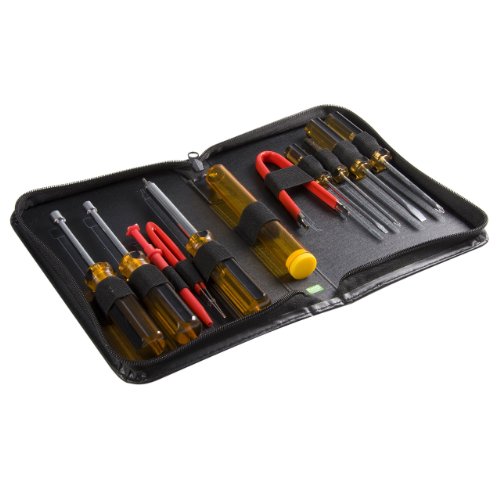
StarTech 11 Piece Computer Tool Kit, TAA (CTK200) | PC Repair Tool Kit with Zippered Vinyl Carrying Case

A note on rack, enterprise, and older hardware
Technicians whose work extends into server rooms and legacy equipment meet a fastener landscape that consumer-focused kits only partly cover. Rack hardware leans on cage nuts and their matching screws, on larger Torx and hex fasteners in drive carriers, and on thumbscrews engineered for gloved or hurried hands, so a full-size handle and a small socket set earn their place beside the precision driver. Enterprise laptops and workstations add security screws in mid-range Torx sizes and occasionally demand long-reach bits for fasteners sunk at the bottom of deep chassis wells, a need the flexible extension in mid-size kits answers only partly, since a flexing shaft cannot transmit the torque a straight long bit can. Older machines contribute their own archaeology: brittle plastics that crack under pry forces a modern case would shrug off, flat-blade screws in early hardware, and fasteners seized by decades of thermal cycling that reward penetrating patience over force. A technician building a kit for this mixed estate should weight handle strength, long-bit availability, and nut driver coverage more heavily than the phone-oriented end of the taxonomy, and should expect to supplement any single box with a small number of full-size singles chosen for the racks and chassis actually under contract.
Choose the set whose bits match your devices, whose steel survives its thousandth screw, whose handle reports torque honestly to your fingers, and whose case lets you prove at a glance that nothing was left behind; a technician equipped that way stops thinking about tools entirely, which is precisely the state in which careful work on other people’s machines becomes possible.