What's inside
- Key Takeaways
- Quick Picks
- How did we select the best reviewed low power NAS hard drives without inventing wattage?
- How do the six picks compare on stated evidence?
- What else makes a NAS installation genuinely low power?
- How do you set up a low-power NAS volume step by step?
- Which mistakes undermine a low-power NAS build?
- How do rebuilds and heavy jobs change the efficiency picture?
- How should replacements be planned in an efficiency-focused enclosure?
- What does a year of continuous running really ask of a household?
- Final Recommendation
- Frequently Asked Questions
- Related Guides
As an Amazon Associate I earn from qualifying purchases. This post may contain affiliate links at no extra cost to you.
gizmoverdict.com is reader-supported. When you buy through links on our site, we may earn an affiliate commission.
Where to buy: Each drive below links to a listing verified in this site’s pool. Five of the six come from Western Digital’s Red Plus line and one from Seagate’s IronWolf family, and the guide says plainly where a listing title publishes its rotational speed and where it leaves the figure to the manufacturer’s documents.
The best reviewed low power NAS hard drives raise an awkward question before any product names appear: what does low power honestly mean for a spinning disk? No listing title in this pool prints a wattage, so this guide will not rank drives by invented consumption figures. What the titles do expose, in two cases, is rotational speed — 5400 RPM on the Seagate IronWolf 4TB and 5640 RPM on the Western Digital Red Plus 8TB — and spindle speed is the lever a buyer can actually see, compare and reason about. A slower-turning platter asks less of its motor, sheds less heat into a crowded enclosure and usually spins with a softer voice, which is why low-power NAS shopping has always revolved around the RPM line even when the conversation pretends to be about watts.
That framing matters because a NAS drive never rests the way a desktop drive does. It spins through the night, through holidays, through the weeks when nobody touches the shares, and its power draw is therefore a continuous background cost multiplied by every bay in the enclosure and every hour of the year. A modest per-drive saving becomes a meaningful enclosure-level saving across a four-bay or eight-bay box, and the heat not generated is heat the fans never have to move. Owners running a NAS in a warm room, on a solar-fed circuit, or simply under a desk they sit beside all day feel low-power design as comfort as much as economy.
The six picks divide by candour as much as by capacity. Two titles publish their speed and cache outright; four Red Plus listings keep their titles brief, confirming brand line, capacity and NAS duty while leaving rotational speed to the fuller listing and to Western Digital’s documentation. This guide treats that difference honestly rather than papering over it: where a figure is not stated, the spec box marks it not stated, and the analysis leans on what each drive’s capacity and line position genuinely offer a low-power build. Capacities run from 1TB to 10TB, so the low-power question can be answered at almost any scale of home storage.
Key Takeaways
- No title in this pool prints a wattage, so rotational speed — stated on two picks — is the visible low-power lever.
- The IronWolf 4TB states 5400 RPM and CMR in its title; the Red Plus 8TB states 5640 RPM, CMR and a 256MB cache.
- Four Red Plus titles leave rotational speed unprinted, and their spec boxes here mark it not stated.
- Low power in a NAS compounds: small per-drive savings multiply across bays and across thousands of running hours.
- Capacities span 1TB to 10TB, letting a low-power build stay modest or grow without changing drive family.
Quick Picks
| Pick | Badge | Why it earns its place |
|---|---|---|
| Seagate IronWolf 4TB | Fully stated low-speed spec | The one title here publishing 5400 RPM, CMR and its cache size in a single line. |
| Western Digital WD Red Plus 2TB | Small-bay economy size | A 2TB NAS drive for compact enclosures and mirrored pairs where capacity is not the battle. |
| Western Digital WD Red Plus 4TB | Mid-size Red Plus staple | The 4TB member of the Red Plus line, sized for the centre of home NAS demand. |
| Western Digital WD Red Plus 1TB | Smallest capacity here | A 1TB NAS drive for light-duty shares, small mirrors and modest backup targets. |
| Western Digital WD Red Plus 10TB | Largest Red Plus capacity | Ten terabytes per bay for owners growing a low-power enclosure without adding bays. |
| Western Digital WD Red Plus 8TB | Stated 5640 RPM and CMR | An 8TB Red Plus whose title publishes its 5640 RPM speed, CMR recording and 256MB cache. |
How did we select the best reviewed low power NAS hard drives without inventing wattage?
We started by refusing the easy fiction. Plenty of buying guides attach precise consumption numbers to drives whose listings never published them, borrowing figures from reviews of different capacities or different revisions. A model line can span several rotational speeds across its capacities, and a wattage measured on one member does not transfer cleanly to its siblings. So the selection rule here was strict: a drive could be praised for low-power character only on evidence its own title or its line’s clear positioning provides, and every unstated figure would be labelled unstated rather than estimated.
Within that rule, the pool sorted itself. The IronWolf 4TB and the Red Plus 8TB carry their low-speed credentials on their title lines — 5400 RPM and 5640 RPM respectively, both with CMR named — and they anchor the guide. The remaining Red Plus capacities earn their places differently: the Red Plus line is Western Digital’s NAS-specific family for home and small-office enclosures running continuous duty, and its smaller members serve builds where total draw is governed as much by bay count and capacity as by spindle speed. A two-bay mirror of 1TB drives sips power in absolute terms whatever their exact speed, simply because so little machinery is spinning.
We also weighed the system around the drive. Low-power storage is a property of a whole installation: how many bays are populated, whether the enclosure sleeps or runs continuously, how warm the room is, how hard the fans must work. The guide’s advice sections therefore treat drive choice and installation habits together, because swapping drives while leaving a NAS cooking inside a sealed cabinet achieves less than either change made thoughtfully. The picks below are the components; the sections after them are the other half of the low-power equation.
A note on the shape of this particular pool is owed to the reader. Five Western Digital drives and one Seagate drive is not a balanced survey of the industry; it is the verified pool available for this guide, and the analysis works with it openly rather than pretending otherwise. The Red Plus family’s dominance here does have one genuine consequence worth naming: a household can build an entire low-power enclosure from a single line, keeping firmware behaviour, acoustic character and replacement logistics uniform across every bay. Uniformity is not a specification, but in a machine meant to run unattended for years it behaves like one.
One further honesty belongs in this introduction. Reviewed, in the keyword, is a word this guide interprets as examined and compared rather than as a promise about other people’s scores; no star ratings or review counts appear anywhere in these pages, because such numbers shift constantly and help nobody choose a drive. The examination here is of specifications, line positioning and fitness for continuous low-power duty, conducted on the evidence the listings themselves supply.
Seagate IronWolf 4TB — Fully stated low-speed spec
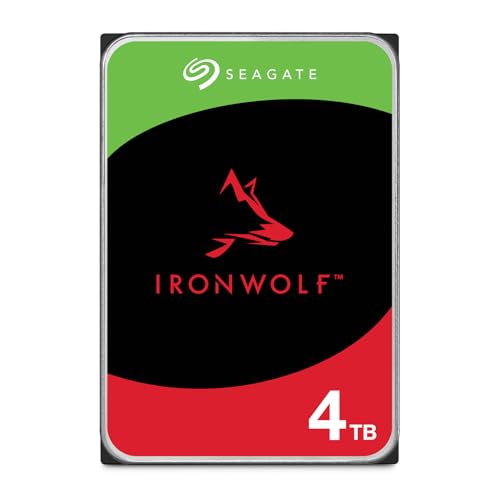
Among these six listings, the IronWolf 4TB is the one that shows its working. Its title reads like a specification sheet in miniature: NAS internal hard drive, CMR, 3.5 inch, SATA 6Gb/s, 5400 RPM, 64MB cache. For a low-power shortlist that is exactly the evidence that matters, because 5400 RPM is the slowest rotational speed printed anywhere in this pool, and a buyer can weigh this drive’s character without opening a single additional document. Seagate built the IronWolf family specifically for multi-bay enclosures in continuous service, and this 4TB member presents that design at its most transparent.
The CMR designation strengthens the case in a way that has nothing to do with electricity and everything to do with the bad days. Conventional recording keeps write behaviour steady during the long, heavy operations a NAS performs when a volume rebuilds or a large backup lands, and a low-power build is not exempt from those days; if anything, an enclosure chosen for economy deserves components that behave predictably under stress, since its owner has usually traded away performance headroom elsewhere. A drive whose title certifies both its gentle spindle speed and its recording technology answers the two questions a careful NAS owner asks first, and it answers them on the record.
Capacity is the honest counterpoint. Four terabytes is a middleweight size: generous for documents, photographs and a household’s working files, modest for a swelling library of high-resolution video. In a mirrored pair it yields four usable terabytes; across four bays with one drive of redundancy it yields twelve. Owners whose archives are outgrowing those figures should look at the larger Red Plus picks below rather than forcing this drive into a role its capacity cannot sustain. Chosen at the right scale, though, the IronWolf 4TB is the pick whose low-power claim needs no faith at all — the number is printed on the box, in the title, where a specification belongs.
- Capacity: 4 TB, per the listing title
- Form factor: 3.5 inch, per the listing title
- Interface: SATA 6Gb/s, per the listing title
- Rotational speed: 5400 RPM, per the listing title
- Cache: 64 MB, per the listing title
- Recording technology: CMR, per the listing title
- Power draw: Not stated in the listing title — verify with Seagate documentation
Strengths
- 5400 RPM printed in the title, the clearest low-speed credential in this guide
- CMR stated outright, supporting predictable behaviour during volume rebuilds
- Cache and interface also published, making this the most verifiable pick here
Trade-offs
- 4TB capacity sits below the two largest picks for archive-heavy households
- No wattage in the title, so exact consumption still requires Seagate’s documents
- The sole Seagate in a Red Plus-heavy list, which matters for owners standardising on one line
Best for: a NAS owner seeking a low-power drive whose 5400 RPM speed and CMR recording are both confirmed on the title line. Not suited for: an archive already pressing past what a 4TB member can hold in a redundant layout.

Western Digital WD Red Plus 2TB — Small-bay economy size
The 2TB Red Plus makes its low-power argument through scale rather than through a printed speed figure. Its title confirms the essentials — Western Digital, 2TB, WD Red Plus, NAS internal hard drive — and leaves rotational speed and cache to the listing body and the manufacturer’s documentation, where a careful buyer will confirm them. What two terabytes means in practice is a small mechanism doing a small job: a mirrored pair in a compact two-bay enclosure, a backup target for a household’s documents, a modest media share. In absolute terms, an installation built around drives of this size draws little power because there is little machinery to feed, and for many homes that absolute figure is the one that actually matters.
There is a discipline this size teaches. Owners of small drives learn to curate: the photo library gets deduplicated, the video archive keeps what it loves, the downloads folder stops being a permanent residence. A 2TB NAS volume is not a deprivation; for a household whose digital life is documents, photographs and music, it is a roomy and honest size that has served the majority of home networks for years. The Red Plus badge matters here because even a small NAS drive works the night shift — continuous duty in a multi-bay box is the line’s stated habitat, and a desktop drive borrowed for the role would be working outside its design brief every hour of its life.
The counterweight is growth. Storage needs rarely shrink, and a 2TB volume bought today can become next year’s constraint, particularly once a household discovers network backups for every computer it owns or starts keeping phone video at full resolution. Owners who suspect that future is theirs should price the 4TB Red Plus below before committing, since stepping up at purchase time is far cheaper than migrating a full volume later. But for a defined, bounded job — a documents mirror, a backup target, a first NAS for a small household — this drive’s modest scale is its virtue, and its power appetite shrinks with everything else about it.
- Capacity: 2 TB, per the listing title
- Duty: NAS internal hard drive, per the listing title
- Brand line: WD Red Plus, per the listing title
- Rotational speed: Not stated in the listing title — verify with Western Digital documentation
- Cache size: Not stated in the listing title — verify with Western Digital documentation
- Power draw: Not stated in the listing title — verify with Western Digital documentation
Strengths
- Small absolute footprint for compact enclosures and mirrored pairs
- Red Plus NAS-specific design for continuous multi-bay duty
- A gentle entry size for a first NAS or a dedicated backup target
Trade-offs
- 2TB fills quickly once whole-house backups and phone video arrive
- Speed, cache and consumption all require verification beyond the title
- Cost per terabyte at small capacities rarely leads its line
Best for: a small household seeking a modest mirrored volume or backup target from a NAS-specific line. Not suited for: a growing media archive that has already outgrown two terabytes once.

Western Digital WD Red Plus 4TB — Mid-size Red Plus staple
If the Red Plus line has a centre of gravity, it sits at 4TB. This listing’s title is as brief as its siblings — brand, capacity, Red Plus, NAS internal hard drive — and the same verification homework applies to its rotational speed and cache. What distinguishes the 4TB member is the balance it strikes inside real enclosures: large enough that a four-bay box with single-drive redundancy offers twelve usable terabytes, small enough that a mirrored pair remains an affordable way to protect a household’s core files. More home NAS volumes have been built at this capacity than at any other in the line’s history, and the depth of that installed base is itself a form of evidence about the size’s fitness.
For the low-power theme of this guide, the 4TB Red Plus occupies the sensible middle. It avoids the absolute draw of the largest mechanisms while holding enough data to keep an enclosure useful for years, and it lets an owner populate fewer bays to reach a given capacity than the 1TB and 2TB picks allow — and every unpopulated bay is a motor not spinning, a small but real contribution to the enclosure’s total appetite. Drive-count discipline is an underrated low-power strategy, arguably the most reliable one available, because it depends on arithmetic rather than on any manufacturer’s claims: reaching twelve terabytes with three drives and one spare bay beats reaching it with six smaller mechanisms in both consumption and noise, even before any per-drive figure is consulted.
The reservations mirror those of its siblings. The short title means the speed and cache checks happen in Western Digital’s documentation, and a buyer comparing this drive directly against the IronWolf 4TB above will notice that Seagate publishes on its title what Western Digital leaves to the datasheet. That asymmetry is a few minutes of reading, not a defect in the drive. Owners who do the reading and find the figures suit their enclosure get the line’s most balanced member; owners who skip the reading are buying a nameplate, and this guide has argued throughout that nameplates are not specifications.
- Capacity: 4 TB, per the listing title
- Duty: NAS internal hard drive, per the listing title
- Brand line: WD Red Plus, per the listing title
- Rotational speed: Not stated in the listing title — verify with Western Digital documentation
- Cache size: Not stated in the listing title — verify with Western Digital documentation
- Power draw: Not stated in the listing title — verify with Western Digital documentation
Strengths
- The line’s balanced capacity, suiting mirrored pairs and four-bay volumes alike
- Fewer, larger drives can replace many small ones, trimming bay count and total draw
- Deep availability from the Red Plus line’s long presence in home NAS enclosures
Trade-offs
- Title omits speed and cache, shifting verification to the manufacturer’s documents
- Video-heavy archives may find 4TB per bay a short horizon
- No consumption figure published in the title for exact power budgeting
Best for: a home NAS owner requiring the Red Plus line’s middle capacity for a balanced, bay-efficient build. Not suited for: a collector whose archive grows by terabytes every year.

Western Digital WD Red Plus 1TB — Smallest capacity here
One terabyte is the smallest capacity in this guide, and the 1TB Red Plus defends a niche the larger drives cannot: the deliberately small NAS. Not every network share is an archive. A household may need a mirrored home for documents and photographs alone, a staging drive for backups arriving from one computer, or a quiet repository for music that a streaming setup reads all evening. For those bounded jobs, a 1TB NAS-specific drive delivers exactly the required machinery and no more, and its total contribution to the enclosure’s power draw is as small as a spinning drive’s contribution gets.
The title follows the family’s terse pattern — Western Digital, 1TB, WD Red Plus, NAS internal hard drive — so rotational speed, cache and consumption all sit in the not-stated column of this guide’s ledger, awaiting the manufacturer’s documentation. That homework matters proportionally more at this size, oddly enough, because small drives are often bought casually, as an afterthought beside the enclosure itself. A NAS drive’s whole purpose is the night shift: continuous spinning, multi-bay vibration, workloads arriving at any hour. Confirming that the specific 1TB member’s published figures suit that duty is the difference between a considered purchase and a hopeful one.
Where this pick truly earns its place is in pairs and in discipline. Two 1TB drives in a mirror protect a terabyte of the files a household can least afford to lose, at a total installation draw lower than a single large performance drive idling in a desktop. Households that separate their storage by importance — a small, protected, always-on volume for the irreplaceable, and bulk capacity elsewhere for the replaceable — will recognise this drive as the building block of the protected tier. Households wanting one volume for everything should pass it by without regret and take the 4TB or larger picks, because a 1TB ceiling met in the first year helps nobody.
- Capacity: 1 TB, per the listing title
- Duty: NAS internal hard drive, per the listing title
- Brand line: WD Red Plus, per the listing title
- Rotational speed: Not stated in the listing title — verify with Western Digital documentation
- Cache size: Not stated in the listing title — verify with Western Digital documentation
- Power draw: Not stated in the listing title — verify with Western Digital documentation
Strengths
- The smallest absolute power footprint a spinning NAS drive can offer
- Ideal mirrored building block for a protected tier of irreplaceable files
- NAS-specific Red Plus design rather than a borrowed desktop mechanism
Trade-offs
- 1TB is a hard ceiling that whole-house backups will reach quickly
- All performance and consumption figures need verification beyond the title
- Small capacities carry the line’s least favourable cost per terabyte
Best for: a household seeking a tiny, always-on mirrored volume for its most important files. Not suited for: a single-volume NAS expected to hold media, backups and archives together.

Western Digital WD Red Plus 10TB — Largest Red Plus capacity
Ten terabytes per bay changes what low power can mean. The 10TB Red Plus carries the family’s usual brief title — brand, capacity, line, NAS duty — and its low-power argument is architectural: a household requiring twenty usable terabytes can reach them with a mirrored pair of these drives, two mechanisms spinning, where the same capacity built from 2TB members would need a shelf of enclosures. Bay count is the silent term in every consumption calculation, and large drives attack that term directly. Fewer, bigger mechanisms, each working continuously, frequently beat many small ones on the only meter that matters, the one on the wall.
The trade is concentration. A mirrored pair of 10TB drives places a great deal of data behind two mechanisms, and a volume rebuild at this capacity is a long operation measured in many hours, during which the surviving drive works at its hardest. Owners choosing this end of the line should pair the purchase with the habits large volumes demand: backups held outside the enclosure, prompt attention to health warnings, and a realistic plan for the day a member needs replacing. None of that diminishes the drive; it simply prices the architecture honestly, in attention rather than in watts.
Verification homework applies here as everywhere in the Red Plus family: rotational speed, cache, recording technology and consumption are not printed in the title and belong to Western Digital’s documentation for this exact capacity. That reading matters more at 10TB than at 1TB, because capacities within one line have historically differed in their internal arrangements, and the owner of a large-volume build is committing more data to the answer. Do the reading, and this pick becomes the low-power guide’s capacity champion — the drive for the household whose archive is large, whose enclosure is small, and whose electricity bill is a line item they actually read.
- Capacity: 10 TB, per the listing title
- Duty: NAS internal hard drive, per the listing title
- Brand line: WD Red Plus, per the listing title
- Rotational speed: Not stated in the listing title — verify with Western Digital documentation
- Cache size: Not stated in the listing title — verify with Western Digital documentation
- Power draw: Not stated in the listing title — verify with Western Digital documentation
Strengths
- 10TB per bay minimises bay count, the hidden driver of total consumption
- Lets a compact enclosure hold an archive that would otherwise need many drives
- Red Plus continuous-duty design at the line’s largest capacity in this guide
Trade-offs
- Long rebuild times when a member of a large volume is replaced
- Heavy data concentration behind each mechanism raises backup stakes
- Speed, cache and recording technology all unstated in the title
Best for: an archive owner seeking maximum terabytes from the fewest spinning mechanisms. Not suited for: a casual installation without backups held outside the enclosure.

Western Digital WD Red Plus 8TB — Stated 5640 RPM and CMR
The 8TB Red Plus is the Western Digital pick that meets this guide on its own evidentiary terms. Its title publishes the figures the rest of the family leaves to datasheets: 8TB capacity, CMR recording, 3.5-inch form factor, SATA interface, 5640 RPM rotational speed and a 256MB cache. That 5640 RPM figure is the interesting one for a low-power shortlist. It sits a step above the classic 5400 class, far below the 7200 RPM performance class, and it describes a deliberate middle tuning — a spindle speed chosen for enclosures that run continuously in occupied rooms, where every increment of speed is paid for in heat and voice.
CMR’s presence in the title completes the low-power picture in an unexpected way. A drive that maintains its write behaviour during rebuilds and heavy backup windows finishes those jobs sooner, and a job finished sooner is a system returned sooner to its idle state, which is where a NAS spends nearly all of its life and nearly all of its energy budget. Efficiency in a storage system is not only the draw at rest; it is also the time spent away from rest. The 256MB cache stated in the title supports that reading, giving the drive a generous buffer for the bursty arrivals that backup software produces, smoothing work that would otherwise keep the mechanism labouring in fragments.
Against the IronWolf at the top of this guide, the comparison becomes genuinely close and genuinely useful. The Seagate states 5400 RPM with a 64MB cache at 4TB; this Western Digital states 5640 RPM with a 256MB cache at 8TB. A buyer can weigh those published figures directly, capacity against speed against buffer, with no datasheet archaeology required for either. That two manufacturers chose to print their low-speed credentials on these particular listings tells its own story about where the low-power NAS market is heading: toward drives whose efficiency claims can be checked on the title line, which is exactly where this guide insists they should live.
- Capacity: 8 TB, per the listing title
- Form factor: 3.5 inch, per the listing title
- Interface: SATA, per the listing title
- Rotational speed: 5640 RPM, per the listing title
- Cache: 256 MB, per the listing title
- Recording technology: CMR, per the listing title
- Power draw: Not stated in the listing title — verify with Western Digital documentation
Strengths
- 5640 RPM and CMR both printed in the title, a verifiable low-speed specification
- 256MB cache, the largest buffer stated anywhere in this guide
- 8TB capacity pairs low-speed tuning with serious archive room
Trade-offs
- Exact wattage still unpublished in the title, as with every pick here
- 5640 RPM trails the IronWolf’s 5400 figure for purists minimising spindle speed
- Large per-drive cost when multiplied across a full enclosure
Best for: a NAS owner seeking a large drive whose low-speed tuning and CMR recording are confirmed in its own title. Not suited for: a minimal two-bay build where 8TB per bay overshoots the archive by years.
How do the six picks compare on stated evidence?
The table below confines itself to what the listing titles publish. Two drives state their rotational speed; four do not, and the empty cells are information in themselves, marking the verification each buyer still owes. Judge the low-power question first by the stated speeds, then by the architectural factors — bay count and capacity — that the surrounding sections explain.
| Drive | Capacity | Speed stated in title | Cache stated in title | CMR stated |
|---|---|---|---|---|
| Seagate IronWolf 4TB | 4 TB | 5400 RPM | 64 MB | Yes |
| WD Red Plus 2TB | 2 TB | Not stated | Not stated | Not stated |
| WD Red Plus 4TB | 4 TB | Not stated | Not stated | Not stated |
| WD Red Plus 1TB | 1 TB | Not stated | Not stated | Not stated |
| WD Red Plus 10TB | 10 TB | Not stated | Not stated | Not stated |
| WD Red Plus 8TB | 8 TB | 5640 RPM | 256 MB | Yes |
What else makes a NAS installation genuinely low power?
Drive choice is only the first term. The second is bay discipline: populate the fewest bays that meet the capacity plan, because each spinning mechanism adds its draw around the clock, while an empty bay adds nothing at all. This is why the guide’s larger picks matter to an efficiency-minded reader despite their size. A household reaching its target capacity with two 10TB drives instead of five smaller ones has removed three motors, three sets of electronics and three sources of heat from its installation permanently, a saving no per-drive figure can match.
Placement is the third term. An enclosure in open air sheds heat passively and lets its fans turn slowly; the same enclosure sealed inside a cabinet with a games console and a router forces its fans to work against trapped warmth, spending electricity to move heat the room never receives. A few centimetres of clearance, a vented shelf rather than a closed box, and distance from radiators or sunlit glass all reduce the cooling burden that every drive in this guide otherwise imposes on its host. Owners sometimes chase a fraction of a watt in drive selection while leaving ten times that saving unclaimed in placement.
Scheduling is the fourth term, and it needs honest handling. Many NAS systems can spin drives down after idle periods, and for an enclosure used in predictable bursts that feature saves real energy. For an enclosure serving backups at scattered hours, media on demand and synchronisation jobs through the night, aggressive spin-down can cost more in wear and in waiting than it saves in watts, as drives cycle repeatedly. The NAS-specific lines in this guide are built for continuous duty; matching the power schedule to the household’s actual rhythm, rather than to an abstract ideal, is the mature version of low-power thinking.
Finally, measure the result. A plug-in power meter between the wall and the enclosure costs little, asks nothing of the network, and converts this entire topic from estimation into knowledge. Run the meter for a week of ordinary life, note the enclosure’s idle and working draw, and the household gains a baseline against which every future change — an added drive, a moved shelf, a new schedule — can be judged. Low power stops being a marketing adjective the moment a number appears on a meter the owner controls and trusts.
How do you set up a low-power NAS volume step by step?
Begin on paper with the capacity plan: the data held today, an honest allowance for growth, and the redundancy arrangement the household can accept. That plan fixes the drive count, which fixes most of the installation’s power character before any hardware arrives. Order the chosen drives together where possible, note their serial numbers as they are unboxed, and keep the packaging until the volume has survived its first week.
Install the drives into a powered-down enclosure, seating each fully in its tray, then power up and confirm every bay reports present with the expected capacity. Build the volume with the chosen redundancy, create the shares the household actually needs, and resist the urge to fill the volume in one marathon copy session. Move data in stages across the first days, letting backup jobs, media indexing and ordinary access interleave, while listening for any mechanism whose voice stands out from its neighbours.
While the volume settles, resist filling every remaining bay with drives borrowed from retired computers. A spare desktop mechanism dropped into an empty tray may look like free capacity, but it brings a different duty design, a different acoustic character and an unknown history into an enclosure whose efficiency and calm were planned as a system. Empty bays cost nothing, draw nothing and keep the installation honest; capacity should be added deliberately, with drives chosen for the role, when the plan actually calls for it.
Then tune the system around the drives. Set fan behaviour to the enclosure’s balanced or quiet profile if one exists, place the box where air moves freely, and decide the spin-down question based on the household’s real access pattern rather than a default. Attach the power meter, record a week of ordinary consumption, and write the figure down with the installation date. That small record turns future troubleshooting — a rising bill, a noisy fan, a warm shelf — into a comparison against a known baseline instead of a guessing game.
Which mistakes undermine a low-power NAS build?
The most common mistake is believing a wattage that nobody published. Listings, forums and even some guides attach consumption figures to drives with a confidence the underlying documents do not support, and buyers then optimise for a fiction while ignoring bay count, placement and schedule, the factors that dominate a real installation’s draw. This guide’s repeated not-stated labels are the antidote: they show exactly where knowledge ends and where the manufacturer’s documentation must be consulted before a decision leans on a number.
A second mistake is populating every bay because the bays exist. An eight-bay enclosure holding eight small drives, bought because the trays were there, can draw more than a four-bay enclosure holding four large ones while offering the same usable space. Capacity planning should drive bay count, never the reverse. A related error is mixing drive sizes casually inside one volume, which typically sizes the volume around the smaller members and wastes the larger drives’ contribution — an inefficiency paid for in both capacity and electricity.
The third mistake is sealing the enclosure away. Low-power drives in a hot cabinet produce a hot cabinet with hard-working fans, and the installation’s total draw climbs even as its owner congratulates themselves on efficient components. The fourth is neglecting the backup in the name of economy: a low-power NAS that holds the only copy of a household’s files is not an efficient system, merely a fragile one with a small electricity bill. Efficiency worth having is the kind that survives contact with a failed drive, and redundancy plus an external backup is what makes that survival routine.
How do rebuilds and heavy jobs change the efficiency picture?
An efficient NAS spends most of its life nearly idle, sipping power while it waits, and that idle dominance is precisely why idle character dominates honest efficiency comparisons. Yet the hours when the system works hard still matter, both for the energy they consume and for what they reveal about the drives. A volume rebuild is the hardest labour a NAS performs: every surviving drive reads itself end to end while the replacement writes itself full, fans run at their busiest, and the enclosure’s draw climbs to its ceiling for the duration. At 4TB that duration is an evening; at 10TB it can stretch across a day, and the energy difference between those two rebuilds is part of the true cost of large-capacity architecture.
This is where the two fully specified picks distinguish themselves again. A CMR drive, as both the IronWolf 4TB and the Red Plus 8TB declare themselves in their titles, holds its write pace through that long sequential labour instead of fading as the hours pass. A rebuild that finishes in ten hours rather than drifting toward twenty returns the enclosure to its idle state sooner, sparing both energy and the owner’s nerves. Efficiency, seen this way, is partly a measure of how gracefully a system handles its worst day, and recording technology — a specification with no obvious connection to power — turns out to be one of its components.
Backup windows tell a smaller version of the same story. A household’s nightly backup arrives as a burst of writes, often compressed and encrypted by the sending computer, and the NAS must absorb that burst at whatever pace the drives allow. A volume that absorbs the burst briskly and settles back to idle spends less of the night awake at working draw than a volume that straggles. Cache size plays a supporting role here, smoothing arrivals into steadier work for the mechanisms, which is why the Red Plus 8TB’s stated 256MB buffer is worth more than its modest place in a spec table suggests.
None of this overturns the guide’s central ordering. Idle draw across thousands of hours still outweighs working draw across dozens, and a buyer should never choose a faster, hungrier drive for the sake of shorter rebuilds alone. The point is subtler: within the low-speed class itself, the drives that publish CMR and healthy cache figures offer an efficiency that extends beyond the idle line on a meter, into the shape of the system’s hardest days. Judging a low-power build means judging both states, the long quiet and the brief storm, and the picks that state their specifications let a buyer judge both with evidence.
How should replacements be planned in an efficiency-focused enclosure?
Every drive in a NAS is a future replacement, and planning that replacement at installation time protects both the data and the efficiency of the whole. The cleanest plan is a same-model spare bought with the set and kept sealed on a shelf. When a member drive reports errors, the spare enters service immediately, the volume rebuilds without waiting for a delivery, and the enclosure returns to its intended population of matched mechanisms — matched being the operative word, since a volume of identical drives behaves, and draws power, as one designed system rather than as a committee of strangers.
Buying later is the weaker plan for a specific reason: model lines evolve. A Red Plus capacity purchased years apart can arrive with different internals under the same nameplate, a reality this guide has flagged each time a title declined to state a speed or a recording technology. A spare drawn from the same purchase as the working set sidesteps that drift entirely. The shelf spare also disciplines the household’s record-keeping: purchase dates, serial numbers and tray positions written down once, at installation, turn a midnight failure into a procedure rather than an investigation.
Retirement deserves the same forethought. A drive leaving NAS service still holds the household’s data in recoverable form, and an efficiency-minded owner should treat disposal as a data task before it is a recycling task: wipe the mechanism with the enclosure’s own secure-erase facility or a verified overwrite, then pass it to electronics recycling. Drives in genuinely good health can be demoted instead — a retired NAS member makes a fine offline backup target in a USB dock, powered only during the weekly copy, which is the lowest-power role any drive can hold. The arc of a well-planned drive runs from continuous duty, to occasional duty, to a clean exit, and each stage of that arc is cheaper when it was imagined at the start.
Finally, keep the meter’s baseline with those installation notes. When a replacement does go in, a week of readings against the original baseline will show whether the enclosure’s character has changed — a fan labouring harder, an idle figure creeping upward — while the change is still fresh enough to diagnose. Efficiency is not a property a system has once; it is a property it keeps, and keeping it is a matter of small measurements taken at the right moments.
What does a year of continuous running really ask of a household?
Translate the low-power question into calendar terms and its importance sharpens. A NAS runs roughly eight and a half thousand hours in a year, most of them unobserved. Any inefficiency in that system is therefore not an event but a climate: a slightly warmer room corner, a fan voice woven into the household’s background, a small continuous addition to the electricity account. Owners feel these things cumulatively rather than acutely, which is why drive selection for continuous duty deserves more care than drive selection for a desktop that sleeps every night. The picks in this guide were chosen for a machine that essentially never clocks off.
Heat is the most tangible of those cumulative effects. Every watt a drive consumes becomes heat in the room, and in summer that heat can ask the household’s cooling to work a fraction harder, a second-order cost that never appears on any drive’s specification sheet. Placing the enclosure in the coolest practical spot — away from sunlit walls, out of the warm stratum near a ceiling, clear of other heat-making equipment — pays twice: the drives run in kinder conditions and the room inherits less warmth to remove. In winter the same heat is merely wasted rather than doubly costly, but the fan noise it provokes remains a year-round tax on a quiet home.
There is also the question of what continuous duty does to the owner’s relationship with the machine. A NAS built from NAS-specific drives, placed well and measured once, tends to disappear from attention for months at a time, which is the highest compliment home infrastructure can earn. A NAS assembled from borrowed desktop parts, or packed into a hot cupboard, keeps requesting attention — a warning here, a noise there, a temperature alert during a heatwave. Low-power design, pursued honestly through stated speeds, sensible bay counts and decent placement, is largely the art of buying that disappearance in advance.
The household’s wider habits complete the picture. Backups scheduled for the small hours, media libraries indexed once rather than nightly, synchronisation jobs batched instead of scattered — each choice trims the hours the enclosure spends at working draw. None requires new hardware. Together with the right drives, they form the realistic version of a low-power NAS: not a laboratory figure, but a quiet box in a cool corner that the household forgets exists, holding everything it values. That forgetting, sustained across years of birthdays, backups, films and file copies, is the outcome this guide’s six picks are ultimately for.
Final Recommendation
On stated evidence, two picks lead this guide. The IronWolf 4TB publishes the slowest spindle speed in the pool at 5400 RPM, with CMR and its cache declared beside it, and it suits the owner whose capacity needs sit in single digits. The Red Plus 8TB publishes 5640 RPM, CMR and a 256MB cache at twice the capacity, and it suits the owner building for a decade of archive growth. Between and around them, the remaining Red Plus capacities serve the architectural route to low power — fewer bays, right-sized volumes — provided their figures are verified in Western Digital’s documentation before purchase. Choose the drive whose evidence matches the installation being built, then give it a cool shelf, a sane schedule and a meter on its plug, and the low-power promise stops being a label and becomes a measured fact of the household, as durable as the archive the drives were bought to hold and as quiet as the corner they were chosen to live in, year after year of unattended service.
Frequently Asked Questions
What actually makes a NAS hard drive low power?
Rotational speed is the visible factor: slower-spinning drives, such as the 5400 RPM IronWolf and the 5640 RPM Red Plus 8TB whose titles state their speeds, are tuned for continuous duty with modest demands. Total installation draw also depends on bay count, enclosure cooling and duty schedule, which is why this guide weighs architecture alongside the drives themselves.
Why does this guide not list wattage for each drive?
Because no listing title in the pool publishes a wattage, and figures borrowed from other capacities or revisions would mislead. Consumption for an exact model belongs to the manufacturer’s documentation, and the spec boxes here mark power draw as not stated wherever the title is silent, pointing the reader to that documentation instead of inventing a number.
Is a larger drive ever the lower-power choice?
Yes, at the system level. Reaching a capacity target with two large drives instead of five small ones removes three spinning mechanisms from the installation entirely. The Red Plus 10TB pick exists for exactly that reasoning. Per-drive draw is only one term; the number of drives is another, and it is frequently the larger one.
Does CMR matter for a low-power build?
Indirectly, yes. CMR drives sustain their write behaviour during rebuilds and long backup runs, finishing heavy jobs predictably and returning the system to its idle state. Two picks here, the IronWolf 4TB and the Red Plus 8TB, state CMR in their titles. For the other picks, recording technology is not stated in the title and should be checked in manufacturer documentation.
Should a low-power NAS spin its drives down when idle?
It depends on the access pattern. An enclosure used in predictable bursts can save energy with spin-down; an enclosure serving scattered backups, synchronisation and on-demand media may cycle its drives so often that the saving evaporates. NAS-specific lines are built for continuous duty, so matching the schedule to the household’s rhythm matters more than chasing the feature itself.
How can the real consumption of a NAS be checked?
With a plug-in power meter between the wall socket and the enclosure. A week of ordinary use gives an honest, representative baseline covering idle and working draw together. That measured figure, recorded carefully at installation, lets every later change to drives, placement or schedule be judged against evidence rather than against a label.
Related Guides
Efficiency-minded storage planning continues in our neighbouring coverage of choosing drives for a home NAS server, the setup walkthrough in building a quiet network storage box, and the capacity-planning advice in sizing a backup volume for a household.