What's inside
- Key Takeaways
- Quick Picks
- How did we choose the best hard drives to use with Synology 1815 owners actually run?
- How do the six drives compare inside one eight-bay chassis?
- What should a DS1815+ owner check before filling eight bays?
- How do you install and settle a new drive set in a DS1815+?
- What mistakes do DS1815+ owners make when replacing drives?
- How do rebuilds and everyday responsiveness feel on each family?
- What about power draw, heat and noise across a full row of eight?
- How should owners plan spares and replacements for the years ahead?
- Final Recommendation
- Frequently Asked Questions
- Related Guides
As an Amazon Associate I earn from qualifying purchases. This post may contain affiliate links at no extra cost to you.
gizmoverdict.com is reader-supported. When you buy through links on our site, we may earn an affiliate commission.
Where to buy: All six drives below link to listings checked in this site’s product pool. Three carry Synology’s own branding and three come from Seagate, Western Digital and Toshiba, and the guide keeps those two families separate throughout, because the choice between first-party and third-party drives is the real decision inside this purchase.
The best hard drives to use with Synology 1815 start from a fact about the machine itself: the name in the search refers to the DS1815+, an eight-bay desktop NAS from 2015, built in an era when Synology published broad third-party compatibility and its own hard drive line did not yet exist. That age changes the shopping logic completely. A DS1815+ still in service today is a machine whose owner values capacity, quiet competence and parts that simply work in an older chassis, and the drive question is not which model tops a benchmark chart but which spinning disks suit an eight-bay enclosure designed a decade ago.
Eight bays multiply every small decision. A drive drawing slightly more power or running slightly warmer matters eight times over inside one chassis with shared airflow. A capacity choice made for one bay tends to be repeated across the row as volumes grow. Noise that would vanish inside a tower case becomes a low hum in a living space when eight mechanisms spin together through the night. This guide therefore weighs the six candidates the way a DS1815+ owner actually lives with them: as sets, as a row, as a long-term population of disks rather than as single purchases.
The six picks divide cleanly. Synology’s HAT5300 and HAT5320 enterprise drives offer the manufacturer’s own answer, in 8TB and in 4TB and 8TB variants respectively. Seagate’s IronWolf 4TB and Western Digital’s Red Plus 4TB represent the established third-party NAS lines, and Toshiba’s N300 brings a 10TB option for owners whose priority is squeezing the most raw space from each of the eight slots. Every rotational speed, cache figure and recording-technology claim in this article comes from the listing titles in the pool; where a title stays silent, the spec boxes say so plainly instead of borrowing numbers from a datasheet the listing never showed.
Key Takeaways
- The Synology 1815 in this guide is the DS1815+, an eight-bay NAS from 2015, and every recommendation is framed for that chassis.
- Synology’s own HAT5300 and HAT5320 drives are the first-party route; IronWolf, Red Plus and N300 drives are third-party options that run in a DS1815+.
- Only one pick states 5400 RPM in its title; the HAT5300-8T states 7200 RPM, and several titles leave rotational speed unstated.
- Capacity per bay ranges from 4TB to the Toshiba N300’s 10TB, so the same eight bays can hold very different totals.
- Specifications in this guide come from listing titles alone, and silent titles are marked as not stated rather than filled in from memory.
Quick Picks
| Pick | Badge | Why it earns its place |
|---|---|---|
| Synology HAT5300-8T | First-party enterprise flagship | Synology’s own 8TB enterprise drive, with 7200 RPM and an MTTF figure stated right in the listing title. |
| Synology HAT5320 4TB | First-party, modest capacity | The newer HAT5320 enterprise series in a 4TB size for partial fills and smaller volumes. |
| Synology HAT5320 8TB | First-party, full-size fill | The HAT5320 series at 8TB, matching the HAT5300’s capacity with the newer series badge. |
| Seagate IronWolf 4TB | Third-party CMR workhorse | A NAS drive whose title states CMR recording, 5400 RPM and a 64MB cache in full. |
| Western Digital WD Red Plus 4TB | Third-party NAS staple | The Red Plus nameplate in a 4TB NAS internal drive, a familiar sight in home Synology bays. |
| Toshiba N300 10TB | Largest capacity per bay | A 10TB NAS drive for owners counting total terabytes across all eight slots. |
How did we choose the best hard drives to use with Synology 1815 owners actually run?
We began with the chassis rather than the drives. The DS1815+ accepts 3.5-inch SATA drives in eight tool-less trays, and it belongs to a generation of Synology hardware sold before the company’s own drive programme existed, so the honest candidate pool includes both the current first-party HAT drives and the third-party NAS lines that owners have run in this model for years. Any guide pretending the HAT series is the only legitimate answer would be rewriting the history of a 2015 machine; any guide ignoring the HAT series would be hiding the manufacturer’s present-day option. Both families belong here, labelled as what they are.
From that pool we kept drives whose listing titles identify them as NAS or enterprise models, because a desktop drive built for eight-hour days behaves differently from a drive built for continuous duty in a multi-bay enclosure, where vibration from neighbouring mechanisms is a permanent condition rather than an accident. We also kept the capacity spread deliberate: three 4TB options, two 8TB options and one 10TB option, because DS1815+ owners divide into those refreshing a modest volume and those rebuilding the box for another decade of growth.
One more filter shaped the final six: every pick had to make sense bought eight at a time. Plenty of drives are attractive as single purchases and awkward as a matched row, whether because a capacity sits at an odd point in its line or because a model’s availability looks thin for an owner possibly needing a ninth example as a spare. The six below all pass that row test, which is the only test a DS1815+ owner is really taking.
Finally, we treated listing titles as the only specification source. That discipline produces some gaps the reader will notice, and the gaps are intentional. A title that omits rotational speed does not get a rotational speed in this guide, even where the model line is well known, because listings change, regional variants differ, and a buying decision deserves the document the seller actually published. The comparison work below therefore leans on what is verifiable: brand family, stated capacity, stated speed where given, stated cache where given, and the recording technology where a title names it.

Synology HAT5300-8T — First-party enterprise flagship
The HAT5300-8T is the drive Synology built to answer its own question. Its listing title describes an 8TB 3.5-inch SATA drive turning at 7200 RPM, graded for enterprise duty, with an MTTF figure of 2.5 million stated in the title itself. Slotted into a DS1815+, it gives the older chassis the manufacturer’s current enterprise mechanism rather than a drive designed for somebody else’s enclosure, and that provenance is the core of its appeal: firmware, testing and branding all come from the company whose logo sits on the front of the NAS.
Consider what eight of these do to the arithmetic of a DS1815+. Eight 8TB mechanisms present 64TB of raw space before any redundancy scheme takes its share, which transforms a 2015 enclosure into a genuinely roomy archive for a household’s photo library, a small studio’s project history or a media collection that has outgrown a two-bay box. The 7200 RPM rotational speed stated in the title also separates this pick from the slower-turning NAS drives further down the page; in a multi-drive volume, where the array’s responsiveness reflects the whole row, that speed is a real characteristic rather than a marketing adjective. Owners rebuilding a DS1815+ as a primary working volume, with virtual machines or a busy shared folder riding on it, feel that difference more than owners using the box as a cold archive.
There is a counterweight, and it is honesty about heat and noise. A row of eight 7200 RPM enterprise mechanisms asks more of the DS1815+’s fans than a row of slower drives, and in a quiet room the enclosure will make its presence known. The HAT5300 line is also the earlier of Synology’s two enterprise series in this guide, so a buyer choosing between this drive and the HAT5320 at the same 8TB capacity is choosing between two generations of the same idea; the title-level specifications visible here are fuller for the HAT5300, which states its speed and MTTF openly, and that transparency itself counts as a point in its favour.
- Capacity: 8 TB, per the listing title
- Form factor: 3.5 inch, per the listing title
- Interface: SATA, per the listing title
- Rotational speed: 7200 RPM, per the listing title
- Duty grading: Enterprise grade, per the listing title
- Reliability figure: MTTF 2.5 million, as stated in the listing title
- Cache size: Not stated in the listing title — verify with Synology documentation
Strengths
- Synology’s own drive for a Synology chassis, with testing and firmware from the enclosure’s maker
- 7200 RPM stated in the title, the joint-fastest rotational speed among these six picks
- An MTTF figure printed in the listing title, a rarity among consumer-facing drive listings
Trade-offs
- Eight 7200 RPM mechanisms will run the DS1815+ fans harder than a slower row of drives
- Enterprise positioning generally costs more per terabyte than the third-party NAS lines below
- The earlier of the two Synology enterprise series here, so the HAT5320 may suit buyers preferring the newer line
Best for: a DS1815+ owner seeking a full eight-bay rebuild around the manufacturer’s own enterprise drive at 8TB per slot. Not suited for: a quiet-room installation where fan noise from a fast-spinning row would grate nightly.

Synology HAT5320 4TB — First-party, modest capacity
The HAT5320 series is Synology’s newer enterprise line, and this 4TB member of it occupies a particular niche in a DS1815+ rebuild: the partial fill. Not every owner of an eight-bay box needs eight large drives on day one. Volumes grow, budgets arrive in stages, and a set of 4TB first-party drives lets an owner populate the chassis with matched mechanisms now, leaving empty trays or smaller volumes to expand later, all inside the manufacturer’s own ecosystem.
The listing title for this drive is comparatively terse: HAT5320 Enterprise Series, 3.5-inch, SATA III, internal hard drive, 4TB. It does not state a rotational speed or a cache figure, and this guide will not invent either. What the title does establish is the series identity and the interface generation, and for a first-party purchase those facts carry weight, because the value of a HAT drive lies less in any single headline number and more in the manufacturer’s validation programme standing behind the whole model line. A DS1815+ owner burned in the past by a mismatched third-party drive may reasonably decide that the badge is the specification that matters most.
Capacity planning deserves a paragraph of its own here. Four terabytes across eight bays gives 32TB raw, and after a redundancy scheme claims its portion the usable figure lands in the mid-twenties, which remains a large home volume by any honest measure. The 4TB size also suits a different pattern: two separate volumes inside one chassis, perhaps a working volume and an internal backup target, each built from its own group of drives. In that arrangement the HAT5320 4TB stops looking like the small option and starts looking like the flexible one, the drive that lets the DS1815+ behave as two machines in a single box.
- Capacity: 4 TB, per the listing title
- Form factor: 3.5 inch, per the listing title
- Interface: SATA III, per the listing title
- Series: HAT5320 Enterprise Series, per the listing title
- Rotational speed: Not stated in the listing title — verify with Synology documentation
- Cache size: Not stated in the listing title — verify with Synology documentation
Strengths
- Newer Synology enterprise series, carrying the manufacturer’s current validation programme
- 4TB size suits staged fills, split volumes and owners not chasing maximum terabytes
- SATA III interface stated plainly in the title, matching the DS1815+ drive trays
Trade-offs
- The title leaves rotational speed unstated, so speed comparisons need Synology’s own documents
- Half the per-bay capacity of the 8TB picks, which matters in a chassis with a fixed bay count
- First-party enterprise pricing applies even at this smaller capacity
Best for: a DS1815+ owner requiring matched first-party drives for a staged fill or a split-volume layout at 4TB per bay. Not suited for: an owner determined to extract the maximum raw capacity from all eight slots in one purchase.

Synology HAT5320 8TB — First-party, full-size fill
Take the newer Synology enterprise series and stretch it to 8TB and the result is this drive, the natural rival to the HAT5300-8T at the top of the page. Both are first-party, both fill a DS1815+ bay with eight terabytes, and the choice between them is the kind of decision that looks trivial in a spec table and feels significant in a checkout basket, because it commits the whole row of eight trays to one generation of Synology’s drive programme or the other.
The title here again keeps its cards close: HAT5320 Enterprise Series, 3.5-inch, SATA III, 8TB. No rotational speed is printed, no cache size is printed, and so this guide compares the two 8TB Synology drives on the ground the listings themselves provide. On that ground, the HAT5300 states more, while the HAT5320 represents the later series. An owner prizing published figures can point to the older drive’s transparency; an owner prizing currency can point to this drive’s place in the current line. Neither instinct is foolish, and a DS1815+ will accept either mechanism in its trays.
Where this pick earns its keep is in long-horizon thinking. A DS1815+ rebuilt in the present day is a machine being asked for a second decade, and populating it with the manufacturer’s newer enterprise series aligns the drives’ support horizon with that ambition. Matched sets matter here as well: eight identical HAT5320 8TB drives give a volume uniform behaviour across every bay, simplify spares — one cold spare on the shelf covers any tray in the row — and remove the nagging variable of mixed firmware personalities inside one array. For an owner who has decided on first-party drives and on 8TB, this is the coherent version of that decision.
- Capacity: 8 TB, per the listing title
- Form factor: 3.5 inch, per the listing title
- Interface: SATA III, per the listing title
- Series: HAT5320 Enterprise Series, per the listing title
- Rotational speed: Not stated in the listing title — verify with Synology documentation
- Cache size: Not stated in the listing title — verify with Synology documentation
Strengths
- The current Synology enterprise series at the full 8TB per-bay size
- Uniform matched sets simplify spares and give the volume consistent behaviour
- First-party validation for owners prioritising manufacturer backing over headline figures
Trade-offs
- Listing title omits rotational speed and cache, so the spec sheet lives in Synology’s documentation
- Committing eight bays to one series is a larger single decision than mixing a test drive or two
- Enterprise first-party pricing across eight drives is the most expensive route in this guide
Best for: a DS1815+ owner seeking a matched eight-drive set from Synology’s newer enterprise series at full capacity. Not suited for: a cautious owner preferring to trial one or two drives before committing the whole chassis.
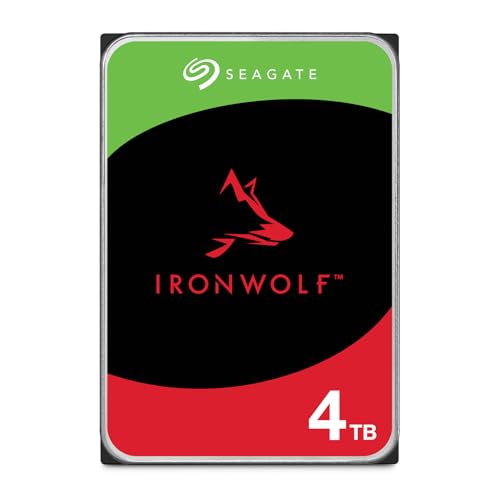
Seagate IronWolf 4TB — Third-party CMR workhorse
The IronWolf 4TB arrives with the most forthcoming title among the third-party picks: NAS internal hard drive, CMR recording, 3.5 inch, SATA 6Gb/s, 5400 RPM, 64MB cache. Every one of those details is checkable against the listing itself, and together they describe a drive designed around the exact conditions inside a DS1815+ — continuous operation, neighbouring drives vibrating on either side, and a workload of file serving, backup targets and media streaming rather than bursty desktop use.
The CMR designation deserves its sentence, because recording technology shapes how a NAS drive behaves when a volume rebuilds or a large write lands. Conventional magnetic recording lays tracks side by side without overlap, and drives using it sustain their write behaviour under the long sequential loads that array rebuilds impose. That the IronWolf’s title states CMR outright removes a research chore that plagues this category, where some lines have historically mixed technologies under one nameplate. For a DS1815+ owner planning a rebuild of a multi-terabyte volume, a stated recording technology is not trivia; it is the difference between a predictable weekend and a mysterious one.
Rotational speed cuts the other way, and fairly. At 5400 RPM this is the slowest-turning pick in the guide, which in an eight-bay chassis reads as a feature for some owners and a compromise for others. Slower rotation generally means a quieter, cooler row of drives, kinder to a NAS living in a study or a lounge, and for the file-serving duties that dominate home NAS life the array’s aggregate throughput rarely hinges on one mechanism’s spindle speed. The owner running databases or many small-file workloads over the network will notice the ceiling sooner. Both readings are true, and the verdict below simply asks which household the DS1815+ serves.
- Capacity: 4 TB, per the listing title
- Form factor: 3.5 inch, per the listing title
- Interface: SATA 6Gb/s, per the listing title
- Rotational speed: 5400 RPM, per the listing title
- Cache: 64 MB, per the listing title
- Recording technology: CMR, per the listing title
Strengths
- CMR stated in the title, removing guesswork about rebuild behaviour
- 5400 RPM rotation suits quieter, cooler eight-bay operation
- A complete title — speed, cache, interface and technology all published
Trade-offs
- The slowest spindle speed here, felt in small-file and database-style workloads
- 4TB per bay caps the chassis well below the 8TB and 10TB picks’ totals
- Third-party status means Synology’s own drive programme does not stand behind it
Best for: a DS1815+ owner seeking a fully specified CMR drive at 5400 RPM for a quiet, cool-running volume. Not suited for: an owner building the DS1815+ primarily for many-small-files workloads over the network.

Western Digital WD Red Plus 4TB — Third-party NAS staple
Red Plus is the nameplate that taught the home NAS market what a NAS drive was, and its 4TB member sits in this guide as the establishment third-party choice. The listing title is brief — Western Digital 4TB WD Red Plus NAS internal hard drive — and brevity cuts both ways. It confirms brand, capacity and intended duty, and it leaves rotational speed, cache and recording technology unprinted on the title line, so those details live in the fuller listing text and in Western Digital’s documents rather than in anything this guide will assert.
What can be said on solid ground is the line’s role. Red Plus exists specifically for multi-bay home and small-office enclosures, positioned between the entry Red line and the Red Pro tier, and a DS1815+ with eight trays sits squarely in the territory the line was drawn for. Owners who have run Red-family drives in earlier Synology boxes will find the continuation of a known quantity here: same naming logic, same intended habitat, a supply chain deep enough that a replacement drive years from now is a realistic expectation rather than a hope. In a 2015 chassis being kept alive deliberately, that continuity of supply is a practical virtue, not a nostalgic one.
The honest limitation is the research burden the short title creates. A buyer comparing this drive against the IronWolf above must do extra reading to place the two side by side on speed and cache, because one title publishes those figures and the other does not. That is a few minutes of work, not a disqualification, and the fuller listing will answer most of it. But a guide that quietly filled the gap from general knowledge would be doing the reader no favour, since Red Plus capacities have historically spanned more than one rotational speed. Check the listing’s own detail section, match it against the volume’s needs, and this drive becomes exactly what its nameplate promises.
- Capacity: 4 TB, per the listing title
- Duty: NAS internal hard drive, per the listing title
- Brand line: WD Red Plus, per the listing title
- Rotational speed: Not stated in the listing title — verify with Western Digital documentation
- Cache size: Not stated in the listing title — verify with Western Digital documentation
- Recording technology: Not stated in the listing title — verify with Western Digital documentation
Strengths
- A NAS-specific line with a long history inside Synology enclosures
- Deep retail availability, which matters when a replacement is needed years later
- Positioned for multi-bay home duty, matching the DS1815+ eight-tray layout
Trade-offs
- Short title pushes speed, cache and recording-technology checks into the listing body
- 4TB capacity is the modest end of this guide’s spread
- Third-party drive in a first-party chassis, without Synology’s drive programme behind it
Best for: a DS1815+ owner requiring a familiar NAS-specific 4TB drive with strong long-term availability. Not suited for: a buyer requiring every headline specification to be confirmed on the title line before ordering.

Toshiba N300 10TB — Largest capacity per bay
Every guide has one pick that changes the shape of the whole decision, and here it is a Toshiba. The N300’s title states a 10TB NAS 3.5-inch internal hard drive, which across eight DS1815+ bays sums to 80TB of raw space — a quarter more than the 8TB picks offer and two and a half times the 4TB options. For the owner whose DS1815+ exists to hold a growing archive that cannot shrink, that per-bay figure is the argument, and everything else about the drive is supporting evidence.
Toshiba’s N300 line is the company’s NAS-specific family, built for enclosures that run around the clock, and its presence in this guide also corrects a lazy assumption that home NAS storage is a two-brand contest. A third manufacturer with a genuine NAS line gives the DS1815+ owner leverage: a different supply chain when one brand’s stock runs thin, a different pricing rhythm when the others sit firm. The title does not state rotational speed or cache for this capacity, so those checks belong to Toshiba’s documentation, and a careful buyer will make them before filling eight trays. Capacity may lead the argument, but it should not be the only witness heard.
There is also a structural point about very full chassis. A DS1815+ populated entirely with 10TB drives concentrates more data behind one ageing backplane, one power supply and one set of fans than the same box held when new. That is not an argument against this pick; it is an argument for pairing it with a serious backup habit, because the more a single enclosure holds, the more its owner owes the data a second home. Owners who already back up externally can take the 80TB raw figure with a clear conscience. Owners whose DS1815+ is the only copy of everything should read the mistakes section below twice.
- Capacity: 10 TB, per the listing title
- Form factor: 3.5 inch, per the listing title
- Duty: NAS internal hard drive, per the listing title
- Brand line: Toshiba N300, per the listing title
- Rotational speed: Not stated in the listing title — verify with Toshiba documentation
- Cache size: Not stated in the listing title — verify with Toshiba documentation
Strengths
- 10TB per bay, the highest capacity in this guide, for 80TB raw across the chassis
- A genuine NAS-specific line from a third manufacturer, widening supply options
- Suits archive-heavy use where total terabytes decide the purchase
Trade-offs
- Speed and cache absent from the title, so verification homework is required
- Maximum data concentration in one ageing enclosure raises the stakes on backup
- Per-drive cost at 10TB is the highest here even before multiplying by eight
Best for: a DS1815+ owner seeking the largest raw total the eight bays can hold, with backups already arranged elsewhere. Not suited for: an owner whose NAS holds the sole copy of irreplaceable files.
How do the six drives compare inside one eight-bay chassis?
Read the table as a chassis planner rather than a league table. Multiply any row by eight and the DS1815+ takes on a different personality: a file vault, a working volume, a two-volume split. The columns stick to title-stated facts, so gaps in the table are gaps in the listings, and they mark exactly where a buyer’s own verification should go next.
| Drive | Capacity | Speed stated in title | Cache stated in title | Family |
|---|---|---|---|---|
| Synology HAT5300-8T | 8 TB | 7200 RPM | Not stated | Synology enterprise |
| Synology HAT5320 4TB | 4 TB | Not stated | Not stated | Synology enterprise |
| Synology HAT5320 8TB | 8 TB | Not stated | Not stated | Synology enterprise |
| Seagate IronWolf 4TB | 4 TB | 5400 RPM | 64 MB | Seagate NAS |
| WD Red Plus 4TB | 4 TB | Not stated | Not stated | WD NAS |
| Toshiba N300 10TB | 10 TB | Not stated | Not stated | Toshiba NAS |
What should a DS1815+ owner check before filling eight bays?
Start with the volume plan, not the shopping cart. Decide whether the DS1815+ will hold one large volume, two smaller ones, or a working volume plus an internal backup target, because that decision fixes the capacity per bay worth buying. A single-volume plan rewards the 8TB and 10TB picks. A split plan can make 4TB drives the smarter purchase, since each volume gets its own group of trays and a smaller drive size keeps the groups balanced. Owners who skip this step often discover, mid-checkout, that they have priced a row of drives for a layout they never actually chose.
Next, think about the chassis as an ageing system. A DS1815+ in service today has fans, a power supply and a backplane with a decade behind them. Fresh drives deserve a fresh look at the enclosure: clear the fan grilles, confirm both fans spin freely, and consider where the box sits, because eight new mechanisms in a dusty corner cupboard will run warmer than the same drives on an open shelf. Drive selection and drive environment are one decision wearing two hats, and the environment half costs nothing but attention.
Redundancy arithmetic deserves plain language. Any scheme that tolerates a failed drive spends capacity to buy that tolerance, so the raw totals quoted throughout this guide — 32TB, 64TB, 80TB — always shrink before a single file lands. Plan from the usable figure backwards: estimate the data, add honest growth room for the years the rebuild is meant to cover, then check which per-bay capacity still fits after redundancy takes its share. That backwards calculation is the difference between a DS1815+ that serves quietly for years and one that starts flashing capacity warnings within eighteen months.
Noise expectations deserve one honest paragraph before the order is placed, because a DS1815+ rarely lives in a data centre; it lives in a study, a lounge, a hallway cupboard. Every mechanical drive makes some sound, and eight of them seeking at once make a soft chatter that most households tune out within a week and a few never do. If the enclosure will sit within earshot of a bed or a recording microphone, weight the slower-spinning and NAS-tuned picks more heavily, place the chassis on a solid surface that will not act as a sounding board, and keep a few centimetres of clearance so the fans can work slowly instead of urgently. If the box lives in a garage rack or a ventilated closet, acoustics can drop to the bottom of the priority list and capacity or speed can lead instead. Neither household is wrong; they are simply shopping for different rooms, and the same six drives rank differently in each.
Finally, stage the migration. Moving data from old drives to a new set inside the same chassis goes safest one volume at a time, with the old set kept intact until the new volume has run for some days and a backup elsewhere has been verified. Rushing a full eight-bay swap in a single evening concentrates every risk into the hours when the owner is most tired. The drives in this guide will wait patiently in their boxes; the data deserves the same patience.
How do you install and settle a new drive set in a DS1815+?
Begin with the backup, before a single tray slides out. Copy anything irreplaceable to a destination outside the chassis — an external drive, another machine, a cloud tier — and verify the copy opens. Only then power the NAS down cleanly through its interface, let the drives spin down fully, and work on a surface where eight trays can be laid out in order. Photographing the original tray order with a phone takes ten seconds and settles any later argument about which drive sat where.
Fit one drive at a time, seating each mechanism in its tray and sliding the tray home until it latches with the same firm click as its neighbours. A tray that resists is usually a drive seated a fraction high in its frame; reseat it rather than forcing the latch. When the full set is in, power up and let the system discover the row before creating anything. Check that every bay reports present, note any drive whose reported capacity looks wrong, and only then build the volume according to the layout decided earlier.
The settling period matters more than the installation. A new volume should be filled gradually over its first days, with an ear kept on the enclosure: new clicking, rhythmic knocking or a fan working far harder than before are all messages worth acting on while the old drives still sit safely in their boxes. Run the NAS through ordinary life for a week — backups landing, media streaming, shares mounting — before declaring the rebuild finished and retiring the old set. That week of probation is cheap insurance bought with nothing but patience.
What mistakes do DS1815+ owners make when replacing drives?
The classic error is assuming the newest compatibility rules apply to a 2015 machine. Synology’s drive policies for its recent models are stricter than the environment the DS1815+ was designed in, and owners reading current headlines sometimes conclude their older box accepts only first-party drives. It does not; third-party NAS drives run in a DS1815+, as they have since the model launched. The HAT drives in this guide are a choice with real advantages, not a toll gate, and a guide or a forum post that blurs that distinction sends owners spending under a misapprehension.
A second mistake is mixing capacities casually across one volume. Volumes built from uneven drives generally size themselves around the smaller members, so one 4TB drive dropped into a row of 8TB mechanisms can quietly waste space across the whole set. Mixed rows have legitimate uses — a spare pressed into emergency service, a staged upgrade — but they should be deliberate, with the cost understood, rather than discovered months later in a storage report that makes no sense.
Third, owners under-buy capacity because they plan for the data they have rather than the data they are accumulating. Photo libraries grow by the month, video arrives in ever-heavier formats, and backups swell silently. A rebuild is the one moment when expanding is cheap in effort; filling the chassis with drives sized for last year’s archive guarantees a second rebuild on a shorter fuse. The fourth mistake completes the set: treating the NAS as its own backup. Redundancy inside the chassis protects against a failed drive, not against deletion, theft, fire or a failing enclosure, and the larger the volume built from these picks, the more that distinction matters.
How do rebuilds and everyday responsiveness feel on each family?
A drive set reveals its character twice: once in daily service, and once on the bad day when a volume rebuilds. Daily service in a home DS1815+ is mostly undemanding — files copied on and off, a backup landing overnight, a film streaming to one screen — and every pick in this guide handles that diet without drama. The differences gather at the edges. A volume built from the 7200 RPM HAT5300-8T mechanisms answers many-small-file requests with a touch more urgency, the sort of workload produced by a photo library being indexed or a folder of thousands of small documents being browsed over the network. The 5400 RPM IronWolf set trades that edge for calm, and in a streaming-and-backup household the trade is invisible in practice.
Rebuild day is sterner. When a drive in a redundant volume is replaced, the surviving members read themselves end to end while the newcomer writes itself full, a process measured in hours for multi-terabyte members and one that punishes any drive whose sustained write behaviour falters under a long sequential load. This is where stated recording technology earns its keep: the IronWolf title’s CMR designation speaks directly to that scenario. For the picks whose titles stay silent on recording technology, the prudent owner verifies the point in manufacturer documentation before building a volume whose rebuild they may one day have to sit through. The check costs minutes now and buys certainty on the worst day of the volume’s life.
Capacity interacts with rebuild time in a way first-time buyers underestimate. A 10TB member takes proportionally longer to reconstruct than a 4TB member, simply because more sectors must be written, and during those hours the volume works with reduced margin. Large-capacity rows therefore pair naturally with conservative habits: prompt replacement of any drive showing errors, a cold spare on the shelf rather than in a delivery van, and backups current enough that a rebuild is an inconvenience rather than a cliff edge. None of this argues against the N300 or the 8TB picks; it argues for matching the owner’s habits to the row they install.
Responsiveness also has a network ceiling that no drive choice can repeal. The DS1815+ speaks to the household over gigabit Ethernet, and a single client pulling a large file will meet that ceiling long before any of these drives reaches its own limit. Where drive speed shows through is in parallel life: several clients, an indexing job and a backup all pressing the volume at once. Owners whose households genuinely live that way should weight the faster and enterprise-graded picks more heavily; owners whose NAS works one job at a time can let quietness and capacity lead instead, and spend the difference on the backup drive this guide keeps recommending.
What about power draw, heat and noise across a full row of eight?
Eight drives share one power supply, one pair of fans and one room, so their collective behaviour matters as much as any single specification. Rotational speed is the lever the listings actually expose: the HAT5300-8T states 7200 RPM, the IronWolf states 5400 RPM, and the remaining titles leave speed unprinted, which is precisely why this guide refuses to rank the six on wattage. No listing title here publishes a power figure, and inventing a league table of consumption would be fiction dressed as measurement. What can be reasoned honestly is directional: faster-spinning rows generally ask more of cooling, and cooling in a small enclosure announces itself as fan noise.
Placement is the owner’s counter-move. A DS1815+ on an open shelf in a ventilated room runs its fans lazier than the same box sealed in a media cabinet, whatever drives it holds. Rubber-footed surfaces, a few centimetres of clearance behind the exhaust, and distance from soft furnishings that trap warm air all lower the acoustic price of any row. Owners choosing the 7200 RPM first-party set for a bedroom-adjacent installation should budget that placement care as part of the purchase; owners choosing the 5400 RPM IronWolf set for a lounge get more forgiveness from the hardware itself.
Heat also writes the long-term story. Drives that spend a decade warm age differently from drives that spend it cool, and an eight-bay chassis concentrates the question. After installing any new set, an owner should read the system’s own temperature reports across a warm afternoon and a heavy backup evening, and treat those readings as the baseline for the row’s life. A sudden rise months later usually means dust, a tired fan or a changed room rather than a failing drive, and catching it early is the cheapest reliability work in this entire guide. The drives are the purchase; the environment is the maintenance contract the owner signs with themselves.
One more collective effect deserves naming: spin-up. Eight mechanisms starting together draw a brief surge and produce a brief chorus, and in a household where the NAS sleeps and wakes on a schedule, that moment repeats daily. It is harmless, but it startles owners who expected silence from a box of new drives. Leaving a home NAS running continuously — the duty these NAS and enterprise lines are built for — removes the chorus entirely and matches the usage the drives were designed around, which is one more reason this guide favours always-on operation for a DS1815+ over aggressive sleep schedules.
How should owners plan spares and replacements for the years ahead?
A drive purchase for a DS1815+ is really two purchases: the row that goes in now, and the replacement that will be needed some year when one member of the row reports errors. Planning the second purchase at the moment of the first is the habit that separates calm owners from panicked ones. The simplest form of the plan is a cold spare — one extra drive of the same model, bought with the set, kept in its sealed packaging on a shelf. When a member falters, the spare enters service the same evening, the volume rebuilds overnight, and the failed unit’s replacement becomes a routine errand instead of an emergency order placed while a volume runs exposed.
Buying the spare with the set carries a subtler benefit: batch consistency. Drives manufactured together tend to share characteristics, and a spare drawn from the same production period as the installed row avoids the small mismatches that arise when a model line quietly revises itself across the years. Model lines do revise. A Red Plus or an IronWolf bought five years apart may share a nameplate while differing in details the title never mentioned, which is another reason the same-model spare on the shelf outperforms the same-model listing bookmarked for later. Bookmarks cannot rebuild a volume at midnight.
Warranty thinking belongs in the same conversation, handled carefully. This guide prints no warranty terms, because no listing title in the pool states them, and terms change across regions and revisions. The check belongs in the manufacturer’s documentation for the exact model, done before purchase, with one question in mind: does the coverage suit a drive expected to spin continuously for years inside a multi-bay enclosure? Enterprise and NAS lines exist precisely because that duty differs from desktop service, and their documentation is where the difference is spelled out. An owner who reads those pages once, at buying time, will never have to guess at them during a failure.
There is also the question of the chassis outliving the drives, or the drives outliving the chassis. A DS1815+ rebuilt today may itself be replaced in five years by a newer enclosure, and SATA drives in standard 3.5-inch trays travel well: the row installed now can migrate into a successor box, provided the new home accepts the same form factor and interface, which the titles here confirm for every pick. That portability softens the commitment considerably. The owner is not marrying a drive set to a 2015 enclosure forever; they are buying storage that can follow the household’s next NAS through the door, and the purchase should be judged with that longer itinerary in mind.
Record-keeping closes the plan. A simple note — purchase date, model, which tray holds which serial number, where the spare sits — turns a future failure from archaeology into administration. Photograph the tray order, save the note beside the household’s other appliance records, and update it whenever a drive changes. Five minutes of documentation at installation can save an evening of guesswork years later, when memory of the rebuild has faded and the only witness left is the note itself. Owners of a decade-old NAS have usually learned this lesson once already; the rebuild is the moment to apply it.
Final Recommendation
For most DS1815+ owners, the decision resolves into a single question of allegiance. Trust the manufacturer’s programme and the HAT5320 8TB offers the current first-party series at full capacity, with the HAT5300-8T standing beside it for owners who prefer the drive whose title publishes its speed and reliability figure openly. Prefer the established third-party lines and the IronWolf 4TB is the most transparently specified option here, while the Red Plus 4TB trades title detail for depth of availability. Chase capacity above all and the Toshiba N300 10TB stands alone. A 2015 enclosure still earning its shelf space deserves drives chosen with this much care, and whichever family wins, the old DS1815+ will repay the attention with another long tour of quiet duty, holding the household’s archive on fresh mechanisms instead of on drives that have already given a decade.
Frequently Asked Questions
Do third-party drives really work in a DS1815+?
Yes. The DS1815+ dates from 2015, before Synology’s own drive line existed, and owners have run Seagate, Western Digital and Toshiba NAS drives in this model since its launch. The IronWolf, Red Plus and N300 picks in this guide are third-party options for exactly that reason. First-party HAT drives bring the manufacturer’s validation programme; they are not a requirement imposed by this chassis.
Should all eight drives in the chassis match?
Matching sets behave most predictably, simplify spares and keep volume sizing simple, which is why this guide frames purchases as rows of eight identical drives. Mixed capacities inside one volume tend to size the volume around the smaller drives. A mixed row can still make sense during a staged upgrade, provided the trade-off is understood before the trays go in.
Is 4TB per bay enough for a home DS1815+?
Across eight bays, 4TB drives give 32TB raw before redundancy takes its share, leaving usable space in the mid-twenties of terabytes under a typical one-drive-tolerant layout. Households archiving photos, documents and a moderate media library will find that generous. Households hoarding high-resolution video should do the growth arithmetic honestly and look at the 8TB or 10TB picks instead.
Why do several spec boxes say a figure is not stated?
Because the listing titles for those drives do not print the figure, and this guide takes its specifications from the titles in its pool rather than from general knowledge. Listings and regional variants change over time. The not-stated lines point to the manufacturer’s documentation, where the current official figure for the exact model can be confirmed before money moves.
Does the DS1815+ benefit from 7200 RPM drives?
The HAT5300-8T states 7200 RPM in its title, and a faster spindle can help workloads built from many small operations across a busy volume. File serving, backups and media streaming — the ordinary home NAS diet — lean more on the network link and the array as a whole. Owners in quiet rooms should weigh the extra fan activity a fast row of eight can bring.
What should be done with the old drives after a rebuild?
Keep them intact until the new volume has run through a week or two of ordinary use and an external backup has been verified. After that probation, healthy old drives can serve as offline backup copies stored away from the NAS, which turns yesterday’s volume into a genuine second line of defence rather than e-waste.
Related Guides
Drive choices for a home NAS connect naturally to the wider storage picture, so readers planning a full refresh may also want our neighbouring coverage of NAS drives for small home servers, the practical steps in setting up redundant storage at home, and the archive-planning advice in building a long-term photo backup system.


