What's inside
As an Amazon Associate I earn from qualifying purchases. This post may contain affiliate links at no extra cost to you.
gizmoverdict.com is reader-supported. When you buy through links on our site, we may earn an affiliate commission.
Where to buy: dome and panoramic models with verified listings are linked below go to their Amazon listings, where you can check price on Amazon and verify whether the unit is an IP camera, an analogue camera needing a DVR, or a recorder bundle. That single check prevents the most expensive misunderstanding in this category.
The phrase best 360 degrees dome outdoor security cameras hides a confusion that this guide exists to untangle, because three genuinely different technologies all market themselves with the same round number. A fisheye dome sees everywhere at once through one extreme lens and untangles the circular image in software. A PTZ speed dome sees one direction at a time and physically motors its gaze around, which is not the same promise at all. A dual-lens camera stitches two ordinary views into a wide panorama that usually spans about a hundred and eighty degrees, half the circle, however the headline phrases it.
None of these is a fraud, but they fail in different ways and suit different buildings. The fisheye never blinks and never misses the corner behind it, yet its detail spreads thin at the edges and its dewarped views take getting used to. The PTZ reaches astonishing distances with optical zoom and can follow a person across a yard, yet while it stares at the gate it is blind to the fence. The dual-lens panorama gives you a natural, undistorted widescreen of one facade with detail the fisheye cannot match, at the cost of the other half of the world. Choosing among them is choosing which blindness you can live with.
The six picks below are organised around that honest taxonomy rather than around brand or price. Two are true fisheye designs, one analogue and one digital. One is a PTZ wearing the 360 label through rotation. Two are dual-lens panoramas wearing it through width. Read the technology paragraphs as carefully as the product reviews, because in this category the mechanism matters more than the megapixels, and a camera that sees everything at once is a different instrument from one that merely can, eventually, look anywhere.
A word on how to use the reviews that follow. Each one opens by placing the camera in its true technology family before discussing the product itself, because a model can only be judged fairly against the physics it lives under. If you already know your family, you can read selectively. If you arrived believing the three families were one, read everything, because the most valuable thing this page sells is the distinction, and it is free.
Key Takeaways
- True simultaneous 360 coverage comes only from a fisheye lens plus dewarping software.
- PTZ domes rotate to look anywhere but record one direction at any moment.
- Dual-lens models like the Reolink Duo 2V cover about 180 degrees, not a full circle.
- Analogue fisheye domes need a compatible DVR and coax cable; they are not network cameras.
- Fisheye detail thins toward the edges, so ceiling height decides real-world usefulness.
- One fisheye over a central ceiling can replace several ordinary cameras in a single room or yard.
Quick Picks
| Pick | Badge | Why it earns a place |
|---|---|---|
| Amcrest Fisheye IP PoE Camera 5MP | Best true fisheye on a network | A 5MP fisheye with intelligent video features and PoE simplicity. |
| Reolink Duo 2V PoE Dual-Lens Camera | Best panoramic facade camera | Two lenses, one undistorted 180-degree view, IK10 vandal shell. |
| Jennov 4K 8MP PTZ PoE Speed Dome | Best zooming investigator | 20x optical zoom and a huge infrared claim for big properties. |
| DCSEC 1080P Fisheye Dome Analogue Camera | Best for legacy coax sites | A 1.7mm fisheye dome that upgrades old DVR systems cheaply. |
| Real HD 8MP Dual-Lens PoE Panoramic Camera | Best value metal panorama | Dual-lens 180-degree coverage in a metal housing with colour nights. |
| 4K 8MP 180 Fisheye Eyeball Dome Analogue Camera | Sharpest analogue fisheye here | An 8MP-class analogue eyeball for DVR sites wanting wide detail. |
How did we sort these dome cameras?
The selection began by classifying every candidate by its actual viewing mechanism, because mixing the three technologies into one undifferentiated ranking would repeat the marketing confusion this article exists to correct. Each of the three families received representation proportional to how buyers actually shop: fisheyes for true all-at-once coverage, a strong PTZ for the patrol-and-zoom use case, and dual-lens panoramas for facade coverage with undistorted detail.
The second filter was outdoor honesty. A dome earns a place here only if its housing, sealing and intended mounting genuinely suit exterior life, or, in the case of the indoor-leaning Amcrest fisheye, if its panoramic role under eaves and canopies is made explicit rather than glossed. Analogue models were required to state their DVR dependence in their own listings, since a buyer stranded with a coax camera and no recorder has been failed by somebody, and this guide declines to be that somebody.
Finally, each model was weighed on what its coverage costs in detail. A 5MP fisheye spreads its pixels across an entire hemisphere; an 8MP dual-lens spreads its across half that area in a natural shape. Neither is simply better. The reviews therefore describe the shape of each camera’s competence, the ceiling heights, yard sizes and sightlines where it shines, and the specific moment, usually a face at a distance, where its technology quietly runs out of pixels.
The reviews also separate two numbers that listings love to blur: the degrees a camera can eventually face and the degrees it records in a single instant. Only the second figure protects you at 3 a.m., so it is the figure this guide grades. A rotating camera is graded as an investigator, a stitched camera as a half-circle witness and a fisheye as the full circle, and no score from one family is allowed to masquerade as a score in another.
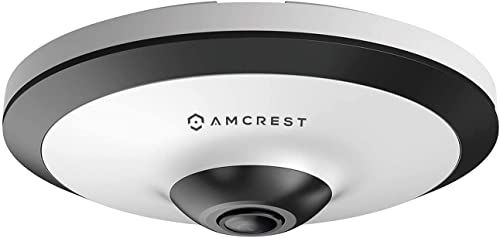
Amcrest Fisheye IP PoE Camera 5MP — Best true fisheye on a network
The Amcrest fisheye is the camera this category’s name actually describes. One lens, one circular image, the whole space all the time. Its 5MP sensor records a complete hemisphere that software then unwraps into whatever views you need: a flattened look at one side of the room, a quad split that behaves like four virtual cameras, or the original circle for a quick situational glance. For a shop floor, a restaurant dining room or a covered loading area, a single unit centred on the ceiling replaces the traditional four-corner install and removes the blind seams where incidents so often choose to happen.
Intelligent video features lift it above a mere wide eye. Amcrest’s IVS analytics can draw tripwires and intrusion zones inside that circular view, so the camera alerts on a person crossing into the stockroom area rather than on every movement in a busy room. Heat-mapping style overviews, offered in the wider ecosystem, turn the same footage into a quiet lesson about where customers actually walk. These are the dividends of a mature platform: the hardware is a lens, but the product is the software wrapped around it, and Amcrest has been wrapping this class of camera longer than most.
Now the placement honesty this guide promised. Amcrest positions this fisheye primarily for indoor duty, and its natural outdoor home is under cover: a porch ceiling, a canopy, the soffit over a shopfront. Treat it as weather-sheltered rather than storm-proof, and mount accordingly. Within that shelter it thrives. The PoE connection keeps the install to one cable, the camera joins Amcrest recorders or standard software without drama, and the dewarping on recorded clips means an incident at the edge of the room can be re-examined from angles you never configured in advance.
Detail expectations need calibration rather than disappointment. Five megapixels spread across a hemisphere gives strong situational awareness and reliable identification within a few metres of the mounting point, softening to description at the room’s far corners. Pair it with one ordinary camera over the till or the door if faces at distance are evidence you require, and the combination still uses fewer cables than the old four-camera layout. As the panoramic heart of a small system, this Amcrest remains the reference design against which the rest of this roundup’s claims should be measured.
Ownership is correspondingly calm. There are no moving parts to wear, the firmware ecosystem is established, and the camera’s failures, when they come, are the ordinary network kind rather than exotic mechanical ones. For buyers whose space is one honest room or covered area and whose fear is the unseen corner, this is the pick that actually delivers the number on the category’s tin, all three hundred and sixty degrees of it, simultaneously and without sleight of hand.
A final operational pleasure deserves mention: because the fisheye’s master recording contains the whole room, reviewing an incident becomes a kind of time travel with a steering wheel. Investigators routinely discover that the important detail was not where everyone first looked, the till, but at the door the suspect touched on entry. A conventional camera that never framed that door has nothing to offer. The Amcrest’s archive, re-dewarped toward the entrance, frequently does, and that retrospective reach is the deepest argument for the format.
- Sensor: 5MP fisheye, full circular view
- Coverage: genuine 360 degrees with dewarping
- Power: PoE over a single network cable
- Features: IVS intelligent video analytics
- Mounting: ceiling or wall, orientation selectable
- Recording: NVR, software or onboard options by setup
Strengths
- Sees everywhere at once, always
- Retrospective dewarping of recordings
- Mature app and recorder ecosystem
Trade-offs
- Positioned for indoor and covered use
- Edge detail thins at distance
- Dewarping learning curve for beginners
Best for: Shops, lobbies and covered yards needing one-camera total coverage.
Not suited for: Exposed high walls in driving rain or long-range identification.

Reolink Duo 2V PoE Dual-Lens Camera — Best panoramic facade camera
Let the correction come first, because this guide insists on it: the Duo 2V is a 180-degree camera. Two lenses sit side by side in its dome, each watching its half of a facade, and the camera stitches their outputs into a single wide panorama. It cannot see behind itself, and it never pretends otherwise in its engineering, whatever shelf it was filed under. What it offers in exchange for the missing half-circle is the cleanest wide view in this roundup: no fisheye curvature, no dewarping step, just a natural widescreen image of your frontage with detail spread evenly across it.
That evenness is the dual-lens advantage in one word. A fisheye spends its finest pixels on the centre and starves the rim; the Duo spends two sensors across one panorama, so a face at the left gate and a face at the right fence arrive with comparable clarity. Eight megapixels of combined class across a half-circle is a far richer ration than five across a whole one. For the classic suburban brief, watch the driveway, the front door and the pavement approach in one view, this distribution of pixels is simply better matched to the geography of the problem.
The housing suits the exposure that wall-mounted life brings. An IK10 rating is the top of the common impact scale, the class of shell that shrugs off the deliberate blow rather than merely the accidental knock, and it matters because a camera watching a frontage at reachable height is a camera someone may eventually test. Person, vehicle and animal detection trims the alert stream into categories a household can act on, and colour night vision keeps clothing and car colours descriptive after dark, given some light to work with, whether its own illumination or the street’s.
Installation is a one-cable PoE affair, and the creative decision is the mounting wall. Choose the facade the camera will spend its life facing, centre it on the axis of interest, and accept the half-world behind it as somebody else’s problem, ideally a second camera’s or a locked gate’s. The stitch line between lenses deserves a test walk at close range, since a person crossing exactly at the seam very near the camera can briefly distort; at normal garden distances the join is effectively invisible in the recorded panorama.
Filed honestly, the Duo 2V is not a failed 360 camera but a triumphant 180 one. Most properties do not need eyes in the back of their heads; they need a superb view of the approach, the frontage and the boundary, held in a shell that resists interference. If your space is a wall and a world in front of it, this Reolink covers that world better than any true fisheye in this list, and the degrees it surrenders are degrees you never needed.
Snow country gives the Duo 2V an unexpected advantage worth recording. Its flat, forward-facing dome sheds the sideways weather that blinds upward-looking fisheyes, and its illuminators sit close to the lenses they serve, so the colour night picture survives conditions that turn a panoramic circle into a white ring. Owners in northern climates consistently underrate how much of a camera’s year is winter, and a design that keeps its composure through February earns its keep in the season when properties stand emptiest.
- Sensor: dual lenses, 8MP combined class
- Coverage: about 180 degrees stitched panorama
- Housing: IK10 vandal-proof dome class
- Detection: person, vehicle and animal alerts
- Night: colour night vision with illumination
- Power: PoE single cable
Strengths
- Natural widescreen without fisheye warp
- Toughest housing rating in this list
- Smart detection sorts people from pets
Trade-offs
- Sees a half-circle, never behind itself
- Stitch line can show at close range
- Needs wall or eave facing the scene
Best for: House fronts, driveways and yard walls needing one wide honest view.
Not suited for: Central ceilings or any space needing coverage in all directions.
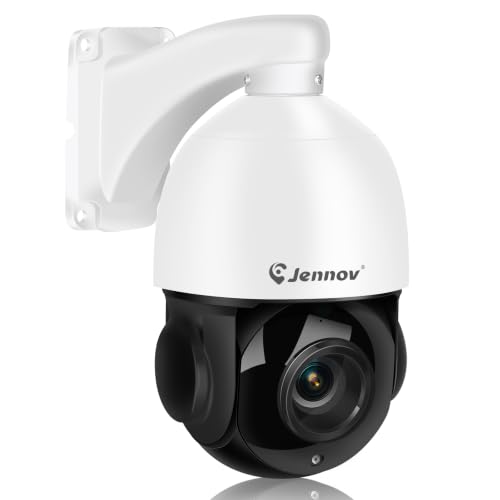
Jennov 4K 8MP PTZ PoE Speed Dome — Best zooming investigator
The Jennov speed dome is the camera that borrowed this category’s name, and it is time to be precise about the loan. It does not record 360 degrees. It can rotate through 360 degrees, panning and tilting under motor power to face any point on the compass, and its twenty-times optical zoom can then interrogate that point in detail. The distinction is not pedantry; it is the difference between a lighthouse and a floodlight. Both are valuable. Confusing them leaves a dark interval in your evidence exactly where a patient intruder will choose to work.
Within its true role, the specifications are formidable. An 8MP sensor behind a 20x zoom reads detail at distances where every fixed camera in this roundup has given up: the far gate of a farmyard, the bottom of a long car park, the fuel store across a depot. The infrared claim of three hundred and twenty feet belongs to the zoomed, cooperative-target end of physics, yet even discounted generously it describes a camera built for night work at range. Auto tracking lets it follow a detected person across its field, keeping the subject framed while a fixed camera would have waved goodbye at the edge of its view.
Patrol design is where owners succeed or fail with a PTZ. Set a handful of preset viewpoints that correspond to real assets, the gate, the barn door, the parked machinery, and tour them at intervals short enough that no asset rests unwatched for long. Park the camera’s home position on the most valuable view so its idle hours are spent guarding what matters most. Resist the theatrical continuous spin; it impresses visitors, wears the motors and guarantees the lens is usually facing somewhere useless. A PTZ rewards the owner who thinks like a watchkeeper writing a roster.
Power and mounting deserve respect. Motors, heaters in cold climates and a large infrared array draw more than a fixed dome, so confirm your PoE budget is the higher-wattage kind this class expects, and mount the unit on a bracket that will not flex in wind, because at twenty-times zoom a trembling mount turns the picture into soup. The speed dome form also announces itself, which cuts both ways: deterrence for the casual trespasser, a visible patrol pattern for the calculating one. Pairing with even one fixed camera over the main entrance closes that calculable gap.
Judged as what it is, this Jennov is the strongest tool in the list for large, open, distance-heavy properties, and the wrong tool for a small yard that needs an unbroken record. Buy it to investigate, to zoom, to follow, and ideally to work beside fixed eyes that never blink. Buy it believing it sees everywhere at once and it will eventually show you a perfect, detailed recording of the wrong side of your property while history happened on the other.
Cold weather is the PTZ’s quiet examination, and owners in harsh climates should plan for it. Motors stiffen, domes ice at the rim, and a camera that cannot complete its morning tour is telling you it needs a model with a heater or a more sheltered mount. The Jennov’s outdoor rating covers a great deal, yet physics keeps a vote. If your winters are serious, mount the dome where a roof edge steals the worst of the wind, and schedule a midday tour that breaks any overnight ice before the evening watch begins.
- Sensor: 8MP, 4K recording
- Zoom: 20x optical, pan and tilt motors
- Night vision: infrared rated to 320ft
- Housing: speed dome, outdoor rated
- Power: PoE, higher draw than fixed domes
- Recording: NVR or software, preset tours supported
Strengths
- Optical zoom identifies at real distance
- Auto tracking follows moving subjects
- One unit patrols a large property
Trade-offs
- Records one direction at a time
- Motors add a wear component
- Needs generous PoE power budget
Best for: Farms, yards and car parks where threats arrive from far away.
Not suited for: Small spaces needing an unbroken all-around record.

DCSEC 1080P Fisheye Dome Analogue Camera — Best for legacy coax sites
This DCSEC dome belongs to the other wiring civilisation, and its review must start there. It is an analogue high-definition camera: its picture travels down a coaxial cable to a DVR that records it, and it has no network port, no app and no interest in your Wi-Fi password. The four-in-one output switches between TVI, CVI, AHD and old CVBS so it can marry whichever recorder family a site already owns. For a building wired with coax in a previous CCTV generation, that compatibility is not a limitation. It is the entire value proposition, because rewiring a premises costs multiples of any camera.
The lens is a 1.7mm fisheye, which delivers the super-wide hemispheric view this category promises, though the listing’s own language calls it 180 degrees and the practical truth is a very wide dome view rather than the full dewarped circle of the Amcrest. Resolution is 2MP, honest 1080p, and that sets the identification envelope: superb for seeing that something happened everywhere in a small shop or office, adequate for recognising familiar people at close range, and not the tool for reading detail across a large floor. Small rooms are its kingdom, and in small rooms it is genuinely effective.
Dewarping, where it exists, lives in the DVR. Some recorders offer fisheye correction modes for compatible cameras; many simply record the round or wide image as it comes, leaving the operator to interpret it. Ask your DVR’s manual before assuming the elegant split views of the IP world will appear. Plenty of owners run these domes happily in their native wide view, treating them as situational-awareness cameras that prove sequence and presence, backed by one higher-resolution camera at the till or door for identification. That two-tier pattern is the classic analogue strategy and it still works.
Installation craft is analogue craft. Power comes from a separate 12V supply, often a shared boxed unit in the ceiling void, and the coax run’s connectors decide reliability more than the camera does; a corroded BNC joint has ended more investigations than any sensor. Outdoor mounting is within the design’s intent, though the dome deserves the same sheltered respect as any wide lens, since a rain-spattered bubble sees nothing at all. Keep the cover clean, keep the connections dry, and this simple hardware will run for years without asking for a firmware update or a password change.
Choose the DCSEC when the building has already voted for coax. It upgrades a legacy system to wide, high-definition awareness for the price of a modest dinner per camera position, and it asks nothing of your network. Choose anything else in this roundup if you are starting from bare walls, because running new cable in 2026 means running Ethernet, and the IP cameras it feeds will do more, see sharper and explain themselves to your phone. Context, as ever in this category, is the specification that matters most.
There is also a human factor in analogue’s favour that spec sheets ignore: repairability by ordinary electricians. Any competent CCTV tradesperson in any town can test a coax run, swap a power supply and re-terminate a BNC connector from the van, without accounts, passwords or app pairings. For a small business whose system must simply work on Monday morning, that ecosystem of local, walk-in expertise is a genuine feature, and it is one the network world, for all its power, has never quite replicated.
- Sensor: 2MP, 1080p analogue HD
- Lens: 1.7mm fisheye, very wide view
- Output: 4-in-1 TVI, CVI, AHD, CVBS switchable
- Connection: coax cable to a DVR
- Power: 12V supply, separate from signal
- Recording: DVR required, no network features
Strengths
- Reuses existing coax wiring runs
- Format switching matches most DVRs
- Simple, proven, inexpensive hardware
Trade-offs
- 1080p ceiling on detail
- No app, no network, DVR does everything
- Dewarping depends on DVR support
Best for: Shops and homes with working coax and a DVR worth keeping.
Not suited for: New installs or anyone expecting phone-app setup.

Real HD 8MP Dual-Lens PoE Panoramic Camera — Best value metal panorama
Real HD’s dual-lens dome follows the same honest geometry as the Reolink in this list, two lenses stitching a 180-degree panorama, and differentiates itself with a metal housing and an aggressive value proposition. The metal matters more than marketing usually admits. A camera that lives outdoors for a decade meets ladders, footballs, hail and the occasional deliberate knock, and a metal shell ages through those encounters with a dignity plastic rarely manages. It also sheds heat better on a sun-baked wall, a quiet reliability factor in climates where summer facades become radiators.
The panoramic image shares the family’s virtues. No fisheye warp, no dewarping ritual, just a wide natural view across a frontage or garden with 8MP-class detail divided between the two lenses. Full colour night vision, driven by onboard illumination, keeps the after-dark picture descriptive: jacket colours, vehicle colours, the difference between a fox and a dog at the bins. The trade is that the illuminators announce the camera’s position and draw insects on summer nights, an exchange most owners accept happily for footage that can actually describe a person to the police.
Where a generic brand asks for your diligence is the platform around the camera. The app will be less polished than Reolink’s, the firmware cadence less predictable, and the manual more of a pamphlet than a book. The camera’s ONVIF-style streaming means a standard recorder can take over recording duties if the app disappoints, and testing that fallback during the first week, while returns are painless, is the professional way to buy hardware like this. Many units will simply work for years; the diligence is for the minority that will not, and it costs you one evening.
Mounting follows panorama rules. Centre the camera on the wall it serves, high enough to look slightly down the approach paths, and walk the stitch line at several distances during setup to learn where the join hides best in your specific scene. A gate or doorway parked exactly on the seam at close range is the one framing to avoid; shift the camera a metre either way and the seam dissolves into a fence post or a shadow line where no face will ever need to cross it.
As a package, this is the value engineer’s panorama: the same coverage geometry as the premium pick, a tougher-feeling shell, and savings that can fund the recorder or the second camera the system probably needs. It asks for a buyer comfortable verifying compatibility personally rather than outsourcing trust to a logo. For that buyer, and this roundup suspects there are many, the Real HD dual-lens is a thoroughly rational way to watch a wide world honestly.
One more scenario flatters this metal panorama: the rental property or holiday home that sits unwatched for weeks. Its wide, undistorted view lets an owner checking in remotely read the scene instantly, no dewarping gymnastics, no rotating camera to aim, just the frontage as it stands. Combined with person detection alerts, it answers the only two questions an absent owner really asks: is everything as I left it, and has anyone been there who should not have been. Simplicity, remotely, is a feature with real cash value.
- Sensor: dual lens, 8MP combined class
- Coverage: 180-degree stitched panorama
- Housing: metal body, outdoor build
- Night: full colour night vision with lights
- Power: PoE network connection
- Detection: app alerts through its platform
Strengths
- Metal housing feels built to last
- Wide panorama without fisheye distortion
- Colour footage after dark aids descriptions
Trade-offs
- Generic brand, app polish varies
- 180 degrees despite category label
- Stitch quality varies with distance
Best for: Homeowners wanting a wide metal-bodied panorama without premium branding.
Not suited for: Buyers who need a big-brand app and support organisation.

4K 8MP 180 Fisheye Eyeball Dome Analogue Camera — Sharpest analogue fisheye here
This eyeball dome is the analogue world’s answer to a fair question: if a site is already wired with coax and run by a capable DVR, why should its wide camera settle for 1080p? The sensor is an 8MP-class unit feeding a 4K analogue signal over the same old cable, and the eyeball mount, a ball that aims within its socket, lets the installer point the fisheye’s sweet spot precisely at the counter, the doorway or the yard corner that matters. For the right legacy site, it is a strikingly modern picture arriving by a very old road.
The condition, stated as plainly as this guide can manage, is that the DVR must accept an 8MP analogue input on that channel. Many older recorders top out at 2MP or 5MP per channel regardless of their marketing vintage, and an 8MP camera feeding such a box is downscaled or rejected outright. The camera’s four-in-one output helps with format families, TVI, CVI and AHD, but format and resolution are separate gates and both must open. Check the recorder’s per-channel specification before ordering, in writing, from the manual rather than the seller’s optimism.
Night performance is deliberately modest, rated around thirty feet, and the review will not inflate it. This is an entrance and interior camera after dark: a porch, a shop doorway, a small yard where the subject passes within a few metres of the lens. At those ranges the fisheye’s detailed centre does its work and faces record recognisably. Beyond them, the honest answer is a separate illuminator or a different camera, and owners who respect that boundary get excellent service from a tool aimed at the work it was built for.
The eyeball form brings a small practical joy: aiming. Fixed domes commit you to whatever the bracket allows, while the ball mount lets you nudge the view after the screws are tight, compensating for the wall that turned out not to be plumb and the counter that sits a metre left of the plan. It also means the camera can be nudged by a determined hand, so mount it beyond casual reach or accept it as an indoor and supervised-outdoor instrument, which matches its night range anyway.
In the taxonomy of this roundup, this camera is the legacy site’s delicacy: not for every DVR, not for long nights, but for the shopkeeper whose recorder is modern, whose coax is sound and whose doorway deserves a wide, sharp, always-on witness, it delivers a picture quality that embarrasses the idea that analogue means antiquated. Verify the recorder, respect the range, and it will quietly be the best-looking channel on the whole DVR.
Finally, a word about pairing this eyeball with its older sibling in the same shop. Running the 8MP fisheye at the entrance and a 1080p dome over the interior gives a DVR site a sensible hierarchy: maximum wide detail where strangers arrive, adequate awareness where staff circulate. The recorder’s storage math stays sane because only one channel drinks at the 4K rate, and the owner gains a genuine upgrade path, channel by channel, instead of a forklift replacement of a system that mostly worked.
- Sensor: 8MP class, 4K analogue output
- Lens: fisheye, 180-degree panoramic class
- Output: TVI, CVI, AHD analogue 4-in-1
- Night vision: infrared rated to 30ft
- Connection: coax to a compatible DVR
- Power: 12V DC supply required
Strengths
- Highest analogue resolution in this list
- Eyeball mount aims the view precisely
- Short-range IR suits entrances
Trade-offs
- DVR must support 8MP analogue input
- Thirty-foot night range is modest
- No network features of any kind
Best for: DVR owners upgrading one key position to wide, sharp coverage.
Not suited for: Long night views or new network-based installs.
How do the six wide-coverage domes compare?
| Model | Standout trait | Watch out for |
|---|---|---|
| Amcrest Fisheye IP PoE Camera 5MP | True 360 fisheye, PoE | Covered mounting preferred |
| Reolink Duo 2V PoE Dual-Lens Camera | 180-degree dual-lens panorama | Half-circle only |
| Jennov 4K 8MP PTZ PoE Speed Dome | PTZ with 20x zoom, 320ft IR claim | Never simultaneous coverage |
| DCSEC 1080P Fisheye Dome Analogue Camera | Analogue fisheye for DVR sites | 2MP and DVR-dependent |
| Real HD 8MP Dual-Lens PoE Panoramic Camera | Metal dual-lens 180 panorama | Generic platform caveats |
| 4K 8MP 180 Fisheye Eyeball Dome Analogue Camera | 8MP analogue fisheye eyeball | Short IR, DVR resolution trap |
What decides whether wide coverage actually works?
How does fisheye dewarping change what you see?
A fisheye camera records a circular image in which the centre is detailed and the horizon curves around the rim like a planet in a snow globe. Dewarping is the software act of unwrapping that circle into watchable rectangles: a flat view of one wall, a four-way split like a virtual quad of cameras, or a panoramic strip. Good dewarping, whether it happens in the camera, the recorder or the app, is what makes a fisheye usable rather than merely clever, and it is why the same hardware can feel brilliant in one ecosystem and clumsy in another.
Two practical consequences follow. First, you can often dewarp recorded footage after an incident, choosing viewpoints you never set up live, because the original circle contained everything. That retrospective freedom is the fisheye’s superpower and no PTZ can imitate it. Second, digital zoom inside a dewarped view is still digital zoom, limited by the pixels the sensor spread across the hemisphere. Dewarping rearranges detail beautifully; it cannot manufacture detail the lens never captured, so expectations should scale with sensor resolution and mounting height.
Why does ceiling height rule fisheye usefulness?
A fisheye dome is a top-down instrument. Mounted at a sensible ceiling height over the middle of a shop floor, a lobby or a covered yard, it maps movement everywhere and identifies people who pass within a few metres of the pole. Raise it to the top of a tall warehouse or a two-storey facade and the geometry turns against you: faces shrink to the tops of heads, the useful identification ring contracts, and most of the frame becomes floor. The same camera that felt omniscient at three metres feels like a weather satellite at eight.
Wall mounting changes the bargain again. A fisheye on a wall delivers a hemispheric view that suits a corridor or a facade, with dewarped views biased toward the horizontal. Several models here can flip their dewarping between ceiling and wall orientations in settings, and choosing the wrong one produces comically warped people. Set the orientation during installation, walk the coverage with a phone in hand, and confirm that the zones you care about sit in the detailed heart of the image rather than at its stretched rim.
When does a PTZ beat a fisheye outright?
Distance is the PTZ’s home ground. A speed dome with twenty-times optical zoom reads a face, a plate or a parcel label at ranges where a fisheye offers only a coloured smudge, because the zoom lens concentrates the whole sensor on the small patch that matters. For a large rural property, a construction site or a car park with one long axis, a patrolling PTZ that tours preset viewpoints and zooms on demand gathers evidence a fixed panoramic camera physically cannot.
The price is the blind interval. While the PTZ tours the gate, the fuel store behind it unwatched, and a thinking intruder times the patrol the way swimmers time a lighthouse. Mature installations solve this with partnership: fixed cameras, fisheye or ordinary, hold the continuous record while the PTZ acts as the investigator that zooms into whatever the fixed cameras notice. If your budget stretches to one camera only, decide whether your risk is near and wide or far and narrow, and let that answer pick the technology.
What wiring separates IP domes from analogue ones?
IP domes speak Ethernet. One network cable delivers power and data, the camera appears on your network, and recording goes to an NVR, a server or the camera’s own storage depending on model. Analogue high-definition domes, the TVI, CVI and AHD formats represented twice in this roundup, speak coax. They send a high-definition picture down the same style of cable that 1990s CCTV used, which makes them brilliant for upgrading an old wired site and useless without the DVR that decodes them at the far end.
The practical trap is assuming the two worlds mingle. An analogue fisheye will not appear in your router’s device list, cannot be viewed in a browser and will sit mute if plugged into anything except a compatible DVR input, while an IP dome will not help a legacy coax site without new cable. Check what your building already has before falling for a camera. Reusing sound coax with analogue HD domes can save a fortune in rewiring; starting fresh, IP is the more flexible and future-facing choice almost every time.
How should you light a wide view after dark?
Wide cameras and light have a complicated friendship. A fisheye or panorama sees so much scenery that any single bright source inside its view, a porch lamp, a neighbour’s security floodlight, bends the exposure of the whole frame around itself, leaving the corners murkier than the infrared specification promised. Walk your property at night before drilling anything and inventory the light that already exists. Sometimes the best camera accessory is moving a lamp six feet so it stops auditioning as the sun in every frame.
Where you add light, add it for the camera’s benefit rather than for drama. A modest, warm, always-on lamp near a doorway flatters colour night vision, extends the useful identification range of every technology in this roundup and deters more reliably than a startling floodlight that mostly illuminates the intruder’s confidence. Motion floods still have their place at remote boundaries, but the areas where faces matter deserve steady, gentle light that lets a wide lens spend its pixels on people instead of on glare.
What does a sensible hybrid system look like?
The strongest small systems in this category rarely use one technology alone. A typical pattern that works: a fisheye holding the unbroken record of the main space, a dual-lens panorama owning the front facade, and, on larger properties, a PTZ standing by as the zooming responder. Each covers the others’ constitutional blindness. The fisheye cannot zoom, the panorama cannot turn, the PTZ cannot be everywhere, and together those sentences stop being weaknesses and become a division of labour.
Build the hybrid in stages rather than in one heroic weekend. Start with the camera that covers the highest-risk area continuously, live with it for a month, and let its footage teach you where the true blind spots and false alarms live. The second purchase, informed by that evidence, is almost always wiser than the second purchase planned from a catalogue. Recorders bought with spare channels at the outset make this staged wisdom painless, which is why this guide keeps returning to headroom as the cheapest feature in any system.
Which misunderstandings ruin wide-coverage installs?
Believing the PTZ watches everything at once
The most expensive misreading in this category is treating a rotating camera as continuous coverage. It is a guard who turns his head, not a guard with eyes everywhere. Events behind the lens during a tour are simply not recorded, and no setting changes that physics. If the space needs an unbroken record, anchor it with a fisheye or fixed cameras and let the PTZ add zoom, rather than asking one moving camera to be in six places on a schedule an intruder can learn.
Mounting a fisheye too high to identify anyone
Installers love height for the commanding view it gives on day one, and owners discover at the first incident that the footage shows hats and shoulders in beautiful panoramic detail. Decide the identification distance you need, then mount low enough that faces cross the camera’s detailed zone on their way to the asset. A fisheye at three metres over a door approach outperforms a fisheye at seven metres over a yard for almost every real investigation a home or small business ever runs.
Buying an analogue dome for a network system
It happens constantly: a shopper sees a high-definition fisheye at a tempting price, misses the alphabet of TVI, CVI and AHD in the description, and receives a camera with a coax connector and no network port. The camera is not faulty; it belongs to the other wiring civilisation. Read listings for the connector and the required recorder before ordering, and if your site has no DVR and no coax, walk past analogue bargains however bright their specifications shine.
Forgetting the view from the camera’s chair
Owners aim cameras from the ground, imagining the view, and discover the truth only in the first recording: a gutter fills the top third, a climbing rose owns the left edge, the neighbour’s new fence has annexed the gate. Always preview from the mounting point itself, phone in hand, live stream open, before the final screws go in. Five minutes on the ladder with the actual picture beats an afternoon of re-aiming, and it is the only moment when the building tells you the truth about what its cameras will see.
Final Recommendation
Budget honestly for the supporting cast whichever technology you choose. The fisheye wants a recorder or software that dewarps gracefully, the PTZ wants a PoE budget with muscle and a mount that will not tremble, the analogue domes want a DVR that speaks their language at their resolution, and every one of them wants a mounting height chosen for faces rather than for grandeur. The camera is the headline of the system, but these supporting decisions write the story the footage will eventually tell.
Start from the shape of your space. A single room, a covered yard, a shop floor: the fisheye’s unbroken circle is the honest answer, with the Amcrest for network installs and the analogue domes for coax sites already wired. A facade, a driveway frontage, a long garden wall: the dual-lens panoramas cover that half-world with detail no fisheye matches, and the Reolink Duo 2V does it inside a vandal-proof shell. A big property with distance in it: the Jennov PTZ earns its place as the zooming investigator, ideally with fixed cameras holding the record it cannot.
The label on the box promised three hundred and sixty degrees, and now you know the three different things that promise can mean. Choose the meaning that matches your building, mount at a height that respects faces, and the camera you install will tell the truth about your property in the round, in the wide, or in the far, whichever truth you actually needed.
Mount one camera, live with its footage for a month, and let that evidence, not a catalogue, choose the second.
If the choice still feels tangled after all of the above, reduce it to the single question your building answers for you: does the risk arrive from every direction at once, from one direction at distance, or along one wide frontage. Every direction means fisheye. Distance means the PTZ. A frontage means the panorama. The building has known the answer since it was built; the camera merely has to agree with it.
Frequently Asked Questions
Can one fisheye dome really replace four ordinary cameras?
In a single open space, often yes. A ceiling-centred fisheye covers the whole floor area that four corner cameras would, with no blind seams between their views, and its footage can be dewarped into separate viewpoints after the fact. What it cannot replace is their combined detail at distance, so large floors still benefit from a dedicated camera over the till, the door or the high-value shelf where identification matters most.
Does the Jennov PTZ record a full circle?
It can look in any direction over time by panning and tilting, and it can tour preset positions automatically, but at any instant it records only the scene its lens faces. That makes it a powerful zooming investigator rather than simultaneous panoramic coverage. Pair it with fixed cameras if the record must never have gaps, and set tour intervals briskly enough that no viewpoint goes unvisited for long.
Why is the Reolink Duo 2V listed as 180 degrees here?
Because that is what it honestly is: two lenses side by side stitching one wide panoramic image of roughly a half-circle. That honesty is a virtue, since the resulting picture is undistorted and detailed across a facade or yard frontage. It simply does not see behind itself, so it belongs on a wall facing the area of interest, not in the middle of a space needing coverage in every direction.
Will an analogue fisheye work with my existing DVR?
Only if the DVR speaks the same format. These cameras typically offer switchable TVI, CVI, AHD and sometimes CVBS output to match different recorder families, but the recorder must support the resolution as well as the format. Check both the format list and the maximum supported resolution in your DVR’s specification before ordering, and expect setup through the DVR’s on-screen menus rather than an app.
How do I watch fisheye footage without the round image?
Through dewarping in the camera’s app, the recorder’s interface or desktop software. You choose a view mode, such as a single flattened view, a four-way split or a panorama, and the software unwraps the circle accordingly. Most systems let you dewarp recorded clips as well as live views, so keep the original fisheye recording setting enabled; the round master file is what preserves every possible viewpoint for later.
Do wide domes work through a window at night?
Poorly, and the reason is physics rather than quality. Infrared and onboard white lights reflect off glass straight back into the lens, whiteing out the frame, while even in daylight the glass adds reflections and softness. Any camera in this roundup belongs on the outside of the glass it watches through, in its weather housing, with an unobstructed view. Indoor-looking-out is a compromise for webcams, not for security evidence.
Related Guides
Explore neighbouring guides before you commit to a mounting plan: PoE camera wiring for beginners Choosing an NVR with enough channels PTZ patrol patterns that actually deter
Related guides
- Best 1080p IP Cameras: PoE Domes, Turrets, Bullets and a PTZ That Earn Their Cable
- Best Doorbell Cameras No Subscription: Local Storage Picks, and the Ring/Blink Truth
- Best AC Powered Wireless Security Cameras: Wi-Fi Data, Mains Power, Zero Sleep
- Best Sony Full Frame Cameras for Astrophotography: Sensitivity vs Resolution


