What's inside
- Where to buy
- Key Takeaways
- Quick Picks
- How did we rank the best 4k cameras canon offers?
- How do the best 4k cameras canon makes compare mode by mode?
- Why does oversampling matter more than the 4K label?
- What does a 4K crop actually do to your lenses?
- Which Canon 4K camera suits each kind of shooter?
- How does Canon Log change the buying decision?
- What should EF lens owners know before choosing an RF body for 4K?
- How long will a Canon 4K body stay current?
- What does 10-bit recording change for a Canon shooter?
- How should you audition a Canon body before committing to the system?
- How do Canon’s colour profiles change what you should buy?
- What mistakes do Canon 4K buyers make most often?
- Final Recommendation
- Frequently Asked Questions
- Related Guides
As an Amazon Associate I earn from qualifying purchases. This post may contain affiliate links at no extra cost to you.
gizmoverdict.com is reader-supported. When you buy through links on our site, we may earn an affiliate commission.
Where to buy
Nothing in this guide leaves the Canon ecosystem, which makes the listing details unusually important: the R50 arrives in a bundle built around its kit zoom, the R7 listing stacks three lenses into the box, the R6 Mark II and EOS RP come as kits with the same versatile 24-105mm STM zoom in different mounts of ambition, and the R100 is the simple starter kit. Compare the glass as carefully as the bodies, because inside one brand the lens is often the real difference between two offers.
Canon shooters asking for the best 4k cameras canon are not short of options; they are short of honest translation. Canon’s 4K label covers everything from the R6 Mark II’s oversampled 4K60 — footage downsampled from a much larger readout for exceptional detail — to the EOS RP’s heavily cropped 4K24, a mode so narrowed that the kit lens stops behaving like the lens you bought. Both wear the same two characters on the box. This guide exists to separate them, model by model, in the open.
The five linked cameras below therefore form a ladder with the rungs labelled truthfully. Two APS-C bodies — the R50 and the R7 — deliver oversampled 4K that embarrasses older flagships. The little R100 offers 4K as a cropped extra rather than a headline, and says so here. Two full-frame bodies split the difference across a generation: the current R6 Mark II doing nearly everything well, and the older EOS RP offering full-frame stills with a 4K mode whose limits this guide will state without varnish. A sixth Canon, the R5 Mark II, is covered without a link as the range’s ceiling.
Key Takeaways
- The EOS R6 Mark II is the complete Canon 4K camera: oversampled 4K60, full width, strong heat manners and flagship autofocus.
- The EOS R7 matches that oversampled quality at 4K60 in APS-C, adding reach and the strongest stills bursts in this guide.
- The EOS R50 is the creator sweet spot — oversampled 4K30 with Canon colour and a flip screen, at the friendliest position here.
- The EOS R100’s 4K is cropped with contrast-only focusing and no log profile; buy it for stills and treat video as a bonus.
- The EOS RP’s 4K is cropped harder still, around 1.75x, with contrast focusing — a full-frame stills camera whose video is a footnote.
- The R5 Mark II, covered without a link, defines the ceiling: 8K raw and 4K120 for those whose work demands them.
Quick Picks
| Pick | Badge | Why it earns its place |
|---|---|---|
| Canon EOS R50 with 18-45mm bundle | Creator sweet spot | Oversampled 4K30, Dual Pixel AF, a proper flip screen and Canon colour — the channel-starter done right. |
| Canon EOS R7 with three-lens bundle | APS-C flagship for 4K60 | Oversampled full-width 4K60 in 10-bit with C-Log3, plus a bundle that covers sport reach from day one. |
| Canon EOS R100 with RF-S 18-45mm kit | Stills first, 4K as a bonus | A genuinely good 24.1MP stills camera whose cropped, contrast-focus 4K must be bought with open eyes. |
| Canon EOS R6 Mark II with RF 24-105mm kit | The complete Canon 4K camera | Full-frame oversampled 4K60, class-leading autofocus and heat manners that redeemed a product line. |
| Canon EOS RP with RF 24-105mm kit | Full-frame stills, video footnote | The gentlest route to full-frame Canon stills — with a 4K mode cropped around 1.75x that this guide refuses to oversell. |
| Canon EOS R5 Mark II | Prose-only range ceiling | 8K raw, 4K120 and Canon’s flagship hybrid specification — the ceiling the ladder climbs toward, covered without a link. |
How did we rank the best 4k cameras canon offers?
Within a single brand, the ranking criteria can be refreshingly specific. We graded each model’s 4K as actually implemented: oversampled or line-skipped, full-width or cropped and by how much, the frame-rate ceiling, whether Canon Log is available for grading, and whether the Dual Pixel autofocus — the technology that made Canon the default recommendation for a decade of creators — survives in the 4K mode or quietly hands over to contrast detection. That last test eliminates more famous names than any other in this guide.
Heat and recording behaviour formed the second axis, because Canon’s recent history includes both embarrassment and redemption in this department, and the current bodies differ meaningfully. Stills performance was weighed third — every camera here is a hybrid to some degree — and ecosystem position last: RF mount depth, RF-S lens growth, and the adapted EF back-catalogue that many Canon loyalists already own.
The result is a ladder with honest rungs rather than a coronation. A reader who shoots stills first and wants full-frame rendering should reach a different verdict from a reader filming a channel, and the reviews below are written so each can find their own answer without wading through the other’s priorities.
One more discipline governed the order below: no camera was promoted for a specification its buyer could not use in the first month. Raw video, exotic frame rates and flagship burst modes all appear in this guide labelled with the constituencies they serve, because a recommendation that requires the buyer to become someone else first is not advice but advertising. The rungs are ordered by how completely each camera serves the person most likely to buy it.

Canon EOS R50 with 18-45mm bundle — Creator sweet spot
The R50 is where Canon’s 4K story becomes simple for most buyers. Its 24.2-megapixel APS-C sensor oversamples 4K30 from a 6K readout, so the footage carries the crisp, alias-free detail that separates real 4K from the upscaled kind, and it does so at the full width of the sensor with Dual Pixel autofocus fully alive — eyes found and held, products tracked, the focusing behaviour that built Canon’s creator reputation intact in the mode that matters. There is no 4K60 here, and this guide will not dress that absence up; what the R50 offers is the rate most creators actually publish, executed properly.
The bundle pairs the body with the compact RF-S 18-45mm kit zoom, and the body itself is designed around the person holding it at arm’s length: a fully articulating touchscreen, a deep enough grip, simplified video modes that nonetheless leave the manual door open, and Canon’s colour science delivering skin tones that need no apology straight from the card. Stills are entirely respectable — the same sensor family, fast enough bursts for family sport, and the RF mount’s growing lens shelf ahead of it.
Limits are the honest small print of its class. No in-body stabilisation, so lens IS and technique carry the handheld load; no Canon Log profile for heavy grading, though the standard profiles are polished; a single card slot and a small battery that heavy video days will empty. None of these touches the central proposition. For a first serious Canon for video-led creation, the R50 is the rung where the ladder stops feeling like a compromise.
The R50’s second career is as a household camera, and it is better at the job than its creator marketing implies. The same eye autofocus that flatters a vlogger holds a child’s face across a garden; the articulating screen that frames a desk setup also frames a low shot of a toddler without the photographer lying in the grass; and the simplified modes let a partner who never reads manuals borrow it and return with keepers. Cameras that serve two constituencies this gracefully tend to be the ones still in daily use three years later, while single-purpose tools migrate to a shelf.
Growth from the R50 follows a pleasant path. Its first companion should be a fast RF-S or adapted prime for indoor life, where the f/6.3 end of the kit zoom asks more of the sensor than a beginner expects; its second, when the channel or the hobby demands, is the body upgrade that the mount makes painless. Because the R50 teaches Canon’s current menu language and colour habits, nothing learned on it is wasted upward. That continuity is a real feature of buying inside a system at the right rung, and the R50 is engineered to be exactly that rung.
- Sensor: APS-C, 24.2 megapixels
- 4K: up to 30p, oversampled from 6K, full width
- Autofocus in 4K: Dual Pixel CMOS AF II with eye detection
- Log: no Canon Log; polished standard profiles
- Screen: fully articulating touchscreen
- Mount: Canon RF; bundle includes 18-45mm kit zoom
Strengths
- Oversampled 4K30 with autofocus that simply works
- Creator handling and Canon colour out of camera
- RF mount gives the purchase a future
Trade-offs
- No 4K60 mode at any setting
- No in-body stabilisation fitted
- Small battery on long video days
Best for: new creators, family filmmakers and Canon loyalists stepping into 4K properly for the first time.
Not suited for: slow-motion shooters or graders who need a log profile.
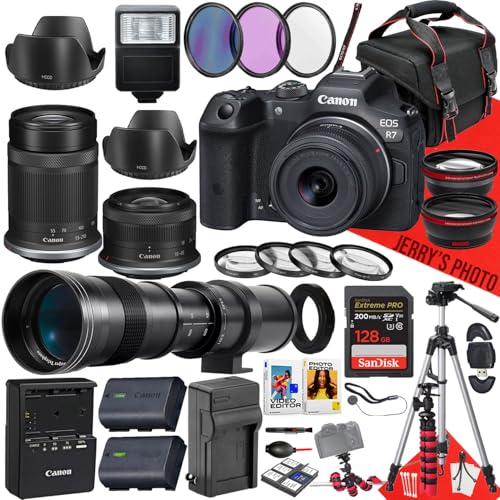
Canon EOS R7 with three-lens bundle — APS-C flagship for 4K60
The R7 is the most complete APS-C camera Canon has made, and its 4K is the proof. At 60 frames per second it oversamples from the full width of its 32.5-megapixel sensor — no additional crop, detail that survives the edit — recording 10-bit colour with Canon Log 3 for those who grade and Canon’s trusted standard colour for those who publish directly. At 30p a dedicated high-quality mode oversamples even more densely. This is flagship video behaviour wearing an APS-C badge, and for sports and wildlife creators the format’s reach multiplies every lens by 1.6 in the bargain.
The bundle leans into that identity: the 18-45mm and 55-210mm zooms cover the everyday and the sideline, and a long 420-800mm telephoto joins them as a bright-day specialist for distant subjects. In-body stabilisation coordinates with the lenses, the autofocus detects people, animals and vehicles with modern confidence, and the stills side — fast bursts, pre-shooting capture, a sensor that resolves detail rival systems envy — makes the R7 the strongest hybrid in this entire guide for a shooter who owes clients both motion and stills.
Two honest cautions complete the verdict. Sustained 4K60 in warm conditions meets Canon’s stated recording limits sooner than a fan-cooled cinema body would, so event shooters should plan shade and airflow; and the dense sensor’s rolling shutter asks for respect during fast pans, particularly at the lower rates. Neither dents the proposition for its tribe. If the R50 is Canon’s invitation, the R7 is its APS-C argument in full.
The R7’s ergonomics deserve the paragraph that spec sheets deny them. A deep grip, a proper joystick, dual dials and a body sealed for weather make it the Canon in this guide most comfortable at a rainy touchline for three hours — which is where its tribe actually works. The electronic viewfinder is bright and detailed enough for manual focus verification, and the vari-angle screen serves the video half without compromising the stills half. Tools disappear into the hand at different rates; the R7 disappears quickly, and at an event that speed is a creative feature.
Its IBIS behaviour in video warrants a specific compliment: Canon’s coordinated system, combining body and lens correction with digital assistance available when wanted, produces walk-and-talk footage that smaller Canon bodies cannot match, and at 4K60 that steadiness is what separates usable sideline B-roll from a tremor study. Owners should still temper the digital layer for serious work — the corners will explain why — but the optical foundation is the strongest in the APS-C class, and the R7’s tribe shoots handheld more than any other.
- Sensor: APS-C, 32.5 megapixels
- 4K: up to 60p oversampled full-width; HQ mode at 30p
- Colour: 10-bit recording with Canon Log 3
- Lenses in bundle: 18-45mm, 55-210mm, 420-800mm telephoto
- Stabilisation: in-body, coordinated with RF lenses
- Autofocus: people, animal and vehicle detection
Strengths
- Oversampled 4K60 without a crop penalty
- Stills and video both at flagship APS-C level
- Bundle covers reach most buyers add later
Trade-offs
- Warm-condition limits on long 4K60 sessions
- Rolling shutter visible in fast pans
- Third bundled lens is bright-light only
Best for: sports, wildlife and event hybrid shooters inside the Canon system.
Not suited for: long-form indoor recordists who need fan-cooled endurance.

Canon EOS R100 with RF-S 18-45mm kit — Stills first, 4K as a bonus
This guide’s honesty policy matters most right here. The R100 records 4K, and the number on the box is not a lie — but the mode is cropped substantially beyond the APS-C format’s usual factor, focuses by contrast detection rather than Canon’s Dual Pixel system, and offers no Canon Log profile. Framed by the kit lens, that crop turns a modest wide angle into a standard view, and moving subjects in 4K will hunt in a way R100 stills never do. A buyer choosing this camera for video headline alone is buying the weakest 4K implementation in this guide, and the review’s duty is to say so in the first paragraph rather than the last.
Now the counterweight, because the R100 is simultaneously the best stills value on this page. The same 24.1-megapixel sensor class as the R50, Dual Pixel autofocus for photography that finds eyes reliably, Canon colour, the RF mount’s future, and a body small enough to be carried daily — as a stills camera with occasional Full HD video, which remains excellent and full-width, it is a thoroughly rational purchase for families and students. Its 4K serves for a static tripod shot of a recital or a product, where the crop can be framed around and the subject stays put.
Buy it, therefore, as what it is: the stills-first entry to the Canon system, with a 4K mode for stationary subjects and a first-rate Full HD mode for everything else. The reader who needs moving 4K should climb one rung to the R50 and spend the difference without a backward glance; the reader whose life is photographs will find the R100’s money better spent on the lens after next. Both decisions are respectable. Only the uninformed one is a mistake.
There is a teaching argument for the R100 that its critics skip. A student given a camera with full manual control, a real sensor and no video crutches worth leaning on learns photography’s fundamentals faster than a student handed a flagship that compensates for every inattention. Photography courses have quietly adopted entry Canons for exactly this reason for decades, and the R100 is the current form of that instrument: honest, limited and instructive. Its limitations even grade the homework — a student who returns with sharp, well-exposed stills from an R100 actually knows something.
The R100 also protects a household budget in a way that compounds. Because its stills ceiling is high and its video ceiling is known, its owner is not tempted into the mid-life upgrade anxiety that afflicts buyers of almost-right video cameras. The money not spent chasing 4K adequacy becomes the lens fund, and a lens bought for the R100 serves every Canon body that follows it. Judged across five years rather than five weeks, the little camera’s economics are more sophisticated than its specification.
- Sensor: APS-C, 24.1 megapixels
- 4K: up to 24/25p, substantially cropped readout
- Autofocus in 4K: contrast detection (Dual Pixel serves stills and HD)
- Log: no Canon Log profile available
- Screen: fixed rear display
- Mount: Canon RF; kit includes RF-S 18-45mm zoom
Strengths
- Excellent stills sensor and eye AF for photography
- Smallest, simplest entry into the RF system
- Full HD video is full-width and dependable
Trade-offs
- 4K crop narrows every lens significantly
- Contrast focusing hunts on moving 4K subjects
- Fixed screen and no log limit video growth
Best for: stills-led families and students who want the Canon system with video as an occasional extra.
Not suited for: anyone buying primarily for 4K video of moving subjects.

Canon EOS R6 Mark II with RF 24-105mm kit — The complete Canon 4K camera
The R6 Mark II is the camera this guide’s ladder leans toward, because it is the Canon that stops asking its owner to choose. Its 24.2-megapixel full-frame sensor records 4K60 oversampled from a 6K readout at full width — detailed, low in rolling shutter artefacts, and recorded in 10-bit colour with Canon Log 3 for grading or Canon’s colour for direct delivery. Pre-recording captures the seconds before the button press, the autofocus detects subjects from horses to aeroplanes, and in-body stabilisation rated among the strongest in the business steadies handheld footage. Where its predecessor generation made headlines for heat, this body manages sustained 4K60 with a composure that restored the line’s professional credibility.
The kit lens is the correct partner: the RF 24-105mm f/4-7.1 covers the working range of most assignments in one barrel, and while its variable aperture leans on the sensor’s excellent high-sensitivity behaviour after dark, that behaviour is precisely what a modern full-frame sensor is for. Stills performance is flagship-adjacent — fast bursts, superb low-light files, dual card slots for professional security — making the R6 Mark II the rare body that a wedding professional can shoot an entire career chapter on without a supporting cast.
Reservations are about appetite rather than ability. The 24.2-megapixel count trails the R5 line for heavy stills cropping; the deepest video features — raw output, the highest frame rates — live further up the range; and the whole proposition sits at a professional position that casual buyers should climb to deliberately. For the Canon shooter whose work is real, though, this is the verdict the rest of the guide has been arranging: the complete 4K camera in the system, bought once and used for everything.
Two R6 Mark II behaviours deserve documentation because owners discover them late and value them most. The first is focus breathing discipline with compatible RF lenses: the body compensates for the framing shift as focus racks, which keeps interview reframing invisible and product shots stable — a cinema courtesy in a hybrid body. The second is its high-frame-rate Full HD mode, which serves slow-motion needs beyond the 4K headline and reminds the buyer that a professional tool is a system of modes, not a single specification. Both are the kind of detail that separates a body designed by a video division from one merely approved by it.
The R6 Mark II’s resale and rental ecology complete the professional case. It is the body second shooters bring, rental houses stock and insurers recognise; accessories, cages and L-brackets exist in depth; and a working photographer can replace one in any major city within a day. None of that appears in a resolution table, and all of it decides whether a camera is a professional instrument or a talented amateur. By that measure the R6 Mark II is the most professional object in this guide, the R5 Mark II’s prose-only ceiling included.
- Sensor: full-frame, 24.2 megapixels
- 4K: up to 60p, oversampled from 6K, full width
- Colour: 10-bit with Canon Log 3
- Stabilisation: in-body, coordinated IS with RF lenses
- Features: pre-recording, dual card slots, deep subject detection
- Kit lens: RF 24-105mm f/4-7.1 IS STM
Strengths
- Oversampled 4K60 with professional heat manners
- Autofocus and stabilisation among the best anywhere
- Stills and video both career-grade
Trade-offs
- Resolution trails the R5 line for cropping
- Kit lens aperture leans on high ISO at dusk
- Professional positioning, professional commitment
Best for: wedding, event and commercial hybrid professionals inside Canon’s system.
Not suited for: casual buyers or stills shooters who crop heavily.

Canon EOS RP with RF 24-105mm kit — Full-frame stills, video footnote
The RP earns its place in a 4K guide partly as a warning label and partly as a stills bargain, and the order of those two duties matters. Its 4K records at up to 24 frames per second from a crop of roughly 1.75x — deeper even than the R100’s — with contrast-based focusing, which converts the bundled 24-105mm kit lens into an effective standard-to-telephoto and discards the wide half of its range. For interviews on a tripod, framed around the crop, the footage is usable and the colour is Canon’s. For anything wider, moving or spontaneous, the mode is a limitation wearing a feature’s clothing, and rival pages that list the RP among 4K recommendations without that sentence are doing their readers a disservice.
The stills camera underneath the warning is genuinely attractive. A 26.2-megapixel full-frame sensor in the lightest body Canon has put around one, an electronic viewfinder, Dual Pixel autofocus for photography, and the same sensible 24-105mm kit lens make the RP the gentlest route into full-frame rendering — the shallow depth, the low-light grace, the look that brings people to the format. Owners who photograph families, travel and portraits and shoot video as an occasional memo own a camera that suits them precisely.
Age frames the purchase: the RP belongs to the first RF generation, with a small battery, a single card slot and video specifications its successors have comprehensively surpassed. Bought at its current position as a full-frame stills instrument with emergency video, it remains coherent. Bought as a 4K camera, it is the one verdict in this guide where we advise the reader, in plain terms, to choose differently — the R50 below its price class in ambition films circles around it.
The RP has developed an unexpected second life that its launch reviewers did not predict: it is the full-frame body photographers buy to convert. Adapted vintage lenses, infrared conversions, dedicated monochrome experiments — the RP’s accessible position and simple, honest sensor make it the chassis for projects that would never be risked on a flagship. A camera that enables a second photographic hobby has a value no mode list captures, and the RP’s light body travels to the strange locations those projects favour.
Even within conventional use, one RP virtue deserves its sentence: its stills files at modest sensitivities have a gentleness that portrait photographers describe with uncharacteristic affection, and its eye autofocus for photography — full Dual Pixel, unlike the 4K mode — is genuinely reliable for family work. The tragedy of the RP is only ever its video marketing. Read as a stills camera with a famous name and a modest video appendix, it has been a fair deal since the day it launched, and time has only improved the arithmetic.
- Sensor: full-frame, 26.2 megapixels
- 4K: up to 24p, heavy crop around 1.75x
- Autofocus in 4K: contrast detection (Dual Pixel for stills/HD)
- Screen: fully articulating touchscreen
- Kit lens: RF 24-105mm f/4-7.1 IS STM
- Build: lightest full-frame body in the range, single slot
Strengths
- Most accessible full-frame stills rendering here
- Light body with a genuinely useful kit lens
- Canon colour and Dual Pixel stills autofocus
Trade-offs
- 4K crop discards the wide half of the kit lens
- Contrast focusing unsuited to moving 4K subjects
- First-generation battery and single-slot limits
Best for: stills photographers wanting full-frame rendering whose video needs are occasional and static.
Not suited for: video-led buyers at any level — see the R50 and R7.
Canon EOS R5 Mark II — Prose-only range ceiling
The R5 Mark II appears without a purchase link because our pool holds no verified listing for it, and it closes the guide by showing where Canon’s 4K story currently ends. A 45-megapixel stacked sensor records 8K raw internally and 4K at up to 120 frames per second with the oversampling and colour depth of the cinema-adjacent tier, while neural-network processing assists everything from autofocus to upscaling. Against that specification, every compromise itemised in the linked reviews above — crops, rates, heat negotiations — is simply absent, replaced by the flagship’s own currencies of cost, media appetite and file sizes that reorganise a workflow.
Its stills specification is the range’s summit as well, which makes it the professional’s single-body answer where the R6 Mark II is the professional’s value answer. The honest distance between them is narrower than the marketing suggests for most assignments: the R6 II’s 4K60 covers the majority of paid work, and the R5 II earns its premium in resolution, frame-rate headroom and raw video specifically. Naming that distance plainly is the service a prose-only entry can perform.
Read it, then, as calibration. A buyer whose brief includes 8K deliverables, heavy cropping or 4K120 slow motion has found their Canon and should budget for its ecosystem of fast media and storage. Everyone else has been shown, by contrast, how much of the flagship’s real-world 4K the R6 Mark II and R7 already deliver — which is, in the end, the most useful thing a ceiling can tell the people shopping beneath it.
The R5 Mark II’s presence also disciplines the used market beneath it, which benefits this guide’s readers indirectly. Each flagship generation pushes the previous professional bodies toward the positions the R6 Mark II now occupies, and Canon’s mount continuity means those bodies arrive with their lens ecosystems intact. A patient buyer watching the ladder over two generations can assemble a professional 4K kit for the price of one new flagship — a strategy the R5 Mark II’s existence makes possible and its specification makes tempting to skip. Both reactions are rational; the guide merely notes that the ceiling, by existing, furnishes the rooms below it.
For the working minority who do buy it, the deciding features are usually unglamorous: the pre-continuous stills capture that rescues the unreactable instant, the eye-control autofocus inherited from the R3 line, the cooling grip accessory that extends 8K sessions. Flagships are bought on such specifics, not on their headlines, and the R5 Mark II’s specifics are unusually well aimed at the hybrid professional. It closes this guide as it closes Canon’s range — as the answer to briefs the other five cameras were never pretending to address.
- Sensor: full-frame stacked, 45 megapixels
- Video: 8K raw internal; 4K up to 120p
- Colour: 10-bit and raw workflows with Canon Log options
- Autofocus: flagship subject detection with eye control
- Media: CFexpress plus SD, high-speed workflow
- Status: prose-only — no verified listing in pool
Strengths
- The range’s complete video and stills ceiling
- Raw recording and 4K120 headroom
- Flagship build, speed and detection systems
Trade-offs
- Media, storage and cost ecosystems are professional-grade
- Specification exceeds most assignments honestly
- No verified listing in our pool to link
Best for: professionals whose deliverables genuinely include 8K, raw or 4K120.
Not suited for: buyers whose work the R6 Mark II already covers completely.
How do the best 4k cameras canon makes compare mode by mode?
Every figure below describes the 4K mode as implemented — width, rate, focusing and log — because within one brand those four variables are the entire argument.
| Model | Sensor / Format | Headline capability | Watch out for |
|---|---|---|---|
| EOS R50 bundle | Oversampled, full width | 4K30 ceiling | Dual Pixel AF; no log |
| EOS R7 bundle | Oversampled, full width | 4K60, 10-bit | Dual Pixel AF; C-Log3 |
| EOS R100 kit | Cropped readout | 4K24/25 | Contrast AF in 4K; no log |
| EOS R6 Mark II kit | Oversampled, full width | 4K60, 10-bit | Dual Pixel AF; C-Log3 |
| EOS RP kit | Heavy crop ~1.75x | 4K24 | Contrast AF in 4K; limited profiles |
| EOS R5 Mark II (prose) | Oversampled, 8K raw | 4K120 | Flagship AF and log suite |
Why does oversampling matter more than the 4K label?
Two cameras can both record a 3840 × 2160 file and produce images a world apart, because the question is how much scene information was gathered to build each pixel. An oversampled readout captures far more than 4K — six or seven thousand pixels across — and averages that wealth down, which suppresses aliasing shimmer on fine patterns, lowers noise and renders detail with a calmness that pixel-counting never describes. A cropped or line-skipped readout gathers barely enough, or gathers it dishonestly, and the resulting file carries the full resolution number with a fraction of the authority.
This is why the R50, R7 and R6 Mark II verdicts in this guide read so differently from the R100 and RP verdicts despite all five wearing the same badge. Oversampling is the dividing line between 4K as a capture format and 4K as a container. Buyers comparing any cameras — Canon or otherwise — should ask the oversampling question before every other, because it predicts the footage’s character more reliably than the sensor size printed beside it.
What does a 4K crop actually do to your lenses?
A crop discards the edges of the image circle, which is the same as fitting a longer lens: multiply every focal length by the crop factor to learn what the camera will actually frame. On the R100’s 4K mode the kit zoom’s wide end stops being wide, so interiors and groups overflow the frame; on the RP’s roughly 1.75x crop the bundled 24-105mm behaves like a standard-to-long lens and the wide half of its range — the half travel photographers live on — simply vanishes in video mode. Depth of field deepens equivalently, softening the background separation the buyer may have chosen the camera to obtain.
Crops are not automatically disqualifying: wildlife videographers sometimes welcome the reach, and a static interview can be framed around any factor. The sin is only in the surprise. A buyer who knows the number can plan lenses around it — an ultra-wide for the cropped mode is a legitimate strategy — while a buyer who discovers it at the first family gathering owns a grievance instead of a camera. Hence this guide’s insistence on printing the crop in the specification box, where it belongs, rather than in a footnote.
Which Canon 4K camera suits each kind of shooter?
Map the ladder to the life, not the ambition. The channel creator filming themselves at a desk lives on the R50: flip screen, eye autofocus, oversampled quality, no wasted specification. The hybrid professional shooting weddings and commercial work belongs on the R6 Mark II, whose dual slots, heat manners and full-frame rendering are occupational requirements rather than luxuries. The sports and wildlife shooter takes the R7 and its reach, accepting APS-C as the advantage it is at the sideline.
The stills-led households split by format loyalty: the R100 for the Canon system at its most accessible, the RP for full-frame rendering with video as a memo. And the R5 Mark II waits for the small, real constituency whose deliverables name its features. Notice what the map never does: it never recommends a camera for a mode its review had to apologise for. That discipline, applied to any brand’s range, is worth more than the specific verdicts.
How does Canon Log change the buying decision?
Canon Log records a deliberately flat, low-contrast image that preserves highlight and shadow information for grading, at the cost of footage that looks unfinished until it is processed. Its presence divides this guide’s cameras by intent: the R7 and R6 Mark II offer C-Log3 for creators who grade; the R50 omits log and polishes its standard profiles for creators who publish; the R100 and RP omit it in their cropped modes entirely. None of those positions is wrong, but they are not interchangeable, and a buyer who discovers a taste for grading six months after choosing a log-less body has met a ceiling that money, not skill, must remove.
The pragmatic test is behavioural. If your current workflow already includes colour correction — if you shoot raw stills and enjoy the developing — log will feel like home and belongs on your required list. If your videos go from card to publication with a title and a prayer, Canon’s standard colour is not the lesser choice but the correct one, and the R50’s omission is a feature aimed at you. Buy for the workflow you have, with one rung of headroom for the one you are visibly growing toward.
What should EF lens owners know before choosing an RF body for 4K?
Canon’s EF-to-RF adapter is the quiet hero of this entire guide: decades of EF and EF-S glass mount on every body here with autofocus and stabilisation behaviour essentially intact, which converts an existing lens cabinet into a reason to stay with Canon and a discount on the new body. Video shooters should know the adapter adds a small length and that focus-by-wire EF lenses behave as they always did — the adapter translates mounts, not personalities — but the economic fact dominates: a Canon loyalist’s second lens for any of these cameras may already be on their shelf.
Two cautions keep the advice honest. The cropped 4K modes multiply adapted lenses exactly as they multiply native ones, so the R100 and RP warnings apply with full force to an adapted wide-angle. And the control-ring and filter variants of the adapter, while attractive, are optional refinements; the plain adapter preserves the value argument. For the reader with EF glass and a 4K ambition, the ladder’s correct first rung is usually the R50 or R7 plus an adapter — a conclusion no lens-less comparison table would ever reach.
How long will a Canon 4K body stay current?
Longer than the upgrade cycle wants you to believe, because 4K delivery standards move slowly and the oversampled bodies here already exceed what most platforms publish. The realistic obsolescence is not resolution but workflow: codecs, connectivity and autofocus expectations drift, and a body with log, 10-bit recording and modern detection — the R7 and R6 Mark II profile — carries years of headroom in all three. The cropped entry models date faster precisely because their video was a compromise at birth.
Protect the purchase with the boring virtues: dual-slot bodies for paid work, firmware kept current, batteries rotated rather than exhausted. A Canon bought at the right rung in 4K terms will be retired by its owner’s ambitions, not by its specification — and by then the mount, the lenses and the habits all transfer upward, which is the deepest argument for choosing the rung carefully now.
There is a final, unfashionable longevity factor: service. Canon’s service network and parts pipeline for current RF bodies are the deepest in the industry alongside one rival, and a body that can be repaired economically in year six is a different purchase from one that cannot. Professionals price that in without thinking; families discover it the first time a shutter or a screen fails out of warranty. The ladder’s upper rungs carry the strongest service stories, which is one more reason paid work belongs on them.
What does 10-bit recording change for a Canon shooter?
Bit depth decides how rudely footage can be treated in the edit. An 8-bit file bands in skies and breaks in shadows when a grade pushes it; a 10-bit file, with sixty-four times the tonal steps, absorbs correction with grace — which is why the R7 and R6 Mark II pair their 10-bit recording with Canon Log 3, and why the absence of both on the cropped models matters beyond spec-sheet pride. For the creator who publishes from the card, 10-bit is invisible. For the creator who grades, it is the difference between a look and an apology.
The storage and computer costs are real but modest by current standards, and they scale with ambition rather than with the camera: the same R6 Mark II that records production-grade 10-bit for a client on Tuesday records efficient standard files for a family Saturday. That elasticity — professional depth on demand, simplicity by default — is the mature form of the hybrid idea, and it is the quality the top of this guide’s ladder is actually selling.
How should you audition a Canon body before committing to the system?
Shoot the audition your life will repeat, not the one that flatters cameras. For most readers that means twenty minutes: a face by a window in mixed light, a moving child or dog across a room, a dim interior at the sensitivity you will actually use, and one minute of 4K at the rate you intend to publish, framed with the lens you intend to own. Review everything at full size on the largest screen you have. The bodies in this guide separate themselves quickly under that ordinary cruelty — autofocus habits, colour temperament, the truth about a crop — in ways no specification table survives.
Bring the memory card home and live with the files for a day before deciding. Colour preferences are personal and durable; the Canon rendering that delights one household leaves another cold, and both reactions are data. A system purchase is a decade of such files. The hour spent auditioning is the cheapest research in photography, and the dealers and rental houses who facilitate it earn the loyalty they receive.
How do Canon’s colour profiles change what you should buy?
Canon sells colour as much as hardware, and its two audiences want opposite things from it. The publish-direct audience wants the standard profile’s skin tones, its gentle contrast and its refusal to embarrass anyone under mixed lighting — the R50’s entire design serves them, and serving them well is not a lesser ambition. The grading audience wants the flattest, widest capture the sensor allows, accepting footage that looks like dishwater until it is developed — C-Log3 on the R7 and R6 Mark II is theirs. A buyer who misidentifies their audience buys the wrong camera even inside the right model line, because the profile menu is where the two workflows divide.
The encouraging news is that Canon’s standard colour has become good enough to narrow the practical gap for most published work. Skin under the standard profile survives compression and platform re-encoding with a grace that log footage, badly graded, does not. The honest hierarchy is therefore: log for those who grade deliberately, standard for everyone else, and no shame attached to either — only to choosing by fashion rather than by workflow.
What mistakes do Canon 4K buyers make most often?
Reading the 4K badge as a uniform promise is the mistake this entire guide exists to prevent. Inside one brand, one badge covers oversampled excellence and a 1.75x crop with contrast focusing. The model-level facts — width, rate, focusing system, log — are the product; the badge is the packaging.
Assuming Dual Pixel autofocus works in every mode comes second. Canon’s famous focusing serves stills and HD on the R100 and RP but steps aside in their 4K modes, and buyers who film moving children with those settings meet a hunting lens and a ruined recital. Check the focusing system at the rate you will actually use.
Third, stills photographers buy the RP for full-frame video dreams its crop cannot fulfil, while video creators buy the R100 for a price and discover the ceiling in a month. Both errors are the same error — buying the badge over the brief — wearing different clothes.
Finally, owners neglect the adapter economics in both directions: EF veterans overpay for duplicate RF glass they do not yet need, while new buyers dismiss the vast, affordable EF back-catalogue that the adapter unlocks. The mount is a library; read the catalogue before spending.
Fifth, buyers audition cameras with the lens they wish they owned rather than the lens in the box. Kit zooms decide the first year of footage for most households, and a body that only sings with a fast prime is a two-purchase commitment disguised as one. Judge the kit as it ships; upgrade paths are for later budgets.
Sixth, do not let a stills specification smuggle a video decision past you. Megapixel counts and burst rates headline most product pages, yet a wedding stills triumph and a 4K disappointment can share one body — the RP is the standing example. Read the video column of the specification as if it were the only column, once, before buying any hybrid.
Final Recommendation
The ladder resolves cleanly. The R6 Mark II is Canon’s complete 4K camera and this guide’s headline recommendation for anyone whose work is paid or precious; the R7 delivers most of its video virtue with APS-C reach for the sport and wildlife tribe; and the R50 is the rung most new creators should actually buy, because its oversampled 4K30 with living autofocus answers the brief they truly have.
Below those three, buy with the warnings attached and the cameras become bargains rather than traps: the R100 as a stills camera with a stationary-subject 4K extra, the RP as full-frame stills with a video footnote. Above them, the R5 Mark II waits for the few whose deliverables speak its language. Canon’s range rewards the buyer who reads modes instead of badges — and a range that contains both the R50’s honesty and the R6 Mark II’s completeness has earned the loyalty it asks for, one truthful rung at a time.
One closing counsel for the Canon loyalist standing at the foot of the ladder: the mount is the marriage, the body is the chapter. Choose the body whose 4K implementation matches the work in front of you this year, keep the lenses forever, and let the next chapter arrive when the work — not the catalogue — asks for it.
Frequently Asked Questions
Which Canon camera has the best 4K video overall?
The R6 Mark II among the linked cameras — oversampled full-width 4K60 in 10-bit with C-Log3, strong heat manners and flagship autofocus. The prose-only R5 Mark II exceeds it with 8K raw and 4K120, at a professional cost in money and media. For most buyers the practical distance between the two is smaller than the specification distance, which is precisely why the R6 model anchors this guide.
Is the Canon R100 good for 4K video?
Only for stationary subjects. Its 4K mode is cropped, focuses by contrast detection and lacks Canon Log, so moving subjects hunt and wide lenses narrow. Its Full HD is full-width and good, and as a stills camera it is excellent value — buy it for those, not for 4K. Think of its 4K as a tripod mode for ceremonies and products, and its reputation becomes fair again.
How bad is the EOS RP’s 4K crop in practice?
Roughly 1.75x, which turns the kit 24-105mm into an effective standard-to-telephoto range and removes wide-angle video entirely. A tripod interview framed around the crop looks fine; spontaneous, wide or moving 4K does not. The R50 films far better for less ambition. Owners who frame with the crop in mind — standing further back, choosing the lens for the effective range — extract honest service from it; owners who discover it mid-shoot do not.
Does the R50 shoot 4K60?
No — its ceiling is oversampled 4K30, executed very well. Buyers who need 60p inside Canon should step to the R7 for APS-C or the R6 Mark II for full-frame, both of which oversample the rate at full width.
Can I use my old EF lenses on these cameras?
Yes, with Canon’s EF-to-RF adapter, with autofocus and stabilisation essentially intact. Remember that cropped 4K modes multiply adapted lenses just as they do native ones, so wide EF glass on an R100 or RP still narrows in 4K. The adapter is inexpensive beside any lens it rescues, which is why it is so often the highest-value line in a Canon upgrader’s basket.
Which Canon should a wedding videographer choose?
The R6 Mark II: dual card slots for security, dependable 4K60, low-light full-frame rendering and autofocus that holds through a ceremony. The R7 serves as a strong second body for reach at the reception; the cropped models should not be entrusted with the day.
Should a Canon shooter who mainly films family events choose 4K or 1080p?
For most family filming, the honest answer is whichever mode the camera does best rather than the bigger number. On the R50 and R7, 4K is oversampled, cool-running and clearly sharper — choose it freely. On the R100 and EOS RP, the cropped 4K narrows your lenses and softens the result, while their 1080p modes are clean, light and easy; a grandparent’s birthday filmed in good 1080p will look better in ten years than the same afternoon squeezed through a compromised 4K pipeline.
Related Guides
Continue with the neighbouring frame-rate and format guides to place Canon’s ladder in context. Best 4K 60fps cameras Best 24p cameras for film cadence Best 24 megapixel digital cameras
Related guides
- Best AC Powered Wireless Security Cameras: Wi-Fi Data, Mains Power, Zero Sleep
- Best Canon Point and Shoot Digital Cameras: PowerShot Picks From Pocket Compacts to Travel Zooms
- Best Balancing Stabilizers for Mirrorless Cameras: Payload, Balancing and Native Vertical Shooting
- Best 1080p IP Cameras: PoE Domes, Turrets, Bullets and a PTZ That Earn Their Cable


