What's inside
- Where to buy
- Key Takeaways
- Quick Picks
- How did we choose these 4K video cameras?
- How do the six compare where 4K gets difficult?
- Which of the best 4 k video cameras matches the films you actually make?
- How do you set up a 4K camera for a reliable shoot?
- What separates a 4K camera from a camera that shoots 4K?
- What does a real shoot day reveal that spec sheets hide?
- How should a beginner grow a 4K kit over the first year?
- How do these cameras divide a working week of filming?
- What separates footage that gets watched from footage that gets filed?
- A note on renting, borrowing and the honest test
- Slating takes like a documentary crew
- What do 4K camera buyers most often get wrong?
- Final Recommendation
- Frequently Asked Questions
- Related Guides
As an Amazon Associate I earn from qualifying purchases. This post may contain affiliate links at no extra cost to you.
gizmoverdict.com is reader-supported. When you buy through links on our site, we may earn an affiliate commission.
Where to buy
All six of the best 4 k video cameras below are sold through Amazon’s US store, but the boxes differ in ways that change the real purchase: two listings are bundles with lenses included, three are body-only or kit variants where your existing glass decides readiness, and one pairs a cinema body with a fast zoom as a working kit. Each review states what arrives in the carton, because a body without a lens records nothing, however impressive its video menu.
Finding the best 4 k video cameras used to mean choosing between a camcorder and a compromise. The six mirrorless bodies in this guide mark how completely that era ended: every one of them records 4K footage that would flatter a broadcast documentary, yet they split sharply on the questions that decide real shoots. How long before heat calls a halt? How badly does the image jelly when you pan? Does the 4K mode crop your lens into a different focal length? This guide is organised around those honest limits, because a camera’s best 4K mode is a brochure and its worst 4K behaviour is your footage.
The field spans three sensor sizes and three philosophies. Canon’s R50 and R7 serve creators and hybrid shooters inside the RF system, at APS-C sizes friendly to family budgets. Sony answers with the a6700 for stills-led hybrids and the full-frame ZV-E1 for video-first creators, then raises the stakes with the FX30, a true cinema body wearing a Sigma zoom in this listing. Panasonic’s GH6 stands as the Micro Four Thirds endurance specialist, the camera that treats recording limits as a personal insult. All six shoot stills well; all six are judged here as video cameras first.
One scope note: this guide covers general-purpose 4K shooting — family films, channels, events, short documentaries — rather than the specialist cinema and 10-bit grading territory our companion coverage explores. Where a body here also does serious colour work, we say so, but the ranking rewards the complete filming experience: autofocus you can trust with a toddler, stabilisation that saves a walk-and-talk, and thermals that survive a wedding ceremony in July.
Key Takeaways
- Canon’s EOS R50 is the friendliest start: oversampled 4K to 30p, subject-detect autofocus and a flip screen, in a bundle that films on day one.
- Sony’s a6700 is the hybrid athlete — 4K at 60p across the full sensor width and 120p with a crop — though fast pans expose its rolling shutter.
- The full-frame ZV-E1 makes the prettiest 4K here and focuses like a mind-reader, but its single card slot and heat limits mark it as a creator tool, not an event tank.
- Panasonic’s GH6 is the endurance champion: fan-cooled, effectively unlimited 4:2:2 10-bit recording, and stabilisation that embarrasses gimbals.
- Sony’s FX30 bundle is the cinema route — Super 35 sensor, cooling fan, tally lamps and a fast Sigma zoom — for shooters building a rig and a workflow.
- Canon’s EOS R7 brings dual slots and 4K 60p to wildlife and sports hybrids, with a crop in its fastest modes that reach-hungry shooters may call a feature.
Quick Picks
| Pick | Badge | Why it earns its place |
|---|---|---|
| Canon EOS R50 with 18-45mm Bundle | Best for new creators | Oversampled 4K, Canon colour and autofocus that finds faces before you do — the gentlest serious start in this guide. |
| Sony Alpha a6700 | Best hybrid all-rounder | 4K 60p across the full width, 120p for drama, AI-driven autofocus — the stills-and-video athlete of the APS-C world. |
| Sony ZV-E1 | Best image quality for creators | The a7S-lineage full-frame sensor in a creator body: peerless low-light 4K, cinematic blur, automation that frames you. |
| Panasonic LUMIX GH6 | Best for long-form recording | Fan-cooled and effectively unlimited in 4:2:2 10-bit, with stabilisation that walks like a gimbal — the marathon runner. |
| Sony FX30 with Sigma 18-50mm f/2.8 | Best cinema starter kit | A true cinema body — fan, tally lamps, timecode path — bundled with a fast constant-aperture zoom, ready to rig and roll. |
| Canon EOS R7 with Lens Bundle | Best for sports and wildlife video | Dual slots, IBIS and 4K 60p in Canon’s APS-C flagship — and this bundle’s telephoto reach turns it toward the field. |
How did we choose these 4K video cameras?
Every camera here had to clear the same bar: genuine 4K recording from a large interchangeable-lens sensor, with autofocus a solo shooter can trust. Pure camcorders and action cameras live in their own guides; this one serves readers choosing a system camera whose lenses, stills and video grow together. Within that bar, we scored the four horsemen of real-world 4K: crop behaviour, rolling shutter, thermal stamina and colour depth. A camera could forgive one weakness; none of the six forgives none, and each review names its horse plainly.
Crop behaviour deserved its own column because it changes the lens you thought you owned. A body that crops at 4K 60p turns a wide vlogging zoom into a standard lens at exactly the moment you wanted width, so the reviews state which modes are full-width and which are not. Rolling shutter — the skew that leans buildings during fast pans — scales with sensor readout speed, and it separates these bodies more honestly than resolution figures do. Thermal stamina separates them further still: fan-cooled designs record until the card fills, while compact sealed bodies manage heat by ending your take, politely, at the ceremony’s climax if you push the highest modes in hot rooms.
We also weighed the ecosystem tax. A 4K body commits you to lenses, and the RF, E and Micro Four Thirds shelves differ in video-friendly glass — quiet focusing motors, minimal focus breathing, stabilisation that cooperates with the body. Bundles were judged as purchases, not bodies: the FX30’s Sigma zoom and the R50’s kit lens change what each box can film on its first evening, and the scores reflect the box, not the brochure.

Canon EOS R50 with 18-45mm Bundle — Best for new creators
The R50 understands its owner: one person, no crew, filming themselves and their family with a camera that must never become the story. Its headline 4K mode samples the full sensor width down from 6K, so footage at 30p carries a crispness that survives a television screen, and Canon’s colour — especially skin tones under kitchen lighting — flatters without a colourist. The autofocus detects people, animals and vehicles and holds eyes through the chaos of a birthday party, while the vari-angle screen flips forward for the presenter pieces that anchor a young channel. This bundle includes the 18-45mm kit zoom, so the box films immediately.
Now the honest limits, stated the way a friend would. There is no 4K 60p at any setting, so slow-motion fans must drop to Full HD for smooth half-speed work. Rolling shutter is present in fast pans — whip the camera across a room and verticals lean — though at the walking pace of family filming it stays invisible. Heat is the third limit: the compact sealed body manages long 4K sessions in warm rooms less gracefully than the fan-cooled bodies here, so ceremony-length continuous recording in summer deserves a rehearsal before the real day. None of these flaws ambush the R50’s intended owner; all of them matter to the owner it is not for.
As a stills camera it moonlights happily with a 24.2-megapixel sensor, and the RF mount gives it a growth path through Canon’s expanding lens shelf. The single card slot and modest weather resistance mark its tier clearly. Judged as the first serious 4K camera for a family documentarian or a new creator, though, the R50’s balance of kindness and capability is the most persuasive in this guide — it is the camera least likely to be abandoned in a drawer by March.
One more R50 virtue emerges over months rather than minutes: its stills are good enough that the family archive does not split into ‘camera photos’ and ‘phone photos’ eras. The same body that filmed the school concert photographs the weekend walk at 24.2 megapixels with colours grandparents describe as ‘how it actually looked’. Canon’s phone app moves both kinds of file to a handset without ceremony, which matters more to real households than any menu depth. If the R50 has a philosophy, it is that the best camera is the one at the birthday — and its size, price and manners conspire to make sure it is.
- Sensor: 24.2MP APS-C
- Video: 4K to 30p oversampled; no 4K 60p
- Stabilisation: lens-based; digital option for video
- Screen: vari-angle touchscreen
- Card slots: single SD
- In the box: body with RF-S 18-45mm kit zoom
Strengths
- Oversampled 4K and Canon colour flatter people effortlessly
- Subject-detect autofocus suits solo and family filming
- Bundle films on day one with lens included
Trade-offs
- No 4K 60p; slow motion means dropping to Full HD
- Rolling shutter shows in fast pans
- Sealed compact body has the least thermal headroom here
Best for: new creators and family filmmakers filming people at conversational pace.
Not suited for: slow-motion specialists, or anyone recording hour-long ceremonies in hot venues.

Sony Alpha a6700 — Best hybrid all-rounder
The a6700 is Sony’s argument that one APS-C body can headline both a photography portfolio and a video channel. Its 4K recording at 60 frames per second uses the full sensor width, oversampled from 6K, so wide lenses stay wide at the frame rate sports and travel shooters actually want. Step to 120p for slow motion and a crop arrives — the standard bargain — but the mode exists, records in 10-bit colour, and turns a skateboard session or a dog’s beach sprint into cinema. Log profiles with LUT preview support shooters who grade; picture profiles serve those who would rather not.
Autofocus is this camera’s party trick and its practical core. Sony’s AI processing unit recognises people by body and head when eyes vanish, tracks animals, birds, vehicles and insects, and holds focus through occlusions that would send lesser systems hunting. For a solo shooter filming a moving subject, that reliability is worth more than any resolution figure. The rolling shutter is the counterweight: the sensor’s readout is not fast enough to keep architecture honest during whip pans, and action shooters will see skew in aggressive moves. Film at sane pan speeds and it never enters the conversation; chase motocross with violent tracking and it will.
The body is a stills camera’s body — proper viewfinder, deep grip, dual dials — which hybrid shooters prefer and pure video shooters tolerate. A single card slot and a fanless design set its event limits: long 4K 60p sessions in heat need the same rehearsal honesty as the R50. But as the one camera for a photographer who films seriously, or a filmmaker who photographs seriously, the a6700’s combination of modes, focus and the enormous E-mount lens shelf makes it the most complete hybrid in this guide.
Editors add a footnote in the a6700’s favour: its 10-bit files grade with a flexibility that survives mixed lighting, the wedding videographer’s tax, and its S-Log3 pipeline matches Sony’s larger bodies closely enough to serve as a second camera on professional shoots. That B-camera career is a real ownership path — the body you learn on becomes the locked-off wide shot when your work grows a budget. The camera’s compactness hides this ambition; rigged with a cage, monitor and microphone it scales, and stripped to a pancake lens it holidays. Few bodies in this guide span that range without changing personality, and the a6700’s owners tend to keep it through several upgrades of everything else.
- Sensor: 26MP APS-C BSI
- Video: 4K 60p full-width; 4K 120p cropped; 10-bit
- Stabilisation: 5-axis in-body
- Autofocus: AI subject recognition
- Card slots: single SD/CFexpress combo
- Mount: Sony E
Strengths
- Full-width 4K 60p keeps wide lenses honest
- AI autofocus tracking leads the class for moving subjects
- 10-bit log with LUT preview serves graders and beginners alike
Trade-offs
- Rolling shutter leans verticals in fast pans
- Single card slot limits paid redundancy
- Fanless body needs thermal respect at 4K 60p in heat
Best for: hybrid shooters splitting their weekends between stills and serious video.
Not suited for: ceremony videographers needing dual slots and guaranteed hour-long takes.
Sony ZV-E1 — Best image quality for creators
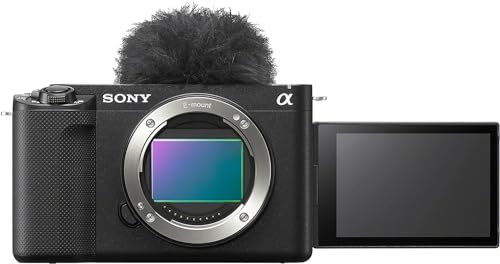
The ZV-E1 takes the most video-devoted sensor Sony makes — the 12.1-megapixel full-frame chip from the a7S III, whose enormous pixels sip light — and wraps it in a body designed for people who film themselves. The 4K it produces at up to 60p has a look the APS-C cameras here cannot imitate: shallow depth of field that separates a presenter from a bookshelf, low-light footage that stays clean in restaurants and evening streets, and dynamic range that holds a window and a face in the same frame. Creator automation piles on: product showcase focus, breathing compensation with supported lenses, and an AI framing mode that crops and follows like a patient cameraman.
The sacrifices were chosen deliberately and should be chosen by you the same way. There is no viewfinder, because its owner films from the flip screen. There is one card slot, because its owner’s footage is a vlog, not a wedding contract. The compact body manages heat actively but not infinitely: sustained 4K 60p in warm conditions is the mode most likely to meet a thermal shutdown, and the camera rewards shooters who work in takes rather than unbroken hours. Its twelve megapixels make it the weakest stills camera here by count, though the files themselves are lovely within that count.
Understand the ZV-E1 as a lens into a specific life: the established creator filming talking-head, travel and lifestyle content who wants the full-frame look without a cinema rig’s ceremony. For that reader it is not a compromise at all — it is the most direct route in this guide to footage that looks expensive. For the event professional or the stills-led hybrid, its omissions are structural, and the a6700 or FX30 will serve better.
ZV-E1 ownership has a distinctive texture: it is the camera creators reach for when the alternative is not filming at all. Its size invites the café, the train and the evening street where a rig would invite attention instead, and its automation forgives the divided attention of a presenter who is simultaneously talent, director and crew. The firmware’s addition of higher frame-rate modes after launch extended that invitation to slow-motion work. What owners budget for, knowingly, is media and power — full-frame 4K at its best modes eats both — and a small cage or grip for longer handheld days. Judge it as a specialist that knows its specialism completely.
- Sensor: 12.1MP full-frame BSI
- Video: 4K to 60p; higher via firmware modes
- Stabilisation: 5-axis in-body plus dynamic mode
- Viewfinder: none — screen only
- Card slots: single SD/CFexpress combo
- Extras: AI framing, product showcase focus
Strengths
- Full-frame low-light 4K quality leads this guide
- Creator automation genuinely replaces a camera operator
- Smallest full-frame body here for travel filming
Trade-offs
- Single card slot and no viewfinder limit professional briefs
- Sustained 4K 60p in heat meets thermal limits
- Twelve megapixels cap stills ambitions
Best for: established creators filming themselves in available light.
Not suited for: wedding videographers, stills-first hybrids, or viewfinder devotees.

Panasonic LUMIX GH6 — Best for long-form recording
Ask the GH6’s owners what sold them and most give the same answer: it does not stop. Panasonic fitted an active cooling fan — heresy to stills purists, gospel to videographers — and the result is 4K and Cinema 4K recording in 4:2:2 10-bit colour that runs until the card or the battery gives out, in heat that sends sealed bodies into thermal retirement. For interviews, ceremonies, theatre, podcasts and any shoot where ‘the camera stopped’ is a firing offence, that stamina is not a specification. It is the product. Internal ProRes recording on the fast card slot removes transcoding from the edit as well.
The image machinery behind the stamina is equally serious. The 25.2-megapixel Micro Four Thirds sensor records 5.7K modes above the 4K brief, high frame rates for slow motion, and anamorphic formats for cinema glass. Stabilisation is the system’s legend: body and lens systems cooperate to produce walking shots smooth enough that gimbal salesmen change the subject. Autofocus is the honest weakness — Panasonic’s contrast-based system of this generation is sure-footed for interviews and deliberate work, but it lacks the phase-detect subject sorcery of the Sony and Canon rivals, and fast, erratic subjects expose it.
The Micro Four Thirds format frames the whole bargain. Its smaller sensor gathers less light per frame than the full-frame ZV-E1 and asks more of high-ISO settings, while returning compact lenses, deep depth of field that keeps a roomful of speakers sharp, and a total kit weight a documentary shooter can carry all day. For long-form, controlled and professional video — the interview chair, the stage, the ceremony — the GH6 is the most trustworthy tool in this guide, and the one its rivals’ owners quietly envy at hour two of a hot shoot.
The GH6’s depth shows in features its rivals treat as firmware wishes: waveform and vectorscope monitoring built in, four-channel audio options with the accessory unit, shutter-angle control, and timecode that behaves like a broadcast department’s. Documentary editors love its file organisation as much as its images. The fan, so often discussed, is in practice inaudible in any room with a subject in it, and owners report forgetting it exists until a rival camera stops mid-interview and reminds them. Micro Four Thirds lens economics complete the case — the fast zooms this camera deserves cost and weigh a fraction of full-frame equivalents, which is why one-person documentary crews adopt it as a system, not a stopgap.
- Sensor: 25.2MP Micro Four Thirds
- Video: C4K/4K 4:2:2 10-bit, effectively unlimited
- Cooling: active fan
- Stabilisation: body plus lens, class-leading
- Recording: internal ProRes to CFexpress
- Autofocus: contrast-based DFD system
Strengths
- Fan cooling removes thermal limits from long shoots
- Internal ProRes and 4:2:2 10-bit streamline professional edits
- Stabilisation produces gimbal-like walking footage
Trade-offs
- Autofocus trails phase-detect rivals on erratic subjects
- Smaller sensor concedes low-light ground to full-frame
- Fan and pro build make it the chunkiest body here
Best for: interviews, ceremonies, theatre and podcasts — long takes in warm rooms.
Not suited for: run-and-gun shooters chasing unpredictable action autofocus.

Sony FX30 with Sigma 18-50mm f/2.8 — Best cinema starter kit
The FX30 is not a stills camera with video features; it is a small cinema camera that happens to share a mount with them, and this listing’s bundle with Sigma’s 18-50mm f/2.8 zoom makes it a production kit rather than a body awaiting decisions. The cinema identity shows everywhere: an active cooling fan for unlimited takes, tally lamps so talent knows when you are rolling, a body threaded with mounting points for handles and monitors, timecode synchronisation for multi-camera shoots, and menus organised around frame rates, shutter angle and LUTs rather than scene modes. Its Super 35 — APS-C-format — sensor records 4K at up to 60p in 10-bit 4:2:2, with 120p available cropped for slow motion.
The Sigma zoom deserves its own paragraph because bundle lenses are usually the apology; this one is the argument. A constant f/2.8 across the 18-50mm range covers documentary wides and interview close-ups at an aperture that works in real rooms, focuses quietly, and stays compact enough for gimbal work. Paired with the FX30’s dual-base-ISO sensor — which keeps low-light footage clean at two sensitivity plateaus — the kit films an evening event without a lighting truck. Rolling shutter exists, as on every body here without a stacked sensor, and the fastest modes crop; cinema shooters plan around both as a matter of craft.
What the FX30 will not do is be your family stills camera: it has no viewfinder, no mechanical shutter and no interest in burst photography. It is the pick for the reader whose ambition has a direction — short films, client video, a channel growing into production — and who wants the camera to teach professional habits: external audio through the optional handle, monitoring with LUTs, footage logged like a grown-up shoot. As the first rung of Sony’s Cinema Line, it also rents its owner a future: the lenses, media and skills transfer upward.
A production habit the FX30 teaches early is worth naming: because it exposes like a cinema camera — shutter angle, base ISO discipline, LUT-previewed monitoring — its owners learn transferable craft faster than hybrid shooters do. The footage slots beside Sony’s larger cinema bodies convincingly enough that rental houses see FX30s hired as B-cameras, which tells a beginner exactly where the ceiling of their purchase sits. The Sigma zoom’s focus breathing is well controlled for video, and its size keeps a gimbal payload sane. Add the optional handle when client work arrives and the audio path becomes fully professional; until then, the body’s mini-jack and shoe-mounted options cover the apprentice years honourably.
- Sensor: Super 35 (APS-C format), dual base ISO
- Video: 4K 60p 10-bit 4:2:2; 120p cropped
- Cooling: active fan, unlimited takes
- Audio: pro inputs via optional top handle
- In the box: body with Sigma 18-50mm f/2.8 zoom
- Stills: minimal — no EVF or mechanical shutter
Strengths
- Cinema ergonomics: fan, tally lamps, mounting points, timecode
- Bundled constant f/2.8 zoom is a genuine working lens
- Dual base ISO keeps evening footage clean
Trade-offs
- Not a stills camera in any meaningful sense
- Pro audio path wants the optional handle investment
- Fastest frame rates arrive with a crop
Best for: aspiring filmmakers and client videographers building a real rig.
Not suited for: families wanting one camera for photos and films alike.
Canon EOS R7 with Lens Bundle — Best for sports and wildlife video
The R7 is Canon’s APS-C flagship, and its video specification reflects the subjects its owners chase. It records 4K at up to 60p — with a crop in that mode, or via a finer-quality setting that trades a little sharpness for the frame rate — plus oversampled 4K at 30p that ranks among the cleanest APS-C footage anywhere. For the wildlife and sports shooter, the crop at 60p is less a flaw than a philosophy: the smaller field of view stacks with the format’s inherent reach and with this bundle’s telephoto lenses to put distant subjects large in the frame. A heron at the far bank, a striker at the far touchline — the R7 was designed for exactly those distances.
Professional furniture separates it from the R50 below it in Canon’s line: dual card slots for backup, in-body stabilisation cooperating with lens systems, weather sealing, and a 32.5-megapixel stills sensor with rapid bursts for the photographic half of an outing. Rolling shutter is the tax on that resolution — the sensor reads slowly enough that fast pans and vibrating perches show skew, and action videographers learn to pan smoothly and let subjects move within the frame instead. Heat management is respectable at 30p and merely adequate at 60p in summer sun; the fan-cooled pair here outlast it on marathon days.
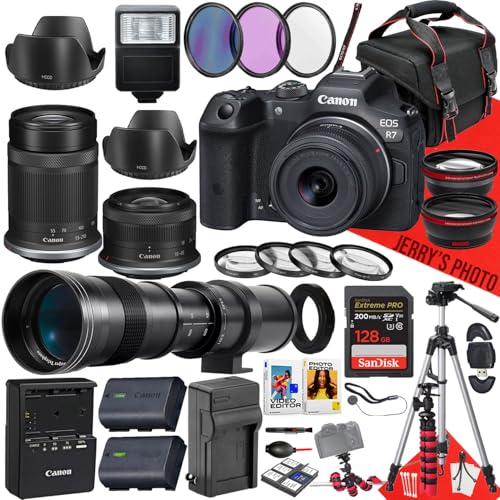
The bundle shapes the recommendation. Alongside the standard kit zoom, the listing adds telephoto reach that turns the R7 toward birds, sport and travel detail from the first weekend — while also asking the buyer to read the lens list carefully, since long manual-focus glass in such bundles demands patience and suits deliberate subjects better than fleeting ones. For the hybrid shooter whose heart is at the long end of the lens, no other camera in this guide arrives so completely aimed at their subjects.
R7 owners who film wildlife develop a signature workflow: the oversampled 30p mode for behaviour and beauty, the cropped 60p for action and slow-motion emphasis, and stills bursts interleaved without changing bodies — a single morning at a hide producing a film and a portfolio simultaneously. The in-body stabilisation cooperating with long RF lenses makes handheld telephoto video steadier than the format’s history would suggest. Its menus and dials mirror Canon’s professional bodies, so the learning transfers upward. The bundle’s longest lens teaches patience — manual focus at extreme reach is a meditation — but the kit and mid-telephoto glass in the box carry the everyday filming while that patience develops.
- Sensor: 32.5MP APS-C
- Video: 4K 60p cropped/fine modes; 4K 30p oversampled
- Stabilisation: in-body, coordinated with lens
- Card slots: dual SD
- Autofocus: subject detection for people, animals, vehicles
- In the box: body with kit and telephoto lenses — read listing
Strengths
- Dual slots and sealing suit serious field days
- Oversampled 4K 30p is exceptionally clean
- Bundle reach serves wildlife and sports immediately
Trade-offs
- Rolling shutter is the price of its high-resolution sensor
- 4K 60p modes crop or soften the image
- Bundle’s longest glass rewards deliberate, patient subjects
Best for: wildlife, sports and travel hybrids who film at a distance.
Not suited for: wide-angle vloggers, or shooters needing fan-cooled marathon stamina.
How do the six compare where 4K gets difficult?
Resolution ties at 4K across this table by definition, so the columns track the behaviours that separate footage: whether the fastest modes crop, how the sensor handles pans, how heat is managed, and how deep the colour goes for editing. Read your own shooting pattern down the rows — the ceremony videographer and the skate filmer need different winners, and this table is honest enough to give them different answers.
| Model | Top 4K mode | Crop behaviour | Cooling | Colour depth | Card slots |
|---|---|---|---|---|---|
| Canon EOS R50 with 18-45mm Bundle | 4K 30p | Full-width at 30p | Passive | 8-bit class profiles | Single |
| Sony Alpha a6700 | 4K 60p / 120p | Full-width 60p; crop at 120p | Passive | 10-bit log | Single |
| Sony ZV-E1 | 4K 60p | Full-width | Active management | 10-bit log | Single |
| Panasonic LUMIX GH6 | C4K/4K 60p | Full-width | Fan — unlimited | 10-bit 4:2:2, ProRes | Dual media types |
| Sony FX30 with Sigma 18-50mm f/2.8 | 4K 60p / 120p | Crop at 120p | Fan — unlimited | 10-bit 4:2:2 | Dual media types |
| Canon EOS R7 with Lens Bundle | 4K 60p | Crop in 60p modes | Passive | 10-bit log options | Dual |
The pattern to carry away: fans equal freedom. The two actively cooled bodies are the only ones whose recording limit is the size of your card, and both come from cinema-minded lineages. Every passive body here is excellent inside its thermal envelope — the skill is knowing whether your shoots live inside it. A twenty-minute talking-head session and a two-hour ceremony are both ‘video work’, and they should buy different cameras.
Which of the best 4 k video cameras matches the films you actually make?
Talking heads, wildlife, or weddings — does the subject choose the camera?
More than any specification does. Talking-head and presenter work rewards flip screens, eye autofocus and creator automation — R50 and ZV-E1 territory — because the camera is its own operator. Wildlife and sports reward reach, dual slots and high frame rates, which is the R7’s whole design brief, with the a6700 as the stills-led alternative. Weddings and ceremonies reward stamina and redundancy above beauty: the fan-cooled GH6 and FX30 record until the vows are done, and the GH6’s stabilisation covers the handheld processional without a gimbal’s choreography.
Mixed lives need honest ranking. If eighty percent of your filming is family and twenty percent is a yearly ceremony, buy for the eighty and rent or borrow stamina for the twenty. The camera that serves your ordinary weekends will be charged, packed and loved; the ceremony specialist bought for one day a year becomes shelf decoration with a sensor.
How much should rolling shutter worry you?
Rolling shutter skew appears when the camera or the subject moves fast across the frame — whip pans, vehicle-mounted shots, vibrating hides. Its severity here runs from the noticeable on the high-resolution R7 to the mild on the fast-reading cinema bodies, with the a6700’s action reputation carrying the same caveat. The professional answer is technique: pan at a measured speed, track subjects smoothly, and let motion happen inside the frame rather than chasing it. Filmmakers have made features on slower sensors than any of these by respecting that discipline.
If your style is genuinely frantic — run-and-gun travel, skate follow-filming, motorsport from the fence — weight this column heavily and test before committing. If your camera lives on a tripod or a steady hand, cross it off your worry list and spend the attention on audio instead, where your audience will actually notice the difference.
Do you need 10-bit colour and log profiles?
Only if you will grade. Log footage looks flat and grey from the camera because it is saving its contrast decisions for your editing software, where 10-bit depth keeps skies smooth while you make them. The a6700, ZV-E1, GH6 and FX30 all offer serious log and 10-bit paths, and the GH6 and FX30 add the 4:2:2 sampling and ProRes options that professional pipelines prefer. If your workflow is film, trim, post — and there is no shame in it; most beloved family footage is made exactly so — the R50’s standard profiles will look better with less effort than log you never grade.
The middle path is a gentle profile: slight contrast reduction, natural colour, edited lightly. Every body here offers one, and it is where most solo creators should live until a specific project demands the full log discipline.
How do you set up a 4K camera for a reliable shoot?
Cards, batteries and heat — the unglamorous checklist
4K recording eats storage at rates that surprise stills photographers: budget cards by the hour of footage, not the day of shooting, and buy media rated for sustained video writes rather than burst photography. Format cards in the camera that will use them, on the morning of the shoot, after the previous shoot is safely archived in two places. Batteries follow the same arithmetic — the fan-cooled bodies and 4K 60p modes draw hard — so carry twice the power your plan requires and treat the second battery as insurance you are delighted not to claim.
Heat discipline is a setup choice, not luck. Open the screen away from the body, avoid filming in direct midday sun where shade exists, prefer the frame rate the project needs rather than the maximum the menu offers, and rehearse any continuous take longer than half an hour at home in a warm room. Every thermal shutdown in this category announces itself in rehearsals to owners who hold them.
Audio and stabilisation — where audiences actually judge you
Viewers forgive a soft frame and abandon a video over bad sound, so the microphone decision outranks every lens decision in this guide. Every body here accepts an external microphone; use that input — a small on-camera shotgun for events, a wireless lavalier for presenters — and monitor with headphones whenever the body allows. Set levels manually for important work, because automatic gain will pump audibly the first time a room falls silent.
For movement, learn your stabilisation’s personality before the shoot that matters. In-body systems smooth walking but can wobble at wide focal lengths; digital modes crop for their margin; the GH6’s combined system is the exception that behaves like hardware costing far more. Practise the slow, heel-to-toe videographer’s walk with your actual camera and lens, and your footage will thank you more than any accessory purchase this year.
What separates a 4K camera from a camera that shoots 4K?
The distinction is everything around the sensor: whether the body can sustain the mode, whether the autofocus serves a moving subject, whether the audio path respects your audience, and whether the files slot into an edit without conversion rituals. A camera that shoots 4K lists the resolution; a 4K camera — the GH6 and FX30 by design, the hybrids by balance — treats the resolution as the beginning of the specification. This guide’s rankings quietly encode that difference, which is why the lowest-resolution sensor here, the ZV-E1’s, produces some of the most admired footage.
It is also why last year’s model is often this year’s bargain. Video capability ages slower than stills fashion; a body whose 4K was flagship-grade recently remains flagship-grade for the family films and channel episodes most readers will ever make.
What does a real shoot day reveal that spec sheets hide?
It reveals that autofocus confidence is a creative feature. A shooter who trusts the camera to hold a subject’s eye spends their attention on framing, timing and the subject’s mood; a shooter who does not becomes a focus-puller with anxiety, and the footage shows it. This is why the a6700’s and Canons’ subject detection matter beyond their brochure value, and why the GH6’s deliberate autofocus suits controlled interviews — where the subject sits still and the operator’s attention belongs on the questions — better than its spec suggests. Match the focus system to the chaos level of your subjects and half of ‘image quality’ takes care of itself.
It also reveals that ergonomics are endurance. A body that balances on a small gimbal for six hours, whose record button falls under the finger without a look, whose screen reads in sunlight — these decide the last hour of a wedding day more than any codec. The fan-cooled pair feel overbuilt in the shop and exactly right at hour nine. The compact creators feel liberating at breakfast and demand battery discipline by lunch. Neither is a flaw; both are the purchase, and this guide’s per-camera honesty about thermals and handling exists so the shoot day holds no surprises that a rehearsal would not have caught.
How should a beginner grow a 4K kit over the first year?
Sequence matters more than selection. Month one belongs to the camera and its included or first lens, shot constantly, because your early footage teaches you which limitations are yours and which are the equipment’s. The first purchase after that is almost always audio — the microphone matched to your dominant subject — because it transforms perceived quality overnight. The second is light: a single modest panel or the discipline of windows transforms indoor footage more than any lens. Glass comes third, aimed at the focal length your footage keeps wishing for, and stabilisation hardware last, once your walking technique has plateaued and a gimbal’s cost can be judged against real need.
Resist the parallel temptation to upgrade the body within the year. Every camera in this guide out-resolves its beginner owner’s first-year technique by a wide margin, and the footage difference between your month-two and month-twelve work on the same body will exceed any difference a new body could have sold you. Bodies in this class reward loyalty; skills compound; the archive improves. That is the unglamorous economics of getting good at filming things.
How do these cameras divide a working week of filming?
Monday’s interview belongs to the GH6 and FX30 temperament: controlled light, a seated subject, long takes where fan-cooled stamina and monitoring tools turn the camera into studio furniture in the best sense. The GH6’s stabilisation even covers the walk-in establishing shots on the way to the chair. Wednesday’s family documentary belongs to the R50 and ZV-E1 — cameras that come out of a tote bag, find the children’s faces before the moment peaks, and forgive the operator for also being a parent. The same footage, attempted on the cinema pair, would arrive over-engineered and possibly late; attempted on the compact pair at the interview, it would arrive with thermal anxiety in the third hour. Matching temperament to task is the whole craft of choosing from this guide.
The weekend’s sport and wildlife split the difference. The R7’s reach and dual slots serve the touchline and the hide, the a6700’s tracking serves the same subjects for the stills-led shooter, and both demand the rolling-shutter discipline their reviews describe. What unifies the week is that no single body wins all five days — which is why working videographers so often own a pair from this list, a stamina body and a spontaneity body, and why beginners should buy for their most frequent day first and let the rarer days wait for the second purchase.
Editing day delivers the final verdict on every choice. The GH6’s and FX30’s files arrive organised for a professional pipeline; the a6700’s and ZV-E1’s log footage rewards the grader; the R50’s standard profiles cut fastest for the family archivist who wants the film finished before the weekend ends. Storage bills arrive too — a week of enthusiastic 4K is measured in terabytes across a season — and the wise shooter budgets drives with the same seriousness as lenses. None of this appears on a camera’s box, and all of it is the actual product you are buying.
What separates footage that gets watched from footage that gets filed?
Review a year’s worth of family and channel footage honestly and a pattern emerges that no camera purchase can repeal: the clips that get rewatched are the ones with clear sound, steady framing and a beginning that starts at the moment rather than ten seconds before it. Resolution is not on the list. This is why this guide keeps returning to microphones, stabilisation habits and autofocus trust — the unglamorous triad that decides whether a 4K file becomes a memory or a storage statistic. Every camera here can produce the watched kind of footage; the operator’s priorities decide whether it does.
The second pattern is editorial mercy. Short clips, honestly trimmed, survive; hour-long unbroken recordings become obligations nobody opens. Filming in takes — starting and stopping around moments, as the creator bodies here encourage — is not a limitation of attention but a kindness to your future audience, which includes your future self. Choose the camera whose handling makes that rhythm natural in your hands, keep its cards formatted and its batteries charged, and the archive will take care of its own reputation. The best 4K camera, in the end, is the one whose footage your family actually gathers to watch.
A note on renting, borrowing and the honest test
Before committing to the top of this guide’s price range, consider the oldest professional habit: rent or borrow the finalist for one real shoot. A weekend with the GH6’s monitoring tools or the FX30’s cinema layout will tell your hands what reviews cannot — whether the menus think the way you do, whether the body balances with your lens, whether the footage’s colour pleases you before any grading. Rental houses stock most of this list precisely because professionals test this way, and a single weekend’s hire is cheap tuition compared with a year of mild dissatisfaction.
Borrowing works too, and this category’s community lends generously: camera clubs, creator groups and workplaces all contain an a6700 or an R50 whose owner will trade a weekend’s loan for a memory card of your stills. Test in your light, on your subjects, with your computer’s patience for the files. The camera that survives your real life — not the showroom, not the chart — is the camera this guide has been trying to point you toward all along.
Slating takes like a documentary crew
Slate your takes with a spoken sentence — date, place, subject — before the action starts, the way documentary crews have done for a century. It costs three seconds, identifies every clip in any future archive without opening it, and rescues more family film projects than any codec ever invented. When the footage matters enough to shoot in 4K, it matters enough to introduce properly, and the habit marks the exact moment a camera owner becomes a filmmaker. Your grandchildren, opening these files in forty years, will know exactly where they are and who is laughing — which is, after all, the entire point of pressing record on the people you love most in the world.
What do 4K camera buyers most often get wrong?
Buying the maximum frame rate for every shoot. 4K 60p and 120p cost heat, storage and sometimes a crop. Film at the rate the delivery needs — usually 24p or 30p — and keep the fast modes for the moments that earn slow motion.
Ignoring the crop column. A vlogging lens chosen for its width becomes a different lens inside a cropped 4K mode. Check which modes are full-width on your shortlisted body before choosing glass.
Recording the once-only event on one card. Single-slot bodies are creator tools. For ceremonies and contracts, dual slots or a fan-cooled professional body are the honest answer — or a second camera rolling wide.
Spending on the body and filming with the built-in microphone. Audiences judge sound first. A modest microphone transforms any camera in this guide more than a body upgrade would.
Never rehearsing a long take. Thermal limits are discoverable at home and catastrophic at a venue. Run your longest planned take, in a warm room, before the day it counts.
Final Recommendation
Name a single default and it is the Sony a6700: full-width 4K 60p, autofocus that tracks like it means it, and stills credentials that keep it employed on photographic days. The GH6 owns long-form trust, the FX30 bundle owns cinematic ambition, the ZV-E1 owns the prettiest self-filmed footage, the R7 owns the distant subjects, and the R50 owns the beginner’s heart — which is to say, this category has matured to the point where the honest answer is a match, not a monarch.
Choose the body whose limits sit furthest from your favourite subjects, and your 4K footage will stop looking like a specification and start looking like the moments you meant to keep.
Frequently Asked Questions
Which of these is best for filming weddings and ceremonies?
The Panasonic GH6 for a single-camera professional, thanks to fan-cooled unlimited recording and stabilisation; the FX30 runs it close for cinema-style work. Compact passive bodies risk thermal limits during unbroken hour-long takes in warm venues, whatever their image quality.
Do I need 4K 60p, or is 30p enough?
For most family, travel and talking-head filming, 30p is enough and kinder to storage and heat. Choose 60p if you shoot sport, wildlife or anything you may slow to half speed; choose 120p only when slow motion is a signature of your style.
Which camera handles heat best on long shoots?
The two fan-cooled bodies — the GH6 and the FX30 — record until the card fills. Among the passive bodies, lower frame rates and open screens extend takes considerably, but no sealed compact here promises ceremony-length 4K 60p in summer heat.
Can these cameras replace a camcorder for family use?
For most families, yes — with better low-light footage and interchangeable lenses as the prize, and autofocus and audio that now match camcorder convenience. The trade is zoom range and grab-and-go simplicity, which is why the R50 bundle exists as the gentlest bridge.
What lens should a beginner pair with a body-only pick?
A standard zoom covering wide to short-telephoto in one barrel — the range the bundles here include — teaches framing without a bag of glass. Add a fast prime for indoor and evening work once you know which focal length your footage keeps returning to.
Is rolling shutter a reason to avoid the R7 and a6700?
Only for frantic camera movement. Both skew visibly in whip pans and stay honest at sane filming speeds; wildlife and sports shooters have used this class of sensor professionally for years by panning smoothly and letting subjects cross the frame.
Do I need a gimbal to get stable 4K footage from these cameras?
Not at first, and possibly not at all. The in-body stabilisation in the Panasonic and Sony picks here smooths walking shots well enough for family films, travel diaries and most business content, and the Canon bodies pair their digital stabilisation with RF lenses that carry their own optical correction. A gimbal earns its place when movement is the shot — long tracking walks, choreographed product reveals, real-estate walk-throughs at a steady glide — and even then it complements rather than replaces technique: soft knees, a wide stance and both hands on the camera fix more footage than any motor. Buy the camera, shoot for a month, and let your own shakiest clip make the case.
Related Guides
Keep reading with our companion guides: best 4k bridge cameras for all-in-one reach mirrorless video settings explained for beginners best microphones for mirrorless cameras.



[…] full-frame shelf continues in our companion guides: best 24 megapixel digital cameras compared full-frame vs APS-C — the honest differences how to inspect a used DSLR before […]