What's inside
- Key Takeaways
- Quick Picks
- How We Chose These Picks
- Why Does Recording Technology Decide RAID Behaviour?
- What Actually Happens During a Rebuild, and Why Does It Take So Long?
- How Do the Six RAID Picks Compare Side by Side?
- How Do You Build and Maintain a RAID Set That Ages Gracefully?
- Which RAID Level Fits Which of These Drives?
- Which Mistakes Ruin RAID Builds?
- Final Recommendation
- Frequently Asked Questions
- Related Guides
As an Amazon Associate I earn from qualifying purchases. This post may contain affiliate links at no extra cost to you.
gizmoverdict.com is reader-supported. When you buy through links on our site, we may earn an affiliate commission.
Where to buy: all six drives link to their Amazon listings from the Quick Picks table and from their detailed reviews below. RAID members should be bought as matched sets wherever possible, so check the exact capacity and model line on each listing, and order the hot spare in the same basket rather than as an afterthought.
Choosing the best hard drives for raid setups is a different exercise from choosing a fast or capacious single drive. Inside an array, a drive is a citizen: it must report errors promptly instead of vanishing into its own repairs, tolerate the vibration of its neighbours, record data in a pattern the controller can rebuild from, and match its siblings closely enough that a replacement never shrinks the set. The six picks below all come from the two NAS-drive families built for exactly that citizenship — Western Digital’s WD Red Pro line and Seagate’s IronWolf and IronWolf Pro lines — and the guide around them explains the ideas that separate a dependable array from a row of disks waiting to embarrass you.
The single most important of those ideas is recording technology. RAID rebuilds read every surviving member end to end and write a full replacement, and drives that use shingled recording can slow that process painfully or behave unpredictably under sustained array writes. Every pick in this roundup comes from a line whose titles or family specification centre on CMR — conventional magnetic recording — and where a particular listing title states CMR outright, the spec box says so; where the title is terse, the box marks the detail for verification against the maker’s documentation rather than assuming it.
Key Takeaways
- RAID membership is a behaviour specification before it is a capacity one: prompt error reporting, vibration tolerance and CMR recording matter more than headline size.
- The Seagate IronWolf titles state CMR explicitly, and the 4TB model also prints its 5400 RPM speed and 64MB cache; the IronWolf 10TB adds an explicit RAID-optimised claim.
- WD Red Pro titles are terse — capacity and family only — so spindle speed and cache for the 16TB and 12TB picks need Western Digital documentation to confirm.
- The IronWolf Pro pair brings enterprise NAS positioning at 16TB and 24TB for arrays whose rebuild windows and bay counts justify the step up.
- Buy members as a matched set and keep one cold spare of the largest member size on the shelf from day one.
Quick Picks
| Pick | Badge | Why it is here |
|---|---|---|
| Western Digital 16TB WD Red Pro NAS Internal Hard Drive | Large Red Pro | Sixteen terabytes of Red Pro for roomy NAS arrays that want pro-tier members without leaving the WD ecosystem. |
| Western Digital 12TB WD Red Pro NAS Internal Hard Drive | Red Pro mid-size | The twelve-terabyte Red Pro suits arrays standardised on that member size for tidy rebuild and expansion maths. |
| Seagate IronWolf 4TB NAS Internal Hard Drive | Fully stated small member | Its title confirms CMR, 5400 RPM and 64MB cache — a small, honest member for compact arrays and mirrors. |
| Seagate IronWolf Pro 16TB Enterprise NAS Internal HDD | Pro tier at 16TB | Enterprise NAS positioning and CMR at sixteen terabytes for arrays that work their members hard. |
| Seagate IronWolf Pro 24TB Enterprise NAS Internal HDD | Largest member here | Twenty-four terabytes per bay for wide arrays where bays, not drives, are the scarce resource. |
| Seagate IronWolf 10TB NAS Internal Hard Drive | RAID-optimised claim | The only title here that says RAID optimised in so many words, with 7200 RPM and CMR alongside. |
How We Chose These Picks
We limited the field to NAS-class drives, because NAS is the consumer-and-small-business face of RAID: these drives are engineered for multi-bay enclosures, continuous operation and array controllers, with error-recovery behaviour that cooperates with a RAID set instead of fighting it. Desktop drives were excluded no matter how attractive their capacities, and surveillance drives were excluded because their firmware priorities — smooth sequential video writing above all — answer a different brief.
Within the NAS class we required CMR recording as the family standard. Seagate prints CMR in the IronWolf titles gathered here, and Western Digital’s Red Pro line is its CMR NAS tier; where an individual WD title does not spell the technology out, we flag the confirmation step in the spec box rather than papering over it. That might look fussy, but RAID is precisely the workload where recording technology stops being trivia: a rebuild is the longest sustained write an array ever performs, and it happens when the set is already wounded.
We also read the six titles as a sceptical purchaser would, separating what each listing proves from what it merely implies. That separation runs through the spec boxes below, and it produces an asymmetry readers should understand rather than smooth over: the IronWolf rows can be filled in from the listings themselves, while the Red Pro rows carry verification notes for speed and cache. The asymmetry reflects the brands’ listing styles, not a hidden verdict about the drives, and the detailed reviews treat both families’ engineering with the same respect.
Capacity spread was the third filter. The six picks run from 4TB to 24TB so that a two-bay mirror in a flat and a twelve-bay rackmount in a studio can both shop from the same logic. We also kept both ecosystems represented — three WD Red Pro and IronWolf choices on each side of the aisle, roughly — because real arrays are usually loyal to one line, and a roundup that only serves one loyalty serves half its readers.
Why Does Recording Technology Decide RAID Behaviour?
Conventional magnetic recording writes each track independently, so a drive can rewrite any region at full pace whenever the controller asks. Shingled recording overlaps tracks to gain capacity, which forces the drive to rewrite whole bands when data changes — fine for archival writing, miserable under the random, sustained, whole-surface workload of a RAID rebuild or a busy parity array. The industry learned this publicly and painfully when shingled drives appeared in NAS clothing and arrays began timing out during rebuilds. That history is why this roundup treats CMR as a gate, not a preference.
Under rebuild conditions the difference compounds. A parity array reconstructing a failed member reads all survivors sequentially while writing the replacement continuously, often for many hours. A CMR member sustains that write from first sector to last. A shingled member may start briskly on fresh bands and then sag as its rewrite machinery engages, stretching the window in which a second failure would be fatal. When a title states CMR — as the IronWolf listings here do — it is stating rebuild behaviour, and that is the most RAID-relevant sentence a title can contain.
What else does a RAID controller expect from its members?
Prompt honesty about errors. When a desktop drive hits a bad patch, it retries internally for as long as it takes, because a lone drive has nobody else to ask. In an array, that silence looks like death: the controller waits, times out, and may eject a healthy-but-quiet drive, degrading the set for no good reason. NAS drives are tuned to attempt recovery briefly, then report the problem and let the array’s redundancy do its job. It is an invisible specification that never appears in titles, and it is carried by family membership — Red Pro and IronWolf are built to that contract; desktop lines are not.
Vibration is the second invisible contract. Spinning drives excite each other through the chassis, and in a populated enclosure the combined vibration can push heads off track, throttling throughput and multiplying retries. NAS-class drives in this class carry sensors and compensation for that environment, and the pro tiers strengthen the provision for larger enclosures. A two-bay mirror forgives almost anything; a twelve-bay chassis forgives nothing, which is why enclosure size should steer you toward or away from the Pro picks below.
How should member size relate to the RAID level you run?
Mirrors forgive large members because a rebuild copies one drive. Parity arrays multiply the exposure: a single-parity set of very large members spends a long time one failure from loss, so the 24TB IronWolf Pro belongs in dual-parity company, while the 4TB and 10TB picks can live more comfortably under single parity in small enclosures. The rule of thumb running through the detailed reviews is simple — as member size climbs, parity depth and spare discipline must climb with it. Capacity is cheap; the window during which your data exists exactly once is not.

Western Digital 16TB WD Red Pro NAS Internal Hard Drive — Large Red Pro
Sixteen terabytes is where a home or studio NAS stops being a backup appliance and becomes the primary store, and the Red Pro badge is Western Digital’s promise that the drive is built for that responsibility: NAS-class error behaviour, multi-bay vibration tolerance and CMR recording as the line’s standard. In a four-to-eight-bay enclosure running dual parity, a set of these gives a serious photo library, video archive or small-business file estate a home with room to grow into.
The listing title, in WD fashion, tells you the capacity, the family and nothing further. Spindle speed, cache size and the fine print of the specification live in Western Digital’s documentation for the exact model, and a buyer populating a whole enclosure should read that sheet once — particularly to confirm the details against an existing array if these are joining established members. None of that diminishes the drive; it simply means the purchase routine for Red Pro is datasheet-first, a habit this guide recommends for every terse listing in the roundup.
Think about rebuild posture before choosing this size. Sixteen-terabyte members under dual parity in a six-bay box make a comfortable, defensible set. The same members under single parity in a four-bay box leave a long single-copy window after a failure. The drive is identical in both stories; the array design decides whether it was a wise purchase, which is why the badge in the Quick Picks table reads as a size recommendation rather than a universal one.
Ownership rhythm matters at this size too. A sixteen-terabyte set represents enough stored life — a decade of photographs, a studio’s client archive — that its maintenance should run on a calendar, not on vibes: scheduled scrubs, a quarterly glance at SMART trends, a spare whose presence is verified rather than remembered. Owners who adopt that rhythm find the big Red Pro set boring in the best possible way. Owners who treat a large array as an appliance to be ignored until it complains eventually meet the complaint and the rebuild on the same difficult weekend.
- Capacity: 16TB (stated in the listing title)
- Family: WD Red Pro NAS internal hard drive
- Recording technology: CMR is the Red Pro line standard — confirm for this model with Western Digital documentation
- Spindle speed: Not stated in the listing title — verify with Western Digital documentation
- Cache: Not stated in the listing title — verify with Western Digital documentation
Strengths:
- Red Pro NAS engineering: array-friendly error behaviour and multi-bay vibration tolerance.
- Sixteen terabytes per bay consolidates growing libraries into fewer enclosures.
- CMR line standard suits the sustained writing of parity rebuilds.
Trade-offs:
- The title states no speed or cache figures, so specification checks need the datasheet.
- Large members demand dual parity and a stocked spare to keep rebuild risk proportionate.
- Cost per enclosure set climbs quickly when every bay takes a drive of this size.
Best for: a four-to-eight-bay NAS running dual parity, standardised on WD Red Pro at sixteen terabytes per member. Not suited for: a small single-parity set, where the rebuild window after a failure stretches too long for comfort.

Western Digital 12TB WD Red Pro NAS Internal Hard Drive — Red Pro mid-size
Twelve terabytes has settled into the role of default member size for serious NAS arrays, and this Red Pro is the roundup’s representative of that consensus. It suits the enormous installed base of arrays already built around twelve-terabyte members — replacements and expansions should match the established size, because arrays grow and rebuild most gracefully when every member agrees about capacity. A mixed set wastes the surplus of its largest member until the whole set is replaced.
As a Red Pro, it carries the line’s NAS contract: error recovery that reports rather than hides, vibration provision for populated enclosures, and CMR recording as the family standard. The title itself confines its claims to capacity and family, so the same datasheet routine applies — confirm spindle speed and cache against Western Digital’s documentation for the model code, especially if the drive will join members from a different production era of the same line.
There is a thermal argument for this size in compact enclosures. Desktop-class towers and small rackmount NAS boxes move limited air, and a set of mid-size members is a known quantity for the enclosure designers who built around this capacity class. Owners of four and five-bay boxes who keep their units in cupboards and lofts — imperfect environments, honestly assessed — will find the twelve-terabyte tier the path of least surprise, with rebuilds that finish overnight rather than over a weekend.
There is a resale-and-reuse footnote that quietly favours this tier: twelve-terabyte NAS drives leaving a refreshed array remain useful as backup targets, offsite rotation drives in single enclosures and test-bench members, because the size suits almost any secondary role. A set bought at this capacity therefore tends to cascade through an organisation’s storage hierarchy for years after its front-line service, which softens the arithmetic of the original purchase considerably.
- Capacity: 12TB (stated in the listing title)
- Family: WD Red Pro NAS internal hard drive
- Recording technology: CMR is the Red Pro line standard — confirm for this model with Western Digital documentation
- Spindle speed: Not stated in the listing title — verify with Western Digital documentation
- Cache: Not stated in the listing title — verify with Western Digital documentation
Strengths:
- Matches the member size a large share of existing Red Pro arrays already run.
- NAS-class error behaviour and vibration tolerance for populated enclosures.
- Rebuild windows stay moderate compared with the largest members in this list.
Trade-offs:
- Terse title: every figure beyond capacity requires a documentation check.
- Density-focused builds will need more bays than the 16TB or 24TB picks require.
- Joining an IronWolf-standardised array mixes ecosystems and complicates spares.
Best for: an existing twelve-terabyte Red Pro array replacing a member or expanding in step. Not suited for: a new high-density build where bay count is capped and larger members fit the parity plan.
Seagate IronWolf 4TB NAS Internal Hard Drive — Fully stated small member
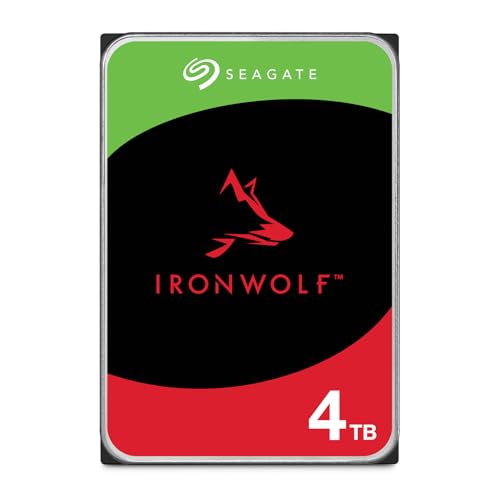
Small arrays deserve the same engineering honesty as large ones, and this IronWolf 4TB is the most forthcoming listing in the roundup about what it is: the title states CMR recording, a 3.5-inch SATA 6Gb/s interface, 5400 RPM spindle speed and a 64MB cache. For a two-bay mirror guarding family photos and documents, or a compact four-bay set under modest load, that is a complete little identity card with nothing left to chase through documentation.
The 5400 RPM speed deserves defence rather than apology. In small enclosures, slower spindles run cooler and quieter, draw less from modest power supplies, and still saturate what a home network asks of a mirrored pair. RAID members in a two-bay box spend their lives serving a household’s evening traffic, not a studio’s ingest hour, and a drive specified honestly for that duty will out-serve a faster drive specified for a different one. Seagate’s IronWolf line wraps that spindle in NAS firmware behaviour — the error-reporting contract and multi-bay awareness that define this entire category.
Four terabytes is also the size at which redundancy stops feeling expensive. Mirroring a pair costs one drive’s capacity; a four-bay single-parity set surrenders a quarter. Owners stepping up from a single external drive to their first real array will find this the gentlest place to learn RAID habits — scrubs, SMART watching, spare keeping — on members whose replacement never becomes a financial event.
One more household consideration: power cuts and restarts. Small home arrays live on ordinary wall sockets, get unplugged by cleaners and ride out neighbourhood outages without the protection a rack enjoys. NAS-class members are built with that untidy reality in mind — continuous-duty design assumes an unglamorous electrical life — and a mirrored pair of these recovers from an abrupt stop with the array’s own consistency checks doing the worrying. It is a modest virtue, but small arrays live and die by modest virtues.
- Capacity: 4TB (stated in the listing title)
- Recording technology: CMR (stated in the listing title)
- Form factor and interface: 3.5-inch, SATA 6Gb/s (stated in the listing title)
- Spindle speed: 5400 RPM (stated in the listing title)
- Cache: 64MB (stated in the listing title)
Strengths:
- The title documents recording technology, speed and cache without a datasheet detour.
- 5400 RPM running suits quiet, cool operation in compact home enclosures.
- IronWolf NAS firmware behaviour brings the array error-reporting contract to small sets.
Trade-offs:
- Four terabytes fills quickly under video libraries, so media-heavy sets outgrow it.
- Slower spindle trails the 7200 RPM picks for multi-user, random-heavy workloads.
- Cache is the smallest stated here, in keeping with its modest duty positioning.
Best for: a two-bay mirror or small four-bay NAS holding documents, photos and modest media with quiet running as a priority. Not suited for: a busy multi-user studio array, where the 7200 RPM IronWolf picks carry the load better.

Seagate IronWolf Pro 16TB Enterprise NAS Internal HDD — Pro tier at 16TB
The IronWolf Pro badge moves the conversation from home arrays to arrays that earn money. Seagate positions the Pro line as enterprise NAS, and the title supports the posture: CMR recording, 3.5-inch SATA 6Gb/s interface and a 7200 spindle figure. Sixteen terabytes at that tier is a working drive for virtualisation datastores on NAS, busy creative-team shares and backup targets that ingest every night — sets whose members are exercised hard and replaced on schedule rather than on failure.
What the Pro step buys, beyond the standard IronWolf contract, is headroom in the invisible specifications: stronger provision for large enclosures, higher workload expectations and the general over-engineering that lets an array absorb a bad month without drama. The title does not print a workload number, so estates with formal endurance budgets should pull Seagate’s documentation for the model and file the figure with the purchase record — the same discipline this guide applied to enterprise drives elsewhere.
Pair this size with the right enclosure thinking. Sixteen-terabyte Pro members in an eight-bay rackmount under dual parity make a set that can lose a drive on Friday and be whole again before the team’s Monday standup, with the spare swapped in by whoever drew the short straw. That operational calm — not the capacity — is what the Pro premium actually purchases, and estates that have lived through a weekend rebuild understand its value precisely.
For purchasing departments, the Pro tier also simplifies an argument that recurs in every storage budget: why not buy the cheaper standard line and replace failures more often? The honest answer is that member swaps are not free — each one costs staff time, a rebuild window and a slice of risk — so a line positioned for heavier duty pays for itself in avoided events across a large fleet. In a two-bay home box that argument collapses, which is why this guide keeps steering small enclosures toward the standard IronWolf picks and reserving this Pro for sets where avoided events have real prices.
- Capacity: 16TB (stated in the listing title)
- Recording technology: CMR (stated in the listing title)
- Form factor and interface: 3.5-inch, SATA 6 Gb/s (stated in the listing title)
- Spindle speed: 7,200 RPM (stated in the listing title)
- Positioning: Enterprise NAS internal HDD (stated in the listing title)
- Cache: Not stated in the listing title — verify with Seagate documentation
Strengths:
- Enterprise NAS positioning for arrays with heavy, sustained member workloads.
- CMR and interface stated in the title, simplifying specification sign-off.
- 7200 RPM spindle suits multi-user shares and datastore duty better than 5400 RPM members.
Trade-offs:
- Pro-tier pricing across a full enclosure set is a serious line item.
- Cache and workload figures still require Seagate documentation to confirm.
- Oversized for a quiet home mirror, where the standard IronWolf answers the brief.
Best for: an eight-bay or rackmount NAS carrying business shares or virtualisation storage under dual parity. Not suited for: a two-bay home enclosure, where its enterprise headroom goes unused and its running character dominates the box.

Seagate IronWolf Pro 24TB Enterprise NAS Internal HDD — Largest member here
Twenty-four terabytes per bay is a statement about which resource is scarce. In a full rackmount enclosure, bays run out long before budgets do, and this IronWolf Pro answers by packing the roundup’s largest capacity into each slot, with the Pro line’s enterprise NAS positioning and CMR stated in the title alongside a 3.5-inch SATA 6Gb/s interface. Media archives, surveillance-adjacent retention on NAS platforms and backup estates that measure growth in shelf units are its natural habitat.
The responsibilities scale with the capacity. A twenty-four-terabyte member’s rebuild is the longest event in this roundup, reading every surviving member across a set that — in a wide array — holds an enormous estate. Dual parity stops being a preference at this size and becomes the entry ticket, and the hot spare stops being a nicety: a same-size spare on the shelf is the difference between a rebuild that starts tonight and one that starts after a delivery.
There is also a growth-planning elegance to starting at the top. An array founded on 24TB members in a half-populated enclosure expands by adding identical members, keeping the set uniform for years. Estates that begin small and replace upward live through the mixed-size era, wasting the surplus of every oversized member until the set converges. For a buyer certain of the destination, this Pro is how the destination gets built in one step.
Cooling deserves a sentence in any discussion of very large members. A chassis packed with high-capacity drives is a chassis whose fans work for a living, and rackmount estates should confirm that their airflow story — front-to-back paths, blanking plates in empty bays, a room that holds its temperature in August — is written for a full complement of big spindles. The drive itself is built for enterprise NAS duty; the room around it must hold up its side of the arrangement.
- Capacity: 24TB (stated in the listing title)
- Recording technology: CMR (stated in the listing title)
- Form factor and interface: 3.5-inch, SATA 6Gb/s (stated in the listing title)
- Positioning: Enterprise NAS internal HDD (stated in the listing title)
- Spindle speed: Not stated in the listing title — verify with Seagate documentation
- Cache: Not stated in the listing title — verify with Seagate documentation
Strengths:
- The largest member capacity here, maximising every bay of a capped enclosure.
- IronWolf Pro enterprise NAS design for sustained array workloads.
- CMR recording stated outright, protecting rebuild behaviour at scale.
Trade-offs:
- The longest rebuild exposure in the roundup demands dual parity without exception.
- A matching cold spare is a significant purchase in its own right.
- Spindle speed and cache are absent from the title, so performance planning needs the datasheet.
Best for: a wide, dual-parity rackmount NAS where bays are exhausted and the archive keeps growing. Not suited for: a small enclosure or single-parity set, where one failure leaves an outsized estate single-copy for too long.

Seagate IronWolf 10TB NAS Internal Hard Drive — RAID-optimised claim
Buried in this IronWolf’s title is the phrase the whole roundup revolves around: RAID optimised. Seagate prints it alongside 10TB capacity, a 3.5-inch SATA 6Gb/s interface, 7200 RPM spindle speed and CMR recording, which makes this listing the most complete statement of RAID intent among the six. Ten terabytes is a versatile member size — substantial enough for a media-forward home array, modest enough that rebuilds stay civilised in a four-bay box.
The 7200 RPM spindle distinguishes it from its 4TB sibling in daily character. Multi-user households, Plex-style media serving to several screens and light virtualisation all lean on a member’s ability to juggle scattered requests, and the faster spindle with CMR recording answers that juggle more willingly. In a small enclosure the trade is a little more heat and presence; in a cupboard-ventilated four-bay unit serving a busy house, it is usually the right trade.
Consider this the roundup’s middle path for WD-averse, Seagate-curious builders: pro-adjacent specification without the Pro tier’s enterprise positioning, and a title that does the specification work for you. Arrays standardising on it get uniform members, a stated recording technology and a RAID claim in writing — a tidy foundation for a set expected to run for years with nothing more dramatic than the occasional scrub.
Expansion behaviour is a final point in this drive’s favour. A four-bay set founded on ten-terabyte members can grow by replacement in place — swap members one at a time for larger IronWolf units years later, expanding only when every bay agrees — or by adding a second enclosure standardised on the same member. Either path keeps the documentation simple, because the founding member’s specification is fully printed in its own title, ready to be copied into the register the day the array is built.
- Capacity: 10TB (stated in the listing title)
- Recording technology: CMR (stated in the listing title)
- Form factor and interface: 3.5-inch, SATA 6Gb/s (stated in the listing title)
- Spindle speed: 7200 RPM (stated in the listing title)
- Array positioning: RAID optimised (stated in the listing title)
- Cache: Not stated in the listing title — verify with Seagate documentation
Strengths:
- The only title here claiming RAID optimisation in so many words.
- 7200 RPM and CMR together suit busy multi-user home and studio arrays.
- Ten-terabyte members keep four-bay rebuild windows moderate.
Trade-offs:
- Cache size is not printed in the title, unlike its smaller IronWolf sibling.
- Faster spindle brings more heat and noise than the 5400 RPM pick in small enclosures.
- Standard IronWolf tier, so the largest enclosures should look to the Pro pair.
Best for: a four-to-six-bay home or studio NAS with several simultaneous users and media serving in its daily duties. Not suited for: a silent bedroom-adjacent two-bay mirror, where the 5400 RPM IronWolf runs more politely.
What Actually Happens During a Rebuild, and Why Does It Take So Long?
A rebuild begins the moment the controller accepts a replacement member. For a mirror, the surviving drive is read from first sector to last while its contents are written to the newcomer. For a parity set, every surviving member is read and the missing member’s contents are calculated and written. Either way, the array performs the largest single read it will ever do, at the same time as it writes an entire drive — and it usually keeps serving users throughout, because arrays exist to avoid downtime. The rebuild is therefore a marathon run while carrying the shopping, and its duration is set by member size, array width, controller pace and how much production traffic refuses to wait.
This is the mechanical heart of every sizing recommendation in this guide. A four-terabyte member in a home mirror might complete its marathon overnight. A twenty-four-terabyte member in a wide, busy parity set measures the same event in days. During all of it, the set’s redundancy is reduced — under single parity, eliminated — so the probability-weighted risk of the whole arrangement concentrates into that window. Shortening the window is possible: prioritise rebuild speed in the controller’s settings during an incident, pause heavy jobs, and keep the spare stocked so the window starts at failure rather than at delivery. Lengthening it accidentally is also easy: one shingled member, one throttled controller setting left over from a quiet-running experiment, one rebuild competing with a full backup run.
Households feel rebuilds differently from businesses, and the difference is worth planning for. A home array rebuilding through a weekend competes with everything the household asks of it — streamed films stutter, photo uploads crawl, backups queue — and the temptation to pause or rush the process should be resisted in favour of simply letting it finish while expectations are managed. Schedule the swap for a Friday evening, warn the house, and let the set heal at its own pace. A studio array has the opposite problem: clients keep arriving, so rebuild priority settings and honest conversations about degraded performance become part of the incident, and the Pro-tier picks earn their positioning by absorbing that double duty more gracefully.
After the rebuild completes, the work is not quite done. Run a scrub. Confirm every member reports healthy. Read the logs for the surviving members, because a rebuild stresses the whole set and occasionally exposes a second drive that was quietly approaching its own failure — the notorious pattern in which arrays lose two members in a week is usually one old failure and one rebuild-revealed failure. Then replace the spare you consumed. An array that has healed and been re-spared is an array returned to its designed state; an array that has merely healed is one incident away from having no move left.
How does drive health monitoring change the maintenance rhythm?
Modern NAS platforms watch their members continuously — SMART attributes, temperature, reallocated sectors, the slow drift of a drive’s self-reported health — and the practical effect is to move failures from the category of surprise into the category of schedule. A member whose error counts creep upward can be replaced on a calm Tuesday, rebuilt under no pressure, and retired before it ever takes the array down. That rhythm only works if someone reads the reports the platform generates, which is why this guide keeps returning to the register-and-review habit: alerts routed to an inbox nobody opens are decoration.
Health monitoring also refines spare policy. A fleet whose members report their decline in advance can hold fewer cold spares than a fleet flying blind, because replacements can be ordered against a forecast instead of stocked against a catastrophe. Small home arrays gain less from that refinement — one spare for one box remains the sane minimum — but the monitoring habit itself scales down perfectly: glance at the health page monthly, act on the first warning rather than the fifth, and let drives retire with dignity instead of drama.
How Do the Six RAID Picks Compare Side by Side?
| Drive | Capacity from title | Stated in title | Array role |
|---|---|---|---|
| WD Red Pro (B08K3VVKSW) | 16TB | Family and capacity | Large WD-standard arrays |
| WD Red Pro (B0DF9VNT3X) | 12TB | Family and capacity | Mid-size WD-standard arrays |
| Seagate IronWolf (B09NHV3CK9) | 4TB | CMR, 5400 RPM, 64MB cache, SATA 6Gb/s | Small mirrors and compact sets |
| Seagate IronWolf Pro (B0B94PNF7P) | 16TB | CMR, SATA 6Gb/s, 7200 RPM, enterprise NAS | Business arrays, heavy duty |
| Seagate IronWolf Pro (B0CSPCFKR9) | 24TB | CMR, SATA 6Gb/s, enterprise NAS | Wide dual-parity archives |
| Seagate IronWolf (B097C98J7H) | 10TB | CMR, 7200 RPM, RAID optimised | Busy multi-user home arrays |
Notice, too, how the stated-detail column predicts the ownership experience. Drives whose titles carry their specifications tend to belong to estates that keep tidy registers, because the information was never hard to capture; drives behind terse titles reward the one-time datasheet habit this guide keeps recommending. Neither column measures quality — it measures how much clerical help the listing gives you on day one.
The table exposes the two shopping styles in this category. Seagate’s listings let you specify from the page; Western Digital’s ask for one datasheet visit per model. Neither style changes the drives themselves, but it changes how an order gets documented — and arrays live for years inside their documentation. If your household or business keeps an asset register, the IronWolf rows fill it from the listing; the Red Pro rows fill it after ten minutes with a PDF, which is a fair price for staying inside an ecosystem your existing array already trusts.
How Do You Build and Maintain a RAID Set That Ages Gracefully?
Begin by buying the set as a set. Order all members together, note their model codes and firmware revisions in a register, and resist the temptation to save money with a near-match from another line. Uniform members rebuild predictably, vibrate in chorus rather than in argument, and keep the spare question simple: one spare size covers every bay. Where an existing array forces a mixed purchase, match capacity exactly and recording technology absolutely — a CMR set must never gain a shingled member, whatever the shelf label suggests.
Burn the array in before trusting it. Build the set, run a full initialisation and surface scan, copy data in stages, and watch the logs through the first scrub. Infant mortality is a real pattern in spinning disks, and it is far better discovered while the old storage still holds the only other copy. Once the set carries production data, schedule scrubs at the interval your platform recommends and actually read the reports — a scrub that nobody reads is a ritual, not a safeguard.
Plan replacements before failures. Keep the cold spare on the shelf, labelled with the array it serves. When a member does fail, swap promptly, let the rebuild finish without piling extra load onto the wounded set, and order the next spare the same week. Afterwards, retire the failed drive through a destruction process proportionate to what it held: arrays concentrate a household’s or a business’s whole memory, and a dead member is still a complete copy of a slice of it.
One purchasing subtlety deserves its own paragraph: batch awareness. Drives bought together often share a production batch, which is good for uniformity and carries one theoretical shadow — a batch-level defect could age several members in step. Large estates sometimes split orders across batches deliberately. Home and studio builders need not chase that refinement, but they should record purchase dates in the register, because a set whose members all share a birthday deserves slightly earlier health scrutiny as the years accumulate, and a staggered replacement rhythm — refreshing the hardest-worked member first — naturally desynchronises the set over time.
Finally, remember what RAID is not. It is not backup. It protects against drive failure, not against deletion, ransomware, fire or theft, and every array in this guide — however many Pro badges it wears — still needs a separate copy of anything irreplaceable, ideally in another building. The drives above make the array honest; the backup makes the data safe.
Which RAID Level Fits Which of These Drives?
The mirror is the honest beginner’s array and the permanent answer for two-bay boxes: one member’s contents duplicated on the other, rebuild by simple copy, capacity halved. The IronWolf 4TB pair is this guide’s mirror candidate — modest capacity, cool running, fully stated specification — and for documents, photographs and household records, a mirror of NAS drives plus a genuine backup remains a thoroughly respectable end-state rather than a stepping stone.
Single parity — the family of layouts that dedicates one member’s worth of capacity to reconstruction data — suits three-to-five-bay sets of small-to-mid members, where rebuilds finish quickly and the odds of a second failure inside the window stay low. The IronWolf 10TB and Red Pro 12TB live comfortably here in home and studio service. The discipline single parity demands is promptness: a failed member replaced this week, from a stocked spare, keeps the window short enough for the maths to stay friendly.
Dual parity spends two members’ worth of capacity to survive two failures, and it is the level this guide insists on as members reach sixteen terabytes and beyond. The Red Pro 16TB, IronWolf Pro 16TB and IronWolf Pro 24TB all belong under dual parity in any set wider than a mirror, because their rebuild windows are long enough that a second ageing member giving up mid-rebuild is a realistic scenario rather than a paranoid one. Wide arrays — eight bays and up — should treat dual parity as the floor regardless of member size.
Striped mirrors, where pairs are mirrored and then combined, trade capacity for speed and fast, simple rebuilds, and they suit working storage — video editing shares, virtualisation datastores — built from the 7200 RPM picks here. Their rebuild copies a single mirror partner rather than recalculating a wide set, so even large members heal comparatively quickly. The cost is half the raw capacity, always, which is why archives live on parity and workspaces live on striped mirrors.
Whichever level you choose, write the choice and its reasoning into the same register that holds the members’ model codes. Arrays get inherited — by a colleague, a family member, a future you who has forgotten the reasoning — and a set whose design logic is documented can be maintained, expanded and troubleshot by its heir. An undocumented array is a puzzle box full of somebody’s photographs.
Which Mistakes Ruin RAID Builds?
A sixth mistake hides in the settings rather than the shopping: leaving the controller’s rebuild priority at its quietest setting forever, or disabling scrubs because they once made an evening’s streaming stutter. Those settings exist to be tuned per incident — quiet during production, committed during recovery — and an array whose owner has never opened the management page is an array running on defaults chosen by a firmware team for a generic customer. Spend twenty minutes learning where the rebuild priority, scrub schedule and health alerts live in your platform before the first failure, and the first failure becomes a demonstration instead of a discovery.
The founding mistake is populating an array with desktop drives because the capacities matched. Desktop error behaviour ejects members under exactly the conditions RAID creates, and the savings curdle within a year. Second comes the shingled surprise: a member whose recording technology sags during rebuilds, stretching the danger window — the reason this roundup gates on CMR and flags every title that leaves it unstated. Third is parity stinginess at large member sizes, running 16TB or 24TB members under single parity and calling the long rebuild window acceptable. Fourth is the missing spare, which converts a manageable failure into a degraded week waiting on delivery. The fifth mistake is conceptual and the most expensive: treating the finished array as a backup, and discovering the difference during the first deletion accident.
Final Recommendation
A note on confidence before the verdict itself: every recommendation here rests on family engineering and stated specifications rather than on any promise that a given drive will not fail. Drives fail — that premise built the entire RAID idea. What a well-chosen member changes is the character of the failure when it comes: reported promptly, absorbed by the set, rebuilt inside a planned window, replaced from a stocked shelf. Judge the picks below by that standard — not by the fantasy of the drive that never dies, which no listing in this roundup is selling.
Most builders should start from the middle of this list and move only with a reason. The IronWolf 10TB states everything a RAID buyer wants in writing — CMR, 7200 RPM, RAID optimisation — at a member size four-bay boxes handle gracefully, while WD loyalists get the same logic from the Red Pro 12TB after one datasheet check. Step up to the Pro pair when the enclosure is large, the workload is commercial or the capacity per bay truly binds; step down to the IronWolf 4TB when the array is a quiet mirror with modest appetites. Build the set uniformly, spare it properly, back it up separately — and the array will repay you in the only currency RAID deals in: failures that are errands, not emergencies.
Frequently Asked Questions
Can I mix drive brands or capacities in one RAID set?
Controllers generally allow it, and arrays generally forgive it, but the set inherits the limits of its weakest arrangements: capacity is calculated from the smallest member, and mixed recording technologies or error behaviours introduce exactly the unpredictability RAID exists to remove. A replacement in an emergency may reasonably break uniformity for a weekend; a build plan should never start there. Standardise on one line and one size per set, as every pick in this roundup assumes.
Why does CMR matter so much for RAID specifically?
Because a rebuild is the most demanding sustained write an array performs, and it happens while the set is already degraded. CMR members sustain that write evenly from start to finish. Shingled members can slow dramatically when their overlapped tracks need rewriting, extending the window in which one more failure loses data. That is why the IronWolf titles printing CMR — and the Red Pro line’s CMR standard — carry more weight in this category than any speed figure.
Is RAID a substitute for backup?
No, and the distinction decides real outcomes. RAID survives a dead drive. It does nothing against accidental deletion, corruption that the array faithfully mirrors, ransomware, theft or a flooded room. Keep a genuine backup — a separate device, a rotated offsite copy or a cloud tier — for anything you cannot recreate. Several drives in this roundup working together still constitute exactly one copy of your data.
How long does a rebuild take on drives of these sizes?
Longer than intuition suggests, and it grows with member size and array busyness. Small members in a quiet four-bay box may heal overnight; very large members in a busy wide array can take days. Controllers, parity level and how much production load competes with the rebuild all move the figure, which is why this guide pairs every capacity with a parity recommendation and urges a stocked spare: the rebuild clock starts when the spare goes in, not when the courier arrives.
Should a two-bay mirror use NAS drives or desktop drives?
NAS drives, for the same reasons at smaller scale. A mirror’s members still sit in each other’s vibration, still run continuously and still need error behaviour that cooperates with the controller. The IronWolf 4TB in this roundup exists precisely for that box: modest capacity, stated CMR, a spindle speed chosen for cool and quiet running. Desktop drives in a mirror are a false economy that usually announces itself during the first rebuild.
What should I do with a failed array member?
Replace it promptly with the stocked spare, let the rebuild complete, and confirm the set reports healthy before anything else. Then handle the failed drive as what it is — a device holding a slice of everything the array held. If it leaves your premises for warranty or disposal, use a destruction or erasure process appropriate to the data. And order the next spare immediately; an array without a spare is borrowing calm from the future.
Do NAS drives need a special enclosure or controller?
No special hardware is required beyond a NAS enclosure or controller that accepts standard 3.5-inch SATA drives, which describes the entire mainstream market. What NAS drives need is an environment that respects their assumptions: bays that hold them firmly against vibration, airflow that keeps a full complement cool, and a platform whose firmware schedules scrubs and reports health. Any reputable multi-bay enclosure provides that environment; a stack of drives wired loosely on a desk does not, whatever badges the drives wear.
Related Guides
Continue with our roundup of NAS enclosures for home and studio use, the explainer on choosing between RAID levels, and our picks for backup drives that complement an array.


