What's inside
- Key Takeaways
- Quick Picks
- How Did We Shortlist Soundbars of 28 Inches or Less?
- Comparison Table
- How Do You Measure a Space for a Short Soundbar?
- What Connections Should a Small Bar Have?
- What Mistakes Do Short-Soundbar Buyers Make?
- Which Rooms in a Real House Do Short Bars Actually Serve?
- How Should You Set Up a Short Bar Once It Arrives?
- What Does the Wattage in These Titles Actually Tell You?
- How Do Short Bars Handle Music?
- What Happens When the Small Television Gets Replaced?
- Why Do Small Televisions Sound So Poor in the First Place?
- How Long Should a Short Bar Last, and What Kills Them?
- What Is the Right Budget Attitude for a Short Bar?
- How Do You Choose Between the Two Stated 17-Inch Bars?
- Final Recommendation
- Frequently Asked Questions
- Related Guides
As an Amazon Associate I earn from qualifying purchases. This post may contain affiliate links at no extra cost to you.
gizmoverdict.com is reader-supported. When you buy through links on our site, we may earn an affiliate commission.
Where to buy: The six bars below all link to listings verified in this site’s product pool. Where a listing title states a length, that length is quoted; where it does not — and two titles here stay silent on dimensions — the guide says so instead of estimating, because a bar bought for a tight shelf deserves measurement honesty above all.
The hunt for the best soundbars 28 or less — twenty-eight inches of length, that is — starts with a tape measure, not a specification sheet. Short bars serve the televisions and furniture the flagship systems ignore: the 32- and 40-inch sets in bedrooms and kitchens, the desk-mounted monitor in a study, the caravan television, the narrow media unit whose shelf was designed before soundbars existed. A 28-inch ceiling keeps every candidate in this guide proportional to those screens and spaces, while still leaving room for real stereo separation and, in one case, a built-in subwoofer.
Length discipline forces honest trade-offs, and this roundup names them rather than hiding them. A short cabinet cannot move as much air as a long one; bass must be borrowed from ports, passive design or a subwoofer folded inside. What short bars return in exchange is placement freedom — they fit the shelf, clear the television’s feet, travel between rooms, and never dominate a small space visually. The six picks divide into three pairs: two tiny bars for the smallest screens, two 17-inch all-rounders, and two fuller-featured bars whose titles leave their exact length unstated and therefore flagged for a tape-measure check before ordering.
Key Takeaways
- Two picks state their size outright: the Saiyin at 11.7 inches and the MZEIBO and WebsLand at 17 inches each, all comfortably inside the 28-inch brief.
- The TCL S45H states no length in its listing title, and neither does the BESTISAN or the ULTIMEA — for those three, length is not stated and should be confirmed against maker documentation before trusting a tight fit.
- Only the ULTIMEA offers a 2.1 layout with a built-in subwoofer and app control, making it the fullest sound in the smallest-form group.
- Connection lists vary more than cabinet sizes: HDMI ARC appears on the BESTISAN and MZEIBO, while others lean on Bluetooth and optical-style simplicity.
- Short bars reward proximity — they are designed for listeners a few feet away, in bedrooms, kitchens and studies, not for filling a hall.
- Peak-power figures in titles are marketing weather, not climate; judge these bars by layout, connections and placement fit.
Quick Picks
| Pick | Badge | Why it earns its place |
|---|---|---|
| BESTISAN Soundbar | HDMI-Equipped Compact | Wired HDMI plus Bluetooth 5.0 in a home-theatre bar whose title leaves its length unstated. |
| Saiyin 11.7-Inch Sound Bar | Smallest of the Six | An 11.7-inch bar promising small size and big power for the tiniest televisions. |
| MZEIBO Sound Bar | Best Connection List | 17 inches, Bluetooth 5.3, and both ARC and optical named in its title. |
| ULTIMEA 2.1ch Soundbar | Only 2.1 With App Control | Built-in subwoofer and app control; its title states channels, not inches. |
| WebsLand 17-Inch Sound Bar | Bass-Forward 17-Inch | Dual bass ports and a 90W peak figure in a stated 17-inch cabinet. |
| TCL S45H | Big-Brand 2.0 Bar | A 2.0-channel TCL bar for smart TVs, with length absent from its title. |
How Did We Shortlist Soundbars of 28 Inches or Less?
The pool assembled for this keyword supplied the candidates, and the first pass was dimensional honesty. Titles that state a size were taken at their word — 11.7 inches and 17 inches sit far inside the ceiling. Titles that state no size were not excluded, because several compact bars simply omit dimensions from their headlines, but they were flagged: any reader with a hard shelf limit must verify those three against the maker’s documentation or the listing’s full specification section before ordering. A guide about fit that guessed at fit would betray its only job.
The second pass weighed what each cabinet does with its inches. Channel layout came first — the ULTIMEA’s 2.1 arrangement with a built-in subwoofer is a different proposition from a 2.0 bar of similar span — followed by connections, because a small bar still needs to talk to its television properly. HDMI ARC earns its prominence in these assessments: it lets the television remote run the volume and lets the bar sleep and wake with the screen, the two behaviours that decide whether a bar feels integrated or ornamental.
Finally, each bar was placed mentally in its natural habitat. The Saiyin belongs under a kitchen television; the TCL under a bedroom smart TV; the ULTIMEA in a study where one person listens closely. Verdicts follow those habitats, because a short bar’s success is measured at three feet, not thirty.

BESTISAN Soundbar — HDMI-Equipped Compact
The BESTISAN opens the list because its title leads with the connection small bars most often lack: wired HDMI, alongside wireless Bluetooth 5.0, in a bar its maker frames as a home theatre system for the television. HDMI matters disproportionately at this size. Bedroom and kitchen televisions are operated by whoever is nearest, with whichever remote is at hand; a bar that wakes with the screen and obeys the television’s volume buttons disappears into the routine, while one needing its own remote for every adjustment becomes the household’s least favourite object within a month.
The dimensional caveat must be stated as plainly as the praise: the listing title gives no length, so this bar’s exact span is not stated here — verify with BESTISAN documentation before committing it to a measured shelf. Its positioning in this roundup reflects its compact class and connection set, not a certified measurement. Readers with generous stands can weigh it on features; readers with exactly 27 inches of shelf should treat the verification step as part of the purchase, not an optional errand.
In use, this is the bar for the second television that has started hosting first-rate viewing — the spare-room set that became the football room, the kitchen screen that now carries the evening news and a film after. Bluetooth covers the phone-music duty such rooms accumulate, and the home-theatre framing suggests a bar tuned for programme sound rather than desktop squeak. It is the sensible, connection-first opening bid of the six.
- Connections named: wired HDMI and Bluetooth 5.0 (per listing title)
- Role: home theatre system for TV (per listing title)
- Length: the listing title gives no measurement — check BESTISAN documentation
- Channels: not stated in the listing title
- Best habitat: second televisions and kitchen sets
Strengths
- HDMI connection keeps the television remote in charge
- Bluetooth 5.0 covers phone and tablet music duty
- Home-theatre tuning suits programme viewing over desktop use
Trade-offs
- Exact length unconfirmed by its own title
- Channel layout unstated, so surround expectations should stay modest
- No subwoofer arrangement named in the title
Best for: a kitchen or spare-room television that needs proper HDMI manners above all.
Not suited for: a shelf measured to the half-inch, until its length is confirmed in documentation.
One more BESTISAN consideration belongs to households with several televisions of different ages. Because its title names both a wired HDMI route and a current Bluetooth version, this is the bar most likely to survive being rehomed — bought for the kitchen set, inherited by the spare room, ending its days under a teenager’s first television. Equipment at this end of the market is often judged as disposable; a connection set that broad quietly argues otherwise, and it is a greener and cheaper story than three successive purchases of narrower bars.
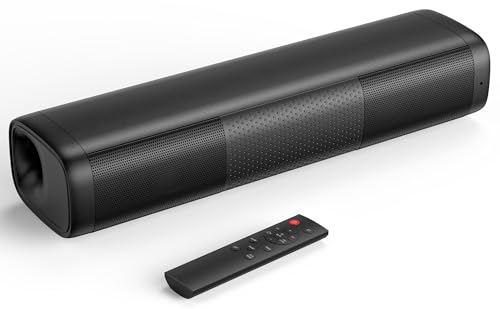
Saiyin 11.7-Inch Sound Bar — Smallest of the Six
At 11.7 inches, the Saiyin is less a small soundbar than a soundbar that has been distilled. Its title pairs the dimension with a promise — small size, big power — and the honest reading of that promise is about proportion: at the distances this bar serves, a desk’s width or a caravan’s galley, even modest output arrives undiluted. A listener two feet away does not need a system built to fill a lounge; they need clear, forward sound that their television’s downward-firing speakers cannot deliver from inside a cabinet niche.
The habitats multiply once a bar shrinks this far. Under a computer monitor it becomes a genuine desktop upgrade, freeing the screen’s own speakers from duties they perform badly. In a camper or boat cabin it fits shelves that reject everything else in this guide. Beside a small bedroom television it leaves room for the clock, the book and the glass of water that share the dresser. Portability follows naturally: this is the bar most likely to be moved between rooms as needs change, and the least likely to be left behind in a house move because it “belongs” to one television.
Physics collects its fee in the low frequencies, as it always does. An 11.7-inch cabinet cannot reproduce deep bass, and film scores will sound lean beside the 17-inch pair below. The Saiyin’s answer is that its listeners sit close enough for leanness to read as clarity. Buy it for proximity and fit; do not buy it as a lounge system in miniature, because miniaturisation changes what a bar is for.
- Length: 11.7 inches (per listing title)
- Design claim: small size, big power (maker’s wording in title)
- Role: home theatre system in miniature (per listing title)
- Best habitats: desks, caravans, cabins, small bedrooms
- Bass expectation: lean by physical necessity
Strengths
- Fits spaces every other pick here must refuse
- Close-range clarity suits desks and small screens perfectly
- Easy to move between rooms as needs change
Trade-offs
- Deep bass is beyond an 11.7-inch cabinet’s physics
- Maximum volume serves near listeners, not a lounge
- Stereo separation is narrow at this width
Best for: a monitor desk, caravan or cabin television where space is the whole question.
Not suited for: a main living-room screen expected to carry film night.
The Saiyin also makes an unusually honest gift, for the same reason it makes an honest purchase: its dimension is the headline, so nobody’s expectations are ambushed. Given to a student, a grandparent with a small set, or a friend furnishing a first flat, it arrives as a problem visibly solved — the television will sound better tonight, in the space that actually exists. Larger bars given as gifts carry an unspoken furniture negotiation; this one carries a tape-measure answer printed in its own name, and that clarity is worth more than a spec sheet’s worth of wattage claims.

MZEIBO Sound Bar — Best Connection List
The MZEIBO’s title reads like a checklist written by someone who has answered support emails: 17 inches of bar, 50 watts, Bluetooth 5.3, and both ARC and optical connections named outright. That completeness earns it the connection crown in this roundup. ARC gives the television-remote relationship; optical gives a fallback for older sets that predate ARC; Bluetooth 5.3 gives the modern phone link. A bar at this size lives or dies by how gracefully it joins households full of mixed-age equipment, and the MZEIBO joins everything.
Seventeen inches is also, not coincidentally, a sweet spot for the smaller television classes. Under a 32-inch set the bar spans a satisfying share of the screen’s width, giving stereo material room to separate without the cabinet overhanging the stand’s edges. The stated wattage should be read the way all such figures deserve — as the maker’s own headline number, useful for comparing within a brand’s range and meaningless across brands — while the bar’s real credentials are its layout and links, which the title states verifiably.
Consider this the default recommendation for a buyer who cannot audition anything and wants the fewest possible surprises: the size is stated, the connections are stated, the role is stated. In a category where two of six titles omit their own length, that plain-spoken completeness is a feature in itself, and it is why the MZEIBO anchors the middle of this list.
- Length: 17 inches (per listing title)
- Power figure: 50W (maker’s figure in listing title)
- Connections named: ARC and optical, Bluetooth 5.3 (per listing title)
- Role: speaker for smart TV (per listing title)
- Fit: proportioned for 32-inch class televisions
Strengths
- Both ARC and optical named — the fullest wired story here
- Stated length removes all fit uncertainty
- Bluetooth 5.3 is the newest wireless version in this group
Trade-offs
- No subwoofer or extra channel named in the title
- Wattage figure cannot be compared across brands
- 17 inches still caps bass and stereo width
Best for: a 32-inch television household wanting stated size and every connection in writing.
Not suited for: a listener expecting subwoofer weight from a single slim cabinet.
There is a subtle MZEIBO advantage in mixed households: visitors. A bar whose behaviour is governed by the television remote requires no induction ceremony for grandparents, babysitters or guests, while app-driven and multi-remote setups generate the small support calls that sour family technology. Where the small television in question serves a guest room or a rental property, that invisibility is arguably the product. The MZEIBO will never be the most exciting bar in this guide, and for a significant class of rooms, exciting was never the requirement.

ULTIMEA 2.1ch Soundbar — Only 2.1 With App Control
The ULTIMEA is the overachiever of the group: the only pick whose title claims a 2.1-channel layout with a subwoofer built in, and the only one offering app control. In a short cabinet, a built-in subwoofer changes the character of everything — film scores gain a floor, voices gain body, and the bar stops sounding like a television accessory and starts sounding like a small system. App control suits this bar’s likely habitats, too: studies and bedrooms where the phone is already the remote for the lights, the heating and the music.
Its title, like the BESTISAN’s, withholds the tape-measure fact: channels and features are stated, inches are not. Length: not stated in the listing title — verify with ULTIMEA documentation. The bar is catalogued by its maker among compact home-theatre models and plainly belongs to the small-bar class this guide covers, but a hard 28-inch shelf limit deserves a documented number, and this guide will not invent one. Feature-led buyers with flexible shelving can proceed on the strength of the layout; measurement-led buyers should verify first.
The built-in subwoofer also shapes placement advice. Bass generated inside the main cabinet arrives integrated and even, but it also means the bar itself carries more vibration and weight than its 2.0 rivals, and it prefers a solid shelf to a flimsy one. Give it a stable home, keep its frontage clear, and the ULTIMEA delivers the most complete sound-per-inch proposition in this roundup — the pick for listeners who want their small bar to feel like a system rather than an apology.
- Configuration: 2.1 channels (per listing title)
- Bass: subwoofer built in (per listing title)
- Control: app control named (per listing title)
- Length: no measurement appears in the listing title — check ULTIMEA documentation
- Role: home theatre system (per listing title)
Strengths
- Fullest sound layout available in this compact group
- App control fits phone-centred households
- Built-in bass keeps the installation to one cabinet
Trade-offs
- Exact length unconfirmed by its title
- Heavier, more vibration-prone than 2.0 rivals
- App dependence may not suit remote-only households
Best for: a study or bedroom listener wanting system-grade sound from one small cabinet.
Not suited for: a hard-measured shelf, until ULTIMEA’s documentation supplies the inches.
App control deserves one balanced paragraph of its own, because it divides households cleanly. For the listener who already runs a home from a phone, the ULTIMEA’s app is not a gimmick but the natural surface for volume, input and sound adjustments, usable from the bed or desk without hunting a remote. For the listener who regards every additional app as a small tax on attention, the same feature is a reason to choose a rival. Neither reaction is wrong; the mistake is buying without knowing which household you are. The ULTIMEA’s hardware case — the 2.1 layout — stands regardless of which side of that divide the buyer lands on.

WebsLand 17-Inch Sound Bar — Bass-Forward 17-Inch
WebsLand’s 17-inch bar makes its intentions audible in its title: dual bass ports for deep bass, and a 90-watt peak power figure. Ports are the classic small-cabinet bargain — carefully tuned openings that let a compact enclosure reinforce low frequencies it could never produce sealed. The result, in bars of this class, is a presentation with more warmth and thump than the dimensions suggest, particularly welcome in the gaming and film viewing that small bars increasingly serve in bedrooms and dens.
The peak figure deserves the standard translation. Peak power describes a momentary ceiling under the maker’s own conditions, not a sustained output, and it cannot be lined up against the MZEIBO’s differently-measured number or anyone else’s. What can be compared is design intent: where the MZEIBO spends its title on connections, the WebsLand spends its on bass architecture. Buyers choosing between the two 17-inch bars are really choosing a priority — joinery or low end — and both choices are defensible depending on whether the television in question is old or the films are loud.
Placement interacts with ports in one practical way: a ported cabinet wants a little breathing room behind or around it, and shoving it flush into a closed niche can blur the very bass the ports were tuned to produce. On an open stand or shelf, with its stated 17 inches confirmed in the title, the WebsLand is the entertainer of the small-bar group — the one most likely to be borrowed for a games night in another room.
- Length: 17 inches (per listing title)
- Bass design: dual bass ports (per listing title)
- Power figure: 90W peak (maker’s figure in listing title)
- Role: sound bar for television viewing and gaming rooms
- Placement: ported design prefers open air around the cabinet
Strengths
- Ported bass gives small-cabinet warmth and impact
- Stated length, no fit guesswork
- Entertaining tuning suits films and games
Trade-offs
- Peak wattage is not comparable across brands
- Ports lose effect inside closed cabinetry
- Connection list is less fully stated than the MZEIBO’s
Best for: a bedroom or den screen where films and games want bass a plain bar cannot give.
Not suited for: a closed media niche that would smother the rear air its ports need.
The WebsLand’s gaming suitability deserves expansion, since small bars increasingly live under the screens where consoles and PCs spend their evenings. Games reward exactly what a ported compact bar offers: directional midrange for footsteps and dialogue, plus low-end reinforcement for engines and impacts, delivered at the near distances where a player sits. Latency is handled by the wired television connection rather than Bluetooth, which players should insist on for anything competitive. Set up that way, the WebsLand turns a bedroom gaming corner into something with genuine atmosphere, without the desk-space invasion of separate speaker systems.

TCL S45H — Big-Brand 2.0 Bar
The TCL S45H closes the list as the establishment candidate: a 2.0-channel sound bar for smart TVs from one of the world’s largest television makers. That parentage carries practical weight in this category. TCL’s bars are designed alongside TCL’s televisions, firmware support follows a major manufacturer’s cadence, and the 2.0 layout — two channels, no subwoofer claims — is stated with a plainness the guide appreciates. What the title does not state, in line with the addendum discipline for this model, is the bar’s length: not stated in the listing title — verify with TCL documentation before relying on a precise fit.
A 2.0 bar is a deliberate product, not a deficient one. It promises stereo television sound, honestly delivered: clearer voices than the set’s own speakers, wider presentation, no bass box to house. For news, sport, drama and the general traffic of a bedroom or kitchen television, that promise covers most of the day. TCL’s television integration is the quiet bonus — owners of the brand’s sets can expect the bar to behave like a native accessory rather than a foreign peripheral, with setup and control following the television’s own logic.
The S45H therefore suits the buyer who distrusts novelty brands, values a support trail, and watches programmes rather than subwoofer demonstrations. Its length check is a five-minute errand against TCL’s documentation; its 2.0 honesty is permanent. In a roundup built on stated facts, a big brand stating its channels plainly earns the closing place.
- Configuration: 2.0 channels (per listing title)
- Role: sound bar for smart TV (per listing title)
- Maker: TCL, a major television manufacturer
- Length: not stated in the listing title — verify with TCL documentation
- Bass: no subwoofer named; stereo presentation is the promise
Strengths
- Major-maker support and television integration
- Honest 2.0 layout with no inflated claims
- Natural partner for TCL smart televisions
Trade-offs
- No subwoofer, so deep bass is out of scope
- Length must be verified outside the title
- Stereo width is bounded by a compact cabinet
Best for: a TCL television owner wanting a same-brand stereo upgrade for everyday viewing.
Not suited for: a film fan expecting subwoofer depth from a 2.0 cabinet.
A final TCL note concerns resale and hand-me-down value, the unglamorous tail of every electronics purchase. Major-brand bars with plain, honest specifications move easily between households and rooms because the next owner can discover exactly what the product is from the maker’s own documentation. The S45H’s 2.0 clarity will read the same in five years; a bar bought on a peak-wattage headline has nothing to say for itself once the headline is forgotten. For a category bought largely for second rooms and family circulation, that legibility is a genuine, if quiet, virtue.
Comparison Table
| Bar | Stated length | Layout | Headline trait |
|---|---|---|---|
| BESTISAN Soundbar | Not stated in title | Not stated | Wired HDMI plus Bluetooth 5.0 |
| Saiyin Sound Bar | 11.7 inches | Compact stereo class | Smallest cabinet here |
| MZEIBO Sound Bar | 17 inches | TV speaker layout | ARC and optical both named |
| ULTIMEA Soundbar | Not stated in title | 2.1, built-in subwoofer | App control |
| WebsLand Sound Bar | 17 inches | Ported stereo | Dual bass ports |
| TCL S45H | Not stated in title | 2.0 | Big-brand smart-TV pairing |
How Do You Measure a Space for a Short Soundbar?
Measure three things, not one. The shelf’s width is the obvious figure, but the television’s own feet decide the usable span: many sets stand on two feet near their edges, and a bar must fit between them or in front of them without rocking on a foot. Depth matters next — a bar pushed to the shelf’s front edge sounds best, so the shelf must hold the cabinet’s full depth at that position, with a finger’s width behind for cables. Height completes the trio wherever the shelf sits below a screen on a stand: the bar must not creep into the picture or block the television’s remote sensor, which usually lives at the screen’s lower centre.
Then measure the listener. Short bars are near-field instruments, voiced for the four-to-ten-foot distances of bedrooms, kitchens and studies. If the main seat sits fifteen feet from a small television, the honest upgrade may be a larger bar category altogether, and forcing a 17-inch cabinet to fill that gap produces the strained, shouty sound that gives small bars an undeserved reputation. The 28-inch ceiling in this guide is a fit constraint, not a room-size promise.
Write the three measurements down before opening any listing, and keep them beside the keyboard while shopping. It sounds like advice from a joiner rather than an audio guide, but the single largest cause of returns in this category is a bar that almost fits — a half-inch too long for the gap between the feet, a whisper too deep for the shelf — and almost-fitting is entirely preventable with a tape measure and thirty seconds. The stated lengths in this roundup exist to be compared against those three numbers; the unstated ones exist to be verified against documentation, and either way the numbers on the notepad, not the photographs on the page, should cast the deciding vote.
What Connections Should a Small Bar Have?
HDMI ARC remains the gold standard at any size, for the remote-control and auto-wake behaviour described earlier. Optical is the honourable fallback for older televisions, surrendering remote integration but delivering clean digital sound. Bluetooth serves the second life of every small bar — music and podcasts from phones — and its version number matters less than its stability at the room’s actual distances. A 3.5mm auxiliary input, where offered, quietly rescues older equipment and desktop setups alike.
The trap to avoid is the television’s headphone socket pressed into service as a line output. It works, after a fashion, but volume then lives in two places at once and sound quality rides on the set’s cheapest circuitry. Buyers of the BESTISAN or MZEIBO, whose titles name proper television connections, start ahead of that trap; buyers of any bar should confirm the wired route in the full listing before assuming it, because at this end of the market the difference between a television bar and a Bluetooth speaker wearing a television costume is exactly that socket.
What Mistakes Do Short-Soundbar Buyers Make?
Ordering by headline wattage is the first, and this guide has flagged the figures wherever titles print them precisely so they can be discounted properly. The second mistake is ignoring the television’s feet and sensor, producing the bar that fits the shelf but not the set. The third is expecting lounge-scale bass from a cabinet shorter than a school ruler’s big brother; the ULTIMEA’s built-in subwoofer and the WebsLand’s ports stretch the physics, they do not repeal it.
The fourth mistake cuts the other way: assuming a short bar must be a weak one. At bedroom distances, with the listener inside its designed range, a good 17-inch bar delivers a completeness that surprises owners who auditioned it from across a shop floor. Judge these products at the distance they were built for, in the room they were bought for, and most of the disappointment in this category evaporates.
A fifth mistake is subtler and increasingly common: buying a short bar for a television that lives on a wall with no shelf at all, then improvising a perch from a mantel or a stack of books. A bar needs a stable, level, front-edge position, and if the room cannot offer one, the correct purchase sequence is furniture first, audio second — a narrow floating shelf costs little, installs in an hour, and converts an impossible room into the natural habitat every pick in this guide was designed for. Improvised perches wobble, block sensors and eventually deposit the bar on the floor at 2 a.m., which is a review nobody wants to write.
Which Rooms in a Real House Do Short Bars Actually Serve?
Walk a house with this category in mind and the rooms announce themselves. The kitchen television, watched standing up at four feet while cooking, is a Saiyin or MZEIBO room: dialogue and commentary matter, bass does not, and the bar must survive steam, splashes of attention and a shelf shared with cookbooks. The main bedroom is an ULTIMEA or TCL room, where evening volumes are low, the furniture is dresser-height, and a bar that behaves itself with the television remote is worth more than one with theatrical ambitions. The study is the WebsLand’s natural parish when a console shares the monitor, or the Saiyin’s when the desk is purely for work and calls.
The spare room deserves special mention because it is where short bars go to be underestimated. Guests judge a house partly by whether the spare-room television is watchable, and a modest bar transforms that judgement for less than the cost of the bedding. The BESTISAN’s HDMI manners suit that room particularly — no instructions taped to the door, no remote archaeology for visitors. And the children’s room, often forgotten in audio planning, benefits from exactly this category’s restraint: clear voices at low volume, a cabinet too small to dominate, nothing with a separate subwoofer to be climbed on, kicked or repurposed as a step.
What unites these rooms is that none of them is a cinema. Their televisions are watched closely, briefly and socially, and their sound should be sized accordingly. The mistake this category exists to correct is the assumption that every screen deserves the flagship treatment; most screens deserve the right-sized treatment, which is a different and usually cheaper virtue.
How Should You Set Up a Short Bar Once It Arrives?
Begin with the television’s settings, because small bars inherit whatever the set decides to send them. Choose the ARC or optical output, switch the internal speakers off completely, and set the digital output to its plainest mode if voices sound processed before the bar has done anything. Position the bar centred on the screen and pulled to the shelf’s front edge; in small rooms that front-edge placement is worth more than any equaliser, because it removes the shelf’s own reflection from the sound’s first arrival.
Then test at the room’s real distances and hours. A kitchen bar should be judged from the stove during a news broadcast, not from a chair dragged to concert position. A bedroom bar should be judged at the volume the household actually uses at night, when dialogue clarity is hardest and most valuable. Live with the result for several evenings before concluding anything, adjusting the bar’s position by inches before adjusting its settings by menus — in near-field listening, inches are the more powerful tool. Only when position and television settings are settled does a comparison between bars mean anything at all.
What Does the Wattage in These Titles Actually Tell You?
Two titles in this roundup print power figures — the MZEIBO’s 50 watts and the WebsLand’s 90 watts peak — and a reader could be forgiven for concluding the second bar is nearly twice as powerful as the first. It is not a conclusion the numbers can support. Manufacturers measure power under conditions of their own choosing: different distortion limits, different frequencies, different definitions of the moment being measured. A peak figure in particular describes the best instant of the bar’s life, not its working day. The only honest use of such numbers is within one maker’s own range, where the ruler at least stays the same.
What actually predicts a small bar’s usable output is a duller set of facts: driver size, cabinet volume, and the distance to the listener. This is why the guide keeps returning to placement and proximity — a modest bar at four feet delivers more perceived loudness and clarity than a heroic specification at fourteen. Buyers who internalise that stop shopping for watts entirely, and start shopping for the layout, connections and fit that this roundup grades. The titles’ figures have been recorded faithfully in the spec boxes, as the pool records them; the analysis simply refuses to let them vote.
How Do Short Bars Handle Music?
Small bars lead double lives as room radios, and in kitchens and studies the music shift can exceed the television shift. Judged as music systems, the six divide by bass architecture again: the ULTIMEA’s built-in subwoofer gives songs a foundation the others approximate, the WebsLand’s ports add warmth that flatters radio and pop, and the TCL and MZEIBO deliver the tidy, speech-forward balance that talk radio and podcasts reward. The Saiyin, at desk distance, makes a surprisingly companionable near-field music speaker, the audio equivalent of a good desk lamp — local, clear, and exactly where the listener is.
Bluetooth is the working connection for this second life, and its behaviour at range decides satisfaction more than its version badge. A kitchen bar that holds a phone’s connection through a doorway will be used daily; one that stutters will be demoted to television-only within a month. Test the link during the returns window from the places the phone actually rests — the counter, the desk’s far corner, the bedside table — because that geography, not the specification, is the product being bought.
What Happens When the Small Television Gets Replaced?
Second televisions are replaced more casually than main sets, and a short bar will likely serve two or three screens across its life. That prospect rewards the connection-rich picks: a bar with ARC and optical, like the MZEIBO, or HDMI and Bluetooth, like the BESTISAN, walks into the next television’s era without adapters or compromises. It also rewards documented dimensions — the stated lengths in this guide let a future furniture decision be made from the record, while the unstated three will need their documentation kept, a small argument for saving the maker’s specification page on purchase day.
There is a matching argument about ambition. A bar bought for a 32-inch set that later finds itself under a 50-inch replacement will sound narrow for the new screen, and the household should expect that migration to trigger a rethink rather than a complaint. The graceful path is the one this category enables naturally: the short bar retires to a smaller room, a larger bar takes the main screen, and every television in the house ends up better served than before. Sized honestly and connected generously, these are among the most reusable electronics a household buys.
Why Do Small Televisions Sound So Poor in the First Place?
The modern small television is an acoustic compromise wearing a screen. Thin panels leave no room for forward-facing drivers of any size, so manufacturers aim the speakers downward or backward and let the wall or the stand do whatever reflecting can be done. At the same time, the electronics budget of an inexpensive set flows to the panel and the smart platform, because those are what showrooms compare. The result is sound that is quiet, congested and strangely distant even at close range — speech smeared, music flattened, and volume controls that must be ridden constantly between dialogue and action.
A short bar repairs the geometry before it repairs anything else: real drivers, facing the listener, at the screen’s own position. That is why even the smallest pick here, the Saiyin, transforms its television out of proportion to its price class, and why owners consistently describe the upgrade in terms of clarity rather than power. Understanding the cause also calibrates the cure — a household whose complaint is congestion and direction does not need a subwoofer system; it needs sound arriving from the right place, which every bar in this guide provides by the simple act of existing at the shelf’s front edge.
How Long Should a Short Bar Last, and What Kills Them?
Nothing in a small bar works very hard. There are no fans, no batteries in the bar itself, and no moving parts beyond the drivers, so a well-kept unit should serve through several televisions. The realistic killers are environmental and procedural: kitchen grease settling into grilles, bathroom-adjacent humidity in an ensuite setup, a power supply lost in a house move, or a remote that vanishes and cannot be replaced — the last being the most common cause of premature retirement in this class, and a practical argument for bars whose essential behaviour runs through the television remote, as the HDMI-equipped picks here arrange.
Care is correspondingly simple. Keep the grille dusted, the cabinet out of direct steam and splashes, and the cables strain-free where they enter the back panel. Save the maker’s documentation page and the remote in a known drawer when the bar is rehomed between rooms. Households that do these unglamorous things routinely report small bars outliving the televisions they were bought for, which is the correct hierarchy for equipment this inexpensive and this useful.
What Is the Right Budget Attitude for a Short Bar?
This category punishes both stinginess and extravagance, in different currencies. The stingy purchase — the anonymous bar with no stated connections, no documented dimensions and no maker to consult — tends to be bought twice, the second time from this list. The extravagant purchase, importing flagship expectations into a 17-inch cabinet, guarantees disappointment no matter how much is spent, because the constraint was never money; it was always air volume and distance. The sane middle is what the six picks represent: documented facts, connections appropriate to the television’s age, and a layout matched to the room’s actual listening.
Value here should also be counted in years and rooms rather than in features per pound. A bar that serves a kitchen set, then a spare room, then a student’s flat has delivered three installations for one outlay, and the picks with broad connections and stated dimensions are the ones likeliest to complete that journey. Judged on that horizon, the differences among these six matter less than the shared discipline of buying the documented over the hyped — the discipline this entire guide, from its first flagged length to its last, has tried to practise.
How Do You Choose Between the Two Stated 17-Inch Bars?
The MZEIBO and WebsLand share a stated length and divide almost everything else, which makes them the cleanest head-to-head in this guide. Choose by the television first: an older set without ARC, or a household juggling several sources, favours the MZEIBO’s written connection list, where ARC and optical are both named and Bluetooth 5.3 is the group’s newest. Choose by the content second: a room whose viewing leans toward films, games and music with low-end appetite favours the WebsLand’s dual bass ports, accepting that its connection story must be confirmed deeper in the listing.
There is also a temperament divide. The MZEIBO buyer wants the purchase finished — size stated, sockets stated, behaviour predictable. The WebsLand buyer wants the purchase felt — warmth in the soundtrack, weight in the game, a small bar with a grin. Neither temperament is a flaw, and households usually know their own within a sentence of the question being asked. What both buyers share is the stated 17 inches, the measurement honesty that lets a shelf be promised without crossed fingers, and it is no accident that the two bars embodying that honesty sit at the centre of this guide’s recommendations.
Final Recommendation
For most small-television households, the MZEIBO is the safest pair of hands in this guide: stated 17 inches, ARC and optical both in writing, and no dimension left to faith. The ULTIMEA is the enthusiast’s alternative, trading a verified length for the group’s only 2.1 layout and app control, while the WebsLand serves the film-and-games corner of the small-room world with its ported bass. The Saiyin stands alone for genuinely tiny spaces, and the BESTISAN and TCL cover the connection-first and brand-first buyers respectively, each with a length to verify before a tight shelf is promised.
The through-line of this roundup is that small bars succeed by honesty — about their size, their connections and their physics. The MZEIBO embodies that honesty most completely on paper, which is why a household measuring a shelf tonight, tape still in hand, should start there and only move when a specific need pulls it elsewhere. Every other pick on this page is a deliberate deviation — smaller, fuller, bassier, more connected or more corporate — and deviations chosen for a named reason tend to satisfy, while deviations chosen on a headline tend to be returned.
Frequently Asked Questions
Does “28 or less” refer to the bar’s length?
Yes — this guide reads the phrase as a maximum cabinet length of 28 inches, the dimension that decides whether a bar fits a shelf and suits a smaller television. Where a title states a length, it is quoted; where it does not, the guide flags the gap rather than estimating.
Can a 17-inch bar serve a 55-inch television?
It can produce sound for one, but the pairing is mismatched: the bar’s stereo image will feel narrow against a wide screen, and its output is voiced for closer listening. Short bars earn their keep under small and mid-size sets, or in secondary rooms where the screen itself is modest.
Why do three titles omit their length entirely?
Listing titles are written to sell features, and dimensions often live deeper in the product page. That is precisely why this guide refuses to guess: the BESTISAN, ULTIMEA and TCL lengths should be confirmed in maker documentation or the listing’s specification section before a hard shelf limit is trusted.
Is a built-in subwoofer as good as a separate one?
Not for depth, but depth is not the whole story at this size. The ULTIMEA’s integrated approach keeps bass even and the installation single-box, which suits bedrooms and studies. A separate subwoofer, found in larger categories, reaches lower and louder — at the cost of space these rooms do not have.
Which of these bars is best for a computer desk?
The Saiyin, by a distance measured in inches: at 11.7 inches it sits beneath a monitor without evicting the keyboard, and its near-field clarity is exactly what desk listening needs. Confirm the wired connection route for your monitor or computer in the full listing before ordering. Desk listeners should also raise the bar to ear height where the setup allows — a small stand or even a shelf beneath the monitor transforms near-field clarity, because a bar firing at chest level from a low desk wastes its best work on the furniture.
Do short bars work with streaming sticks and games consoles?
Yes, indirectly: the bar serves the television, and the television serves everything plugged into it. This is worth remembering when a small television has only two HDMI sockets and both are occupied — the bar does not need a socket of its own for each source, because the television acts as the switchboard, passing every connected device’s audio down the single ARC or optical path to the bar waiting beneath the screen. Connect the bar by ARC where possible, set the television to output to it, and every source — stick, console, broadcast — inherits the improved sound without further wiring.
Can a short bar be wall-mounted under a small television?
Most bars in this class are light enough for straightforward mounting with ordinary fixings chosen carefully for the wall construction, but check the individual maker’s guidance, because ported designs like the WebsLand need air around the cabinet and all bars need their remote sensors unobstructed. A shelf remains the more forgiving and easily reversed option in rented rooms, and at these weights a sturdy shelf bracket usually achieves the same clean look without drilling into studs.
What if my shelf is exactly 28 inches wide?
Treat the stated lengths as the authority and leave working room: a 17-inch bar sits comfortably with space for cables and air, while any bar whose length is unstated in its title should be verified in documentation before a shelf that tight is committed. Remember the television’s feet may consume part of the measured width, so measure between them rather than across the whole shelf. A bar that fits with an inch to spare on each side also gains a little acoustic freedom, since cabinets hard against the television’s feet can pick up vibration on bass-heavy scenes.
Related Guides
Readers furnishing other rooms may also want our guides to soundbars for dialogue clarity, soundbars for an 82-inch television and soundbars that connect to Google Home.


