What's inside
- Key Takeaways
- Quick Picks
- How did we judge value in phones bought outright?
- How do the six outright phones compare on storage, support and freedom?
- What does owning a phone outright actually change each month?
- How long should a phone bought in full be expected to serve?
- Which mistakes follow people into outright phone buying?
- What should be arranged in the first week of owning a phone outright?
- How does an owned phone change the hand-me-down conversation?
- Which specification matters most once the phone is yours?
- Final Recommendation
- Frequently Asked Questions
- Related Guides
As an Amazon Associate I earn from qualifying purchases. This post may contain affiliate links at no extra cost to you.
gizmoverdict.com is reader-supported. When you buy through links on our site, we may earn an affiliate commission.
Where to buy: Each phone below is a current Amazon listing for an outright purchase — the handset is paid for once, in full, and arrives owing nothing to any carrier, which is the entire philosophy of this shortlist in a single sentence.
There is a clean arithmetic pleasure in the best fully paid affordable smartphones no contract attached: you hand over money once, the phone is yours in the way a kettle is yours, and no monthly line item spends the next two years quietly reminding you of the afternoon you bought it. The contract model bundles the handset into the service bill until the two are impossible to separate; the outright model keeps them apart on purpose, so the service can be shopped, swapped or shrunk without the phone ever being held hostage by the arrangement.
Affordable, in this guide, is a discipline rather than a number. It means the engineering money went to the things a phone is actually used for — the camera that takes the family’s photographs, the battery that survives the family’s longest day, the storage that holds the family’s archive — and not to the theatre that inflates a flagship’s brochure. The six picks below come from three makers who have turned that discipline into an art: Google’s Pixel a-series, Samsung’s Galaxy A line, and Nothing’s numbered phones. All six are sold for outright ownership; five state their unlocked status in their titles outright, and the sixth, the Pixel 10a, is handled below with the honesty its title’s silence deserves.
Owning outright changes a household’s options in ways that compound quietly, year after year. A paid-off phone can take a SIM-only deal this year and a different one next year. It can be handed to a teenager without a carrier’s permission, kept as a spare without a penalty, sold or traded on the household’s schedule rather than a contract’s. The reviews below therefore judge each handset twice: once as a piece of hardware, and once as an asset — how long it will stay current, how freely it can move between networks, and how gracefully it will serve a second owner when its first one upgrades.
Key Takeaways
- Outright ownership separates the phone bill from the service bill permanently — the core advantage of this whole category.
- Two Pixel 9a listings differ only in storage and colour: 128GB in Peony, 256GB in Obsidian, both with 8GB of RAM where stated.
- The Pixel 10a’s title does not state unlocked status — this guide flags it rather than assuming it.
- Samsung’s pair splits by origin: the A56 is a dual-SIM international model, the A57 a US version with a US warranty stated.
- The Nothing Phone (2a) carries the largest stated RAM here at 12GB, paired with 256GB of storage.
- Seven years of Pixel Drops on the 10a listing is the longest support promise printed in any title in this guide.
Quick Picks
| Pick | Badge | Why it earns its place |
|---|---|---|
| Google Pixel 9a, 128GB + 8GB RAM, Peony | The balanced Pixel | Google’s camera-first formula at the storage size most households actually fill. |
| Google Pixel 9a, 256GB, Obsidian | The roomier Pixel | The same 9a idea with double the storage for people who film and keep everything. |
| Google Pixel 10a | The long-support Pixel | Thirty-plus hours of battery and seven years of Pixel Drops headline the newest a-series pitch. |
| SAMSUNG Galaxy A56 5G Unlocked 8+256GB, Dual SIM International Graphite | The dual-SIM traveller | An international A56 with two SIM slots, 256GB of storage and a 120Hz AMOLED screen. |
| Samsung Galaxy A57 5G (2026), Unlocked Android Smartphone, 128GB | The warranted Samsung | The US-version A57 with IP68 sealing and a one-year US warranty stated in its title. |
| Nothing Phone (2a) Smartphone Unlocked 5G Android Phone | The design-led alternative | Nothing’s clean software and 12GB of RAM in the Milk finish, with a 50MP dual camera. |
How did we judge value in phones bought outright?
An outright purchase is judged over years rather than months, so the first filter was longevity: how long the maker keeps the phone’s software current, because a paid-off handset that stops receiving attention becomes a liability while its hardware is still sound. The second filter was freedom of movement — unlocked status stated in the title wherever possible, so the phone can follow the household between services. The third was the honest core specification: storage sized for a photo archive, memory enough to keep the interface unhurried, a battery that does not make the charger a piece of furniture the day revolves around. And behind all three filters sat a question no specification can answer: does this phone’s maker treat its mid-range owners as first-class citizens, with the same software care and the same update cadence as the flagship crowd? The three makers represented here earned their places partly on that citizenship.
Titles were read as contracts. Where a listing states a warranty, a region or a SIM arrangement, the review repeats it exactly, because those details decide an outright purchase’s real value — an international model and a US version of near-identical phones are different assets, and pretending otherwise would be a disservice. Where a title is silent, most notably on the Pixel 10a’s unlock status, the spec box records the silence and tells you the one check to make. A phone bought in full deserves paperwork read in full.
Value, finally, was judged against the household’s whole cost of the phone’s life rather than the number on the listing alone. A handset that needs a replacement in year three because its storage or its support ran out was not cheaper than the one still serving in year five; it was merely cheaper in the photograph taken at purchase. Every pick below survived that longer accounting, which is why the guide can recommend six phones from three makers without a single apology among them.

Google Pixel 9a, 128GB + 8GB RAM, Peony — The balanced Pixel
The Pixel a-series has become the reference point for this entire category, and the 9a in Peony shows why the formula endures. Google’s pitch is a transfer of wealth: the camera intelligence and software care of the flagship line, carried into a handset priced for outright purchase. The title is admirably plain — 128GB of storage, 8GB of RAM, unlocked, in a soft pink finish that photographs of the phone do not do justice — and that plainness is itself a selling point. Nothing in the listing needs decoding; the phone is what it says it is, owned the moment it is paid for.
The 8GB of RAM is the figure to dwell on, because it is what keeps this phone feeling composed in its third year rather than merely its third week. Google’s software is famously willing to help — transcribing, translating, tidying photographs — and help of that kind draws on working memory constantly. Eight gigabytes gives those features room to operate without evicting the messaging thread or the map from the background. Paired with 128GB of storage, the configuration describes the median household accurately: thousands of photographs, a sensible shelf of apps, and no interest in storage management as a hobby.
Colour deserves its sentence, because Peony is doing quiet work in this listing. Affordable phones are so often offered in graphite, black or apology-grey that a genuinely warm finish reads as a small act of respect toward the person carrying it. An outright phone is kept for years and seen hundreds of times a day; liking the object is not frivolous. Households buying for a teenager, or for anyone who has ever lost a black phone in a dark car footwell, will understand the practical side of a colour that can be spotted at a glance.
The ownership case completes the review. Unlocked in the title, the 9a can begin life on whichever service the household already uses, move when a better arrangement appears, and end its career as a spare, a hand-me-down or a trade-in without any carrier’s signature. That itinerary is the outright model’s whole argument, and the 9a executes it with the least friction in this guide: no region caveats, no SIM puzzles, no warranty fine print to decode. If the guide had to reduce itself to a single default recommendation for a household buying its first phone outright, this is the handset it would name.
One more scene belongs in this review, because it is where a-series Pixels earn their reputation: the school play, the holiday table, the dog doing something unrepeatable. Google’s computational photography was built for exactly those unrepeatable seconds, extracting a keepsake from light that would defeat a lesser camera at this tier. The title does not print camera figures, and this review will not invent them, but the line’s identity is the worst-kept secret in the category. Households whose photographs are their archive should weight that identity heavily — it is the reason this phone, and not a marginally cheaper rival, anchors the guide.
- Lock status: unlocked, per the listing title
- Memory: 128GB storage and 8GB RAM, as stated in the title
- Colour of this listing: Peony
- Battery and camera figures: not stated in the listing title — verify on the listing page
- Role: the default outright purchase for a typical household
Strengths
- Google’s camera and software care without flagship commitment
- 8GB of RAM keeps the helpful features and the daily apps coexisting
- Unlocked status stated plainly, with no region caveats
Trade-offs
- 128GB will eventually ask keen videographers for housekeeping
- Title omits battery and camera figures, which need a listing-page check
- The a-series design is deliberately understated beside Samsung’s polish
Best for: a household buying outright for the first time and wanting the calm default
Not suited for: filming long video constantly and never offloading any of it
Configurations of this model multiply quickly, so confirm the Peony 128GB variant is the one on screen: open the Pixel 9a Peony listing.

Google Pixel 9a, 256GB, Obsidian — The roomier Pixel
Everything said about its Peony sibling applies here in a darker finish and with the storage doubled, and the interesting question is not what this phone is but who should pay the difference in capacity. The answer is anyone whose camera roll behaves like an archive rather than a noticeboard. Video is the usual suspect — a single minute of high-quality footage outweighs a shelf of still photographs — but the quieter culprits are messaging threads that accumulate years of shared clips, offline maps and music for travel, and games whose installations have grown to small-planet size. For those households, 256GB is not indulgence; it is the difference between a phone that is managed and a phone that is simply used.
Obsidian, Google’s name for its black finish, plays the opposite social role to Peony: it disappears. In meetings, in photographs of the phone itself, in a jacket pocket, the dark handset asks for no attention, and many owners prefer exactly that. There is a practical footnote — a black phone is harder to spot in a dark bag and warmer in direct sun — but the deeper point is that this pair of listings lets a household choose its temperament without changing its phone, which is how a mature product line should behave.
The title of this listing is sparser than its sibling’s: it states 256GB and unlocked, and leaves the RAM figure unprinted. The honest treatment is to record that silence in the spec box and direct you to the listing page for the number, rather than to borrow the figure from the Peony listing and present the loan as fact. Listings are separate documents; this guide reads each one as it stands. What can be said without borrowing is that the storage headline is the reason this variant exists, and households choosing it are buying years of not thinking about storage — a legitimate thing to purchase.
Set the two 9a listings side by side and the guide’s advice is simple enough to fit on a sticky note. If the household photographs more than it films, backs up at least occasionally, and would rather keep the difference in price for the case, the charger and the first year of service, the 128GB phone is the balanced buy. If the camera roll is a family institution and nobody in the house has ever willingly deleted a video, the 256GB phone ends that argument permanently. Both are the same calm, unlocked, outright-owned handset underneath; the choice is about appetite, not quality.
There is a resale footnote that favours this variant in particular. When a 9a eventually moves on — sold, traded or handed to a relative — the 256GB configuration is the one second owners ask for, because their archives are growing too. Outright ownership makes that second life a household asset rather than a carrier transaction, and buying the roomier phone is partly a bet on its own future usefulness to someone else. It is a small consideration beside the daily one, but in a guide about phones as property, the property’s next chapter counts.
- Lock status: unlocked, per the listing title
- Storage: 256GB, as stated in the title
- RAM: not stated in this listing’s title — verify on the listing page rather than assuming the sibling figure
- Colour of this listing: Obsidian
- Role: the 9a for households whose camera roll is an archive
Strengths
- Double storage ends the storage-management chore for years
- Same unlocked, outright simplicity as the 128GB model
- Understated finish that disappears into professional life
Trade-offs
- RAM figure requires verification on the listing page
- Extra capacity is wasted on light, backup-disciplined households
- Dark finish is easy to lose in a dark bag or car
Best for: a family archivist who films freely and deletes reluctantly
Not suited for: a light user whose photographs live in the cloud anyway
Because the two 9a listings sit side by side in search results, check the capacity in the title before paying: verify the 256GB Obsidian listing.

Google Pixel 10a — The long-support Pixel
The Pixel 10a’s title reads like a list of promises about time. Thirty-plus hours of battery. Seven years of Pixel Drops — Google’s name for the feature and software updates that keep a phone current long after its launch season. For a handset bought outright, those two promises are the whole ballgame, because an owned phone’s value is measured in years of good service rather than in the excitement of its first month. A phone that is still receiving its maker’s attention in year six is a different asset from one abandoned in year three, however similar their launch photographs looked.
The features the title chooses to name sketch the intended life. Gemini and Gemini Live put Google’s assistant at the centre, available for the spoken, hands-busy queries that suit kitchens and cars. Camera Coach addresses the moment most family photographs actually fail — not the hardware but the framing — by guiding the shot before it is taken. Call Screen continues the Pixel line’s quiet war on nuisance calls, and Car Crash Detection watches for the one journey nobody plans. Read together, the list describes a phone designed to be helpful in the background of a life rather than admired in the foreground of a shop.
Now the honesty this pick requires. Its title, unlike the two 9a listings above, does not use the word unlocked, and it does not state a storage or RAM figure beyond naming the 128GB Obsidian configuration. This guide will not fill those silences by inference, because an outright purchase is exactly where such details matter: a household buying a phone to move freely between services must confirm the unlock status on the listing page and with the seller before paying, full stop. The phone’s promises about time are printed boldly; its paperwork about freedom needs one verification step, and the spec box below records that plainly.
With that check made, the 10a’s position in this guide is distinctive. It is the pick for the household that keeps phones the longest — the five, six, seven-year owners for whom support lifespan is not a footnote but the headline. Its battery promise suits the same temperament, since long-keepers are rarely nightly chargers by religion. Choose it with the verification done, and it offers the longest runway of any handset here; choose any phone in this guide carelessly, without reading its title’s silences, and the runway was never the real problem.
The feature list also hints at how Google expects this phone to be used across those seven years: less as a games machine, more as a quiet household staffer. Call Screen absorbs the robocall tide that rises every year. Camera Coach improves the photographs of people who will never open a settings menu. Crash detection stands guard over journeys. None of these headline a shop display, and all of them compound — a phone that saves its owner small efforts weekly is a phone still earning its pocket space in year five, which is precisely the lifespan its update promise describes.
- Lock status: not stated in the listing title — verify unlocked status on the listing page before buying
- Storage: Obsidian 128GB named in the title
- Battery: 30+ hours, per the title
- Support: 7 years of Pixel Drops, per the title
- Named features: Gemini Live, Camera Coach, Call Screen, Car Crash Detection, per the title
- RAM: not stated in the listing title — verify on the listing page
Strengths
- Seven-year update promise is the longest printed in this guide
- Battery endurance pitched at real, forgetful charging habits
- Background helpfulness — call screening, camera coaching, crash detection
Trade-offs
- Unlocked status is not stated in the title and must be verified
- RAM figure likewise absent from the title
- Newest-model listings deserve an extra careful read of variant details
Best for: a long-keeper who measures a phone in years of updates
Not suited for: anyone unwilling to verify unlock status before an outright purchase
That single verification is this pick’s price of admission: read the Pixel 10a listing and find the unlock wording before deciding.

SAMSUNG Galaxy A56 5G Unlocked 8+256GB, Dual SIM International Graphite — The dual-SIM traveller
The Galaxy A56’s title contains a word that reorganises the whole review: International. This is the global-market version of Samsung’s mid-range handset, sold unlocked with dual SIM, 8GB of RAM and 256GB of storage behind a 6.7-inch 120Hz AMOLED display, running Android 15, in Graphite. For the right household, that specification is close to perfect — two SIMs mean a home number and a travel number, or a work line and a personal line, living in one handset; the storage is the generous tier; the screen refreshes at the smooth rate once reserved for flagships. International phones exist because the world is bigger than one market, and frequent travellers feel that truth in their pockets.
The same word carries the review’s duty of care. An international model is built for the world’s networks generally rather than one country’s specifically, so the household’s homework is to confirm that the bands and services it depends on at home are properly served by this variant — a check the listing page and the carrier can answer, and one this guide flags rather than performs. Warranty handling can likewise follow the model’s own terms rather than a domestic programme’s, which is worth one read of the listing’s warranty wording. None of this is a reason to avoid the phone; it is a reason to buy it knowingly, the way its globetrotting audience usually does.
Water resistance is claimed in the title without a rating figure, and the review records it in exactly those terms — a claim to weigh, with its precise grade to be confirmed on the listing page. What needs no confirmation is the shape of the value here: Samsung’s A-series polish, the big smooth screen, the roomy memory pairing and the dual-SIM flexibility, in a handset whose outright ownership is uncomplicated by any contract. For a household split between two countries, or two numbers, or two lives, this is the pick that was designed around the split.
Compare it with its A57 sibling below and the Samsung half of this guide resolves into a genuine choice rather than a ranking. The A56 offers more storage, a second SIM and the traveller’s freedoms, with homework attached. The A57 offers the domestic certainties — US version, stated warranty, a printed IP68 grade — with less storage and one SIM’s simplicity. Households should choose by biography: the passport or the warranty card, whichever document better describes the phone’s intended life.
The dual-SIM arrangement deserves one practical illustration, because its value is easy to underestimate from a spec sheet. Land in another country, buy a local SIM at the airport for the week’s data, and the home number stays alive on the second slot for the bank’s verification texts and the family’s calls — no handset swap, no missed messages, no roaming negotiation. Back home, the same trick separates a work line from a personal one, with the work line free to fall silent at weekends. Households living either pattern will find the A56’s second slot used weekly; households living neither should let the A57’s certainties win instead.
- Lock status: unlocked, per the listing title
- SIM: dual SIM, per the title
- Memory: 8GB RAM and 256GB storage, as stated in the title
- Display: 6.7-inch 120Hz AMOLED, per the title
- Origin: International model, per the title — confirm band support and warranty terms for your country on the listing page
- Software: Android 15, per the title; water resistance claimed without a printed rating
Strengths
- Dual SIM serves travellers and two-number households natively
- 256GB storage with 8GB of RAM is a generous pairing
- 120Hz AMOLED display brings flagship smoothness to the tier
Trade-offs
- International origin means band and warranty homework
- Water resistance is claimed without a stated rating grade
- Graphite-only listing limits the colour conversation
Best for: a two-country or two-number life that wants one handset
Not suited for: a household that wants domestic warranty handling without questions
The band question is answered fastest on the listing itself: check the Galaxy A56 international listing against your carrier’s requirements.
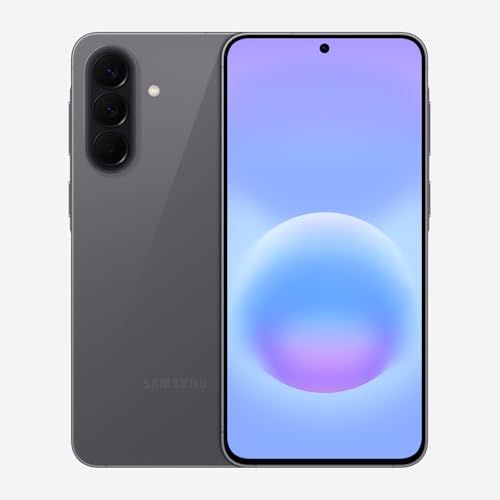
Samsung Galaxy A57 5G (2026), Unlocked Android Smartphone, 128GB — The warranted Samsung
If the A56 is the traveller, the A57 is the settler — and its title reads like a certificate of domestic respectability. Unlocked Android smartphone, 128GB, AMOLED display, triple camera, IP68, a 5000mAh battery, US version, and a one-year US warranty, in Awesome Gray, dated 2026. Nearly every anxiety an outright purchase can carry is answered somewhere in that sentence. The warranty is a named, domestic one. The water and dust resistance carries a proper printed grade — IP68 is the serious end of sealing, the rating that speaks of surviving immersion rather than merely shrugging at rain. The battery figure is stated rather than implied.
IP68 deserves its paragraph, because it changes how a phone is lived with. A handset sealed to that grade stops being an object that must be rescued from the kitchen counter’s splashes, the garden’s drizzle and the beach bag’s sand. It can be rinsed, within reason, when life gets on it. For households whose phones work for a living — on sites, in kitchens, around children and animals — that sealing is worth more than a camera mode, and its presence in a mid-range outright phone is a marker of how far this category’s standards have climbed.
The trade against its sibling is equally plain: 128GB rather than 256GB, and no dual-SIM headline. For a household whose photographs back up regularly and whose life runs on one number, neither absence will ever be felt, and what is gained in exchange — the warranty’s clarity, the sealing’s confidence, the domestic version’s straightforward support story — is felt every time the phone is dropped in a puddle or a question needs asking. Samsung sells certainty here, and certainty, bought outright, is a perfectly rational thing to spend on.
There is also a timing note embedded in the title’s 2026 date: this is the current model year of the line, which matters to outright owners more than to anyone. A phone bought in full at the start of its maker’s attention receives the longest support runway its line will offer, and pairing that runway with a domestic warranty makes the A57 the conservative portfolio choice of this guide — the pick least likely to produce a surprising sentence in any future conversation about it.
Picture the A57 at work and its specification stops looking like a list. It is the phone that takes the photograph of the finished job in the rain, that survives the flour-dusted counter and the sandy toolbox, that gets wiped down at the end of the day and charged without ceremony. AMOLED screens flatter site photographs and video calls alike, and the triple camera covers the wide scene and the close detail a working day asks for. Samsung aimed this handset at people whose phones are tools; the IP68 grade and the domestic warranty are simply that aim, written in the language of specifications.
- Lock status: unlocked, per the listing title
- Storage: 128GB, per the title
- Display and camera: AMOLED display; triple camera, per the title
- Sealing: IP68, as stated in the title
- Battery: 5000mAh, per the title
- Origin and warranty: US version with US 1-year warranty, per the title; RAM not stated in the title — verify on the listing page
Strengths
- IP68 sealing suits working, splashing, sandy lives
- Domestic version with a stated one-year US warranty
- Current model year gives the longest support runway
Trade-offs
- 128GB is half its sibling’s storage
- No dual-SIM headline for two-number households
- RAM figure needs confirming on the listing page
Best for: a household that values warranty clarity and serious sealing
Not suited for: a two-SIM traveller, who should take the A56 instead
Warranty wording rewards a first-hand read: inspect the Galaxy A57 listing and its stated terms.

Nothing Phone (2a) Smartphone Unlocked 5G Android Phone — The design-led alternative
Nothing is the youngest maker in this guide, and the Phone (2a) carries the energy of a company still introducing itself. Its title assembles a specification that would flatter phones far above this tier: a Dimensity 7200 Pro processor, a 50MP dual camera, a 6.7-inch AMOLED display, a 5000mAh battery, NFC for the tap-to-pay life, and — the figure that should make the whole guide sit up — 12GB of RAM paired with 256GB of storage, in the pale Milk finish. Twelve gigabytes of working memory is the largest figure printed in any title here, and it is not a vanity number: it is headroom that keeps a phone’s interface unhurried deep into its ownership.
The brand’s other argument is software temperament. Nothing’s take on Android is famously restrained — a distinctive dotted visual language over a system kept close to clean Android’s clarity, without the layers of duplicated apps that crowd some rivals. For an outright owner, that temperament has a practical edge: a lighter system ages more gracefully on the same hardware, and the phone’s personality comes from design rather than from bloat. The transparent-back design language the brand is known for gives the object an identity no other pick here attempts; in a category of black rectangles, the (2a) is recognisably itself across a room.
The honest caveats are about ecosystem rather than hardware. A young brand’s support network, accessory shelf and repair story are thinner than Samsung’s or Google’s, and an outright owner — who cannot lean on a carrier shop — should weigh that thinness at purchase time. The listing’s own terms are the place to confirm what backing stands behind this unit. Set against that, the specification per unit of commitment is the boldest in this guide, and households comfortable buying from the newer name have historically been rewarded for the nerve.
Consider, finally, who this phone flatters. It suits the owner who notices design, who keeps a phone for its full life and wants that life to feel current, and who will use the memory headroom the way it begs to be used — many apps, much switching, no tidying. In a guide about owning phones outright, the (2a) is the pick that most feels like a possession rather than an appliance, and for some households that feeling is not decoration at all. It is the reason the phone will still be liked in year three.
A final consideration belongs to the household’s other devices. NFC in the title means the (2a) participates fully in the tap-to-pay, tap-to-pair economy that now runs transit gates, shop counters and headphone connections; a phone without it feels oddly excluded from modern errands. The big battery and the efficient processor generation named in the title point the same way — toward a handset that spends its day doing errands rather than looking for sockets. Nothing’s youth shows in its support network, not in its understanding of what a phone is for.
- Lock status: unlocked 5G, per the listing title
- Memory: 12GB RAM and 256GB storage, as stated in the title (listed as 12+256GB)
- Display: 6.7-inch AMOLED, per the title
- Camera: 50MP dual camera, per the title
- Battery and extras: 5000mAh; NFC, per the title
- Colour of this listing: Milk
Strengths
- Largest stated RAM in this guide, with generous storage to match
- Clean, distinctive software and design identity
- NFC and a big battery cover the practical bases
Trade-offs
- Young brand’s support and accessory ecosystem is thinner
- Design language will not suit every taste
- Warranty terms should be read on the listing before purchase
Best for: a design-aware owner who multitasks heavily and keeps phones long
Not suited for: a household that wants the deepest support network behind its phone
Smaller brands reward a careful read of the fine print: go through the Nothing Phone (2a) listing in full.
How do the six outright phones compare on storage, support and freedom?
An owned phone should be compared like an owned anything: by how much room it gives you, how long its maker stands behind it, and how freely it can move. The table reads the titles, nothing more.
| Pick | Storage as listed | RAM as listed | Freedom and backing | Standout trait |
|---|---|---|---|---|
| Pixel 9a 128GB Peony | 128GB | 8GB | Unlocked | The balanced default |
| Pixel 9a 256GB Obsidian | 256GB | Not stated in title | Unlocked | Room for the family archive |
| Pixel 10a | 128GB named | Not stated in title | Unlock status not stated — verify | 7 years of Pixel Drops |
| Galaxy A56 5G | 256GB | 8GB | Unlocked, dual SIM, international | 120Hz AMOLED, two SIMs |
| Galaxy A57 5G | 128GB | Not stated in title | Unlocked, US version, 1-year US warranty | IP68 sealing |
| Nothing Phone (2a) | 256GB | 12GB | Unlocked | Largest memory pairing here |
What does owning a phone outright actually change each month?
The visible change is the bill: service becomes a standalone, shoppable item, and households discover how much of the old monthly figure was handset rent wearing a service costume. SIM-only arrangements compete for an owned phone’s business in a way they never could for a financed one, because the phone is free to leave. That freedom disciplines the market on the household’s behalf, month after month, without the household lifting a finger beyond the occasional comparison.
The invisible changes are behavioural. An owned phone is repaired rather than replaced when its screen cracks, because no upgrade schedule is whispering otherwise. It is handed down without paperwork. It travels abroad with a local SIM bought at an airport kiosk — the dual-SIM A56 turns that trick into a settings toggle — rather than with a roaming package negotiated in advance. Ownership converts the phone from a subscription with a screen into a tool with a lifespan, and households tend to care for tools they own in a way they never cared for devices they were renting.
There is a subtler monthly change, too: the upgrade itch loses its schedule. Contract life trains households to replace phones when the paperwork says so, which is rarely when the phone says so. An owned handset is replaced when its battery fades, its support ends or its owner simply fancies a change — decisions made by the household’s calendar rather than a billing cycle’s. Phones kept on their owners’ terms tend to be kept longer, chosen better and liked more, and the six titles in this guide were selected with exactly that longer, calmer ownership in mind.
How long should a phone bought in full be expected to serve?
Plan around the maker’s attention, because that is the real lifespan. Hardware in this tier is durable enough to outlast its welcome; what expires is software support — the updates that keep banking apps working and security intact. The titles here print the extremes of that story: the Pixel 10a promises seven years of Pixel Drops, the longest commitment in the guide, while other listings leave support duration unstated, which is itself information. A household buying for a six-year horizon should weight printed support promises heavily; a household that upgrades every three years can treat them as background.
Battery ageing is the second clock, and it ticks for every phone in this guide equally. A handset charged nightly will hold noticeably less of its charge by year three or four, which is why the generous battery figures in several titles matter to long-keepers, and why an owned phone’s mid-life battery service can be a rational expense rather than a defeat. Judge an outright purchase as a small fleet decision — purchase, mid-life maintenance, eventual hand-me-down — and the category’s value stops being a slogan and becomes a schedule.
Which mistakes follow people into outright phone buying?
The classic is importing contract habits: choosing the phone by its monthly-looking price in a comparison table, or waiting for a carrier promotion to bless the purchase, when the outright market rewards simply buying the right handset at a fair moment. The second is neglecting the paperwork column — region, warranty, SIM arrangement, unlock status — because those lines decide the ownership experience while the camera specifications decide only the photographs. The third is underbuying storage to save a small difference today, then paying for that saving monthly in housekeeping and deleted memories across years.
Two quieter errors complete the set. Households forget that an owned phone needs its own arrangements for the accidents of life — a case from day one, and a decision made in advance about repair versus replace — because no carrier programme is standing behind it by default. And shoppers assume unlocked means universally compatible, when the accurate statement is narrower: unlocked means free to join a service, with the service’s own requirements still to be confirmed, as the A56 and 10a reviews above insist. Outright buying rewards readers; the titles in this guide were written to be read.
What should be arranged in the first week of owning a phone outright?
Ownership comes with a small administration of its own, and the first week is when to do it. Fit the case before the phone’s first outing, not after its first fall; the outright owner’s repair bill is their own, and a case is the cheapest insurance in the entire purchase. Register or record the warranty position while the listing and the receipt are still in front of you — screenshot the terms, save the order confirmation somewhere that is not only the phone itself, and note the date the cover runs to. A warranty nobody can find is a warranty in name only.
Then set the phone free properly. Confirm it works on the household’s chosen service with a real call, a message and a data session away from home Wi-Fi, because an outright phone’s freedom is only real once it has been exercised. Move the photographs and contacts across in one deliberate sitting, set the backup running, and put the old handset — charged, wiped when ready — into the drawer as the household spare. A week spent this way converts a purchase into an arrangement, and arrangements are what outright ownership is for.
How does an owned phone change the hand-me-down conversation?
It removes the permission slip. A contract phone passed to a teenager or a parent carries its paperwork with it — whose name, whose account, whose upgrade is being spent. An owned phone is simply given, the way a bicycle is given, and the recipient’s service can be as modest as their needs dictate. That simplicity has a quiet economic side: households that hand phones down deliberately extract three, four, five years of service from a single purchase, and the second owner of a well-chosen handset like the 256GB 9a or the (2a) receives a device with real life left in it rather than a favour that feels like one.
The etiquette is worth one paragraph. Wipe the phone properly before it changes hands, so the gift is the hardware and not the archive; set it up with its new owner rather than merely handing it over; and pass along the case, the charger and the warranty note from that first week. A hand-me-down done this way reads as generosity. Done carelessly — full storage, a stranger’s photographs, a mystery account still signed in — it reads as disposal, and the phone’s second life starts with a chore instead of a pleasure.
Which specification matters most once the phone is yours?
Storage, and it is not close. Processors in this tier are all adequate for the daily round, cameras differ in character more than in competence, and screens have converged on good. Storage is the one specification that cannot be renegotiated after purchase — on most of these handsets it is fixed at the factory — and the one whose shortage announces itself at the worst moments. That is why the storage figure appears in every spec box in this guide and keeps resurfacing in the reviews: of all the numbers in all six titles, the storage line is the one a household will still be living with in year four.
Final Recommendation
Let the household’s biography choose. The Pixel 9a in Peony is the calm default for a first outright purchase, and its Obsidian sibling is the same phone for the family that films everything. The Pixel 10a, once its unlock status is verified on the listing, is the long-keeper’s runway — seven years of maker attention is a rare thing to be able to buy. Samsung’s pair divides by passport: the A56 for the two-SIM, two-country life with its homework done, the A57 for the household that wants a domestic warranty and IP68 certainty. The Nothing Phone (2a) rewards the design-aware multitasker with the most memory in the guide. Whichever name wins, the deeper victory is the same: a phone that is yours, a service that must earn you monthly, and a bill that never again hides one inside the other.
One closing thought for households still hesitating at the threshold of this category: the first outright phone is the hard one, because it asks for the whole sum at once while the old arrangement still whispers in monthly figures. Every phone after it is easier, because the household has felt the freedom once — the shopped service, the handed-down handset, the upgrade taken on its own schedule — and freedoms, once felt, are rarely handed back. Choose from these six with your paperwork read and your storage sized honestly, and the category will do the rest of the persuading itself.
Frequently Asked Questions
Does buying a phone outright mean giving up a good service deal?
Usually the opposite. Carriers and smaller providers compete hardest for customers whose phones are already paid for, because those customers can leave at any time, and SIM-only arrangements are priced with that freedom in mind. The household’s leverage comes precisely from the separation this guide is about: the handset is settled, so every service conversation starts from a position of being able to walk away. Keep the phone long enough and the service savings typically become the largest single number in the whole arrangement.
How can we be sure an unlocked phone will work on our carrier?
Unlocked means the phone is not tied to a seller’s network; it does not, by itself, guarantee a particular carrier will activate it. The reliable sequence is to take the exact model from the listing, check it against the carrier’s own compatibility tools or support line, and only then pay. That discipline matters most for the international A56 and for the Pixel 10a, whose title leaves unlock status unstated — in both cases the check is short, free and decisive, and it converts a hope into a fact before money moves.
Is 128GB enough, or is 256GB the honest choice?
It depends on the camera roll’s behaviour, which every household can inspect in a minute on its current phone. Stills, messages and a normal app shelf live comfortably in 128GB for years, especially with any kind of backup habit. Video changes the arithmetic brutally: frequent filming, downloaded films for travel and big games can make 256GB the calmer purchase, which is why both the 9a and the A56 offer it. The rule of thumb is to buy for the household’s actual archive, not its aspirations.
What does an international model change about warranty and support?
It changes whose paperwork governs. An international handset like the A56 is sold for the world market, so its warranty handling follows the listing’s own terms rather than a domestic programme, and its network design targets global bands rather than one country’s specifics. Neither fact is a defect, and travellers may find the arrangement preferable. It simply must be bought knowingly: read the warranty wording on the listing, confirm the bands your home service needs, and the international model becomes an informed choice instead of a surprise.
Why do update promises matter more for an owned phone?
Because the owned phone’s life is not interrupted by an upgrade cycle. A financed phone is typically replaced when its payments end, whatever its software state; an owned phone is kept until it stops serving, and the day it stops serving is usually the day its maker stops updating it — apps withdraw support, security patches end, and the hardware’s remaining health becomes irrelevant. The Pixel 10a’s printed seven years of Pixel Drops is therefore not a flourish. For a long-keeper, it is the product.
Should an owned phone still be insured or covered somehow?
That is a household judgement rather than a rule, and it hinges on the cost of the worst day. An owned phone’s screen repair or replacement comes out of the household’s pocket, so households that would feel a sudden replacement as a genuine blow should price a case, a screen protector and, if the numbers suit, a standalone cover arrangement in the first week. Households that keep the old handset as a charged spare — this guide’s recurring advice — already own the most practical insurance policy in the category: a working phone in the drawer, ready the same evening.
Related Guides
Continue with our guide to pairing an owned phone with a SIM-only plan, the explainer on reading phone warranty and region terms before buying, and our comparison of mid-range phones built to be kept for years.
Related guides
- Best 3D Art Tablets
- Best Balancing Stabilizers for Mirrorless Cameras: Payload, Balancing and Native Vertical Shooting
- Best Canon Point and Shoot Digital Cameras: PowerShot Picks From Pocket Compacts to Travel Zooms
- Best Basic Phones Camera Buyers Can Trust: Flip Phones and Simple Handsets That Still Take a Photograph


