What's inside
- Key Takeaways
- Quick Picks
- How did we measure bang for buck without printing a single price?
- How do the locked and unlocked value picks stack up side by side?
- What separates real value from a cheap phone in disguise?
- How should a household choose between the locked and unlocked paths?
- Which value traps catch Verizon shoppers most often?
- What does a year of ownership reveal that a shop visit cannot?
- How should the case, the charger and the spare be budgeted into value?
- Final Recommendation
- Frequently Asked Questions
- Related Guides
As an Amazon Associate I earn from qualifying purchases. This post may contain affiliate links at no extra cost to you.
gizmoverdict.com is reader-supported. When you buy through links on our site, we may earn an affiliate commission.
Where to buy: The six phones below are current Amazon listings, checked for this guide, split between Verizon Prepaid’s own locked handsets and unlocked phones that can be brought to a Verizon line once activation is confirmed.
Value means something specific in the hunt for the best bang for your buck smartphones Verizon shoppers can actually use. It is not the cheapest handset on the shelf, and it is not the flagship on promotion either. It is the phone where each unit of money lands on something felt daily — a screen that stays readable at the bus stop, a camera that rescues the badly lit family photograph, a battery that removes the charger from the day’s planning — rather than on a specification that exists to win a comparison table and is never noticed again. Hold that definition tightly, because the phone market’s loudest voices will spend the whole shopping trip trying to loosen it.
Verizon adds a fork in the road that this guide refuses to blur. Down one path sit the carrier’s own prepaid handsets: three of the picks below are sold locked to Verizon Prepaid, priced and packaged for that service, with their lock status printed in their titles. Down the other path sit unlocked phones — a Pixel, a Galaxy A36, a TCL — which are nobody’s property but their owner’s and can be brought to a Verizon line, provided the household does the one piece of homework unlocked phones always require: confirming that the exact handset will activate on the line in question. Both paths can deliver outstanding value in the right hands. They deliver it to different households, and the reviews below keep the paths separate so nobody buys a locked phone expecting freedom, or an unlocked phone expecting a carrier’s welcome mat to be automatic.
Bang for buck also has a time dimension that prepaid and unlocked shoppers feel more keenly than contract households. A phone’s value is its price divided by its years of good service, and the denominator is where cheap phones go to die: storage that fills in year one, a battery that fades in year two, support that wanders off in year three. Every pick below was chosen to defend its denominator — with 128GB of storage across the whole shortlist, with batteries sized for real days, and with makers whose mid-range phones are treated as citizens rather than bait. That defence is the thread to hold while reading: whenever a review praises a screen or a camera, it is really praising the years that screen or camera will go on being praised for, in a kitchen, on a road, at a school concert, long after the unboxing photographs have been forgotten.
Our Top Picks
Key Takeaways
- Three picks are locked to Verizon Prepaid; three are unlocked and need an activation check before joining a Verizon line.
- Every pick in this guide carries 128GB of storage — the value floor this shortlist refuses to go below.
- The Galaxy A17’s title claims optical image stabilisation on its 50MP triple camera, a feature rarely printed at this tier.
- The Moto g Power’s multi-day battery pitch is the endurance headline among the locked picks.
- TCL’s NXTPAPER display is the comfort play: a big 120Hz panel designed to be easy on the eyes for long reading.
- Value is a ratio, not a price — years of service divide the cost, so support and storage matter as much as the sticker.
Quick Picks
| Pick | Badge | Why it earns its place |
|---|---|---|
| Verizon Prepaid Samsung Galaxy A16 5G, 128GB (Locked to Verizon Prepaid) | The screen-value pick | An FHD+ Super AMOLED panel and a 50MP triple camera inside Verizon Prepaid’s own range. |
| Verizon Prepaid Moto g Power 2025, 128GB (Locked to Verizon Prepaid) | The battery-value pick | Motorola’s Power formula — multi-day battery, 50MP camera, 90Hz screen — on Verizon Prepaid. |
| Verizon Prepaid Samsung Galaxy A17 5G, 128GB (Locked to Carrier) | The camera-value pick | A 50MP triple camera with OIS and Android 16, the freshest software headline in the locked group. |
| Google Pixel 9a with Gemini | The unlocked camera pick | Google’s photo intelligence in Porcelain, free to join any line that will activate it. |
| Samsung Galaxy A36 5G A Series, 128GB Unlocked Android Smartphone | The unlocked all-rounder | A US-version Galaxy with a warranty, a rugged design pitch and an AMOLED screen. |
| TCL 60 XE NXTPAPER 5G Unlocked Android Phone, 6.8″ 120Hz Display, 8+128GB | The reading-comfort pick | The biggest screen here, tuned by TCL’s NXTPAPER approach for long, easy reading sessions. |
How did we measure bang for buck without printing a single price?
Prices move too quickly to be the foundation of a guide, so value was measured in the currency that does not move: what the handset returns every day. Each candidate was scored in the mind against the four daily dividends — screen, camera, battery, storage — and against the two slow ones, support lifespan and freedom of movement. A phone strong in the daily four and respectable in the slow two is value. A phone that wins one spectacular category while starving the rest is a story, not a recommendation.
The daily four deserve one refinement, because households weight them differently and should. Screen quality is the dividend of the reader and the watcher; camera quality belongs to the family’s memory-keeper; battery belongs to the traveller, the tradesperson and the forgetful; storage belongs to everyone eventually, which is why it became the floor rather than a variable. A household honest about its own weightings can read the six reviews below as six different answers to its own question, and the guide’s tables are arranged to let those weightings, rather than any house ranking, do the choosing.
The Verizon question was handled as a gate rather than a score. Locked picks had to state their allegiance plainly, and they do — the words are in their titles. Unlocked picks had to be phones a household could plausibly bring to Verizon’s network, with the activation confirmation treated as a step in the purchase rather than a detail to skip. Nothing in this guide asserts that a specific unlocked handset is guaranteed a place on a specific line; that guarantee is the carrier’s to give, and the reviews say where to ask for it.
One more measurement deserves naming, because it quietly eliminated more candidates than any other: the cost of the second year. A handset whose service arrangement, storage or support forces a replacement, an upgrade or an apologetic workaround in its second year has spent its value already, whatever its first year felt like. The survivors below all project a calm second year — room left, charge left, updates still arriving — and a calm second year, multiplied across a household’s phones, is where bang for buck stops being a slogan and becomes a bank balance.
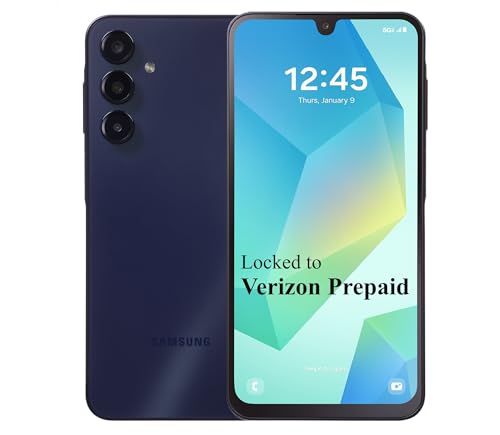
Verizon Prepaid Samsung Galaxy A16 5G, 128GB (Locked to Verizon Prepaid) — The screen-value pick
Begin the value argument where this phone begins it: the display. A 6.5-inch FHD+ Super AMOLED panel at 90Hz is hardware that, not long ago, lived several price tiers above the prepaid aisle, and its presence here is the single largest daily dividend in the locked half of this guide. FHD+ resolution keeps small text honest; AMOLED contrast keeps photographs and video rich in the mixed light of real life; the 90Hz refresh keeps scrolling composed. A phone is looked at for hours a day, and money spent on the thing being looked at is the least wasted money in any handset budget.
The camera backs the screen up rather than apologising for it: a 50MP triple camera, where triple means the wide everyday shot has company — the broader scene and the closer detail that single-camera prepaid phones simply decline. Storage sits at the guide’s 128GB floor, which in practice means the camera can be used the way its specification invites, freely, without a monthly eviction meeting. The battery is described in the title as long-lasting without a printed figure, and the spec box records that phrasing faithfully; households for whom battery is the first question should read the Moto g Power’s review next, because that is where this guide’s endurance argument lives.
The lock is the term of the value, and it is printed without decoration: locked to Verizon Prepaid. That means this screen and this camera are bought together with a commitment to Verizon’s prepaid service, and the value calculation must include the household’s contentment with that service — its coverage on their roads, its fit with their usage. For a household already settled there, the A16 converts prepaid’s usual compromises into something close to a flagship’s daily experience, and that conversion is precisely what bang for buck means on the locked path.
One more angle completes the case: longevity of satisfaction. Phones are usually replaced not when they break but when they begin to feel poor — the screen that looks dull beside a friend’s, the camera that embarrasses at a family event. A handset whose display and camera start this far ahead postpones that feeling by years, and every postponed replacement is value compounding quietly in the household’s favour. The A16’s specification is not merely good for its aisle; it is defensive, bought against the day a lesser phone would have started to feel like a compromise.
Picture this phone at a school concert, because that is where its two headline features conspire. The AMOLED panel stays legible in a dark hall without blasting the neighbours with brightness, and the triple camera gives the distant stage a fighting chance while the photographer’s neighbours make do with a single fixed view. Nobody buys a prepaid handset for concert duty, yet family life keeps scheduling exactly that duty, and the A16 is the locked pick best dressed for it. Value hides in these unplanned moments more often than in any specification table.
- Lock status: locked to Verizon Prepaid, per the listing title
- Display: 6.5-inch FHD+ Super AMOLED at 90Hz, per the title
- Camera: 50MP triple camera, per the title
- Storage: 128GB, per the title
- Battery: described as long-lasting in the title; capacity not stated — verify on the listing page
- Colour of this listing: Black
Strengths
- Finest display available among this guide’s locked picks
- Triple camera covers wide, standard and close work
- Specification that postpones the itch to upgrade
Trade-offs
- Verizon Prepaid lock excludes every other service
- Battery capacity must be confirmed on the listing page
- No service bundle is folded into this listing
Best for: a Verizon Prepaid household that reads, photographs and watches on its phone daily
Not suited for: anyone whose Verizon relationship is a contract account rather than prepaid
Screen claims deserve a look at the full listing before the decision hardens: examine the Galaxy A16 Verizon Prepaid listing.
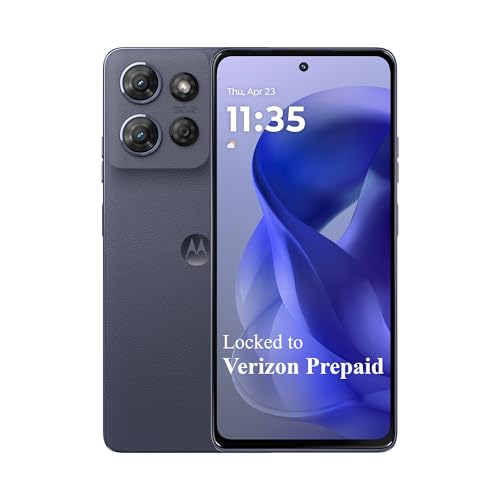
Verizon Prepaid Moto g Power 2025, 128GB (Locked to Verizon Prepaid) — The battery-value pick
Motorola’s Power line has one idea, executed for years with increasing polish: the battery is the feature. This 2025 edition on Verizon Prepaid states the idea in its title as a multi-day battery, and everything else in the specification is arranged so the idea can be true — a 50MP camera for the day’s photographs, a 6.6-inch display at 90Hz for the day’s reading, 128GB of storage for the day’s accumulations, and 5G for the day’s errands. A phone that ends the evening with charge to spare changes its owner’s behaviour in a way no camera mode can: it gets taken places, used freely, and trusted.
Trust is the right word for what endurance buys. The phone in the glovebox for the long drive, the phone carried through a festival weekend, the phone of the grandparent who charges on Sundays — these are phones whose owners have stopped performing battery arithmetic, and that freedom is a daily dividend as real as any screen statistic. Multi-day is the title’s phrase and this review keeps it in the title’s terms; the precise capacity figure is a listing-page detail. What the line’s long history supports is the intent: this handset was designed around going longer, and its specification makes room for that design at every turn.
The Verizon Prepaid lock frames the purchase exactly as it framed the Samsung above: the endurance is bought together with allegiance to one prepaid service. For households whose lives run on that service — and whose usage includes the long days, the rural roads and the forgotten chargers that make battery the first specification — the exchange is heavily in their favour. Cosmic Black, the listing’s finish, suits the phone’s temperament: unshowy, work-ready, unbothered.
Value shoppers should also note what the Power does not spend on. There is no stabilisation headline, no display-resolution trophy, no design theatre. The money visibly went to the battery, the storage and a competent camera, which is the correct allocation for the household this phone serves — one that measures a handset by the evenings it does not ruin. In a guide devoted to bang for buck, the Moto g Power is the purest expression of the idea on the locked path: spend where the day is lived.
There is a winter-morning test that endurance phones pass and others fail: the car will not start, the phone is the torch, the map, the call for help and the wait’s entertainment, all on whatever charge the night happened to leave. A multi-day battery turns that morning from a rationing exercise into a non-event. Households in cold country, on rural roads or in jobs that end far from sockets will recognise the scenario instantly, and for them the g Power’s headline is not a luxury statistic. It is the phone’s whole personality, and it is priced into a prepaid handset, which is the surprise this guide exists to report.
- Lock status: locked to Verizon Prepaid, per the listing title
- Battery: multi-day battery, per the title; exact capacity not stated — verify on the listing page
- Camera: 50MP, per the title
- Display: 6.6-inch at 90Hz, per the title
- Storage: 128GB, per the title
- Model year and finish: 2025; Cosmic Black
Strengths
- Endurance-first design removes daily charging anxiety
- 128GB storage matches the guide’s value floor
- Specification budget spent on lived experience, not theatre
Trade-offs
- Locked to Verizon Prepaid for its working life
- Exact battery capacity requires a listing-page check
- Camera lacks the stabilisation headline of the A17 below
Best for: long days, long roads and owners who charge when they remember
Not suited for: a household planning to leave Verizon Prepaid within the year
Endurance claims are best read alongside the listing’s full specification: look at the Moto g Power 2025 prepaid listing.

Verizon Prepaid Samsung Galaxy A17 5G, 128GB (Locked to Carrier) — The camera-value pick
Three letters in this title do the heavy lifting: OIS. Optical image stabilisation on the 50MP triple camera means the lens assembly physically steadies itself against the tremor of a human hand, and the photographs that benefit are precisely the ones prepaid phones usually lose — the indoor birthday shot, the evening street, the grandchild who will not hold still under imperfect light. Stabilisation is a flagship habit that has wandered down into this tier, and its presence in a Verizon Prepaid listing is the strongest single camera-value claim in this guide.
The rest of the title keeps pace. A 6.7-inch Super AMOLED display at 90Hz is the largest screen among the locked Samsung pair, trading the A16’s finer FHD+ resolution for size — a trade readers of small text should weigh in the A16’s favour and viewers of video in the A17’s. Android 16 is named outright, the freshest software headline in this guide, which matters to an outright-minded prepaid household because a phone bought today should start its support life at the front of the queue, not a version behind it. Storage holds the guide’s line at 128GB, in Black.
The lock wording here is the generic “locked to carrier” in the title’s parentheses, with the listing’s Verizon Prepaid branding doing the naming. Read it as what it is: a Verizon Prepaid handset, committed like its stablemates. Households choosing between the two locked Samsungs are really choosing a photographic philosophy — the A16’s finer screen for the reader, the A17’s steadied camera and bigger panel for the photographer and the viewer — and that is a pleasant kind of decision, the kind value shopping is supposed to produce.
There is a future-proofing footnote worth adding. A camera that handles today’s difficult light gracefully tends to age well, because photographic demands grow slowly while app demands grow fast; pairing that camera with the newest Android version in the guide gives this handset two separate kinds of runway. For a household that keeps phones until they genuinely stop serving, the A17’s combination — stabilised camera, current software, big AMOLED, honest storage — is the locked path’s most complete argument.
The A17 also benefits from a generational courtesy: buying the current model at the start of its life on the prepaid shelf. Prepaid ranges often trail the wider market by a season, so a handset arriving with Android 16 already aboard is effectively a year younger than its shelf-mates, and that year shows up later as an extra season of updates, app compatibility and resale relevance. Value shoppers habitually hunt for exactly this accident of timing — the new model at the old model’s station — and the A17 is this guide’s instance of it.
- Lock status: locked to carrier, sold as a Verizon Prepaid handset, per the listing title
- Camera: 50MP triple camera with OIS, per the title
- Display: 6.7-inch Super AMOLED at 90Hz, per the title
- Software: Android 16, per the title
- Storage: 128GB, per the title
- Battery: not stated in the listing title — verify on the listing page
Strengths
- Optical stabilisation rescues low-light, unsteady-hand photographs
- Newest Android version named in this guide
- Largest display among the locked Samsung picks
Trade-offs
- Display resolution steps behind the A16’s FHD+ panel
- Battery figure absent from the title
- Carrier lock commits the household to Verizon Prepaid
Best for: a prepaid photographer whose best moments happen in poor light
Not suited for: a fine-print reader who prizes pixel density over screen size
Stabilisation is worth confirming in the listing’s own camera description: read the Galaxy A17 listing closely.

Google Pixel 9a with Gemini — The unlocked camera pick
Cross to the unlocked path and the value argument changes its accent. The Pixel 9a’s title promises an unlocked Android smartphone with an incredible camera and AI photo editing, all-day battery and powerful security, in Porcelain at 128GB. Google’s confidence about the camera is the line’s founding claim: the a-series exists to carry flagship photographic intelligence into handsets that ordinary households buy outright, and the editing tools named by implication — the software that rescues the photobombed, badly lit, almost-great shot — are where that intelligence shows itself weekly rather than yearly.
For a Verizon household, the unlocked status cuts both ways and both ways deserve print. The freedom is real: this phone can join a Verizon line, leave it, join another carrier, serve as a spare, be handed down — the whole outright itinerary — without asking any network’s permission. The duty is equally real: an unlocked phone must be confirmed as activatable on the specific Verizon line it is destined for, through the carrier’s own compatibility check, before the household relies on it. This guide states that duty in every unlocked review because the five minutes it takes are the difference between freedom and a returns process.
Gemini’s presence in the name signals where Google believes value is moving: toward assistance. The phone that drafts the message, summarises the thread and edits the photograph is selling time rather than specifications, and for busy households that trade can be the best value in this guide — provided the household actually uses the help. Porcelain, the pale finish, gives the object a calm, ceramic quality that suits its temperament: this is the thoughtful phone in the shortlist, the one whose specification sheet undersells its daily usefulness.
Judge it against the locked Samsungs and the philosophical split of this guide becomes vivid. The Samsungs offer their excellence inside one service’s walls, with the walls clearly marked. The Pixel offers its excellence in the open, with one verification errand attached. Households that know they will stay with Verizon for years can bank the locked phones’ simplicity; households whose lives might move should pay the Pixel’s small errand and keep the door unlocked behind them.
The Pixel’s editing tools deserve a concrete illustration, because their value is easy to file under gimmick. A family photograph is taken; a stranger crosses the background, a face blinks, the light through the window blows out one corner. The software this line is known for addresses exactly those three ordinary tragedies, after the fact, on the phone, without a computer or a subscription to anything. Multiply that rescue by every birthday, holiday and school event across the phone’s life and the editing suite stops being a feature and becomes a quiet archive-quality programme, running in the background of the family’s memory-keeping.
- Lock status: unlocked, per the listing title
- Storage: 128GB, per the title
- Camera pitch: camera and AI photo editing headline the title; sensor figures not stated — verify on the listing page
- Battery pitch: all-day battery, per the title; capacity not stated in the title
- Colour of this listing: Porcelain
- Verizon note: confirm activation of this exact handset on your Verizon line before relying on it
Strengths
- Photographic intelligence and editing are the line’s proven strengths
- Unlocked freedom across carriers and hand-me-downs
- Assistant features sell time back to busy households
Trade-offs
- Verizon activation must be confirmed by the household
- Camera and battery figures are pitched, not printed, in the title
- Value depends on using the software help on offer
Best for: a photography-first household that wants carrier freedom with its camera
Not suited for: anyone unwilling to run the activation check before switching lines
The compatibility question has a definite answer waiting at the carrier: note the exact Pixel 9a model from the listing, then confirm it.

Samsung Galaxy A36 5G A Series, 128GB Unlocked Android Smartphone — The unlocked all-rounder
The Galaxy A36 is the unlocked path’s Samsung answer, and its title is a small masterpiece of reassurance: 128GB, unlocked, AMOLED display, rugged design, 5G connectivity, affordable performance, US version, 2025, a one-year US warranty, in Awesome Lime. Where the A56 in this programme’s wider family asked for homework, the A36 offers paperwork already done — a domestic version with a domestic warranty, sold for a domestic household that wants its phone’s backing to be as straightforward as its screen.
Affordable performance is the phrase to take seriously, because it describes a tuning philosophy rather than an apology. The A36’s engineering aims at the daily round executed without drama — messages, maps, photographs, video, the two dozen ordinary miracles a phone performs before lunch — and an AMOLED display lifts that round visually in the way Samsung’s panels reliably do. Rugged design, in the title’s words, speaks to a handset built to be carried by people whose days are not gentle: the school run, the site visit, the dog walk in February.
Awesome Lime deserves its moment, because colour is a value feature in a phone kept for years. A lime handset is findable — in bags, in grass, in the footwell of a car — in a way black handsets theatrically are not, and it signals an owner who chose rather than accepted. Households buying for teenagers have understood this forever; the A36 simply extends the courtesy to everyone. Pair the colour with the warranty and the US-version clarity and the phone reads as the unlocked path’s family choice: cheerful on the outside, conservative in its paperwork.
Against the Pixel, its unlocked rival here, the A36 trades photographic intelligence for Samsung’s hardware polish, display quality and support familiarity. Neither trade is wrong; they describe different households’ priorities with unusual clarity. What both unlocked picks share is the activation duty on a Verizon line — confirm first, then enjoy the freedom — and what the A36 adds is the comfort of a warranty written for the country the phone will live in.
One underappreciated virtue of the domestic Galaxy route is the ecosystem that surrounds it without being asked. Cases, screen protectors, chargers and repair benches for a mainstream US Samsung model exist in every town in the country, and an outright owner — who arranges their own support — benefits from that ubiquity every time anything small goes wrong. A cracked protector is a five-minute errand rather than a postal saga. Value calculations rarely include the geography of spare parts, but households that keep phones for years learn to, and the A36 scores quietly and heavily on exactly that axis.
- Lock status: unlocked, per the listing title
- Storage: 128GB, per the title
- Display: AMOLED, per the title; size and refresh figures not stated — verify on the listing page
- Origin and warranty: US version with US 1-year warranty, per the title
- Design pitch: rugged design, per the title; sealing grade not stated in the title
- Colour of this listing: Awesome Lime; model year 2025
Strengths
- Domestic version with a stated one-year US warranty
- AMOLED display and a design pitched at ungentle days
- Colour that can actually be found when dropped
Trade-offs
- Display details require a listing-page confirmation
- Photographic software is Samsung’s, not the Pixel’s party trick
- Verizon activation check still applies, as with all unlocked picks
Best for: a family phone that needs warranty clarity and a bit of cheer
Not suited for: a photography perfectionist, who should take the Pixel’s software instead
The warranty line is the detail to savour before checkout: go over the Galaxy A36 listing once, carefully.

TCL 60 XE NXTPAPER 5G Unlocked Android Phone, 6.8″ 120Hz Display, 8+128GB — The reading-comfort pick
TCL’s entry is built around a single, unusual conviction: that a phone screen should be pleasant to look at for hours, not merely impressive for minutes. The NXTPAPER name in the title refers to the company’s paper-like display approach — a matte, glare-taming treatment developed across its tablet and phone lines — here applied to the largest panel in this guide, 6.8 inches refreshing at 120Hz. For the household member who reads long articles, follows serialised fiction on a phone, or works through documents on trains, that combination of size, smoothness and reduced glare is a daily dividend no benchmark captures.
The supporting specification is complete rather than token: 8GB of RAM with 128GB of storage in the stated 8+128GB pairing, a 50MP main camera for the day’s photographs, a 5010mAh battery with its figure printed plainly — a courtesy several pricier rivals in this guide decline — and AI tools named in the title as part of the package. Unlocked status completes the picture: this is a phone free to join a Verizon line once activation is confirmed, or to live on any other service the household prefers, which suits TCL’s role here as the unlocked path’s comfort specialist.
Honesty requires noting what NXTPAPER trades away. A matte, paper-leaning panel does not chase the saturated punch of Samsung’s AMOLED displays; video looks calmer rather than more vivid, and households whose phone is primarily a pocket cinema should weigh the A36’s or the locked Samsungs’ panels accordingly. The trade is deliberate and, for readers, correct: comfort across a three-hour reading session outranks spectacle across a three-minute trailer. Value, once again, is a biography before it is a benchmark.
TCL’s wider position deserves a closing word. This is a maker whose fame was built on televisions — on panels, in other words — and the 60 XE reads like a panel-maker’s phone: the display is the argument, everything else is competently arranged around it, and the price discipline comes from a company that manufactures its own centrepiece. For the reading household on the unlocked path, that is a coherent and rather elegant kind of value.
The reading case deserves numbers of a human kind. A commuter reading forty minutes each way, a parent reading in bed after the house sleeps, a student working through set texts on the bus — these are hours of screen time weekly, and they are the hours in which glare and eye fatigue actually accumulate. A panel designed to soften that accumulation is not a novelty; it is occupational equipment for the reading life. The 60 XE’s other specifications merely had to be competent for the phone to earn its place here, and on the evidence of its title — memory, camera, battery all present and printed — they are comfortably more than that.
- Lock status: unlocked, per the listing title
- Display: 6.8-inch at 120Hz with NXTPAPER 3.0, per the title
- Memory: 8GB RAM and 128GB storage, as stated in the title
- Camera: 50MP main camera, per the title
- Battery: 5010mAh, per the title
- Verizon note: confirm activation of this exact handset on your Verizon line before relying on it
Strengths
- Paper-like display comfort for genuinely long reading
- Largest, fastest-refreshing screen in this guide
- Battery figure printed plainly in the title
Trade-offs
- Matte panel trades vividness for comfort
- Brand’s phone support story is younger than Samsung’s or Google’s
- Unlocked activation on Verizon still needs confirming
Best for: a reader whose phone is a book, a newspaper and a desk in one
Not suited for: a pocket-cinema household that wants maximum screen punch
Display comfort is a personal judgement, so weigh the panel description carefully: study the TCL 60 XE listing before choosing.
How do the locked and unlocked value picks stack up side by side?
Read the path column first. It decides the household’s homework and its freedom for the life of the phone; every other column is a pleasure to compare only after that one is settled.
| Pick | Path | Display as listed | Camera as listed | Standout trait |
|---|---|---|---|---|
| Galaxy A16 5G (Verizon Prepaid) | Locked to Verizon Prepaid | 6.5″ FHD+ Super AMOLED 90Hz | 50MP triple | Finest locked screen |
| Moto g Power 2025 (Verizon Prepaid) | Locked to Verizon Prepaid | 6.6″ 90Hz | 50MP | Multi-day battery pitch |
| Galaxy A17 5G (Verizon Prepaid) | Locked to carrier | 6.7″ Super AMOLED 90Hz | 50MP triple with OIS | Stabilised camera, Android 16 |
| Pixel 9a | Unlocked — verify activation | Not stated in title | Camera with AI photo editing | Photographic intelligence |
| Galaxy A36 5G | Unlocked — verify activation | AMOLED | Not stated in title | US warranty, rugged pitch |
| TCL 60 XE NXTPAPER 5G | Unlocked — verify activation | 6.8″ 120Hz NXTPAPER | 50MP main | Reading comfort |
What separates real value from a cheap phone in disguise?
Time exposes the difference. A genuinely valuable phone is still pleasant in its third year: its storage has room, its battery survives its owner’s day, its software is still receiving its maker’s attention, and its camera has not become the family’s joke. A cheap phone in disguise front-loads its appeal into the unboxing — a big screen, a bold claim — and then taxes its owner monthly in small frustrations that never appear on a receipt. The six picks here were filtered by imagining their third years, which is why the shortlist is heavy on storage, battery intent and maker commitment, and light on spectacle.
The other separator is honesty of specification. Titles that print their figures — 128GB here, 5010mAh there, OIS in the camera line — let a household do its own arithmetic, while titles that trade in adjectives ask to be taken on faith. This guide has repeated the printed figures and flagged the adjectives wherever they appear, because value shopping is impossible in a fog. When two phones compete and only one of them will tell you its battery size, the one telling you has understood the assignment.
There is a third separator, and it is the household’s own behaviour after purchase. Real value survives contact with a family’s habits because it was chosen with those habits in view: the reader’s glare problem, the traveller’s charging problem, the photographer’s light problem. A phone chosen against a fantasy biography — the filming that never happens, the gaming that bores by February — wastes its strengths exactly as surely as a cheap phone wastes its price. The reviews below keep returning to biographies for this reason: value is not a property of the handset alone, but of the fit between the handset and the life it is bought into.
How should a household choose between the locked and unlocked paths?
Start with the household’s honest forecast. If the next several years look settled — same home, same roads, same satisfaction with Verizon’s prepaid service — the locked path converts that settledness into simplicity and into handsets packaged for exactly that life, with the A16, the g Power and the A17 dividing the honours by screen, battery and camera. There is no prize for freedom a household never uses, and the locked phones’ clarity about their allegiance is a form of respect.
If the forecast holds any weather — a possible move, a job that travels, a teenager who will take the phone to another state or another carrier’s territory — the unlocked path’s small errand buys an option on all of it. Run the carrier’s compatibility check on the exact model, keep the result, and then choose among the Pixel’s photographic intelligence, the A36’s warranted all-round polish and the TCL’s reading comfort. The check is five minutes; the option it buys lasts the phone’s whole life. Households should also weigh who else will own the phone eventually, because hand-me-downs flow downhill along the unlocked path and stop at the locked path’s wall.
Which value traps catch Verizon shoppers most often?
The first trap is assuming every Verizon-flavoured phone fits every Verizon account: the locked picks here belong to Verizon Prepaid specifically, and a contract household that buys one has purchased a paperweight with excellent specifications. The mirror trap catches unlocked shoppers who skip the activation check and discover a compatibility wrinkle after the old phone has been wiped. The third trap is judging value by the launch photograph — choosing the handset with the boldest single claim while its storage, battery or support quietly undermines the years that decide real value.
Two more complete the set. Shoppers compare the locked phones’ packaged simplicity against the unlocked phones’ sticker and forget to count the service arrangements each path implies, when the honest comparison is of whole arrangements over whole years. And households overlook the hand-me-down horizon: a phone that will serve a second family member doubles its value denominator, which quietly favours the unlocked picks and the roomier, better-supported handsets in either path. Value is arithmetic done over time, and time is the variable most often left out of the sum.
A final trap is subtler because it wears the costume of thrift: buying the value phone and then starving it. The handset arrives, but the case is postponed, the backup never switched on, the photographs never given a second home, the activation check on the unlocked pick deferred until the old phone is already gone. Each omission is small; together they convert a well-chosen phone into a fragile one, and the household ends up paying the difference between value and cheap after all — in repairs, in lost photographs, in a rushed replacement. The picks in this guide deserve their small supporting habits, and those habits are part of what their prices should be understood to include.
What does a year of ownership reveal that a shop visit cannot?
The shop visit reveals the screen’s brightness under shop lights and the camera’s behaviour across a shop. The year reveals the rest: whether the battery’s promise survives a winter, whether the storage floor holds against a real archive, whether the maker’s updates arrive as a rhythm or as a rumour, and whether the phone’s finish still pleases the hand that holds it daily. Every pick in this guide was chosen by projecting that year rather than that visit — the multi-day battery, the printed storage floor, the current Android version, the domestic warranty — because value is a property of years, and years are the one thing a shop cannot show you.
The year also reveals the household. Phones teach their owners what they actually do: the reading that dwarfs the filming, the filming that dwarfs the reading, the charging that never happens on schedule. A household that has lived a year with any handset here will know its own biography well enough to make the next choice — locked or unlocked, screen or battery, camera or comfort — in minutes. That self-knowledge is the final dividend of buying value properly the first time, and it compounds into every phone the household buys afterward.
How should the case, the charger and the spare be budgeted into value?
A phone’s true cost includes the small court that attends it, and value households count the court honestly. A case and a screen protector from the first week protect the resale and hand-me-down value that this guide keeps invoking; a decent charger at the place the phone actually sleeps prevents the battery behaviours that shorten a handset’s prime. None of these items is exciting, and all of them are cheaper than the single accident each one exists to prevent. The outright and prepaid worlds reward this kind of completeness, because nobody else is standing behind the phone — the household is the warranty department, the insurance scheme and the support desk, and equipping those roles properly is part of the purchase.
The spare deserves its line in the budget too, even when the spare is simply the previous phone kept charged in a drawer. A household with a working spare can repair a broken handset calmly instead of replacing it desperately, and calm repairs are where the real savings of the unlocked and prepaid life are banked. Count the drawer phone as an asset, keep its charger with it, and the value arithmetic of every pick in this guide improves without a single specification changing.
Final Recommendation
Choose the path by forecast, then the phone by temperament. Settled Verizon Prepaid households should take the Galaxy A16 for its screen, the Moto g Power for its endurance, or the Galaxy A17 for its steadied camera — three different definitions of value, each printed honestly in its title. Households with weather in their future should run one activation check and then take the Pixel 9a for its photographic intelligence, the Galaxy A36 for its warranted polish, or the TCL 60 XE for the most comfortable reading screen in the guide. Do the small homework your path requires, and every phone here will repay it daily — which, divided by years, is the only definition of bang for buck that has ever survived contact with real life.
If the household can only remember one sentence from this guide, let it be the ordering: network first, years second, specifications third. Get those in the right sequence and the six phones here arrange themselves almost without argument, because each was chosen to be the best answer to a particular household’s version of the question. Get them in the wrong sequence and even an excellent phone becomes an expensive lesson — a lesson this guide was written, at some length, so that nobody reading it has to pay for it.
Frequently Asked Questions
Will a Verizon Prepaid phone work on a regular Verizon plan?
Treat the answer as no unless the carrier tells you otherwise in writing. Prepaid handsets in this guide are sold locked to Verizon Prepaid, a service that runs parallel to the carrier’s contract side, and their titles state the lock plainly. Households on contract plans should shop the unlocked half of this guide instead, confirm the exact handset against the carrier’s compatibility check, and only then move the line. The five-minute check is the whole difference between the two paths, and skipping it is how good phones become returns.
How do we confirm an unlocked phone will activate on Verizon?
Use the carrier’s own compatibility route with the exact model in hand — the listing gives you the model identity, and the carrier’s checker or support line gives you the verdict. Do it before the old phone is wiped or traded, and keep a note of the answer with the phone’s paperwork. The unlocked picks here — the Pixel 9a, Galaxy A36 and TCL 60 XE — were chosen as plausible candidates for that check, but this guide deliberately stops where the carrier’s authority begins: plausible is a reason to check, never a substitute for checking.
Is 128GB genuinely enough, or is it this tier’s compromise?
At this tier it is the honest size, and the fact that all six picks meet it is the shortlist’s quiet thesis. A household’s photographs, messages, apps and a sensible layer of downloads live inside 128GB for years, especially with photographs backed up occasionally. What 128GB will not survive is a serious filming habit combined with never offloading anything — and that household should be shopping a larger tier entirely rather than blaming this one. Storage anxiety, like battery anxiety, is a design flaw in a purchase; this floor exists to design it out.
Why does optical stabilisation matter enough to headline a pick?
Because it rescues the photographs people actually lose. Most family photography happens indoors, in the evening, of subjects in motion, shot by hands that are laughing. In those conditions the difference between a stabilised and an unstabilised camera is not subtle — it is the difference between the keeper and the blur that gets deleted. The Galaxy A17’s printed OIS claim is therefore not a specification trophy; it is a promise about birthday parties, and promises about birthday parties are the core business of a family phone.
Does the TCL’s paper-like screen suit video as well as reading?
It suits video the way a matte photograph suits a wall: calmly, without glare, and with less of the saturated punch that glossy AMOLED panels deliver. For long viewing in bright rooms, the glare taming can be the more comfortable experience; for films watched in the dark, Samsung’s panels in this guide will look richer. The TCL was chosen for the reading household first, and its review says so plainly. Households should choose by what the screen will actually show most — pages or pictures — and let that honest answer pick between the TCL and its AMOLED rivals.
Is a prepaid phone a lesser phone, or just a differently sold one?
The evidence of this guide is that the prepaid shelf now holds handsets whose screens, cameras and storage would have anchored mainstream ranges very recently — an FHD+ AMOLED here, a stabilised 50MP camera there, 128GB everywhere. What prepaid changes is the commercial arrangement around the hardware: the lock, the service relationship, the absence of a contract’s machinery. Households that understand the arrangement can buy the hardware at its full quality and skip the machinery they never wanted, which is less a compromise than a clarification.
Related Guides
Keep going with our explainer on bringing an unlocked phone to a new carrier, the guide to reading prepaid phone locks before you buy, and our roundup of mid-range phones with the longest support runways.