What's inside
- Sunroom screens are sold in two different aisles — here is where each pick lives
- Key Takeaways
- Quick Picks
- How We Chose These Picks
- Is your sunroom an indoor room with glass, or an outdoor room with a roof?
- How much brightness and glare control does a wall of windows actually demand?
- The Six Sunroom Televisions, Reviewed One by One
- How do you measure your sunroom’s light before you commit to a screen?
- How should a sunroom television be mounted, wired and looked after?
- Side by side: how the six sunroom screens divide the work
- What are the most common mistakes people make putting a TV in a sunroom?
- Final Recommendation
- Frequently Asked Questions
- Related Guides
As an Amazon Associate I earn from qualifying purchases. This post may contain affiliate links at no extra cost to you.
gizmoverdict.com is reader-supported. When you buy through links on our site, we may earn an affiliate commission.
Sunroom screens are sold in two different aisles — here is where each pick lives
Every television ranked below is sold on Amazon under the exact listing we verified, and the links in this guide point to those listings rather than to a brand’s general storefront. That distinction matters more for this category than for most, because the best tvs for a sunroom come from two product families that sit in different parts of the catalogue: indoor flagships built to fight glare, and genuine outdoor televisions built to survive weather. A thumbnail cannot tell them apart. The listing title can, and the titles are what this guide is built on.
A sunroom is the hardest room in the house to put a screen in, and it is worth understanding why before spending anything. Three walls of glass mean the light never sits still: a morning sunroom is a different viewing environment from the same room at four in the afternoon, and both differ again on an overcast day when the whole room glows evenly and reflections come from everywhere at once. Ordinary living-room televisions are designed around a controlled room where the brightest object is the screen itself. In a sunroom the screen is often the darkest object in the room, and a panel that cannot push back against ambient light turns into a mirror with a programme faintly visible behind your own reflection.
There is a second question hiding inside the first one, and honest buying guides separate them. Is your sunroom a true interior room — insulated, heated, sealed against rain — that merely happens to have a lot of glass? Or is it a three-season space, a converted porch, a room where humidity drifts in and the temperature swings with the weather outside? A sealed, conditioned sunroom can host an indoor television with strong anti-glare treatment, and that route buys you the best picture quality and the richest smart features for the space. A leaky, unconditioned sunroom is outdoors in everything but name, and it needs a television engineered for weather, even if that television never takes a direct raindrop in its life.
The six picks below are split deliberately across those two routes. Three are indoor sets whose listings advertise anti-reflection or glare-free screens alongside serious HDR hardware. Three are outdoor televisions — one built for full shade, two built for full sun — whose weatherproof construction makes them the safe answer for sunrooms that breathe with the seasons. Read the route first and the model second; getting the route wrong is the expensive mistake, and no badge in the quick picks table can rescue a television installed in the wrong kind of room.
Key Takeaways
- A sunroom punishes weak screens twice over: direct sun through the glass washes out the picture, and the bright room itself reflects off glossy panels from every seat in the house.
- Conditioned, sealed sunrooms can run indoor televisions — the Hisense U7 and the two Samsung indoor sets here all advertise anti-reflection or glare-free screens in their listings.
- Three-season sunrooms that swing with the outdoor temperature belong to the outdoor route: the SunBriteTV Veranda 4 is a full-shade design, while the Titan S300 Mini and Samsung The Terrace are built for full sun.
- Only the outdoor picks claim weatherproofing in their titles; none of the indoor sets does, so placement and room sealing decide which half of this list is even eligible for your space.
- Size interacts with glass: the 75-inch QN90F suits a deep sunroom with seating far from the screen, while the 55-inch sets fit the converted-porch rooms most sunrooms actually are.
Quick Picks
| Pick | Badge | Why it earns its place |
|---|---|---|
| Hisense 55″ U7 Mini-LED (2026) | Best Indoor Pick for a Sealed Sunroom | An anti-reflection Mini-LED panel with Dolby Vision IQ and a native 165Hz refresh, sized for the typical glass-walled room. |
| Samsung 75″ Neo QLED QN90F | Best for a Big, Deep Sunroom | Samsung’s glare-free Neo QLED treatment on a 75-inch Mini LED canvas, with Vision AI and Object Tracking Sound+ for a room where the TV is far from the sofa. |
| SunBriteTV 55″ Veranda 4 (full shade) | Best True Outdoor Pick for Shade | A purpose-built outdoor television rated by its maker for full shade, for sunrooms that are covered, screened and never climate-controlled. |
| Titan S300 Mini 65″ Full Sun Outdoor | Best for Sun-Drenched Glass Rooms | A full-sun outdoor set, weatherproof and waterproof as titled, running Tizen on a 65-inch 120Hz panel made in the USA. |
| Samsung 65″ The Terrace Full Sun | Best Premium Outdoor Pick | Samsung’s outdoor flagship line in a full-sun, weatherproof, anti-reflection build with Neo Quantum HDR+ and Dolby Atmos. |
| Samsung 55″ M70H Mini LED (2026) | Best New-Model Indoor Alternative | A 2026 Mini LED set with the Vision AI Companion and Pure Spectrum Color for a conditioned sunroom that doubles as a casual viewing room. |
How We Chose These Picks
We started from the room rather than from the catalogue. A sunroom’s defining trait is uncontrolled light, so the first filter was glare handling as the listings themselves describe it: anti-reflection coatings, glare-free panels, or — on the outdoor side — a full-sun design brief. Any television whose title said nothing about fighting bright rooms was left out, however strong its living-room credentials, because a sunroom is precisely where an ordinary panel’s weaknesses stop being theoretical.
The second filter was honesty about environment. Sunrooms divide into conditioned interior rooms and three-season spaces, and a pick list that pretends one product serves both equally well would mislead somebody. So the list carries both routes in the open: indoor sets with glare treatment for sealed rooms, and outdoor sets with weatherproof construction for rooms that are not sealed. Where a listing title states a shade class — full shade, full sun — we repeat that class and judge the pick against it, never upgrading a shade rating in our prose.
Third, we weighed the details a sunroom actually exposes. Sound matters because glass rooms echo and because outdoor sets often play to people spread across a patio door’s width of seating. Refresh rate matters because sunrooms double as sports rooms on bright weekend afternoons. Smart platform matters because a sunroom television frequently runs without a cable box, fed entirely by streaming and voice control. Each review below scores its pick against those lived realities, using only the specifications the verified listing titles state — anything the title leaves silent is marked as such in the spec list rather than filled in from assumption.
We also deliberately left two kinds of product off this list. The first is the budget indoor television with a glossy screen and no glare claim of any kind: in a normal room it is a bargain, in a sunroom it is a mirror that occasionally shows programmes, and including one as a token cheap option would have been a disservice dressed as range. The second is the outdoor enclosure — the weatherproof box that promises to make any indoor television an outdoor one. An enclosure is an accessory, not a television; it complicates heat, sound and remote control, and it belongs in a conversation about protecting a set you already own, not in a ranking of the best televisions to buy for a sunroom in the first place.
Is your sunroom an indoor room with glass, or an outdoor room with a roof?
Answer that question with evidence, not optimism. Walk into the room on a humid morning and look at the windows: if condensation forms on the inside of the glass, moisture is moving through that space freely, and electronics will meet it too. Check whether the room has a heating vent or a mini-split, whether the doors to the house seal with weatherstripping, and whether the floor stays cold in January. A room that holds household temperature and dry air all year is an interior room, and the indoor picks in this guide are legitimate candidates for it.
A three-season sunroom fails those tests on purpose — it was built to be sat in during pleasant weather, not to be lived in through a freeze. Screens, sliding panels and uninsulated glass let the room track outdoor conditions with a lag. In that space, the enemy is not a single rainstorm; it is the slow accumulation of humidity cycles, pollen dust and temperature swings working on a cabinet that was never sealed against any of them. Indoor televisions in three-season rooms often work beautifully for a season or two, which is exactly what makes the failure mode treacherous: the damage is cumulative and invisible until the panel or the board gives up.
The outdoor picks exist for that second kind of room. Their listings describe weatherproof construction, and two of them are designed for full sun, which in a glass room translates to surviving the worst seat-at-noon brightness the space can produce. The full-shade SunBriteTV sits between the worlds: a genuinely outdoor-built television whose design brief assumes a roof overhead — which a sunroom, by definition, has. If your room is covered but unconditioned, that is the profile drawn for it.
How much brightness and glare control does a wall of windows actually demand?
More than intuition suggests, because the problem is two problems wearing one coat. The first is raw washout: sunlight entering through glass raises the black level of everything on screen, so dark scenes — night matches, moody films, the shadow detail in a nature documentary — flatten into grey. The second is reflection: a glossy panel mirrors the bright room back at the viewer, and in a sunroom the room is bright from three directions, so there is no seat that escapes the mirror effect entirely. Brightness fights the first problem. Anti-glare treatment fights the second. A sunroom television needs a credible answer to both, which is why this guide’s indoor picks all advertise reflection handling in their titles rather than relying on panel brightness alone.
Notice what the listings do and do not claim. The outdoor sets describe their design class — full shade, full sun — instead of printing a nit figure in these titles, and the indoor sets name their glare technologies rather than a number. We take that at face value: a full-sun outdoor television is engineered for direct exposure and will not be troubled by sun that has already passed through glass, while a glare-free indoor flagship is engineered for bright rooms and earns its place in a sealed sunroom. What we will not do is invent a nit rating for a set whose title does not state one, and neither should a salesperson talking you up a size class.
Placement can rescue a marginal screen or sabotage a great one. A television mounted on the one solid wall, facing the glass, shows the audience a picture; a television mounted against the glass, facing inward, forces viewers to watch with the bright garden behind the panel and their eyes adapted to outdoor light — the hardest viewing geometry there is. If your sunroom layout allows it, put the screen on the house wall, tilt it slightly downward to throw reflections at the floor, and treat curtains or shades on the sunniest wall as part of the television budget rather than as decoration.
The Six Sunroom Televisions, Reviewed One by One
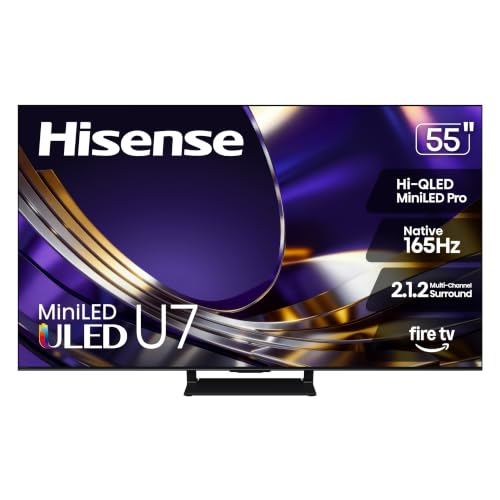
Hisense 55″ U7 Mini-LED (2026) — Best Indoor Pick for a Sealed Sunroom
The U7 is the pick that treats the sunroom as a bright living room and attacks the problem with panel technology. Its listing leads with Mini-LED ULED backlighting behind a 4K UHD panel and names an anti-reflection treatment outright — the two headline traits a glass room demands — and then keeps going into territory most sunroom shoppers never think to ask about: Dolby Vision IQ, which adapts HDR tone mapping to ambient light, is close to a purpose-built feature for a room whose brightness changes by the hour. A format that adjusts the picture to the room is worth more in a sunroom than in any dark cinema room, where ambient adaptation has nothing to adapt to.
The rest of the title reads like a gaming specification that happens to live in a bright room: native 165Hz refresh, VRR 330, IMAX Enhanced certification and a 2.1.2-channel audio system with Dolby Atmos. For a sunroom that doubles as the house’s sports and game space — a very common second life for these rooms — that combination means fast weekend football without the smeared motion a basic panel shows, and built-in sound with some height to it in a room where a soundbar may have nowhere sensible to sit. Fire TV is the platform, with Alexa+ voice control, so the set runs streaming-first with no box required on the wall.
Consider how this set behaves across a sunroom day, because that is where its specification coheres. Morning light arrives low and sideways, raking across the panel from the east glass; the anti-reflection surface earns its keep in exactly those raking angles, where glossy screens flare worst. Midday brings the washout test, and the Mini-LED backlight’s local control is what keeps a bright scene’s shadows from collapsing into uniform grey. Evening is the gaming shift, and the 165Hz native panel with VRR is simply more headroom than any console in the room can use. Few indoor sets are specified this evenly across all three shifts, and that evenness — not any single headline number — is the real argument for the U7 in a room that changes its mind about light every two hours.
- Screen size: 55 inches
- Panel and backlight: Mini-LED ULED, Hi-QLED, 4K UHD
- Glare handling: Anti-Reflection, as stated in the listing title
- Refresh: Native 165Hz, VRR 330
- HDR and audio: Dolby Vision IQ, IMAX Enhanced, Dolby Atmos, 2.1.2 Ch
- Smart platform: Fire TV with Alexa+
- Weather sealing: Not stated in the listing title — verify with the maker’s documentation
Strengths
- Dolby Vision IQ’s ambient adaptation is genuinely matched to a room whose light swings from dawn glare to dusk.
- The anti-reflection treatment is named in the title rather than implied, which is the claim a sunroom buyer most needs in writing.
- Native 165Hz with VRR headroom makes it the strongest gaming and sports panel among the indoor picks here.
Trade-offs
- It is an indoor television: nothing in the listing promises weather resistance, so an unconditioned sunroom is out of bounds.
- At 55 inches it suits a typical converted porch, but a long sunroom with seating twelve feet back will find it modest.
- Fire TV ties the smart experience to Amazon’s ecosystem, which households standardized on another platform may not prefer.
Best for: a sealed, conditioned sunroom that hosts films, sport and games in roughly equal measure. Not suited for: a three-season room that takes on humidity, where the outdoor picks below are the honest answer.
See the Hisense U7 listing on Amazon and check the current price

Samsung 75″ Neo QLED QN90F — Best for a Big, Deep Sunroom
Scale changes the sunroom calculation. In a long room — the kind built along the back of a house, with a dining end and a lounging end — a 55-inch screen at the far wall becomes a bright postage stamp, and the QN90F’s 75-inch Neo QLED canvas is the answer this list offers. Samsung’s listing describes the panel as Glare Free, which is the company’s strongest anti-reflection claim, applied here to a Mini LED backlight with Neo Quantum HDR+. In a room where reflections arrive from three walls of glass, a glare-free treatment on a very large panel is doing double duty: the picture stays legible, and the screen’s sheer size means a reflected window occupies a smaller fraction of what you are watching.
Vision AI handles the processing side, Object Tracking Sound+ with Dolby Atmos attempts the difficult trick of making audio follow action in a room full of hard, reflective surfaces, and the Gaming Hub is built in for households whose sunroom is also the console room. Alexa is built in rather than added by a stick. None of that changes the fundamental classification: this is an indoor flagship, and its size makes the classification question sharper, not softer — a 75-inch indoor panel installed in a leaky three-season room is a large, expensive object exposed to the wrong environment. In the right room, though — sealed, conditioned, deep — it is the most complete sunroom television on this page.
There is also a social geometry to a screen this size in a glass room. A sunroom’s seating is rarely arranged in cinema rows; people sit along the glass, at angles, in the wicker chair that faces partly away. A 75-inch picture stays legible from those oblique seats in a way a smaller panel does not, and the glare-free surface matters most precisely at those angles, where reflections strengthen. The QN90F is therefore less a television for a viewer than a television for a roomful of them — the Sunday gathering, the match watched from three sofas and a doorway. Buy it when the sunroom is the house’s true living room and the audience is whoever wanders in.
- Screen size: 75 inches
- Panel and backlight: Neo QLED 4K, Mini LED (2025 model 75QN90F)
- Glare handling: Glare Free, as stated in the listing title
- HDR and audio: Neo Quantum HDR+, Object Tracking Sound+ with Dolby Atmos
- Processing: Vision AI
- Smart features: Gaming Hub, Alexa Built-in
- Weather sealing: Not stated in the listing title — verify with the maker’s documentation
Strengths
- The largest screen in this guide, paired with the strongest named glare treatment among the indoor picks.
- Object Tracking Sound+ suits a long room where viewers sit at very different distances from the screen.
- Mini LED backlighting with Neo Quantum HDR+ gives it the contrast machinery bright-room HDR needs.
Trade-offs
- A 75-inch panel demands a serious wall and a serious mount; many sunroom stud walls were not framed with it in mind.
- It remains an indoor set with no weatherproofing claimed in its listing, despite the flagship positioning.
- The 2025 model year means it sits a generation behind the 2026 sets in this guide on paper.
Best for: a deep, conditioned sunroom where the main seats are far from the screen and films are the main event. Not suited for: a compact porch conversion, where its size would dominate the glass and crowd the furniture.
Open the Samsung QN90F listing on Amazon to check price and delivery options
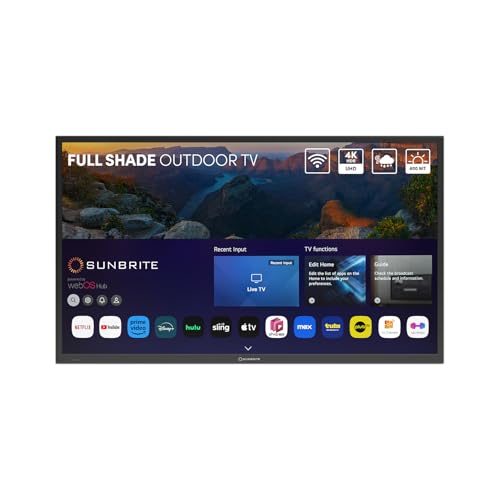
SunBriteTV 55″ Veranda 4 (full shade) — Best True Outdoor Pick for Shade
The Veranda 4 is where this guide crosses from indoor televisions with good manners into televisions actually built to live outside a climate-controlled envelope. SunBriteTV’s whole catalogue is outdoor screens, and the Veranda line is its full-shade tier: the listing describes a smart outdoor TV in 4K UHD with HDR, designed for covered spaces. A sunroom with a solid roof is, in exposure terms, a permanently shaded outdoor location — the glass keeps direct rain off while the room still breathes outdoor air — and that is an unusually precise match for what this set was engineered to do.
What you give up versus the indoor flagships is spec-sheet glamour: the title is terse, naming size, resolution, HDR and the shade class without a refresh-rate or audio-channel boast. What you gain is the thing the flagships cannot offer at any price — a cabinet and panel assembly intended from the first sketch for life outside the conditioned house. For the sunroom that hosts Thanksgiving overflow but stands cold in February, or the screened room that is a porch in everything but the brochure, that trade is the correct one, and the 55-inch size fits the furniture scale of most such rooms without turning the glass wall into a billboard.
The Veranda’s restraint is worth one more look, because in the outdoor category restraint is information. SunBriteTV sells brighter, sun-rated tiers above this one, and the existence of those tiers is what makes the full-shade label on this model trustworthy — the maker is not claiming one cabinet conquers every exposure, but sorting its own range by the light each design can honestly handle. A buyer whose sunroom matches the shade brief gets a set built by a company that demonstrably knows where its limits are. That discipline, visible right in the product line’s structure, is a better predictor of a long service life than any single specification printed on a box.
- Screen size: 55 inches
- Design class: Outdoor TV, Full Shade (Veranda 4 Series, SB-V4-55-BL)
- Resolution and HDR: 4K UHD HDR
- Smart features: Smart TV platform, as titled
- Brightness figure: Not stated in the listing title — verify with the maker’s documentation
- Refresh rate: Not stated in the listing title — verify with the maker’s documentation
Strengths
- Purpose-built outdoor construction for a room that is covered but never climate-controlled.
- The full-shade brief matches a roofed sunroom’s exposure honestly instead of overselling sun tolerance.
- 4K UHD with HDR keeps it a modern picture, not a ruggedized afterthought.
Trade-offs
- Full shade means full shade: a sunroom wall that takes hours of direct sun through glass asks more than this tier promises.
- The listing title is spare, so several specifications a comparison shopper wants must be confirmed on the product page.
- Its outdoor build is wasted money in a fully conditioned room, where an indoor flagship gives more picture for the space.
Best for: a covered, unconditioned sunroom or screened porch-room where the roof is solid and direct sun is brief. Not suited for: a glass box that bakes in afternoon sun for hours, which needs a full-sun design instead.
Read the SunBriteTV Veranda 4 listing on Amazon and check the current price

Titan S300 Mini 65″ Full Sun Outdoor — Best for Sun-Drenched Glass Rooms
If the Veranda is the shade answer, the Titan S300 Mini is the answer for the sunroom that functions as a greenhouse with furniture. The listing calls it a full sun outdoor TV — the highest exposure class in the outdoor catalogue — and describes it as weatherproof and waterproof for patios, decks and covered spaces. Inside a glass room, direct sun arrives filtered but still fierce, and a panel designed to hold a picture in unfiltered yard sun treats that as an easy shift. The 65-inch size and 120Hz refresh round out a specification aimed at sport and gatherings as much as at quiet evening viewing.
Titan is a specialist outdoor brand rather than a television giant moonlighting outdoors, and the listing’s details reflect that: Tizen powers the smart side, and the set is described as USA-made. For a sunroom that opens to a deck — the entertainment hinge of the house, with people drifting between inside glass and outside air — a television that belongs to the outdoor family removes the mental tax of worrying about the door left open, the humid evening, the pollen season. It simply lives where it is mounted. The honest limit is that outdoor engineering prioritizes survival and daylight legibility; a dedicated dark-room cinephile panel will still win on black-level subtlety at midnight, and this set makes no claim otherwise.
The USA-made note in the listing will matter to some buyers for a practical reason beyond preference: outdoor televisions live or die by support, because a weatherproof cabinet is a specialist assembly that a general repair shop may decline to open. A domestic specialist maker with a defined product line is a different ownership proposition from an imported badge with no outdoor pedigree. Pair that with the Tizen platform — the same smart system Samsung’s indoor range uses, so the interface learning curve for the household is zero — and the Titan reads as the low-friction way to put a full-sun screen in a glass room: familiar software, specialist hardware, and an exposure rating with headroom to spare.
- Screen size: 65 inches
- Design class: Full Sun Outdoor TV (S300 Mini)
- Resolution and refresh: 4K UHD, 120Hz
- Weather construction: Weatherproof and waterproof, as stated in the listing title
- Smart platform: Powered by Tizen
- Origin: USA-Made, as stated in the listing title
- Panel type: LED
Strengths
- Full-sun design class is the strongest daylight brief in this guide, and a glass room never exceeds it.
- Weatherproof and waterproof construction ends the humidity anxiety for three-season spaces entirely.
- 120Hz at 65 inches makes it a credible sports screen for the room where everyone gathers on bright afternoons.
Trade-offs
- Outdoor sets trade some dark-room finesse for daylight muscle; midnight film purists should weigh that honestly.
- At 65 inches it needs the larger sunrooms; a small porch conversion will feel swamped by it.
- Tizen is the only platform on offer — households invested in another ecosystem get no alternative build.
Best for: a sunroom that takes direct sun for hours and doubles as the house’s bright gathering space. Not suited for: a small, shaded, fully conditioned room, where its outdoor armour is solving problems the room does not have.
View the Titan S300 Mini listing on Amazon to check the current price

Samsung 65″ The Terrace Full Sun — Best Premium Outdoor Pick
The Terrace is Samsung’s statement that an outdoor television does not have to feel like a compromise appliance, and the full-sun version in this listing is the top of that argument. The title stacks the credentials in order: Neo QLED 4K panel, full-sun design, Neo Quantum HDR+, Dolby Atmos, weatherproof construction, anti-reflection treatment. That is the indoor flagship vocabulary — the same HDR and panel language as the QN90F above — carried into a cabinet built for the outdoors. In a sunroom, it lands as the pick for the household that wants one screen to be both the daylight workhorse and the evening showpiece, and is willing to pay the outdoor flagship tier to get it.
The anti-reflection claim deserves emphasis because it is the Terrace’s answer to the mirror problem that brightness alone cannot solve. A sunroom’s reflections come from bright glass behind the viewer, and a treated panel surface that scatters that reflection is what keeps a dark film scene watchable at four in the afternoon. Alexa is built in, the smart platform is Samsung’s own, and the model is the 2024 build of the line. The classification honesty still applies in reverse: this is a lot of television for a modest room, and its full-sun capability is insurance a north-facing, tree-shaded sunroom will never cash in. Buy it for a bright, exposed, unconditioned or semi-conditioned room and it earns its keep every sunny day.
One more consideration separates the Terrace from the other outdoor picks: ecosystem gravity. A household already running Samsung televisions indoors gets a familiar remote logic, the same smart platform behaviour and a picture character that matches the rest of the house, which sounds trivial until two different platforms are fighting for the family’s habits across rooms. The Terrace extends that household standard through the glass wall and out into the weather without asking anyone to learn a second system. For the Samsung house with a serious sunroom, that continuity is a genuine feature, and it is the reason this set, rather than a cheaper full-sun rival, anchors the premium end of this guide.
- Screen size: 65 inches
- Panel: Neo QLED 4K (QN65LST9DAFXZA, 2024)
- Design class: The Terrace Full Sun, outdoor TV
- Weather construction: Weatherproof, as stated in the listing title
- Glare handling: Anti-Reflection, as stated in the listing title
- HDR and audio: Neo Quantum HDR+, Dolby Atmos
- Smart features: Smart TV with Alexa Built-in
Strengths
- Flagship Neo QLED picture hardware in a genuinely weatherproof, full-sun outdoor build — the list’s only pick with both.
- Anti-reflection treatment addresses the sunroom mirror effect directly, not just the washout problem.
- Dolby Atmos support gives the big glass room a sound plan without immediate extra hardware.
Trade-offs
- It is the premium tier of this guide; the budget for it could buy an indoor flagship and money left over.
- A 2024 model, so it predates the newest processing generations found in the 2026 picks here.
- Full-sun engineering is surplus in a shaded room — the Veranda 4 covers that brief more sensibly.
Best for: a bright, exposed sunroom that is the home’s main entertainment space and is not fully climate-controlled. Not suited for: a small or deeply shaded sunroom, where the Terrace’s daylight armour would never be called on.
Check the Samsung The Terrace listing on Amazon for the current price

Samsung 55″ M70H Mini LED (2026) — Best New-Model Indoor Alternative
The M70H is the quiet option in this guide: a 2026 Samsung Mini LED set whose listing emphasizes the Vision AI Companion, a Mini LED Processor 4K, Pure Spectrum Color and Motion Xcelerator with DLG 120Hz. Nothing in its title claims an anti-glare technology by name, and this review will not pretend otherwise — its sunroom case rests on the Mini LED backlight’s brightness headroom and modern processing rather than on a named reflection treatment. That makes it the pick for the gentler sunroom: north-facing glass, a tree canopy outside, a room that is bright in the diffuse way rather than in the direct-beam way, and fully conditioned like the rest of the house.
Within that brief it has real virtues. A 2026 model carries the newest version of Samsung’s smart experience, the listing advertises endless free content as part of the package, and Motion Xcelerator with DLG 120Hz gives casual sport and gaming a smoother ride than a basic 60Hz panel. Pure Spectrum Color speaks to the wide-colour side of the picture, which matters in a room where washed-out colour is the everyday complaint. Position it honestly — the sunroom that behaves like a bright living room — and the M70H is a sensible, current, right-sized choice. Position it in a sun-blasted three-season room and you have bought the wrong tool, which is a placement error, not a product flaw.
It is worth being precise about the kind of brightness the M70H faces well. Diffuse brightness — the even glow of a north-facing room, a white ceiling bouncing daylight, garden light softened by a canopy — raises the room’s ambient level without creating a single fierce reflection source, and a modern Mini LED panel with strong processing handles that gracefully, adjusting contrast and colour so the picture reads as intentional rather than washed. Direct beam is a different phenomenon: a hard-edged shaft of sun that turns one patch of screen into a mirror and overheats the panel’s day. The M70H’s brief is the first kind. Sunrooms are not all furnaces, and for the substantial minority that are bright-but-gentle, this 2026 set is the most current way to fill the wall.
- Screen size: 55 inches
- Panel and backlight: Mini LED, 4K (2026 model)
- Processing: Samsung Vision AI Companion, Mini LED Processor 4K
- Colour: Pure Spectrum Color
- Motion: Motion Xcelerator + DLG 120Hz
- Content: Endless Free Content, as stated in the listing title
- Named anti-glare treatment: Not stated in the listing title — verify with the maker’s documentation
- Weather sealing: Not stated in the listing title — verify with the maker’s documentation
Strengths
- The newest model year in this guide, with Samsung’s current Vision AI Companion smart experience.
- Mini LED backlighting gives a diffuse-bright room more headroom than an edge-lit set can offer.
- DLG 120Hz motion handling suits the casual sport and gaming a family sunroom typically hosts.
Trade-offs
- No anti-glare technology is named in the listing, so direct-sun rooms should look at the glare-free picks first.
- Strictly an indoor television — the three-season sunroom is outside its design brief.
- Its free-content pitch overlaps what any streaming stick provides, so it should not be the deciding factor.
Best for: a conditioned, diffusely bright sunroom used as an everyday second living room. Not suited for: a sunroom with hours of direct beam through the glass, where named glare treatment matters more.
See the Samsung M70H listing on Amazon and check today’s price
How do you measure your sunroom’s light before you commit to a screen?
Guesswork is how sunrooms end up with the wrong television, and a weekend of simple observation beats any showroom test. Start with the seat test: sit where you will actually watch, at the hours you actually watch, and hold up a phone with its screen off. The dark glass of the phone is a small, honest mirror — whatever windows you can see reflected in it are the windows your television will reflect too, and the brighter they appear, the more glare machinery the television needs. Repeat at noon, at four, and at dusk on a sunny day; sunrooms change character completely across that span, and the worst reading is the one to buy for.
Next, map the direct sun. Note which wall the sun strikes, for how long, and in which season — a sunroom that is gentle in December can be a furnace of light in June when the sun rides higher and the trees outside have not yet leafed out, or the reverse where summer foliage shades glass that winter exposes. If direct beam lands on the intended screen wall for hours, you are in full-sun territory regardless of what the room is called, and the exposure classes in this guide should be read that way. If the beam lands on the seating instead, the screen faces bright glass and the reflection problem dominates — anti-glare treatment becomes the priority and raw brightness the supporting act.
Finally, test the room’s air, not just its light. Leave a cheap hygrometer in the room for a week and read it morning and evening; a sunroom whose humidity swings widely with the weather is telling you it is not a sealed interior space, whatever the estate agent called it. Check the floor after a cold night for the chill that signals no insulation, and look for the dust and pollen film that unconditioned rooms accumulate on every surface — the same film settles inside an unsealed television cabinet. These observations take minutes and cost almost nothing, and they decide the single most consequential fork in this guide: indoor flagship or outdoor build.
How should a sunroom television be mounted, wired and looked after?
Mounting in a sunroom starts with the wall you have, not the wall you wish for. Many sunrooms are framed with slim posts between glass panels, and the only structure that will honestly carry a large television is the house wall — which is also, conveniently, the best viewing wall. Use a mount rated well above the panel’s weight, find studs rather than trusting drywall anchors, and choose a tilting mount even if you expect to set the angle once: the downward tilt that kills reflections needs a mount that can hold it. For the outdoor picks, follow the maker’s clearances for airflow; a weatherproof cabinet manages heat deliberately, and smothering it against insulation or enclosing it in a decorative box defeats the engineering you paid for.
Wiring deserves the same realism. Sunrooms frequently have fewer outlets than living rooms and none where the television wants to live, so plan the circuit before the screen arrives — an outdoor-rated installation near a door that opens to a deck should keep connections protected from the weather that door admits. Streaming-first platforms on every pick in this guide reduce the box count to the television itself, which suits a room where a media console may not fit the furniture plan. If a console or a stick player joins the set, give it the same environmental honesty as the screen: an indoor streaming box in an unconditioned room ages by the same rules as an indoor television.
Care is simple but not optional. Glass rooms grow a film of pollen and dust faster than any other room in the house, and a panel wiped with the wrong cloth or a household glass cleaner can lose its anti-reflection coating in patches — use a dry or barely damp microfibre cloth and nothing abrasive, exactly as the makers of treated panels instruct. Outdoor sets should be checked seasonally at their seals and cable entries, because the gasket you never inspect is the one that fails quietly. And when the room will stand empty through the coldest weeks, the outdoor picks are built to be left in place; an indoor set in a marginal room is better brought inside for the winter than left to condense through it — a chore that, the second year running, usually convinces its owner to buy the outdoor television they should have bought first.
Side by side: how the six sunroom screens divide the work
| Pick | Size | Route | Glare or exposure claim in the title | Room it fits |
|---|---|---|---|---|
| Hisense 55″ U7 Mini-LED (2026) | 55″ | Indoor flagship | Anti-Reflection | Sealed sunroom, mixed film/sport/gaming |
| Samsung 75″ Neo QLED QN90F | 75″ | Indoor flagship | Glare Free | Deep conditioned sunroom, distant seating |
| SunBriteTV 55″ Veranda 4 | 55″ | Outdoor, full shade | Full Shade design class | Covered, unconditioned sunroom |
| Titan S300 Mini 65″ | 65″ | Outdoor, full sun | Full Sun, weatherproof and waterproof | Sun-blasted glass room, gathering space |
| Samsung 65″ The Terrace | 65″ | Outdoor, full sun | Full Sun, weatherproof, Anti-Reflection | Premium exposed sunroom, main screen |
| Samsung 55″ M70H (2026) | 55″ | Indoor, current model | No glare technology named in title | Diffusely bright conditioned sunroom |
What are the most common mistakes people make putting a TV in a sunroom?
The first mistake is buying for the room at its best rather than at its worst. Shoppers audition televisions mentally at dusk, when every screen looks rich, and then discover in June that their panel is a mirror by day. Judge every candidate against the brightest hour the room actually gets, and let that hour veto screens — including, if necessary, every indoor screen on this page.
The second mistake is hanging an indoor television in a three-season room because it survived the first summer. Humidity damage is cumulative and mostly invisible; the set that “was fine last year” is often a set quietly corroding. If the room is not sealed and conditioned, the outdoor route is not an upsell, it is the category.
Third, people mount the screen on the glass wall because the house wall holds the door. Watching toward the house, with bright glass behind the panel, is the worst geometry in the room — your eyes adapt to the garden’s brightness and the picture loses by comparison no matter what you bought. Rearrange the furniture before you accept that layout.
Fourth, reflections get blamed on the television when the mount is at fault. A screen tilted flat against a wall reflects the opposite windows straight into the seats; a slight downward tilt throws those reflections at the floor. Finally, shoppers forget that glass rooms echo: a television whose sound was adequate in a carpeted den may turn harsh and thin surrounded by glass, so plan the audio — built-in Atmos support, or a speaker plan — as part of the sunroom decision, not an afterthought.
A fifth mistake deserves its own warning because it masquerades as thrift: buying the indoor set now and “seeing how it goes” in an unconditioned room, with a plan to replace it with an outdoor model only if it fails. The failure, when it comes, rarely announces itself as a clean death on a convenient weekend. It arrives as intermittent faults — a board that misbehaves on humid mornings, a panel that blooms at the edges after a hot spell — that consume weekends in diagnosis before the replacement is finally ordered anyway. The household pays for both televisions and enjoys neither fully. Classifying the room honestly at the start is not caution; it is the cheaper of the two paths, and the observation tests in this guide exist to make that classification easy to get right the first time.
Final Recommendation
Start with the room classification and let it cut this list in half. Sealed and conditioned: the Hisense U7 is the balanced buy, with the QN90F above it for a deep room and the M70H beside it for a gentler, newer everyday set. Covered but unconditioned: the SunBriteTV Veranda 4 fits a shaded brief, while the Titan S300 Mini and The Terrace cover sun-exposed glass, the Terrace adding flagship picture hardware to the same armour. Every route ends at a screen that was designed for the light and the air it will actually live in. A sunroom rewards the television that was chosen for its worst afternoon, not its best evening — buy for the glare at two o’clock in June, and every other hour of the year will take care of itself.
Frequently Asked Questions
Can a regular indoor TV survive in a sunroom?
In a sealed, heated, air-conditioned sunroom, yes — that room is an interior room with extra glass, and an indoor set with anti-reflection treatment is a legitimate choice. In a three-season sunroom that tracks outdoor humidity and temperature, a regular TV is living outside its design brief; it may work for a while, but the environment is working on it the whole time, and an outdoor-built set is the durable answer.
What matters more for a sunroom, brightness or anti-glare coating?
They solve different halves of the problem. Brightness keeps the picture from washing out when ambient light is high; anti-glare treatment stops the panel from mirroring the bright room back at you. A sunroom has both problems at once, which is why this guide favours sets whose listings name a glare treatment or an outdoor exposure class instead of relying on a single specification.
Is a full-shade outdoor TV enough for a sunroom?
For a roofed sunroom where direct sun through the glass is brief or filtered, a full-shade outdoor set like the Veranda 4 matches the exposure honestly. If one wall of the room takes direct sun for hours — a south or west glass wall with no shade — that is effectively a full-sun brief, and the full-sun picks are the safer classification.
What size TV suits most sunrooms?
Most sunrooms are converted porches or modest additions, and the 55-inch picks fit that furniture scale well. Rooms built along the whole back of a house, with seating ten feet or more from the screen wall, justify the 65- and 75-inch options here. Measure the viewing distance before the wall; in a glass room an oversized screen also becomes the largest reflective surface you own.
Do outdoor TVs work well inside a sunroom, or will the picture look crude?
Modern outdoor televisions are proper 4K HDR sets — every outdoor pick in this guide is a 4K UHD model, and the Terrace carries the same Neo QLED and Neo Quantum HDR+ language as Samsung’s indoor flagships. What outdoor engineering changes is the cabinet, the sealing and the daylight brief, not the fundamental picture. In a bright room the outdoor set will usually look better than an indoor one, because it was designed for the light it is actually facing; the indoor flagship only pulls ahead in a darkened room at night.
Where should the TV go in a sunroom?
On the solid house wall, facing the glass, tilted slightly down. That geometry puts the bright garden behind the viewers instead of behind the picture, and the tilt throws window reflections toward the floor. Avoid mounting on or directly opposite the sunniest glass where possible, and treat shades on that wall as part of the installation.
Related Guides
For more bright-room and outdoor viewing research, see our guides to best no glare tvs, best weatherproof tvs and best outdoor tvs for florida.
Small bright rooms are a category of their own, and our guide to the best tvs for a dorm sizes screens for them honestly.
Daylight rooms punish weak tuners and weak panels alike, and our guide to the best new tvs for antenna reception covers the broadcast half of the sunroom.
Take the glass away and the same brightness questions move under a roof, where our guide to the best tvs for covered patio judges them.
Related guides
- Best 1080p IP Cameras: PoE Domes, Turrets, Bullets and a PTZ That Earn Their Cable
- Best 43 1080p TVs: Why 43 Inches Went 4K — and Where True Full HD Survives
- Best Doorbell Cameras No Subscription: Local Storage Picks, and the Ring/Blink Truth
- Best AC Powered Wireless Security Cameras: Wi-Fi Data, Mains Power, Zero Sleep


