What's inside
- Key Takeaways
- Quick Picks
- How Did We Judge the Best SSDs for SQL Server?
- What Do Read-Intensive and Mixed-Use Actually Mean?
- How Do the Six SQL Server SSDs Compare?
- How Should SQL Server’s Files Be Laid Out Across Drives?
- What Mistakes Do Buyers Make Choosing Database SSDs?
- When Has a Server Outgrown SATA Entirely?
- How Do You Watch an SSD’s Endurance Before It Becomes an Emergency?
- What Should You Check About RAID Controllers and SSDs?
- Final Recommendation
- Frequently Asked Questions
- Related Guides
As an Amazon Associate I earn from qualifying purchases. This post may contain affiliate links at no extra cost to you.
gizmoverdict.com is reader-supported. When you buy through links on our site, we may earn an affiliate commission.
Read the premise before the picks, because it is narrower than the keyword suggests: these are 2.5-inch SATA SSDs for the servers SATA can serve — small production boxes, branch servers, modest virtualisation hosts, test rigs. Five picks are enterprise drives from Kingston, Micron and Samsung’s data-centre line. The sixth is a consumer drive, included deliberately and labelled honestly, because many real SQL Server installations — development, testing, a two-person business’s only box — run exactly there.
The best ssds for sql server are not chosen the way gaming drives are. A database does not care about a headline sequential speed it will touch twice a year; it cares about sustained random I/O under a mixed read-write load, hour after hour, year after year, without the pace collapsing as the drive fills and ages. That is an endurance and consistency contest, and it is graded in a vocabulary this guide will use precisely: drive writes per day, the endurance budget a workload spends; read-intensive, mixed-use and write-intensive, the workload classes makers design and warrant drives for; and the unglamorous enterprise features — self-encryption standards, data-centre firmware lineage — that separate a server drive from a laptop drive wearing a bigger price tag.
The listings here vary in how much of that vocabulary they speak, and this guide holds its usual line: what a title states is used, what it omits is marked as not stated, and no endurance figure is borrowed from a datasheet and pinned to a drive whose listing did not print it. Kingston’s two DC600 models state their class outright — mixed-use, enterprise, one with TCG Opal encryption named. Micron’s 5300 PRO and 5400 PRO carry an enterprise lineage their terse titles only hint at. Samsung’s PM893 is a data-centre model whose listing says almost nothing beyond its identity. And the 870 EVO states a consumer speed figure and a consumer audience, and will be discussed as exactly that.
Key Takeaways
- Five picks are enterprise SATA SSDs; the sixth, Samsung’s 870 EVO, is a consumer drive included deliberately and openly for small-server, test and development duty — and labelled as such everywhere it appears in this guide.
- Kingston’s DC600M and DC600ME are the only listings in this pool that print their workload class for the buyer: Mixed-Use, in the title itself.
- No listing here prints a DWPD or endurance figure in its title; where endurance matters to your design, the spec boxes direct you to the maker’s documentation for the exact model rather than guessing from a sibling’s numbers.
- Encryption is stated on two picks: the DC600ME names TCG Opal in its title, and the Micron 5300 PRO names self-encryption with TCG eSSC — both standards an auditor can be shown.
- All six are 2.5-inch SATA drives — the interface is the ceiling every pick shares, and the guide treats SATA’s limits honestly against NVMe alternatives, including the wait statistics that tell you when a server has genuinely outgrown it.
- Database storage is a consistency contest: sustained mixed I/O, at the same pace in year three as in week one, not a sequential speed touched twice a year by a backup verification.
Quick Picks
| Pick | Badge | Why it is here |
|---|---|---|
| Kingston DC600M 960GB | Stated mixed-use enterprise | An enterprise SATA SSD whose listing prints its class — Mixed-Use — at just under a terabyte, the classic mirrored-pair size for a small server. |
| Kingston DC600ME 1.92TB | Mixed-use with Opal | The DC600 line at 1.92TB, with TCG Opal self-encryption named in the listing for regulated deployments. |
| Micron 5300 PRO 3.84TB | Big enterprise capacity | A 3.84TB enterprise SATA drive, self-encrypting, from Micron’s established data-centre 5300 family of server drives. |
| Micron 5400 PRO 1.92TB | The newer Micron generation | The 5400 PRO at 1.92TB in a slim 7mm 2.5-inch SATA form, the successor lineage to the 5300. |
| Samsung PM893 3.84TB | Samsung’s data-centre entry | A 3.84TB SATA III drive from Samsung’s PM enterprise family, for buyers standardised on Samsung across their fleet. |
| Samsung 870 EVO 1TB | The honest consumer option | A consumer SATA SSD, up to 560MB/s read in its listing, for dev, test, staging rigs and the smallest production boxes whose failure would be an inconvenience rather than an incident. |
How Did We Judge the Best SSDs for SQL Server?
The first criterion was class, verified from the listing: is this drive sold as an enterprise device for server duty, and does the title say so? Kingston’s pair say it in full — Enterprise, Mixed-Use — and Micron’s and Samsung’s data-centre family names say it to anyone who knows the lineages, which this guide explains rather than assumes. The 870 EVO fails that test on purpose and is included under a different flag, because the guide’s honesty about the small-server reality is worth more than a purist pool.
The second criterion was the endurance conversation, and here the guide’s discipline bites hardest: not one title in this pool prints a DWPD figure, a total-bytes-written rating or a workload class beyond Kingston’s “Mixed-Use”. Those numbers exist in the makers’ documentation and they are the numbers a serious deployment is specced from. This guide therefore does two things at once — it teaches the vocabulary thoroughly, so a reader can hold a datasheet conversation, and it refuses to attach specific endurance figures to drives whose listings did not state them. Any guide that prints a precise DWPD beside a listing that never mentioned it is decorating, not informing.
The third criterion was fit for the SATA tier’s real deployments. These drives go into servers with 2.5-inch SATA bays — often older, perfectly serviceable machines whose storage is their bottleneck — and into arrays where several drives share the work. Capacity points at 960GB, 1.92TB and 3.84TB map onto the classic roles: a mirrored pair for the system and logs, a set for the data files, room for tempdb to breathe. Each pick below is assigned to its role, with the verdicts naming the deployments that should walk past it toward NVMe or toward a heavier class.
What Do Read-Intensive and Mixed-Use Actually Mean?
The classes describe how much writing a drive is designed and warranted to absorb each day, expressed as drive writes per day — DWPD — the number of times the drive’s full capacity may be written daily across its warranty life. A read-intensive drive is built for workloads that mostly read: boot volumes, content delivery, databases whose queries vastly outnumber their updates. Its endurance budget is the smallest of the enterprise classes, and its price per terabyte is usually the gentlest. A mixed-use drive carries a materially larger daily write budget, aimed at the balanced read-write diet of a general database, a mail server, a virtualisation host. Write-intensive classes above that serve logging, caching and high-churn analytics, at prices that reflect the extra NAND endurance engineered in.
SQL Server’s diet depends on which of its files you are feeding. The data files of a reporting system are read-mostly; the same files in an order-processing system are written constantly. The transaction log is a sequential write stream with its own latency sensitivities. Tempdb, on a busy instance, can be the most write-hungry citizen of the whole server. A competent deployment therefore does not ask “which class is the SQL Server class” — it asks which class each volume’s behaviour matches, and it is common to find read-intensive capacity holding data files while a mixed-use pair carries tempdb and logs. Kingston’s stated Mixed-Use on both DC600 picks makes them this guide’s natural all-rounders for the mixed volumes; the other enterprise picks’ classes must be confirmed in their makers’ documentation before being assigned to a write-heavy volume, and the spec boxes say so.
A worked miniature makes the arithmetic tangible without inventing any drive’s figures. Suppose a volume writes a few hundred gigabytes on a busy day. Against a drive whose warranted budget is a full drive-write daily, that volume spends a modest fraction of its allowance and can expect the drive to outlast the server around it. Against a budget a fifth that size, the same innocent workload spends the drive’s whole rated life in a fraction of the warranty period — same database, same users, same queries, and a storage layer quietly ageing in dog years. The database does not know which budget it was given. The buyer is the only one who ever does, which is why the class printed on a listing — or confirmed in a datasheet — is the most consequential line in this entire guide.
The failure mode for getting this wrong is slow, which is why it is so often gotten wrong. An under-classed drive does not fail on installation day; it performs beautifully while its endurance budget is spent at several times the warranted rate, and it begins to fail — throttling, erroring, wearing its spare area away — in year two, at the exact age when the server has become load-bearing and its storage is no longer anyone’s active project. Endurance is a promise about the far end of the drive’s life, and it is bought, like insurance, against a day you cannot yet see.

Kingston DC600M 960GB — The stated mixed-use all-rounder
Kingston’s listing is the most informative in this guide, and it earns the lead position on that honesty: an Enterprise 960G DC600M, Mixed-Use, a 2.5-inch SATA SSD, model SEDC600M/960G. Every word a database buyer scans for is present — the enterprise class, the workload class printed outright, the form factor and interface. Mixed-use is the class a general SQL Server volume describes itself as: data files read and written in earnest proportion, logs streaming, tempdb churning on the busy days. A drive that states that class in its title can be assigned to those volumes without a documentation expedition, and that statedness is a genuine feature in a category where competitors make you dig.
The 960GB capacity point is the classic server size for a reason: it suits a mirrored pair carrying an operating system, a SQL Server installation and a mid-size database’s data and log files, in the small production servers this guide’s premise describes. It is also, not incidentally, the size at which a spare on the shelf stays affordable — and a cold spare, bought with the pair and kept in its bag, is what turns a drive failure from a procurement delay into a maintenance window, because the rebuild can begin the hour the failure is noticed rather than the day a delivery arrives. Small deployments live and die on exactly that difference in tempo. It is also the natural tempdb-and-log volume beside larger data drives — the fast, class-stated pair that absorbs the instance’s churn while the 3.84TB picks hold the estate. Kingston’s DC line is the maker’s data-centre family, and the DC600M is its SATA mixed-use citizen, positioned for exactly the always-on, write-serious duty a database imposes.
Neither the drive’s DWPD figure nor its speeds are printed here, and this guide will not supply them from elsewhere; the class is stated, the number belongs to Kingston’s documentation, and a deployment speccing near an endurance limit should read it there. What can be said from the listing is complete enough for the common decision: enterprise, mixed-use, SATA, just under a terabyte. For the small production server that is the centre of this guide’s world, that is the specification that matters, stated by the one maker who bothered.
- Capacity: 960GB, per the listing title
- Class: Enterprise, Mixed-Use, per the listing title
- Form factor: 2.5-inch, per the listing title
- Interface: SATA SSD, per the listing title
- Model: SEDC600M/960G, per the listing title
- DWPD / endurance figure: Not stated in the listing title — take the rated figure from Kingston’s documentation for deployment maths
- Speeds: Not stated in the listing title — see Kingston’s documentation
Strengths
- The workload class is printed in the title — the only small pick here a volume can be assigned to on the listing alone.
- Enterprise data-centre lineage aimed at always-on mixed duty.
- The classic mirrored-pair size for a small production server’s system, log and data volumes.
Trade-offs
- The endurance number behind the class still requires the documentation trip for formal specs.
- Just under a terabyte is a role size, not a whole estate, for a growing database.
- SATA’s ceiling applies, as it does to every pick in this guide.
Best for: a small production SQL Server — a practice’s line-of-business database on a mirrored pair in a tower server. Not suited for: a write-saturated logging instance chewing a full drive daily, whose class homework points above mixed-use entirely.

Kingston DC600ME 1.92TB — Mixed-use, encrypted, double size
The DC600ME extends its sibling’s stated case in the two directions a growing deployment asks for: capacity doubles to 1920G, and the listing adds TCG Opal — the self-encryption standard — to the Enterprise, Mixed-Use description, model SEDC600ME/1920G. The Opal point deserves its weight. A server drive that encrypts itself, to a standard an organisation’s security policy can name, answers the auditor’s question and the decommissioning question in one feature: data at rest protected in life, and a drive that can be crypto-erased rather than shredded at retirement. In regulated small businesses — the medical practice, the law firm, the accountant — that stated standard is often the difference between a drive that may be bought and one that may not.
At 1.92TB, this is the data-volume size: a mirrored pair holds a serious small-business database estate with room for years of growth, or a single volume in a larger array carries a database whose data files have outgrown the 960GB tier. The mixed-use class, stated as on its sibling, suits the general database diet; the same caveat about confirming the exact DWPD in Kingston’s documentation applies to deployments speccing near a limit, and the guide repeats it because the discipline is the point.
Between the two Kingstons, the choice is arithmetic and policy rather than quality: the 960GB for system, log and tempdb roles and smaller estates; the 1.92TB ME where the data volume needs the room or the compliance file needs the word Opal printed on the purchase. A deployment could rationally buy both — ME pairs for data, M pairs for the churn volumes — and standardise on one maker’s stated-class family across the whole server, which is a tidiness administrators value more than benchmark tables suggest.
- Capacity: 1.92TB (1920G), per the listing title
- Class: Enterprise, Mixed-Use, per the listing title
- Encryption: TCG Opal, per the listing title
- Form factor: 2.5-inch, per the listing title
- Interface: SATA SSD, per the listing title
- Model: SEDC600ME/1920G, per the listing title
- DWPD / endurance figure: Not stated in the listing title — confirm in Kingston’s documentation
Strengths
- Stated mixed-use class plus a stated encryption standard — the most compliance-complete listing here.
- The data-volume capacity point, with the same family manners as the 960GB pick.
- Crypto-erasure at retirement is a real operational gift in regulated small businesses.
Trade-offs
- The endurance figure itself remains a documentation lookup, as across this pool.
- Opal’s value depends on the server’s management of it; an unmanaged encrypted drive is a locked drawer without a key plan.
- Still SATA — the interface ceiling is shared by the whole guide.
Best for: a regulated small business’s SQL Server — patient records’ back-office database, client files’ index — where Opal belongs in the compliance file. Not suited for: a home-lab instance with no encryption policy, paying for a stated standard nobody will ever audit.

Micron 5300 PRO 3.84TB — The big enterprise capacity
Micron’s 5300 PRO listing states its essentials with data-centre brevity: a 3.84TB 7mm 2.5-inch Enterprise SATA 6Gb/s solid state drive, self-encrypting (SED) with TCG eSSC, model MTFDDAK3T8TDS. The 5300 family is Micron’s established enterprise SATA line, and the PRO designation within it is the family’s mainstream server tier. At 3.84TB this pick is the joint-largest in the guide — the data-volume estate drive, sized for the database whose tables are measured in terabytes and whose growth is a line on a chart rather than a hope.
The self-encryption is stated, with its standard named as TCG eSSC — the enterprise variant of the TCG storage specifications — giving this pick the same compliance grammar as the Kingston ME, in Micron’s dialect. For a deployment standardised on Micron, or one whose procurement wants an SED at the largest SATA capacity, the 5300 PRO is the complete sentence: enterprise, encrypted, 3.84TB, in the slim 7mm form that fits every 2.5-inch bay ever made, including the dense ones.
The listing’s one significant silence is the workload class, and here the guide’s discipline matters most, because the 5300 family is known for spanning classes across its range. This title does not print read-intensive or mixed-use, so this guide does not assign the drive a class; a buyer intending it for a write-heavy volume must take the exact model’s class and DWPD from Micron’s documentation before committing it. Assigned to data files with that homework done — or to the read-mostly estates its capacity suits — it is a formidable, honestly describable pick. Assigned blind to tempdb, it would be a gamble, and the difference between those two sentences is the entire value of reading listings the way this guide does.
- Capacity: 3.84TB, per the listing title
- Class: Enterprise, per the listing title
- Encryption: Self-encrypting (SED), TCG eSSC, per the listing title
- Form factor: 7mm, 2.5-inch, per the listing title
- Interface: SATA 6Gb/s, per the listing title
- Model: MTFDDAK3T8TDS, per the listing title
- Workload class / DWPD: Not stated in the listing title — confirm this exact model’s class in Micron’s documentation before write-heavy duty
Strengths
- The joint-largest capacity here, with stated self-encryption, in a slim 7mm enterprise drive.
- An established data-centre family’s mainstream tier, from one of the NAND makers themselves.
- The natural estate drive beside a Kingston pair carrying the churn volumes.
Trade-offs
- Its workload class is not printed, so write-heavy assignments require documentation homework first.
- Capacity at this tier is a considered purchase, especially bought in mirrored pairs.
- An older generation than the 5400 line below it in this guide.
Best for: a terabyte-scale reporting database whose data files are read far more than they are rewritten, on an encrypted estate drive. Not suited for: a tempdb volume on a busy OLTP instance, until Micron’s documentation confirms this model’s class can carry that churn.

Micron 5400 PRO 1.92TB — The newer Micron generation
The 5400 PRO’s listing is the tersest in this guide — “Micron 5400 Pro 1920Gb Sata 2.5 7Mm Solid State Drive Single Pack” — and reading it fairly requires saying what the name carries. The 5400 is the generation after the 5300 in Micron’s enterprise SATA line, and the PRO tier within Micron’s families is the mainstream server class. A buyer who knows the lineage reads a complete specification in that short title; a buyer who does not should treat the terseness itself as the information: this listing asks to be bought by people who spec from documentation, and its spec box below records exactly how much it declines to say.
At 1.92TB it lands on the same data-volume point as the Kingston DC600ME, and the comparison between them is this guide’s cleanest study in listing philosophies. Kingston prints class and encryption and lets the buyer proceed; Micron prints identity and lets the buyer’s documentation habit proceed. The drives are peers in role — enterprise SATA for server estates — and a deployment standardised on Micron, or refreshing a 5300-based fleet to its successor generation, will choose the 5400 PRO with its eyes open and its datasheet downloaded.
For SQL Server duty, assign it as its sibling was assigned: data volumes and general server estates, with the workload class and endurance figure confirmed in Micron’s documentation before any write-heavy volume is committed to it. That sentence is not a weakness in the pick; it is the professional norm this entire category runs on, where listings are order codes and datasheets are specifications. The guide simply refuses to let a listing’s brevity become a reviewer’s invention.
- Capacity: 1.92TB (1920Gb), per the listing title
- Form factor: 2.5-inch, 7mm, per the listing title
- Interface: SATA, per the listing title
- Family: Micron 5400 PRO enterprise line (the listing states the model family name)
- Workload class: Not stated in the listing title — Micron’s datasheet states the class; read it there
- Encryption: Not stated in the listing title — the 5400 PRO datasheet is the source
- DWPD / endurance figure: Not stated in the listing title — take it from Micron’s documentation for the exact model
Strengths
- The current Micron enterprise SATA generation at the workhorse 1.92TB point.
- Slim 7mm form fits every 2.5-inch server bay, dense enclosures included.
- The natural refresh for fleets already standardised on Micron’s 5300 line.
Trade-offs
- The listing states almost nothing beyond identity; every deployment figure is a datasheet lookup.
- No encryption standard is named in the title, unlike its 5300 sibling.
- Shopping on stated class alone is easier with Kingston’s listings.
Best for: a Micron-standardised server room refreshing its SATA estate to the current generation, datasheets already on file. Not suited for: a first purchase made from the listing page alone, with no datasheet ever opened.

Samsung PM893 3.84TB — Samsung’s data-centre entry
Samsung’s PM893 listing is nearly as terse as Micron’s 5400: a 3.84TB SATA III 2.5-inch internal SSD, and nothing else — no class word, no encryption claim, no speed. The PM prefix is the information for those who read Samsung’s families: PM is Samsung’s data-centre SATA line, the enterprise counterpart to the consumer EVO and PRO names, built for server bays and server duty cycles. This guide states that lineage as context and then, with its usual discipline, declines to decorate the drive further: its workload class, endurance figure and encryption status are not in this title, and they belong to Samsung’s documentation.
At 3.84TB it ties the Micron 5300 PRO as the guide’s estate size, and the fork between them is ecosystem and evidence. The Micron states enterprise and self-encryption in its title; the Samsung states capacity and interface and relies on the PM name. A server room standardised on Samsung — whose drives its spares shelf, monitoring habits and procurement all know — will rationally choose the PM893 and do the datasheet homework once, for the fleet. A buyer choosing cold between the two listings has more stated evidence on the Micron’s side of the page.
For the database itself, the role is the same estate role: data files at scale, in mirrored pairs or array sets, in the SATA servers this guide’s premise serves. Samsung’s data-centre drives have a long tenure in exactly those bays across the industry, which is a fact about the family rather than a figure about this listing, and the guide offers it in exactly those terms. Buy the PM893 as a fleet decision, with its class confirmed on paper, and it will behave like what it is: Samsung’s enterprise SATA citizen at the largest common capacity.
- Capacity: 3.84TB, per the listing title
- Interface: SATA III, per the listing title
- Form factor: 2.5-inch internal, per the listing title
- Family: Samsung PM data-centre line (the listing states the model name PM893)
- Workload class: Not stated in the listing title — Samsung’s datasheet is the source
- Encryption: Not stated in the listing title — the PM893 datasheet states it
- DWPD / endurance figure: Not stated in the listing title — read it in Samsung’s documentation for the model
Strengths
- Samsung’s data-centre family at the estate capacity, for fleets standardised on the maker.
- The joint-largest size here, in the universal 2.5-inch SATA form.
- A fleet purchase’s logic: one datasheet exercise covers every bay it fills.
Trade-offs
- The listing is the guide’s most silent: class, encryption and endurance all live elsewhere.
- Cold buyers comparing listings alone get more stated evidence from the Micron at this size.
- As with all its peers, SATA’s ceiling is the deployment’s ceiling.
Best for: a Samsung-standardised small data room adding terabyte-scale SATA capacity to its SQL Server estate. Not suited for: a purchase that must be justified from the listing page alone, compliance file open and pen in hand.
Samsung 870 EVO 1TB — The honest consumer option
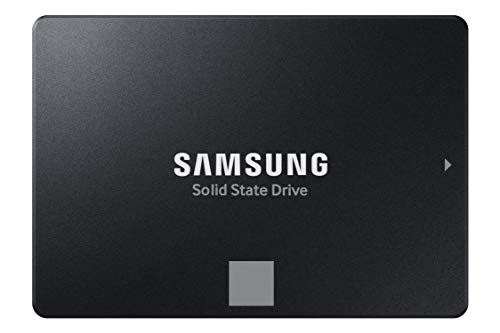
Now the drive this guide promised to label without flinching. The 870 EVO’s listing describes a consumer SATA SSD: 1TB, read speeds up to 560MB/s, for IT pros, creators and everyday users, model MZ-77E1T0B/AM. It is an excellent drive of its kind — Samsung’s consumer SATA line is the benchmark of that class — and its kind is not the enterprise kind. It carries no stated workload class, no enterprise endurance rating in its title, and no data-centre firmware lineage. In this guide it is the pick for the servers whose consequences are small: development instances, test and staging rigs that mirror production, the home lab, and the very small production box whose database is a convenience rather than a livelihood — with its eyes open about what it is.
There is also a lifecycle argument for the EVO in the lab role specifically: test rigs are rebuilt constantly, their drives reimaged, their databases restored and dropped in a rhythm that has nothing to do with endurance budgets and everything to do with convenience. A consumer drive in that churn is a consumable in the honest sense — bought cheaply, worked cheerfully, replaced without a capital request when it tires. The sin this guide polices is not consumer hardware in a server; it is consumer hardware in a server whose failure would matter, wearing enterprise clothing it never claimed. The EVO claims none, and that is precisely why it can be recommended here with a straight face.
Why include it at all? Because those deployments are real, numerous and ill-served by guides that pretend every SQL Server is a bank’s. A development team restoring production backups nightly to a test instance needs pace and capacity, not a warranted DWPD; a two-person business whose entire database is a few gigabytes, backed up properly and rebuildable in an afternoon, can rationally run on a consumer drive and spend the difference on the backup system that actually protects them. The dishonesty would be in presenting the EVO as an enterprise equal. Presented as what it is — the finest consumer SATA drive of its generation, in roles where consumer is a defensible specification — it earns its row.
The stated 560MB/s read is, incidentally, the SATA interface’s practical ceiling introducing itself: every drive in this guide lives under that same ceiling for sequential work, enterprise and consumer alike. Where the enterprise picks justify themselves is not that number but the unstated-here territory of sustained mixed I/O, endurance and firmware manners over years. The EVO’s buyer should simply know which territory their deployment lives in. If the database’s downtime would be an incident with a name and a postmortem, buy from the five picks above this one. If it would be an inconvenience with a restore from backup, the EVO is an honest way to spend less.
- Capacity: 1TB, per the listing title
- Class: Consumer SSD — stated audience: IT pros, creators, everyday users, per the listing title
- Read speed: Up to 560MB/s, per the listing title
- Interface: SATA III, 2.5-inch, per the listing title
- Model: MZ-77E1T0B/AM, per the listing title
- Enterprise workload class: Not stated in the listing title — this is not an enterprise-class drive
- DWPD / endurance figure: Not stated in the listing title — see Samsung’s consumer documentation
Strengths
- The benchmark consumer SATA drive, at the interface’s full sequential pace.
- Perfectly defensible for dev, test, staging and lab instances where its class matches the consequences.
- Lets a tiny deployment spend its savings on backups, where small servers’ real risk lives.
Trade-offs
- Not an enterprise drive: no stated class, no data-centre endurance story in the listing.
- Sustained write behaviour under years of database churn is outside its design brief.
- Production buyers must be able to say, in writing, why consumer class fits their consequences.
Best for: a development team’s test instance, restored nightly from production backups and rebuilt without tears if it dies. Not suited for: the only server a dental practice runs on, where the database is the appointment book, the billing and the business.
How Do the Six SQL Server SSDs Compare?
| Pick | Capacity | Class as listed | Encryption as listed | Natural role |
|---|---|---|---|---|
| Kingston DC600M | 960GB | Enterprise, Mixed-Use | Not stated in title | System, log and tempdb pair |
| Kingston DC600ME | 1.92TB | Enterprise, Mixed-Use | TCG Opal | Data volume, regulated sites |
| Micron 5300 PRO | 3.84TB | Enterprise | SED, TCG eSSC | Large data estate |
| Micron 5400 PRO | 1.92TB | Family name only in title | Not stated in title | Data volume, Micron fleets |
| Samsung PM893 | 3.84TB | Family name only in title | Not stated in title | Large data estate, Samsung fleets |
| Samsung 870 EVO | 1TB | Consumer | Not stated in title | Dev, test, smallest boxes |
The table’s honest message is how much of this category is decided off the listing page. Kingston states its class and lets a small buyer proceed with confidence; Micron and Samsung state identity and expect a datasheet; the EVO states its consumer nature and a speed. A deployment plan written from this table alone should therefore be a plan about roles and capacities, with a column of homework — class and DWPD for the Micron and Samsung volumes — assigned before purchase, not discovered after installation.
How Should SQL Server’s Files Be Laid Out Across Drives?
The classic layout survives because the physics that inspired it survives. The operating system and SQL Server binaries want a quiet home. The transaction logs want their own volume, where their sequential writes are not interleaved with random data I/O and where a log’s growth cannot strangle the data files’ disk. The data files want the estate volume, sized for years of growth. Tempdb wants the fastest, most write-tolerant home it can get, because on a busy instance it is the hardest-worked fileset in the building. In the SATA tier this guide serves, that layout maps naturally onto the picks: a mirrored Kingston pair for system and logs, a second pair or an array set of the 1.92TB or 3.84TB drives for data, tempdb placed with the mixed-use class where its churn belongs.
Two sizing rules protect the layout from its own success. Never let a database volume live above roughly eight-tenths full: growth headroom is not waste, it is the space autogrowth, index rebuilds and the occasional enormous transaction all need at the worst moment. And give tempdb room to be wrong about its worst day — a reporting query gone rogue can fill a tempdb volume with a thoroughness that looks deliberate, and the instance stops with it. Capacity in this category is cheap insurance bought in advance; the 3.84TB picks exist because estates that planned for growth met it calmly.
Mirroring deserves its sentence: in the small-server tier, RAID mirroring at the controller or the operating-system level is the standard answer to a drive’s death, and every pick here is sized in the classic mirrored-pair increments for that reason. What mirroring does not do — this batch’s recurring chorus — is substitute for backups. A mirrored pair faithfully replicates a dropped table, a corrupted page and an encrypted volume. The backup system, tested restores and all, remains the database’s actual safety net.
What Mistakes Do Buyers Make Choosing Database SSDs?
The expensive mistake is speccing by sequential speed, the one figure every listing loves and no database workload lives on. A drive chosen for its headline megabytes and installed under a mixed random workload will show its real character in the month-end reporting run, not in the benchmark that sold it. The second mistake is class blindness: installing a read-class or consumer drive under tempdb and logs because the capacity matched, and meeting the endurance budget in year two. The third is forgetting that SATA is a shared ceiling — a server whose workload has genuinely outgrown SATA’s IOPS needs an NVMe conversation, not a sixth SATA drive and optimism.
The quieter mistakes are administrative. Buyers who never record which drive holds which volume discover, at replacement time, that the estate’s map existed only in a departed administrator’s memory. Buyers who fill volumes to the brim meet autogrowth failures during the largest transaction of the quarter. And buyers who treat a new SSD as a reason to relax backups have inverted the whole logic of the purchase: the drive’s job is to make the database fast and durable day to day, and the backup’s job is to make its worst day survivable. Both jobs, fully funded, is the definition of a professional small deployment.
When Has a Server Outgrown SATA Entirely?
Honesty about this guide’s ceiling is part of its value, so here is the ceiling stated plainly. SATA’s interface caps each drive’s throughput at the figure the 870 EVO’s listing happens to print — the mid-500s of megabytes per second — and, more bindingly for databases, caps the queue depth and IOPS a single drive can sustain. NVMe drives, speaking PCIe directly, exceed those figures by multiples and add the latency advantage that heavy OLTP workloads can genuinely feel. A server whose storage latency is measurably the bottleneck — shown in SQL Server’s own wait statistics, with storage waits at the top and the drives saturated — is a server having an NVMe conversation, and no drive in this guide should be sold to it.
Most small servers are not that server. Their wait profiles are dominated by memory pressure, blocking, and queries doing more work than they should; their storage, upgraded from spinning disks to any enterprise SATA SSD in this guide, stops appearing in the problem list entirely. The upgrade path also has a practical shape: the servers this guide serves are often machines with 2.5-inch SATA bays and years of life left, whose owners need them faster this quarter, not replaced this year. For those machines, the picks here are not a compromise — they are the correct and complete answer, and the NVMe question can be revisited at the server’s replacement, with wait statistics in hand.
The discipline is to let measurement, not fashion, call the transition. Record the instance’s storage waits before the SATA upgrade and after; if storage waits vanish from the top of the list, the ceiling is theoretical for your workload and the money is better spent on memory or on the backup system. If they persist at saturation, you have the evidence that justifies the platform change — and evidence, in infrastructure, is what separates an upgrade from a gesture.
How Do You Watch an SSD’s Endurance Before It Becomes an Emergency?
Enterprise SSDs report their own ageing, and a deployment that reads the reports converts endurance from a surprise into a schedule. The drive’s health telemetry — exposed through the maker’s tools, the server’s management or standard SMART-style attributes — tracks the percentage of the rated life consumed, the spare area remaining and the error history. The habit to build is a quarterly glance, recorded: life-used percentage against the calendar, projected against the warranty horizon. A drive consuming its budget at the planned rate is a drive doing its job; a drive consuming it at three times the planned rate is a workload-class mismatch announcing itself while there is still time to reassign volumes calmly.
That quarterly glance also catches the quieter failures: a mirror member silently erroring, a drive running hot in a bay whose airflow has been blocked by a cable rerouted during other work, firmware a generation behind its twin. Servers accumulate these small drifts the way houses accumulate draughts, and the storage layer — asked to be perfect for years at a stretch — repays the attention more than any other part of the machine. Pair the health habit with the replacement rule this batch’s other guides repeat in their own accents: replace on evidence, in a planned window, while the old drive can still hand its contents over gracefully.
Finally, keep the paperwork that makes the telemetry meaningful: purchase dates, which bay holds which serial, which volumes live where, and the class and DWPD figures pulled from documentation at install time — the homework this guide kept assigning, filed where the next administrator can find it. An SSD estate whose facts are written down can be managed by whoever inherits it; one whose facts lived in a predecessor’s head is a future incident with the date left blank.
What Should You Check About RAID Controllers and SSDs?
One compatibility conversation belongs in every SATA SSD deployment and is skipped in most: how the array’s controller treats the drives beneath it. SSDs rely on housekeeping — the TRIM command’s guidance about which blocks are free, and the drive’s own garbage collection — to sustain their write pace over years. Some older RAID controllers pass that guidance imperfectly or not at all, and a drive behind such a controller can age faster and slow sooner than the same drive on a modern controller or a direct connection. Before building an array from any pick here, confirm the controller’s SSD behaviour in its documentation — the same documentation habit, applied one layer up the stack.
The second check is cache policy. A controller’s write cache, battery- or flash-backed, can flatter a database’s write latency wonderfully — and an unprotected cache can lose acknowledged transactions in a power cut, which is the one sin a database storage layer must never commit. If the controller’s cache is enabled for writes, its backup power must be real, tested and alarmed; if it is not, the honest settings are write-through or a disabled cache, accepting the latency the drives themselves provide. SQL Server’s durability promises are only as good as the weakest cache between the log and the platter, and that sentence deserves to be read twice by anyone configuring a small server.
None of this indicts the drives; it locates them in their system. The picks in this guide are the storage layer of a stack that includes a controller, a file system, an instance configuration and a backup regime, and the professional deployments are the ones where each layer was asked its questions in turn. The drives will hold up their end. The guide’s closing advice is simply to make sure the rest of the stack was chosen with the same care.
Final Recommendation
For the small production server at the centre of this guide, build on the Kingstons, because they are the picks whose listings let you: DC600M pairs for system, log and tempdb duty, DC600ME pairs for the data volume where its stated class and TCG Opal encryption cover both the workload and the compliance file. For terabyte-scale estates, the Micron 5300 PRO brings stated enterprise encryption at 3.84TB, the PM893 serves Samsung-standardised rooms at the same size, and the 5400 PRO refreshes Micron fleets at 1.92TB — each with its class confirmed in the maker’s documentation before a write-heavy volume is committed, as this guide has insisted at every step. And for dev, test and the smallest boxes, the 870 EVO is the honest consumer choice, bought as a consumer choice.
Whichever combination lands in the bays, write down the layout, leave every volume a fifth empty, schedule the quarterly health glance before the server goes live, and keep the backups boring and tested. Record, too, the figures this guide kept sending you to datasheets for — class, DWPD, encryption standard — in the server’s own documentation folder, so that the next person to spec a replacement inherits facts rather than folklore about what is spinning, silently and essentially, underneath the database everyone depends on. A database’s storage is a promise made to a future incident — the audit, the outage, the growth nobody forecast — and the drives in this guide keep that promise in proportion to how honestly they were chosen: class matched to workload, endurance read before it was spent, and no figure believed that nobody had actually stated.
Frequently Asked Questions
Is SATA fast enough for SQL Server?
For the small and mid-size deployments this guide addresses, yes — with the layout done properly. SATA SSDs deliver random I/O that spinning disks cannot approach, and most small instances are limited by memory, query quality and concurrency long before the SATA ceiling. When an instance genuinely saturates SATA’s IOPS — measurable, not guessable — that is the evidence-based moment to plan an NVMe tier, not a reason to have skipped SATA for the years it served well.
What does DWPD mean and why can’t I find it in these listings?
Drive writes per day: how many full-capacity writes a drive is warranted to absorb daily over its warranty life — the endurance budget in one number. It is absent from these listing titles because retailers’ titles are order summaries, not datasheets; the figure lives in each maker’s documentation for the exact model. This guide marks it “not stated” rather than inventing it, and any deployment speccing near an endurance limit should pull the real figure before purchase.
Should tempdb get its own drives?
On a busy instance, tempdb is the first candidate for dedicated, write-tolerant storage — it is the fileset most likely to churn through an endurance budget and the one whose distress stops the whole instance. In this guide’s terms that means the stated mixed-use tier, sized generously. Quiet instances can share volumes without sin; the sin is not measuring which kind of instance you have.
Can a consumer SSD really run a production database?
It can, and in very small deployments with honest consequences it sometimes should — the 870 EVO’s section makes that case in full. The conditions are that the database is small, the backups are excellent and tested, the downtime cost of a drive failure is an inconvenience rather than an incident, and the decision is made knowingly. Production databases whose failure has a name, a regulator or a revenue figure attached belong on the enterprise picks.
How many drives does a small SQL Server need?
Four is the classic small answer: a mirrored pair for system and logs, a mirrored pair for data, with tempdb placed deliberately on one of them or on its own pair in busier instances. The picks here are sized for those pairs — 960GB and 1.92TB for the working volumes, 3.84TB where the estate demands it. Fewer drives can work with volumes sharing disks; more becomes an array conversation. The layout section above walks through the reasoning.
How long will an enterprise SATA SSD last under a database?
As long as its endurance budget, spent at your workload’s rate — which is why the class conversation dominates this guide. A correctly classed drive, in a correctly laid-out instance, should serve across its warranty horizon with life to spare; the quarterly health check described above turns that expectation into a tracked fact rather than a hope. The drives that die young under databases are almost always class mismatches — a read-class or consumer device under a write-heavy volume — which is a purchasing error, not a technology verdict.
Should I mix drive models in one array?
Deliberately, sometimes; accidentally, never. A mirrored pair built from two different enterprise models — a Kingston and a Micron, say — insures against a single model’s bad batch or firmware surprise taking both copies, and is a recognised fleet strategy. An array accumulated from whatever was on sale, with classes mixed and ages unrecorded, has no such logic. If you mix, mix on paper: same capacity, compatible classes, serials and roles written down.
Does encryption on the drive replace SQL Server’s own encryption?
They protect against different events. A self-encrypting drive — the DC600ME’s stated TCG Opal, the 5300 PRO’s stated SED — guards data at rest: the removed, lost or retired drive. SQL Server’s own encryption features guard data in use and in backup files, under the database’s key management. Regulated deployments often run both, and the drive-level layer’s great operational virtue is the crypto-erase at decommissioning, which no software feature on a removed drive can perform.
Related Guides
Storage for a database sits inside a wider estate: our best hard drives for home media servers guide covers arrays that serve films instead of tables, the best hard drives for security camera systems roundup handles the other workload that writes without pause, and the best hard drives for mac backups guide lays out the backup discipline every database in this article ultimately depends on.


