What's inside
- Key Takeaways
- Quick Picks
- How Did We Choose These Six Tactical Headsets and Muffs?
- How Does Electronic Hearing Protection Actually Work?
- How Does the Adapter Ecosystem Connect a Muff to a Radio?
- How Do the Six Systems Compare in One Table?
- How Should You Set Up and Test a Radio-Headset Pairing?
- Which Mistakes Do Buyers Make in This Category?
- How Do You Keep Tactical Headsets Working Season After Season?
- Which Pick Suits Airsoft, Hunting and Range Days Respectively?
- How Should You Think About Hearing Protection as a Long-Term Practice?
- What Does a Complete Team Setup Look Like Beyond the Headsets?
- Final Recommendation
- Frequently Asked Questions
- Related Guides
As an Amazon Associate I earn from qualifying purchases. This post may contain affiliate links at no extra cost to you.
gizmoverdict.com is reader-supported. When you buy through links on our site, we may earn an affiliate commission.
Where to buy: Three of the picks below are complete communication headsets that connect to a radio out of the box; the other three are electronic hearing protection that joins a radio only through a separate microphone and push-to-talk adapter — and this guide labels which is which in the first line of every review.
The best communication headsets tactical buyers actually need come in two species that shops cheerfully blur together, and unblurring them is this guide’s first job. Species one is the true communications headset: ear protection, a boom microphone and a radio connection in one unit, ready to plug into a handheld radio and carry your voice. Three picks live here — the 3M PELTOR ComTac V, the EARMOR M32X and the Retevis EHK007. Species two is the electronic ear muff: superb hearing protection with amplified ambient sound, so you hear range commands and conversation while gunfire is clipped to safe levels — but no microphone for transmitting, and no radio connection, until you add a separate mic and push-to-talk adapter of the right type for your radio. The Howard Leight Impact Sport, the Walker’s Razor Slim and the Sordin Supreme Pro-X live here, and each of their reviews states the adapter requirement in plain words, because a buyer who discovers it at the range has been failed by somebody.
Why include both species in one guide? Because real buyers cross-shop them constantly, and because for many users — range shooters who mostly listen, hunters who coordinate by voice at close range, airsoft players building a first loadout — the honest answer may be either species depending on how much transmitting the day actually involves. What the two species share is the protection core: rated noise reduction, electronic compression or amplification that keeps quiet sounds audible, and a fit that must survive hours of wear, sweat and movement. The titles here give us two stated NRR figures — 22dB for the M32X, 23dB for the Razor Slim — and where a title does not state a rating, the spec box says so instead of borrowing one from the product’s reputation.
Read the picks by your radio and your role. If you run a Baofeng-pattern handheld, two picks name that compatibility in their titles. If you run a professional or military radio ecosystem, the ComTac V is the pool’s representative of that world. If you transmit rarely and protect always, the three muffs compete on fit, profile and endurance — with the adapter caveat priced into the decision from the start. The guide sections explain how electronic protection actually works, how the adapter ecosystem fits together, and how to set up a radio-headset pairing that works the first time you key it.
Key Takeaways
- Two species share this keyword: true comms headsets with microphones, and electronic muffs that need a separate mic/PTT adapter to transmit.
- ComTac V, EARMOR M32X and Retevis EHK007 are complete communication headsets; Impact Sport, Razor Slim and Sordin Pro-X are hearing protection first.
- The M32X states NRR 22dB and Kenwood/Baofeng compatibility; the Razor Slim states 23 dB NRR — figures are printed only where titles state them.
- Electronic protection amplifies quiet sound and compresses dangerous peaks, so commands stay audible while shots stay safe.
- Helmet and rail compatibility is a first-class question: the M32X is built as an ARC rail helmet headset.
- An adapter is not a flaw in a muff — it is a second purchase, and it belongs in the budget from day one.
- Buy for the day you actually have: airsoft rewards transmitters, hunting rewards listeners, and the range rewards whoever protects consistently.
Quick Picks
| Pick | Badge | Why it earns its place |
|---|---|---|
| 3M PELTOR ComTac V | Best professional comms headset | A foldable, single-lead headset with a standard dynamic mic from the defence-grade PELTOR line — the real thing. |
| EARMOR M32X | Best helmet-ready comms pick | An ARC rail helmet headset with mic, NRR 22dB, IPX-5 waterproofing and Kenwood/Baofeng compatibility in its title. |
| Retevis EHK007 | Best radio-first value pick | A tactical headset for radio with ENC and an adjustable headband, titled for Baofeng UV-5R compatibility. |
| Howard Leight Impact Sport | Best-known electronic muff | The range-day staple in olive drab — electronic protection that needs a separate mic/PTT adapter to join a radio. |
| Walker’s Razor Slim | Best low-profile muff | A slim electronic muff stating 23 dB NRR and sound-activated compression — plus the same adapter caveat for radio use. |
| Sordin Supreme Pro-X | Best premium protection | Active electronic ear defenders with gel pads — the comfort-led muff, which likewise needs an adapter path to transmit. |
How Did We Choose These Six Tactical Headsets and Muffs?
The pool was verified around a single honesty rule: a product’s species must be statable from its own title and nature, without marketing fog. True headsets had to present the communications triad — protection, microphone, radio connection — as the ComTac V does with its standard dynamic mic and single lead, the M32X with its helmet-headset-with-mic framing, and the EHK007 by naming itself a tactical headset for radio. Electronic muffs had to be the genuine leaders of their kind — the Impact Sport and Razor Slim are the range world’s default answers, and the Sordin Pro-X is its premium tier — so that a reader choosing the protection-first route chooses among the best of it, with the adapter requirement stated rather than discovered.
We kept the two species interleaved rather than segregated, because that is how the buying decision actually happens: a shooter weighs a complete headset against a beloved muff plus an adapter, and the comparison should happen inside one guide with the caveat printed in both columns. What we did not do is fudge the boundary. No muff in this guide is described as radio-ready, no adapter is implied to be in any box, and the comparison table carries a species column so the distinction survives even a skim. Where titles state protection ratings we print them — 22dB, 23 dB — and where they do not, most notably for the ComTac V and the Impact Sport in this pool’s fetch, the spec boxes record the silence; both products have reputations, but this guide prints titles, not reputations.
The spread otherwise follows the field’s real variety: a defence-professional headset, a helmet-rail system, a Baofeng-world radio headset, two American range staples and a Swedish premium muff. Prices are excluded by this site’s standing rule, ratings likewise, so the ordering follows role rather than cost: complete comms first, in descending order of professional gravity, then the protection-first three in the order a range buyer would meet them. A reader who knows their species can start at the right half of the list; a reader who does not should read the guide section on how electronic protection works before choosing, because it explains what the muffs do superbly and why their silence on transmit is a design, not a defect.
How Does Electronic Hearing Protection Actually Work?
Start with the passive foundation every pick shares: ear cups that seal around the ear and attenuate sound by mass and gasket, summarised — where a title states it — by a Noise Reduction Rating. The M32X’s title states NRR 22dB and the Razor Slim’s states 23 dB NRR; treat those figures as laboratory comparisons between products, useful for ranking, rather than as a promise about a specific shot at a specific range. The electronic layer is what makes this category modern. Microphones on the cups pass ambient sound to internal speakers at a controlled level: quiet sounds — a range officer’s instruction, a hunting partner’s whisper, footsteps — arrive amplified and clear, while an impulse above the safe threshold is compressed or clipped in the instant it occurs. The Razor Slim’s title names the mechanism directly: sound-activated compression.
The result is a soundscape that foam plugs cannot offer. Plugs and passive muffs protect by subtraction, taking the whole world down with the gunshot; electronic protection protects by editing, keeping the world’s information and removing only its danger. For communication-adjacent activities that difference is everything, because the wearer stays socially and situationally present — hearing the ceasefire call is a safety feature in itself. The limits deserve equal clarity. Electronics need batteries, and a dead electronic muff reverts to its passive rating, which is why endurance and battery discipline appear in this guide’s care section. And amplification is not transmission: the muffs’ microphones listen for your ears, not for a radio, which is the entire reason the adapter conversation exists.
Fit governs all of it, because a seal broken by glasses arms, a hat band or a rifle stock’s cheek weld leaks exactly the impulse the system exists to stop. Low profile is therefore a protection specification and not a style choice — the Razor Slim’s whole design brief — since a slim cup clears a stock and stays sealed through a shooting position. Gel pads, the Sordin Pro-X’s stated feature, attack the same problem from the comfort side, moulding around glasses and holding a seal across hours. When you compare the six, read profile and pads as safety equipment, because on a loud day that is literally what they are.
One more behaviour of the electronics deserves a buyer’s attention: how the system treats its own microphones in wind and in crowds. Amplification is indiscriminate — it raises the partner’s whisper and the wind’s roar with the same enthusiasm — so outdoor users learn to value the volume control’s placement and the cups’ wind behaviour as everyday features rather than specifications. Indoors, the same indiscriminate ear is a virtue, catching the range officer at the far end of the line. None of the six titles quantifies this, and none should be expected to; it is the quality your first field day will grade, which is why the pairing test in this guide insists on realistic ambient noise rather than a quiet kitchen. Buy the electronics for the soundscape you actually inhabit.
How Does the Adapter Ecosystem Connect a Muff to a Radio?
For the three muffs, the path to a radio runs through hardware their boxes do not contain, and the path has a shape worth learning before money moves. A transmitting setup needs a microphone that hears you and a push-to-talk switch that keys the radio, delivered as an adapter assembly matched to your radio’s accessory connector — the Kenwood-style two-pin world of the Baofeng-pattern radios is one dialect, professional connectors are several others, and they do not interchange by optimism. The muff contributes its speakers as the receiving side, typically through its audio input, while the adapter’s mic and PTT do the talking. Assembled correctly, the result is a genuine comms setup whose protection half is excellent — which is why people build these rigs — but it is a rig: two purchases, a compatibility question, and a cable arrangement to manage.
Contrast the true headsets, where the triad is integrated. The ComTac V’s single lead, named in its title, is the professional pattern: one cable from headset to the radio’s push-to-talk unit, the microphone already boomed at the mouth, the whole system designed as a unit and sealed against the field. The M32X builds the same integration around a helmet, with ARC rail mounting and Kenwood/Baofeng compatibility stated, so its buyer’s compatibility question is answered by the title. The EHK007 likewise names its radio family — Baofeng UV-5R and its relatives — in its title. Integration buys simplicity and weatherproofing; the adapter route buys the freedom to choose your protection independently of your radio. Neither is the wrong answer, but they are different purchases, and the price of confusing them is a range day spent listening to a conversation you cannot join.
A practical test closes the section: before buying any component, name your radio’s exact model and accessory standard out loud, and require every part of the chain — headset or muff, adapter, PTT — to state its compatibility with that standard in writing. The titles in this pool model that discipline where they can. Where a title is silent, as several are about connectors and ratings, the maker’s documentation is the authority, and a seller who cannot confirm compatibility in writing is telling you something worth hearing before the purchase rather than after it.
Budget the rig as a rig, too. A muff plus a quality adapter assembly plus the cables to dress it properly is a different total from the muff alone, and comparing that honest total against a complete headset’s price is the only fair version of the category’s central argument. Sometimes the rig wins — the protection was the priority and the adapter merely completes it. Sometimes the integrated headset wins on simplicity, weather sealing and one less connector to fail in the rain. Either outcome is respectable; the disreputable outcome is the one reached by comparing a muff’s shelf price against a headset’s, as though the adapter were free and its compatibility guaranteed. It is neither, and the buyer who prices it in from the start is the buyer this section was written for.

3M PELTOR ComTac V — Best professional comms headset
The ComTac V is the genuine article: a PELTOR communications headset from 3M’s defence line, described in its title with a professional’s economy — foldable, single lead, standard dynamic mic, with the model code MT20H682FB-47 in coyote colour. Every element of that terse description is a working feature. Foldable, because professional kit lives in packs and vehicles. Single lead, because the professional pattern runs one cable to a push-to-talk unit and tolerates no spaghetti. A standard dynamic microphone, because the boom mic is not an accessory on a comms headset — it is half the product. This is a complete communication headset: it transmits as designed, with no adapter improvisation anywhere in its chain.
Its place at the head of this guide is about ecosystem gravity. The ComTac pattern is the one professional users — military, law enforcement, and the serious training world that follows them — have standardised around, which means knowledge, parts culture and compatibility expectations all orbit it. The title in this pool does not state an NRR figure, and the spec box records that silence rather than importing one; a buyer for whom the exact rating is a procurement requirement should take it from 3M’s documentation, where it belongs. What the title does establish is the species and the tier, and for the user whose radio world is professional, this is the pool’s only native citizen of that world.
- Species: Complete communication headset — transmits as designed
- Microphone: Standard dynamic mic, per the listing title
- Connection: Single lead, per the listing title
- Form: Foldable, per the listing title; colour code CY (coyote)
- Protection rating: Not stated in the listing title — verify with the maker’s documentation
- Radio compatibility: Determined by the lead/PTT pairing — confirm against your radio in the maker’s documentation before buying
Strengths
- The professional standard of the category, with the ecosystem and the parts culture to match.
- Integrated microphone and single-lead discipline — no adapter chain anywhere.
- Foldable field design built for transport, vehicles and hard use.
Trade-offs
- Its professional ecosystem assumes professional radios and PTT units.
- The title states no NRR, so rating-led buyers must consult the documentation.
- For a Baofeng-and-airsoft loadout, it is more system than the day requires.
Best for: a professional or serious training user inside the PELTOR radio world. Not suited for: a first airsoft loadout built around a Baofeng handheld, where the M32X or EHK007 speak the radio’s language natively.

EARMOR M32X — Best helmet-ready comms pick
The M32X is the most completely specified pick in this guide, and its title reads like a checklist written by its users: a tactical helmet headset with mic, ARC rail ear muffs, NRR 22dB noise-canceling ear protection for airsoft, military and hunting, IPX-5 waterproofing, and Kenwood/Baofeng compatibility. Begin with the species line, because it matters here: this is a complete communication headset — the microphone is in the title — built to mount on a helmet’s ARC rails rather than under a headband, which is how the growing helmet-wearing world of airsoft, training and tactical sport actually runs its comms. If your headwear is a helmet, the headband headsets in any guide are the wrong shape, and this pick exists for you.
The stated figures do real work. NRR 22dB gives the protection a printed number. IPX-5 waterproofing answers the weather question that field use asks in the first month. Kenwood/Baofeng compatibility names the accessory standard of the most common handheld radios in the hobbyist and volunteer world, retiring the adapter lottery for those users. The noise-canceling phrasing in the title sits alongside the rating, and buyers should read the pair as the protection story: rated passive reduction plus electronic management of the soundscape. For a helmet-based loadout that must transmit, protect and survive rain on a stated budget of features, the M32X is the guide’s most self-contained answer.
- Species: Complete communication headset — microphone included, per the listing title
- Mounting: ARC rail helmet fit, per the listing title
- Protection: NRR 22dB, per the listing title
- Weather: IPX-5 waterproof, per the listing title
- Compatibility: Kenwood/Baofeng, per the listing title
- Battery details: Not stated in the listing title — verify with the maker’s documentation
Strengths
- Helmet-native design — the only pick here built around ARC rails.
- The fullest stated specification in the guide: rating, waterproofing, compatibility and intended uses, all printed in the title itself.
- A complete headset in itself: no adapter is required for its named radio family.
Trade-offs
- Helmet mounting presumes a helmet; bare-head users need the headband world instead.
- Its compatibility names one radio dialect — other radios need verification.
- Airsoft-first buyers should still confirm the mic arrangement suits their radio’s PTT expectations.
Best for: a helmet-wearing airsoft, training or hunting user running a Kenwood/Baofeng-pattern radio. Not suited for: a range shooter who wears a cap and a smile, for whom the low-profile muffs below fit the day better.

Retevis EHK007 — Best radio-first value pick
Retevis is a radio company first, and the EHK007 shows it: a tactical headset for radio, sold as ear protection with ENC, an adjustable headband and a well-fitting design, compatible — its title insists, with a list — with the Baofeng UV-5R, BF-F8HP PRO and AR-5RM. Species first, as always in this guide: this is a communication headset for radio, built to plug into the handheld and carry both directions of the conversation; the ENC in its title addresses the clarity of what you hear and send in noisy surroundings, from ranges to racing, a use the title names outright. For the enormous Baofeng-pattern world — airsoft teams, event crews, preparedness groups, race marshals — this is the pick that speaks the installed base’s language without translation.
The adjustable headband and well-fitting claims mark its other axis: this is the headband-worn complete headset of the guide, the one for users whose headwear is a cap or nothing. The title does not state an NRR figure, and the spec box marks the silence plainly — protection is claimed as the product’s purpose, but a buyer who needs a printed rating for a workplace rule should verify it in Retevis’s documentation before purchase. Within its stated brief, though, the EHK007 is the most direct purchase in the guide: radio family named, headset complete, no adapter mathematics anywhere in the transaction.
- Species: Complete communication headset for radio — transmits as designed
- Compatibility: Baofeng UV-5R/BF-F8HP PRO/AR-5RM, per the listing title
- Noise handling: ENC, per the listing title
- Fit: Adjustable headband, well-fitting, per the listing title
- Protection rating: Not stated in the listing title — verify with the maker’s documentation
- Weather rating: The listing title does not state one — check Retevis’s documentation
Strengths
- Names its radio family precisely — the Baofeng world can buy without guessing or gambling.
- A complete headset at the accessible end of the category’s character and cost.
- Headband format suits cap-and-nothing users the helmet pick simply cannot serve.
Trade-offs
- No printed NRR in the title for rating-governed workplaces.
- Its dialect is Baofeng-pattern; professional radio users belong with the ComTac.
- ENC is claimed without elaboration, so noisy-environment buyers should test early.
Best for: an airsoft team member, marshal or event crew voice running a Baofeng-pattern handheld. Not suited for: a professional-radio user, or a workplace whose safety case requires a printed protection rating from the listing itself.
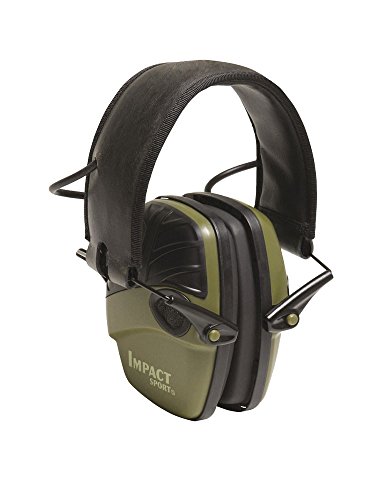
Howard Leight Impact Sport — Best-known electronic muff
Now the species line that this entire guide exists to print clearly: the Impact Sport is an electronic ear muff — hearing protection with amplified ambient sound — and it is not a radio headset. It carries no transmitting microphone, and to join a radio it needs a separate microphone and push-to-talk adapter matched to that radio, bought additionally and verified for compatibility. Stated that plainly, its virtues can be appreciated honestly, because they are considerable: the Impact Sport, in its olive drab green as this listing’s title notes, is the range world’s default electronic muff, the design a generation of shooters learned the category from, with a slim profile that clears a rifle stock and a control layout that generations of gloves have operated.
Its fame rests on the electronic bargain done well: range commands, conversation and range ambience audible at safe levels, gunfire clipped in the instant. For the shooter whose day is ninety percent listening — instruction, scoring, hunting sign, a partner’s voice — that bargain may be the whole requirement, and the adapter question never arises. For the shooter who must also transmit, the Impact Sport becomes the protection half of a rig, and the adapter section above is required reading. The title in this pool states no NRR figure, so the spec box records the silence; the product’s rating lives in Honeywell’s documentation, where a rating-governed buyer should confirm it.
- Species: Electronic ear muff — NOT a radio headset as sold
- Radio use: Requires a separate mic/PTT adapter matched to your radio — not included
- Colour: Olive drab green, per the listing title
- Maker: Howard Leight by Honeywell, per the listing title
- Protection rating: Not stated in the listing title — verify with the maker’s documentation
- Battery details: Not stated in the listing title — check Honeywell’s documentation
Strengths
- The category’s benchmark muff, refined across a full generation of range use.
- Slim profile that respects a rifle stock and a full day’s wear alike.
- Superb at its actual job: hearing the whole range while the range is loud.
Trade-offs
- It cannot transmit — the adapter is a second, compatibility-checked purchase.
- No NRR figure in this listing’s title.
- Its audio input route for a radio rig adds cable management to the day.
Best for: a range shooter or hunter whose day is listening-first, with radio as an occasional adapter-built extra. Not suited for: a team member who must transmit all day, where a complete headset — ComTac, M32X or EHK007 — is the honest single purchase.

Walker’s Razor Slim — Best low-profile muff
The same species honesty applies, in the same first breath: the Razor Slim is an electronic ear muff, not a communication headset, and transmitting through a radio with it requires a separate microphone and push-to-talk adapter for your radio, purchased additionally. What the Razor Slim is, on its own stated terms, is the low-profile specialist of protection: a slim electronic muff in black whose title gives the guide one of its two printed ratings — 23 dB NRR — alongside sound-activated compression, a low-profile fit, cushioned ear cups and HD speakers. That is a complete protection brief, argued in the title itself, and it explains the design’s following among rifle shooters for whom cup clearance against the stock is the difference between a seal and a leak.
The slimness deserves its physics paragraph. A shooting position presses the strong-side cup against the stock’s comb; a bulky cup breaks its seal at exactly the moment of the shot, admitting the impulse the rating promised to stop. A low-profile cup stays sealed through the position, so the printed 23 dB is more likely to be the delivered 23 dB — a case where the ergonomic feature is the safety feature. The HD speakers claim speaks to the listening half: amplified ambient sound rendered clearly enough that voices and range commands stay intelligible at safe gain. As a muff, this is a complete and confident product. As a comms purchase, it is half a rig, and this guide will not let the distinction blur.
- Species: Electronic ear muff — NOT a radio headset as sold
- Radio use: Requires a separate mic/PTT adapter matched to your radio — not included
- Protection: 23 dB NRR, per the listing title
- Electronics: Sound-activated compression, per the listing title
- Fit: Low-profile with cushioned ear cups, per the listing title
- Speakers: HD speakers, per the listing title
Strengths
- A printed 23 dB NRR — one of only two stated ratings anywhere in this pool.
- The slimmest profile here, built to keep its seal hard against a rifle stock.
- Sound-activated compression named outright and proudly in the title.
Trade-offs
- No transmission without the separate adapter purchase.
- Slim cups trade some ear room for their profile; large-eared shooters should trial the fit.
- Its black finish and sport styling mark it as range gear rather than field kit.
Best for: a rifle shooter who needs the seal to survive the shooting position and mostly listens. Not suited for: a squad member whose role is calling and coordinating by radio all day, where a complete headset removes the adapter from the equation.
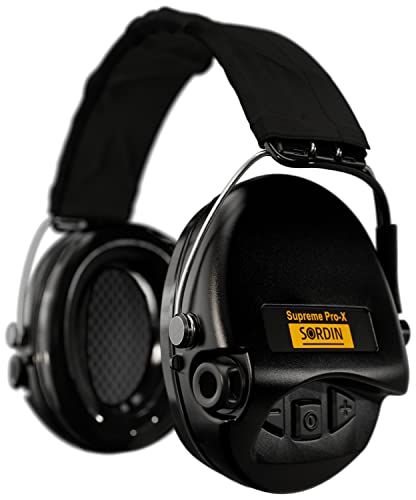
Sordin Supreme Pro-X — Best premium protection
The third muff, and the same clear label: the Sordin Supreme Pro-X is an active electronic ear defender — premium hearing protection — and it does not transmit to a radio without a separate microphone and push-to-talk arrangement matched to that radio, which is a further purchase outside this box. Within its true species, the Pro-X is the comfort aristocrat. Its title specifies active electronic ear defenders with a textile band and gel pads, in black, under a model code as precise as a part number. Gel pads are the headline a long-day wearer should care about: they mould around glasses arms and jewellery, hold the seal that protection depends on, and stay comfortable in hour four in a way foam often does not — and comfort, in protection, is compliance, because the muff that stays on protects and the muff that comes off does not.
Sordin’s following is the professional-adjacent one: hunters who spend dawn in a hide, instructors who live on ranges, shooters for whom the muff is worn more hours than any other kit they own. The title states no NRR figure in this pool’s fetch, and the spec box says so without borrowing one; the rating is a documentation fact for the buyer who needs it printed. What the title does sell is the wearing experience — band, gel, active electronics — and for the protection-first buyer whose transmitting needs are occasional and adapter-served, that experience is the product. Buy it as the finest version of what it is, with the adapter caveat understood, and it will not disappoint; buy it believing it is a radio headset, and the fault will be the blur this guide was written to prevent.
- Species: Active electronic ear defenders — NOT a radio headset as sold
- Radio use: Requires a separate mic/PTT adapter arrangement for your radio — not included
- Pads: Gel pads, per the listing title
- Band: Textile band, per the listing title
- Protection rating: Not stated in the listing title — verify with the maker’s documentation
- Model: 75302-X-02-G-S, per the listing title
Strengths
- Gel pads deliver the best long-wear seal in this guide, glasses and long hours included.
- A premium protection instrument from a specialist maker of the first rank.
- The wear-it-all-day brief, executed at the very top of the category.
Trade-offs
- Transmission requires the separate adapter path, as with both other muffs.
- No printed rating in this listing’s title.
- Its premium is spent on wearing experience, which listening-light users may not amortise.
Best for: an instructor, hunter or range professional who wears protection for whole days and transmits rarely. Not suited for: a team role built around a radio voice, where every complete headset above outranks any muff.
How Do the Six Systems Compare in One Table?
| Pick | Species | Transmits as sold? | Rating stated |
|---|---|---|---|
| 3M PELTOR ComTac V | Comms headset | Yes — dynamic mic, single lead | Not stated in title |
| EARMOR M32X | Comms headset (helmet) | Yes — mic, Kenwood/Baofeng | NRR 22dB |
| Retevis EHK007 | Comms headset | Yes — Baofeng family | Not stated in title |
| Howard Leight Impact Sport | Electronic muff | No — adapter needed | Not stated in title |
| Walker’s Razor Slim | Electronic muff | No — adapter needed | 23 dB NRR |
| Sordin Supreme Pro-X | Electronic muff | No — adapter needed | Not stated in title |
Print this table’s middle columns on the inside of your eyelids before buying anything in this category. The species column predicts your day: headsets arrive ready to talk; muffs arrive ready to protect, with a second purchase between them and a transmitted word. The rating column’s gaps are equally instructive — only two titles in the pool print a number, so a buyer governed by a rating must do documentation work for the other four, and should treat that work as part of the purchase rather than as an errand for later. And the table rewards one final reading: no row is a mistake. Each product is a coherent answer to a real day — the errors in this category live entirely in the matching between the row and the reader, which is a matching only the reader can finally make.
How Should You Set Up and Test a Radio-Headset Pairing?
Test the chain at home, at conversation volume, before it matters. Connect the headset — or the muff-and-adapter rig — to the radio, and run a two-person check with a partner on a second radio at increasing distance: across the room, across the building, across the field’s near end. Transmit at your working voice, not a shout; a setup that only works when you raise your voice will fail you in every situation where raising it is impossible or unwise. Check receive clarity with the protection active and ambient sound present — a running engine, a radio playing — because the field will provide both. If your rig has volume controls at both the radio and the headset or adapter, set the radio’s level first at a healthy middle and trim at the ear thereafter, so one control becomes the day’s single habit.
Then test the wearing system as a system. Helmet users: mount the M32X or your rig, don and doff the helmet ten times, and confirm nothing snags, shifts or silently unplugs — the failure that matters is the connector eased half-out by the third donning. Stock users: take your shooting position with the muffs and dry-check the seal through the full motion, because the seal you verified standing upright may be fiction at the cheek weld. Everyone: practise the push-to-talk by touch until your thumb finds it without a glance, and agree the team’s radio discipline — call signs, brevity, who talks first in an emergency — while the radios are still on a table. A tactical comms setup is a small society with hardware; the hardware half is finished only when the society half works. Write the test results down, too — which channel, which volume settings, which connector felt fragile — because the next setup day will otherwise re-derive them from scratch, at the muster, with the day already running late.
Which Mistakes Do Buyers Make in This Category?
The category’s defining mistake is the species error: buying an electronic muff and discovering at the first team day that it cannot transmit. It is an expensive, embarrassing and entirely preventable error, prevented by the single question this guide has asked on every page — does it have a microphone for the radio, in the box, as sold? The second mistake is the compatibility assumption: headsets, adapters and radios speak connector dialects, and “tactical headset” on a listing is not a dialect. Name your radio’s accessory standard and require written confirmation for every link in the chain.
Third, rating shopping by headline: comparing a stated 22dB against a stated 23 dB as though the laboratory difference will govern a field day, while ignoring seal, fit and profile, which govern it entirely. Fourth, forgetting the consumables of the electronic age — batteries, spare cushions, the gel pads’ eventual replacement — so that a premium system degrades into a uncomfortable one by its second season. Fifth, for helmet users, buying headband comms and improvising the marriage with straps and hope; the rail-mounted pick exists precisely because that improvisation fails under movement. Each of these mistakes is a sentence long and a season expensive; the guide’s structure — species first, compatibility second, fit always — is designed to make all five in the same purchase impossible.
How Do You Keep Tactical Headsets Working Season After Season?
Field equipment ages by moisture, impact and neglect, in that order. Dry everything before storage — a headset put away damp after a wet day corrodes its contacts and mildews its cushions in the dark — and store it unsealed enough to breathe, with batteries removed for long lay-ups so a leaking cell cannot write off an electronic muff in its case. Inspect cables and connectors monthly during the season: the single lead of a comms headset flexes at its ends, and a crackle that appears in the workshop is a failure that has been kind enough to announce itself before the field did. Keep a small kit with the gear — spare batteries, a spare cushion set, the adapter your rig depends on — because the day’s most likely failures are all in that pouch’s weight class.
Cushions and gel pads are consumables with a service life, and replacing them on schedule is protection maintenance, not cosmetics: a flattened pad leaks impulse noise exactly where the rating assumed a seal. Foam windscreens on boom microphones tear and vanish; spares cost little and keep your transmitted voice out of the wind. Finally, re-run the pairing test at each season’s start, with the whole chain, at distance — radios get replaced, adapters get borrowed, firmware and frequencies drift — and the ten-minute check that opens this guide’s how-to section is cheaper than the first team day spent discovering the drift. Tactical gear rewards the boring virtues: dry, inspected, tested, complete.
Which Pick Suits Airsoft, Hunting and Range Days Respectively?
The three classic days in this category weight the six picks differently, and walking through them is the fastest way to a shortlist. The airsoft day is a team sport played at conversational violence: constant low-level coordination, helmets everywhere, radios in every third hand, and weather as a participant. Transmitting is the job, so the complete headsets own the day — the M32X where helmets and Baofengs meet, which is most of the sport, and the EHK007 for headband players in the same radio family. Protection still matters — pyrotechnics and close-quarters noise are real — but the day’s failures are communication failures, and a muff, however excellent, spectates.
The hunting day inverts the weighting. Hours of listening — wind, birds, a partner’s whispered direction — are punctuated by seconds of gunfire, and the party is small enough that voice carries without radios for most of it. Here the muffs come into their kingdom: the Sordin’s gel comfort for a dawn-to-dusk hide, the Impact Sport’s proven field manners, the Razor Slim where a rifle is the day’s instrument. The radio, if one is carried at all, is for the separated party or the emergency, and an adapter-built rig — or simply the radio’s own speaker at need — serves that rare moment honestly. The shooting-range day sits between the two: instruction and scoring are listening work, the line is a listening environment, and transmitting belongs to the range officer’s own systems rather than to yours. Most range regulars should buy protection first and treat any adapter as a later refinement — the reverse of the airsoft player’s correct order, which is why this guide refuses to give the category a single podium.
How Should You Think About Hearing Protection as a Long-Term Practice?
Strip the tactics away and the category’s core is a health-adjacent habit stated in purely practical terms: ears are not replaceable equipment, impulse noise is cumulative in its effects, and the protection you actually wear — every session, for the whole session — is the only protection that counts. That is why this guide keeps returning to comfort and seal as safety properties. A muff abandoned in the range bag at hour two because it hurts has a delivered rating of zero for the rest of the day, whatever its title printed. Gel pads, slim profiles and light builds are, in this light, not luxuries but adherence technology, and the premium picks earn their place by being worn.
The practice has a few rules worth adopting wholesale. Protect for every shot, including the .22 at the quiet end of the line and the other person’s rifle two bays down, because impulse noise does not respect whose trigger it was. Double up — plugs under muffs — where the environment is extreme or indoor, accepting the muff’s amplification as the channel that keeps commands audible through both layers. Replace cushions before they look ruined, since the seal degrades ahead of the appearance. And model the habit for the youngest shooter on the line, whose ears have the longest future to protect and who will copy what the adults actually do rather than what they say. The headsets and muffs in this guide are tools; the practice is the product, and it is bought fresh every session.
What Does a Complete Team Setup Look Like Beyond the Headsets?
A team’s communication is a system of which headsets are the visible third. The radios themselves must share a frequency plan the whole team actually follows — programmed identically, checked at the same pairing test, with a spare radio in the team kit because radios fail at the same rate as everything else electronic. The channel plan deserves the same written-down status as the frequency: which channel is the team’s working net, which is the emergency or admin channel, and who has authority to move the team between them. Batteries form the third layer — a charging rotation for the radios that mirrors the headsets’ own, owned by a named person, because a team whose comms die at hour five has a logistics failure wearing a technology costume.
The human layer closes the system. Call signs that are short, distinct and unembarrassing; a brevity code the team actually uses rather than admires; a radio check at every muster, run like the film crews run their comms check in this site’s production guide, with names spoken and faults surfaced while they are still cheap. New members get the discipline as induction, not as folklore. None of this appears in any listing title, and all of it decides whether the six products in this guide perform as a system or as six individual purchases happening near each other. Buy the headsets with the system in mind — species, compatibility, spares — and the team day becomes the sum of its preparation.
Final Recommendation
Choose your species first and the rest of the decision resolves itself. If your day is transmitting — coordinating a team, a crew, a patrol — buy a complete headset: the ComTac V for the professional radio world, the EARMOR M32X for a helmet and a Baofeng-pattern radio, the Retevis EHK007 for headband wear in that same radio family. If your day is listening under loud conditions, buy the best protection and budget the adapter honestly: the Razor Slim for a rifle seal at a stated 23 dB, the Impact Sport for the benchmark range muff, the Sordin Pro-X for whole-day gel-pad comfort. What you must not do is buy a muff believing it is a headset; this guide has printed the distinction in every review so that no reader of it ever has to learn the difference at the range, in front of the team, holding a radio that cannot hear them. And what you must do, whichever species you choose, is test the whole chain at home, at distance, in noise, before the day that counts on it arrives.
Frequently Asked Questions
Can I use the Howard Leight Impact Sport with my radio?
Only by adding a separate microphone and push-to-talk adapter matched to your radio’s accessory connector. The Impact Sport is an electronic ear muff — it protects your hearing and amplifies ambient sound for your own ears — but it has no transmitting microphone and no radio connection as sold. The same applies to the Walker’s Razor Slim and the Sordin Supreme Pro-X.
Which picks work with a Baofeng UV-5R?
Two titles answer directly: the EARMOR M32X states Kenwood/Baofeng compatibility, and the Retevis EHK007 names the Baofeng UV-5R and its relatives in its title. Both are complete communication headsets, so no adapter stands between them and the radio. Other radios and other picks require compatibility confirmation in the makers’ documentation.
What does NRR mean, and is 23 dB much better than 22 dB?
NRR is a laboratory noise reduction rating for comparing hearing protectors; the Razor Slim’s title states 23 dB and the M32X’s states 22dB. A one-decibel laboratory difference is minor beside the real-world variables — seal quality, fit against glasses or a stock, and whether the wearer keeps the protection on. Buy the fit first and let the rating arbitrate between near-equals.
Why do several titles not state a protection rating?
Because manufacturers choose what to print in a listing title, and this guide reports titles rather than reputations. The ComTac V, EHK007, Impact Sport and Sordin Pro-X titles in this pool do not state an NRR figure; each product’s rating is a fact to confirm in the maker’s documentation, which a rating-governed buyer — a workplace with a written requirement, for instance — should do before purchase.
Do I need a helmet for the EARMOR M32X?
The M32X is designed as an ARC rail helmet headset, so its intended mounting is a helmet with rails. That is its strength for helmet-wearing users and its disqualification for bare-head ones, who should look at the headband-worn EHK007 or ComTac V among headsets, or the muffs if their day is listening-first.
Will electronic muffs protect me if the batteries die?
The passive seal still attenuates — the cups are physical protectors in their own right — but the amplification and compression that define the category stop with the power, and you lose ambient awareness first and foremost. Treat batteries as part of the safety system: fresh at the season’s start, spares in the kit, and a check in the pre-day routine.
What should I verify before the first team day?
Run the full pairing test at distance with a partner, confirm every connector is seated and strain-relieved, practise the push-to-talk by touch, verify the seal in your actual shooting or working position, and agree the team’s call discipline. A chain tested at home fails, when it must, in private — an untested one chooses its own moment.
I mostly shoot alone at a range. Is a comms headset wasted on me?
For pure solo range work, largely yes — your day is listening, and the muffs serve it better and more simply. The honest exception is the shooter whose range life is social or instructional, or who is building toward team activities: then a complete headset bought once beats a muff plus an adapter bought in frustration later. Let next season’s calendar, not this month’s, arbitrate.
Related Guides
Voice under pressure takes different forms across this site. The film production intercom headsets cover the crew-communication cousin of this category, the call-center VoIP headsets guide handles the office version of all-day voice, and the PS4 headsets that cut background noise apply microphone discipline to the gaming chair.


