What's inside
- Key Takeaways
- Quick Picks
- How Did We Choose These Headsets for Glasses Wearers?
- Why Do Headsets Hurt When You Wear Glasses?
- Which Design Traits Should Glasses Wearers Look For?
- What About Glasses, Headsets and Long Video Calls on Camera?
- The Six Picks in Detail
- How Does Your Frame Style Change the Answer?
- Suspension Band or Fixed Band: Which Is Kinder to Frames?
- What Cushion Materials Actually Feel Like Over Frames?
- Does the Same Advice Hold for Work Calls and Glasses?
- How Do the Six Picks Compare for Glasses Wearers?
- How Do You Fit a Headset Over Glasses Properly?
- Which Mistakes Do Glasses Wearers Keep Making?
- Should Glasses Wearers Just Switch to Earbuds or On-Ear Headphones?
- How Should You Shop When Fit Cannot Be Known in Advance?
- When Should You Replace Cushions or the Headset Itself?
- Final Recommendation
- Frequently Asked Questions
- Related Guides
As an Amazon Associate I earn from qualifying purchases. This post may contain affiliate links at no extra cost to you.
gizmoverdict.com is reader-supported. When you buy through links on our site, we may earn an affiliate commission.
Where to buy: the six headsets below are all sold on Amazon, and each linked name goes to the listing we verified. If a model appears in several colour or platform variants, choose the variant on the listing page rather than a lookalike listing, because cushion and band designs can differ between variants of the same headset name.
Anyone who wears glasses knows the moment: forty minutes into a session, a dull ache builds where the earcup presses your frames against your head, and the game, call or film stops being the thing you are paying attention to. Shopping for the best headsets to wear with glasses starts from an uncomfortable truth we will state once and then work around honestly: none of the six listing titles in this guide claims glasses compatibility. No manufacturer here printed the words you are searching for. So this guide judges what can actually be judged from verified listings and known design traits — clamping style, cushion material, total weight where the title states it, and whether the headband is a fixed padded band or a suspension design that spreads load differently. Where glasses fit itself is concerned, every spec box below carries the same line, because it is the truth: not stated in the listing title, verify glasses fit with the manufacturer. What we can do is rank the design traits that decide whether frames and earcups coexist peacefully, and teach you how to fit whichever you buy so the ache never starts.
Key Takeaways
- No listing title here claims glasses compatibility, so judge the traits that cause the pain: clamp force, cushion softness, weight and band design.
- Memory foam cushions, named in two listings below, mould around temple arms instead of crushing them into your head.
- Weight is a glasses issue, not just a comfort statistic; the BlackShark V2 X states 240 g, and every gram hangs partly on your frames.
- Suspension headbands spread load across the top of the head and usually pair with gentler earcup pressure.
- How you put the headset on matters as much as which you buy: frames seated correctly inside the cushion seal end most aches.
Quick Picks
| Pick | Badge | Why it is here |
|---|---|---|
| SteelSeries Arctis Nova 1 | Lightest wired all-rounder | An ultra-lightweight comfort-focused design that works across PC and consoles, so one gentle headset covers every system you own. |
| Logitech G325 LIGHTSPEED | Wireless comfort pick | Logitech pitches all-day comfort in the title itself, with LIGHTSPEED wireless for a couch-and-desk life without a cable tugging at your frames. |
| HyperX Cloud III | Memory foam benchmark | The Cloud line built its name on plush memory foam and a durable frame, and this wired generation connects to nearly everything. |
| Turtle Beach Stealth 600 PlayStation | Long-session wireless | Memory foam cushions plus a battery claim aimed at marathon players, in the PlayStation and PC listing of this multiplatform model. |
| CORSAIR VOID v2 Wireless | Big-headset, soft-touch option | A roomy VOID chassis in a lightweight wireless build, for players whose frames need space as much as softness. |
| Razer BlackShark V2 X | Featherweight wired choice | The title states 240 g, and that low mass pressing on your temple arms is the whole argument. |
How Did We Choose These Headsets for Glasses Wearers?
We began by discarding the search’s own premise. Typing glasses into a headset search returns headsets whose marketing departments wrote the word into a description somewhere, not headsets engineered around frames. Instead we filtered for the physical traits that determine whether a temple arm survives an evening: cushion material soft enough to deform around the arm rather than lever it into your skull, clamp force tuned for sealing without squeezing, weight low enough that the earcups are not hanging off your frames, and headband designs — suspension straps in particular — that carry the headset on your crown instead of gripping your head like a vice. Every pick below clears that filter on at least several counts, and its analysis names which counts.
We also insisted on platform honesty. A glasses-friendly headset you cannot connect to your console is a paperweight, so the set spans wired multi-system designs, a LIGHTSPEED wireless model, a PlayStation-listed wireless model and a dual-wireless Corsair, covering PC, PlayStation, Xbox wired paths and Switch between them. Microphone quality mattered as a secondary filter because glasses wearers skew towards long sessions, and long sessions are usually social ones — squad play, co-op nights, work calls that become game nights. Finally, we treated every battery figure and comfort adjective in a listing title as a claim to be weighed, not a measurement to be repeated, and we have written the analyses that way throughout.
Why Do Headsets Hurt When You Wear Glasses?
The mechanics are simple once you picture them. An earcup seals by pressing a cushion ring against the side of your head. Your glasses’ temple arm passes exactly through that ring’s territory, so the cushion presses the arm, the arm presses the skin above your ear, and the arm’s hinge and tip become two concentrated pressure points with your head as the anvil. Three variables decide how much that hurts. Clamp force is the headline one: headsets tuned for passive noise isolation grip hard, because grip is what seals out the room. Cushion stiffness is the second: a firm cushion treats the temple arm as a pebble in a shoe, while a soft, slow-rebound foam flows around it and distributes the load. The third is time. Almost any headset is tolerable for twenty minutes; the ache is a cumulative pressure injury that announces itself in hour two, which is why reviews written after a quick try-on miss it entirely.
There is also a sound consequence, not just a comfort one. A temple arm holding the cushion away from your skin breaks the seal, and a broken seal leaks bass. Glasses wearers often report that a headset sounds thin, then discover it sounds full the moment they take their frames off. Thick arms leak more than thin ones, metal arms less than chunky acetate, and cushions with enough depth and softness to swallow the arm restore both comfort and sound at once. When you read the picks below, read them with both ledgers in mind: every design trait we praise is doing double duty, sparing your temples and rescuing your low end.
Frame choice interacts too, and it is worth saying because nobody tells new glasses wearers this: if you buy glasses with gaming or desk work in mind, thin, flat, flexible temple arms are the single biggest comfort upgrade available, bigger than any headset feature. Several picks below will feel transformed by nothing more than switching from thick acetate arms to slim metal ones. We cannot sell you glasses in a headset guide, but we can tell you where the problem actually lives.
Which Design Traits Should Glasses Wearers Look For?
Start with the cushion. Memory foam is the material named in the Cloud III and Stealth 600 listings, and it earns its reputation here: it compresses where the temple arm sits and stays compressed, effectively carving a channel for your frames over the first minutes of wear. Fabric-covered cushions breathe better across long sessions than leatherette and grip frames less aggressively, though leatherette seals slightly better; several wearers keep both styles and swap by season. Cushion depth matters alongside softness — a deep cushion gives the arm somewhere to go.
Then the band. A suspension headband, the design the G733 family popularised and a trait to look for across this category, hangs the earcups from a flexible strap that rests on your crown. The practical effect for glasses wearers is that the cups can sit with less inward force because the strap, not the clamp, is doing the positioning work. Try a quick experiment with any headset you already own: wear it ten minutes without your glasses, then ten minutes with them, and notice where the cups sit. Most wearers find the cups ride slightly higher and further back with frames on, because the arms occupy space the cushion expected to fill. That small displacement explains both the bass leak and the ache, and it is why a band with adjustment range to spare — room to lengthen the fit and re-centre the cups over your ears — is a quiet glasses feature in its own right. Fixed padded bands are not automatically worse, but they rely more on clamp, so their cushions need to be softer to reach the same comfort. Weight is the third trait, and the only one with a number attached in this pool: the BlackShark V2 X states 240 g. Treat that figure as a reference point when comparing any headset whose weight you can verify, because mass is pressure multiplied by hours.
Finally, look at how the earcups move. Cups that swivel flat and pivot on their yokes accommodate the fact that glasses shift the geometry of your ears slightly outward; rigid cups meet that geometry with an edge. None of the listing titles below itemises its pivot hardware, which is precisely the sort of detail the verification line in each spec box exists for. Readers whose heads run large as well as bespectacled will find a useful cross-check in our guide to the best headsets for people with big heads, where clamp and band extension are judged even more strictly.
What About Glasses, Headsets and Long Video Calls on Camera?
A modern wrinkle deserves its own paragraph: many glasses wearers now spend their headset hours visible on camera, and discomfort shows. A wearer fighting a pinch shifts the headset, touches their frames, and gradually migrates both out of position, which reads on video as restlessness and slowly wrecks the fit they started with. Comfort is therefore also a presentation feature. The headsets that stay put — foam that has moulded, bands that do not creep — are the ones that let you forget your face for an hour, and the camera notices the difference even when you do not. If you present, teach or stream, weight the long-session picks here, the Cloud III, Stealth 600 and G325, above the purely featherweight ones, because their comfort is the kind that survives being watched.
The Six Picks in Detail

SteelSeries Arctis Nova 1 — Lightest wired all-rounder
The Arctis Nova 1’s listing leads with two phrases a glasses wearer should care about: comfort design and ultra lightweight. SteelSeries’ Arctis line has always hung its earcups from an adjustable elasticated ski-goggle-style strap arrangement in its higher tiers, and the Nova 1 carries the family’s comfort-first philosophy into an entry wired model: the headset’s mass is small, and what mass there is gets spread rather than clamped. For frames, that combination is the kindest in the wired world. The temple arms are not being asked to support a heavy headset or resist a hard squeeze, so the two classic ache points — above the ear and at the hinge — stay quiet through long sessions.
The wired multi-system connection is the practical bonus: one headset follows you from PC to PlayStation to Switch to Xbox controller without a dongle drawer, which matters if your glasses-wearing hours are split across a desk and a couch. The noise-cancelling microphone handles squad chat and work calls credibly, and the drivers are tuned as hi-fi-leaning by gaming standards, so the seal your frames allow you translates into clean sound. Our caution is the usual one for this entire guide, stated plainly: the listing does not claim a glasses channel or glasses certification, and cushion behaviour around your specific frames is yours to verify against the manufacturer’s information and, ideally, a returns-friendly first week of long sessions.
- Glasses fit: Not stated in the listing title — verify glasses fit with the manufacturer
- Connection: wired, multi-system (PC, PlayStation, Switch, Xbox per listing)
- Microphone: noise-cancelling, retractable-style Arctis design
- Fit: comfort-focused lightweight build
- Colour of this listing: white
Strengths
- Very low mass means the earcups rest on your head rather than hanging from your frames.
- The family’s comfort-led band design spreads what weight there is across the crown.
- One wired headset genuinely covers every gaming platform in a typical house.
Trade-offs
- Wired means a cable across the desk or couch, with the occasional tug transmitted straight to your frames.
- Entry-tier materials ask for gentler handling than the metal-framed picks below.
- The white finish of this listing shows desk grime faster than the black alternatives.
Best for: glasses wearers who game across several systems and want one light wired headset that disappears during long sessions. Not suited for: players who specifically want wireless freedom, or heavy-handed users who sit on their gear.

Logitech G325 LIGHTSPEED — Wireless comfort pick
Logitech put the words all-day comfort in this listing’s title, and for once the marketing phrase points at the right problem for glasses wearers, because all-day is exactly when frames start to bite. The G325 is a LIGHTSPEED wireless headset, and removing the cable removes an underrated glasses irritant: cable tug. Every time a wired cable catches on a desk edge or your own shoulder, the earcup shifts, the cushion re-seats itself across your temple arm at a slightly new angle, and the pressure clock restarts. A wireless headset, once seated comfortably, tends to stay seated.
The listing also states 24-bit audio and a battery figure of 24-plus hours, which we repeat as the seller’s claim rather than a measurement; in practice it describes a headset you charge every few days rather than every night. The built-in microphone includes noise reduction, aimed at keeping keyboard and room noise out of calls. For glasses specifically, the G325’s appeal is its positioning as a comfort-tuned, relatively light wireless design from a maker whose headband geometry is generally relaxed. As with every pick here, the title is silent on glasses fit itself, so the verification line below applies with full force — but if your frames ache most when a cable drags your headset around, this is the pick aimed at your version of the problem. Players comparing wireless routes across budgets should also scan our best affordable gaming headsets pc roundup, where several comfort-led designs compete on price.
- Glasses fit: Not stated in the listing title — verify glasses fit with the manufacturer
- Connection: LIGHTSPEED wireless plus Bluetooth per listing
- Microphone: built-in, with noise reduction
- Battery: 24+ hours as claimed in the listing title
- Audio: 24-bit audio per listing
Strengths
- No cable means no tugs re-seating the cushions across your temple arms mid-session.
- Comfort is the stated design brief, not an afterthought, which shows in relaxed clamp tuning for this class.
- Dual wireless modes cover a gaming PC and a phone without re-pairing rituals.
Trade-offs
- A built-in microphone cannot be positioned at your mouth the way a boom can, so chat clarity depends on room quiet.
- Wireless adds charging to your routine, and a forgotten charge ends a session outright.
- The comfort claim is the maker’s; your frames and your head remain the final test.
Best for: glasses wearers whose ache arrives with cable snags and re-seating, and who split time between a PC and a couch. Not suited for: competitive players who want a big positionable boom microphone, or anyone who refuses to manage a battery.
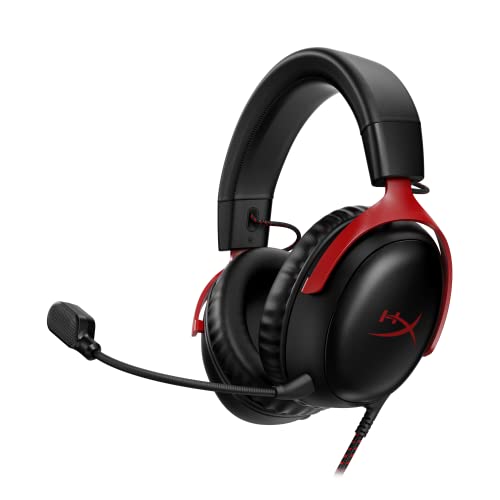
HyperX Cloud III — Memory foam benchmark
The Cloud name became the default recommendation for comfort long before this guide, and the Cloud III’s listing states the reason in two words: memory foam. For a glasses wearer, memory foam is not a luxury adjective; it is the mechanism by which a cushion stops fighting your frames. Press a temple arm into slow-rebound foam and the foam yields, moulds, and holds a shallow channel, so the arm sits in the cushion rather than being pinned by it. Combined with the line’s durable metal frame, which keeps its clamp consistent instead of loosening into sloppiness or tightening with age, the Cloud III is the wired pick we would hand first to someone whose current headset leaves marks.
Connectivity is the other half of its brief: the listing names USB-C, USB-A and 3.5mm, covering modern laptops, desktops and controllers without adapters. The microphone is a larger 10mm element by the listing’s description, with an ultra-clear positioning claim we will let your squadmates judge. What the Cloud III does not do is cut the cable or chase featherweight numbers; it is a substantial, well-built wired headset whose comfort comes from cushion engineering rather than minimal mass. If your ache is specifically the pinch at the temple rather than overall weight, foam is the more relevant medicine, and this is the foam benchmark in the pool.
- Glasses fit: Not stated in the listing title — verify glasses fit with the manufacturer
- Connection: wired USB-C, USB-A and 3.5mm per listing
- Microphone: 10mm element per listing, detachable-style Cloud design
- Cushions: memory foam
- Frame: durable metal construction per listing
Strengths
- Memory foam moulds around temple arms instead of pressing them flat against your head.
- The metal frame holds its tuned clamp for years rather than drifting tighter or looser.
- Three wired connection options end compatibility guesswork across PC and consoles.
Trade-offs
- It is a weightier headset than the Nova 1 or BlackShark, so crown pressure replaces pinch for some wearers.
- Wired-only, with no wireless mode for couch play.
- Deep foam cushions run warm in summer rooms during long sessions.
Best for: glasses wearers whose pain is the temple pinch and who play wired at a desk or console for hours at a stretch. Not suited for: players sensitive to total headset weight, or anyone set on wireless.

Turtle Beach Stealth 600 PlayStation — Long-session wireless
This pick is the PlayStation and PC listing of the Stealth 600 — the model appears in several platform listings, and this one is the right door if your gaming lives on a PS5 or a computer. Its glasses-relevant credentials arrive as a pair: memory foam cushions, the same mould-around-the-arm mechanism praised in the Cloud III, delivered here in a wireless chassis. That combination is rarer than it should be. Many wireless headsets chase low weight with firm thin cushions; the Stealth 600 instead brings the soft-cushion approach to a cable-free design, so frames get foam kindness without cable tugs.
The listing’s battery claim is a large one, stated in the title as an 80-hour figure; treat it, as always, as the seller’s best case, but even a heavily discounted version of that number describes a headset charged weekly rather than nightly, which suits glasses wearers in an unexpected way — fewer charging interruptions means fewer times you take the headset off, disturb a comfortable seating, and start the pressure clock again. The flip-to-mute microphone parks itself out of the way and mutes by motion, a small mercy during long co-op nights. The honest limits: this listing is PlayStation-flavoured, so Xbox households should look to the wired picks, and the foam-plus-wireless build is not the lightest object in this guide.
- Glasses fit: Not stated in the listing title — verify glasses fit with the manufacturer
- Connection: wireless for PS5, PS4 and PC, plus Bluetooth per listing
- Microphone: flip-to-mute, noise-cancelling per listing
- Cushions: memory foam
- Battery: 80-hour figure as claimed in the listing title
Strengths
- Memory foam and wireless freedom together address both the pinch and the cable-tug causes of ache.
- A long claimed battery life means long, undisturbed sessions between charges.
- Flip-to-mute is the fastest silent control there is during a live game.
Trade-offs
- This listing serves PlayStation and PC; Xbox players are pointed elsewhere in this guide.
- Foam cushions plus a big battery make it one of the heavier wireless options here.
- The headline battery number is a claim to plan around loosely, not a guarantee.
Best for: PlayStation and PC glasses wearers who play in long wireless sessions and want foam comfort without a cable. Not suited for: Xbox households, or minimalists who rank low weight above cushion softness.

CORSAIR VOID v2 Wireless — Big-headset, soft-touch option
The VOID line has always been the roomy end of Corsair’s range: big earcups, a spacious fit, a chassis that assumes heads and hairstyles need volume. For glasses wearers, roominess is a genuine trait, because a cup with internal space does not need to clamp as desperately to stay placed, and temple arms fare better in a headset that sits around the ear generously rather than gripping it. The v2 listing describes a lightweight build for the size, with dual wireless — a 2.4GHz connection for gaming and Bluetooth for everything else — and a battery figure of 70 hours stated in the title, which we file under seller claims to plan around rather than promises.
Dolby Atmos support headlines the audio side for PC play. For our purposes the more relevant observation is fit geometry: wearers who find most gaming headsets simply small — whose frames sit wide, whose ears need depth — often discover that the ache was never about softness but about a cup too cramped to accommodate glasses at all. The VOID v2 is the pick in this pool aimed at that discovery. It is also the most physically imposing headset here, and small heads may find the fit loose rather than kind; glasses comfort is personal geometry, and this guide’s recurring instruction to verify fit with the manufacturer matters most for the extremes, which is what this headset is.
- Glasses fit: Not stated in the listing title — verify glasses fit with the manufacturer
- Connection: 2.4GHz wireless plus Bluetooth per listing
- Audio: Dolby Atmos support per listing
- Battery: 70-hour figure as claimed in the listing title
- Fit: roomy VOID chassis, lightweight for its size per listing
Strengths
- Generous cup volume gives wide frames and larger ears physical room instead of a squeeze.
- Dual wireless covers low-latency PC play and phone Bluetooth in one headset.
- A long claimed battery life suits players who charge on weekends, not weeknights.
Trade-offs
- The big chassis can feel loose on smaller heads, trading pinch for slippage.
- It is visually and physically the bulkiest pick in this guide.
- Atmos and headline battery figures are listing claims, not our measurements.
Best for: glasses wearers with larger heads or wide frames who find mainstream headsets cramped before they find them heavy. Not suited for: small heads, or players wanting the most compact travel-friendly design.

Razer BlackShark V2 X — Featherweight wired choice
One number does most of the talking for this pick, and unusually for a listing title, it is a number that matters: 240 g, stated right in the title. Every gram of a headset is ultimately supported by your head, and a meaningful share of an earcup’s share is transmitted through whatever touches your head — including your temple arms. A genuinely light headset reduces the force at every contact point at once, which is why so many glasses wearers end up loyal to featherweight wired models like this one. The BlackShark V2 X pairs that low mass with noise-isolating earcups and a 3.5mm connection that plugs into controllers, PCs and handhelds indiscriminately.
The microphone is Razer’s HyperClear cardioid design, a bendable boom that rejects sound from behind it, which keeps squad chat clean in ordinary rooms. The drivers are the line’s TriForce Titanium 50mm units per the listing. None of this is exotic, and that is the point: this is a simple, light, wired tool whose glasses argument is physics rather than features. Its cushions are not memory foam in the Cloud III’s league, so if your specific ache is a hard pinch at one point, foam may serve you better than lightness. But if your ache is the slow, whole-side soreness of a heavy headset grinding your frames hour after hour, 240 g is the most persuasive sentence in this guide. Wired purists comparing across the category can cross-check it against the options in our best gaming wired headsets with microphone roundup.
- Glasses fit: Not stated in the listing title — verify glasses fit with the manufacturer
- Connection: wired 3.5mm
- Microphone: HyperClear cardioid boom per listing
- Weight: 240 g as stated in the listing title
- Drivers: TriForce Titanium 50mm per listing
Strengths
- The stated 240 g weight lowers pressure at every contact point, frames included, for the whole session.
- A plain 3.5mm plug works with virtually every controller, PC and handheld ever made.
- The cardioid boom keeps chat clear without needing software noise tools.
Trade-offs
- Cushions are comfort-ordinary rather than memory foam, so a focal pinch may persist for some frames.
- Wired only, and the cable is part of the headset’s permanent furniture.
- The esports-plain styling offers none of the wireless picks’ couch flexibility.
Best for: glasses wearers whose soreness is weight-driven and who play wired across mixed platforms. Not suited for: wearers whose pain is a single sharp pinch point, where the Cloud III’s foam is the better medicine.
How Does Your Frame Style Change the Answer?
Not all glasses load a cushion equally, and matching the pick to the frame style sharpens every recommendation in this guide. Thick acetate arms, the bold fashion default, present the worst case: a wide, stiff beam that cushions must swallow whole. Foam depth is the countermeasure, which is why acetate wearers should start with the Cloud III or the Stealth 600 and treat lightness as secondary. Thin metal arms, especially flat spring-hinged ones, nearly disappear into any competent cushion; their wearers can prioritise other traits — connection, microphone, weight — because almost every pick here will treat them gently. Rimless and half-rim frames flex more at the hinge, so their enemy is a hard focal pinch that bends the arm’s alignment over time; soft foam again, and a strict habit of lifting cups on and off rather than sliding.
Contact-lens part-timers face a sneakier version of the problem: a headset that feels fine on lens days and pinches on glasses days, which tempts them to blame the frames entirely. The real story is usually a marginal fit exposed by the arms, and the fix is the same cushion logic, applied before the marginal becomes unbearable. Sunglasses deserve a sentence for outdoor and sim-rig players: their arms are often the thickest of all, and a headset comfortable over your everyday glasses may not be over your shades, so test with the frames you actually wear in the chair.
Children and teenagers in the household are the last geometry to consider, because a headset bought for a parent migrates. Smaller heads and smaller frames change clamp behaviour completely, and a VOID-sized chassis that is kind to a large adult can swallow a young wearer. If the headset will be shared, the adjustable, lighter wired picks — Nova 1 first among them — adapt across the widest range of heads and frames in this pool.
Suspension Band or Fixed Band: Which Is Kinder to Frames?
The headband decides where a headset’s weight goes, and glasses wearers feel that decision at their temples. A fixed padded band is a single structure: it rests on the crown and its stiffness helps set the clamp, so the whole system tends to grip as one piece. A suspension design splits the job — a rigid outer frame holds the earcups’ position while a flexible inner strap, elastic or leather, floats on your head and self-adjusts. Because the strap conforms rather than presses, suspension headsets often feel secure with noticeably less inward force at the cups, and less inward force is exactly what a temple arm wants.
The trade is durability and drift. Elastic straps age; a suspension band that felt perfect in year one can sag by year three, letting the cups ride lower and changing where they meet your frames. Fixed bands age more predictably, and a metal-framed fixed design like the Cloud III holds its geometry for years. Neither architecture wins outright. If your ache arrives early and sharply, suspension’s gentler initial clamp usually helps most. If you keep gear for five years and want the fit you tested to be the fit you keep, a well-made fixed band with soft cushions is the steadier bet. Between the two, cushion material remains the tiebreaker, because the band decides the force and the cushion decides how that force is distributed across your arm.
What Cushion Materials Actually Feel Like Over Frames?
Leatherette, the synthetic leather on many stock cushions, seals best and therefore sounds fullest, but it grips skin and frames alike and traps heat; over a long session the grip becomes a slow drag on your temple arms every time you turn your head. Fabric and mesh covers trade a whisper of seal for a large gain in kindness: they slide rather than stick, breathe through summer sessions, and let a temple arm settle without being grabbed. Velour-style plush sits between the two, soft against frames and cooler than leatherette, at the cost of the weakest seal of the three.
Foam density underneath the cover matters as much as the cover itself. Slow-rebound memory foam, the Cloud III and Stealth 600 route, is the only common fill that holds a moulded shape around your arm through a session. Standard foam springs back instantly, which sounds lively and feels, over frames, like a constant gentle argument. If you love a headset’s sound but not its stock cushions, aftermarket pads are the highest-value experiment in this entire category: a deeper, softer set can convert a pinching headset into your favourite, and the swap usually takes two minutes and no tools. Buy the replacements from a maker who lists your exact model, because cup geometry is not universal.
Does the Same Advice Hold for Work Calls and Glasses?
Mostly, with one shift in emphasis. Workdays are longer than gaming sessions and involve more taking the headset off and putting it back on — coffee, conversations, the door. Every re-seating is a fresh negotiation between cushion and frame, so work wearers benefit disproportionately from designs that seat consistently: memory foam that remembers the channel, and bands that return to the same position without fiddling. The ache pattern also differs. Gamers notice pain during play; office wearers often notice it at lunch, when the headset comes off and the pressure releases, which makes them slower to blame the headset at all.
If your job is call-heavy, the mono and lightweight end of headset design deserves a look alongside this pool, since one earcup means half the frame contact. But for stereo work — video calls where you want both ears, focus music between calls — the six picks here remain the right shortlist, with the G325’s all-day positioning and the Nova 1’s lightness translating directly from play to work. The fitting sequence in the how-to section below applies unchanged at a desk; the only addition is to re-run it after any optician visit, because adjusted frames sit differently and your headset’s moulded cushions will need a session to learn the new geometry.
How Do the Six Picks Compare for Glasses Wearers?
| Headset | Connection | Cushion or fit trait | Weight evidence | Choose it when |
|---|---|---|---|---|
| SteelSeries Arctis Nova 1 | Wired, multi-system | Comfort-led lightweight design | Described as ultra lightweight in the listing | You game everywhere and want one gentle headset |
| Logitech G325 LIGHTSPEED | LIGHTSPEED wireless, Bluetooth | All-day comfort positioning | Not stated in the listing title | Cable tugs keep re-seating your cushions |
| HyperX Cloud III | Wired USB-C, USB-A, 3.5mm | Memory foam cushions | Not stated in the listing title | The temple pinch is your main pain |
| Turtle Beach Stealth 600 PlayStation | Wireless plus Bluetooth | Memory foam cushions | Not stated in the listing title | You want foam comfort without a cable on PS5 or PC |
| CORSAIR VOID v2 Wireless | 2.4GHz wireless plus Bluetooth | Roomy, spacious chassis | Described as lightweight in the listing | Mainstream cups feel cramped on your frames |
| Razer BlackShark V2 X | Wired 3.5mm | Noise-isolating earcups | 240 g stated in the listing title | Overall soreness from headset mass is the issue |
The weight evidence column is deliberately uneven, because the listings are uneven: only Razer printed a number. Read the empty cells as instructions, not oversights — a headset whose weight you cannot verify before purchase is a headset to buy from a returns-friendly seller.
How Do You Fit a Headset Over Glasses Properly?
Technique rescues more glasses wearers than hardware does, so learn the sequence. Put your glasses on first and settle them exactly where you wear them. Then, instead of sliding the headset down over them, lift the earcups wide, place them over your ears, and let the cushions come in against the temple arms rather than dragging across them. Sliding drags the arms out of position and folds them into the cushion at a random angle, which is how a comfortable headset produces a painful first hour. Once the cups are on, reach a fingertip under each cushion and check that the temple arm lies flat along your head, not kinked upward by a cushion edge.
Next, set the headband length so the cups sit centred on your ears without the band pulling them upward; a cup riding high concentrates its pressure on the top of the temple arm, the most sensitive spot. Then wear the headset for a full session before judging it, because memory foam and new cushions generally need a sitting to mould and soften. If an ache develops, note where: above the ear suggests band length or clamp, at the hinge suggests cushion stiffness, behind the ear suggests the arm’s tip and a cup sitting too far back. Each location points at a different fix, from re-seating to a cushion swap to a different pick entirely.
Two accessories earn their keep for stubborn cases. Thin glasses straps that hold frames snug prevent the micro-shifts that restart pressure points, and aftermarket cushions in softer foam or fabric can transform a headset whose drivers you love but whose stock pads fight your frames. Neither is an admission of defeat; both are cheaper than a new headset. What does not work is simply enduring it. Pressure pain does not toughen you up over a season; it shortens sessions and, eventually, puts the headset in a drawer.
Which Mistakes Do Glasses Wearers Keep Making?
The first is shopping by the word glasses in marketing copy and discovering that a claimed feature was a shallow groove that does not align with their frames. Judge traits, not adjectives, and use returns windows as part of the purchase. The second is testing a headset for ten minutes in a shop or at a desk and declaring victory; the ache this guide is about lives in hour two, so any honest test must too. The third is cranking the headband tight to restore a bass seal that the temple arms are leaking, trading a sound problem for a pain problem when softer or deeper cushions would have solved both.
Fourth, wearers blame the headset for what their frames are doing. Thick, stiff acetate arms will defeat most cushions, and if you game daily, choosing your next frames with slim flexible arms is a legitimate part of your audio setup. Fifth, they wear the headset over a hat, hood or hair arrangement that shifts the cups, then judge the fit unfairly. Sixth, they ignore the behind-the-ear tip of the arm entirely; a tip digging in back there is often cured by an optician’s two-minute adjustment, free at most practices, and no headset purchase will fix it.
Should Glasses Wearers Just Switch to Earbuds or On-Ear Headphones?
It is a fair question, and the honest answer is: sometimes, but know what you are trading. Earbuds bypass the temple arm entirely, which is why they are the refuge of the truly pinch-afflicted, and modern gaming earbuds with low-latency dongles are respectable. What they surrender is the headset package this guide exists for: a proper boom microphone at your mouth, big-driver sound, and the ability to wear them for a whole day without in-ear fatigue, which is its own ache with its own hour-two arrival. On-ear headphones, which rest on the ear itself, sound like a compromise and usually are not one for glasses wearers: they press the ear directly against the temple arm’s hinge area, concentrating force on a smaller area than an over-ear cushion does. Most glasses wearers who try on-ears for relief return to over-ears within a week.
The over-ear headset remains the right default because its problem is solvable with traits and technique, as this guide has laid out, while the alternatives swap a solvable problem for structural ones. Keep earbuds as the pressure valve for your worst days and travel, and let a properly fitted headset carry your main sessions.
How Should You Shop When Fit Cannot Be Known in Advance?
Accept the epistemology of this purchase: no specification sheet can tell you whether a given cushion and your given frames agree, because frame geometry varies more than headset geometry does. So shop like a scientist with a returns policy. Shortlist two picks from this guide that attack your ache by different mechanisms — say, the Cloud III’s foam against the BlackShark’s lightness — and buy the first from a seller whose returns window covers a fortnight of real sessions. Test it at full session length on consecutive days, using the fitting sequence, and keep a three-line diary: where it hurt, when it started, what fixed it. If the diary trends worse, return it while the window is open and order the second mechanism. This feels slow and is in fact the fastest route, because the alternative — keeping a nearly-right headset and enduring it — costs you a season of shortened sessions.
One more piece of shopping hygiene: buy the exact listing you researched. Several models in this pool exist in platform-specific and colour variants whose cushions and bands are not guaranteed identical, and a bargain variant from a marketplace seller can quietly be a different fit wearing a familiar name. The links in this guide point at the verified listings for that reason. If you choose a different variant on the listing page, re-check its stated traits against the analysis of the pick before you commit, and keep the same returns discipline, because the fit you are buying is the variant’s, not the model’s reputation.
Resist two temptations during testing. Do not judge a headset in the first fifteen minutes, when every cushion feels plush and no pressure has accumulated; the only honest verdicts in this category are written after hour two. And do not modify what you may return: no aftermarket cushions, no band bending, until the headset is definitely yours. Once it is yours, modify freely — pads, straps and frame adjustments are how a good fit becomes a perfect one.
When Should You Replace Cushions or the Headset Itself?
Cushions are wear parts, and glasses accelerate their wear along one specific line: the groove your temple arm presses into the foam. Over a year or two that groove deepens, the foam around it thins, and a headset that was kind becomes gradually less so, in a decline slow enough to blame on your frames or your tolerance. Before replacing any headset in this guide for comfort reasons, price a fresh set of cushions. Restoring the original foam depth restores the original fit, and the cost is a fraction of a new headset. If fresh cushions do not restore comfort, the band has likely drifted — elastic tired, hinge loosened — and that is the honest moment to shop again, diary in hand, knowing far more about your own ache than you did the first time.
Final Recommendation
Start by naming your ache.
If it is the pinch at your temples, the Cloud III’s memory foam is the most direct answer in this pool, with the Stealth 600 delivering the same cushion logic wirelessly for PlayStation and PC. If it is whole-side soreness from mass, the BlackShark V2 X’s stated 240 g and the Nova 1’s featherweight wired design attack the cause. If cable tugs keep restarting your discomfort, go wireless with the G325; if every headset feels cramped before it feels heavy, the VOID v2’s room is your experiment. Whichever arrives, fit it with the sequence above and judge it at hour two, not minute ten. Your frames are not an obstacle to good audio; they are a specification, and a headset chosen against that specification will let you forget both it and them for entire evenings at a time, season after season.
Frequently Asked Questions
Do any headsets actually have glasses channels in the cushions?
Some headsets elsewhere on the market do carve a relief channel into the foam for temple arms. None of the six listing titles in this guide claims such a feature, which is why every spec box here carries the verification line instead of an invented claim. If a channel matters to you, confirm it in the manufacturer’s own specifications for the exact model and variant before buying, and remember that a channel only helps if it aligns with where your frames actually sit.
Are memory foam cushions always better for glasses?
Not always, but they are the most reliable single trait. Foam moulds around the arm and distributes pressure, which addresses the pinch. It does less for weight-driven soreness, and it sleeps warmer than fabric. Wearers whose ache is heaviness rather than pinch may do better with a lighter headset in ordinary cushions, like the BlackShark V2 X, than with a heavy foam one.
Why does my headset sound thin when I wear my glasses?
Your temple arms are holding the cushions slightly away from your head, and the broken seal leaks low frequencies. Softer or deeper cushions that swallow the arm usually restore the bass, as can seating the arms flat inside the cushion line. If one side sounds thinner than the other, check that side’s arm position first; asymmetric fit is the most common cause.
Should I choose wired or wireless if I wear glasses?
Choose by irritant. Wireless removes cable tugs that re-seat cushions across your arms, which is a real and underrated benefit. Wired models include the lightest and the best foam options in this pool, and never end a session on a battery. Neither connection type is inherently kinder; the cushion and the mass decide that, so pick the connection that suits your setup and the fit traits that suit your frames.
Can an optician really help with headset pain?
Yes, and it is the cheapest fix in this guide. Temple arms can be adjusted to sit flatter, tips can be re-angled, and a frame that has drifted out of alignment concentrates pressure exactly where headsets press. If one side hurts more than the other, suspect your frames before your headset. Many practices make small adjustments free, especially where you bought the glasses.
How long should I test a headset before deciding it hurts?
At least one full-length session of the kind you actually play — two hours is a fair benchmark — on two separate days. New cushions soften slightly, and your own tolerance varies with fatigue. A headset that is merely noticeable at hour two is usually a keeper once fitted properly; one that has you lifting a cup off one ear to rest it is telling you the truth, so believe it and use the returns window.
Do glasses-friendly traits cost sound quality?
One honest trade exists: the softest, deepest cushions and the gentlest clamps seal slightly less firmly than isolation-tuned designs, so in a loud room a comfort-first headset may let in more ambient noise and lose a shade of bass impact. In the quiet rooms most people game and work in, the difference is small, and it reverses in glasses wearers’ favour — a firm headset whose seal your arms break sounds worse than a soft one that seals around them. Judge in your room, with your frames, at your volume.
What if only one side hurts?
Asymmetry is diagnostic gold. Heads and frames are both slightly uneven, and a one-sided ache usually means one temple arm sits higher, one cushion has worn faster, or one hinge on the headset pivots less freely than the other. Swap the headset around briefly if the design allows, check the frames against a mirror, and inspect the cushions side by side. The fix is frequently a frame adjustment or a single replacement cushion rather than a new headset.
Related Guides
Competitive players wearing glasses face the same fit questions under stricter latency demands, covered in our guide to the best headsets for esports. And if your long sessions are recording sessions rather than matches, the comfort reasoning in our guide to the best headsets for podcasting wireless pairs naturally with everything above.


