What's inside
- Key Takeaways
- Quick Picks
- How We Chose These Picks
- Which of the best birding cameras and lens fits your situation?
- What does 35mm-equivalent reach actually mean?
- When does the big-sensor camera beat the superzooms?
- How do you actually hold a 2000mm-equivalent steady?
- What should a new birding photographer practise first?
- How do you set up a superzoom for birds before you leave home?
- What changes when you photograph birds near water?
- How do you photograph small birds in woodland shade?
- How do you choose between Nikon’s two reach flagships?
- How do you identify birds from photographs honestly?
- What does a year of birding photography actually cost?
- What should you check before you buy?
- How do you photograph birds at feeders without ruining the feeders?
- What should you do on the days when no bird cooperates?
- Field Notes From Real Sessions
- Comparison Table
- What are the most common mistakes buyers make?
- Final Recommendation
- Frequently Asked Questions
- Related Guides
As an Amazon Associate I earn from qualifying purchases. This post may contain affiliate links at no extra cost to you.
gizmoverdict.com is reader-supported. When you buy through links on our site, we may earn an affiliate commission.
Shopping for the best birding cameras and lens combinations runs into an honest shape on today’s market: for most birders the answer is a bridge camera, one body with a fixed superzoom lens that reaches further than any affordable lens-and-body pairing. The six picks here span that class from a 60-times zoom veteran to a 125-times flagship, plus one larger-sensor outlier whose shorter reach trades distance for image quality.
Where to buy: follow any pick’s link to reach its Amazon listing. A note on numbers before we begin, because this guide will repeat it until it sticks: the long focal lengths quoted for these cameras are 35mm-equivalent figures — the field of view the lens delivers compared with a full-frame camera — not the physical focal lengths of the small lenses actually fitted. Equivalents are the honest way to compare reach across formats, as long as nobody mistakes them for glass measurements.
Two neighbouring hobbies were kept out of the pick list deliberately. Feeder cameras that identify visiting birds automatically, and digital binoculars, are their own products with their own guides; this one is about a camera you raise, aim and learn with, in the field, at birds that did not agree to pose.
Prices in this class move with seasons and successors, so this guide ranks by capability and character rather than by the figure on any given day. Check the listings for the current position, and remember that in birding the expensive mistake is rarely the camera — it is the season spent discovering the first one was bought for somebody else’s patch.
Key Takeaways
- Bridge superzooms dominate this class because their reach per unit of money beats interchangeable-lens kits for most birders.
- Quoted long focal lengths are 35mm-equivalent figures describing field of view, not physical lens measurements.
- The Sony RX10 V’s larger sensor trades extreme reach for the best image quality in this line-up.
- The Nikon P1100’s 125x zoom is the reach ceiling; the linked bundle is the clean listing, not the renewed one found first.
- No autofocus hit-rate promises appear in this guide, because none can be honestly made for birds in flight.
Quick Picks
| Pick | Badge | Why it earns its place |
|---|---|---|
| Nikon COOLPIX P950 | The birding bridge standard, 83x reach | Enormous equivalent reach in a single carryable body. |
| Nikon COOLPIX P1100 | 125x — the furthest reach in the class | Furthest equivalent reach of any pick in this guide. |
| Sony RX10 V | The quality-first outlier with the big sensor | Best image quality in the line-up by a clear margin. |
| Panasonic LUMIX FZ80 | The value veteran with 60x and a wide start | Wide starting angle captures habitat and flocks. |
| KODAK PIXPRO AZ653 | The budget bridge that still reaches 65x | Genuine superzoom reach at an entry commitment. |
| Nikon COOLPIX B700 | The older Nikon bridge with 60x and raw files | Raw files give shaded exposures a second life. |
How We Chose These Picks
We required every pick to be a genuine field camera: an eye-level viewfinder for bright marshes and snowy fields, a zoom range that reaches across water and into canopy, and stabilisation strong enough to make that reach usable handheld. Within those gates we spread the picks across budgets and philosophies, from the Kodak’s entry price to Nikon’s two generations of reach obsession.
Listing hygiene mattered here. The first P1100 bundle surfaced during research was a renewed offering and was excluded; the linked pick is the clean bundle listing, with card, filter and bag included, and the two should not be confused at checkout. The same discipline removed feeder-identification cameras and binocular hybrids, however charming, because they answer different questions.
We also refused a temptation common in this category: quoting autofocus success rates. No honest number exists that transfers between a still heron and a diving tern, so this guide describes autofocus behaviour in words tied to situations, and leaves invented percentages to listings that need them.
Which of the best birding cameras and lens fits your situation?
No single ladder runs through this line-up, because the picks spend two different currencies. The order below simply walks from the reach-first instruments toward the quality-first one and out the other side to the honest bargains, so you can feel the exchange rate change as you read. Decide which currency your own patch spends before deciding which of these cameras deserves your season.
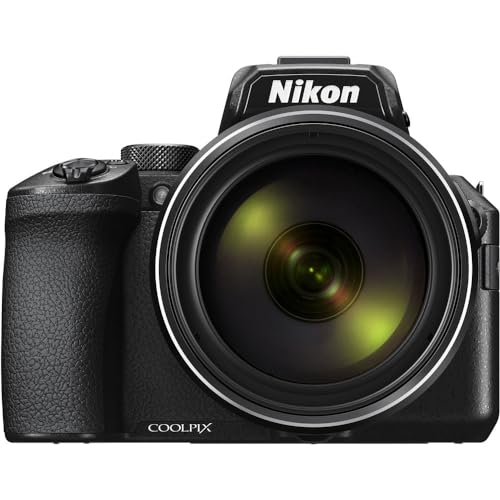
Nikon COOLPIX P950 — The birding bridge standard, 83x reach
The P950 is the camera a generation of birders reached for when a warbler appeared at the top of a far oak, and its eighty-three-times optical zoom — reaching a 2000mm-equivalent field of view — remains the class’s centre of gravity. That equivalent figure deserves its standard explanation: the physical lens is far shorter, and the small sensor crops the world to a telephoto sliver, which is precisely the trick that makes this reach affordable and carryable.
Around that lens sits a birder’s checklist answered properly: an eye-level finder for glaring days, a vari-angle screen for the bird below the boardwalk, stabilisation that makes the long end a working tool rather than a lottery ticket, and a dedicated bird-watching mode lineage that Nikon refined across generations of this family. It is a known quantity in hides and on seawalls for good reason.
Its compromises are the class compromises, worn openly. The small sensor asks a lot of high sensitivity settings under canopy shade, and autofocus on fast flight is a skill you build rather than a promise the camera makes. Bought as the reach-first instrument it is, the P950 still defines what most people mean by a birding camera.
- Zoom: 83x optical, reaching a 2000mm-equivalent field of view
- Sensor: small-format sensor enabling the extreme reach
- Viewfinder: electronic eye-level finder plus vari-angle screen
- Stabilisation: optical system for handheld telephoto work
- Role: the reach-first birding standard
Strengths
- Enormous equivalent reach in a single carryable body
- Finder and screen suit both glare and awkward angles
- Birding-focused control lineage refined over generations
Trade-offs
- Small sensor struggles under dark canopy
- Flight autofocus rewards practice over promises
- Fixed lens means the reach you buy is the reach you keep
Best for: Birders who prioritise identification-grade reach above all else.
Not suited for: Photographers who print large from high-sensitivity files.
P950 owners develop a recognisable fieldcraft: the camera lives at moderate zoom, the thumb rests near the controls that matter, and the full reach is a place visited deliberately rather than lived in. Within a season the bird list grows a column of species that would have been binocular rumours without it, and the owner’s identification skills grow faster than the photography — because every distant bird, photographed, can be studied at home until it confesses its name.

Nikon COOLPIX P1100 — 125x — the furthest reach in the class
The P1100 exists because Nikon looked at the P950’s reach and asked what more looked like. The answer is a 125-times optical zoom reaching a 3000mm-equivalent field of view, a figure that belongs to telescopes in most people’s imaginations. At that equivalent, a distant osprey nest fills the frame, the Moon shows its craters honestly, and the atmosphere itself — heat shimmer, haze, your own heartbeat — becomes the limiting factor rather than the lens.
The linked pick is a bundle with memory card, filter and bag, and it was chosen with care: the first P1100 bundle found in research was a renewed listing and was set aside, so confirm you are looking at this clean bundle rather than its renewed cousin. The extras are genuinely the ones a new owner buys in week one anyway, which makes the bundle logic unusually defensible.
Use the far end wisely and this camera is a marvel; live there and it will teach you humility. Most owners find the P1100’s genius is not its maximum but its range — the ability to walk a zoom from landscape to portrait-of-a-kingfisher without changing position and flushing the bird. That discretion, more than the headline number, is what the extra reach buys in the field.
- Zoom: 125x optical, reaching a 3000mm-equivalent field of view
- Bundle: includes memory card, UV filter and camera bag
- Listing note: clean bundle listing; a renewed bundle exists separately
- Stabilisation: optical system, essential at the long end
- Role: maximum-reach birding and lunar curiosity
Strengths
- Furthest equivalent reach of any pick in this guide
- Bundle covers the first week’s accessories honestly
- Zoom range replaces footsteps that would flush the bird
Trade-offs
- Atmosphere and shake, not optics, limit the extreme end
- Largest and heaviest of the Nikon pair
- Small-sensor image quality under canopy shade
Best for: Shorebird, raptor-nest and distant-water birding where approach is impossible.
Not suited for: Woodland photographers who live in shade at moderate distances.
The P1100 asks its owner to become part meteorologist. At its extreme equivalent, the morning’s cool, still air is a different instrument from the afternoon’s shimmer, and owners learn to schedule their ambition: the nest check at dawn, the habitat work at noon, the Moon whenever it performs. The bundle’s bag becomes the camera’s permanent home, because a tool this specialised is packed like one — deliberately, the night before, with the weather already consulted.

Sony RX10 V — The quality-first outlier with the big sensor
The RX10 V breaks this guide’s pattern on purpose. Its zoom reaches a 600mm-equivalent field of view — modest beside the Nikons — but behind that lens sits a sensor far larger than any other pick here, and the difference announces itself in feather detail, in shade, in dawn light, in every situation where the superzooms’ small sensors begin to smear what they record. It is the birder’s camera for birds at honest distances.
Sony’s autofocus investment shows in the field behaviour: subject recognition that understands it is looking at an animal, tracking that holds a walking wader through reeds, and a general sense that the camera is cooperating with the photograph rather than tolerating it. This guide makes no hit-rate promises for flight — no honest guide can — but for perched, swimming and walking birds, the RX10 V’s focus manners are the class benchmark.
The bundle linked here adds card and bag to a camera that asks premium money, and the buyer should be clear about the trade being made: you are spending reach to buy quality. For the birder whose patch is a garden, a local reserve with close hides, or a riverbank where birds tolerate people, that trade is not a compromise at all. It is the correct camera.
- Zoom: 25x optical, 24-600mm-equivalent field of view
- Sensor: large one-inch-class sensor, the biggest here
- Autofocus: AI-assisted subject recognition and tracking
- Video: high-quality 4K recording for behaviour clips
- Bundle: includes memory card and camera bag
Strengths
- Best image quality in the line-up by a clear margin
- Autofocus manners lead the class for perched birds
- Constant bright aperture keeps dawn and dusk workable
Trade-offs
- Reach is a fraction of the Nikons’ equivalents
- Premium pricing among bridge cameras
- Heavier than its zoom range suggests
Best for: Birders at close-to-moderate range who prize feather detail and print quality.
Not suited for: Long-distance shorebird work where reach is the whole game.
RX10 V owners are the birders other birders ask to see photographs from. Their files survive the big screen at the bird club, their prints hold a wall, and their dawn sessions end later than everyone else’s because the light that defeats the small sensors is exactly where this camera is still working. The reach they surrendered is repaid in the currency they chose, and after a year of feather detail they rarely describe the choice as a compromise at all.

Panasonic LUMIX FZ80 — The value veteran with 60x and a wide start
The FZ80 has been the sensible birder’s recommendation for years, and its formula explains its longevity: a sixty-times zoom beginning unusually wide — a 20mm-equivalent that swallows the whole wetland in one frame — and reaching a 1200mm-equivalent that identifies the duck at the far end of it. One camera, habitat and portrait, without a lens change in the rain.
That wide start is more birder-friendly than it first appears. Habitat photographs give records context, group shots of a flock establish scale, and the wide end doubles the camera’s usefulness on the family holiday that shares the trip. Panasonic’s stabilisation and a proper eye-level finder keep the long end honest, and the whole package has historically undercut the Nikons it competes with.
Age is its tax. The design belongs to an earlier generation, with autofocus and high-sensitivity behaviour to match, and its aperture narrows considerably as the zoom extends, asking more of the sensor at exactly the distances birders use most. As a value instrument bought with clear eyes, it remains the pick that gets more people birding with a camera than any other in this guide.
- Zoom: 60x optical, 20-1200mm-equivalent field of view
- Aperture: bright at wide, narrowing toward the long end
- Stabilisation: Panasonic optical system
- Viewfinder: electronic eye-level finder
- Role: the value all-rounder for habitat and bird alike
Strengths
- Wide starting angle captures habitat and flocks
- Reach covers most everyday birding distances
- Long-standing value positioning in the class
Trade-offs
- Earlier-generation autofocus and sensor behaviour
- Aperture narrows where birders need light most
- Newer rivals feel quicker in every operation
Best for: New birding photographers wanting one camera for habitat and species.
Not suited for: Flight specialists who need the fastest tracking available.
The FZ80’s owners are often the patch’s most complete naturalists, because the camera’s wide-to-long range matches how a walk actually unfolds: the flooded field, the flock, the one odd duck at the flock’s edge, all without breaking stride. It ages in their hands like a favourite field guide — a generation behind the newest, and thumbed daily. Many a serious birder’s archive begins with this camera’s files and keeps a soft spot for them permanently.

KODAK PIXPRO AZ653 — The budget bridge that still reaches 65x
Kodak’s PIXPRO line keeps a promise the bigger brands have drifted from: a real bridge camera, with a real sixty-five-times optical zoom and an eye-level experience, at an entry commitment that does not require a family meeting. For the birder upgrading from binoculars-and-memory, or the parent equipping a teenager whose hobby may or may not survive the winter, that promise is the entire point.
Within its class the AZ653 behaves respectably: the zoom reaches a genuinely useful equivalent for garden and park birding, stabilisation keeps the long end civilised, and the controls follow bridge conventions closely enough that skills learned here transfer upward when the hobby deepens. Its own listing even names birding among its intended uses, a small honesty in a category full of borrowed glory.
The limits are the budget’s limits. Video stops at Full HD, the sensor and processing are a step behind the leaders, and low-light work under canopy will show the gap plainly. None of that prevents a year of joyful learning, a full notebook of identified species, and the discovery of whether this hobby is yours — which is the only question a first birding camera truly has to answer.
- Zoom: 65x optical from a wide starting angle
- Video: Full HD recording
- Stabilisation: optical image stabilisation
- Sensor: small-format sensor typical of the budget class
- Role: the entry bridge for new birding photographers
Strengths
- Genuine superzoom reach at an entry commitment
- Bridge handling teaches transferable skills
- Light enough for younger birders to carry all day
Trade-offs
- Processing and sensor trail the class leaders
- No 4K video for behaviour recording
- Shade and dusk expose its budget origins
Best for: Beginners and younger birders testing whether the hobby takes hold.
Not suited for: Experienced photographers who will notice every processing shortcut.
A PIXPRO in a young birder’s hands is a hypothesis being tested, and the camera is honest enough to test it fairly: real reach, real handling, real birds identified. If the hobby fades, little is lost; if it catches — and the notebook fills, and the dawn alarms begin — the upgrade path is understood from the inside, because every limitation the next camera must fix has been personally met. That education is the budget pick’s hidden specification.

Nikon COOLPIX B700 — The older Nikon bridge with 60x and raw files
The B700 is the elder of Nikon’s birding bridges, a sixty-times zoom design reaching a 1440mm-equivalent field of view, and it holds one card its younger budget rivals often lack: raw file capture. For the birder who edits — who lifts a shaded exposure, corrects the colour of an overcast morning, crops with intent — raw files turn a modest sensor’s output into material that can be genuinely worked.
Its birding manners come from the same lineage as the P950, in an earlier dialect: a proper finder, a tilting screen, stabilisation for the long end, and a snap-back zoom habit that helps relocate a bird lost at full magnification. In the hand it feels like what it is, the respected ancestor of the current standard, and on the used-adjacent market it often represents the cheapest route into Nikon’s way of doing superzoom.
Buy it as the older model it is. Autofocus speed, video specification and general responsiveness belong to its generation, and buyers who need the current state of the art should climb to the P950 or beyond. Buyers who value raw files and proven handling at yesterday’s prices will find the B700 aging with unusual grace.
- Zoom: 60x optical, reaching a 1440mm-equivalent field of view
- Files: raw capture alongside JPEG, rare at its level
- Viewfinder: electronic finder with tilting rear screen
- Stabilisation: optical system for telephoto handholding
- Role: the editor-friendly older Nikon bridge
Strengths
- Raw files give shaded exposures a second life
- Nikon superzoom handling in an earlier, proven form
- Attractive route into the class on the used-adjacent market
Trade-offs
- Responsiveness belongs to its generation
- Video and autofocus trail the P950 clearly
- Availability varies as the model ages
Best for: Editing-minded birders who want raw files without flagship money.
Not suited for: Buyers who want the fastest current autofocus in the class.
The B700 rewards the birder who edits, and its owners tend to be the ones with a system: raw files in dated folders, a light touch in processing, prints that belie the camera’s age. On the used-adjacent market it circulates among birders like a good telescope — respected, handed on, still working. Its tilting screen and Nikon’s handling make it the connoisseur’s budget route, the pick for the photographer who reads manuals and means it.
What does 35mm-equivalent reach actually mean?
Every long number in this guide — 1200mm, 2000mm, 3000mm — is an equivalence, a comparison of field of view. A bridge camera’s physical lens might measure a few hundred millimetres at most, but its small sensor sees only the centre of the image, narrowing the view to what a much longer lens would show on a full-frame camera. Saying 2000mm-equivalent is honest shorthand for that narrow view, provided nobody believes a two-metre lens is hiding inside the body.
Equivalence cuts both ways, and birders should understand the other edge. The same small sensor that grants reach also gathers less light and resolves less fine detail than a large sensor at the same field of view, which is why the RX10 V’s mere 600mm-equivalent can out-photograph the P1100’s 3000mm at moderate range. Reach and quality are two currencies, and every pick in this guide is an exchange rate.
Depth of field follows the physical lens, not the equivalent, so bridge photographs carry the deep focus of a small format. For birding that is often a gift — a whole flock stays sharp — and occasionally a curse, when a busy background refuses to melt away behind a portrait. Knowing which effect your format produces is part of learning your camera.
When does the big-sensor camera beat the superzooms?
Distance decides. Inside roughly the range where a 600mm-equivalent frames the bird well — garden feeders with a hidden photographer, tame park waterfowl, hides built close to scrapes and perches — the RX10 V’s larger sensor produces feathers, eyes and dawn colours the small-sensor cameras cannot match at any zoom setting. Quality you can use beats reach you do not need.
Beyond that range the argument inverts completely. A bird occupying forty pixels in a quality frame is a record of a bird-shaped rumour, while the same bird through a P950’s reach becomes an identifiable species with readable plumage. Identification is birding’s core verb, and for the wader across the estuary, the raptor over the far ridge, the seabird beyond the harbour wall, reach is not a luxury specification. It is the photograph.
Many serious birders eventually own both philosophies — the quality camera for the local patch, the reach camera for expeditions — and this guide’s spread exists so a first purchase can be made with the second one already understood.
How do you actually hold a 2000mm-equivalent steady?
At extreme equivalents, technique replaces equipment as the limiting factor. Tuck elbows into ribs, breathe out halfway, and let the stabilisation settle for a breath before pressing. Brace against the hide’s frame, a fence post or a monopod whenever the field offers one; a beanbag on a car window remains the shorebird photographer’s oldest and best tripod.
Shutter speed discipline matters more as reach grows. The old reciprocal rule, adjusted for the equivalent focal length, gives a floor below which even stabilisation cannot save you, and bright days at the coast are when extreme zoom shines precisely because light is plentiful enough to keep speeds honest. Overcast canopy at full zoom is the class’s hardest exam, and every small-sensor pick here finds it so.
Bursts are a legitimate technique, not an admission of failure. A short burst at the long end lets you choose the frame where your heartbeat, the wind and the bird’s own stillness briefly aligned. Delete the rest without sentimentality; the archive keeps the moment, not the statistics.
What should a new birding photographer practise first?
Start with the birds that cooperate: gulls on a rail, ducks on a pond, pigeons being pigeons. Learn your zoom’s behaviour, your finder’s lag, your camera’s idea of focus, on subjects that forgive. The warbler in the canopy will still be difficult in a month, but by then the camera will have stopped being one of the difficulties.
Learn to find the bird in the finder at moderate zoom, then zoom in, rather than hunting at full magnification where the world becomes a shaking keyhole. Every pick here rewards that habit, and several offer zoom-return tricks that pull back briefly to relocate a lost subject. It is the single technique that separates a frustrating first season from a fruitful one.
Keep a notebook, even a digital one. Species, place, light, what worked — the record turns photographs into birding knowledge, and reviewing your own near-misses teaches faster than any guide, including this one. The camera is the instrument; the notebook is where the musician improves.
How do you set up a superzoom for birds before you leave home?
The field is the wrong classroom for menu archaeology. At home, build the camera’s birding configuration deliberately: continuous autofocus with the tracking mode your model favours, a burst rate you can manage, the finder and screen brightness set for daylight, and the zoom’s starting position at the moderate range where birds are found rather than the extreme where they are lost. Save the configuration if the camera allows, because cold fingers at dawn should be executing decisions, not making them.
Decide your exposure philosophy in advance. Most birders on small-sensor bridges let the camera guard the highlights — sky and white plumage blow out beyond rescue — and accept shadow noise as the format’s tax. A slight underexposure habit, correctable in raw on the B700 or in careful JPEG discipline elsewhere, preserves the feather detail that identifies the bird, which is the photograph’s first job.
Pack for the bird’s comfort as much as your own: muted colours, a hat that shades the finder, and the patience equipment no shop sells. The camera is the least of birding, and the superzoom’s great gift — reach — is best spent from a position the bird has already accepted, which is a position chosen slowly, early, and downwind of your own importance.
What changes when you photograph birds near water?
Water doubles every challenge and most rewards. Reflections confuse autofocus systems into admiring the surface instead of the bird, so single-point focus aimed at the bird’s eye, with patience, beats the clever modes whenever a grebe rides its own mirror. Exposure faces the same seduction: bright water lies to meters, and the bird — usually darker than its stage — needs the exposure the meter is trying to talk you out of.
The long equivalents of the Nikon pair come into their kingdom across water, because the approach problem disappears: the bird is out there, you are on the bank, and only optics can close a distance that no fieldcraft may cross. Early light is the professional’s hour on reservoirs and estuaries, when the air is still, the shimmer has not woken, and the extreme zoom performs like the instrument its headline promises.
Shorebirds add the discipline of tides. The feeding flats empty and fill on the water’s schedule, the birds concentrate as the tide pushes them toward the roost, and the photographer who arrives with the tide table gets the hour when reach, light and subjects align. It is the oldest calendar in birding, and no camera setting substitutes for reading it.
How do you photograph small birds in woodland shade?
Woodland is where this class earns its criticism honestly: small sensors, long zooms and dark canopy are three facts that conspire. The working answers are proximity and patience — a feeding station you maintain, a hide near a known perch, a slow morning in one good clearing beats a frantic mile through gloom — because every metre closer is worth stops of light no setting can counterfeit.
This is the RX10 V’s finest argument and the FZ80’s hardest exam. The Sony’s larger sensor and brighter lens keep working where the budget bridges begin to smear, while the value picks ask their owners for better positions and lower expectations. Neither answer is wrong; they are the two currencies of the class, spent in the habitat where the exchange rate is cruellest.
Sound becomes a field tool in the woods. Calls locate what eyes cannot, and the birder who learns the ten common voices of their patch finds birds at three times the rate of the one scanning trunks. The camera’s job shrinks to the last ten seconds of an encounter your ears arranged — which is how woodland birding has always worked, with or without a superzoom.
How do you choose between Nikon’s two reach flagships?
The P950 and P1100 are the same idea at two temperatures, and choosing between them is an exercise in self-knowledge. The P950’s 2000mm-equivalent already exceeds what the atmosphere permits on most days in most places; the P1100’s 3000mm-equivalent is for the minority of situations — still dawn air, distant nests, shorebirds beyond every rope — where the limit is optics rather than weather, and for the lunar and astronomical curiosities that ride along free.
Size and habit argue the other way. The P1100 is the larger commitment in the hand and the bag, and its extreme end demands the steadiest technique in this guide; a birder who walks all day may find the P950’s balance of reach and carry produces more photographs by October, because it was present at more encounters. Presence, again, is the archive’s first law, in feathers as in football.
The bundle question settles itself practically: the P1100 pick here arrives with card, filter and bag, the exact first-week purchases, while the P950’s plain listing suits the birder whose bag already owns them. Count what you actually need to buy alongside each camera, and the apparent price gap usually narrows to an honest coin toss decided by your patch.
How do you identify birds from photographs honestly?
A photograph extends the observation; it does not replace it. The honest identifier works from the frame outward — size against known companions, structure before colour, the bill’s shape and the leg’s length — and treats the camera’s colours as evidence with a known bias, because small sensors under canopy shade render greens and browns with more enthusiasm than accuracy. The notebook’s notes, written in the field, correct the file’s testimony at home.
Cropping is the bridge camera’s second shutter. The reach that frames a distant bird for identification usually frames it small, and the discipline is to crop for the question — the wing bars, the eye ring, the bill — rather than for beauty. An identification crop is a working document, judged by whether the species confesses, and many a life list rests on frames no one would frame.
Share uncertain photographs as uncertain. The birding community’s identification help is one of its great generosities, and it flows toward the photographer who posts the doubtful frame with the place, the date and their own best guess honestly labelled. The camera that makes such frames at two hundred metres is doing citizen science, whatever its price.
What does a year of birding photography actually cost?
Less than the rumours and more than the camera. The bridge itself is the famous figure, but the year adds up in quieter currencies: the bag and the rain cover, the second battery for dawn, the notebook and the field guide, the reserve entries and the petrol to the estuary at the hour the tide table demands. Budgeted honestly, a serious first year with any pick in this guide still costs less than a single prestige lens for the interchangeable systems — which is the class’s founding argument, intact.
The other currency is mornings. Bird photography pays its returns between dawn and breakfast, in the months when the light and the migration agree, and no equipment shortens that apprenticeship. The photographers whose archives grow are not the ones with the longest zooms but the ones whose alarms survived the winter — a specification entirely absent from every listing in this guide.
Against those costs, set the returns in their own coin: a patch known bird by bird, a notebook that reads like a diary of attention, and a skill — seeing — that transfers to every walk for the rest of a life. Priced against that, even the flagship bundle is the cheap part of birding.
What should you check before you buy?
- Name your patch’s typical distance: Garden, hide, reservoir or estuary — the honest distance of your ordinary birding chooses between the quality currency and the reach currency before any brand is discussed.
- Read equivalents as equivalents: Every long number is a 35mm-equivalent field of view; compare fields of view freely, and never let one masquerade as a physical lens measurement in your reasoning.
- Check which bundle is in the basket: The P1100 exists in a clean bundle and a renewed one; the pick here is the clean listing, and thirty seconds of reading at checkout protects the distinction.
- Decide your processing life: Raw files and patient editing point one way; straight-from-camera simplicity points another, and both are respectable — but they choose different picks in this line-up.
- Plan for the bird’s comfort: Your position, your clothing and your patience are part of the specification; a camera whose reach lets the bird ignore you is an ethical feature, not merely a technical one.
- Give it a season before judging: A month of cooperative subjects — gulls, ducks, the park’s regulars — is the tuition every pick in this guide charges, and the warblers will still be there when you graduate.
How do you photograph birds at feeders without ruining the feeders?
The feeder station is the beginner’s university and the expert’s studio, and its first rule is that the birds’ welfare outranks the frame: feed consistently or not at all, clean the station as a ritual, and site the photography so your presence never becomes the reason a shy species abandons a food source it depends on. A camera position the birds have accepted — a hide, a window, a chair that never moves — is worth more than any lens in this guide.
Work the perches, not the feeder itself. A natural branch placed where the light is kind, a step from the food, gives queuing birds a portrait stage and gives the photographer the composition the plastic feeder never will. The big-sensor pick feasts in this controlled closeness, while the superzooms practise their craft at a distance that keeps the station calm.
Rotate the stage with the seasons and keep the notebook honest about what visited, because a feeder log across a year is a small scientific document disguised as a hobby. The photographs illustrate it; the log is the knowledge — and the pair of them, kept faithfully, will teach a new birder more than any single upgrade sold in this guide.
What should you do on the days when no bird cooperates?
Photograph the place. The habitat frames — the marsh at dawn, the wood’s architecture, the reservoir’s weather — are the context every future bird portrait will need, and the wide ends of these zooms exist for exactly such consolation. Many photographers’ finest frames from a birdless day are the ones that explain where the birds live, and exhibitions are built from such honesty.
Practise on the willing: the gull, the pigeon, the park duck whose portrait has been taken ten thousand times and who remains, pose by pose, an exacting teacher of focus and light. Skill banked on common birds is spent on rare ones without conversion loss, and the birder who scorns the practice subjects will meet the rarity with unpractised hands.
Field Notes From Real Sessions
At a kingfisher on the far bank, the photographer stayed seated, let the longest Nikon reach across the river, and never tested the bird’s patience. The bird never knew, which remains the whole ethic of the craft in one clause. The ethic held: the bird’s day continued undisturbed.
At osprey nest duty from the public hide, the photographer found the atmosphere, not the lens, setting the limit by late morning. By the time the shimmer rose, the morning’s work was already safely on the card. Still air is a specification no shop can sell.
At a garden goldfinch at the feeder, the photographer chose the big-sensor Sony and took feathers you could count. At feeder distance, quality stopped being an argument and became a visible fact. Quality, at that distance, needed no advocate.
At the estuary at low tide, the photographer worked the beanbag on the car window and let the waders come to the mud. The beanbag, the window frame and the tide did the tripod’s job between them. Three tools shared one job without an argument.
At a snowy owl reported two counties away, the photographer packed the reach camera, arrived quietly and photographed from the road like everyone sensible. The road was as close as manners allowed, and the reach made manners sufficient. Manners plus reach equalled a photograph.
At first light on the reservoir, the photographer used the wide end for the habitat, then walked the zoom to the grebes. Habitat first, portrait second — the walk’s story told in the right order. The story was told in the right order.
At a teenager’s first reserve trip, the photographer handed over the Kodak and watched the hobby either catch or not, cheaply. Whatever the hobby’s future, that first identified page of the notebook is permanent. A notebook page outlives every camera in this guide.
At the overcast woodland morning, the photographer shot raw on the older Nikon and rescued the shade in the evening edit. The edit that evening was gentle, because the raw file had kept the morning’s promises. Gentleness in the edit began with honesty in the field.
At a tern colony from the boat, the photographer kept shutter speeds high, shot in bursts and accepted the sea’s terms. Burst, breathe, choose one frame — the sea kept the rest of the sequence. One frame was chosen; the sea kept the negatives.
At the notebook’s hundredth species, the photographer realised the camera had become a birding habit rather than a purchase. The hundredth species was a common bird, photographed uncommonly well, which felt correct. Common birds, uncommonly seen, are the hobby’s core.
At a heron below the boardwalk, the photographer tilted the screen, stayed standing and let the bird keep its dignity. From standing height, dignity intact on both sides of the lens. Dignity was mutual, which is rarer than reach.
At moonrise over the marsh, the photographer turned the extreme zoom skyward just once, because it was there. Some photographs are taken because the instrument invites them, and joy needs no further justification. Joy is a legitimate reason in any field guide.
Comparison Table
| Pick | Defining fact | Signature strength | Best for |
|---|---|---|---|
| Nikon COOLPIX P950 | Zoom: 83x optical, reaching a 2000mm-equivalent field of view | Role: the reach-first birding standard | Birders who prioritise identification-grade reach above all else. |
| Nikon COOLPIX P1100 | Zoom: 125x optical, reaching a 3000mm-equivalent field of view | Role: maximum-reach birding and lunar curiosity | Shorebird, raptor-nest and distant-water birding where approach is impossible. |
| Sony RX10 V | Zoom: 25x optical, 24-600mm-equivalent field of view | Bundle: includes memory card and camera bag | Birders at close-to-moderate range who prize feather detail and print quality. |
| Panasonic LUMIX FZ80 | Zoom: 60x optical, 20-1200mm-equivalent field of view | Role: the value all-rounder for habitat and bird alike | New birding photographers wanting one camera for habitat and species. |
| KODAK PIXPRO AZ653 | Zoom: 65x optical from a wide starting angle | Role: the entry bridge for new birding photographers | Beginners and younger birders testing whether the hobby takes hold. |
| Nikon COOLPIX B700 | Zoom: 60x optical, reaching a 1440mm-equivalent field of view | Role: the editor-friendly older Nikon bridge | Editing-minded birders who want raw files without flagship money. |
What are the most common mistakes buyers make?
Mistaking equivalent for physical focal length
A 3000mm-equivalent bridge does not contain a telescope-sized lens, and expecting full-frame depth and light behaviour from it ends in confusion. Equivalents compare fields of view; physics keeps its own ledger.
Hunting for birds at full zoom
Searching through a shaking keyhole is the beginner’s longest frustration. Find the bird wide, centre it, then zoom — the routine takes a day to learn and saves a season.
Believing autofocus promises
No camera guarantees flight shots, and any percentage attached to that claim is invented. Practise on gulls, learn your camera’s tracking habits, and let skill close the gap marketing cannot.
Buying a feeder camera for field birding
Automatic feeder identification is a delightful garden product and no use at all on a cliff path. Match the tool to the birding you actually do.
Ignoring the atmosphere
Heat shimmer and haze at extreme range will soften more frames than any lens flaw. Shoot early, shoot closer when you can, and blame the air before the equipment.
Chasing the bird instead of waiting for it
A flushed bird photographs badly and feeds worse. The reach in this guide exists so the bird can come to the frame; set up on the route, the perch, the tide line, and let the subject’s habits do the approaching.
Shooting only at maximum zoom
The extreme end is the hardest place to make a good photograph — atmosphere, shake and light all conspire there. Most keepers in most archives were made in the comfortable middle of the zoom, closer than pride wanted to admit.
Ignoring the notebook because the camera remembers
A photograph without place, date and circumstances is an ornament; with them, it is a record. Birding’s knowledge compounds in the notebook, and the camera is its illustrator, not its replacement.
Final Recommendation
Decide which currency your birding spends. If your birds are distant — estuaries, reservoirs, ridges — the P950 is the class standard and the P1100 its reach-obsessed heir, bundle and all. If your birds are near and your standards are photographic, the RX10 V stands apart. The FZ80 remains the value all-rounder, the Kodak the honest entry, and the B700 the editor’s older Nikon with raw files up its sleeve.
Whichever body arrives, give it a month of gulls and ducks before judging it on warblers.
If your patch is open country — coast, reservoir, moor — spend on reach and learn the weather: the Nikon pair are your instruments, chosen by whether the extreme equivalent is a tool you will use weekly or a story you will tell twice.
If your patch is gardens, hides and tame water, spend on the sensor: the RX10 V will make the photographs your club asks about, and its shorter reach will rarely be the reason a bird escaped your archive.
If your patch is still hypothetical, spend the least that buys real reach and real handling, and let a season of notebooks — the Kodak’s honesty or the FZ80’s range — tell you which currency your own birding actually spends.
One last field note, because it decides more archives than any specification in this guide: learn your patch before you judge your camera. A season on one reserve, one reservoir, one stretch of coast teaches the distances, lights and habits that no review can know, and it converts the abstract question of reach versus quality into a set of facts with your name on them. Birders who skip that season keep buying answers to other people’s birding; birders who serve it discover that the camera question, asked properly by their own notebook, usually answers itself — and that the answer, whatever it is, tends to stay answered for years.
The best birding camera is the one whose reach matches your patch, and whose quirks you have practised into invisibility.
Frequently Asked Questions
Do I need an interchangeable-lens camera for birding?
Not for most birding. A professional wildlife kit reaches further in quality but costs multiples of these bridges and weighs like luggage. The superzooms here cover identification and pleasing photographs for the overwhelming majority of field situations.
Which pick is best for birds in flight?
None can be promised that title honestly. The RX10 V’s autofocus manners make it the strongest candidate at moderate range, while the Nikons give reach for distant flight. Practise matters more than the badge on the camera.
Why does the Sony cost so much with less zoom?
Because its sensor is far larger and its lens stays bright across the range. You are buying image quality, autofocus sophistication and low-light ability — the currencies that matter when birds are near enough to fill a 600mm-equivalent frame.
Is the P1100 bundle the renewed one I saw?
No. The renewed bundle found during research was excluded; the linked pick is the clean bundle with card, filter and bag. Check the listing wording at checkout to be certain you have the right one.
Can these cameras photograph other wildlife?
Happily. Deer at dawn, seals from a cliff path, dragonflies at the pond margin — everything in this guide transfers. Birds are simply the hardest common subject, so a camera that birds well, wildlife well.
Are bridge cameras good for safari or only birds?
The same reach that frames a distant wader frames a lion across a waterhole, and safari guides have recommended this class to travellers for years precisely because it packs like a camera and reaches like a telescope. Heat shimmer applies on the savannah exactly as on the estuary, and the early hours remain the professional’s answer to both.
How important is weather sealing for birding?
Birding happens in the weather birds prefer, which is often the weather photographers endure. None of these bridges should be treated as waterproof; a rain cover, a dry bag for the walk out, and the discipline to wipe down at home matter more than any sealing claim at this level.
Should I buy the older B700 or save for the P950?
If you edit raw files and find the B700 at a gentle price, it can serve beautifully while you learn. If autofocus speed and the current generation’s refinements matter, or you shoot JPEG only, the P950 is the straightforward answer. The honest variable is not the cameras — it is how you process.
What binoculars pair with these cameras?
A modest, bright pair in the classic birding sizes complements any pick here, because finding the bird is binocular work and photographing it is camera work. Many birders carry the binoculars as the primary instrument and the superzoom as the recorder, and that division of labour survives every upgrade either tool receives.
Related Guides
For the wider camera conversation happening across this cluster, see: best cameras to take pictures at night best cameras to watch your pets best cameras jewelry photography.
Related guides
- Best Kids Smartwatches for Texting and Calling: Six Watch-Phones Under Parent Control
- Best Fast Charge Qi Wireless Chargers: Qi2 at 15W and Qi2.2 at 25W
- Best Airbnb Security Cameras: Compliant Outdoor Cameras and Noise Sensors for Hosts
- Best 5.5 Inch Android Phones: Compact Phones That Still Fit One Hand


