What's inside
- Where to buy
- Key Takeaways
- Quick Picks
- How did we narrow down the best dolby atmos ceiling speakers?
- Where exactly should height speakers sit in the ceiling?
- How do the six height picks compare?
- How many height channels does your receiver actually support?
- What installation mistakes ruin an Atmos ceiling layout?
- Final Recommendation
- Frequently Asked Questions
- How do you calibrate and test the height layer once it is installed?
- How should height wiring be planned before the ceiling closes?
- Should your room choose aimable or fixed height speakers?
- What does the height layer actually add to films, sport and games?
- How do height speakers interact with the rest of the system?
- Related Guides
As an Amazon Associate I earn from qualifying purchases. This post may contain affiliate links at no extra cost to you.
gizmoverdict.com is reader-supported. When you buy through links on our site, we may earn an affiliate commission.
Where to buy
Every model in this guide to the best dolby atmos ceiling speakers reaches United States buyers through Amazon, and the listings mix buying units in a way that demands attention: the three Klipsch models and the Polk are priced per single speaker, the Sonos set is a pair, and the Silver Ticket is a specialised dual-woofer unit that serves one channel. An Atmos layout needs two or four height speakers, so translate the plan into units before translating it into an order, or a box will arrive containing half a ceiling.
The best dolby atmos ceiling speakers do exactly one job, and this guide refuses to blur it. They are height channels: flush-mounted speakers installed in the ceiling above the listening area, wired to the height outputs of an Atmos-capable AV receiver, reproducing the overhead layer of a Dolby Atmos soundtrack. They are not the up-firing modules that sit on top of floor speakers and bounce sound off the ceiling, and they are not add-on speakers of any kind; those bounce designs are a separate product class with its own guide elsewhere on this site, and none appears here as a pick. A real in-ceiling height channel puts the sound source where the mix intends it to be, above you, and that positional honesty is the entire point of the format.
Within that clear boundary, one honest axis separates the six picks: aimability. A height speaker fires downward by default, yet Atmos effects are mixed to arrive from specific points above and slightly ahead of or behind the seats. Models from Klipsch’s CDT line, and the angled Silver Ticket, let the installer tilt the sound toward the listening position; the Polk and the Sonos fire straight down and rely on placement and dispersion instead. Neither approach is automatically superior, but they suit different rooms and different installers, and the reviews below treat that difference as the main event rather than a footnote. Every pick is passive and needs an Atmos receiver with powered height channels; there is no shortcut around that requirement, and no speaker here contains its own amplification.
Key Takeaways
- This guide covers in-ceiling height channels only; bounce-style add-on modules belong to a different class and a different guide.
- Aimability is the deciding trait: pivoting designs steer overhead effects toward the seats, fixed designs depend on careful placement.
- Most picks are sold as single speakers, so a two-height layout means two units and a four-height layout means four.
- An Atmos-capable receiver with assignable height channels is mandatory; the speakers themselves are passive.
- The Sonos pick only functions inside a Sonos Amp ecosystem and should be ignored by everyone outside it.
- Height channels carry effects and ambience rather than dialogue, so consistency with your other speakers matters less than coverage and aim.
Quick Picks
| Model | Badge | The case for it |
|---|---|---|
| Klipsch CDT-5650-C II | Best overall height channel | Both the horn tweeter and the woofer pivot, so overhead effects can be aimed at the sofa with unusual precision. |
| Klipsch CDT-5800-C II | Best for large rooms | The eight-inch version of the same aimable design covers bigger seating areas and higher ceilings. |
| Polk Audio 70-RT | Best disappearing act | A three-way Vanishing Series design behind a wafer-thin grille for rooms where the ceiling must look untouched. |
| Sonos In-Ceiling by Sonance | Best for Sonos homes | Built to pair with the Sonos Amp, including its room-tuning support, for households already inside that ecosystem. |
| Silver Ticket 5252AC | Best angled centre-height option | A dual-woofer unit whose whole driver assembly tilts, aimed at centre-height and angled-ceiling duties. |
| Klipsch CDT-3650-C II | Best for smaller rooms | The compact aimable Klipsch brings the same pivoting idea to modest rooms and lower ceilings. |
How did we narrow down the best dolby atmos ceiling speakers?
The first cut was categorical. Anything that sits on top of another speaker, anything sold as a reflective add-on, and anything designed primarily as a general music speaker with Atmos mentioned in passing was excluded, because the question here is narrow: which speakers should be cut into a ceiling specifically to reproduce the height layer? What remained were models with a genuine installed base in Atmos systems, published cutout data, and designs whose dispersion behaviour suits overhead duty. That process favoured established architectural lines from Klipsch, Polk and Sonance over anonymous listings with theatrical claims.
The second cut examined how each design handles direction. Dolby’s own guidance for height speakers assumes the sound can be placed meaningfully above the listening area, and a speaker that fires at the floorboards between the sofa and the screen wastes much of that intent. We therefore recorded, for every candidate, whether the tweeter alone pivots, whether the whole driver assembly tilts, or whether the design is fixed and relies on wide dispersion. That single attribute explains most of the price spread in this category, and it is reported plainly in every review below rather than hidden behind adjectives.
The final filter was ecosystem honesty. One pick belongs to a closed system and only earns its place for households already committed to that system; including it without that warning would be a disservice, and excluding it entirely would ignore a large group of real buyers. The rest are conventional passive speakers that any Atmos receiver can drive, which keeps the guide useful to the majority. As with every ceiling product, published wattage figures were ignored as marketing, and no pick was ranked by a number that lacks a shared measurement standard.
Where exactly should height speakers sit in the ceiling?
Dolby’s layout guidance places a pair of height speakers above and slightly in front of the main seating, roughly in line with the front left and right speakers, angled in the mix to suggest sounds passing overhead. A four-height layout adds a second pair behind the seating, which turns overhead effects from a line into a plane and is the single most convincing upgrade an Atmos room can receive after the first pair. The exact angles matter less than the discipline of symmetry: heights should mirror each other across the room’s centre line, sit clear of joists and light fittings, and keep a sensible distance from walls that would reflect their output oddly.
Ceiling height shapes the experience strongly. In a room with a standard flat ceiling, a fixed-fire speaker placed correctly can cover the seats well, because the distance to the listeners is short and the dispersion cone reaches them. In a tall room, the cone from a downward speaker lands in a smaller pool of sound, and aimable designs earn their premium by steering that pool onto the sofa. In a room with a sloped or vaulted ceiling, geometry gets awkward enough that an angled unit like the Silver Ticket, or careful repositioning of the seating itself, becomes part of the design rather than an afterthought.
It is worth stating what height speakers are not asked to do. They rarely carry dialogue, they are not the place to spend the largest share of a theater budget, and they do not rescue a room whose main five channels are poorly placed. Their material is rain, aircraft, debris, music score swells and the general sense that the room’s air has become part of the film. Judged on that material, coverage and aim beat raw output every time, which is why this guide keeps returning to those two words.

Klipsch CDT-5650-C II — Best overall height channel
The CDT in this model’s name stands for Controlled Dispersion Technology, and it is not decoration. In the CDT-5650-C II, both the horn-loaded tweeter and the six-and-a-half-inch woofer sit in a mechanism that lets the installer pivot the sound toward the listening position after the speaker is mounted. For a height channel, that is the most valuable trick in the category: the hole can go where the joists allow, and the sound can still go where the mix intends. Klipsch’s horn tweeter also brings the brand’s characteristic efficiency and projection, so overhead effects arrive with a clarity that survives being filtered through a ceiling’s worth of distance and air.
The character this produces in an Atmos mix is easy to describe. Rain in a forest scene stops sounding like noise from the ceiling and starts sounding like weather above the characters, because the energy is directed at the listeners rather than spread across the floor. Flyovers track cleanly from the front heights toward the rear of the room in a four-channel layout. The speaker is sold individually, which suits height duty perfectly since layouts need two or four matched units, and its paintable grille and standard Klipsch architectural fit and finish make it a straightforward install for anyone who has cut a ceiling before. It needs an Atmos receiver channel like every pick here; there is no amplifier hiding inside it.
Long-term, the CDT mechanism also forgives imperfect planning. If the seating moves when a room is rearranged, the aim can be revisited without moving the hole, a luxury no fixed design offers. That adjustability, combined with the horn’s projection in taller rooms, is why this model sits at the top of the guide: it solves the height channel’s central problem, direction, more completely than anything else at its size.
- Format: 6.5-inch two-way in-ceiling height speaker, sold individually
- Aiming: pivoting horn tweeter and woofer assembly aimed at seating
- Tweeter: horn-loaded design for projection across ceiling distance
- Grille: paintable, low-profile round grille
- Power: passive, requires an Atmos receiver height channel
- Quantity note: order two for a two-height layout, four for four heights
One practical detail separates satisfied CDT-5650 owners from frustrated ones: aim before the final calibration, not after. The pivoting assembly changes where the sound goes, which changes what the receiver’s calibration microphone hears, so the correct sequence is mount, aim at the primary seat, then calibrate, then leave the mechanism alone. Owners who fiddle with the tilt after calibration slowly unbalance a system that was measured for a different geometry. Set it once, with the seating in its real position and the room’s curtains or rug in their normal state, and the setting tends to stay right for years.
Strengths
- Full assembly aiming puts overhead effects on the seats, not the floor.
- Horn projection keeps effects clear in rooms with higher ceilings.
- Re-aimable after installation if the seating layout changes.
Trade-offs
- Klipsch brightness will not match every main speaker’s voicing.
- Sold singly, so the pair price must be assembled mentally.
- The aiming mechanism rewards an installer who takes time to set it.
Best for: Atmos rooms where seating position is fixed and known, and the installer wants the height layer aimed with intent. Not suited for: buyers who want the absolute flattest, most invisible grille regardless of aim.
Building a two- or four-height layout around a known sofa position? Check the CDT-5650-C II listing, count your height channels, and confirm the cutout against your joist plan.

Klipsch CDT-5800-C II — Best for large rooms
Take the CDT idea and scale it to an eight-inch woofer and you have the CDT-5800-C II, an in-ceiling speaker built for the rooms where the smaller model starts to feel stretched: long media rooms, high ceilings, seating spread across two rows. The same controlled-dispersion mechanism pivots the driver assembly toward the listeners, and the horn tweeter’s projection suits the extra distance. In a two-row theater, aiming matters even more than in a single-sofa room, because the installer is choosing a compromise point between rows, and a fixed speaker offers no compromise to choose.
A note on the listing itself, because it confuses people: some marketplace text around this model is stuffed with unrelated product words by sellers, but the product is exactly what the CDT line has always been, a single in-ceiling architectural speaker, sold as one unit. Judge it by the manufacturer’s description and the cutout template, not by keyword clutter. In use, its larger cone gives height effects more body, so a helicopter pass or a collapsing building in the height layer carries weight as well as position. Like its smaller sibling it is passive, and each unit needs its own height channel from an Atmos receiver.
The buying logic mirrors the 5650 with one addition: scale. Four of these across a big room is a serious commitment of ceiling holes and amplifier channels, and it should follow a settled seating plan rather than precede one. Where the room genuinely is large, though, stepping down to the smaller model to save a little per unit is the false economy this pick exists to prevent, because height effects that cannot reach the back row with clarity might as well not be installed there at all.
- Format: 8-inch two-way in-ceiling height speaker, sold individually
- Aiming: pivoting controlled-dispersion assembly for tweeter and woofer
- Tweeter: horn-loaded, suited to longer throw distances
- Grille: paintable round grille
- Power: passive, driven by an Atmos receiver height channel
- Quantity note: one unit per height position; large rooms usually run four
In two-row rooms the 5800’s aiming compromise deserves a deliberate decision. Aiming midway between the rows serves both moderately; aiming at the main row serves the people who paid for the room and gives the second row a slightly less precise overhead image. Most installers choose the main row, because the second row in home theaters usually hosts guests who are delighted by any height effect at all. Either way, the existence of a choice is the product: a fixed eight-inch speaker in the same ceiling offers output without the option, and output was never the scarce resource in height channels.
Strengths
- Output and body suit high ceilings and two-row seating.
- Aiming lets one design serve both rows with a chosen compromise.
- Matches the CDT-5650-C II for mixed layouts front and rear.
Trade-offs
- The eight-inch cutout is a bigger commitment in a finished ceiling.
- Oversized for a small single-sofa room, where it buys nothing.
- Per-unit pricing makes a four-height layout add up quickly.
Best for: dedicated theater rooms with high ceilings, long throw distances or two rows of seats. Not suited for: compact media rooms where the six-and-a-half-inch CDT already covers the sofa.
Measure your throw distance honestly, and if the room is genuinely large, review the CDT-5800-C II details before defaulting to the smaller chassis.

Polk Audio 70-RT — Best disappearing act
The 70-RT comes from Polk’s Vanishing Series, a line designed around a single aesthetic promise: the speaker should be heard and not seen. Its grille is exceptionally thin and sits nearly flush, with a fine perforated pattern that, once painted, reads as a faint shadow line rather than a fitting. For a living-room theater, where the ceiling is part of the decor and four obvious speaker grilles would fight the room, that near-invisibility is a feature with real value, and it is the reason this fixed-fire design holds its own against aimable rivals.
Under the grille sits a three-way arrangement, unusual in this class, with a small midrange and a ring radiator tweeter alongside the woofer. The practical benefit for height duty is smooth, wide dispersion: because the speaker cannot be aimed, it compensates by spreading its output evenly across a broad area, so listeners a seat or two off centre still receive a convincing overhead layer. In a standard-height ceiling over a single seating row, that trade works well. The 70-RT is sold individually, needs a receiver height channel like the rest, and installs with the same cutout discipline as any architectural speaker.
Choose it with clear eyes about the compromise. A sloped ceiling, a very tall room, or seating pushed far from the recommended height positions will expose the fixed aim, and no setting on the receiver can fully redirect physics. But in the ordinary flat-ceilinged living room that describes most Atmos installations, the Polk’s blend of smooth coverage and visual silence is a combination the pivoting models, with their slightly more prominent grilles and mechanisms, do not quite match.
- Format: three-way in-ceiling speaker from the Vanishing Series, sold individually
- Aiming: fixed-fire design relying on wide, even dispersion
- Grille: ultra-thin, near-flush, paintable for minimal visibility
- Drivers: woofer, midrange and ring radiator tweeter
- Power: passive, requires an Atmos receiver height channel
- Fit check: best results in standard-height flat ceilings over one seating row
The 70-RT also rewards attention to what surrounds it in the ceiling. Because its grille is so discreet, neighbouring fittings become the visual story: recessed lights, vents and alarms should be aligned with the same care, or the invisible speaker ends up framed by a crooked light that draws every eye. Installers who work in high-end living rooms often lay out the whole ceiling on a grid for this reason. The Polk’s near-absence makes that discipline worthwhile, since a well-gridded ceiling with vanishing speakers is the closest a theater room comes to architecture that simply sounds good.
Strengths
- The least visible installed result of any pick in this guide.
- Wide dispersion forgives listeners seated off the centre line.
- Three-way layout keeps the height layer smooth rather than splashy.
Trade-offs
- No aiming adjustment exists if the layout changes later.
- Tall or sloped ceilings weaken its fixed-fire coverage.
- Premium positioning for a speaker whose job is effects, not dialogue.
Best for: living-room theaters where the ceiling’s appearance is non-negotiable and the layout follows Dolby’s standard positions. Not suited for: vaulted ceilings or rooms where seats sit far outside the usual height-speaker footprint.
If the room must look untouched, look closely at the 70-RT listing and its grille dimensions, then plan positions by the book.

Sonos In-Ceiling by Sonance — Best for Sonos homes
This pick comes with a gate in front of it, and the gate is the review: these speakers are built by Sonance specifically to be driven by the Sonos Amp, and they only make sense inside that ecosystem. Paired with the Amp, they are recognised by the system and can use Sonos’s room-tuning process, which measures the space and adjusts the sound accordingly, a convenience no conventional passive speaker offers a receiver owner without calibration work. Outside that pairing, you are paying for integration you cannot use, and the Klipsch models above are the rational choice.
Inside the gate, the proposition is genuinely attractive. A Sonos Amp can drive a pair of these eight-inch speakers as height or surround channels alongside a Sonos soundbar front stage, or serve them as a stereo music zone with the same app the household already uses for everything else. The speakers themselves are fixed-fire, relying on placement and the system’s tuning rather than pivoting hardware, and they are sold as a pair, which simplifies the common two-height layout. Build quality reflects the Sonance architectural pedigree, with a paintable grille designed to sit quietly in a finished ceiling.
The honest summary is that this is a lifestyle-system answer to a home-theater question, and for the right household that is praise rather than criticism. If your front stage is already a Sonos bar, your music already runs through the Sonos app, and the idea of a separate receiver fills you with dread, these speakers complete the system coherently. If you own, or plan to own, a conventional Atmos receiver, walk past this pick without a second thought, because its entire value lives in an ecosystem you are not using.
- Format: 8-inch in-ceiling speakers built by Sonance for Sonos, sold as a pair
- System requirement: designed for the Sonos Amp; integration features need that pairing
- Aiming: fixed-fire, supported by Sonos room tuning when paired with the Amp
- Grille: paintable, discreet architectural finish
- Power: passive speakers powered by the Sonos Amp, not a conventional receiver in normal use
- Quantity note: the pair format matches a two-height layout in one box
Sonos households should think about the second Amp before the first pair is installed. A common and satisfying layout uses one Amp for the height pair and another for rear surrounds or a music zone, all unified in the same app, and planning the equipment shelf, power and network drops for two units from the start avoids a cramped retrofit. The speakers themselves will wait patiently in the ceiling for whichever Amp arrangement feeds them, but the wiring topology, home-run to one rack location, should be decided while the ceiling is open rather than improvised afterwards.
Strengths
- Room tuning with the Sonos Amp simplifies achieving balanced height sound.
- Completes a Sonos soundbar system without adding a receiver.
- Sonance build quality and a grille that respects finished interiors.
Trade-offs
- Value collapses entirely outside the Sonos Amp ecosystem.
- Fixed aim offers no correction for awkward ceiling geometry.
- Locks the height layer to one brand’s amplifier roadmap.
Best for: committed Sonos households adding height channels to a soundbar-based system via the Sonos Amp. Not suited for: receiver-based theaters, or anyone who might leave the Sonos ecosystem later.
Already running a Sonos front stage? Confirm the Sonos In-Ceiling pair listing and verify your Amp plan before ordering; everyone else should keep scrolling up this page.

Silver Ticket 5252AC — Best angled centre-height option
Silver Ticket’s 5252AC is the odd instrument in this orchestra, and its oddness is purposeful. Instead of one woofer, it carries two 5.25-inch woofers with a pivoting tweeter in a single in-ceiling unit, and the whole driver assembly can be angled after installation. The design began life aimed at centre-channel duty in ceilings, where a single speaker above a screen needs to throw dialogue toward the seats at an angle, and that same geometry makes it interesting for Atmos work: a centre-height position, or a front-height pair in a room whose ceiling slope defeats ordinary round speakers.
For Atmos specifically, think of it as a problem-solver rather than a default. In a room where the ceiling pitches, a tilting unit can restore the aim that the architecture removed, and in a layout experimenting with a centre height between the front pair, its dual-woofer layout covers the middle with authority. Its voicing is workmanlike rather than luxurious, which is acceptable in the height layer, where effects and atmosphere dominate and long music sessions are rare. It is a single-channel unit, passive like everything here, and it needs one receiver height channel of its own.
The caution is about coherence. Mixing one unconventional unit into a ceiling of conventional speakers is fine for a centre-height experiment, but building an entire four-height layout from dual-woofer angled units would be an eccentric and expensive way to solve problems most rooms do not have. Treat the 5252AC as the specialist you call when the ceiling’s shape, or a specific centre-height plan, makes the mainstream picks awkward, and it will repay that framing handsomely.
- Format: dual 5.25-inch woofer in-ceiling unit serving one channel, sold individually
- Aiming: full driver assembly tilts after installation; tweeter also pivots
- Role: centre-height positions and sloped-ceiling problem solving
- Grille: paintable finish to match the ceiling
- Power: passive, requires one Atmos receiver height channel
- Fit check: confirm the larger rectangular-style footprint suits your ceiling plan
The 5252AC has one more legitimate Atmos use worth naming: the single-height layout in a room where only a centre overhead position is practical, sometimes chosen for a voice-of-god style channel in immersive formats beyond a basic Atmos setup. That is an enthusiast configuration rather than a mainstream one, and buyers pursuing it already know who they are. For everyone else, the Silver Ticket’s value remains geometric: it tilts. Rooms that need tilt know it from the moment the ladder goes up and the ceiling’s pitch becomes impossible to ignore.
Strengths
- Tilting assembly rescues aim on sloped or awkward ceilings.
- Dual woofers give a centre-height position real presence.
- Solves geometry problems the round fixed speakers cannot.
Trade-offs
- Unconventional format complicates a uniform four-height layout.
- Voicing is functional rather than refined for music.
- Footprint and shape demand more planning than a round cutout.
Best for: centre-height experiments and rooms whose ceiling slope defeats standard round speakers. Not suited for: a uniform set of four heights in an ordinary flat-ceilinged room.
Facing a pitched ceiling or planning a centre height? Study the 5252AC listing and its dimensions before assuming a round speaker will do.
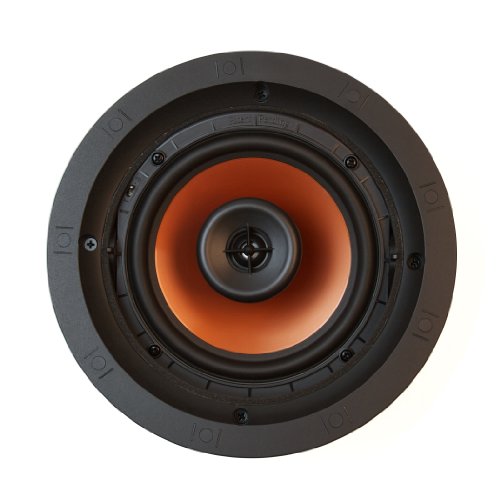
Klipsch CDT-3650-C II — Best for smaller rooms
Not every Atmos room is a theater. In a small media room, a bedroom setup or a den with a low ceiling, the eight-inch models are more speaker than the space can use, and the CDT-3650-C II brings Klipsch’s pivoting idea down to a six-and-a-half-inch chassis sized for those rooms. The horn tweeter and woofer assembly aim toward the seats just as they do in the larger CDT models, which matters at short distances: in a low-ceilinged room the listeners sit close to the height speakers’ axis, and a small aiming adjustment has an outsized effect on whether effects land on the sofa or on the carpet in front of it.
The smaller Klipsch also suits the common two-height layout in a modest room, where it can be paired across the front of the seating without overwhelming the ceiling visually or acoustically. Its efficiency means an ordinary receiver’s height channels drive it without strain, and the paintable grille keeps the installation discreet. Sold individually like its siblings, it lets a buyer start with two heights and add the rear pair later in the same model, keeping the ceiling consistent as the system grows from a modest layout into a fuller one.
What it will not do is scale upward gracefully. Ask it to cover a long room or a high ceiling and the same physics that make it tidy in a den turn against it, which is why the guide keeps the 5650 and 5800 above it for those jobs. Within its intended territory, though, the 3650 is the most rational Klipsch of the three: the aiming mechanism that defines the line, in the size that most real rooms actually need, without paying for cone area that a small space cannot use.
- Format: 6.5-inch two-way in-ceiling height speaker, sold individually
- Aiming: pivoting controlled-dispersion tweeter and woofer assembly
- Tweeter: horn-loaded for clarity at short listening distances
- Grille: paintable round grille with a compact footprint
- Power: passive, needs an Atmos receiver height channel
- Quantity note: buy two for a front-height pair; match the model if adding rears later
Bedroom Atmos deserves a sentence of its own, because it is where the 3650 most often ends up and where expectations need gentle management. A television, a soundbar or compact front stage, and two small heights in a bedroom ceiling produce a surprisingly enveloping late-night system at modest volumes, and the little Klipsch’s clarity at low level suits that use exactly. It will not pressurise the room, and it is not meant to. The pleasure is positional rather than physical, and at that job, in that room, the smallest CDT is not the compromise choice but the correct one.
Strengths
- Full CDT aiming in a size suited to dens and bedroom theaters.
- Short-distance clarity benefits low ceilings and close seating.
- Easy upgrade path to a matching four-height layout.
Trade-offs
- Cannot stretch to high ceilings or long rooms convincingly.
- Same per-unit ordering arithmetic as its larger siblings.
- Bright Klipsch character is consistent, for better or worse.
Best for: small to medium Atmos rooms, low ceilings and two-height layouts that may grow. Not suited for: two-row theaters or rooms where the ceiling sits far above the seats.
Working with a compact room? Check the CDT-3650-C II listing, verify the template against your ceiling, and start with the front pair.
How do the six height picks compare?
| Model | Aiming | Sold as | System note | Room fit |
|---|---|---|---|---|
| Klipsch CDT-5650-C II | Tweeter and woofer pivot | Each | Any Atmos receiver | Most single-row rooms |
| Klipsch CDT-5800-C II | Tweeter and woofer pivot | Each | Any Atmos receiver | Large rooms, two rows |
| Polk Audio 70-RT | Fixed, wide dispersion | Each | Any Atmos receiver | Decor-sensitive living rooms |
| Sonos In-Ceiling by Sonance | Fixed, system-tuned | Pair | Sonos Amp required for full value | Sonos soundbar systems |
| Silver Ticket 5252AC | Whole assembly tilts | Each | Any Atmos receiver | Centre height, sloped ceilings |
| Klipsch CDT-3650-C II | Tweeter and woofer pivot | Each | Any Atmos receiver | Small rooms, low ceilings |
The table reduces the guide to one question: can the speaker be aimed, and if not, what compensates? Klipsch answers with mechanics, Polk with dispersion and invisibility, Sonos with software tuning inside its own ecosystem, and Silver Ticket with a tilting chassis built for problem geometry. Room size then picks among the three Klipsch sizes, and ecosystem membership decides the Sonos question before sound is even discussed.
How many height channels does your receiver actually support?
Atmos layouts are described with a three-part shorthand: main channels, subwoofers, then heights. A 5.1.2 system runs five main channels, one subwoofer and two heights; a 5.1.4 adds the rear height pair; a 7.1.4 surrounds the listener completely. The receiver decides what is possible, because each height speaker consumes one powered amplifier channel, and many mid-range receivers offer seven channels in total, which means choosing between rear surrounds and a second height pair. Read your receiver’s speaker configuration options before ordering speakers, because the ceiling plan must follow the amplifier’s arithmetic, not the other way round.
Processing and amplification are different limits, and listings blur them. Some receivers process more channels than they can power, offering pre-outs for an external amplifier to supply the rest. If your dream layout exceeds the built-in channels, that external amplifier is a real additional purchase to budget for alongside the speakers and wire. Conversely, some receivers power nine or eleven channels outright. Either route is legitimate; the mistake is discovering the distinction after four holes are cut.
For most rooms, the honest recommendation is to start with the layout the receiver powers natively, install it well, and live with real Atmos for a while before chasing the next pair of heights. A carefully aimed two-height system in a modest room delivers the format’s essential magic, and the upgrade to four heights remains available whenever the amplifier situation allows. Ambition sequenced sensibly beats ambition installed all at once and calibrated never.
What installation mistakes ruin an Atmos ceiling layout?
The gravest error is positional optimism: placing heights directly above the sofa because it feels overhead, when the guidance wants them slightly forward of the seats for a front pair, so effects travel over the listeners rather than landing on their heads. The second error is asymmetry, with one height nudged around a joist and its partner left on the ideal line, producing a lopsided overhead image that no calibration fully repairs. The third is wiring the heights to the wrong receiver terminals, most commonly confusing height outputs with a powered second zone, which leaves the Atmos layer silent or, worse, playing the kitchen’s radio.
Two quieter mistakes follow. Setting the receiver’s speaker configuration incorrectly, so the processor never sends height information because it believes no heights exist, is astonishingly common and masquerades as a speaker fault. And skipping the receiver’s calibration routine after installation wastes the one tool that balances levels and distances across a ceiling of speakers at varying distances from the seats. Run the calibration, verify each height chirps from its own location during setup, and confirm with a known Atmos scene before declaring the job done.
Final Recommendation
The Klipsch CDT-5650-C II is the default answer for a reason: its pivoting assembly solves the height channel’s real problem, which is direction, and it does so at the size most rooms need. Step up to the CDT-5800-C II when the room is large or two-rowed, down to the CDT-3650-C II when it is small or low-ceilinged. Choose the Polk 70-RT when the ceiling must stay visually silent, the Sonos pair only when a Sonos Amp already anchors the system, and the Silver Ticket when a slope or a centre-height plan breaks the standard geometry. Aim carefully, calibrate honestly, and the ceiling becomes the most convincing part of the room.
Frequently Asked Questions
Are in-ceiling speakers better than up-firing Atmos modules?
For positional accuracy, yes: a sound mixed to come from above actually comes from above. Up-firing modules are a valid no-cutting alternative covered in a separate guide, but they depend on a flat, reflective ceiling and never localise as precisely.
Do I need two height speakers or four?
Two is the entry point and already delivers the format’s overhead effect. Four adds front-to-back movement above the listener and is the most worthwhile later upgrade, provided your receiver can power the extra channels.
Can I use ordinary ceiling speakers as heights?
Technically a receiver will drive any suitable passive speaker from a height channel. The picks here earn their place through aiming, dispersion or ecosystem tuning suited to overhead duty, which general music speakers usually lack.
Will height speakers work for music?
They can join an upmixed music presentation if your receiver offers one, but they are bought for film and television height effects. A dedicated stereo music zone deserves speakers chosen for that job instead.
How far in front of the sofa should front heights go?
Follow the layout guidance for your configuration: front heights sit above and slightly ahead of the seating, roughly aligned with the front speakers. Aimable models then tilt back toward the listeners to complete the geometry.
Does the Sonos ceiling pair work with a normal receiver?
It is a passive speaker, but its design, recognition and tuning features are built around the Sonos Amp. With a conventional receiver you would pay for integration you cannot use, so the Klipsch or Polk picks are better value there.
How do you calibrate and test the height layer once it is installed?
Calibration begins with the receiver’s own setup routine, run from the primary seat with the room in its normal state: curtains as they will be during films, doors closed, the room quiet. Place the measurement microphone at ear height where heads will actually be, not on the arm of the sofa or held in a hand. The routine sets each height channel’s level and distance so that effects arrive with the intended balance, and its results deserve a manual sanity check afterwards, because a microphone clipped by a seat back or placed in a corner can produce distances that no ceiling ever contained.
Testing needs material whose overhead content you can identify. A rain scene is the classic diagnostic because the height layer should sound like weather distributed above the whole seating area, not like two speakers playing rain at each other. An aircraft pass should travel, arriving from the front heights and departing toward the rear or fading above the screen, depending on the mix. If a pass seems to jump between speakers instead of moving, the usual causes are a level imbalance of a few decibels, heights placed too far apart for the ceiling height, or one channel’s aim pointing at a different seat than its partner’s.
Level taste is personal, and a modest lift to the height channels is a common and legitimate preference in rooms where the ceiling is high or the seating sits outside the ideal footprint. Raise both channels of a pair together, in small steps, and re-test with the same scene, because the goal is envelopment rather than prominence. Height speakers that constantly announce themselves have usually been turned into a novelty; the format works best when a viewer notices the ceiling only at the moment a sound genuinely belongs above them, and forgets the hardware the rest of the time.
Finally, verify the source chain, because many disappointed first auditions are format problems rather than speaker problems. The streaming app, the television’s audio output setting and the receiver’s display should all agree that an Atmos track is playing. A receiver quietly decoding a plain surround mix will send nothing meaningful to the heights no matter how well they are installed, and an evening spent re-aiming speakers to fix a settings menu is an evening this paragraph exists to prevent.
How should height wiring be planned before the ceiling closes?
Height channels are wired like every other passive channel, home-run from the receiver position to each ceiling position, with in-wall rated cable and labelled ends. The planning differences are about the future. A two-height layout installed today often becomes a four-height layout later, and the time to run the rear pair’s cable is while the ceiling is open for the front pair, even if the rear speakers themselves wait a year. Cable coiled and labelled in the cavity costs little; reopening a finished ceiling to add it costs a weekend and a plaster repair.
Route heights away from recessed light housings and their transformers, which can induce hum in long parallel runs, and keep the positions clear of the metalwork of ceiling grids in basements, where a tile ceiling changes the mounting method entirely and belongs to a different conversation. In a conventional plaster ceiling, back boxes or simple insulation displacement above each position keep the cavity tidy and the sound consistent between positions, because two heights with wildly different amounts of insulation pressed behind them will not voice alike no matter how carefully they are calibrated.
Document the layout before it disappears. A phone photograph of each open position with a tape measure in frame, plus a sketch of which cable colour feeds which channel, turns any future fault-finding into a ten-minute task. Height channels fail rarely, but when one goes quiet years later, the difference between a labelled, photographed installation and a mystery in the ceiling is the difference between fixing it and living with it.
Should your room choose aimable or fixed height speakers?
Answer three questions and the choice usually makes itself. First, how far is the ceiling from the seats? The shorter that distance, the wider a fixed speaker’s useful pool of sound at ear level, and the less aiming adds. The taller the ceiling, the more a downward speaker’s energy concentrates in a narrow column, and the more valuable a pivot becomes. Second, how certain is the seating layout? A dedicated room with a fixed sofa rewards aiming at that sofa forever; a multipurpose living room whose furniture migrates with the seasons benefits from the forgiveness of wide dispersion, because an aimed speaker aimed at where the sofa used to be is worse than a fixed one.
Third, what does the ceiling look like? Flat and standard, and both families behave as their designers intended. Sloped, beamed or interrupted by a bulkhead, and geometry starts eliminating options: beams can shadow a fixed speaker’s output entirely, a slope tilts a fixed speaker’s axis away from everyone, and an angled assembly like the Silver Ticket’s becomes less of an eccentricity and more of a necessity. Rooms with ceiling fans deserve a special note, since a height speaker should never be placed where blades pass between it and the listeners, chopping the sound and the installer’s patience alike.
Budget enters last, and honestly. Aiming mechanisms cost money, and in a standard room with a fixed layout the difference between a well-placed fixed speaker and an aimed one is real but modest. The money saved by choosing fixed in such a room is often better spent on the second pair of heights, moving from two channels overhead to four, which changes the experience more fundamentally than any mechanism. Conversely, in a tall room, buying four fixed speakers instead of two aimed ones multiplies a coverage problem rather than solving it. Match the spending to the geometry, not to a hierarchy of features.
What does the height layer actually add to films, sport and games?
In film, the height layer’s most frequent job is not the spectacular flyover but the quiet establishment of place. Rain on a roof, wind in trees, the creak and murmur of a ship, the echo of a cathedral: these sounds sit above and around the action, and they are mixed into the heights precisely because that placement convinces the ear that the room extends beyond the screen. Viewers often report that a good Atmos room feels bigger rather than louder, and that sensation is the height channels working at their least dramatic and most valuable. A well-aimed pair delivers it continuously; a poorly placed pair delivers it in patches that shift as you move your head.
Sport uses the layer differently. Stadium ambience, crowd wash and the public-address echo of an arena live partly overhead in a good broadcast mix, and the effect is of sitting inside the venue’s air rather than watching it through a window. The height speakers are not carrying commentary and should never be asked to; their contribution is the sense of a roof of sound above the crowd noise from the main channels. Games, increasingly, use the layer with real intent: helicopters, weather systems and vertical level design all exploit height positioning, and players tend to notice overhead accuracy in games sooner than in films because the sound responds to their own movement.
Music is the height layer’s weakest brief, and this guide will not pretend otherwise. Upmixing stereo music into ceiling speakers pleases some listeners and irritates others, and the speakers in this guide were chosen for positional film work rather than for music-first systems. If music matters most in the room, the general ceiling guide’s stereo pairs are the right starting point, and the heights can join gently for the occasions when an upmixed concert film turns the room into a venue for an evening.
How do height speakers interact with the rest of the system?
A common anxiety is whether the height speakers must match the brand and range of the main speakers. For the front three channels, matching matters greatly, because dialogue and action pan across them constantly and timbre differences show immediately. Height channels live a different life: their material is effects, ambience and score, sounds that rarely pan directly from a main speaker into a height in a way that exposes a voicing difference. That is why mixing a Klipsch height pair over a different brand’s front stage is a normal, accepted practice, and why the buying decision here can rest on aim, coverage and room fit rather than on brand loyalty to the floor speakers.
The subwoofer’s relationship with the heights is indirect but worth setting correctly. Receivers ask for a crossover point per channel group, and small ceiling speakers should hand their lowest frequencies to the subwoofer rather than strain to produce them from a ceiling cavity. Setting the height crossover sensibly protects the speakers, cleans up the effects layer, and costs nothing in perceived overhead impact, because the sounds that define the height layer live well above the crossover region. The receiver’s calibration routine usually proposes a sensible figure; accept it unless you have a specific reason not to.
Room correction deserves a final balanced word. Modern receivers measure and adjust each channel’s level, distance and frequency balance, and in a ceiling installation, where positions are compromises imposed by joists and lights, that correction earns its keep. It cannot move a speaker, redirect a fixed driver, or invent coverage where geometry denies it, which is why this guide spends so many words on placement and aim before calibration is ever mentioned. Electronics polish the decision; they do not replace it. Get the holes in the right places, aim what can be aimed, and then let the receiver finish the job it is actually equipped to do.
Before the first film, one humble ritual pays off: sit in every seat your household actually uses and play the same overhead scene in each. The centre seat will sound best, because the room was aimed and calibrated around it, but every other seat should still receive a coherent overhead layer rather than a lopsided one. If a side seat hears only the nearest height speaker, a small aim adjustment or a decibel of level trim usually repairs it, and discovering that on installation day is far cheaper than discovering it during a family film night a month later.
Keep the cutout templates and a note of which receiver terminal feeds which ceiling position in the same envelope as your other equipment paperwork. Height channels are the least accessible speakers in any house, and the note that takes two minutes to write on installation day is the note that turns a future fault, a receiver upgrade or a room rearrangement from an excavation into a lookup. Ceilings reward households that document them, because everything about the system is designed to be forgotten once it works, right up until the day it needs attention.
Related Guides
Height channels sit on top of a foundation, so it helps to read the general layout first in best ceiling speakers, then weigh the premium tier in best high end ceiling speakers, and finally consider the no-cutting alternative for the rest of the room in best on wall speakers home theater.


