What's inside
- Where to buy
- Key Takeaways
- Quick Picks
- How did we evaluate the best drop ceiling speakers?
- How does a 70-volt system actually get planned?
- How do the six picks compare?
- Why does support hardware matter as much as the speaker?
- What mistakes do drop ceiling projects make?
- Final Recommendation
- Frequently Asked Questions
- How do you commission and balance a distributed system once it is in?
- How does a drop ceiling system grow with a building?
- Which buildings benefit most from lay-in tile speakers?
- How do paging and background music share one system without fighting?
- What should be in the handover file when the job is done?
- How do ceiling height and tile condition change the plan?
- What does a sensible spare and inspection routine look like?
- Related Guides
As an Amazon Associate I earn from qualifying purchases. This post may contain affiliate links at no extra cost to you.
gizmoverdict.com is reader-supported. When you buy through links on our site, we may earn an affiliate commission.
Where to buy
Every product in this guide is listed on Amazon for the United States market, and the buying units are commercial ones: two-packs of lay-in tile speakers, pairs from established public-address brands, and single units bought in multiples for a floor plan. Count the ceiling grid, not the product photographs, because a drop ceiling job is planned in tiles and zones, and the listings here mix packs, pairs and singles in a way that punishes skimming.
The best drop ceiling speakers belong to a different electrical world from the home speakers elsewhere in this batch, and the distinction has to come first. A drop ceiling, the suspended grid of removable tiles found in offices, classrooms, shops and clinics, takes speakers designed for that grid, and those speakers run on distributed constant-voltage lines, most commonly 70-volt in North America, with 25-volt and 100-volt variants in the family. On such a line, one commercial amplifier feeds dozens of speakers, and each speaker carries a transformer with selectable taps that decide how much power that speaker draws. No home receiver belongs in this system, and no home receiver should be connected to it: the wiring architecture, the amplifier and the speakers are a matched commercial ecosystem, and this guide treats them as one.
The site already maintains a guide to round 70-volt ceiling speakers that mount in cut holes; this guide is about the other form factor, the lay-in tile speaker that replaces a ceiling tile outright, sitting in the grid on its own frame or bridge rails with no cutting at all. That form is the drop ceiling’s native speaker, installed in minutes per position, removable for access, and invisible in the grid’s rhythm. The buying facts that matter here are tap ranges, plenum rating where the space above the tiles serves as an air-handling plenum, the tile-bridge or support hardware that carries the speaker’s weight, and coverage per unit. One pick below is honestly labelled as something else: a round speaker with a backcan that suits tile ceilings without being a lay-in tile, included because some grids and some budgets prefer it.
Key Takeaways
- Drop ceiling speakers run on 70-volt or 25-volt distributed lines with tapped transformers, never on home receivers.
- The lay-in tile form replaces a whole ceiling tile, installs without cutting, and needs proper bridge support in the grid.
- Tap settings are the volume plan for a building: higher taps near noise, lower taps in quiet rooms, all from one amplifier.
- Plenum rating matters wherever the ceiling void handles return air, which describes most commercial drop ceilings.
- Coverage per speaker, not loudness per speaker, decides how many units a floor needs.
- One pick here is a round backcan speaker rather than a lay-in tile, and it is labelled as such wherever it appears.
Quick Picks
| Product | Badge | Its claim on a place |
|---|---|---|
| Rockville DCS8T 2-Pack | Best standard tile speaker | An eight-inch 2×2 lay-in tile with a wide tap range and an 8-ohm option, sold as a two-pack for typical rooms. |
| Rockville DCS6T | Best half-tile fit | A 6.5-inch tile speaker sized for a 2×1 space, handy where a full tile position is not available. |
| Bogen CSD2X2 | Best established PA choice | A plenum-rated drop-in pair from a public-address specialist with decades of installed history. |
| Pure Resonance Audio SD4 | Best wide-area coverage | A dispersion-array design that covers a large open floor with fewer positions than conventional tiles. |
| JBL Professional CSS8008 | Best round backcan option | An eight-inch round speaker with backcan and multi-voltage taps for tile ceilings that are not using lay-in units. |
| Monoprice 2×2 Ceiling Tile Speaker | Best straightforward single | A plain 2×2 tile speaker sold individually for music and paging, easy to spec room by room. |
How did we evaluate the best drop ceiling speakers?
The first test was architectural honesty: is the product genuinely designed for a suspended grid? True lay-in tile speakers carry their own frame sized to the grid, roughly two feet square in the common North American pattern, and rest in the grid with support rails or a bridge that transfers weight safely. Products that were merely round speakers photographed near a tile ceiling were excluded, with one deliberate exception, clearly labelled, where a respected round model with a backcan serves tile ceilings well. Everything else here drops into the grid the way a tile does, because that is the installation the buyer is planning.
The second test was the transformer. A distributed-line speaker lives by its taps, the selectable power settings that let an installer balance a building: a speaker over a quiet office draws little, a speaker over a workshop draws more, and both share one amplifier. We favoured models publishing a useful spread of tap settings across 70-volt working, with 25-volt or 100-volt compatibility noted where the listing states it, and an 8-ohm bypass where offered, since that flexibility helps small systems and future changes. Listings that hid their tap data behind marketing language were set aside.
The third test was compliance and coverage. Where the ceiling void is a plenum, and in most commercial buildings it is, the speaker and its enclosure should carry the appropriate rating, and several picks state theirs plainly. Coverage figures, the area one speaker serves at a given ceiling height, matter more than any output claim, because they set the unit count for a floor. As with every speaker guide in this batch, headline wattage was treated as a seller’s figure rather than a ranking tool; in distributed audio more than anywhere, the tap you select is the power the speaker uses, and the printed maximum is close to meaningless.
How does a 70-volt system actually get planned?
Start with the rooms and their noise. A quiet office or classroom wants intelligible announcements and gentle background music at close range, so speakers can be tapped low and spaced for evenness. A retail floor or restaurant adds crowd noise and higher ceilings, asking for more speakers or higher taps. A workshop or warehouse bay adds machinery noise that no background system should try to defeat, and there the honest design goal is paging that cuts through, from speakers placed near where people work rather than spread evenly into empty air. The tap selector on each speaker, set during installation, is how one amplifier serves all three behaviours at once.
The arithmetic is refreshingly simple compared with home audio. Add up the taps of every speaker on the line and keep the total comfortably below the amplifier’s rated output, leaving headroom for a future speaker or a tap raised later. Cable runs can be long and thin compared with low-impedance home wiring, because the constant-voltage line trades current for voltage, which is precisely why the architecture exists: a school corridor or a supermarket cannot be wired like a living room. Zones come from the amplifier, with separate lines for areas that need independent volume or separate paging, such as a shop floor and its stockroom.
Placement in the grid follows the room’s use rather than its geometry alone. Speakers belong over people, not over shelving, storage or the empty end of a classroom, and in a grid ceiling the tile pattern quantises your choices to two-foot increments, which is coarse enough that walking the room with the plan matters. Keep positions clear of air diffusers, whose noise competes with the speaker and whose metalwork crowds the tile, and of sprinkler heads and lights that the grid already hosts. A few minutes reconciling the speaker plan with the reflected ceiling plan saves the classic discovery that the ideal tile already contains a vent.

Rockville DCS8T 2-Pack — Best standard tile speaker
The DCS8T is the reference shape of this category: an eight-inch speaker built into a full 2×2 lay-in tile format, with a metal grille that sits in the grid like a tile with holes in its story. Its transformer offers a genuinely useful ladder of taps for 70-volt and 100-volt lines, running from a whisper for a small office up to a full setting for a noisy floor, plus an 8-ohm position for the small-system edge cases where a tiny low-impedance amplifier is in use. That spread is what an installer actually buys in a tile speaker, because it lets one stocked model serve every room in a building at different levels.
This pick is specifically the two-pack listing, and that boundary matters because the same model appears in several pack sizes; the two-pack is the natural unit for a classroom, a small office suite or a shop, and larger floors should be planned as multiples of it rather than by hunting for a different product. The stated dispersion is wide, which suits the even, unobtrusive coverage background music wants, and the metal grille shrugs off the knocks of a working building better than a cloth or plastic face would. In the grid, the unit needs its support properly seated like any lay-in speaker, a point the installation section returns to.
Judged against the building it will serve, the DCS8T’s virtue is lack of drama. It does not ask the installer to learn a proprietary system, it does not need a special amplifier beyond the standard distributed kind, and its taps cover the realistic range of a floor’s rooms without swapping models. For a facilities manager standardising on one tile speaker for a property, that boring completeness is the highest recommendation this category offers.
- Format: 8-inch lay-in tile speaker for 2×2 grid positions, two-pack listing
- Line: 70V/100V transformer with multiple taps plus an 8-ohm setting
- Taps: a wide ladder from low background settings to full output
- Grille: metal face suited to working buildings
- Coverage: wide dispersion for even background coverage
- Install note: seat the unit on proper tile-bridge support in the grid
A note on standardisation from the facilities side of the fence: a building that stocks one tile model, a handful of spare grilles and a printed tap map for every room can repair a failed speaker between classes or before a shop opens. The DCS8T’s breadth of taps is what makes that single-model policy possible, because the same unit can be a corridor whisperer on one floor and a workshop voice on another with nothing but a selector moved. Buildings that standardise sleep better than buildings that improvise, and this speaker is built to be standardised on.
Strengths
- One model covers quiet and noisy rooms through its tap range alone.
- Standard 2×2 lay-in form installs in minutes per position.
- Two-pack sizing matches how small commercial rooms are actually specced.
Trade-offs
- Pack variants of this model are easy to confuse when reordering.
- Background-music voicing will not satisfy a listening-room brief.
- Requires a proper distributed-line amplifier, never a home receiver.
Best for: offices, classrooms and shops standardising on one tile speaker across varied rooms. Not suited for: home use, or any system built around a domestic AV receiver.
Count your grid positions room by room, then verify the DCS8T two-pack listing so the pack size in the cart is the one this review describes.

Rockville DCS6T — Best half-tile fit
Grid ceilings do not always offer a full tile where a speaker needs to go. Lights, diffusers and structural quirks fragment the pattern, and corridors in particular often present a half-tile’s worth of sensible space. The DCS6T exists for those positions: a 6.5-inch tile speaker shaped to fit a 2×1 space in the grid, with a 70-volt and 100-volt transformer offering taps suited to background and paging levels, spring terminals for fast connection, and a metal grille matching its larger sibling’s working-building manners.
Its output expectations should be set by its size and its tap ceiling, which are modest by design. This is a speaker for intelligibility and presence in smaller or narrower areas: a corridor that needs announcements to reach its far end, a small office that a full tile would overwhelm, a reception nook, a treatment room. Within that brief it is well judged, and its ability to share a system and a visual language with the DCS8T means a building can mix full and half tiles without the ceiling looking like a parts catalogue.
The spring-terminal detail deserves its sentence, because installers working above a grid, often on a ladder with one hand holding the unit, value a connection that accepts a wire quickly and grips it honestly. Small ergonomic truths like that, repeated across forty positions in a school, are the difference between a product professionals reorder and one they quietly replace. The DCS6T earns its place as the problem-position specialist in a line that covers the standard positions already.
- Format: 6.5-inch tile speaker shaped for a 2×1 grid space
- Line: 70V/100V transformer with background-level tap options
- Terminals: spring connections for fast overhead wiring
- Grille: metal face matching the wider Rockville tile family
- Role: corridors, small offices and fragmented grid positions
- Install note: confirm the half-tile position’s support before ordering
Corridors deserve a moment of respect in distributed design, because they are where announcements earn their keep. People are moving, doors are opening, and the message must arrive intelligibly the first time. A run of half-tile speakers at modest taps along a corridor’s length beats a single loud unit at its end in every way that matters: evenness, clarity and the absence of a painful hot spot under the speaker itself. The DCS6T’s format exists precisely because corridors rarely offer full tiles where they are wanted, and a system planned around that reality sounds planned rather than patched.
Strengths
- Fits the half-tile positions that full speakers cannot use.
- Shares a system and appearance with standard 2×2 tile speakers.
- Quick terminals genuinely speed up ladder work.
Trade-offs
- Modest output ceiling suits background and paging, not loud floors.
- Less common format, so spares should be stocked deliberately.
- Still needs the same distributed amplifier as any 70-volt speaker.
Best for: corridors, small rooms and awkward grid fragments in a larger 70-volt system. Not suited for: main coverage of a large or noisy floor on its own.
Walk your grid and mark the positions where a full tile will not fit; those marks are this speaker’s job description, so check the DCS6T listing against them.
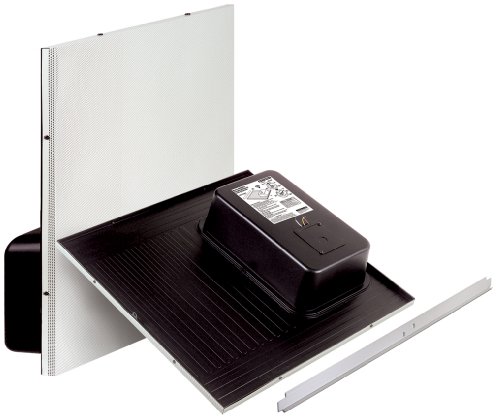
Bogen CSD2X2 — Best established PA choice
Bogen has been building public-address equipment since long before ceiling tiles were a product category, and the CSD2X2 carries that institutional weight. It is a drop-in ceiling speaker sold in pairs, built around an eight-inch high-sensitivity driver, with a transformer for 70-volt and 25-volt lines, the latter still common in older school and institutional systems. Its enclosure is plenum rated, which in the many buildings whose ceiling void returns air to the HVAC system is not a nicety but a requirement, and its whole design assumes a life measured in decades of school bells, office announcements and background music.
High sensitivity is the specification to notice, because on a distributed line it translates directly into coverage per unit of amplifier capacity: a sensitive speaker reaches its working level on a lower tap, leaving the amplifier’s budget for the rest of the building. In a large institutional system with scores of speakers, that efficiency compounds into real money and simpler amplification. The drop-in form keeps installation to the grid-native minimum, and the pair packaging matches the way rooms in such buildings are usually served.
Choose the Bogen when the building is the client: a school, a clinic, a municipal office, anywhere the system must satisfy an inspector, a maintenance department and a twenty-year horizon. Its voicing is the clear, forward sound of the PA tradition, optimised for the spoken word that remains these systems’ most important content. Background music through it is perfectly pleasant, but intelligibility is the design’s first language, and in an emergency announcement that priority stops being a preference and becomes the point.
- Format: drop-in ceiling speaker for grid ceilings, sold in pairs
- Line: transformer for 70V and 25V distributed systems
- Enclosure: plenum rated for air-handling ceiling voids
- Driver: 8-inch high-sensitivity design for efficient coverage
- Role: institutional paging and background music
- Install note: confirm local plenum and support requirements before fitting
Institutions should also weigh the Bogen’s service ecosystem. A model embedded in the PA trade comes with documentation written for maintenance departments, replacement continuity across years, and specifications stated in the vocabulary inspectors use. When a school district’s electrician opens a ceiling in 2035, the paperwork trail behind a speaker like this is the difference between a like-for-like swap and an archaeological investigation. That administrative durability never appears in a sound check, and it decides more institutional purchases than sound ever will.
Strengths
- Plenum rating satisfies the strictest common ceiling-void rules.
- High sensitivity stretches one amplifier across more rooms.
- A PA specialist’s track record in institutional buildings.
Trade-offs
- Speech-first voicing is less lush for music-led spaces.
- Utilitarian appearance suits institutions more than boutiques.
- 25V compatibility is wasted where no legacy system exists.
Best for: schools, clinics and public buildings needing compliant, intelligible paging for decades. Not suited for: design-led retail spaces chasing a particular ceiling aesthetic.
If your building’s ceiling void is a plenum, start the compliance conversation here and read the CSD2X2 listing for its ratings before comparing anything else.
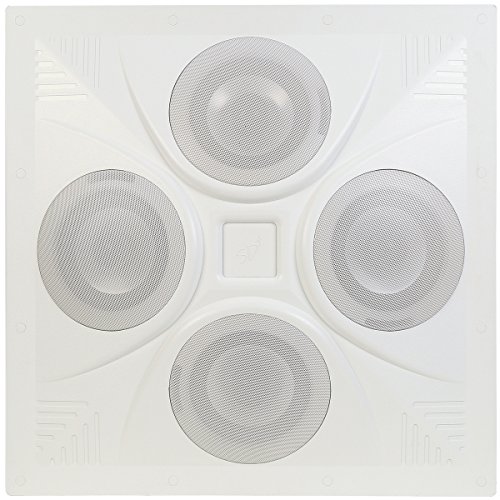
Pure Resonance Audio SD4 — Best wide-area coverage
The SD4 attacks the costliest variable in a distributed system, which is the number of positions. Its SuperDispersion design uses an array of drivers arranged to spread sound across an unusually wide area from a single ceiling point, so a large open floor, a showroom, a cafeteria, a warehouse office, can be covered evenly by fewer speakers than conventional tiles would need. Fewer positions means less wire, less installation time and fewer holes in the grid’s pattern, and on a big floor those savings multiply into the project’s deciding factor.
The unit carries a built-in transformer offering both 8-ohm and 70-volt working, which gives the installer flexibility between a small low-impedance setup and a proper distributed line. Its coverage claim should be read the way all such claims should, as a planning guide for typical ceiling heights rather than a promise for every architecture, but the underlying principle is sound: dispersion engineered at the speaker is cheaper than coverage bought with extra positions. In tall spaces the advantage narrows, because every ceiling speaker’s pool of sound shrinks as the ceiling rises, and the SD4 does not repeal that geometry.
Where it shines is the wide, low, open floor that defines so much commercial space. A single SD4 above a showroom or an open office can hold background music and announcements at an even level across an area that would otherwise take four ordinary tiles and the wiring to feed them. For a business fitting out such a floor, that consolidation simplifies everything downstream: fewer taps to balance, fewer positions to maintain, and a ceiling that stays mostly tiles.
- Format: ceiling speaker array in a tile-friendly housing, sold individually
- Line: built-in transformer for 8-ohm or 70V operation
- Design: multi-driver dispersion array for wide single-point coverage
- Role: large open floors, showrooms, cafeterias and halls
- Coverage: intended to replace several conventional positions per area
- Install note: verify support and weight arrangements for its housing in the grid
The SD4 changes the maintenance map of a large floor as well as its installation cost. Four conventional positions mean four grilles to clean, four taps to document and four chances for a single failure to leave a quiet patch. One wide-coverage unit concentrates all of that into a single documented point, which a facilities team can check in a minute during a walk-round. The trade is concentration of risk, as the review notes, but in a staffed building with a spare on the shelf, concentration is often the more manageable of the two risks.
Strengths
- Wide dispersion cuts the position count on large open floors.
- Dual-mode transformer suits both small and distributed systems.
- Even coverage reduces the loud-spot, quiet-spot pattern of sparse layouts.
Trade-offs
- Less advantage in small rooms or tall ceilings.
- A failed unit leaves a bigger coverage gap than a failed tile.
- Array format is visually busier than a plain tile grille.
Best for: large open commercial floors wanting fewer, wider-covering positions. Not suited for: small cellular offices or low-budget corridor paging.
Measure your open floor’s area and ceiling height, then study the SD4 listing and its coverage guidance before fixing the position count.
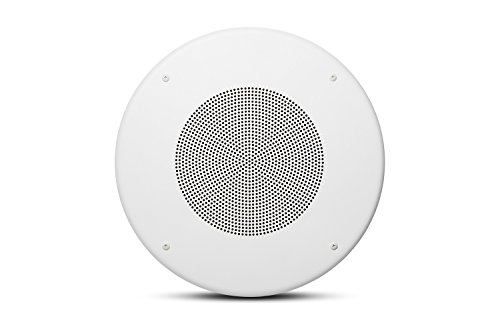
JBL Professional CSS8008 — Best round backcan option
Honesty about form first: the CSS8008 is not a lay-in tile. It is a round eight-inch ceiling speaker with its own backcan, made by JBL’s commercial division for distributed systems, and it earns its place in a drop-ceiling guide because plenty of tile ceilings are better served by round speakers mounted through tiles or in the grid with appropriate support than by full lay-in units, particularly where the ceiling already hosts round fittings or where only a few positions are needed. Pretending it is a tile would be a disservice; recommending it as the round alternative is simply accurate.
Its transformer is the most cosmopolitan here, a multi-tap unit covering 100-volt, 70-volt and 25-volt lines, which makes the CSS8008 a natural spare and retrofit choice in buildings whose systems vary or whose history is murky. The backcan matters more than it might appear: it gives the driver a defined enclosure, keeps insulation and debris off it, and helps with the plenum and consistency questions that open-backed speakers leave to the installer. JBL Professional’s commercial pedigree shows in the documentation culture around the product, the kind facilities teams actually read.
Sold as a single speaker, it suits the incremental way real buildings evolve: two positions this quarter, a corridor next year, a replacement for a failed unit from another era. In a guide dominated by tiles, the CSS8008 is the reminder that a drop ceiling is a mounting environment, not a single product shape, and that the right answer for a given grid sometimes comes in the round.
- Format: round 8-inch ceiling speaker with backcan, sold individually; not a lay-in tile
- Line: multi-tap transformer for 100V, 70V and 25V lines
- Enclosure: backcan provides a defined, protected volume
- Role: round-fitting positions in tile ceilings and mixed-system retrofits
- Coverage: conventional single-point dispersion per position
- Install note: needs a cut tile or suitable mounting arrangement, unlike lay-in picks
The CSS8008’s backcan has one more virtue that only appears in winter: consistency. An open-backed speaker’s behaviour changes with whatever the ceiling void holds, insulation shifted by a heating contractor, a duct added years later, debris from a roof repair. A backcan gives the driver the same small room to work in regardless of the void’s biography, so a system balanced at installation stays balanced as the building ages around it. In a guide about ceilings that hide their workings, that sealed indifference to the hidden world is worth real money.
Strengths
- Triple-voltage transformer fits almost any distributed system it meets.
- Backcan keeps the driver protected and its behaviour consistent.
- JBL Professional documentation and support culture.
Trade-offs
- Installation is slower than a lay-in tile’s drop-in simplicity.
- Round format may clash with a ceiling standardised on tiles.
- Sold singly, so floor-wide counts must be assembled deliberately.
Best for: tile ceilings needing round positions, and mixed or legacy systems needing a flexible spare. Not suited for: projects wanting the fastest possible drop-in installation across many rooms.
If your ceiling plan includes round positions, check the CSS8008 listing for its tap table and mounting requirements before mixing formats.

Monoprice 2×2 Ceiling Tile Speaker — Best straightforward single
Monoprice built its name on giving commercial basics a plain price and a plainer description, and its 2×2 tile speaker is exactly that: a full-tile lay-in speaker for music and paging, sold individually, designed to sit in a standard grid and do the standard job. In a category where installers often need one model they can order by the dozen without a conversation, that straightforwardness is the product. Each unit serves one grid position, so a room’s plan translates directly into a quantity, and reordering a replacement years later starts from a name anyone in the purchasing chain can find.
The speaker’s brief is background music and paging at the levels ordinary offices, shops and classrooms use, and its design stays inside that brief without pretending to be a dispersion array or an institutional monument. For a small business fitting out its own premises, or a school district topping up an existing system room by room, the appeal is administrative as much as acoustic: one tile, one position, one line on the order. Its transformer follows the distributed convention of the category, so it joins a 70-volt line alongside other brands’ speakers without ceremony, taps being the universal language of these systems.
That universality deserves emphasis as the closing thought on this pick. Distributed audio’s great civic virtue is interoperability: speakers from different makers share a line because the standard, not the brand, defines the connection. The Monoprice tile is the purest expression of that virtue in this guide, a commodity position-filler that frees the budget for the rooms where a Bogen’s compliance or an SD4’s coverage genuinely earns its premium.
- Format: 2×2 lay-in tile speaker, sold individually
- Line: transformer for distributed-line music and paging systems
- Role: standard grid positions in offices, shops and classrooms
- Grille: plain tile-style face for an unobtrusive grid appearance
- Coverage: conventional per-position coverage for background levels
- Install note: support the tile properly in the grid like any lay-in unit
There is a purchasing rhythm the Monoprice tile suits better than any rival here: the phased fit-out. A growing business opens with six rooms wired and four speakers afforded, adds the training room next quarter and the second office next year, and each phase needs the same plain tile to arrive and match. Commodity availability is a feature in that world, as real as any acoustic specification, and a speaker that can be reordered by a office manager from a two-word description earns a loyalty that exotic models, however capable, rarely inspire.
Strengths
- Sold singly, so quantities map exactly onto grid positions.
- Standard design joins any 70-volt line without fuss.
- Plain specification makes purchasing and spares simple.
Trade-offs
- No special coverage or compliance story for demanding buildings.
- Background-duty voicing only, as its brief intends.
- Support and documentation are thinner than the PA specialists’.
Best for: standard rooms and incremental top-ups of an existing distributed system. Not suited for: plenum-critical or wide-open floors needing specialised picks.
Count the plain positions in your plan, the ones with no special demands, and confirm the Monoprice tile listing for each of them.
How do the six picks compare?
| Model | Form | Line options | Sold as | Standout trait |
|---|---|---|---|---|
| Rockville DCS8T | 2×2 lay-in tile, 8-inch | 70V/100V plus 8-ohm | Two-pack | Wide tap ladder |
| Rockville DCS6T | Half-tile, 6.5-inch | 70V/100V | Single format | Fits 2×1 grid spaces |
| Bogen CSD2X2 | Drop-in tile speaker | 70V/25V | Pair | Plenum rated, sensitive |
| Pure Resonance SD4 | Dispersion array | 70V plus 8-ohm | Each | Covers wide areas singly |
| JBL CSS8008 | Round with backcan | 100V/70V/25V | Each | Most flexible transformer |
| Monoprice 2×2 Tile | 2×2 lay-in tile | Distributed line | Each | Plain standard position-filler |
Read the forms column first, because it decides the installation method, then the line options, because they decide compatibility with the building’s amplifier. Between those two columns, most real projects can assign every position in the building to one of these six without reaching outside the guide.
Why does support hardware matter as much as the speaker?
A lay-in speaker is heavier than the tile it replaces, and the grid was designed for tiles. Tile bridges and support rails exist to carry that extra weight back to the grid’s suspension wires rather than letting a speaker sag on the cross tees, bowing the ceiling line and, in the worst case, dropping a unit onto the room below. Building codes and ceiling manufacturers have opinions on this, and seismic regions have stricter ones. The speaker is the audible part of the purchase; the bridge is the part that keeps it in the ceiling for twenty years, and any quote that omits support hardware to look cheaper is omitting the point.
The same seriousness applies above the ceiling. Where the void is a plenum, everything placed in it, speaker enclosures, cable and junction arrangements, falls under the plenum rules of the local code, which is why the Bogen’s rating and the JBL’s backcan appear in this guide as headline facts rather than specifications in a footnote. Facilities managers inherit these systems and their paperwork, and a system installed with its compliance documented is worth more to a building than a marginally better-sounding one installed on optimism.
What mistakes do drop ceiling projects make?
The expensive mistake is connecting distributed speakers to the wrong electronics, most often a home receiver pressed into service because it was available. The architectures are incompatible in both directions, and the results range from silence to damaged equipment. The second mistake is tap anarchy: speakers installed at whatever tap they shipped with, leaving one end of a corridor shouting and the other whispering, because nobody walked the floor with the plan and set each unit deliberately. The third is undercounting positions in open areas, where a sparse grid of speakers at high taps produces pools of loudness and deserts of quiet that even coverage at lower levels would have avoided.
Two quieter errors complete the set. Ignoring the plenum question until an inspector raises it can force a finished ceiling to be reopened, the costliest sentence in this entire category. And forgetting the paging test, speaking a real announcement at a real volume in the finished space, leaves intelligibility unverified until the first fire drill or busy Saturday does the testing instead. Distributed audio is a building system; it should be commissioned like one.
Final Recommendation
Standardise on the Rockville DCS8T two-pack for ordinary rooms, add the DCS6T wherever the grid only offers a half tile, and specify the Bogen CSD2X2 where plenum rules or institutional longevity govern. Give large open floors to the Pure Resonance SD4’s wide coverage, keep the JBL CSS8008 for round positions and mixed legacy systems, and let the Monoprice tile fill the plain positions honestly. Above all, plan the taps, the support and the amplifier as one system, because in distributed audio the building is the product and the speakers are merely its voice.
Frequently Asked Questions
Can I run these speakers from a home AV receiver?
No. These are distributed-line speakers designed for 70-volt or 25-volt commercial amplifiers with tapped transformers. A home receiver is a low-impedance device for a different architecture, and the two should never be connected.
What does a tap setting actually do?
It selects how much power that speaker draws from the shared line, which sets its volume relative to the rest of the building. Quiet rooms get low taps, noisy areas get higher ones, and the sum of all taps must stay within the amplifier’s capacity.
Do lay-in tile speakers need support beyond the grid?
Yes. A speaker outweighs a tile, so tile bridges or support rails should carry its weight to the grid’s suspension. Skipping support risks sagging, rattling and, in the worst case, a falling unit.
What is a plenum, and why does it affect my choice?
A plenum is a space used for air circulation in a building’s HVAC system, and the void above many drop ceilings serves as one. Equipment installed there must meet plenum ratings under local code, which is why rated enclosures appear as headline features in this guide.
How many tile speakers does a room need?
It depends on ceiling height, room size and ambient noise. Even coverage at modest levels beats a few loud positions, and wide-coverage designs like the SD4 exist to serve large areas with fewer units. Plan from the floor’s use, not from a fixed tiles-per-room rule.
Can different brands share one 70-volt line?
Yes. The constant-voltage standard is interoperable by design, so speakers from different makers can share an amplifier and a line, each set to its own tap. That is how buildings expand systems across decades.
How do you commission and balance a distributed system once it is in?
Commissioning begins at the amplifier with every tap at its planned setting and the volume at zero, which sounds obvious and is skipped constantly. Raise the system to a working level, then walk every room with the plan in hand, listening for the three faults that matter: a room too loud for its purpose, a room where announcements smear into unintelligibility, and a dead position. Adjust taps one room at a time and write the final settings onto the plan, because the plan with real numbers on it becomes the building’s record, and the next person to balance the system, perhaps after a refit moves a wall, will bless your handwriting.
Intelligibility testing deserves real speech, not music. Stand in the noisiest part of the floor at the busiest plausible hour, have a colleague read a list of similar-sounding words or a delivery address through the paging microphone, and count how much survives. Music forgives a system everything; consonants forgive nothing. If words are being lost, the answers are rarely more volume, which mostly makes the smearing louder, but more positions at lower taps, better microphone technique at the paging desk, or a speaker moved closer to where people actually stand.
Background music levels should be set against the room’s purpose with equal honesty. A restaurant wants music present at the table and absent from the conversation, which is a narrower band than most installers guess, and it shifts between a quiet Tuesday and a full Saturday, one reason zone volume controls at the amplifier earn their place. Set the level for the ordinary day, document it, and resist the seasonal temptation to keep nudging it upward, because distributed systems fail socially long before they fail electrically: a system people find intrusive gets switched off, and a switched-off system covers nothing.
How does a drop ceiling system grow with a building?
The architecture’s kindness is that growth is arithmetic rather than surgery. A new room needs positions, wire home-run to the amplifier’s location, and taps whose total, added to the existing sum, stays within the amplifier’s capacity with headroom to spare. When the total eventually outgrows one amplifier, a second amplifier takes the new zones and the building gains independent control of them as a side effect. Nothing already installed needs to change, which is why schools and hospitals run systems assembled across forty years of budgets without the older wings sounding like antiques.
Growth planning is mostly documentation and spare capacity. Leave the amplifier shelf with room and power for a second unit, run the conduit or accessible routes that future wire will need while the ceiling is open today, and keep a small stock of the building’s standard speakers against the day one fails during the week it is needed most. Record every addition on the same tap map that commissioning produced. A distributed system is one of the few building technologies that genuinely rewards this modest foresight with decades of uneventful service, and the buildings that enjoy that service are the ones whose paperwork grew with their ceilings.
Which buildings benefit most from lay-in tile speakers?
The classroom is the form’s natural home, because schools combine every requirement at once: announcements that must be understood by thirty children, background levels low enough for teaching, hundreds of identical rooms that reward standardisation, and maintenance teams who need a failed unit swapped between lessons. A lay-in speaker fits that world perfectly, dropping into the grid in minutes and returning the room to service before the next bell. Offices follow for similar reasons at smaller scale, with the added pressure that their ceilings are visible to clients and their speakers must disappear into the grid’s pattern rather than announce themselves.
Retail and hospitality use the same hardware to a different emotional end. A shop’s ceiling system is atmosphere equipment: music at a level that makes browsing pleasant and conversation easy, with announcements reserved for closing time and lost children. Evenness matters more than level, because a loud spot above one rail and silence above another reads to customers as carelessness. Restaurants add the complication of a noise floor that rises with the room’s success, and their systems earn their keep by holding music just under the conversation’s surface through a full evening’s crescendo.
Clinics and care settings use distributed audio most delicately of all. Waiting rooms borrow music to soften anxiety and mask the murmur of other people’s consultations, treatment rooms want calm at very low level, and corridors need announcements that inform without startling. The tap ladder on a speaker like the DCS8T, which lets one system whisper in a treatment room and speak clearly in a lobby, is the technical form of that delicacy. In every one of these buildings the pattern repeats: the ceiling is a utility, the speakers are part of its infrastructure, and the best system is the one nobody mentions.
How do paging and background music share one system without fighting?
Most commercial systems carry two kinds of content with opposite needs. Background music wants to be continuous, gentle and ignorable; paging wants to interrupt, command attention and be understood the first time. Well-designed systems reconcile them at the amplifier, where a paging input can duck or override the music while an announcement plays, then restore it smoothly afterwards. The speakers do not care which they are playing, but the tap plan does: positions set purely for gentle music may leave announcements thin in a noisy corner, so the design level for a dual-duty room should be set by the paging requirement and the music simply played quieter within it.
Microphone discipline at the paging desk decides more intelligibility than any speaker choice. A message spoken close to the microphone, at a steady pace, in complete sentences, survives a mediocre system; a message shouted from across a stockroom at a dangling handset defeats an excellent one. Buildings that train their staff in ten minutes of paging technique gain more clarity than buildings that double their speaker count, a truth every experienced installer has watched a facilities manager discover. The ceiling’s half of the bargain is even coverage at honest levels, and that half is entirely within the buyer’s control at specification time.
Zoning is the peace treaty when one building contains both kinds of listening. A warehouse that needs paging at working volume and an office that needs music at a murmur should not share a volume fate, and separate amplifier zones let each keep its own. Planning zones by acoustic purpose rather than by corridor geography, floor and stockroom together if they share a noise character, offices separate if they do not, produces a system whose controls match the building’s life. The six picks in this guide all speak the same tapped language, so zoning is a wiring and amplifier decision that never forces a change of speaker.
What should be in the handover file when the job is done?
A distributed system outlives its installer, its amplifier and sometimes its building’s management company, so the handover file is a genuine deliverable rather than paperwork for its own sake. It should contain the tap map with final settings per position, the amplifier’s zone assignments and total load calculation, the cable routes as photographed before the tiles went back, the support method used at each position, and the compliance notes for any plenum areas. With that file, a fault in five years is a lookup; without it, the same fault is an afternoon of tile-lifting archaeology billed by the hour.
Include the spares policy in the same file: which models the building standardised on, how many spare units sit in the store, and where the odd formats, the half-tiles and backcan rounds among them, are deployed. Mixed fleets are normal and healthy in this category, as this guide’s own six picks demonstrate, but a mixed fleet without a map becomes a guessing game at the first failure. The buildings that run their ceiling audio for decades without drama are not the ones with the most expensive speakers; they are the ones whose second decade was planned during the first week’s paperwork.
One last entry belongs in the file: the listening notes from commissioning day, recording what ordinary sounded like in each kind of room when the system was new and correct. Levels drift, taps get changed by helpful hands, amplifiers get replaced with their volumes set by ear, and a short written record of the intended state gives every future adjustment a reference to return to. It takes ten minutes to write and it is, in the long life of a building system, the cheapest maintenance contract ever issued.
How do ceiling height and tile condition change the plan?
Most of this guide assumes the standard commercial ceiling, somewhere around nine or ten feet, where a tile speaker’s pool of sound at ear level is generous and positions can be spaced for evenness. As ceilings rise toward the heights found in showrooms, atriums and older industrial conversions, that pool shrinks and lifts away from the listener, and the honest responses are more positions, higher taps within reason, or a wide-coverage design like the SD4 working from a sensible mounting height. What does not work is a single speaker turned up to shout across a tall space, which produces a loud ceiling and a quiet floor, the precise opposite of the design’s intention.
Tile condition is the unglamorous variable nobody budgets for. Old tiles sag, stain and crumble at the edges, and a lay-in speaker installed among them inherits their problems: a grille that sits proud of a sagging neighbour, a bridge bearing on a tile too tired to share the load, a ceiling line that no speaker can make look intentional. A fit-out that replaces the worst tiles around speaker positions, or consolidates speakers into the soundest part of the grid, produces a visibly better result for trivial money. The ceiling is the system’s face, and its condition is part of the specification whether the quote admits it or not.
Acoustic tile versus hard tile changes the room’s answer to the same speaker. Absorbent acoustic tiles drink some of the sound that would otherwise reflect, softening the room and asking a little more from each tap; hard, washable tiles in kitchens and clinical areas reflect energy back into the room, brightening everything and sometimes making a modest system sound larger than it is. Neither is better in the abstract, but the tap plan should be finished by ear in the real room with its real tiles, which is one more reason commissioning, the walk with the plan in hand, is a section of this guide rather than a courtesy.
What does a sensible spare and inspection routine look like?
Ceiling speakers in a working building live unexamined for years, which is mostly a compliment to their reliability and partly a risk that small faults accumulate unnoticed: a grille rattling at one particular tap, a position silenced by a cable disturbed during a lighting refit, a tap changed during an office move and never recorded. A yearly walk with the tap map, playing a test announcement and a minute of music in each zone, catches all of it in less time than a fire-drill takes. Buildings that fold that walk into their existing safety inspections get it for free, because the ceiling is open to attention on the same day anyway.
Spares should mirror the fleet’s actual composition rather than its most common unit alone. One spare of the building’s standard tile, one of any odd format in service, and a spare grille or two for the positions above public areas where appearance matters, cover nearly every realistic failure with a same-day swap. The failed unit can then be tested on the bench at leisure, and most will turn out to be connection casualties rather than dead speakers, returning to the shelf as the next spare. It is a small, calm system of maintenance for a small, calm technology, and it is the final reason this category rewards planners over improvisers.
Do that walk on a day when the building is doing its ordinary work, not when it stands empty and flattering, because a system balanced for a silent Sunday will be found out by Monday’s crowd, machinery and conversation, and the taps deserve to be set for the building as it truly is.
Related Guides
For the residential side of ceiling audio, start with best ceiling speakers; for amplifier-included home kits see best bluetooth ceiling speakers; and for rooms where cutting and grids are both impossible, the surface-mounted route lives in best on wall speakers home theater.


