What's inside
- Where to buy
- Key Takeaways
- Quick Picks
- How We Chose These Picks
- What Should a Beginner Actually Prioritise at This Level?
- How Do the Six Budget Routes Compare for a First Year of Photography?
- How Can a Beginner Get Sharper, Brighter Photographs From a Small Sensor?
- Which Mistakes Do Budget Camera Buyers Make Most Often?
- How Does a Beginner’s Year Divide Between These Body Shapes?
- What Does the First Weekend With a Budget Compact Teach?
- How Should Families Share a Beginner Camera Without Losing It to a Drawer?
- What Accessories Make Sense at This End of the Market?
- How Long Can a Beginner Honestly Stay With One of These Cameras?
- How Do These Cameras Behave on the Holidays Beginners Actually Take?
- What Should You Check When the Camera Arrives?
- How Does a Beginner Learn Composition on a Camera With No Ambitions?
- A Note on Giving One of These Cameras as a Gift
- What About Video, Briefly and Honestly?
- The Two-Question Test for Readers Still Deciding
- Final Recommendation
- Frequently Asked Questions
- Related Guides
As an Amazon Associate I earn from qualifying purchases. This post may contain affiliate links at no extra cost to you.
gizmoverdict.com is reader-supported. When you buy through links on our site, we may earn an affiliate commission.
Where to buy
Names below link out to listings we read line by line, and in the budget corner of the camera market that careful read matters more than usual, because model names repeat across years and specifications vary more than the similar black bodies suggest. The best inexpensive point and shoot cameras for beginners share a promise — a real camera with a real optical zoom, for family, travel and learning, without a system camera’s cost or complexity — yet they divide into distinct shapes: two friendly Kodak compacts, a Kodak bridge camera with an enormous zoom, a slim Sony veteran, a high-zoom Minolta and a Canon sold under its IXUS name, and this guide’s job is matching those shapes to the beginners who will actually thrive with them.
Why choose a dedicated camera at this level at all, rather than a phone? Beginners give three durable answers. A camera is a single-purpose teacher: no messages interrupt the lesson, and its controls exist only for photographs. Optical zoom — even a modest 4x or 5x, let alone the bridge models’ reach — frames subjects a phone merely crops toward. And a camera can be handed to a child, a grandparent or a travelling friend without handing over a phone’s entire life. At this end of the market those arguments matter more, not less, because the camera’s job is presence and practice rather than perfection.
Expectations deserve one honest paragraph before the picks. Inexpensive cameras use small sensors, and their photographs are at their best in daylight and kind indoor light; dusk, gyms and candlelight will test them in ways flagship cameras shrug off. Video here is a useful extra — several models record 1080p Full HD, as their listings state — rather than a creator platform. Buyers who accept that bargain get remarkable value; buyers who expect flagship behaviour at this level will be disappointed by physics, not by any particular model below.
Key Takeaways
- The Kodak PIXPRO FZ45 is the gentle starter: 16MP, 4x zoom, 1080p video and AA batteries a beginner can replace anywhere.
- Kodak’s PIXPRO AZ528 is the reach pick, a bridge camera with a 52x zoom, Wi-Fi and stabilisation for distant subjects.
- Sony’s DSC-W800 is the slim veteran, a 20.1MP pocket camera in silver for effortless everyday carrying.
- The Kodak PIXPRO FZ55 refines the compact formula with a 5x zoom, 1080p video and a rechargeable Li-Ion battery.
- Minolta’s MN35Z offers a 35x zoom with Wi-Fi and 1080p HD video in a bridge-leaning body for stage and sport.
- Canon’s IXUS 285 HS A — the PowerShot ELPH 360 HS A under its international name — brings Canon polish to the slim class.
Quick Picks
| Pick | Badge | Why it earns its place |
|---|---|---|
| Kodak PIXPRO FZ45 Black | Gentlest Start | A friendly 16MP compact with a 27mm wide lens, 1080p video and AA power for zero fuss. |
| Kodak PIXPRO AZ528 | Budget Reach Champion | A 52x bridge zoom with stabilisation, Wi-Fi and a 24mm wide end for wildlife and stages. |
| Sony DSC-W800 Silver | Slim Pocket Veteran | A 20.1MP Sony that vanishes into pockets and has served beginners for years. |
| Kodak PIXPRO FZ55 | Rechargeable All-Rounder | A 5x zoom, 1080p Full HD video and Li-Ion power in a vlogging-friendly compact. |
| Minolta MN35Z | Stage and Sport Value | 35x zoom, Wi-Fi and 1080p HD video on a 3-inch screen for distant subjects. |
| Canon IXUS 285 HS A Silver | Canon-Polished Slim Pick | The ELPH 360 HS A’s international twin, in silver, for beginners who trust Canon handling. |
How We Chose These Picks
Beginner suitability outranked raw specification at every step. A first camera should wake quickly, frame obviously, expose kindly and forgive the unsteady hand, so we favoured models whose listings promise exactly those virtues — stabilisation where distance is involved, wide-angle ends for group photographs, screens a learner can read outdoors, and power arrangements that never strand a beginner. Zoom range was weighed against body shape honestly: the bridge cameras reach enormously and carry accordingly, while the slim compacts trade reach for the pocketability that gets a camera used daily.
We also respected the realities of this market tier. Names like Kodak PIXPRO and Minolta are licensed lines built for value rather than flagship heritage, and Sony’s and Canon’s entries are proven designs that have served beginners for years; this guide describes each as it is, without borrowing glory from expensive siblings. Listings were checked for the specifications quoted — megapixels, zoom, video and battery type all come from the listings themselves — and anything beyond them is described qualitatively, because a beginner guide that invents precision teaches the wrong lesson twice.
What Should a Beginner Actually Prioritise at This Level?
Light first, because it governs everything a small sensor produces. A beginner who mostly photographs outdoors, at family gatherings in bright rooms and on holiday will be delighted by every camera here; a beginner whose life happens in dim halls should temper expectations or save toward a larger sensor later. Within the camera, prioritise the wide end of the lens — the 24mm, 27mm and 28mm figures in these listings — because beginners photograph groups, rooms and landscapes more than distant details, and a wide lens forgives the cramped interiors where family photography lives.
Power arrangements come second, and they split the guide neatly. AA batteries, as in the FZ45, can be bought in any shop on earth and swapped in seconds, at the cost of ongoing purchases. Rechargeable Li-Ion packs, as in the FZ55, cost nothing per outing but demand a charging habit and ideally a spare. Neither is superior; they suit different households, and the pick sections treat the distinction as a headline feature rather than a footnote, because a dead camera teaches a beginner only one lesson.
Zoom comes third, deliberately. Reach is seductive in a listing and genuinely useful for stages, sport and wildlife, yet beginners overbuy it constantly, choosing a bridge camera for a life of portraits and then leaving the bulky body at home. The slim cameras’ modest zooms cover the family range honestly. Buy the zoom your subjects require — no more, because every extra increment is paid for in size, and size is paid for in photographs never taken.

Kodak PIXPRO FZ45 Black — Gentlest Start
The FZ45 is the camera this guide would hand to a nervous beginner without a speech. Its listing describes a 16MP compact with a 4x optical zoom, a 27mm wide-angle lens, 1080p Full HD video and a 2.7-inch LCD, running on AA batteries — and each element of that sentence serves a newcomer. The wide lens fits the whole family into the frame in an ordinary room. The zoom handles portraits and garden distances without intimidating anyone. The screen is clear and simple. And AA power means the camera can be revived in any corner shop, petrol station or hotel lobby on the planet.
In practice it behaves like a friendly appliance for photographs. Menus stay shallow, the automatic exposure is obliging in daylight, and the body is light enough to ride in a coat pocket through a whole holiday. Beginners produce pleasing family and travel photographs with it quickly, which is the entire point: early success is the curriculum, and the FZ45’s curriculum has almost no prerequisites. As a child’s first real camera beyond the toy stage, or a grandparent’s travel companion, its kindness compounds daily.
Its limits are the tier’s limits, plainly worn. The small sensor and modest zoom will not conquer dusk or distance, video is a souvenir-grade extra, and AA batteries become a small recurring cost that rechargeable rivals avoid. The 2.7-inch screen is serviceable rather than lush. None of this matters to its intended owner, who needs a camera that says yes — to the school trip, the allotment, the new grandchild — without a manual, a charger hunt or a moment’s anxiety about breaking something precious.
- Sensor and lens: 16MP with 4x zoom, 27mm wide end
- Video: 1080p Full HD, per the listing
- Power: AA batteries, replaceable anywhere
- Screen: 2.7-inch LCD
Strengths
- AA power removes charging anxiety entirely.
- Wide lens suits rooms and family groups.
- Simplicity builds beginner confidence fast.
Trade-offs
- Modest zoom limits distant subjects.
- Small sensor struggles after dark.
- Batteries are a recurring small purchase.
Best for: first-time owners, children graduating from toy cameras and travellers who value replaceable power. Not suited for: wildlife, stage or low-light photography.

Kodak PIXPRO AZ528 — Budget Reach Champion
The AZ528 answers the beginner whose subjects refuse to come closer. Its listing describes a 16MP bridge camera with a 52x optical zoom beginning at a 24mm wide angle, optical image stabilisation, Wi-Fi, 1080p Full HD video, a 3-inch LCD and a 6fps burst — a specification that reads like a wildlife and sports-day wish list at a beginner’s tier. The bridge body, with its grip and viewfinder-style stance, exists to hold that enormous zoom steady, and stabilisation does the rest of the work when a heron, a striker or a stage performer fills the frame from improbable distances.
For a school-sport parent or a beginning birder, this changes what photography means. Subjects that phones render as rumours become portraits; the moon becomes a subject rather than a smudge; the far end of a nature reserve becomes a gallery. The wide 24mm end keeps the camera honest for landscapes and groups when the day turns social, and Wi-Fi moves the trophies to a phone without a computer interlude. Burst shooting at the listed rate gives distant action several chances to be caught rather than one hopeful frame.
Physics collects its fee in the usual currency. A 52x zoom on a small sensor is a daylight instrument; at full reach in dim light, quality thins and steadiness becomes a discipline of elbows, walls and patience. The bridge body will not pocket, and beginners must learn to carry it deliberately. Its video serves records rather than productions. Judged as the least expensive route in this guide to genuine telephoto photography, though, the AZ528 is not a compromise — it is a specialisation, and specialists should be judged by their speciality.
- Zoom: 52x optical from a 24mm wide end
- Stabilisation: optical image stabilisation
- Video and links: 1080p Full HD, Wi-Fi
- Action: 6fps burst, 3-inch LCD
Strengths
- Reach transforms wildlife and sport access.
- Stabilisation makes the long end usable.
- Bridge grip suits deliberate shooting.
Trade-offs
- Body size ends pocket carrying.
- Full zoom demands daylight and steadiness.
- Low-light quality is the tier’s usual story.
Best for: beginning birders, sports-day parents and travellers who photograph distant wonders. Not suited for: pocket carriers or evening-first photographers.

Sony DSC-W800 Silver — Slim Pocket Veteran
The W800 is the quiet veteran of this guide: a 20.1MP Sony compact in silver, per its listing, from a line that has introduced beginners to dedicated cameras for years. Its virtues are the unfashionable ones — slimness, simplicity, and a body that disappears into a pocket or a small bag so completely that the camera is simply always there. In beginner photography, presence beats specification with metronome regularity, and the W800’s entire design argues for presence.
Using it is a study in low friction. It wakes, frames and photographs with the obliging automatic behaviour Sony refined across this series, and its Carl-Zeiss-badged lens heritage — a hallmark of this Sony line — gives daylight photographs a crispness that surprises owners upgrading from older phones. The silver finish shrugs off the visual wear that black bodies advertise, and the camera’s simplicity makes it the household member that anyone can borrow without a briefing: visitors, grandparents and older children all produce respectable photographs within a minute of holding it.
Date it honestly, as this guide dates every veteran. Its feature set belongs to its generation — video and connectivity expectations should be set accordingly, and low-light work is a small sensor’s familiar negotiation. It offers no creator-era flourishes and asks for none. What it offers is the beginner’s essential experience at its purest: a real camera, with a real zoom and a famous name, that costs little, carries anywhere and teaches photography by being present for it daily.
- Sensor: 20.1MP, per the listing
- Body: slim silver pocket design
- Character: simple automatic operation
- Lineage: Sony’s long-running beginner series
Strengths
- Pocket presence guarantees daily use.
- Daylight quality punches above its tier.
- Anyone can borrow it without instruction.
Trade-offs
- Feature set reflects its generation.
- Zoom range is family-scale, not distant.
- Dim light remains a negotiation.
Best for: everyday carriers, shared household cameras and beginners who value slim simplicity. Not suited for: video creators or distant-subject specialists.
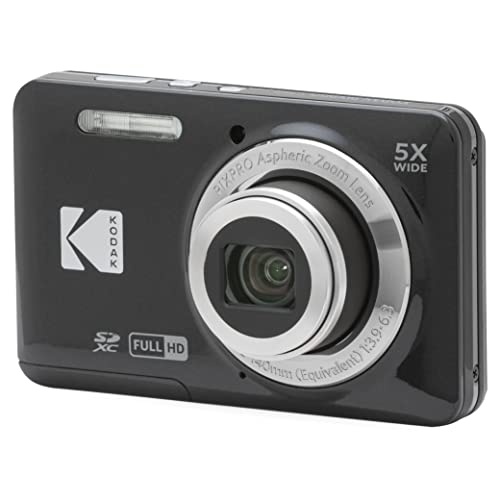
Kodak PIXPRO FZ55 — Rechargeable All-Rounder
The FZ55 is the FZ45’s more modern sibling in spirit: a 16MP compact with a 5x optical zoom, a 28mm wide-angle lens, 1080p Full HD video — the listing states 1080p plainly, and this guide repeats exactly that — a 2.7-inch LCD and a rechargeable Li-Ion battery, presented as a vlogging-friendly point-and-shoot. That battery is the personality difference: where the FZ45 asks for a drawer of AAs, the FZ55 asks for a charging habit, and repays it with slimmer running costs and a camera that tops up beside a phone each night.
The extra zoom step and the vlogging positioning suit the beginner who films as readily as they photograph — family updates, travel diaries, a child’s first attempts at presenting to a lens. The wide 28mm end frames a presenter and their surroundings at arm’s length respectably, the body stays pocketable in black, and the whole package feels like the contemporary default answer to the question this guide’s title asks. For a teenager’s first real camera, it is arguably the most balanced box here: modern power, honest video, a zoom that covers the social world.
Its caveats mirror its sibling’s, adjusted for power. The small sensor keeps its daylight allegiance, the zoom remains a family-range instrument, and a forgotten charge before a big day is the FZ55’s version of the FZ45’s empty battery drawer — which is why a spare battery or a power bank habit belongs in its owner’s kit. None of this diminishes a compact that gets the beginner essentials right in their modern form; it merely asks its owner to plug it in, the most contemporary skill in photography.
- Sensor and lens: 16MP with 5x zoom, 28mm wide end
- Video: 1080p Full HD, per the listing
- Power: rechargeable Li-Ion battery
- Character: vlogging-friendly compact in black
Strengths
- Rechargeable power suits modern routines.
- Balanced zoom covers social photography.
- Video quality serves family film-makers.
Trade-offs
- Charging discipline replaces battery swaps.
- Low-light results remain tier-typical.
- Reach is modest beside the bridge models.
Best for: teenagers, vlogging-curious beginners and anyone whose life already runs on charged devices. Not suited for: distant subjects or forgetful chargers without a spare.

Minolta MN35Z — Stage and Sport Value
The MN35Z carries a famous old name into the budget bridge class, and its listing lays out the offer plainly: a 20-megapixel camera with a 35x optical zoom, 1080p HD video, Wi-Fi and a 3-inch LCD, in black. That combination is aimed squarely at the beginner whose photography happens at a distance — school stages, sports fields, wildlife gardens — but whose budget and experience argue against both the slim compacts’ short zooms and the AZ528’s maximum reach. Thirty-five times is the middle kingdom of zoom: transformative compared with a pocket camera, more manageable than the extremes.
The larger screen earns its place for this audience, because reviewing a distant subject — did the striker’s face survive, is the bird sharp — is half the workflow at long zoom, and a 3-inch display makes that judgement honestly at the fence line. Wi-Fi moves the keepers to a phone for the family chat before the match has even ended. The bridge-leaning body gives two hands and a stance something to work with, which beginners at long zoom need more than any specification.
Minolta’s modern line is a licensed value range rather than the heritage manufacturer’s flagship division, and expectations should be set accordingly: competent, feature-generous, and daylight-leaning at full zoom, with video that records rather than produces. Within those honest borders, the MN35Z serves its stated audience with very little waste — every feature in its listing points at the same distant, daytime, family-and-wildlife world, and beginners living in that world will feel understood by it.
- Sensor: 20 megapixels, per the listing
- Zoom: 35x optical for distant subjects
- Video and links: 1080p HD video, Wi-Fi
- Screen: 3-inch LCD for reviewing reach shots
Strengths
- Zoom transforms stage and field access.
- Large screen suits reviewing distant shots.
- Feature set is focused, with little filler.
Trade-offs
- Value-line build sets realistic expectations.
- Full zoom prefers daylight and support.
- Bridge size requires deliberate carrying.
Best for: stage and sports parents, garden wildlife watchers and beginners needing reach on a budget. Not suited for: pocket-first carriers or low-light work.

Canon IXUS 285 HS A Silver — Canon-Polished Slim Pick
A naming note opens this section, because the listing itself provides it: this camera is the Canon IXUS 285 HS A, identified in its title as the PowerShot ELPH 360 HS A — the same camera wearing its international IXUS badge rather than the ELPH name used in some markets. In silver, it represents Canon’s slim-compact polish at the beginner tier: the handling, menus and colour rendering of the PowerShot family in a body built to be carried without thought and used without a manual.
Canon’s contribution to this class is refinement rather than extremes. The HS designation signals the family’s attention to low-light competence within small-sensor limits, the zoom covers the family range with stabilised ease, and the whole experience — button placement, menu logic, the way the camera wakes and focuses — feels considered in a way value-line rivals rarely match. For a beginner who plans to keep one camera for years of family life, that daily polish compounds into genuine affection, and affection is what keeps cameras in pockets rather than drawers.
Its limits are the slim class’s own: no bridge reach, no creator-era video ambitions, and a sensor whose evening work asks for realistic expectations and a steady hand. The dual naming can confuse shoppers comparing across regions, which is why this section states it in the open. For the beginner who wants the Canon way of doing simple things — and who photographs people, places and daylight — the IXUS 285 HS A is the quiet, confident closing argument of this guide.
- Identity: IXUS 285 HS A, also named PowerShot ELPH 360 HS A
- Body: slim silver Canon compact
- Character: PowerShot handling and colour
- Role: refined everyday family camera
Strengths
- Canon polish shows in daily handling.
- Slim body guarantees pocket presence.
- Colour rendering flatters family photographs.
Trade-offs
- No long-zoom reach for distant subjects.
- Video is an extra, not a headline.
- Dual naming requires a careful listing read.
Best for: beginners loyal to Canon’s way, family photographers and anyone valuing refined simplicity. Not suited for: wildlife, stage or sports reach.
How Do the Six Budget Routes Compare for a First Year of Photography?
| Camera | Body shape | Zoom | Power story |
|---|---|---|---|
| Kodak PIXPRO FZ45 | Pocket compact | 4x from 27mm | AA batteries |
| Kodak PIXPRO AZ528 | Bridge | 52x from 24mm | Rechargeable pack |
| Sony DSC-W800 | Slim pocket | Family range | Rechargeable pack |
| Kodak PIXPRO FZ55 | Pocket compact | 5x from 28mm | Li-Ion rechargeable |
| Minolta MN35Z | Bridge-leaning | 35x | Rechargeable pack |
| Canon IXUS 285 HS A | Slim pocket | Family range | Rechargeable pack |
Body shape is the honest first sort: pocket cameras get carried daily and bridge cameras get carried deliberately, and a beginner’s year is shaped more by that distinction than by any megapixel figure. Power comes second — the FZ45’s AA freedom against everyone else’s charging routine — and zoom third, matched to subjects rather than to specification pride. Read the table in that order and your shortlist will behave.
How Can a Beginner Get Sharper, Brighter Photographs From a Small Sensor?
Give the sensor light and it will repay you beyond its price. Photograph with windows and daylight at your subject’s face rather than behind it, step closer instead of zooming digitally, and let the flash help indoors at conversational distances where it is genuinely effective. At long zoom on the bridge models, brace against walls, rest elbows, and take two frames of anything distant — the second is frequently the sharp one, because the first absorbed the press of the shutter.
Hold the camera with two hands and exhale before pressing, a marksman’s trick that costs nothing and transforms beginner output within a weekend. Clean the lens with a soft cloth more often than feels necessary; pocket cameras live where fingerprints breed. Learn where your model’s focus point sits and put it on the subject’s eye or the object’s heart, rather than trusting the centre of every scene. Finally, review the day’s photographs on the largest screen available each evening — small sensors forgive daylight generously, and seeing that generosity clearly teaches a beginner what their camera loves faster than any tutorial.
Which Mistakes Do Budget Camera Buyers Make Most Often?
Overbuying zoom is the champion error of this tier, followed by expecting night performance that small sensors cannot deliver. Third comes ignoring the power story — discovering the charging cable’s absence on the morning of the school trip. Fourth is judging the camera by its worst indoor photograph rather than its daylight body of work. Fifth, and most quietly damaging, is leaving the camera at home because it felt too precious or too bulky; every model here was priced and built to be carried without ceremony, and the beginner who carries theirs learns in a month what the cautious owner learns in a year.
How Does a Beginner’s Year Divide Between These Body Shapes?
The pocket cameras write their year in frequency. The FZ45, FZ55, W800 and IXUS ride along to school runs, allotments, matches watched rather than photographed at distance, and holidays where they emerge twenty times a day for twenty seconds each. Their photographs accumulate into a dense, ordinary, wonderful record — the texture of a family’s actual year rather than its highlights. Owners of slim cameras consistently underestimate how much of their archive exists simply because the camera was present, and presence is a specification no listing can print.
The bridge cameras write their year in peaks. The AZ528 and MN35Z attend the events where distance rules — the reserve, the recital, the regatta — and return with photographs no other household device could have taken. Between peaks they rest, and that rhythm suits their owners, whose photography is purposeful rather than constant. Neither rhythm is the correct one; they are different relationships with the same hobby, and the beginner who recognises their own rhythm in these paragraphs has done the hardest part of the purchase already.
Households often end with one of each across a few years — a slim camera for the everyday carrier, a bridge for the designated distant-subject photographer — and this guide’s ordering quietly anticipates that pairing. Start with the rhythm you live now. The second camera, if it ever comes, will be bought with a precision that only a year of photographs can teach, and it will be bought from experience rather than from a listing’s promises.
What Does the First Weekend With a Budget Compact Teach?
Saturday morning teaches light. The beginner who photographs the household in window light, then in the garden, then under the kitchen ceiling, has learned more about their sensor than a month of specification reading could offer. Saturday afternoon teaches zoom honesty: the garden bird at full zoom, the child at portrait distance, the group squeezed into the wide end — three frames that map the camera’s true territory. Saturday evening teaches review, ideally on a television or computer screen, where the day’s lessons become visible at a size that flatters nothing.
Sunday teaches the social curriculum. Hand the camera to someone else and watch what they photograph; lend it to a child under supervision and receive the knee-high reportage no adult would think to make. Photograph the same subject as your phone and compare without tribalism — the camera will win some frames honestly and lose others, and knowing which is which is the beginning of photographic judgement. By Sunday night the beginner owns not just a camera but a map of it, and maps are what separate owners from possessors.
Keep those first-weekend photographs whatever their quality. They are the baseline against which a year of quiet improvement will measure itself, and beginners who can see their own progress keep going. The camera that cost the least in this guide can anchor that entire journey, provided the journey actually begins — which is a matter of weekends, not of equipment.
How Should Families Share a Beginner Camera Without Losing It to a Drawer?
Give the camera a home that is not a drawer: a hook by the door, a bowl on the hall table, a designated pocket in the family bag. Shared cameras die of storage more than of damage, because a camera that must be fetched is a camera that photographs only planned occasions. Pair the home with a charging or battery ritual owned by one named person — the household’s keeper of the camera — and rotate that honour monthly if enthusiasm allows, because keepers who are relieved stay generous.
Set one house rule about the memory card: photographs get copied to the family computer or drive on a fixed evening, and the card is never wiped by anyone but the keeper after that copy exists twice. That single rule has saved more family archives than any technology in this guide. A second rule helps the camera’s social life: anyone may borrow it for an occasion by asking the keeper, and it returns with its photographs intact and its battery state reported like a borrowed car’s fuel gauge.
Children deserve their own clause in the treaty. Supervised access, a wrist strap worn without negotiation, and freedom to photograph anything in the garden produce young photographers at a rate that surprises every household that tries it. The budget tier exists partly for this: a camera inexpensive enough to be lent to a careful nine-year-old is a camera that teaches twice — once to its owner, and once to the next generation watching.
What Accessories Make Sense at This End of the Market?
Proportionality is the whole doctrine. A case that costs a meaningful fraction of the camera has misunderstood the assignment; a simple padded pouch, a wrist strap and a screen cloth serve every model here. The memory card deserves more respect than the case — buy an honest card from a known brand, because the photographs are the valuable part of the system. Spare power follows the model’s own logic: AAs in the kitchen drawer for the FZ45, a spare rechargeable or a power bank habit for the rest.
A mini tripod is the one creative accessory worth its small place in the bag, steadying the bridge cameras at long zoom and enabling the family group shot with everyone finally inside it. Beyond that, let photographs you failed to take nominate any further purchases, one at a time. Beginners at this tier are building a practice, not a kit, and every unnecessary accessory is a small tax on the practice’s simplicity — the very quality that made a dedicated camera attractive beside a phone in the first place.
Prints are the accessory nobody lists. A handful of small prints each month — from a home printer, a shop kiosk or an online service — turns a beginner’s screen habit into a wall, a fridge and an album, and walls teach composition faster than screens do. Budget owners who print regularly improve visibly within a season, because a printed photograph cannot be scrolled past its own weaknesses.
How Long Can a Beginner Honestly Stay With One of These Cameras?
Years, if the match was honest. The slim cameras’ limitations are stable and knowable, and a photographer who grows within them develops the two skills that transfer everywhere: seeing light and anticipating moments. The bridge cameras can serve a birder or sports parent through several seasons of improving technique before their sensor becomes the binding constraint. In both cases the camera stops being the limit long after the purchase — the photographer’s eye is the slow-growing component, and it grows on any of these bodies.
The upgrade moment, when it comes, announces itself precisely: a specific photograph, repeatedly attempted and repeatedly lost to a known limitation — the hall too dim, the action too fast, the detail too fine. That announcement is a gift, because it converts an upgrade from a mood into a specification. Beginners who wait for it buy their second camera perfectly. Beginners who upgrade on restlessness buy the same lessons twice at higher prices, carrying cameras whose capabilities they have not yet grown the eyes to use.
And many owners never upgrade at all, because the family archive kept growing and the camera kept being there. That is not a failure of ambition; it is the budget compact fulfilling its founding promise completely, and this guide salutes it as a legitimate ending.
How Do These Cameras Behave on the Holidays Beginners Actually Take?
Beach weeks flatter every model here and threaten them equally. Daylight is abundant, subjects are joyful, and even the slim cameras’ modest zooms frame swimmers, boats and promenade portraits happily. The threats are sand and water, against which a zip bag, a wrist strap and a no-lending-after-sunscreen rule form a complete defence. Bridge owners should resist the full-zoom temptation toward distant ships in heat haze; the shimmering air, not the lens, sets that limit, and the honest photograph is the harbour at wide angle with the day intact.
City breaks reward the wide ends in this guide — the 24mm, 27mm and 28mm lenses that swallow squares, interiors and group dinners whole. Museums and galleries, where flash is unwelcome, test the small sensors more kindly than expected when the beginner braces, breathes and accepts a little grain as the price of the memory. Evening markets divide the field as evenings always do, and the wise beginner shoots the stalls in the blue hour’s remaining light, then puts the camera away and eats.
Family-visit holidays — the grandparents, the cousins, the new baby — are where these cameras justify themselves most completely. They circulate without anxiety, photograph everyone including the household’s usual photographer, and produce a shared archive rather than one person’s phone gallery. A beginner camera at a family gathering is a social instrument first and an optical one second, and every model in this guide was chosen with that gathering in mind.
What Should You Check When the Camera Arrives?
Budget listings reward a calm inspection hour. Confirm the model name on the body matches the listing exactly, since this tier recycles names across generations, and check the box for the battery type your research promised — AA-fed or rechargeable — plus the charger where one belongs. Power the camera on, run the zoom through its full travel, take a photograph at each end of it, record ten seconds of video, and view everything on the largest screen in the house. That short ceremony exercises nearly every system a beginner will use for a year.
Inspect the lens for marks, the screen for dead patches, and every button for a positive click. Format the memory card inside the camera before trusting it, and record the serial number with your household papers. If anything disagrees with the listing, the returns window is the remedy and the first days are when to use it. A budget camera verified this way stops being a gamble and becomes an instrument, which is all any beginner in this guide is really buying.
How Does a Beginner Learn Composition on a Camera With No Ambitions?
Faster than on a flagship, usually, because the camera removes every excuse. Fill the frame with the subject and cut the surroundings that add nothing; the modest zooms here enforce that lesson physically. Put horizons level and either clearly high or clearly low, never drifting through the middle by accident. Watch the edges of the frame for the intruding bin, the stranger’s elbow, the lamppost growing from a beloved head — the classic beginner harvest, visible in the viewfinder to anyone taught to look.
Photograph fewer subjects more times. The child, the dog, the garden through a season: repetition reveals what changing light does to a familiar scene, and that revelation is the core of photographic education at any price. Keep the photographs in dated folders and glance back monthly; progress that feels invisible week to week becomes undeniable across a season, and undeniable progress is the fuel that carries a beginner into their second year with the same inexpensive camera still in hand.
A Note on Giving One of These Cameras as a Gift
Few gifts at this level outperform a beginner camera given properly, because it arrives with an activity attached. Given properly means: a memory card already fitted, power already solved — batteries in the box for the FZ45, a full charge for the rechargeable models — and one photograph already taken, ideally of the giver, so the camera’s story begins before the wrapping settles. Add a small note naming the first suggested subject, and the gift becomes an assignment in the friendliest sense.
Match the model to the recipient with the same honesty this guide applies to buyers. The grandparent receives slim simplicity — the Sony or the Canon — not a bridge camera whose zoom they will never deploy. The sports-mad teenager receives the Minolta or the AZ528 and a clear-eyed word about daylight. The child graduating from toy cameras receives the FZ45, whose AA power and friendly manners make independence safe. A camera matched this carefully is used on the day it is given, which is the only gift metric that has ever mattered.
What About Video, Briefly and Honestly?
Beginners film birthdays, school performances and pet antics, and for those duties the 1080p video listed on the Kodak and Minolta models is genuinely sufficient: bright, shareable records that families keep. What this tier does not offer is the creator’s toolkit — no presenter-flavoured design, no serious audio provisions, no endurance engineering for long productions. A beginner whose ambition is a channel should read our companion guide to compact cameras for video after this one, and treat the present cameras as the stills-led instruments they are.
Filming technique at this level is refreshingly simple. Hold the camera with two hands, keep clips short and purposeful, stand closer than instinct suggests so the microphone hears voices rather than rooms, and let the zoom rest instead of wandering. A dozen calm ten-second clips edit into a better family film than one sweeping three-minute pan, on any camera ever made — and the beginner who learns that here owns a skill worth more than the camera that taught it.
The Two-Question Test for Readers Still Deciding
First: where do your subjects live — across the room, or across the field? Across the room sends you to the four slim and pocket cameras, with power and polish deciding among them. Across the field sends you to the two bridge models, with maximum reach or middle reach deciding between them. Second: how does the camera get its energy in your household — swapped batteries bought anywhere, or a nightly charge beside the phone? Those two answers, given honestly, resolve this six-way comparison for nearly every reader into a single name and a comfortable conscience.
If the answers point in opposite directions — distant subjects, forgetful charging — the honest compromise is the bridge camera whose listing and your habits can be reconciled with a spare battery bought on day one. Compromises chosen knowingly age well; compromises discovered at a school concert do not. Read your finalist’s section once more with your two answers in mind, and let its trade-offs list be the last thing you consult before ordering.
One last encouragement belongs to the beginner who worries that an inexpensive camera signals unserious intent. Photography’s history disagrees: generations learned on humble boxes whose limitations taught them to see, and their archives — sharp where it mattered, joyful everywhere — outlasted the era’s expensive equipment in family affection. The camera in your hand matters less than the habit in your week, and every model in this guide can carry that habit honourably.
So buy the one whose shape fits your days, whose power fits your household, and whose zoom fits your subjects — then stop comparing. Comparison is a fine servant before a purchase and a poor companion after one, and the photographs waiting on the other side of the decision are indifferent to how long the deciding took.
Keep the camera where life happens — the hall bowl, the coat pocket, the family bag — and forgive it its evenings. A beginner camera’s worth is measured in attended moments, and attendance is a habit the owner supplies. Supply it faithfully for one season and the archive on your shelf will make the argument for dedicated cameras more eloquently than this guide can.
That archive, incidentally, is the correct place to judge the purchase in a year’s time: not by the specification you settled for, but by the faces, fields and far-off wonders that would otherwise have gone unphotographed entirely.
Beginners sometimes apologise for starting small, as though photography required a grand entrance. It requires a first photograph, a second, and a fiftieth — and the cameras gathered here exist to make those fifty as easy, as cheerful and as affordable as the current market allows. Start where you stand; the standing is not the limitation anyone remembers later.
Years from now, the beginner who began with any of these six will own something no upgrade can purchase retrospectively: a complete record of the years when they were learning to look. That record begins the morning the box is opened, provided somebody remembers the batteries.
Charge it, load it, carry it, and let the first ordinary week — school gates, garden light, a dog asleep in a sunbeam — deliver the verdict that no listing page can. Beginners who give a camera that week rarely return it; they return, instead, for a second memory card.
And when a photograph from this humble beginning ends up framed on a wall years later, nobody will ask what it cost or what its sensor measured. They will ask who took it, and the answer will be the person who started.
That is the spirit in which this guide was assembled: six honest cameras, their strengths and limits stated in daylight, waiting for six different beginners to begin. The beginning is the entire product. Everything else — the zooms, the sensors, the badges — is commentary.
Pick your commentator, then go and take the first photograph before the light changes.
If two finalists remain after every test in this guide, choose the one you would lend to a beloved beginner without a flicker of anxiety. Lendability is the budget tier’s secret specification — it measures simplicity, durability and replaceability in a single feeling — and the camera you would lend is almost always the camera you should own first.
Order it with the card, the case and the spare power already in the basket, so the camera’s first week is about photographs rather than parcels. Then take it somewhere ordinary and beautiful — which, to a beginner with a new camera, is nearly everywhere.
The rest of the education — light, timing, patience, the eye for a background — arrives free with use, delivered by the subjects themselves. No camera at any price sells those lessons separately; they are simply what photography pays its practitioners, starting with the very first frame.
Begin there, with the frame in front of you rather than the specification behind you, and this inexpensive beginning will keep compounding long after its price is forgotten.
Every photographer alive began with a camera somebody else considered inadequate. The inadequacy was never the point; the beginning was, and it still is.
So let the first frame be imperfect, daylight-lit and entirely yours. The second will be better, and nobody — not even you — will remember what the camera cost by the time the fiftieth arrives.
That is the bargain this whole category offers, stated without decoration: modest tools, honest limits, and an open door into a lifelong way of noticing the world.
Walk through that door with whichever of these six fits your hand and your household, and the photographs will handle the rest of the introduction.
The door is open, the light is good, and the first subject is already waiting somewhere in your ordinary, photographable day.
Go and stand in that light with a camera in your hand, and begin the archive your future self will thank you for starting today rather than someday.
Final Recommendation
Most beginners should start with the Kodak FZ55 for its modern balance, or the FZ45 when AA freedom and maximum simplicity matter more. Choose the Sony W800 or the Canon IXUS for slim, polished everyday carrying under a trusted badge, and climb to the AZ528 or the Minolta MN35Z only when your subjects genuinely live at a distance. Whichever camera arrives, charge it or load it the same evening, photograph the household in daylight the next morning, and review the results together — a beginner who completes that small ceremony owns a camera, while everyone else merely possesses one, and the difference shows in every album that follows.
Frequently Asked Questions
Are these cameras better than a phone for a beginner?
For learning and for zoom, yes: they offer real optical zoom, dedicated controls and distraction-free shooting. A good phone may beat them in dim light, which this guide states openly.
Which pick is best for photographing school sports?
The Kodak AZ528 for maximum reach and stabilisation, or the Minolta MN35Z as the middle-reach alternative. Both are daylight instruments at full zoom, so brace and shoot in bursts.
AA batteries or rechargeable — which should a beginner choose?
AA, in the FZ45, for travel and forgetful households, since replacements exist everywhere. Rechargeable Li-Ion, in the FZ55 and others, for lower running costs and a nightly charging routine.
What video can these cameras actually record?
The Kodak models list 1080p Full HD video and the Minolta lists 1080p HD. Treat video across this tier as a strong extra for family records rather than a creator platform.
Is the Canon IXUS the same as a PowerShot ELPH?
Yes, in this case the listing itself names it both ways: IXUS 285 HS A, also identified as the PowerShot ELPH 360 HS A. IXUS is the badge used in many markets for the same slim line.
What should I buy with the camera on day one?
A memory card if one is not included, a simple case, and either spare AA batteries or a spare rechargeable pack depending on the model. That trio prevents nearly every first-week frustration.
Related Guides
Continue with our Canon point and shoot guide for the full single-brand picture, our compact cameras chosen for video when filming becomes the priority, and our beginner instant camera guide for prints without any screen at all.
Related guides
- Best Sony Full Frame Cameras for Astrophotography: Sensitivity vs Resolution
- Best Affordable Android Tablets: Five True Android Slates and One Fire OS Specialist, Clearly Labelled
- Best 400 FPS High Speed Cameras: The Honest Truth About Burst Slow Motion
- Best Kids Smartwatches for Texting and Calling: Six Watch-Phones Under Parent Control


