What's inside
- Where to buy
- Key Takeaways
- Quick Picks
- How did we choose these tower speakers?
- What makes projecting sound to a rider so different?
- Which boat tower speakers belong in one comparison?
- How do you install and aim tower speakers so the rider hears them?
- What mistakes do tower speaker buyers make?
- How should the tower system share a boat with the cockpit system?
- What does a season of ownership actually demand?
- Surfing or wakeboarding: why does the rope length change the answer?
- Why do demo impressions at the dock mislead tower buyers?
- Final Recommendation
- Frequently Asked Questions
- Related Guides
As an Amazon Associate I earn from qualifying purchases. This post may contain affiliate links at no extra cost to you.
gizmoverdict.com is reader-supported. When you buy through links on our site, we may earn an affiliate commission.
Where to buy
All six tower speakers in this guide are sold in pairs through Amazon’s US store, and the first measurement to take is not on any product page — it is the diameter of your boat’s tower bar, with a caliper or a tape, before a single listing is opened. Tower speakers clamp to that bar, and a clamp that does not match the bar’s diameter is not a minor inconvenience; it is the whole purchase failing at the dock. Every pick below is therefore discussed with its mounting life in view, alongside the other fact that defines this category: these speakers exist to throw sound backwards, across open water, to a rider on a rope tens of feet behind a moving boat.
The best boat tower speakers do a job no other speaker on the boat is asked to do. Cockpit speakers entertain the people in the boat, at conversational distance, inside a hull that helps them. Tower speakers face the other way, firing aft over the wake, and their audience is a wakeboarder or surfer riding at tow-rope distance, wearing the noise of a hull, an engine and moving water as a constant backdrop. Projection is the entire discipline: output that stays intelligible and musical after travelling that far through that much interference. A speaker that sounds wonderful at the dock, auditioned from six feet away, may have nothing to say at sixty — and the reverse can also be true, which is why this guide judges every pick as a projector first and a hi-fi component second.
One piece of marketing must be disarmed before the picks, because it poisons every comparison in this category: peak wattage. The headline watt figures on marine tower speakers are marketing numbers, measured differently — or barely measured at all — by each brand, and they cannot be compared across brands or even trusted within one. A speaker advertised at one peak figure is not thereby louder, cleaner or better than another advertised lower. This guide mentions such figures nowhere as specifications, and judges the picks on the things that actually decide performance at the end of a rope: driver size, enclosure design, sensitivity in spirit if not in print, the amplifier behind them, and the clamp that keeps them aimed where the rider is.
Key Takeaways
- Measure your tower bar’s diameter before shopping: clamp fit is a pass-or-fail specification that no amount of sound quality can rescue.
- Tower speakers are projectors, not cockpit speakers — they fire aft to a rider at tow-rope distance, through engine, hull and water noise.
- Ignore peak-watt headlines when comparing brands; driver size, enclosure and the marine amplifier behind the speakers decide what the rider hears.
- Five of the six picks are passive and need a marine amplifier; the DS18 pair is the self-amplified Bluetooth exception that skips the amp entirely.
- The 8-inch picks — KICKER’s KMTC8 enclosures and Skar’s SK8M-TWR — move more air for bigger boats, longer ropes and louder briefs than the 6.5-inch class.
- BELVA’s LED-lit pair is the style pick, KICKER’s loaded enclosures are the established marine-audio route, and Skar’s two sizes cover the value end at both diameters.
Quick Picks
| Pick | Badge | Why it earns its place |
|---|---|---|
| Skar Audio SK65MB-TWR | Best 6.5-inch value pair | A black two-way marine tower pair from a brand that built its name on loud-for-the-money, sized for the commonest towers. |
| Rockville WB65 | Best metal-enclosure pair | Black metal enclosures with a titanium tweeter, built to shrug off the sun, spray and vibration of tower life. |
| KICKER KMTC8 | Best 8-inch enclosures | Loaded 8-inch enclosures from marine audio’s establishment name, with the projection bigger drivers bring to longer ropes. |
| Skar Audio SK8M-TWR | Best white 8-inch pair | Skar’s formula scaled to 8 inches in a white finish that matches light-coloured towers and gelcoat. |
| BELVA BWT6LED | Best with lighting | A white 6.5-inch pair with multi-colour LED lighting and a remote — the evening-cruise statement piece. |
| DS18 MP4TP.4A | Best no-amplifier option | A compact 4-inch pair with amplification and Bluetooth built in — music aft with no marine amp to install or wire. |
How did we choose these tower speakers?
Projection set the tests. We weighted what a speaker can deliver at distance, in the open, against noise — which favours larger drivers, enclosures designed to throw rather than to bloom, and tweeters that keep speech and cymbal detail attached to the music after a long trip through humid air. Near-field sweetness, the quality that wins living-room comparisons, was deliberately demoted: at the end of a tow rope it is inaudible, and a guide that rewarded it would be sending riders speakers that audition beautifully at the dock and vanish at the second buoy.
Marine survival was the second filter, and it is not a formality. A tower is the harshest seat on the boat: full sun, direct spray, vibration through the bar, and winter storage in between. Enclosure material, grille and hardware quality, and the honesty of a brand’s marine claims all counted. So did the clamp — its range, its lining, its ability to hold aim when the boat crosses a wake at speed — because a speaker that rotates five degrees on its bar is a speaker aimed at the sky, and its specifications become irrelevant mid-session.
Finally, we kept the system honest. Five picks are passive, which means the marine amplifier is part of their true cost and part of their true performance; a tower pair is only ever as good as the amp channels behind it, and the pick sections say so. The DS18’s built-in amplification is scored as the different product it is — a complete, compact answer with a lower ceiling — rather than as a passive pair with a feature. Peak wattage, as promised, was ignored as a comparison tool throughout.
What makes projecting sound to a rider so different?
Stand behind a boat at tow speed, mentally, and inventory what the music is competing with. The engine and exhaust lay down a broad roar. The hull throws spray and slaps water. Wind at riding speed adds its own rushing layer, and the rider is moving through all of it while concentrating on staying upright. Against that backdrop, the qualities that survive are level, clarity in the vocal and treble bands where musical detail lives, and a focused throw that puts the sound on the rider rather than scattering it across the lake. Bass, the glory of cockpit listening, largely surrenders to physics at distance — which is why tower speakers that chase dockside boom often disappoint where it counts, and why the experienced brands voice these enclosures forward and clean.
Distance also rewrites the volume conversation. Sound falls away as it travels, so a rider at the end of a long rope needs the speakers working meaningfully harder than a surfer riding close behind the platform on a short line. That is why the same boat can want the 6.5-inch class for surfing and the 8-inch class for wakeboarding, and why amplifier headroom matters: a system run at its ragged edge for a whole session sounds strained, heats up, and ages early. The honest sizing question is not “how loud at the dock” but “how clean at the rope, at hour three, with the boat full of people asking for one more song.”
There is an etiquette dimension that responsible guides should not skip. A system built to project across water projects across water — to other boats, to docks, to the shoreline houses whose owners did not buy tickets. Tower speakers earn their keep during the tow, pointed at the rider; at anchor, in a cove, at the dock, the cockpit system and a civilised volume are the neighbourly tools. Several picks here will happily entertain a whole anchorage if asked, and part of owning capable projection is knowing when the brief has changed from rider to neighbourhood.

Skar Audio SK65MB-TWR — Best 6.5-inch value pair
Skar Audio built its reputation in car audio on a simple proposition — serious output for money that makes enthusiasts nod — and the SK65MB-TWR carries that proposition up the tower. It is a 6.5-inch two-way marine coaxial pair in black, designed as a full-range tower speaker for the commonest size class in the category. Six and a half inches is where most tower systems live for good reason: the enclosures stay proportionate on typical wake towers, the weight aloft stays manageable, and the projection, fed by a competent marine amplifier, covers surfing and wakeboarding distances for the majority of recreational boats.
The value framing needs its honest shadow. Skar’s headline wattage language is exactly the kind of peak marketing this guide warned about in the introduction, and buyers should set it aside entirely and judge the pair on its format: a two-way coaxial design, a marine build, a brand whose entire business is output per unit of currency. What that buys in practice is a pair that lets the budget flow where it matters more — to the amplifier. A modest tower pair on a good marine amp will out-project a fancier pair starved by a weak one at rope distance every time, and the Skar’s pricing is what makes that allocation possible.
As with every passive pick here, installation quality is part of the product. Clamp the pair firmly to a measured bar, aim them aft and very slightly down toward where a rider’s head actually travels, and run marine-grade cable with the same care as the rest of the boat’s wiring. Do that, feed them properly, and the SK65MB-TWR delivers the category’s core experience — your rider, your playlist, audible and intact over the wake — at the gentlest entry price among the full-size picks in this guide.
One more thing the value price should not make buyers shy about: the 6.5-inch Skar pair is a legitimate end point, not merely a starter to be outgrown. Boats are ecosystems of expense — fuel, maintenance, storage, the rope that needs replacing this season — and a tower system that reaches “the rider hears the music clearly” and stops spending is a rational allocation, not a compromise to apologise for. Owners whose riding is recreational rather than competitive will find this pair still answering the brief years from now, provided the amplifier behind it was bought with the same clear eyes.
- Size: 6.5-inch two-way marine coaxial tower speakers
- Sold as: pair, black finish
- Power path: unpowered enclosures, fed by a marine amplifier
- Design brief: full-range projection to a towed rider
- Brand character: output-focused value specialist
Strengths
- The gentlest entry price among the full-size pairs, freeing budget for the amplifier that decides real performance.
- The 6.5-inch class suits the widest range of towers without overwhelming smaller boats.
- A two-way coaxial layout keeps the enclosure compact while covering the full musical range.
Trade-offs
- Headline wattage is peak marketing — ignore it and judge the format, as with all brands here.
- Passive: the amplifier is a second, necessary purchase and installation.
- Bigger, louder briefs — long ropes, big boats — will outgrow it toward the 8-inch picks.
Best for: recreational wake boats wanting real rider projection on a sane total budget. Not suited for: buyers expecting dockside wattage figures to predict rope-distance performance.
Rockville WB65 — Best metal-enclosure pair
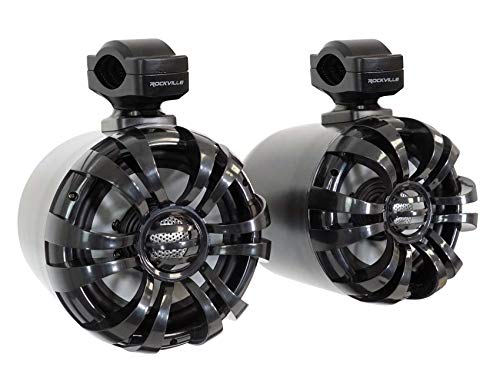
The WB65 makes its argument out of metal. Rockville houses this 6.5-inch pair in black metal enclosures rather than plastic, and tops the design with a 1-inch titanium tweeter — a specification that translates, in tower terms, into two practical virtues. Metal enclosures shrug off the knocks, sun and vibration of life aloft better than thin plastic shells, and they hold their shape and their aim season after season. A titanium tweeter brings the crisp, forward top end that projection duty rewards, keeping vocals and detail attached to the music after the long throw aft, where mellower tweeters let the top of the mix dissolve into wind noise.
Rockville’s own numbers for this pair follow the category’s marketing dialect — a large peak figure with a lower RMS figure beneath it — and the introduction’s warning applies verbatim: those numbers cannot be compared against other brands’ headlines, and the pair should be chosen on its enclosure, its tweeter and its format. On those grounds it is a strong mid-guide pick: waterproof-rated marine construction, a finish that suits the black towers fitted to a large share of wake boats, and a brand that sells enough marine volume to stand behind the product at scale.
The WB65 also suits the owner who keeps a boat for years rather than seasons. Plastic enclosures age visibly under ultraviolet light; well-finished metal ages like hardware. Combined with the clamp discipline this guide keeps repeating — measure the bar, seat the clamp, check the aim after the first hard session — the Rockville pair is the pick most likely to be up the tower, un-faded and un-rattled, when the boat’s other accessories have been replaced twice. Longevity is a sound-quality feature in marine audio, because a speaker that survives keeps the system matched.
The titanium tweeter deserves one more paragraph of translation, because at the end of a rope it is doing the heaviest lifting in the enclosure. Distance and wind strip the top of the music first — the consonants of a lyric, the edge of a guitar, the shimmer that tells your brain a recording is alive. A tweeter material chosen for stiffness and speed holds that information together over the throw in a way that softer domes smear. Riders rarely say “the treble extension was excellent”; they say the music sounded clear instead of distant. On the WB65, that clarity has a hardware address, and it is the small metal dome at the front of each enclosure.
- Size: 6.5-inch marine wakeboard tower speakers
- Enclosure: metal, black finish
- Tweeter: 1-inch titanium
- Sold as: pair
- Power path: passive design — a marine amp supplies the muscle
Strengths
- Metal enclosures outlast plastic under sun, spray and vibration aloft.
- Titanium tweeter keeps projected detail crisp at rope distance.
- Black finish matches the commonest tower colour schemes cleanly.
Trade-offs
- Metal enclosures carry more weight aloft than plastic rivals — check tower and clamp ratings.
- Peak and RMS marketing figures still cannot be compared across brands; buy the format.
- Passive, so the amplifier budget and installation apply in full.
Best for: owners keeping a boat for years who want enclosures built like hardware. Not suited for: the lightest possible tower load, or anyone skipping the amplifier.

KICKER KMTC8 — Best 8-inch enclosures
KICKER is marine audio’s establishment — the name dealers reach for when a tower system has to work the first time — and the KMTC8 is its loaded-enclosure answer at 8 inches. “Loaded” is the operative word: these are complete enclosures with KICKER’s 8-inch marine speakers already installed, charcoal grills over black enclosures, engineered as a unit rather than assembled from parts. The 8-inch driver class is the projection upgrade in this category. More cone area moves more air, and at the end of a wakeboard rope that translates directly into music that arrives with its body intact instead of thinning into a suggestion.
The buyer for the KMTC8 is running a bigger brief than the 6.5-inch class serves: a larger boat, a longer rope, a crew that rides all afternoon, or simply the determination that the rider’s audio will not be the weak link in an expensive day. KICKER’s marine line is built and tested for the environment with a seriousness that shows in the details — the enclosures, the hardware and the brand’s long presence in dealer-installed systems. That establishment status also means advice, parts and matching KICKER amplifiers and cockpit speakers are easy to find, which matters when a tower pair is one chapter of a whole-boat system rather than a lone purchase.
Size discipline is the caveat. Eight-inch enclosures are substantial objects to hang on a tower: they need the bar diameter and clamp to match, the tower structure to be happy with the weight and windage, and a boat whose scale does not make them look like satellite dishes. On a compact runabout they are theatre; on a full-size wake boat they are proportionate and purposeful. Measure the bar, consider the silhouette, feed them with a marine amplifier of real substance, and the KMTC8 delivers the most authoritative rider projection in this guide.
There is also a resale-and-rigging argument that experienced boat owners will recognise. KICKER is the name a second owner hopes to see on the tower when a boat changes hands, and the name a rigger can get parts, clamps and matching components for without a detective phase. Equipment ecosystems matter on boats more than in living rooms, because boats are serviced by other people, in other towns, on a schedule set by the season. A loaded enclosure from the establishment brand is partly a purchase of that serviceability — the sound arrives on day one, and the support is still there in year six when a clamp needs replacing before a holiday weekend.
- Size: 8-inch loaded marine tower enclosures
- Speakers: KICKER marine 8-inch drivers, factory installed
- Finish: black enclosures with charcoal grills
- Sold as: pair of complete enclosures
- Power path: no built-in amplification; marine amp required
Strengths
- 8-inch projection with the body that long ropes and big boats demand.
- Loaded enclosures arrive engineered as a unit — no driver matching to improvise.
- Establishment marine brand with deep dealer and accessory support.
Trade-offs
- The largest, heaviest presence here — towers and clamps must be sized for it.
- Premium positioning within the category’s pricing.
- Overkill for surfing-distance duty on small boats, where 6.5 inches suffice.
Best for: full-size wake boats and long-rope riders who want the authoritative setup. Not suited for: compact boats whose towers would wear them like a costume.

Skar Audio SK8M-TWR — Best white 8-inch pair
The SK8M-TWR is Skar’s formula scaled up and finished in white: an 8-inch two-way marine coaxial pair for towers, aimed at buyers who want big-driver projection without the establishment brands’ pricing — and whose boats wear white. That finish is not a triviality in marine audio. Towers and gelcoat on a large share of boats are white or light-coloured, and a pair of black enclosures bolted across a white tower reads as an afterthought, while a matched white pair reads as equipment the boat was designed around. Skar, alone among the 8-inch picks here, serves that aesthetic without charging for the privilege.
The performance case mirrors the smaller Skar’s, transposed to the larger class. Eight inches of cone per side, a two-way coaxial layout keeping the enclosure tidy, and a value price that leaves the budget’s centre of gravity on the marine amplifier — the component that will actually decide how the pair sounds at distance. As ever with Skar, the wattage in the listing’s headline is a marketing figure to be set aside; the format is the fact. Judged as format, this is the most accessible route in the guide to genuine 8-inch projection.
White marine gear carries one ownership note its black counterparts escape: it shows its life. Sunscreen, dock grime and water spots all announce themselves on a white enclosure, and keeping the pair looking factory-fresh takes a wipe-down habit that black finishes forgive. Owners who prize the matched look will pay that small tax gladly; owners who know they will not should take the hint and buy black. Either way, the SK8M-TWR’s proposition stands — big-class projection, value pricing, and the only white finish at this size in the guide.
Buyers cross-shopping the two 8-inch picks should understand what the Skar’s savings are made of, because they are the respectable kind. The money comes out of brand premium, dealer network and finish fussiness — not out of the driver size or the coaxial format that decide the projection. What remains is the essential machine: big cones, marine intent, white paint. For an owner who services their own boat and buys their own gear, that is the correct place to save. The SK8M-TWR asks its owner to be the support network, and repays the arrangement every time the rider gives a thumbs-up from the end of the rope.
- Size: 8-inch two-way marine coaxial tower speakers
- Sold as: pair, white finish
- Power path: passive pair, driven from marine amplifier channels
- Design brief: full-range projection at the larger driver class
- Brand character: output-focused value specialist
Strengths
- 8-inch projection at value pricing, with the budget left over for a proper amplifier.
- White finish matches light towers and gelcoat like factory equipment.
- Two-way coaxial design keeps a big driver in a manageable enclosure.
Trade-offs
- White shows sunscreen, grime and water spots — a wipe-down habit is part of the price.
- Headline wattage is marketing, not a specification; compare formats, not figures.
- Passive: amplifier cost and installation are part of the true total.
Best for: white-towered boats wanting 8-inch reach without establishment pricing. Not suited for: owners who will never wipe an enclosure down.
BELVA BWT6LED — Best with lighting
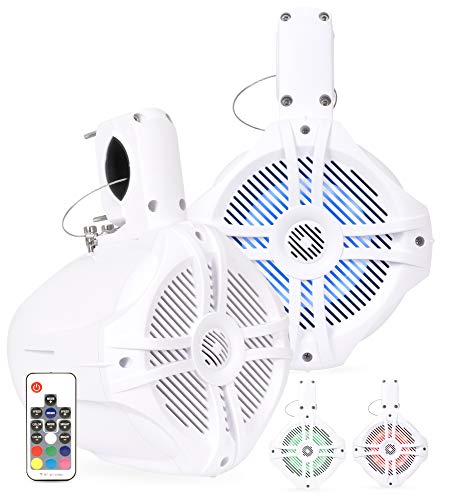
Every guide needs one pick that admits fun is a specification, and the BWT6LED is this one’s. BELVA’s white 6.5-inch marine tower pair builds in multi-colour LED lighting with a remote control, turning the tower into part of the boat’s evening personality — the glow at anchor, the accent at the dock, the small theatre that makes a sunset cruise feel like an occasion. It would be easy to dismiss the lighting as decoration stapled to a speaker. That would miss how boats are actually used: for every hour spent towing a rider at noon, many boats spend an hour at anchor at dusk, and in that hour the BELVA is the only pick in this guide still performing.
Under the lights, the speaker itself is a conventional 6.5-inch marine tower pair in white — the class this guide has already established as the recreational mainstream — and it should be judged by the same rules: passive, amplifier-fed, its headline wattage a marketing figure rather than a promise. Its projection duty is honestly mid-pack; riders chasing maximum reach should be reading the 8-inch sections. What the BELVA adds is a second shift. Boats that host — evening cruises, raft-ups, dock parties — get a speaker that contributes to the atmosphere visually as well as sonically, and the remote keeps the light show adjustable without a trip to the helm.
The cautions are the predictable ones for a feature-led pick. Lighting is wiring as well as speakers, so installation includes the LED circuit and its control, and the feature’s value depends entirely on whether your boating includes the evenings it flatters. A dawn-patrol wake boat that is washed and covered by dark will never switch the lights on, and its owner should buy projection instead. For the social boat, though, the BWT6LED is that rare thing: a pick whose headline feature is exactly the one its buyers will use most.
A word about how the lighting changes the speaker’s social physics, because owners report it consistently: a lit tower gives the boat a centre of gravity after dark. People gather toward it, photographs happen under it, and the speaker becomes the reason the evening extends by one more hour at anchor. That is not an audio specification, and this guide will not pretend otherwise — but boats are social machines before they are audio platforms, and a pick that serves the social brief this directly has earned its place on evidence, not novelty. Buyers whose boating is measured in sunsets as much as in sessions will understand immediately.
- Size: 6.5-inch marine tower speakers
- Lighting: multi-colour LED with remote control
- Sold as: pair, white finish
- Power path: bring your own marine amplifier — these are passive
- Design brief: tower audio plus evening atmosphere
Strengths
- Built-in LED lighting gives the tower a second, evening career no rival here offers.
- Remote control keeps the light show adjustable from anywhere on the boat.
- A mainstream 6.5-inch marine format underneath the showmanship.
Trade-offs
- Projection is mid-pack — maximum-reach riders should choose the 8-inch picks.
- Lighting adds an installation circuit and a feature dawn-only boats will never use.
- White finish shares the SK8M’s keep-it-clean tax.
Best for: social boats, evening cruisers and raft-up regulars. Not suited for: pure performance briefs where every unit of budget belongs to projection.
DS18 MP4TP.4A — Best no-amplifier option
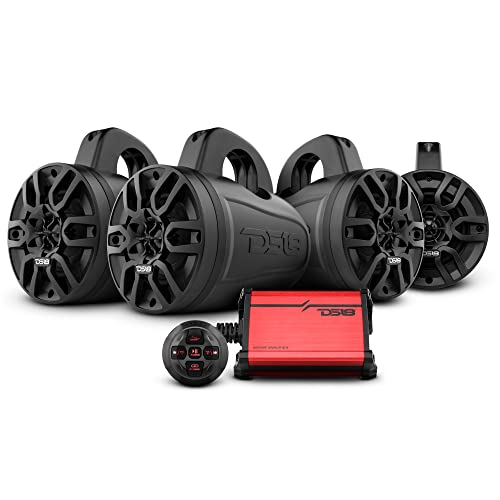
The DS18 pair rewrites the category’s entry requirements. Every other pick here is a passive speaker waiting for a marine amplifier; the MP4TP.4A carries its amplification built in, adds Bluetooth streaming and a remote, and asks only for power and a phone. At 4 inches per enclosure, it is also by far the most compact pair in the guide — a deliberate trade that defines its territory. This is tower audio for boats that cannot or will not host an amplifier installation: smaller boats, simpler electrical systems, owners who want music aft this weekend rather than after a wiring project.
That territory is real, and within it the DS18 is not a compromise but the correct tool. Bluetooth removes the head-unit question entirely; the rider’s or the captain’s phone is the source, the remote handles the practical controls, and the built-in amplification is matched to the drivers by the people who made both — the one configuration in this guide where amplifier matching cannot be gotten wrong. For surfing distance and casual towing, where the rider is close behind the boat, a compact amplified pair covers the brief with a simplicity the passive systems cannot approach at any price.
The ceiling must be stated as plainly as the convenience. Four-inch drivers move a fraction of the air the 8-inch picks move, and no built-in amplifier changes that physics: at long wakeboard ropes, in loud boats, the DS18 will run out of projection while the big passive pairs are still warming up. Its headline wattage, like every other brand’s here, is marketing rather than measurement. Buy it as what it is — the complete, compact, installation-free answer for close-range riding and small boats — and it delights. Buy it expecting KMTC8 reach and the disappointment will be yours, not the speaker’s.
The DS18 also deserves defence against a snobbery the category can slip into: the assumption that a tower system is not real until it involves an amplifier rack. Plenty of boats — centre consoles that fish more than they tow, family runabouts, hire-fleet workhorses — need music aft occasionally and simply, and for them an installed passive system is not a higher standard but a worse fit. A pair that clamps on, pairs with a phone and plays is the whole requirement, honestly specified and honestly met. The guide ranks it last in projection and first in its own brief, and both rankings are sincere.
- Size: 4-inch marine tower speakers
- Amplification: built in — no marine amplifier required
- Source: Bluetooth streaming, with remote control
- Sold as: pair
- Design brief: complete compact tower audio for smaller boats
Strengths
- The only pick that plays with no amplifier to buy, mount or wire.
- Bluetooth and a remote make the phone the whole audio system.
- Compact enclosures suit small towers and light boats the big pairs would swamp.
Trade-offs
- Four-inch physics: projection runs out well before the 8-inch passive pairs.
- Fixed internal amplification sets a permanent performance ceiling.
- Headline wattage is marketing, as throughout this category.
Best for: smaller boats, surf-distance riding and owners who refuse an amplifier project. Not suited for: long-rope wakeboarding or loud, large boats.
Which boat tower speakers belong in one comparison?
| Speaker | Driver | Power path | Finish | Signature strength |
|---|---|---|---|---|
| Skar SK65MB-TWR | 6.5-inch | Passive — marine amp | Black | Value entry to full-size projection |
| Rockville WB65 | 6.5-inch | Passive — marine amp | Black metal | Metal enclosures, titanium tweeter |
| KICKER KMTC8 | 8-inch | Passive — marine amp | Black, charcoal grills | Loaded enclosures, maximum authority |
| Skar SK8M-TWR | 8-inch | Passive — marine amp | White | Big-driver reach at value pricing |
| BELVA BWT6LED | 6.5-inch | Passive — marine amp | White, LED lit | Evening atmosphere with a remote |
| DS18 MP4TP.4A | 4-inch | Self-amplified, Bluetooth | Compact pair | No amplifier, no wiring project |
Read the table by driver size first — it sets the projection class — then by power path, because the passive pairs’ true price includes the amplifier the DS18 deletes. Finish and features arbitrate only between speakers that survive those two cuts.
How do you install and aim tower speakers so the rider hears them?
It starts, as this guide warned, with the bar. Measure the tower tube’s diameter at the exact mounting position — towers taper and vary — and confirm the clamps’ range covers it, with any supplied inserts matched to your measurement. A clamp that is nearly right is wrong: it will either refuse to close or, worse, close and then migrate under vibration until the speaker’s aim wanders. Mount the pair symmetrically, at the same height, spaced as the tower allows, and torque the hardware evenly. Then aim: aft, and fractionally downward toward the water where a rider’s head travels — not level at the horizon, and certainly not at the sky, which is where an un-aimed tower speaker cheerfully performs for the clouds.
Wiring deserves marine respect. Use marine-grade cable, route it through or along the tower with protection where it passes edges and joints, and leave the connections sealed against the spray that will find them regardless. Passive systems add the amplifier to this discipline: mount it dry, ventilated and fused correctly, and set its gains with the rider’s distance in mind rather than the dock’s — a system tuned loud at the swim platform may still be modest at the rope, and a system tuned by dockside enthusiasm alone can be painfully hot for the passengers sitting under the tower. The DS18 deletes most of this paragraph, needing power and a Bluetooth pairing, which remains its most persuasive feature for the installation-averse.
The acceptance test happens on the water, at tow speed, with a rider out back and a familiar track playing. Have the rider signal — thumbs up, down, sideways — for level and clarity, and adjust aim and gain to their verdict, not the helm’s. Then sit in the cockpit and check the other direction: tower speakers firing aft still spill sound into the boat, and passengers should be entertained, not assaulted. A system tuned from both ends of the rope is the one that gets used all season without argument.
What mistakes do tower speaker buyers make?
The founding mistake is comparing peak wattage between brands and buying the biggest number. Those figures are marketing artefacts, measured inconsistently or not at all, and they predict nothing about what a rider hears; driver size, enclosure design and amplifier quality predict nearly everything. The second mistake is shopping before measuring — falling for a pair whose clamps do not fit the tower bar, a failure discovered with the boat on the trailer and the weekend ticking. The third is starving passive speakers: pairing a serious tower set with the cheapest amplifier on the shelf, then blaming the speakers for a thinness that was purchased separately.
Fourth, aiming by eye from the dock and never testing at the rope, so the system’s real audience spends the season in the edge of the throw. Fifth, forgetting the neighbours: running tower projection at anchor, in coves and marinas, where the audience never consented. The technology that makes a rider’s session also makes enemies at a mooring, and the volume control is the difference between a boat people wave at and a boat people complain about. Every one of these errors is avoidable with the information already in this guide — which is, in the end, what the guide is for.
How should the tower system share a boat with the cockpit system?
A well-sorted wake boat runs two audio worlds that should be planned together even though they are bought separately. The cockpit system serves the people aboard — conversation range, hull-assisted, tuned for the seats. The tower system serves the rider. Trouble starts when one system is asked to cover the other’s failure: tower speakers cranked to entertain the cockpit will deafen the passengers sitting beneath them long before the rider is satisfied, and cockpit speakers aimed aft are shouting into a hull. The correct architecture gives each audience its own speakers and, ideally, its own level control, so the captain can feed the rider without negotiating with the crew on every track.
That separation also disciplines the budget conversation. Money spent duplicating capability — a monstrous cockpit system bought to reach the rider, a tower pair bought to double as cockpit fill — is money spent twice for a worse result both ways. Buy the cockpit for the cockpit and the tower for the rope, size each honestly, and the total usually lands lower than the heroic single-system alternative while sounding better in both seats. The picks in this guide were all assessed as tower specialists within that architecture; their job descriptions start at the transom and end at the rider, and the sections above judge them on nothing else.
Source and control unity is the one place the two worlds should merge. A single head unit or phone feeding both zones, with zone levels on one screen, keeps the day simple: music follows the action from cockpit to rider and back without re-pairing rituals. The DS18’s Bluetooth independence is the exception that serves smaller boats, where there may be no head unit worth the name — one more case of the smallest pick solving the smallest boat’s actual problem rather than a scaled-down version of the biggest boat’s.
What does a season of ownership actually demand?
Tower speakers ask little, but they ask it regularly. Each season should open with a clamp check — hardware snugged, inserts seated, aim confirmed — because a winter of storage, trailering and cover-fitting gives every fastener its chance to relax. Connections deserve the same visit: marine environments corrode quietly, and a terminal cleaned in spring is a session saved in July. Enclosures get a gentle wash; white finishes, as the Skar and BELVA sections admitted, will show whether the habit exists. None of this is skilled labour. All of it is the difference between a system that is simply old and one that is old and still aimed, sealed and singing.
Storage choices echo through a tower system’s life. A breathable cover, a dry bilge for the amplifier, and a battery maintained over winter will do more for a system’s fifth season than any specification on the box. Owners in salt water should treat rinsing as routine rather than remedy — salt is patient, and it works on grilles, hardware and terminals all winter if it is left in residence. The brands in this guide all build for the marine brief, but “marine grade” describes resistance, not immunity, and the owners who understand that distinction are the ones whose ten-year-old towers still get compliments at the fuel dock.
Surfing or wakeboarding: why does the rope length change the answer?
Wakesurfing happens almost in the boat’s lap — the rider travels just behind the swim platform, close enough to hold a conversation with the crew at low volume, let alone hear a speaker. At that distance every pick in this guide, including the little amplified DS18, can serve the rider; the deciding factors shift to convenience, mounting and how the system behaves for the passengers. Wakeboarding is the opposite geometry: the rider is far behind the boat, the rope is long, the speed and its wind and spray noise are all higher, and projection stops being a preference and becomes the product. Buyers who do both should size for the wakeboard case and enjoy the surplus while surfing; buyers who only surf can honestly size down and spend the difference on the boat’s other appetites.
That single distinction — the distance between the tower and the audience’s ears — explains more of this category’s price spread than any brand hierarchy. Doubling the throw does not politely double the requirement; it multiplies it, which is why the 8-inch class and serious amplification exist, and why their absence is felt precisely on the days the rope is longest and the boat is fullest. A buyer honest about their rope will find this guide’s ranking nearly sorts itself: short rope, small speakers, simple systems; long rope, big drivers, real amplifiers. Everything else — finish, lighting, brand — is the pleasurable part of the decision, and it comes after.
Why do demo impressions at the dock mislead tower buyers?
Because the dock inverts every condition the speaker was built for. At the dock the listener stands close, the air is still, the engine is off and the water is quiet — a tower speaker’s forward voicing, designed to survive a hostile journey, can sound bright or even brash in that calm, while a mellow cockpit-style speaker sounds rich and complete. Six weeks later, at speed, the verdicts reverse: the mellow speaker’s charms are stripped away by distance and noise in the first hundred feet, and the forward speaker is the one still carrying a lyric to the rider. Buyers who understand this stop auditioning tower speakers the way they audition living-room speakers, and start reading them as tools specified for a working environment — which is the entire editorial stance of this guide, stated one final time because it is the mistake with the highest price in the category.
The same logic applies to showroom walls and online videos, where tower speakers are demonstrated at conversational distance in treated rooms. Such demos can confirm build quality, finish and that a speaker functions; they cannot confirm the only performance that matters. Weight them accordingly, lean on format and physics — driver size, enclosure, amplifier, clamp — and let the rider’s thumbs-up be the review that counts.
Final Recommendation
One last discipline before the shortlist: whatever pair you choose, spend the first session tuning it from the rider’s position, not the helm’s, and write down the amplifier settings that worked. Boats collect operators — partners, friends, grown children — and a system whose good settings live in one person’s memory gets retuned by enthusiasm every weekend. A note in the boat’s documents, with the gain and the aim described in a sentence, keeps the system the rider approved available to everyone who drives. It is a five-minute act of seamanship that this category’s guides rarely mention and its owners always appreciate by August.
And measure the bar. It has been this guide’s refrain because it is the category’s cheapest insurance: five minutes with a caliper protects the entire purchase, the installation day and the first session of the season. Every other decision can be revisited — amplifiers upgraded, aims adjusted, even speakers resold — but a clamp that never fitted turns a good speaker into a return label. Start there, and the rest of the shortlist below is all pleasure.
Match the driver to the rope and the power path to the boat. Most recreational wake boats should start with a 6.5-inch passive pair on a decent marine amplifier: the Skar SK65MB-TWR where budget rules, the Rockville WB65 where metal enclosures and a titanium tweeter’s crispness appeal, the BELVA where the boat’s social evenings deserve the lights. Bigger boats and longer ropes justify the step to 8 inches — KICKER’s KMTC8 for the establishment, factory-loaded answer, Skar’s SK8M-TWR for the same reach in white at a value price. And the small boat, the simple electrical system, the owner who wants music aft without a project: that reader should buy the little DS18 pair, pair a phone, and be on the water while everyone else is still running cable.
Frequently Asked Questions
How do I know which clamp size I need?
Measure your tower bar’s diameter at the mounting point with a caliper or a careful tape measurement, and match it against the clamp range and inserts supplied with the speakers. Towers vary and can taper, so measure the actual position rather than trusting a brochure figure for the boat model. A clamp outside its range will not hold aim, however good the speaker behind it is.
Do tower speakers need a separate amplifier?
Five of the six picks here do: they are passive speakers, and a marine amplifier is part of their true cost and performance. The exception is the DS18 MP4TP.4A, which carries built-in amplification and Bluetooth. If you buy passive, budget for the amp from the start — it decides what the rider hears as surely as the speakers do.
Are bigger tower speakers always better?
Bigger drivers project further with more body, which matters at long wakeboard ropes and on larger boats. At surf distance, a good 6.5-inch pair covers the brief with less weight, cost and visual bulk. Match the driver class to the riding you actually do; an 8-inch pair bought for surfing is money and tower load spent on reach you never use.
Why do brands advertise such different wattage for similar speakers?
Because peak wattage is a marketing figure, not a shared measurement. Brands derive it differently, and the numbers cannot be compared across brands or treated as predictions of loudness. Compare driver size, enclosure design, whether the figure quoted is peak or RMS, and above all the amplifier you will pair with the speakers — those are the honest variables.
Can tower speakers be used at anchor for the whole cove?
They can, and that is precisely when restraint matters. Tower speakers are built to project, and at anchor that projection reaches other boats and shorelines uninvited. Use the cockpit speakers and a neighbourly volume at moorings and docks, and save the tower system’s full voice for the rider it was aimed at.
Should tower speakers point straight back or slightly outward?
Start straight back and slightly down, aimed at the water where the rider travels. A small outward splay can widen the sweet spot for riders who cross the wake widely, at a small cost to centre-distance level. Adjust in small steps between sessions, with the rider reporting — aim is one of those settings that is obvious from the rope and nearly impossible to judge from the dock, which is why this guide keeps sending its readers out back to listen.
Can I add a second pair of tower speakers later?
Usually, yes — towers often have room for a second pair, and passive systems scale by adding speakers to amplifier channels rated for the load, or by adding channels. Plan for it at the first installation if you suspect the ambition exists: leave cable capacity, choose an amplifier with headroom or a growth path, and buy the first pair from a line you can match later. A matched second pair keeps the throw even in a way mixed pairs rarely do.
How weatherproof are tower speakers, really?
They are built for the marine environment — spray, sun and humidity are their design brief — but “marine” is a spectrum of build quality rather than a guarantee, and no speaker enjoys being pressure-washed at close range or stored wet under a cover all winter. Rinse salt off gently, check clamps and connections each season, and treat the enclosures as the outdoor equipment they are.
Related Guides
For the ride to the lake rather than the ride behind the boat, the best bicycle speakers guide covers small speakers built to travel. Back on dry land, the best bluetooth smart speakers roundup handles the house the boat comes home to.


