What's inside
- Where to buy
- Key Takeaways
- Quick Picks
- How did we choose these floor standing speakers?
- Why does stereo make towers earn their keep differently?
- Which floor standing stereo speakers compare most directly?
- How should you place and feed a stereo pair for the best sound?
- What mistakes do tower buyers make most often?
- How do the six pairs divide by room and by listener?
- What should you listen for in the first week with a new pair?
- Why do towers hold their value in a system longer than anything else?
- Final Recommendation
- Frequently Asked Questions
- Related Guides
As an Amazon Associate I earn from qualifying purchases. This post may contain affiliate links at no extra cost to you.
gizmoverdict.com is reader-supported. When you buy through links on our site, we may earn an affiliate commission.
Where to buy
All six towers here are sold through Amazon’s US store, but the listings hide the single most important fact in this entire category: some are priced and packed as one speaker, others as a pair. The two Polk models — the Monitor XT70 and the T50 — are sold singly, so a stereo system means ordering two. The Klipsch, Dayton Audio, Elimavi and Rockville listings are pairs in the box. Every comparison you make, and every budget you set, has to be normalised to two speakers before it means anything, and this guide does that arithmetic openly in each pick section rather than letting a single-speaker price flatter a tower it should not.
The best floor standing stereo speakers are bought for two-channel music first, and that priority shapes everything below. A stereo pair has nowhere to hide: no centre channel to carry the vocal, no subwoofer obliged to fill the bottom, no surround effects to distract from a tonal flaw. What a great affordable tower does is stand in a room, image a singer between the cabinets, hold a bass line with shape rather than thump, and stay composed at the volume a Friday evening actually reaches. Home theatre matters too — most of these towers will anchor a front stage at some point in their lives — but a tower that sings in stereo will act well in a film, while the reverse is not reliably true.
One structural split runs through the list. Five of the six are passive speakers: they need an amplifier or receiver, which you may already own and will certainly upgrade someday independently of the speakers. The exception, Rockville’s TM150D, is a powered pair with amplification built in, plus Bluetooth and media playback of its own — a complete system in two cabinets. Neither route is superior in the abstract. Passive towers are the classic, flexible, keep-for-a-decade purchase; the powered pair is the answer for a room with no amplifier and no intention of acquiring one. This guide respects both, and keeps their costs honest by counting the amplifier in the passive route’s true price.
Key Takeaways
- Sold singly versus sold as a pair is the first line of every listing to check: the Polk XT70 and T50 each need a quantity of two for stereo, while the other four picks arrive as pairs.
- Five picks are passive and need an amplifier or receiver; the Rockville TM150D is the powered exception, with amplification, Bluetooth and media playback built into the pair.
- The Polk Monitor XT70 is the mainstream recommendation — a large, well-voiced tower from a current line, bought twice, that anchors stereo and home theatre alike.
- Dayton Audio’s Classic T65 is the value pair for purists: dual woofers and a silk dome tweeter in a traditional two-way design that spends its budget on the basics.
- Klipsch’s R-26FA carries a built-in Atmos height driver on top — a genuine bonus for film fans, but not a reason to buy it for stereo, where its lively Klipsch character is the real argument.
- Room placement is free performance: every tower here improves audibly when pulled a little from the wall and toed toward the listening seat, before a single setting is touched.
Quick Picks
| Pick | Badge | Why it earns its place |
|---|---|---|
| Polk Monitor XT70 | Best overall tower | A large current-generation Polk tower with the scale and composure stereo music wants — remember, the listing is for one speaker. |
| Polk T50 | Best entry point | The long-running affordable Polk tower, sold singly, that has started more stereo systems than any rival at its level. |
| Klipsch R-26FA | Best for film-leaning rooms | An efficient, vivid pair with an Atmos height driver built into the top — stereo character first, height bonus second. |
| Dayton Audio Classic T65 | Best value pair | Dual 6.5-inch woofers and a silk dome tweeter in a wood-finished pair that prioritises the fundamentals over features. |
| Elimavi Floor Standing Towers | Best big-cabinet presence | Three woofers per cabinet in a brown-finished pair for listeners who want scale and a furniture-like look. |
| Rockville TM150D | Best all-in-one pair | Powered towers with built-in subwoofers, Bluetooth and USB/SD playback — a whole system with no separate amplifier to buy. |
How did we choose these floor standing speakers?
Stereo listening set the tests. We weighted tonal balance across a whole album rather than a demo track, imaging stability as a vocalist moves within a mix, and the ability to play a bass-heavy recording at real volume without the cabinet joining in. Towers are furniture-sized purchases that stay in a room for years, so finish, footprint and the honesty of the buying unit counted too — a guide that lets a single-speaker listing masquerade as a stereo price has failed before the first note. Each pick below states its unit count in plain words, and the comparison table repeats it, because that fact decides more real purchases than any driver specification.
Amplifier reality was the second filter. Passive towers span a range of appetites, but everything ranked here can be driven respectably by the kind of integrated amplifier or AV receiver a first or second system actually contains; none demands exotic power to wake up. The Klipsch’s efficiency makes it the easiest load of the six, the big multi-woofer cabinets reward an amplifier with some current behind it, and the Rockville removes the question entirely. We also considered what each tower becomes in five years: front speakers in a surround system, a second room’s main pair, or the anchor a better amplifier grows into. Longevity of role is part of value at this size.
Finally, we resisted feature creep. One pick carries an Atmos driver, one carries a whole amplifier and media player, and the other four carry nothing but drivers, crossovers and cabinets — and on pure stereo evidence, the plain towers are not embarrassed by their cleverer rivals. Features were scored as bonuses where they genuinely add a use, never as substitutes for the two-channel fundamentals this category is named for.
Why does stereo make towers earn their keep differently?
In a surround system, a tower shares the stage with specialists. In stereo, the pair is the whole orchestra, the hall and the usher. The left and right cabinets must agree with each other precisely, because the phantom centre image — the singer who appears to stand between the speakers — is an illusion built from two matched signals arriving in careful balance. That is why matched pairs, symmetrical placement and equal distance to the listening seat matter more in stereo than anywhere else in audio, and why a tower’s stereo performance is the strictest examination it can sit. A pair that images well will make a modest amplifier sound intelligent; a pair that cannot will make an expensive one sound confused.
Bass tells the second part of the story. With no subwoofer in a pure stereo brief, the towers own the bottom octaves of the music, and cabinet volume — the one specification a tower has that a bookshelf speaker cannot argue with — becomes audible wealth. Floor standers move air from a larger enclosure, reach lower with less effort, and do it while standing at a height that puts the tweeter near a seated listener’s ear without stands. The multi-woofer designs in this guide, Dayton’s dual drivers and Elimavi’s triple array, are chasing exactly that: scale and ease in the bottom half of the music, where a small speaker starts to sound like it is describing bass rather than producing it.
The third part is social. Stereo towers are how a room announces that music is taken seriously in it, and they get used accordingly — albums played whole, guests handed the good seat, a listening habit that justifies the floor space. Buyers should therefore weigh how a pair looks at rest and how it behaves at low volume late at night, not only how it performs at the Saturday peak. Several picks below were chosen with the long, quiet hours in mind as much as the loud ones.

Polk Monitor XT70 — Best overall tower
The XT70 is the big tower of Polk’s current Monitor XT line, and it plays the role of this guide’s default recommendation with very little drama. It is a large floor stander voiced in Polk’s mainstream manner — balanced rather than showy, with enough low-end weight to carry stereo music without a subwoofer’s assistance and enough composure on top to keep long listening sessions fatigue-free. In a stereo pair, that balance is the whole game: acoustic recordings keep their natural scale, rock keeps its drive without turning glassy, and a vocal sits between the cabinets with the steadiness that makes a listener lean back instead of analysing.
Now the arithmetic, stated as plainly as the listing deserves: the XT70 is sold as a single speaker. A stereo pair is two units, a home-theatre front stage is two units plus the matching centre, and any price comparison against the pair-packed rivals in this guide must double the XT70’s ticket before it begins. Polk sells it this way because towers serve as singles in surround layouts too, but stereo buyers should write the real pair cost on their shortlist in ink. Even doubled, the XT70’s case holds — you are buying into a current, complete speaker family with matching centre and surround options, which is the safest long-term address a first serious tower can have.
Placement manners are good for a large cabinet. The XT70 rewards the standard courtesies — a little air behind it, a gentle toe-in, symmetrical distances — without demanding a dedicated room or an understanding spouse’s surrender of the entire wall. It also moonlights exactly as its maker intends: the same towers that carry stereo all week become the front left and right of a Monitor XT surround system, with height speakers from the same family available when Atmos calls. Few purchases in audio cover both a purist present and a cinematic future this evenly, which is why this tower, bought twice, tops the guide.
Longevity of the design line matters at this size, because towers outlive the electronics around them by a decade or more. The Monitor XT family is Polk’s current mainstream line, actively sold and supported, with the centre and surround models a future system needs still in production. That sounds like a procurement detail until you imagine the alternative: falling for a discontinued tower, then hunting a voice-matched centre on the used market in five years. The XT70’s unglamorous availability is a feature a buying guide should weigh like a driver specification, because over a tower’s real lifespan, it will matter just as often.
- Sold as: SINGLE speaker — order two for a stereo pair
- Type: large passive floor standing tower
- Family: Polk Monitor XT, with matching centre and surrounds in the line
- Finish: midnight black
- Power: unpowered — bring an amplifier or AV receiver
Strengths
- Balanced, room-filling stereo voice that stays composed over whole albums, not just demo tracks.
- A current, complete speaker family behind it — centre, surrounds and heights all match.
- Enough inherent scale that stereo music does not go shopping for a subwoofer immediately.
Trade-offs
- Single-speaker listing: the pair price is double the ticket, and forgetting that wrecks budgets.
- A large cabinet needs a room that can give it breathing space from walls and corners.
- Its even-handed character may leave thrill-seekers wanting the Klipsch’s extra sparkle.
Best for: the buyer building a serious stereo pair with a surround future kept open. Not suited for: anyone whose budget only works if the listed price were for two — it is not.

Polk T50 — Best entry point
The T50 is the elder statesman of affordable towers, a Polk design that has been starting stereo systems for years by the simple method of being good enough at everything and difficult about nothing. Its sound is friendly in the specific sense that matters for a first tower: clear enough to reveal why you upgraded, forgiving enough that a modest amplifier and a real-world room do not get cross-examined. For the listener stepping up from a soundbar or a mini system, a pair of T50s delivers the two revelations that hook people on stereo — a singer standing in the room, and bass with a shape to it — at the gentlest price of admission in this guide.
Like its bigger XT sibling, the T50 is sold singly, and the same doubling rule applies to every budget line it appears in. The T-series family around it offers matching centre and satellite options, so the entry point is also an on-ramp: stereo today, a home-theatre front stage when the receiver arrives, with voicing that matches across the expansion. That ecosystem logic, at this price, is the T50’s deepest strength — it is not a dead-end purchase dressed as a bargain.
Its limits are the honest limits of its class and age. Next to the XT70, the T50 gives away scale in the bottom, refinement at the top and a measure of cabinet quietness when a recording gets loud and complicated; next to the Klipsch, it gives away efficiency and sparkle. What it never gives away is listenability. There are systems — a teenager’s first real setup, a second room, a holiday house — where the correct tower is the one that asks the least and pleases the most people, and in those rooms the T50 has been quietly winning for a very long time.
There is a particular listener the T50 serves better than any other pick here: the one whose records and habits are eclectic and whose room is unremarkable. Forgiving speakers flatter the whole of a real music collection, including the thin recordings, the streamed files and the film dialogue at midnight level, rather than only the audiophile pressings. Reviewers reach for their best-recorded tracks; households reach for whatever they love. A tower chosen for the second kind of listening, at a price that leaves budget for the amplifier and the music itself, is a rational centrepiece for a first system — which is precisely the system most likely to still be playing, unmodified, in ten years.
- Sold as: SINGLE speaker — order two for a stereo pair
- Type: passive floor standing tower
- Family: Polk T-series, with matching centre and satellite options
- Finish: black
- Power: passive cabinet, driven by your own amplification
Strengths
- The friendliest first-tower sound here: clear, forgiving and easy to drive.
- A complete budget family to grow into surround without replacing the towers.
- Years of production make it a known quantity with easy availability.
Trade-offs
- Single-speaker listing, like the XT70 — pair maths applies.
- Outclassed in scale and refinement by the XT70 when the budget stretches.
- Plain styling that disappears in a room rather than decorating it.
Best for: first stereo systems, second rooms and anyone upgrading from a soundbar. Not suited for: large rooms played loud, where the XT70’s scale earns its premium.

Klipsch R-26FA — Best for film-leaning rooms
The R-26FA arrives as a proper pair, and it arrives with a party trick built into its top panel: an integrated height driver that fires upward to deliver Dolby Atmos effects by ceiling reflection, turning the stereo pair into the front stage of an Atmos system without separate height speakers. This guide’s position on that trick is stated up front, as the category demands: it is a bonus, not the reason to buy. The reason to buy the R-26FA for stereo is the Klipsch character itself — horn-loaded treble, high efficiency, and a sense of immediacy that makes acoustic instruments and live recordings feel startlingly present, as if the performance had moved a row closer.
Efficiency deserves its paragraph, because it changes the amplifier conversation. Klipsch towers ask little power to reach a given volume, which flatters modest amplifiers and receivers and leaves headroom where other towers spend it. In a stereo context that translates to dynamics: the crack of a snare, the swell of an orchestra, the sudden quiet before a chorus, all rendered with an ease that makes similarly priced rivals sound slightly breathless. The trade is the familiar one — in a small, hard-floored room, that vivid top end needs the civilising help of a rug, soft furnishings and sensible toe-in, or it can turn insistent over a long session.
Then, the bonus, fairly weighed. If your listening leans cinematic — stereo all week, films all weekend, an Atmos receiver already in the rack — the built-in height drivers are a genuinely elegant consolidation: no extra boxes, no extra cable, an Atmos front stage that assembles itself. If your listening is purely two-channel, the height driver will sit silent for its entire life, and its cost within the speaker is money spent on a feature you declined — in which case the Dayton pair below argues its case with a straight face. The R-26FA is the best pick in this guide for the hybrid listener, and it is honest enough to say who should walk past it.
One more consideration separates the R-26FA from a plain pair plus separate height modules: integration is factory-decided. The height driver’s angle, its relationship to the main drivers and the crossover between them were settled by the same engineers on the same test bench, rather than by a module perched at whatever angle a tower top happened to allow. In bounce-Atmos terms, that removes one wobble from a technology that has several. It also keeps the front of the room visually calm — two towers, no passengers — which in a living room that hosts both film nights and family life is worth more than spec sheets ever admit.
- Sold as: PAIR of floor standing speakers
- Type: passive towers with built-in upward-firing Atmos height drivers
- Family: Klipsch Reference series
- Finish: black, with front and top grilles
- Amplification: passive — needs an amplifier or AV receiver
Strengths
- Vivid, efficient Klipsch stereo character that flatters modest amplifiers.
- Built-in Atmos height drivers consolidate a film-leaning system beautifully.
- Sold as a true pair — the ticket price is the stereo price.
Trade-offs
- The Atmos hardware is wasted money in a strictly two-channel household.
- Lively treble needs a furnished room and careful placement to stay civilised.
- Ceiling-bounced Atmos obeys the usual ceiling conditions — flat and reflective, or don’t.
Best for: hybrid listeners whose stereo pair also anchors film nights with an Atmos receiver. Not suited for: pure two-channel purists, who pay for a height driver they will never switch on.

Dayton Audio Classic T65 — Best value pair
Dayton Audio has built a loyal following by spending money where a speaker is audible and declining to spend it where it is merely visible, and the Classic T65 is that philosophy in a tower. The recipe is traditional and, at this price, generous: two 6.5-inch woofers per cabinet handling the weight of the music, a 1-inch silk dome tweeter handling the air, in a two-way passive design finished in wood tones that suit a living room rather than a studio. Sold as a pair, ticket price equal to stereo price — a small honesty that this guide has learned to applaud out loud.
Stereo is where the dual-woofer layout pays its rent. Two drivers sharing the low frequencies move more air with less individual strain than one, which buys the two things affordable towers usually lack: bass that stays shaped at real volume, and a midrange that does not thicken when the bottom gets busy. The silk dome tweeter is the other half of the value argument — silk domes at this level tend toward a smoother, less metallic top than budget metal domes, and over a whole evening of listening that smoothness is the difference between a system you turn up and a system you turn down. The T65 is voiced for the long session, and listeners who measure a speaker by the third hour rather than the third minute will recognise the intent.
What the Dayton does not offer is an ecosystem or an encore. There is no famous matching-centre storyline, no height-speaker sibling, no app, no trick — the pair is the product, complete in itself. Buyers planning a grand surround expansion should weigh that; buyers whose destination is a fine stereo pair, full stop, will find the absence of extras is exactly what funded the drivers. In a guide that keeps warning against paying for features a brief does not need, the T65 stands as the counterexample that proves the rule’s value.
Dayton’s background in selling drivers and kits to builders leaks into the T65 in the best way: it feels like a speaker designed by people who expected its owners to know what is inside. That audience — the value-hunting, specification-reading listener — is also the least forgiving of decoration, and the Classic line’s wood finish and plain proportions are pitched exactly at them. There is a confidence in a product that assumes you will compare its driver complement against rivals costing more, and the T65 sustains that comparison better than any other pair in this guide. It is the pick for the reader who has been nodding at the phrase “budget spent on drivers” since the introduction.
- Sold as: PAIR of tower speakers
- Drivers: dual 6.5-inch woofers, 1-inch silk dome tweeter per cabinet
- Type: two-way passive hi-fi design
- Finish: wood
- Amplification: passive — needs an amplifier or receiver
Strengths
- Dual woofers deliver shaped, unstrained bass and midrange at honest volumes.
- Silk dome tweeter keeps long listening sessions smooth rather than fatiguing.
- True pair pricing and a budget spent on drivers, not features.
Trade-offs
- No speaker-family ecosystem behind it for a matched surround expansion.
- Traditional styling that will not excite design-led rooms.
- Rewards a decent amplifier; a truly weak one will leave its bass underfed.
Best for: stereo-first listeners who want maximum speaker per pound of budget. Not suited for: buyers planning a same-brand surround system around their towers.
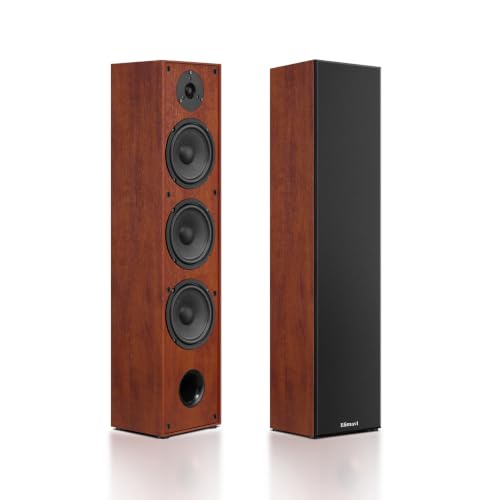
Elimavi Floor Standing Tower Speakers — Best big-cabinet presence
The Elimavi pair makes its case with cabinet architecture: three 6.5-inch woofers stacked in each tower beneath a 1-inch silk dome tweeter, in a brown finish that reads as furniture rather than equipment. Three woofers divide the low-frequency labour three ways, and the audible dividend is the one big cabinets have always offered — effortlessness. A bass line that a single-woofer tower reproduces correctly, a triple array reproduces casually, with the headroom to keep its composure when a film soundtrack or a bass-heavy record asks a sudden question. For listeners whose taste runs to scale — orchestral weight, electronic music’s physical bottom, the sense that the room itself is involved — that ease is not a luxury; it is the product.
Sold as a pair and passive like most of this guide, the Elimavi towers need an amplifier with genuine willingness behind it: multi-woofer cabinets are not difficult loads by nature, but they reward current, and a featherweight amplifier will under-serve them at the volumes their size invites. Room size is the matching consideration. In a generous living room, a pair of tall, brown, triple-woofer towers anchors the space visually and sonically. In a small room, the same cabinets crowd the furniture plan and their bass can overwhelm the air volume available — placement distance from walls stops being a refinement and becomes a negotiation.
Brand context deserves one honest sentence: Elimavi does not carry the decades-deep support story of a Polk or a Klipsch, and buyers are trading that institutional comfort for cabinet and driver count at the price. For the right reader — confident in their amplifier, generous in their room, and prioritising presence per unit of budget — that trade is rational and the reward is audible every time a recording asks for scale. For a first system in a small flat, the guide’s earlier picks argue more safely, and this one waits for the room it deserves.
Placement discipline is where Elimavi ownership is won or lost, so it deserves plain words. Give the pair wall distance before you give them volume; a triple-woofer cabinet pushed into a corner will boom in a way that makes the speakers sound cruder than they are, and no amplifier upgrade fixes physics. Pulled into the room and level-matched, the same cabinets produce the scale their owners bought. Buyers should also plan the physical logistics honestly — these are tall, heavy pieces of furniture that arrive as a pair, and the room, the doorway and the amplifier shelf should all be measured before the order, not during the delivery.
- Sold as: PAIR of tower speakers
- Drivers: three 6.5-inch woofers, 1-inch silk dome tweeter per cabinet
- Type: passive hi-fi tower design
- Finish: brown
- Amplification: passive — pair with an amplifier of real substance
Strengths
- Triple-woofer scale gives bass and dynamics an easy, unforced quality.
- Brown furniture finish suits rooms that reject black-box aesthetics.
- True pair in the box — no single-speaker arithmetic to trip over.
Trade-offs
- Large cabinets overwhelm small rooms, sonically and visually.
- Wants a substantial amplifier to show what the array can do.
- A newer name without the long support history of the legacy brands here.
Best for: bigger rooms and listeners who buy towers for physical scale. Not suited for: small flats or featherweight amplifiers.

Rockville TM150D — Best all-in-one pair
Each of the five passive picks here is half a system. The TM150D is the whole thing: a powered pair of towers in a dark wood finish, with amplification built in, a 10-inch subwoofer section in each cabinet’s design, Bluetooth streaming, and USB and SD playback for music files — no receiver, no separate amplifier, no second purchase standing between the boxes and the music. For a room that has speakers-shaped space but no hi-fi infrastructure and no appetite to build any, that completeness is not a compromise. It is the entire point, and it deserves to be judged as a system rather than as a pair of speakers with something missing.
Judged as a system, its strengths are immediacy and bass presence. The built-in subwoofer sections give film soundtracks and electronic music a physical foundation that the passive pairs only reach with an amplifier’s full cooperation, and Bluetooth removes the last friction between a phone full of music and a room full of sound. A household that listens from phones, a games room, a rental where a rack of electronics is not welcome — these are the TM150D’s home turf, and on that turf the passive picks, however lovely, are incomplete sentences waiting for an amplifier to finish them.
The trade is the classic powered bargain: the amplifier inside is the amplifier forever. A passive tower can be transformed years later by a better amplifier upstream; the TM150D’s electronics define its ceiling permanently, and if the amplifier section ever fails, it fails as a system rather than as one replaceable box. Connectivity is aimed at convenience sources rather than a growing rack of components. Buyers building a hi-fi journey should take the passive road. Buyers buying a finished answer for a specific room should take this one with a clear conscience — it is the only pick here that plays music the evening it arrives, with nothing else to order.
The TM150D also quietly solves a problem the passive pairs cannot: the household where the television, the phone and the music all live in one room with one pair of speakers and zero patience for input rituals. Bluetooth for the phone, media playback for a card or stick of files, and enough built-in low end for film night — the system meets a modern room where it lives. Audiophile culture sometimes treats that convenience as a lesser goal. The households enjoying music every single day through a pair of TM150Ds, while a component system elsewhere sits waiting for its owner to finish researching amplifiers, suggest the hierarchy is not so simple.
- Sold as: PAIR of powered tower speakers
- Type: self-amplified, with built-in 10-inch subwoofer sections
- Playback: Bluetooth, USB and SD media
- Finish: dark wood
- Amplification: built in — no separate amplifier required
Strengths
- A complete stereo system in two cabinets — music the day it arrives.
- Built-in subwoofer sections deliver film and electronic bass with real weight.
- Bluetooth and media playback cover how households actually listen now.
Trade-offs
- The internal amplifier is a permanent ceiling — no upgrading the electronics later.
- An amplifier fault retires the system, not one replaceable component.
- Headline power figures are peak marketing numbers; judge it as a room system, not by arithmetic.
Best for: rooms with no amplifier and no plans for one — rentals, games rooms, phone-first households. Not suited for: hi-fi builders who want components they can upgrade one at a time.
Which floor standing stereo speakers compare most directly?
| Speaker | Sold as | Power | Driver story | Signature strength |
|---|---|---|---|---|
| Polk Monitor XT70 | Single — buy two | Passive | Large tower, XT family voicing | Balanced scale with a full system family |
| Polk T50 | Single — buy two | Passive | Compact tower, friendly voicing | The gentle first-tower upgrade |
| Klipsch R-26FA | Pair | Passive | Horn treble plus built-in Atmos driver | Efficiency, immediacy, film bonus |
| Dayton Classic T65 | Pair | Passive | Dual 6.5-inch woofers, silk dome | Fundamentals funded, features skipped |
| Elimavi Towers | Pair | Passive | Triple 6.5-inch woofers, silk dome | Big-cabinet ease and presence |
| Rockville TM150D | Pair | Powered | Built-in 10-inch sub sections | The complete no-amplifier system |
Two columns decide most purchases: the buying unit, because it sets the true price, and the power column, because it decides whether an amplifier joins the budget. Everything after that is taste in voicing, which the pick sections describe one tower at a time.
How should you place and feed a stereo pair for the best sound?
Begin with geometry, because it is free. The two towers and your seat form a triangle; start with the speakers as far apart as they are from you, tweeters near ear height when seated — a tower’s natural stance usually achieves this — and both cabinets the same distance from the wall behind them. Pull them out from that wall in small steps while a familiar record plays: too close, and bass thickens and the image flattens against the wall; too far, and the bottom thins. Somewhere in the first half-metre of travel, most rooms and most of these towers find the point where the singer steps forward out of the cabinets. Toe the speakers in until they aim near your shoulders, then adjust by degrees — toe-in trades image focus against soundstage width, and the right setting is the one your favourite vocal recording votes for.
Then feed them honestly. A passive tower’s amplifier budget should be real but need not be theatrical: clean power, a volume control that tracks evenly at low level, and sources that are not an afterthought. The Klipsch will reward a modest amplifier out of proportion to its price; the Elimavi’s array will expose a weak one at volume; the Dayton and both Polks sit happily in the wide middle where most integrated amplifiers live. Cable is cable — intact, adequately thick for the run, terminated so it stays that way — and the money saved by believing that is better spent on the records. The powered Rockville skips this entire paragraph, which is, once again, its argument in miniature.
Room treatment, at the domestic scale, is mostly furniture arranged with intent. A rug between the speakers and the seat tames the floor bounce that hardens treble; soft seating and curtains absorb the flutter that makes a vivid speaker like the Klipsch seem louder than it is. None of this requires a studio budget or a single acoustic panel. It requires listening to the room as part of the system, which stereo — two speakers, no reinforcements — demands more honestly than any other format.
What mistakes do tower buyers make most often?
The first is arithmetic: building a budget around a single-speaker listing and discovering at checkout, or worse at delivery, that stereo costs twice the plan. The second is scale blindness — ordering the largest cabinet for the smallest room, where its bass has nowhere to live and its presence crowds out the furniture it was meant to accompany. Towers obey rooms; measure both. The third mistake is judging a pair in the first five minutes at high volume with a demo track, when the purchase will actually live at moderate volume across whole albums — the Dayton’s silk dome and the XT70’s balance are third-hour virtues, invisible in a showroom sprint.
Fourth, starving passive towers with an amplifier bought as an afterthought, then blaming the speakers for a thinness that was never theirs. Fifth, the mirror error: buying the powered Rockville as the foundation of a component system it was never designed to join, then resenting its fixed electronics. Both errors are the same failure — not deciding, before purchase, whether you are buying speakers or a system. This guide has kept that distinction in the open in every section; honour it, and any of the six pairs will serve the room it was chosen for.
How do the six pairs divide by room and by listener?
Small rooms first, because they eliminate fastest. A compact living room or a bedroom system wants the T50’s modest footprint and forgiving voice, or the Dayton pair pulled a sensible distance from the walls; the Elimavi’s triple array and the XT70’s full scale both ask for air that a small room cannot spare, and their bass will make the decision for you, unpleasantly, if you ignore it. The powered Rockville is the small-room wildcard — not because it is small, but because it deletes the amplifier shelf from a room where furniture space is the scarcest resource of all.
The generous living room inverts the shortlist. Here the XT70 becomes the natural anchor, the Elimavi’s presence stops being a liability and starts being the point, and the Klipsch’s efficiency fills the space without an amplifier upgrade joining the invoice. Film-leaning versions of this room are the R-26FA’s home ground, where its built-in height drivers consolidate a system that would otherwise sprout extra boxes at exactly the moment the room is meant to relax. Medium rooms — most real rooms — are where the guide’s middle picks earn their living: XT70 if the budget doubles gracefully, Dayton if it does not, Klipsch if the weekends are cinematic.
Listener temperament cuts across room size. The collector who listens analytically, album by album, will extract the most from the Dayton’s fundamentals and the XT70’s balance. The listener who hosts — music as the room’s social weather, played for hours at conversational-plus level — is the T50’s and the Rockville’s natural owner, because forgiveness and convenience outrank resolution at a dinner party every single time. And the listener who knows, honestly, that a system they must fuss with is a system they will stop using should weight the powered pair’s completeness far above its fixed ceiling. The best tower is the one still playing in five years, and that is a fact about the owner as much as the cabinet.
What should you listen for in the first week with a new pair?
Give a new pair of towers a week of ordinary life before judging them, and judge them with recordings whose sound you already carry in your head. The first test is the voice you know best — a singer whose records you have heard on every system you have owned. On a well-matched pair, that voice should stand between the cabinets at a believable height, stable when you shift in your seat, and free of any boxiness that reminds you it is coming out of furniture. The second test is a recording with real bass architecture — not just loud bass, but bass with notes — played at the volume you actually use. The shape of those notes, held together without the cabinet humming along, is the tower’s core credential.
The third test is the quiet one, and it eliminates more hi-fi than the loud tests ever will: late-evening listening at low volume, where a good pair keeps its balance and its image instead of collapsing into a thin murmur that sends you to the volume control every chorus. The silk-dome pairs and the Polks tend to shine here; it is also where the powered Rockville’s convenience compounds, because a system that sounds complete at whisper level gets used at hours when component systems stay dark. If, after that week, you find yourself playing whole albums again — the surest sign in audio — the pair has passed the only examination that was ever going to matter.
Why do towers hold their value in a system longer than anything else?
Every component around a pair of towers is on a clock. Amplifiers gain and lose features, streaming standards turn over, televisions reinvent their connections, and the receiver that was current at purchase becomes the bottleneck a decade later. Speakers obey slower physics. A well-built tower’s drivers, crossover and cabinet do the same job in year twelve that they did in year one, which is why experienced listeners allocate the durable share of a system’s budget to the speakers and treat the electronics as the replaceable layer. The picks in this guide were chosen with that timescale in mind — even the affordable ones are real cabinets with real driver complements, not appliances with a speaker attached.
That longevity reframes the single-versus-pair question one final time. Doubling the XT70’s ticket feels like a pricing quirk in the cart; spread over the fifteen years a good tower serves, the pair premium over a lesser speaker is a trivial annual sum for a difference you hear every day. The same logic disciplines the opposite temptation: the largest cabinet is not automatically the longest-serving one if the room resents it, because a tower that gets sold in year two for dominating the living room has failed the longevity test regardless of its drivers. Fit — to the room, the amplifier and the owner’s actual habits — is the specification that decides whether a tower becomes furniture in the honourable sense: permanent, used daily, and never thought about as a purchase again.
Final Recommendation
A parting thought on budget shape: whatever the total, the towers should be its largest single line, the amplifier its second, and everything else — cable, stands are unnecessary here, the records themselves — should fight over what remains. Systems budgeted the other way round, electronics first and speakers with the leftovers, almost always end up upgraded in the wrong order for years. The six pairs above were ranked to make the speakers-first budget easy to spend well at several different totals.
For most readers, the answer is the Polk Monitor XT70, bought twice with eyes open about the single-speaker listing: it is the balanced, current, family-backed tower that stereo music rewards and a future surround system will thank you for. The T50 is its gentler sibling for first systems and smaller rooms. Listeners who value fundamentals over features should take the Dayton T65’s driver-rich pair; listeners with big rooms and a taste for scale should hear what the Elimavi’s triple woofers do to an orchestra. Film-leaning households with an Atmos receiver get their own clear answer in the Klipsch R-26FA, height driver and all. And the room with no amplifier in its future is not a lesser case at all — it is the Rockville TM150D’s home ground, the one pair here that arrives as a finished sentence.
Frequently Asked Questions
Why are some tower speakers sold singly and others in pairs?
Towers serve two markets: stereo buyers, who need two, and surround buyers, who may need an odd count across fronts, and manufacturers package accordingly. Polk sells the XT70 and T50 singly; the Klipsch, Dayton, Elimavi and Rockville listings here are pairs. Always normalise to the two-speaker price before comparing, and check the quantity in your basket before checkout.
Do floor standing speakers need a subwoofer for music?
Not as a starting point. A tower’s cabinet volume gives it real bass reach, and most listeners find a good pair complete for stereo music. A subwoofer can add the lowest octave and ease the towers’ workload, and film soundtracks argue for one more strongly than music does — but it is an upgrade to consider after living with the pair, not a tax on buying them.
How much amplifier power do passive towers need?
Less than marketing suggests, and it depends on the speaker and the room. Efficient designs like the Klipsch reach satisfying levels on modest power; larger multi-woofer cabinets like the Elimavi reward an amplifier with more current in reserve. Buy clean power from a reputable maker, match it to your room size and listening level, and distrust headline wattage figures — especially peak numbers — as a comparison tool.
Can these towers become the front speakers of a surround system?
Yes — that is a planned career for several of them. The Polk towers have matching centres and surrounds in their own families, and the Klipsch R-26FA even carries its Atmos height driver built in. The Dayton and Elimavi pairs can serve as fronts with a sensibly matched centre from elsewhere. The powered Rockville is the exception: it is a self-contained stereo system, not a building block.
How far from the wall should floor standing speakers sit?
Start with a modest gap and experiment in small steps while music plays; most towers in ordinary rooms settle somewhere within the first half-metre or so from the wall behind them. Too close thickens the bass and flattens the stereo image; the right distance is where the vocal steps forward and the bottom stays shaped. Corners are almost never the answer for a tower with real bass.
Should I buy towers or bookshelf speakers on stands?
For the same money, towers usually deliver more bass, simpler setup and no stand purchase, at the cost of a larger visual footprint that cannot be tucked away. Bookshelf speakers suit desks and small rooms where a tower would crowd the furniture. In the living-room stereo brief this guide addresses, towers are the straightforward answer — which is why every pick here stands on its own feet.
How long should a pair of tower speakers last?
Decades, with ordinary care. The drivers and cabinets in a well-made tower have no planned expiry, and the usual lifespan limits are environmental — direct sun, damp, enthusiastic toddlers — rather than mechanical. That longevity is why this guide weighs family support and buying-unit honesty so heavily: you are choosing furniture-grade equipment, and the company and configuration behind it should be chosen for the long term too.
Are powered tower speakers worse than passive ones?
Different, not worse. A powered pair like the Rockville TM150D trades upgradability for completeness: the amplifier is fixed, but so is the system’s total cost and simplicity. Passive towers let each component improve independently over years. Choose based on whether you are buying a finished answer for a room or the foundation of a system that will evolve.
Related Guides
Once a stereo pair anchors the room, height channels are the usual next step — see the best add on atmos speakers guide for the module and direct-mount options. For sound that leaves the living room entirely, the best bluetooth smart speakers roundup covers the connected alternative. Whole-building background sound runs on a different standard entirely, covered in the best 70v ceiling speakers.



[…] music with no assistant attached, the best floor standing stereo speakers guide covers the traditional two-channel route, while the best bicycle speakers roundup takes […]
[…] speakers complete a system whose foundation is the front pair, so the best floor standing stereo speakers guide is the natural companion read. For rooms where speakers must cover space rather than surround […]