What's inside
- Where to buy
- Key Takeaways
- Quick Picks
- How did we judge brightness claims in this guide?
- What is an ANSI lumen, and why do the other numbers exist?
- How do you actually watch in a bright room?
- How do screen size and screen gain rewrite the brightness you bought?
- What about sport, news and daytime television?
- The six bright projectors, reviewed one by one
- How do the six compare side by side?
- How should you test a bright projector in your own room?
- Can a bright projector work outdoors in the evening?
- What mistakes do bright projector buyers keep making?
- What does brightness cost in heat, noise and power?
- Why do some projectors look brighter than their figures suggest?
- Final Recommendation
- Frequently Asked Questions
- Related Guides
As an Amazon Associate I earn from qualifying purchases. This post may contain affiliate links at no extra cost to you.
gizmoverdict.com is reader-supported. When you buy through links on our site, we may earn an affiliate commission.
Where to buy
Every projector promises brightness; the best bright projectors are the ones whose promises can be checked. This guide is built around a single skill — telling a measured lumen from a marketing one — and the six machines below were chosen to teach it by example, from the two ViewSonic models whose figures belong to the verifiable tradition, through a trio of smart projectors quoting proper ANSI numbers, to one listing whose headline phrase is not a measurement at all. All six are sold through Amazon in the United States, and the product links in the Quick Picks table and in each review lead to the listings, where the current specification can be read in the seller’s own words before a decision is made. Read those words the way this guide reads them, and the category will never confuse you again.
The lesson, stated plainly at the start so the reviews can use it: a lumen figure means something only when it names its measurement standard. ANSI lumens are produced by a defined method — the image is measured at multiple points on the screen and averaged — and ISO lumens follow a comparably disciplined international method, so figures carrying those labels can be compared across brands with reasonable confidence. A bare lumens figure with no standard named follows whatever method flatters the maker most. And a phrase constructed around the number — a claim of so many thousands of daylight-bright units, in the style of one listing below — is not a measurement in any dialect; it is advertising copy wearing a lab coat, and it should be weighed accordingly.
The second truth is equally plain, and the whole industry would prefer you learned it after purchase: brightness has a ceiling set by physics, not by shopping. Even the strongest verifiable figure in this guide — a maker-rated 5,500 lumens from a laser engine — cannot defeat direct sunlight falling on the screen, because sunlight is not a competing picture but a flood of light orders of magnitude beyond any projector’s reach. What wins against daylight is not a bigger number but a darker target: shade over the screen, curtains that actually close, a smaller image, or an ambient light rejecting screen engineered to refuse light arriving from the wrong direction. The projectors below are ranked for rooms that fight light with those tools in hand. A buyer shopping for a number that repeals the sun is shopping for a disappointment at any price.
Key Takeaways
- Only compare figures that name their standard: ANSI and ISO lumens are measured methods, bare lumens are maker’s arithmetic, and phrases like 5000 Daylight Bright are not measurements at all.
- The ViewSonic LS740HD carries this set’s strongest verifiable claim — a maker-rated 5,500 lumens from a laser engine — and even it will not beat direct sun on the screen.
- Three smart picks here quote proper ANSI figures between 2,600 and 3,000, which makes them honestly comparable with each other and with the wider market.
- Daylight viewing is won by the room, not the projector: shade, curtains, a smaller image and an ambient light rejecting screen each outperform a tier of extra lumens.
- The PA503W’s 4,000-lumen claim serves classrooms and meeting rooms at WXGA resolution — a brightness-first brief where fine detail is not the point.
- Judge every bright projector in its accurate picture mode, because headline lumens are measured in the brightest mode, which is rarely the one films deserve.
Quick Picks
| Pick | Badge | Why it earns its place |
|---|---|---|
| ViewSonic LS740HD | The Verifiable Heavyweight | A 1080p laser projector with a maker-rated 5,500 lumens, optical zoom and corner adjustment for big, bright, imperfect rooms. |
| ViewSonic PA503W | Classroom and Office Muscle | A maker-rated 4,000 lumens at WXGA with optical zoom and legacy VGA alongside HDMI, for presentations that must survive lit rooms. |
| HAPPRUN Outdoor Smart Projector 3000 ANSI | ANSI-Honest Smart Pick | A stated 3,000 ANSI figure with 4K decoding, AI auto focus, built-in apps, HDR10 and Dolby Audio for the living room. |
| 4K Smart Daylight Projector 2700 ANSI | Daylight Living-Room System | A stated 2,700 ANSI lumens with eARC, HDR10+, official apps and a 76W Dolby Audio claim — a daytime system, not just a projector. |
| 4K Google TV Daylight Projector 2600 ANSI | Google TV with Real Numbers | A stated 2,600 ANSI figure, Google TV, WiFi 6, NFC casting and low-latency gaming manners in a ceiling-friendly body. |
| VISSPL 5000 Daylight Bright Projector | The Cautionary Tale | A smart 4K projector whose 5000 Daylight Bright headline is a phrase, not an ANSI figure — bought for its features, never for its number. |
How did we judge brightness claims in this guide?
By evidence, in descending order. A figure attached to a measurement standard — ANSI or ISO — was treated as a claim a buyer can use, because the method behind it is published and the same for every maker who follows it. A figure from an established maker with a reputation in institutional projection, quoted without a standard but consistent with the maker’s wider range, was treated as a serious claim awaiting the usual discount for picture mode. A figure expressed in a unit the listing invented was treated as no figure at all, and the machine carrying it was judged — fairly, and in one case quite favourably — on everything except its number. That hierarchy is not cynicism; it is the same hierarchy a school, a church or a business applies when it buys projection with other people’s money, and home buyers deserve its protection too.
Beyond the claims, we judged the machines as this cluster of guides always does: light source and its servicing story, the placement tools that decide whether brightness survives contact with a real room, the platform that decides whether the projector gets used, and the sound that decides whether anyone can hear the film over the fan that brightness requires. Bright projectors run their light engines hard, and cooling follows output, so the honest bright-room shortlist is also a noise-aware shortlist — a point the reviews return to, because a projector that wins against daylight and loses against its own fan has solved the wrong problem.
Finally, we required range. A guide to bright projectors that contained only institutional machines would abandon the living room, and one containing only smart portables would abandon the classroom and the village hall. The six below span both worlds deliberately, and the lumen lesson is the bridge between them: the same scepticism that protects a school buying the ViewSonic protects a family reading the VISSPL’s headline, and it is the only piece of equipment in this entire guide that costs nothing and never wears out.
What is an ANSI lumen, and why do the other numbers exist?
The ANSI method is almost disappointingly simple, which is its strength. The projector displays a full white image; the light reaching the screen is measured at nine defined points; the readings are averaged and multiplied by the screen’s area. Any maker can perform it, any reviewer can repeat it, and two projectors measured by it can be compared without translation. ISO’s method pursues the same discipline through an international standard. When a listing in this guide quotes 3,000 ANSI or 2,700 ANSI, it is volunteering for that comparability — and volunteering is itself information, because makers whose numbers would embarrass them under measurement rarely volunteer.
The other numbers exist because nothing compels a maker to use the standard, and an unmeasured figure can be made very large indeed. Measure at the lens instead of the screen, measure the light source’s raw output before the optics tax it, measure a single colour at its peak, average nothing — each liberty multiplies the headline, and the liberties compound. This is how the wider market arrived at five-digit brightness claims for machines that a standard would grade in the hundreds. The practice survives because the inflated figure is not, in the narrowest legal sense, a lie: some number was measured somewhere, by someone, once. It is simply not the number that describes the picture on your wall, which is the only number you were ever shopping for.
One more distinction completes the toolkit: the brightest mode discount. Even an honest ANSI figure describes the projector’s brightest picture mode, and that mode is engineered for the measurement and the showroom — colours drift, greens swell, and films look like broadcasts from a stadium. The accurate modes, the ones this guide assumes you will actually watch, typically deliver meaningfully less light in exchange for correct colour. This is not a scandal and not unique to any brand; it is the physics of colour filters and calibrated white points. Its lesson is budgeting: if your room needs every lumen of a projector’s headline figure to survive, your room actually needs the next tier up, or a better screen, or darker curtains — because the figure you will live with is the smaller one.
How do you actually watch in a bright room?
Begin by attacking the light, not the projector. Identify where the daylight lands: if sun strikes the screen wall directly, no purchase in this guide will save the afternoon showing, and the honest solutions are blackout shading on that window, a screen position rotated away from the light, or a viewing schedule that respects the sun’s. Where the light is ambient rather than direct — the ordinary bright living room — the tools stack kindly. Curtains that genuinely close, a screen wall painted a shade deeper than the others, and seating arranged so no window reflects in anyone’s eye line can together buy more visible contrast than a thousand extra lumens.
The screen is the second front. An ambient light rejecting screen is engineered with a surface that accepts light arriving from the projector’s direction and refuses light arriving from windows and ceiling fixtures, which is precisely the geometry of a bright room’s problem. Its effect, in a room with real ambient light, routinely exceeds the effect of stepping up a projector tier, and it costs the household once rather than asking the light engine to run at maximum for its entire life. Size is the third front, and it argues for restraint: the same projector lighting a smaller image lights it brighter, and in a bright room the discipline of a moderate screen is worth more than the spectacle of a huge, washed one.
There is one more ally, easily overlooked because it is not sold in a box: the schedule. The bright room at eight in the evening in December is a dark room wearing a coat, and the household that shifts its film nights an hour later in summer, or draws the west-facing curtains only for the first act, is practising the oldest form of brightness management there is. Projectors reward viewers who meet them halfway, and the meeting point moves with the seasons in a way no specification can fix in place. A household that learns its own room’s light across a year — which window offends in June, which lamp reflects in December, which wall stays mercifully shaded through the longest evenings of the summer — ends up owning knowledge worth more than a tier of hardware, because it applies to every projector, every screen and every film that household will ever own, and because no retailer can sell it back to them at any price, in any sale, ever.
Settings finish the defence. Use the brightest mode for the content that forgives it — sport with company, presentations, daytime television — and reserve the accurate modes for the evening films they were tuned for, rather than demanding one mode serve both masters. Raise the image’s perceived contrast by darkening the wall immediately around the screen, a decorator’s trick that costs a tin of paint. And accept the truce this whole guide is built on: a bright-room projector is not a cave projector that failed, but a different instrument, judged by whether the room’s real life — matches at noon, films at nine — plays clearly on it. By that standard, the six below are the honest contenders.
How do screen size and screen gain rewrite the brightness you bought?
A projector’s lumens are a total, not a density, and the screen decides the density. Spread a fixed output across twice the area and each square metre receives half the light, which is why the same machine that blazes at one size merely glows at another. Bright-room buyers feel this law first and hardest, because their ambient light does not scale down when the image scales up: the room’s wash stays constant while the picture’s light thins. The practical consequence is a discipline the cave-dweller never learns — in a bright room, screen size is a brightness decision. Choosing the moderate screen is not surrendering spectacle; it is concentrating the light you paid for onto an area your room can defend.
Gain is the screen’s own multiplier. A matte white surface returns the projector’s light evenly in every direction, rated around unity, and asks nothing of the seating plan. A higher-gain surface concentrates more of that light towards the viewers in front of it, brightening the picture for the sofa while dimming it for the armchair at the edge — a trade a cinema-style room makes happily and a wide family room should think about twice. Ambient light rejecting surfaces go further, structuring their material to accept the projector’s angle and refuse the windows’ angles, which is why they read as a brightness upgrade despite adding no light at all. When a bright-room budget is being divided, the experienced order is projector first at an honest figure, screen second with the room’s light in mind, and size last, trimmed to whatever the first two can honestly illuminate.
Throw position quietly joins the calculation. A lens at the wide end of its zoom passes light more generously than the same lens stretched to its telephoto extreme, so a mount placed to use the zoom’s brighter middle can recover output that a careless placement spends. None of these adjustments appears in a listing’s headline, and together they routinely account for more visible brightness than the gap between two competing projectors. This is the deepest reason this guide refuses to crown a winner by number: the brightest projector in a bright room is usually the one whose owner treated brightness as a system, and the system is available to every machine on this page.
What about sport, news and daytime television?
Daytime content forgives what films cannot. A football match at noon is bright, contrasty, colour-saturated material watched socially, often with food, conversation and half the room’s lights on — and it tolerates, even prefers, the punchy picture modes that film lovers reject. News and daytime television behave the same way. This is the bright projector’s home fixture, and it reframes the purchase for a large class of buyers: if your projector’s hardest shift is Saturday sport and Sunday family viewing, the accurate-mode discount that haunts film calculations barely applies to you, because the modes you will actually use are the bright ones. The LS740HD’s headroom, the PA503W’s classroom legibility and the smart trio’s ANSI figures all serve this brief directly.
Motion and size complete the daytime picture. Sport at large sizes exposes motion handling mercilessly, and the viewer sitting close to a huge, dim image in a bright room gets the worst of every trade at once — another argument for the moderate screen. Sound matters doubly in the daytime room, because the audience is awake, talking and competing with the commentary, which is why the daylight system’s audio ambition and the eARC path to a soundbar recur in the reviews above. Judged on the daytime brief alone, the ranking in this guide shuffles itself: the institutional pair and the daylight system rise, the cave virtues vanish, and the projector that wins is simply the one whose picture and voice survive your family’s loudest, brightest hour.
The six bright projectors, reviewed one by one

ViewSonic LS740HD — The Verifiable Heavyweight
The LS740HD is what a brightness claim looks like when an institutional maker makes it: a 1080p laser projector rated at 5,500 lumens, with optical zoom, keystone and corner adjustment, 360-degree projection capability, and a listing that names its arenas without blushing — home theater, golf simulation, classroom, auditorium, ceiling mount. ViewSonic sells projectors to organisations that measure what they buy, and the figure here belongs to that culture: a serious number from a maker whose institutional customers would notice a fantasy. Apply this guide’s standing discounts anyway — the accurate picture modes will run below the headline, as they do on every machine — and the headroom that remains is still the largest verifiable reserve in this set.
Laser light is the correct partner for that output. A lamp asked to produce this class of brightness lives a short, expensive life; a laser engine simply works, holding its output across years of the high-duty use this projector invites — the simulator bay running daily hours, the hall that screens weekly, the bright living room that never fully darkens. The placement tools suit the same seriousness: optical zoom and corner adjustment exist for rooms whose geometry was decided by architects rather than by projectionists, and 360-degree projection frees the mount from the horizontal altogether. What the LS740HD does not bring is a smart platform or a 4K badge; it is a light engine with optics, awaiting your sources. For the buyer whose problem is genuinely light — a big room, a big screen, a bright brief — it is the most defensible purchase in this guide.
- Brightness as listed: 5,500 lumens, maker figure from an institutional range
- Resolution as listed: 1080p Full HD
- Light source as listed: laser
- Optics as listed: optical zoom, keystone, corner adjustment
- Mounting as listed: ceiling mount ready, 360-degree projection
- Arenas as listed: home theater, golf simulation, classroom, auditorium
Strengths
- The strongest credible brightness reserve here, from a maker whose buyers measure.
- Laser stamina suits the high daily hours that bright, large venues demand.
- Corner adjustment and 360-degree mounting forgive genuinely awkward rooms.
Trade-offs
- 1080p resolution at sizes where the 4K smart picks advertise more detail.
- No smart platform is advertised; your sources bring the interface.
- Even 5,500 lumens loses to direct sunlight on the screen — shade remains mandatory.
Best for: large bright rooms, halls and simulator bays that need verified light. Not suited for: buyers wanting built-in streaming or native 4K detail.
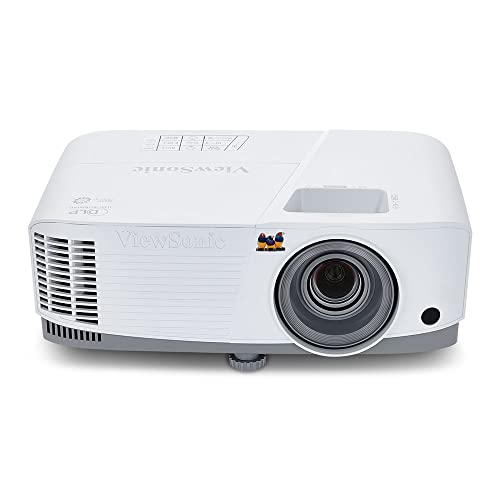
ViewSonic PA503W — Classroom and Office Muscle
The PA503W is the elder workhorse of this pair: a DLP projector rated at a maker-quoted 4,000 lumens, at WXGA resolution, with vertical keystone, optical zoom, a 120Hz capability, low latency positioning, and a connection panel that keeps VGA and USB alongside HDMI. That port list tells the machine’s biography. This is the projector of classrooms, training rooms and community halls, where the source might be a decade-old laptop, the room cannot be darkened because people must take notes, and the image must be legible from the back row under fluorescent light. WXGA — a widescreen resolution below 1080p — is the honest compromise of that brief: text and slides stay crisp at presentation sizes, while film detail is not the job being hired for.
Its place in a home-facing guide is deliberate, because a large share of bright-projector shopping is not for cinemas at all. The home classroom, the church hall, the small business that presents in a glass-walled room, the sports club screening an away match at noon — these buyers need exactly the PA503W’s virtues and none of the smart platform’s. The low-latency and 120Hz notes in its listing even give it a sideline in casual big-screen gaming where brightness matters more than resolution. What it asks in return is the lamp-era courtesy its ViewSonic sibling escaped: a lamp with a finite life, replaced on a schedule the institution plans for. For the briefs it was built for, that is not a flaw but a budget line, and a modest one.
- Brightness as listed: 4,000 lumens, maker figure
- Resolution as listed: WXGA
- Connections as listed: HDMI, VGA, USB
- Optics as listed: optical zoom, vertical keystone
- Refresh as listed: 120Hz, with low-latency positioning
- Arenas as listed: classroom, business, presentation
Strengths
- Brightness aimed at lit rooms where the audience must also see its notebooks.
- Legacy VGA keeps older institutional laptops in the conversation.
- Optical zoom suits the fixed ceiling points of halls and classrooms.
Trade-offs
- WXGA resolution is a presentation compromise, not a cinema specification.
- Lamp servicing belongs in the owning institution’s calendar.
- No smart features are advertised; it is a display for sources, proudly.
Best for: classrooms, halls, offices and noon screenings of any kind. Not suited for: film-first home theaters or detail-hungry viewers.

HAPPRUN Outdoor Smart Projector 3000 ANSI — ANSI-Honest Smart Pick
HAPPRUN’s flagship-style listing earns its place in this guide with two words most of its shelf-mates avoid: 3,000 ANSI. That figure — a maker claim, but a claim made under a published measurement standard — describes a genuinely bright smart projector, and the rest of the listing builds the living-room case around it: 4K decoding, AI auto focus, built-in apps, HDR10 and Dolby Audio. The 4K language follows this cluster’s standing translation: the projector decodes a 4K input and displays its native picture beneath it, which for streamed film is a perfectly respectable arrangement. What distinguishes the machine is that its central number can be placed on the same scale as the standard-quoting projectors of the wider market, and 3,000 on that scale is a strong place for a smart model to stand.
The outdoor word in its name deserves the discipline this guide’s backyard sibling applied: outdoor means portable to the garden for the evening, not weatherproof against it, and no water-resistance claim appears here either. Indoors is where the ANSI figure does its real work anyway — in the living room that dims imperfectly, at screen sizes where lesser smart projectors begin to look apologetic. AI auto focus shortens the path from decision to film, and Dolby Audio gives the solo setup a foundation before the soundbar conversation. Buyers who want a smart projector whose brightness can be discussed in the same breath as the institutional machines — with the standard named and the number standing up — have exactly one shelf to look at, and this is its current flag-bearer.
- Brightness as listed: 3,000 ANSI lumens — measured-standard figure
- Resolution language as listed: 4K decoding over the native picture
- Setup as listed: AI auto focus
- Platform as listed: built-in apps
- Formats as listed: HDR10, Dolby Audio
- Weather note: outdoor framing, no water-resistance claim
Strengths
- An ANSI figure that invites comparison instead of forbidding it.
- Smart platform and auto focus make it a complete living-room system.
- Brightness headroom that serves imperfectly darkened rooms honestly.
Trade-offs
- Accurate picture modes will run below the headline figure, as always.
- The app catalogue of a built-in platform should be checked against your services.
- Outdoor use still means the carry-in ritual; it is not a weatherproof device.
Best for: bright living rooms wanting a smart projector with a checkable number. Not suited for: daylight-struck screens or native-4K sticklers.

4K Smart Daylight Projector 2700 ANSI — Daylight Living-Room System
This machine’s listing uses the word daylight as a design brief rather than a boast, and supports it with the right evidence: a stated 2,700 ANSI lumens, eARC, HDR10+, official apps, a 76W Dolby Audio claim, auto focus, zoom, WiFi and Bluetooth, two HDMI ports, CEC and ceiling-mount readiness. Read the specification as a system and a philosophy emerges — the daylight problem is not only optical. A projector for a bright living room must also sound like the room’s main screen, which is what a serious audio claim and an eARC connection to a soundbar are for, and it must behave like the room’s main screen, which is what official apps and CEC control — one remote waking the whole chain — are for. The ANSI figure, slightly below its HAPPRUN rival, buys credibility of the same currency.
The zoom and ceiling readiness matter more in daylight rooms than in caves, because bright rooms are living rooms, and living rooms impose their geometry: the projector must fit the ceiling point or the shelf the household allows, and focus its light into the screen size the wall permits. HDR10+ support adds dynamic tone mapping for the streamed films this machine will mostly show, spending its finite brightness with per-scene intelligence. The 76W audio figure is a maker claim to be judged by ear, like every audio number, but its ambition is correctly aimed. As a daylight system — light, sound, platform and manners in one box — this is the most complete argument in the set for the room that refuses to go dark.
- Brightness as listed: 2,700 ANSI lumens — measured-standard figure
- Audio as listed: 76W Dolby Audio claim, eARC for a soundbar path
- Platform as listed: official apps built in
- Connections as listed: two HDMI, CEC control
- Setup as listed: auto focus, zoom, ceiling-mount ready
- Formats as listed: HDR10+
Strengths
- A daylight brief answered as a whole system — light, sound and control together.
- ANSI-rated output with HDR10+ tone mapping for streamed films.
- eARC and CEC make it behave like the television it replaces.
Trade-offs
- Its ANSI figure trails the HAPPRUN’s, for buyers counting standardised lumens.
- The audio wattage is a claim to audition, not a conclusion to bank.
- Daylight remains a negotiation: shade and curtains are still co-authors of the picture.
Best for: bright family rooms where the television stays on all day and the curtains stay open. Not suited for: blackout-room purists or buyers who already own a full sound system.

4K Google TV Daylight Projector 2600 ANSI — Google TV with Real Numbers
The daylight projector for the Google household pairs a stated 2,600 ANSI lumens with the platform that household already speaks: Google TV, with WiFi 6, Bluetooth, auto focus, HDMI ARC, Dolby audio support, NFC wireless casting and ceiling-mount readiness, plus a low-latency gaming pitch. NFC casting is the detail that reveals the intended life — tap a phone, share the picture — because daylight projectors live in social rooms where content arrives from everyone’s pockets, not from a curated rack. The ANSI figure sits a step below its two smart rivals in this guide, and the honest framing is that all three live in the same brightness neighbourhood, separated less by their hundreds of lumens than by their platforms and manners.
Google TV is the deepest of those manners: a mature interface, profiles for the household, and an app catalogue whose depth does not need verifying service by service in the way unnamed platforms do. WiFi 6 keeps that platform fed in busy homes, and the ARC connection offers the soundbar path when the room outgrows the built-in audio. The low-latency gaming claim should be read as this class’s usual promise — a fast mode for casual and keen play, with figures to be checked in the listing rather than assumed — and the ceiling readiness acknowledges that even social rooms eventually tire of a projector living on the coffee table. For the household already invested in Google’s ecosystem, this is the daylight pick that asks for no new habits, and its number, like its platform, can be taken at face value.
- Brightness as listed: 2,600 ANSI lumens — measured-standard figure
- Platform as listed: Google TV
- Wireless as listed: WiFi 6, Bluetooth, NFC casting
- Audio path as listed: HDMI ARC, Dolby support
- Gaming as listed: low-latency positioning
- Mounting as listed: ceiling-mount ready
Strengths
- Google TV’s catalogue and polish with an ANSI figure behind the picture.
- NFC casting suits the social, phone-fed life of a bright living room.
- WiFi 6 and ARC give its connections a longer future than most.
Trade-offs
- The lowest ANSI figure of the three smart standard-quoting picks here.
- Gaming latency is a positioning claim; verify figures in the listing if they decide you.
- Bright-room physics still apply: it negotiates with daylight, it does not defeat it.
Best for: Google TV households wanting a bright, social, ceiling-ready screen. Not suited for: buyers maximising lumens per purchase above platform fit.

VISSPL 5000 Daylight Bright Projector — The Cautionary Tale
Every guide needs its teaching example, and the VISSPL volunteers with a headline that this entire article exists to decode: 5000 Daylight Bright. Those words are not an ANSI figure, not an ISO figure and not a measurement in any standard a buyer can check — they are a phrase, constructed so that a large number can stand next to a projector without a method ever being named. We state this not to mock the machine but to free it: judged on everything except its number, the listing describes a perfectly plausible smart projector — 4K support in the decoding sense, WiFi and Bluetooth, 3D Dolby Audio, AI auto focus, and a portable outdoor framing for bedrooms and ceilings. The tragedy of the invented unit is that it hides a decent product behind a claim no informed buyer can use.
So the review proceeds on the honest basis. Expect a native picture in the class’s usual range beneath the 4K support language. Expect brightness suited to dim and darkened rooms — the evenings and bedrooms its own listing names — rather than to the daylight its headline invokes, because a machine that could truly flood a sunlit room would quote the standard that proves it. Enjoy the AI auto focus, which is a real convenience, and the audio arrangement, which is a real feature. And let the purchase, if you make it, be this guide’s lesson in action: a projector bought for its features at a fair price, by a buyer who read the number, recognised the dialect, and declined to pay a premium for a phrase. The VISSPL may serve such a buyer very happily. It is the uninformed buyer — the one who paid extra for five thousand of an imaginary unit — whom its headline was written for, and whom this guide was written against.
- Brightness language as listed: 5000 Daylight Bright — a phrase, not an ANSI or ISO measurement
- Resolution language as listed: smart 4K — input support over the native picture
- Setup as listed: AI auto focus
- Audio as listed: 3D Dolby Audio
- Wireless as listed: WiFi and Bluetooth
- Framing as listed: portable, for outdoor evenings, bedrooms and ceilings
Strengths
- AI auto focus and a full smart feature set at the white-label tier.
- Portable framing suits bedrooms and occasional outdoor evenings.
- Bought with informed eyes, its features can represent fair value.
Trade-offs
- The headline brightness is unverifiable by design; never pay a premium for it.
- Daylight performance should be assumed modest until your own room proves otherwise.
- White-label support and specification drift are the class’s standing caveats.
Best for: informed value hunters who buy features, not numbers. Not suited for: anyone shopping for verified daylight brightness — that buyer belongs with the ANSI picks above.
How do the six compare side by side?
| Projector | Figure as listed | Figure’s basis | Resolution story | Natural habitat |
|---|---|---|---|---|
| ViewSonic LS740HD | 5,500 lumens | Maker figure, institutional range | 1080p native | Big bright rooms, halls, simulator bays |
| ViewSonic PA503W | 4,000 lumens | Maker figure, institutional range | WXGA | Classrooms, offices, lit presentations |
| HAPPRUN 3000 ANSI | 3,000 ANSI lumens | Measured standard | 4K decoding, native below | Bright living rooms, evening gardens |
| Daylight Projector 2700 ANSI | 2,700 ANSI lumens | Measured standard | 4K class, HDR10+ | Daylight living-room system |
| Google TV Daylight 2600 ANSI | 2,600 ANSI lumens | Measured standard | 4K class, Google TV | Social bright rooms, Google homes |
| VISSPL Daylight Bright | 5000 Daylight Bright | No standard — a phrase | 4K support, native below | Dim bedrooms, informed value buys |
The basis column is the only honest way to sort this table, and it rearranges the apparent order completely. The largest digits on the page belong to the claim with no method behind it, while the smallest standardised figures — the ANSI trio — describe real, comparable light that a buyer can plan a room around. The two ViewSonic figures occupy the experienced middle: unstandardised in the listing text, but issued by a maker whose institutional range is bought by measurement, and discounted by this guide for picture mode like everything else. Learn to read the basis before the number and you will never misread a projector listing again, in this guide or any other.
How should you test a bright projector in your own room?
The return window is the only laboratory whose conditions match your life, and bright projectors deserve a deliberate protocol inside it. Test at the hours you actually watch: the noon match, the six o’clock news with the curtains as you really leave them, the nine o’clock film. Test in both picture families — the brightest mode for the daytime content, the accurate mode for the evening film — because you are buying both machines in one box and either can fail you independently. Test at your real screen size, from your real seats, with the room’s real lamps; a projector auditioned on a smaller image in a darker room than your own has been auditioned for a different household.
Three scenes tell you most of what you need. A dark scene from a favourite film, watched in the evening mode, reveals whether the accurate brightness clears your room’s floor. A bright stadium broadcast at midday reveals whether the showroom mode holds its nerve against your actual daylight. And a quiet dialogue scene, from the furthest seat, reveals the fan — the specification no listing in this guide could give you comparably. If all three pass, the number on the box has been translated into your room’s truth, and the argument is over. If one fails, the failure tells you whether the remedy is a screen, a curtain, a different mode or a different projector, which is exactly the knowledge the window exists to provide.
Can a bright projector work outdoors in the evening?
It can, and the arithmetic inverts in the garden’s favour. Outdoors at dusk there is no ceiling to bounce stray light back and no walls to trap it, so once the sky has darkened, a bright projector’s output meets less competition than it does in a white-walled living room — which is why the HAPPRUN in this guide wears an outdoor name honestly, as an evening machine. The discipline travels with it: the screening still starts when the light has properly fallen, the image still shrinks or grows by the screen-size law, and the machine still sleeps indoors, because no listing in this set claims weather resistance. What brightness buys outdoors is time — an earlier start at the twilight’s edge, a larger image holding its body — and for the garden host, twenty extra minutes of usable dusk can be the difference between one film and a double bill.
What mistakes do bright projector buyers keep making?
Comparing numbers across different bases leads, as it has led every section of this guide, because it is the mistake the market is engineered to produce. A buyer who chooses 5000 of an invented unit over 2,700 ANSI has not bought more light; they have bought a larger font. Second comes the sunlight fallacy: expecting any projector, at any figure, to defeat direct sun on the screen, and returning a perfectly good bright projector for failing at physics. Third is judging brightness in the showroom mode — the brightest, least accurate picture the machine can make — and then wondering why films at home look simultaneously dimmer and worse than the demonstration promised.
The room mistakes follow. Buyers enlarge the screen to fill the wall and dilute the very brightness they paid for, when a smaller image would have blazed. They skip the ambient light rejecting screen that would have multiplied their projector’s effective contrast, and spend the same money on a brighter projector whose extra light the room then wastes. They mount the projector at maximum zoom’s edge, where lenses are dimmest, instead of mid-range. And they forget the fan: brightness is heat, heat is airflow, and a bright projector placed close to the seating in a small room should be auditioned in a quiet scene before the return window closes. Every one of these errors is a failure to treat brightness as a system — projector, screen, room, mode — and the system view is this guide’s whole argument.
What does brightness cost in heat, noise and power?
Light is not free, and its bill arrives as heat. A bright projector converts a substantial electrical input into an image and a larger quantity of warm air, and its fans exist to move that air somewhere else. The consequences are practical. A bright machine in a small room warms the room measurably across a long match. Its fan, working at the speed its output demands, is a presence in quiet scenes that a dimmer projector’s fan is not. And its brightest mode — the one the headline was measured in — is usually its loudest, which closes the loop on this guide’s recurring discount: the figure you shop by describes the mode you may like least, in brightness, in colour and in noise alike.
Placement is the mitigation, again. Distance between projector and audience is the cheapest silencer in home cinema, which is one more reason the ceiling and rear-shelf positions suit bright machines, and why the institutional pair’s mounting flexibility matters beyond mere geometry. Ventilation clearance matters thermally as well as acoustically: a bright projector sealed into a cabinet without airflow will throttle its own life to protect itself, and the manual’s clearances are, at this output class, a genuine engineering requirement rather than a legal reflex. Buyers who plan for the heat and the fan as part of the brightness purchase will be delighted by the light. Buyers who discover them afterwards will describe the same projector as flawed, and both will be reporting the same machine truthfully.
Why do some projectors look brighter than their figures suggest?
Because the eye is not a light meter, and two honest effects exploit the difference. The first is colour brightness: a projector whose colour output keeps pace with its white output — the quality Epson’s equal figures advertise elsewhere in this cluster — produces saturated scenes that read as brighter than a machine whose headline was earned by white alone. The second is saturation itself: highly saturated colour is perceived as more luminous than the same measured light in a paler palette, an effect with a long name in vision science and a short consequence in the showroom, where the most vivid projector often wins the brightness argument against a measurably stronger rival. Neither effect is cheating. Both are reasons this guide insists on auditioning in your own room, in the accurate modes, with your own content — the eye you are buying for is the only instrument whose verdict you will live with.
Contrast completes the illusion, and it is not an illusion at all from the viewer’s seat. A picture with deep, clean blacks makes its highlights read brighter by comparison, which is why a moderate-output projector in a dark room can feel more luminous than a powerhouse fighting a lit one. Brightness, in the end, is a relationship between the image and everything around it — the room, the screen, the scene itself. The number on the box describes one term of that relationship. This guide has spent its length on the others, because they are the terms you control.
Final Recommendation
Buy the ViewSonic LS740HD when the brief is genuinely large and bright and the figure must be believed, and the PA503W when the room is a classroom or hall where legibility under lights is the entire job. Among the smart machines, choose by platform among near-equals: the HAPPRUN for the strongest ANSI figure, the 2700 ANSI daylight system for its sound and control manners, and the Google TV model for the household already living in that ecosystem. Buy the VISSPL only the way this guide taught you to — for its features, at a price that ignores its headline. Above all, spend on the room alongside the projector: the household that pairs a 2,700 ANSI machine with curtains, shade and the right screen will watch a better daylight picture than the household that buys five thousand of anything and points it at a sunlit wall, and that sentence is the whole science of bright projection in one breath.
Frequently Asked Questions
What is the difference between ANSI lumens and regular lumens?
ANSI lumens are measured by a published method — light sampled at nine points of a white image, averaged and scaled by screen area — so figures from different makers can be compared. A bare lumens figure names no method, which lets each maker choose the arithmetic that flatters it most. The same projector can honestly carry a modest ANSI figure and an enormous unqualified one; only the first describes the picture on your wall in comparable terms.
Can any projector work in direct sunlight?
No. Direct sun on the screen delivers light far beyond any home projector’s output, including the strongest verifiable figure in this guide. What works is preventing the sun from reaching the image: shade the window, rotate the setup, choose a shaded wall, or schedule around the light. Projectors negotiate with ambient light very successfully; against a direct beam they do not negotiate at all.
How many ANSI lumens does a bright living room need?
For a moderate screen in a room with controlled daylight — curtains drawn, no sun on the screen — the 2,600 to 3,000 ANSI band of the smart picks here is a workable, honest range, with an ambient light rejecting screen extending it considerably. Larger screens and lighter rooms push the requirement towards the institutional machines. Treat any answer without a screen size and a room description attached as a guess wearing a number.
Why does my bright projector look dimmer in its best picture mode?
Because the headline figure is measured in the brightest mode, whose colour is tuned for the number rather than for films. Accurate modes filter and calibrate that output down to correct colour, spending light to buy truth. The gap is normal across every brand in this guide. Budget for it by treating the headline as headroom, and by choosing a projector whose accurate modes still clear your room’s demands.
Is an ambient light rejecting screen worth it?
In a genuinely bright room, it is usually the highest-value purchase in the whole setup. Its surface accepts the projector’s light and refuses light from windows and ceiling fixtures, which raises perceived contrast more than a projector tier’s worth of extra lumens typically does. In a dark room it adds little. The screen, like the projector, should be bought for the room you actually have.
Should I buy a brighter projector or a better screen first?
If your current projector carries a standardised figure anywhere near your room’s needs, the screen usually wins the argument: an ambient light rejecting surface raises the contrast of every image the projector will ever show, in every mode, without adding heat, noise or a watt to the electricity bill. If your projector’s honest figure is far below the room’s demands — a dim portable asked to fill a lit hall — no screen rescues it, and the projector must be replaced first. The order of operations is diagnosis before purchase: measure your room’s problem honestly, then spend on the term of the system that is actually failing.
What does a phrase like 5000 Daylight Bright actually mean?
As a measurement, nothing checkable: it is not an ANSI or ISO figure, and no published method stands behind the unit. As marketing, it means the maker wants a large number associated with the product. The correct response is to price the machine on its verifiable features — platform, focus, audio, connections — and to assume its real brightness belongs to the dim-room class until a standardised figure says otherwise.
Related Guides
Brightness is one axis of the projector decision; the others have their own guides in this cluster. The light-source story behind the laser picks is told in Best Laser Home Theater Projectors, permanent installation is walked through in Best Ceiling Mounted Projectors, and the outdoor version of the daylight negotiation plays out in Best Backyard Projectors.



[…] is developed in Best Laser Home Theater Projectors. For rooms where daylight is the real opponent, Best Bright Projectors is the next […]