What's inside
- Key Takeaways
- Quick Picks
- How Did We Pick Headsets for Switch Players?
- How Does Voice Chat Really Work on Switch?
- Docked or Handheld: Which Play Style Should Lead Your Choice?
- Six Switch Headsets Examined in Detail
- How Do the Six Compare at a Glance?
- Which Buying Mistakes Catch Switch Players Out?
- How Can You Get Better Sound From a Switch Headset Tonight?
- Why Does Nintendo’s Sound Design Reward a Proper Headset?
- A Parent’s Guide to Buying a Switch Headset
- Travelling With a Switch Headset: Trains, Cars and Flights
- Local Multiplayer: Two Players, One Small Screen
- How Long Should a Switch Headset Last, and What Kills It Early?
- A Five-Minute Checklist Before You Check Out
- What About Using a Switch Headset for School, Calls and Films?
- Understanding the Listings: Licence, Generation and Theme
- Setting Up for the First Session, Step by Step
- When Should You Replace a Switch Headset Instead of Repairing the Habit?
- Final Recommendation
- Frequently Asked Questions
- Related Guides
As an Amazon Associate I earn from qualifying purchases. This post may contain affiliate links at no extra cost to you.
gizmoverdict.com is reader-supported. When you buy through links on our site, we may earn an affiliate commission.
Where to buy: Follow the Amazon link under any pick to check its listing, and pay close attention to which Switch generation the title names, because this family now spans the original console, the Lite, the OLED model and the Switch 2.
Choosing the best headsets for gaming nintendo switch means accepting one awkward truth before anything else: Nintendo handles voice chat differently from every rival. On the original Switch, most of Nintendo’s own games send voice chat through a phone app rather than through the console itself, so a headset plugged into the machine gives you game audio while your conversation may live on your phone beside you. Newer hardware and licensed Switch 2 headsets are changing that picture, and the listings below say exactly how far each model goes, but no purchase can repeal how a particular game was designed. Buy with that reality understood and the Switch becomes a wonderful headset platform, light, portable and happy at a desk, on a sofa or in a train seat.
The practical divide in this guide is docked versus handheld play. Handheld, the console’s 3.5mm jack is king: any wired pick here plugs straight in and works in seconds. Docked, your headset must reach you from the dock, which favours wireless models or a long cable and a nearby seat. Around those two poles we judged microphone honesty, weight on a smaller console’s typical audience, battery claims as the listings state them, and whether a headset flatters the Switch’s bright, characterful game soundtracks or fights them. Six picks follow, from licensed wired featherweights to a full wireless model with a noise-cancelling microphone and virtual surround ambitions.
Key Takeaways
- Voice chat on the original Switch often runs through Nintendo’s phone app for first-party games, so plan for game audio in your ears and chat on your phone.
- Handheld play rewards a simple 3.5mm plug; docked play rewards wireless reach or a seat close to the television.
- Licensed Switch and Switch 2 models state their compatibility in the listing title, which is the safest compatibility evidence you can get.
- Light weight matters more on a portable console than in almost any other gaming category.
- A Fortnite-themed licensed edition appears in this line-up, and its bonus virtual item is part of its appeal for the right player.
Quick Picks
| Pick | Badge | Why it earns its place |
|---|---|---|
| Turtle Beach Airlite Fit | Licensed all-rounder | Wired for Switch 2 and Lite with OLED support too, flip-to-mute mic and 40mm speakers in a featherweight shell. |
| Turtle Beach Stealth 500 for Switch | Wireless freedom | Licensed for Switch 2 with Bluetooth, a 40-hour rated battery and memory foam for docked play without a cable. |
| PDP LVL40 Airlite | Colour-matched classic | On-ear Mario neon styling with a noise-cancelling microphone, built light for younger Switch and Lite players. |
| Turtle Beach Recon 70 | Licensed wired value | Switch 2 licensing with Lite and OLED support, flip-to-mute convenience and soft earpads for everyday sessions. |
| PowerA Wired Stereo Headset | Fortnite edition | Officially licensed Fortnite Llambro design for Switch and Switch 2 with a bonus virtual item in the box. |
| AOC Wireless Gaming Headset | Feature maximalist | Bluetooth 5.4 plus 2.4GHz, a noise-cancelling mic, RGB touches and 7.1 virtual surround across Switch, PlayStation and PC. |
How Did We Pick Headsets for Switch Players?
Compatibility evidence came first, and we trusted listing titles over marketing photographs. A headset earns a place here by naming the Switch family in its own title, ideally with the exact generations it serves, because Nintendo’s ecosystem rewards that precision. The Airlite Fit names Switch 2, Lite and OLED support. The Recon 70 names Switch 2 licensing plus Lite and OLED. The Stealth 500 states its Switch 2 licence outright. Where a model serves the original Switch generation, as the PDP and PowerA designs do, the title says Switch and Switch 2 in PowerA’s case, and we present each model against the consoles its own listing claims.
After compatibility, weight and microphone design carried unusual influence. Switch sessions happen in beds, cars and cafés, so a heavy headset that a desktop player would tolerate becomes a genuine burden, and every wired pick here is a deliberately light design. Microphones were judged on how honestly they fit Nintendo’s chat reality: a good boom improves the games and apps that do support headset chat, and it serves PC or other-platform use when the same headset travels. Battery numbers, where a wireless model states them, are reproduced as listing claims rather than promises, because play volume and wireless conditions move real results.
How Does Voice Chat Really Work on Switch?
Here is the plain version every buyer deserves. Nintendo built the original Switch without a universal, console-level voice system of the kind Xbox and PlayStation players take for granted. For many of Nintendo’s own titles, the official route is the Nintendo Switch Online phone app: your phone runs the conversation, often with one earbud in, while the console’s game audio plays through speakers or your headset. Some third-party games handle chat inside the game itself and can use a headset microphone through the console, and the newer Switch 2 generation introduces more integrated chat features, which the licensed headsets in this guide are built to serve as their listings describe.
None of that makes a headset pointless on the original machine. Game audio alone justifies one: Nintendo’s soundtracks and sound design are superb, handheld speakers are small, and shared rooms are noisy. A microphone still matters for the games that support it, for the app worn alongside, and for any second platform the headset touches. What changes is your expectation. Buy a Switch headset for glorious game sound and for chat where the software allows it, not as a master key that unlocks conversation in every Nintendo title, because that key does not exist at any price.
Docked or Handheld: Which Play Style Should Lead Your Choice?
Handheld players live close to their screen, so a short wired connection is no hardship and the console’s own jack delivers clean audio with zero charging. The wired quartet in this guide, Airlite Fit, LVL40, Recon 70 and PowerA, all serve that life directly, and their low weight suits the way a Switch gets held, propped and carried. Tabletop mode with the kickstand sits in between: the jack still works, and a cable that would annoy on a television becomes a short hop to a machine an arm’s length away.
Docked players face distance. The console hides by the television, the player sits across the room, and a standard headset cable simply will not reach. That is the Stealth 500’s moment, with licensed wireless freedom for Switch 2, and the AOC’s moment too, offering Bluetooth 5.4 and a 2.4GHz route for the platforms its listing names. Docked players on the original Switch often compromise with the television’s speakers for group play and a wired headset for solo handheld evenings, which is a perfectly rational split and one reason inexpensive wired picks remain so popular in this ecosystem.
Six Switch Headsets Examined in Detail
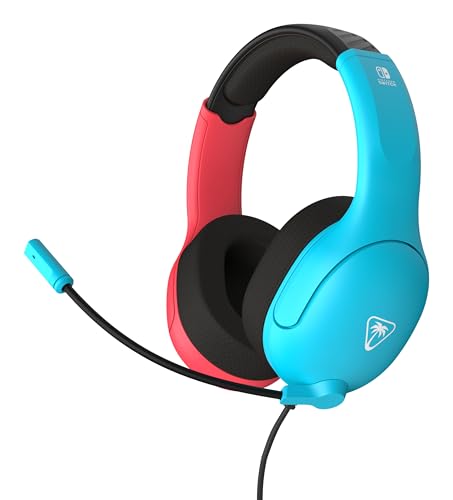
Turtle Beach Airlite Fit — Licensed all-rounder
Turtle Beach designed the Airlite Fit directly around Nintendo’s hardware generations, and its listing is admirably specific: a wired gaming headset for Nintendo Switch 2 and Lite that also works with the Switch OLED model. That sentence does more for a buyer than any adjective could, because it removes the generation guessing that haunts this category. Add 40mm speakers, comfortable ear cushions and a lightweight build, and you have the archetypal modern Switch headset, made by a brand that has supported Nintendo platforms for years and styled here in the family’s neon blue and red language.
The flip-to-mute microphone is the feature you will touch most. In a handheld session on a train or in a living room, flipping the boom up to silence yourself is faster and more certain than any inline switch, and it gives younger players a gesture they can learn in one demonstration. Voice quality through the boom is clear for the games and apps that accept headset chat, and the wired connection keeps latency at zero, which matters in rhythm and fighting games where the Switch library is quietly excellent. Because everything travels through the 3.5mm plug, there is no battery to flatten before a trip and no pairing ritual when a friend hands you their console.
Its limits are the limits of its class. Wired means tethered, so docked play from a sofa is out unless you sit close or add an extension, and the light build that makes it so portable will feel less plush than a big desktop headset during a four-hour role-playing session. The on-paper recipe also targets the newer generations by name, so owners of the very first Switch model should confirm fit with their exact machine against the listing’s stated support. Within its intended world, though, this is the easiest headset in the guide to recommend without caveats.
- Stated support: Nintendo Switch 2 and Lite, plus Switch OLED, per the listing
- Speakers: 40mm in a lightweight wired frame
- Microphone: flip-to-mute boom, raised means silent
- Look: neon blue and red colourway matched to Nintendo’s Joy-Con language
Strengths
- Generation support is spelled out in the title, ending compatibility guesswork.
- Flip-to-mute is the quickest mute gesture a young player can learn.
- Featherweight wired design suits handheld and travel play perfectly.
Trade-offs
- The cable rules out relaxed docked play from across a room.
- Padding is tuned for portability rather than marathon plushness.
- Original-model owners must double-check the stated generation support.
Best for: Switch 2, Lite and OLED players who mostly play handheld and want an officially minded, no-fuss headset. Not suited for: sofa-based docked players who need their audio to cross a room without a wire.

Turtle Beach Stealth 500 for Switch — Wireless freedom
The Stealth 500 answers the docked player’s prayer in licensed form. Its listing describes a wireless gaming headset licensed for Switch 2, with Bluetooth, 40mm drivers, a 40-hour battery claim, a flip-to-mute microphone and memory foam cushions in a lightweight charcoal frame. Licensing matters doubly for wireless on Nintendo hardware, because a generic Bluetooth headset and a Switch have historically had a complicated relationship; a model built and licensed for the platform starts from trust rather than from hope. For a Switch 2 household whose console lives by the television, this is the cleanest route to sofa-distance audio.
Memory foam is more than a comfort garnish here. Docked sessions tend to run longer than handheld ones, films and big adventure games stretch across evenings, and cushions that mould gently keep the headset feeling consistent from the first hour to the third. The 40-hour battery claim, treated as the maker’s best case, still translates into many evenings between charges even after real-world discounts, and Bluetooth gives the headset a second life with a phone or tablet when the console sleeps. Flip-to-mute carries over the family gesture from the Airlite Fit, keeping your mute state physical and obvious.
Wireless freedom charges its usual taxes. You must remember to charge, you accept a little more weight than the wired featherweights, and you pay for radios and batteries that handheld-only players may never exploit. Bluetooth audio behaviour also depends on the host device, so the headset’s performance with a phone tells you nothing certain about any other machine. Judge it as what it is: the docked Switch 2 specialist, and the pick that turns a television setup into a private cinema after dark.
- Licence: built and licensed for Nintendo Switch 2, per the listing
- Battery claim in the listing: up to 40 hours
- Cushions: memory foam in a lightweight charcoal frame
- Microphone: flip-to-mute boom shared with its wired sibling
Strengths
- Licensed wireless solves the docked-distance problem properly.
- Memory foam supports the longer sessions docked play encourages.
- Bluetooth keeps it useful with phones and tablets between games.
Trade-offs
- Charging becomes part of the routine, unlike the wired picks.
- Handheld-only players pay for reach they will rarely use.
- Its licensing story centres on Switch 2 rather than the whole family.
Best for: Switch 2 owners whose console lives docked by the television and who play from the sofa. Not suited for: Lite owners, whose handheld-only machine makes a wired headset the natural match.
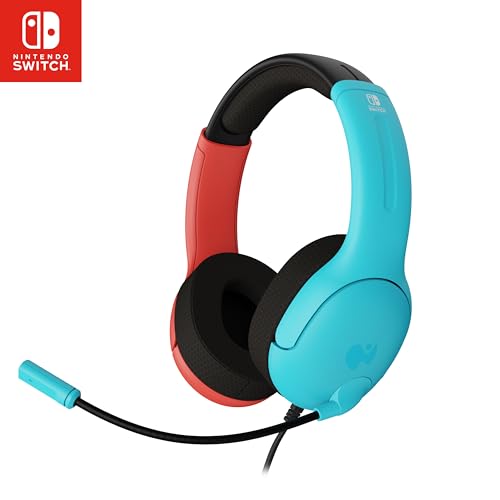
PDP LVL40 Airlite — Colour-matched classic
PDP’s LVL40 Airlite wears its Nintendo affection openly, in a Mario neon red and blue finish that matches the classic Joy-Con pairing. The listing describes a wired stereo headset for Nintendo Switch, Lite and OLED with a noise-cancelling microphone and lightweight, soft-comfort on-ear headphones. On-ear is the detail to notice: where the other wired picks surround the ear, this design rests on it, which keeps the headset smaller, cooler and easier for children to wear correctly without help. For the younger audience that forms so much of the Switch’s heartland, that simplicity is a feature, not a compromise.
The noise-cancelling label belongs to the microphone, a distinction this guide makes everywhere: the boom works to keep your voice clear against room sound for the games and apps that take headset chat, while your own ears rely on the on-ear pads and the game’s volume. In a kitchen-table gaming household, where a parent is cooking ten feet away, that microphone behaviour is the difference between a teammate hearing a callout and hearing dinner. PDP’s long history of licensed Nintendo accessories also shows in the proportions; nothing about the headset fights the console’s portability.
On-ear designs divide adults. Some find them airy and pressure-free, others feel the pads after an hour and wish for the over-ear embrace of the Recon 70. Sound leans bright and clear rather than deep, fitting Nintendo’s melodic soundtracks and dialogue while giving up low-end weight in action scenes. And like its wired siblings it cannot follow you across a room in docked mode. As a first headset for a young Switch player, colour-matched to the controllers they already love, it remains a genuinely charming answer.
- Fit style: on-ear pads, smaller and cooler than over-ear rivals
- Microphone: noise-cancelling boom for clearer outgoing chat
- Stated platforms: Nintendo Switch, Lite and OLED in the listing title
- Finish: Mario neon red and blue, matched to classic Joy-Con colours
Strengths
- Children can put it on correctly without adult adjustment.
- On-ear design stays cooler through warm-room handheld play.
- The colourway makes it feel like part of the console, not an accessory.
Trade-offs
- On-ear pressure bothers some adults during long sessions.
- Bass weight is modest next to the over-ear models here.
- Wired reach limits it to handheld, tabletop and close seating.
Best for: younger Switch and Lite players getting a first headset that matches their console. Not suited for: adults planning long docked sessions who prefer deep, over-ear immersion.
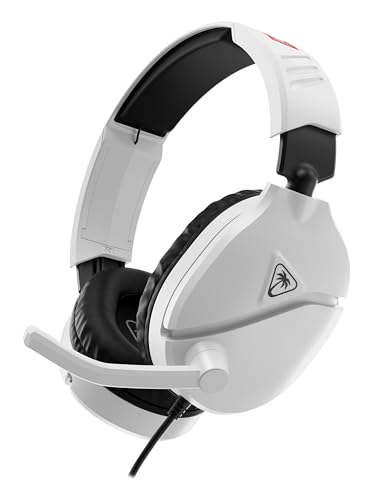
Turtle Beach Recon 70 — Licensed wired value
The Recon 70 is Turtle Beach’s everyman headset translated into Nintendo, and its listing leads with the credentials that matter: a wired multiplatform design for Nintendo Switch 2 that also works with Switch Lite and OLED, is licensed for Switch, and carries 40mm speakers with a flip-to-mute microphone and soft earpads in black and white. Where the Airlite Fit is the newest-generation specialist, the Recon 70 is the household generalist, the headset a parent buys once and watches migrate between consoles, siblings and rooms without ceremony.
Soft earpads and a proven frame shape give it an easy first impression. It disappears during play in the way good budget headsets should, asking nothing, pairing with nothing, and working the instant the plug seats in the jack. The flip-to-mute boom repeats the family’s best gesture, and multiplatform wiring means the same headset can serve a PC for homework calls or another console in the house, which stretches its value well beyond its modest station. Black and white styling also sidesteps the neon question entirely for players who prefer their gear quiet.
Expect the class compromises, honestly stated. The 40mm speakers are clear and willing rather than thrilling, the build favours lightness over luxury materials, and the cable still defines where you can sit in docked mode. None of that undermines its role. In a category where licensing confusion burns buyers regularly, a licensed, clearly labelled, comfortable wired headset at the sensible end of the range is not the boring choice; it is the grown-up one.
- Licence: licensed for Switch, with Switch 2, Lite and OLED named
- Speakers: 40mm in a lightweight multiplatform frame
- Microphone: flip-to-mute boom, Turtle Beach’s signature gesture
- Finish: black and white, the understated option in this line-up
Strengths
- Clear licensing and generation support make buying it stress-free.
- Soft pads and low weight suit mixed-age households.
- Multiplatform wiring lets it moonlight on PC and other consoles.
Trade-offs
- Sound is dependable rather than exciting beside pricier models.
- Materials prioritise lightness over a premium feel.
- Still a cable, so docked distance remains its boundary.
Best for: families wanting one licensed wired headset that every Switch generation in the house can share. Not suited for: players chasing wireless sofa freedom or the deepest sound in this guide.

PowerA Wired Stereo Headset — Fortnite edition
PowerA’s entry is unapologetically a fan object: an officially licensed wired stereo headset for Nintendo Switch and Switch 2 in a Fortnite Llambro design, with a bonus virtual item included, as its listing states. That framing deserves respect rather than irony. For a Fortnite player, the headset is partly equipment and partly merchandise, and the included virtual item is a real part of the value they are buying. PowerA has built its name on officially licensed Nintendo accessories, and that licence is printed in the title where a careful buyer can verify it.
As a headset, it keeps the wired recipe simple: plug into the console’s jack, play handheld or tabletop, and enjoy stereo game audio without batteries or pairing. Fortnite’s audio cues, footsteps, chests and distant build fights, benefit from any proper headset over the console’s speakers, and the licensed design means the fit and controls were shaped with Switch players in mind. It is also the most giftable item in this guide by a wide margin; a birthday buyer who knows the recipient loves Fortnite can hardly miss with a Llambro headset and a bonus item in the same box.
The honest caveats are about audience and ambition. Players indifferent to Fortnite are paying for artwork they do not care about, and the other wired picks offer flip-to-mute microphones or broader generation lists that may serve them better. Stereo wired audio is the whole technical story here, with no wireless or surround processing to discuss. Buy it as the joyful, licensed fan pick it declares itself to be, and it will not disappoint; buy it expecting flagship features and the misunderstanding is yours, not PowerA’s.
- Licence: officially licensed Fortnite edition for Switch and Switch 2
- Bonus: a virtual item is included, per the listing
- Connection: wired stereo through the console’s headphone jack
- Design: Llambro artwork aimed squarely at Fortnite players
Strengths
- The most giftable pick here for a confirmed Fortnite fan.
- Official licensing removes any compatibility anxiety.
- Simple wired design works instantly in handheld and tabletop play.
Trade-offs
- The theme is wasted money for players outside the Fortnite world.
- No flip-to-mute flourish or wireless route to rival siblings.
- Technical ambitions stop at honest wired stereo.
Best for: Fortnite devotees on Switch or Switch 2 who want their headset to show their allegiance. Not suited for: theme-neutral buyers who would rather spend the same money on microphone or comfort features.

AOC Wireless Gaming Headset — Feature maximalist
AOC arrives with the longest feature list in this guide and no intention of hiding it. The listing describes a wireless gaming headset for PlayStation 5 and 4, Nintendo Switch and PC, offering Bluetooth 5.4 and 2.4GHz connections, a noise-cancelling microphone, RGB lighting, Type-C charging, a claimed 20ms latency figure, 45 hours of battery and 7.1 virtual surround. For a multi-platform household, that breadth is the pitch: one headset that can live by the Switch, visit a PlayStation and work at a PC, changing connection method to suit each host.
Sorting the claims is the buyer’s job, and this guide will help. The 2.4GHz route, typically through a small USB dongle, is the gaming-grade path where low latency matters, and it suits docked or PC play where a USB port is free. Bluetooth 5.4 is the convenience path for phones and casual listening. Virtual surround is processing, not seven speakers in a headband; it widens the perceived stage in games that feed it good material. The noise-cancelling phrase, once again, describes the microphone’s treatment of your voice rather than silence at your ears. RGB lighting is pure personality, delightful to some, invisible under your own eyes while you wear it, and a small drain on that battery claim.
Versatility always trades against specialisation. A licensed Nintendo design like the Stealth 500 makes narrower promises with the platform holder’s blessing, while the AOC spreads its talents across three ecosystems and asks you to manage dongles and modes accordingly. Its 45-hour battery claim is the strongest endurance figure among this guide’s wireless pair, though real results will follow your volume and lighting habits. For the player whose gaming life genuinely spans Switch, PlayStation and PC, that trade is not a compromise at all; it is the entire point.
- Connections: Bluetooth 5.4 plus a 2.4GHz wireless route, per the listing
- Battery claim in the listing: up to 45 hours, with Type-C charging
- Audio processing: 7.1 virtual surround for a widened game stage
- Extras: RGB lighting and a noise-cancelling microphone
Strengths
- Serves Switch, PlayStation and PC from a single purchase.
- Two wireless routes let you choose latency or convenience per device.
- The battery claim leads this guide’s wireless models.
Trade-offs
- No Nintendo licence headline, unlike the Turtle Beach wireless pick.
- Dongle and mode management adds steps the wired picks never ask for.
- RGB and processing features will not matter to minimalist players.
Best for: multi-platform gamers who want one wireless headset to rotate between Switch, PlayStation and PC. Not suited for: Nintendo purists who prefer platform-licensed gear and the simplest possible setup.
How Do the Six Compare at a Glance?
| Headset | Connection | Generations named | Signature trait |
|---|---|---|---|
| Turtle Beach Airlite Fit | Wired 3.5mm | Switch 2, Lite, OLED | Flip-to-mute in a licensed featherweight |
| Turtle Beach Stealth 500 | Wireless, Bluetooth | Switch 2 licensed | Memory foam and a 40-hour claim |
| PDP LVL40 Airlite | Wired 3.5mm | Switch, Lite, OLED | On-ear Mario neon design |
| Turtle Beach Recon 70 | Wired 3.5mm | Switch 2, Lite, OLED | Licensed black-and-white generalist |
| PowerA Wired Stereo | Wired 3.5mm | Switch, Switch 2 | Fortnite Llambro edition with bonus item |
| AOC Wireless | Bluetooth 5.4, 2.4GHz | Switch among PS and PC | Virtual surround and 45-hour claim |
Notice how the generations column does the real sorting. A Lite owner can ignore every docked consideration and pick purely on fit and theme, while a Switch 2 household should start from the two models that name that console with licensing behind them. The connection column then splits handheld loyalists from sofa players. Only after those two practical filters should taste enter, neon against charcoal, Fortnite artwork against plain black and white, RGB glow against none.
Which Buying Mistakes Catch Switch Players Out?
Expecting console voice chat in every Nintendo game is the founding mistake of this category, and it flows from experience on other platforms. Read the framing earlier in this guide again before ordering, and check how your favourite titles handle chat specifically. The second mistake is buying for the wrong generation: a headset listing that names Switch 2 and Lite may not be the one an original-model owner needs, and the reverse also holds. Titles are the evidence, so read them as carefully as you would a game’s age rating.
Third, handheld players overbuy wireless. A Lite in a school bag gains nothing from a dongle, and the money saved on a wired pick buys games. Fourth, docked players underbuy reach, then blame a wired headset for a cable that was never going to cross their lounge. Fifth, gift buyers overlook the theme question: the PowerA is a triumph for a Fortnite fan and a puzzling object for a Zelda devotee, while the PDP’s Mario colours delight younger players and may embarrass a teenager. Match the headset to the human, not just to the console.
How Can You Get Better Sound From a Switch Headset Tonight?
Start inside the console’s own settings. Switch the audio output behaviour to suit headphones when prompted, keep the system volume healthy and control loudness from the headset or console rather than crushing it in a game’s menu, because stacked volume controls can muddy clarity. In games, choose headphone or stereo sound modes where offered, and lower music slightly against effects if dialogue gets buried; Nintendo’s mixes are usually excellent, so small nudges beat dramatic ones. For chat through the phone app, one earbud under a headset earcup is the veteran arrangement, inelegant and effective, keeping game audio and voices in the same head.
Fit is the free upgrade nobody uses. Centre the cups, let an on-ear model sit flat rather than folded against the ear’s edge, and take the headset off between matches to reset both comfort and your sense of volume, because ears creep louder over a session. Wired owners should keep the jack clean and the plug fully seated; a pocket-linted socket is behind many crackles blamed on headsets. Wireless owners should charge before a trip rather than during it, and keep the dongle, where one exists, in the case with the console so the pair never separate.
Why Does Nintendo’s Sound Design Reward a Proper Headset?
Play a Nintendo game through television speakers and you hear charm. Play it through a headset and you hear craft. The company’s composers layer melodies over environmental detail, birdsong behind a village theme, water under a bridge theme, tiny mechanical sounds in every menu, and small speakers compress all of that into a pleasant blur. A headset separates the layers. Racing games reveal engine notes and rival positions you never knew were mixed in. Adventure games reward slow exploration with ambient storytelling that never reaches a sofa at television volume. Even puzzle games, the genre nobody buys audio gear for, use sound as feedback, and clean delivery makes their logic easier to follow.
This is also why modest headsets satisfy on this platform more than spec sheets suggest. Nintendo mixes for clarity rather than for cinema-scale dynamics, so a clear 40mm wired design captures most of what the games offer, and the jump to expensive hardware buys refinement rather than revelation. Parents discover a second benefit: a child with a headset hears every cue at moderate volume instead of pushing small speakers to fill a room, which keeps both the child’s ears and the household’s patience in better shape. The Switch may be the least powerful console in the house, but per hour of play it might repay a headset purchase faster than any of them.
A Parent’s Guide to Buying a Switch Headset
Begin with volume discipline, because it outranks every other feature for young ears. Choose a headset, set the console’s volume sensibly, and teach the rule that if someone beside you cannot be heard when they speak your name, the game is too loud. Then look at mechanics a child must operate alone: a flip-to-mute boom beats a tiny inline switch, a plain cable beats a pairing menu, and an on-ear or lightly padded design beats a heavy frame that slides off smaller heads. The PDP and the two Turtle Beach wired models all pass that test, each in a different style.
Durability thinking should be unsentimental. Cables will be yanked, headsets will be sat on, and a model whose microphone detaches or flips away survives childhood better than one with a fixed, bendable stalk. Consider also where the headset will live: a hook beside the dock prevents the floor-and-backpack cycle that kills most accessories. Finally, involve the child in the theme decision where one exists. A headset they chose, Mario neon or Fortnite artwork, gets worn at the volume you set and put away where you asked, and that cooperation is worth more than a decibel of driver performance.
Travelling With a Switch Headset: Trains, Cars and Flights
The Switch was designed to leave the house, and its headset should be equally portable. Wired models win the travel brief almost by default: no battery to drain in a bag, no dongle to leave in a hotel, and no Bluetooth behaviour to negotiate with an aeroplane seat. Coil the cable loosely rather than wrapping it tightly around the frame, because tight wraps fatigue the wire at the plug, and keep the headset in the same pouch as the console so the pair reunite automatically at packing time. The light wired picks in this guide were plainly shaped by people who understood that brief.
Wireless travel has its own pleasures when it works, above all the Stealth 500’s freedom in a holiday rental where the console docks to an unfamiliar television. Charge before departure, carry the cable anyway as insurance, and remember that a headset used for a film on a tablet at the airport and for games in the evening earns its luggage space twice. In cars, the etiquette flips to the passenger: the driver should never be the one wearing the headset, and a back-seat player with the LVL40’s on-ear openness keeps one ear on the family conversation, which many parents quietly prefer.
Local Multiplayer: Two Players, One Small Screen
Shared-screen Switch play creates an audio puzzle that online players never meet. Two people watch one display, often in tabletop mode, and the console offers one headphone jack. The household solutions are social: television or console speakers for shared sessions, headsets reserved for solo play, or one player wearing a single side of an on-ear headset in the most makeshift arrangement of all. Do not buy two headsets expecting a tidy split-audio experience the hardware was not designed to provide.
Where headsets do transform local play is in separate-console households, siblings each with a Lite or a shared pair of machines, playing together from different rooms or different ends of one sofa. There, each player’s own headset delivers private audio and, where the game supports it, clean communication without shouting across the house. That scenario is the quiet engine behind many families owning two wired picks from this guide, often the Recon 70 for one child and the Airlite Fit for another, chosen by fit rather than by hierarchy.
How Long Should a Switch Headset Last, and What Kills It Early?
A wired Switch headset should serve for years, and the failures that end them are drearily predictable. The plug end of the cable frays from being pulled out by the cord. A hinge cracks after the headset becomes a regular passenger in an overstuffed bag. Ear cushions peel in hot cars. Every one of those deaths is postponed by small habits: unplug by the plug, store on a hook, and keep the headset out of sun-baked vehicles. Treat the cable as part of the product, not as packaging, and a modest wired model will outlive the console generation it was bought for.
Wireless models add battery ageing to the list. A battery charged gently and often will hold useful capacity far longer than one repeatedly run to empty and left flat in a drawer, so a headset that lives near its charger ages gracefully. Keep firmware and pairing habits simple, one primary console, one phone, rather than a dozen remembered devices competing at switch-on. And keep the original cable. Type-C leads are common, but the one in the box is the one you will find at midnight before a trip.
A Five-Minute Checklist Before You Check Out
Write down your console generation first, exactly as printed on your machine, then match it against the generation list in the listing title of the headset you are about to buy. Decide your dominant posture second: handheld, tabletop, docked, or a true mixture, because that single answer eliminates half this guide instantly. Third, settle the chat question for your actual games, not for gaming in general, by checking how your two most-played titles handle voice. Fourth, pick your microphone gesture, flip, inline or fixed, based on who will use it and how old they are. Fifth, if the headset is a gift, choose the theme with the recipient’s current obsession in mind and accept that the artwork may be the feature.
Run those five steps and the right pick usually names itself. The Airlite Fit and Recon 70 split the wired honours by generation emphasis and styling, the PDP owns the young-player brief, the PowerA owns the Fortnite brief, and the two wireless models divide by loyalty, licensed Nintendo focus against multi-platform reach. There is no trap left once the checklist is done, which is more than most Switch accessories can promise.
What About Using a Switch Headset for School, Calls and Films?
A headset bought for a console rarely stays in its lane, and the wired picks here moonlight gracefully. The same 3.5mm plug that serves a Lite also serves a school laptop, a tablet for language lessons and a phone for a grandparent call, and a microphone that was bought for game chat turns out to be the clearest voice in a remote lesson. That second life matters when justifying a purchase for a child, and it favours the plainly styled Recon 70 and Airlite Fit, which look at home in a classroom call, over themed designs a teenager may refuse to wear for school.
Films reveal a different virtue: consistency. A child who watches a film on a tablet with the same headset they game with already knows its fit and volume behaviour, so there is no adjustment period and no accidental loud start. Wireless models extend that story to televisions and phones, and the AOC’s Bluetooth route makes it the natural shared headset for an older teenager whose media life spans every screen in the house. None of these headsets pretends to be studio equipment, but as the household’s one honest pair of ears, several of them are quietly excellent.
Understanding the Listings: Licence, Generation and Theme
Three words in a Switch headset title carry more weight than all the adjectives combined. Licensed means the platform holder’s programme stands behind the accessory’s compatibility, and on Nintendo hardware that assurance has real value because the ecosystem is protective by design. The generation list, Switch 2, Lite, OLED, original, tells you which machines the maker is prepared to name, and its absence for your model is information, not an oversight. Theme, finally, is a legitimate feature in this market rather than decoration, because Nintendo play is unusually identity-driven; a headset that looks like it belongs with the console gets worn more, and a headset that gets worn is the only kind that improves anything.
Read titles in that order and the six picks stop competing and start specialising. The Airlite Fit is the licensed new-generation wired answer. The Stealth 500 is the licensed wireless answer for the docked Switch 2. The Recon 70 is the licensed generalist. The PDP is the young player’s on-ear. The PowerA is the fan object. The AOC is the traveller between ecosystems. A buyer who understands those six sentences needs nothing else in this guide, though the detail above exists for those who enjoy knowing why.
Setting Up for the First Session, Step by Step
For a wired pick, begin with the console undocked and in your hands. Seat the plug fully, start a game you know well, and set volume from the console first so the midpoint of its range feels like your normal listening level. Test the microphone in a title or app that accepts it, speaking at ordinary volume, and practise the mute gesture three times until your hand knows it without your eyes. If the headset will serve a child, do this setup together and make the volume rule part of the ritual, not a lecture delivered later.
For a wireless pick, charge it fully before the first session, because a half-charged debut teaches bad habits. Pair it with the console following the listing’s stated route, confirm game audio before touching any chat feature, and then pair a phone second if you intend to use Bluetooth elsewhere, so the console remains the primary relationship. Label the dongle, if your model uses one, with the console’s name; future you, tidying a drawer in six months, will be grateful. End the setup by choosing the headset’s home, a hook, a dock-side tray, a travel pouch, because accessories with a home survive, and accessories without one migrate to the floor.
When Should You Replace a Switch Headset Instead of Repairing the Habit?
Replace a headset when its problem is structural: a cracked hinge, a cable that crackles at a fixed bend, cushions that have collapsed so the drivers sit against the ears, or a battery that no longer survives a single evening. Those are end-of-life signs, and money spent nursing them is money denied to a replacement that would simply work. Replace it also when your household’s hardware changes underneath it, when a Lite-only wired routine becomes a docked Switch 2 routine, because the old headset is not failing; the job description changed.
Do not replace it for problems that live in settings or expectations. A headset blamed for missing voice chat in a Nintendo title was never broken. A wireless model blamed for delay may be innocent Bluetooth physics that a cable or dongle route solves. A child who has outgrown a theme has not outgrown the hardware, and a younger sibling may inherit it happily. The six picks here were chosen to age slowly precisely because their promises are narrow and honest, and a buyer who matches the promise to the household rarely needs the returns label at all.
Final Recommendation
Handheld players should begin with the Turtle Beach Airlite Fit for its explicit generation support and flip-to-mute ease, or the Recon 70 if the headset will be shared across the whole Switch family. Younger players deserve a look at the PDP LVL40 for its size, colours and simplicity, and a Fortnite fan’s choice makes itself with the PowerA edition. Docked Switch 2 households belong with the licensed Stealth 500, while genuinely multi-platform gamers should take the AOC and its travelling connections seriously. Buy for the console generation on your shelf and the chair you actually sit in, keep your chat expectations honest, and any of these six will make Nintendo’s sound design sound the way it deserves to be heard.
Frequently Asked Questions
Can I voice chat with friends using just a headset on the original Switch?
Only where the game itself supports it. Many Nintendo first-party titles route chat through the phone app instead, so your headset delivers game audio while your phone handles the conversation. Some third-party games manage chat internally through the console. Check your favourite titles individually, because the answer is per game, not per headset.
Will a wired headset work with the Switch Lite?
Yes. The Lite keeps the 3.5mm headphone jack, and the wired picks here name Lite support in their listings, including the Airlite Fit, LVL40 and Recon 70. For a handheld-only console, a light wired headset is usually the most sensible purchase in this entire guide.
What changes with Switch 2 headsets?
The licensed models in this guide, including the Stealth 500, Airlite Fit and Recon 70, name Switch 2 in their listings, and the newer console broadens integrated chat compared with its predecessor. Trust each listing’s stated support rather than assuming older accessories carry over unchanged, and prefer licensed models when wireless is involved.
Is Bluetooth audio on Switch reliable for gaming?
It is convenient and fine for relaxed play, but Bluetooth can add delay that competitive or rhythm-game players may notice, and behaviour varies by headset. A 2.4GHz dongle route, like the AOC offers for its platforms, or a plain cable remains the timing-safe choice when precision matters most.
Which pick suits a child best?
The PDP LVL40 Airlite was shaped for that job, with on-ear pads a child can position alone, light weight and colours matched to the console. The Recon 50-style virtues apply here too: simple, wired, nothing to charge and nothing precious to break. Supervise volume, as with any headset, and let them enjoy the Mario colours.
Do I need a different headset for a Switch and a Switch 2 in the same house?
Not if you choose from the models whose listings name both generations, and several wired picks here do exactly that. A shared wired headset is often the household’s simplest answer, since it plugs into whichever machine is free. Reserve separate purchases for a wireless docked setup, where licensing and pairing make a dedicated Switch 2 model the cleaner choice.
Why do some Switch headsets cost so much less than Xbox or PC models?
Because the job is simpler. A wired Switch headset needs no licensed wireless radio, no battery and no multi-platform switching, so honest makers can sell it for less while still doing its one job well. The low price of the wired picks in this guide reflects that simplicity rather than any hidden corner being cut, and it is why buying two for a household is a rational plan.
Can a Switch headset reduce how much game noise the rest of the house hears?
Completely, for the wearer’s own audio. The moment game sound moves from speakers into earcups, the room goes quiet except for the player’s own voice and laughter, which no headset can govern. That is why so many parents describe a child’s headset as a household purchase rather than a gaming one, and why a second wired pick for a sibling often follows the first within a month.
Should I keep the box and receipt for a headset like these?
For the first month, yes, and the reason is fit rather than failure. A headset can be perfectly made and simply wrong for a particular head, a particular pair of glasses or a particular child’s patience, and that verdict only emerges across several real sessions. Buy, test honestly across a week of ordinary play, and keep the packaging until the headset has survived that trial. After that, the box can go; the headset, if this guide did its job, will be staying for years.
What is the single best first test after unboxing?
Play twenty minutes of a game you already know by heart, ideally one with both music and spoken dialogue, at the volume you would choose on an ordinary evening. Familiar material exposes problems instantly: a voice that sits too far back, a cushion that pinches, a cable that pulls when you look down at the controls. If the headset passes your most familiar game without your attention drifting to the hardware itself, it has passed the only audition that really matters. Follow it with one chat test in a title that accepts headset voice, speaking at your natural volume rather than performing for the microphone, because that everyday check predicts months of ordinary use far better than any specification printed on the carton or any promise printed on a store page.
Related Guides
Console cousins worth your time include best xbox one game headsets for the other side of the living room, plus best aviation headsets with noise canceling if your curiosity travels further from the sofa. Players whose heads defeat ordinary frames should read best headsets for people with big heads before ordering anything at all.



[…] home headsets with mic a gentler read. For the long-haul traveller comparing every kind of quiet, best headsets for gaming nintendo switch covers the portable end of the […]