What's inside
- Where to Buy an Inkjet That Treats Cardstock as a Citizen, Not a Rumour
- Key Takeaways
- Quick Picks
- How Did We Judge Cardstock Ability Beyond the Brochure?
- What Should You Know About Cardstock Itself Before Blaming a Printer?
- Straight Paths and Six Colours: How Do the Six Cardstock Contenders Compare?
- How Do You Print a Run of Cards Without Wasting the Expensive Half?
- Which Cardstock Mistakes Do Beginners Blame on Innocent Printers?
- How Does a Wedding or Event Stationery Project Flow Through These Machines?
- What About Business Cards, Tags and the Small-Business Shelf?
- How Should Cardstock Be Stored So the Printer Stays Innocent?
- How Do You Get Honest Colour on Textured and Coloured Card?
- What Does a Year of Cardstock Printing Cost in Attention?
- How Do You Choose Between the Two Professional Machines?
- Why Do Greeting Cards Remain the Perfect Cardstock Classroom?
- How Should Beginners Sequence Their First Five Cardstock Projects?
- What Role Does the Cutting and Finishing Table Play in Print Quality?
- Final Recommendation
- Frequently Asked Questions
- Related Guides
As an Amazon Associate I earn from qualifying purchases. This post may contain affiliate links at no extra cost to you.
gizmoverdict.com is reader-supported. When you buy through links on our site, we may earn an affiliate commission.
Where to Buy an Inkjet That Treats Cardstock as a Citizen, Not a Rumour
The best inkjet printers for cardstock are separated from ordinary inkjets by a single mechanical virtue: the path their paper travels. Cardstock fails in printers that bend it sharply around small rollers, where thick sheets resist, skew, jam or emerge with their surfaces scuffed by the struggle. It succeeds in printers offering a straighter, more patient feed, usually a rear or manual slot that lets a heavy sheet enter nearly flat, be gripped evenly and leave with its printed face unmarked. The six machines below all earn their places on that axis, from two professional photo printers that treat thick fine-art media as their native language down to a crafter’s all-in-one built around the 12 by 12 inch sheets the scrapbooking world runs on.
Cardstock is not one material, and this guide will not pretend otherwise. The invitation suite at a wedding stationer’s thickness, the greeting-card blank with its pre-scored fold, the business card sheet, the matte fine-art board and the craft card in a riot of colours all ask slightly different things of a printer: grip without slipping, ink that sits richly on a surface that may be textured or coated, and registration steady enough that the back of the card can meet the front in the right county. What unites them is that they are all thicker, stiffer and less forgiving than the copier paper a general-purpose printer was raised on.
So read this list as a spectrum of seriousness. At the top stand the Canon PIXMA PRO-200S and the Epson SureColor P900 bundle, professional photo machines whose thick-media manners are the best in the guide and whose colour is built for work that will be judged. In the middle stand Epson’s wide-format photo all-in-ones, the XP-970 and the XP-15000, bringing six-colour output and serious specialty feeding to home studios. At the craft end stand the Canon PIXMA TS9521Ca, designed around the crafter’s sheet sizes, and the compact Epson XP-8800, the small-room route into six-colour card work.
Key Takeaways
- Feed path is destiny with cardstock: rear or manual feeds that keep a thick sheet nearly straight are the feature that matters most.
- The Canon PIXMA PRO-200S is the best overall cardstock inkjet here, a 13 inch professional with eight-colour dye ink and thick-media manners.
- The Epson SureColor P900 listing in this guide is the 17 inch printer bundled with cables and a fibre cloth, the professional step for large, heavy media.
- Epson’s XP-970 and XP-15000 bring six-colour wide-format printing to home studios, at up to 13 by 19 inches for the XP-15000.
- The Canon TS9521Ca is the crafter’s pick, shaped around 12 by 12 inch card and paper-craft workflows.
Quick Picks
| Pick | Badge | Why it earns its slot |
|---|---|---|
| Canon PIXMA PRO-200S | Best overall | A professional 13 inch photo printer with eight-colour dye ink and the feed manners heavy media deserves. |
| Epson SureColor P900 bundle | Best professional pick | A 17 inch SureColor photo printer in a bundle with Ethernet and USB cables plus a fibre cloth. |
| Epson Expression Photo XP-970 | Best wide-format home | A six-colour wide-format all-in-one for creative projects, with scanning and memory card support. |
| Epson Expression Photo HD XP-15000 | Best 13 by 19 value | Six-colour wide-format printing up to 13 by 19 inches with automatic two-sided printing. |
| Canon PIXMA TS9521Ca | Best for crafters | A wireless home all-in-one shaped around craft paper sizes including 12 by 12 inch card. |
| Epson Expression Photo XP-8800 | Best compact photo | Six-colour photo printing with scan and copy in a compact body for creative projects. |
How Did We Judge Cardstock Ability Beyond the Brochure?
We weighted the feed path first, because it is the trait that cannot be fixed by settings. A printer with a rear or manual specialty feed can be taught almost any cardstock within its stated thickness range; a printer whose only path bends sharply will eventually refuse, skew or scuff the one sheet you cared about, usually the last of a matched set. Within that first test we looked at how each maker talks about specialty and thick media in its model’s established behaviour, and we have written each pick’s feeding character individually rather than awarding the whole list a shared compliment.
Ink system came second. Cardstock work is disproportionately colour work, invitations, cards, art prints and photographs, so the colour architecture matters: eight dye colours in the Canon professional, six colours across the Epson photo machines, each widening the range of skin tones, pastels and deep shades that card surfaces are asked to carry. Third came size, because cardstock projects live at specific dimensions, and a machine that cannot reach 13 by 19 or 12 by 12 has voted itself out of those projects regardless of its other virtues.
What we ignored, deliberately, was document speed as a headline. Cardstock printing is a deliberate act performed sheet by sheet, often with the operator watching the first copy like a hawk, and the pages-per-minute figures in the listings, useful for the all-in-ones’ everyday work, say almost nothing about the care with which a thick sheet is handled. Judge these machines by their paths and their colours; the stopwatch belongs to office printers.
What Should You Know About Cardstock Itself Before Blaming a Printer?
Weight is quoted in two dialects that confuse every beginner once: pounds, inherited from paper’s American trade history, and grams per square metre, the honest metric the rest of the world uses. The dialects do not convert by a single number, because the pound figure depends on the paper’s category, so the only safe comparisons are within one dialect or on the maker’s own compatibility guidance for your exact machine. What your hands know, and should trust, is simpler: if the sheet feels like a birthday card it is cardstock, if it feels like a cereal box it is board, and board belongs to very few printers on any list.
Surface is the second education. Coated and smooth stocks hold ink on their surface for crisp detail and saturated colour; uncoated and textured stocks drink ink into their fibres for a softer, more letterpress feeling that flatters some designs and mutes others. A printer cannot change a stock’s character, only honour it, so the craft habit is the test sheet: one sheet, sacrificed to proofing, before a matched set of fifty is committed. Every professional in this guide’s audience keeps a drawer of single test sheets in every stock they use, and that drawer, more than any machine, is the mark of the trade.

Canon PIXMA PRO-200S — Best overall
The PRO-200S is a professional photo printer that treats cardstock not as an edge case but as a close relative of the fine-art media it was born to print. It is a 13 inch wireless machine with a 3 inch colour LCD and an eight-colour dye ink system, and its feeding character is the heart of its case here: a manual feed route that takes thick sheets on a straighter path, the arrangement heavy media asks for by name. Invitation suites, greeting cards with real substance, art prints on matte board-adjacent stocks, all pass through this machine with the composure that separates a tool from a gamble.
The eight-colour dye system earns its keep on exactly the work cardstock carries. Dye inks sink into coated card surfaces with a richness and a gradient smoothness that flatter portraits, wedding palettes and the soft colours of stationery, and the wide colour range holds the difference between blush and beige that invitation buyers are actually paying for. The LCD, a small thing, matters at the machine: feed and media settings confirmed on a screen at the printer, rather than shouted across a room from a driver, prevent the classic error of a perfect file printed on a misunderstood setting. For card work that will be judged by clients, family or paying guests, this is the guide’s reference machine.
- Format: professional 13 inch photo printer, wireless
- Ink: eight-colour dye system for rich card colour
- Feed character: manual feed route suited to thick media
- Interface: 3 inch colour LCD for at-machine media settings
Strengths
- Thick-media feeding turns cardstock from a risk into a routine.
- Eight-colour output holds the subtle palettes stationery lives on.
- Professional build and controls suit judged and client-facing work.
Trade-offs
- Print-only machine, so scanning and copying live elsewhere.
- Dye ink’s richness asks for suitable stocks to show its best.
- Professional appetite for ink makes casual document printing a waste.
Best for: stationers, photographers and serious card makers whose output is judged closely. Not suited for: general household printing, which would starve its talents and feed it the wrong work.

Epson SureColor P900 bundle — Best professional pick
First, the listing honesty: the P900 pick in this guide is the bundle, the 17 inch Epson SureColor photo printer supplied with an Ethernet cable, a USB cable and a fibre cloth. The cables tell you the intended habitat, a studio desk where the machine is wired into the workspace’s backbone rather than floating on wireless goodwill, and the printer inside the bundle is Epson’s serious 17 inch photo flagship for sheet media. For cardstock, its case rests on the same foundation as the Canon’s, deepened: a manual feed path designed for thick fine-art media, the class of sheets beside which heavy cardstock is a light workout.
Seventeen inches changes the projects list rather than merely enlarging it. Large-format cards and folded pieces that begin life as a big sheet, art prints that double as their own packaging statements, and table stationery at a scale home machines cannot reach all enter the repertoire. The P900’s studio manners, its media handling discipline and its place in Epson’s professional line, suit a maker whose cardstock work is graduating from favours to a price list. Buy the bundle knowing the cables are the least of it; what you are purchasing is the widest, most thick-media-fluent platform in this guide.
- Format: 17 inch professional photo printer, bundle listing
- Bundle contents: Ethernet cable, USB cable and fibre cloth
- Feed character: manual feed designed for thick fine-art media
- Habitat: wired studio desk, professional workflow
Strengths
- Widest format here unlocks large card and art projects whole.
- Thick-media fluency is the machine’s native language, not a mode.
- Wired connectivity suits studio desks where reliability outranks tidiness.
Trade-offs
- Largest footprint and commitment in this guide by a wide margin.
- Professional running costs punish casual or document-led use.
- Bundle’s cables are conveniences; the value case must rest on the printer.
Best for: professional makers and studios printing large, heavy media as a business. Not suited for: home crafters, whose card sizes and volumes belong to the machines below.

Epson Expression Photo XP-970 — Best wide-format home
The XP-970 brings the professional conversation down to a home-studio scale without abandoning its principles. It is a wireless all-in-one offering six-colour wide-format printing with scan and copy, up to 8.5 pages per minute on everyday work, and USB and memory card support, aimed by Epson at creative projects. For cardstock, the meaningful traits are the six-colour engine, which keeps gradients and skin tones honest on card surfaces, and a specialty feed arrangement that lets thicker sheets travel a kinder path than the main tray’s bend, the home-scale version of the professionals’ manual-feed virtue.
The all-in-one completeness changes who this machine serves. A home crafter or family stationer can design on screen, print the card, scan the hand-lettered insert and copy the extra place cards without leaving the desk, and the memory card slot serves the camera-led workflow of printing photographs onto card for albums and frames. It will not match the two professionals above for thick-media authority or colour depth, and pretending otherwise would insult both tiers. Judged as the most complete creative desk under the professional line, it is exactly where a serious home studio should start.
- Format: six-colour wide-format all-in-one, wireless
- Everyday pace: up to 8.5 pages per minute
- Extras: scan, copy, USB and memory card support
- Feed character: specialty feed path for thicker creative media
Strengths
- Six-colour output respects photographs and palettes on card.
- All-in-one completeness keeps a creative project at one desk.
- Wide format reaches sizes the compact machines cannot offer.
Trade-offs
- Thick-media authority sits a tier below the professional pair.
- Six cartridges make replenishment a fuller shopping list.
- Everyday pace is modest if the desk also does document duty.
Best for: home studios and family stationers wanting wide, six-colour card work with scanning. Not suited for: client production volumes, which belong to the PRO-200S or the P900.
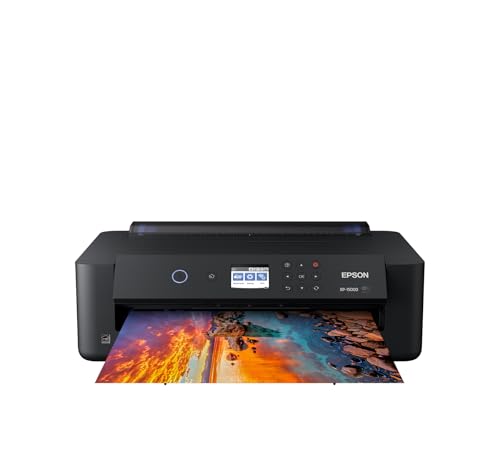
Epson Expression Photo HD XP-15000 — Best 13 by 19 value
The XP-15000 is the wide-format value argument in its purest form: six-colour wide-format photo printing up to 13 by 19 inches, at up to 9.2 pages per minute, with automatic two-sided printing, in a wireless machine aimed at photographers and home studios. That 13 by 19 ceiling is the headline for cardstock workers, because it swallows the projects smaller machines must refuse or tile: the big folded card printed as one sheet, the poster-weight invitation for an event that thinks in architecture, the art print on heavy stock that needs no border’s apology.
Its rear specialty feeding is the trait cardstock owners write home about, giving thick sheets the straighter journey this guide has been preaching since its first paragraph. The six-colour system keeps the wide output photographic rather than merely large, and the auto two-sided feature, unusual in a photo-led machine, quietly serves the card maker printing fronts and backs in register. Against the XP-970 above, the trade is completeness for size: no all-in-one scanning story, but a bigger canvas and a photographer’s focus. Home studios whose cardstock ambitions are measured in inches should start their comparison here and make the others argue them down.
- Format: six-colour wide format up to 13 by 19 inches
- Everyday pace: up to 9.2 pages per minute, auto two-sided
- Feed character: rear specialty feed for thick media
- Audience: photographers and home studios, per its listing
Strengths
- Largest output of the home tier, at genuinely useful card sizes.
- Rear feed gives heavy sheets the straight path they require.
- Two-sided printing helps front-and-back card registration work.
Trade-offs
- No scanning or copying, unlike its XP-970 sibling.
- Wide body claims real desk in a home studio.
- Six-colour running costs follow the photo class, not the office class.
Best for: home studios whose cardstock projects are large, photographic and frequent. Not suited for: desks needing an all-in-one, or crafters whose world is 12 by 12, who should meet the Canon below.

Canon PIXMA TS9521Ca — Best for crafters (12 by 12)
Every other machine in this guide tolerates crafters; the TS9521Ca was designed for them. It is a wireless home all-in-one in Canon’s PIXMA family whose defining party trick is its embrace of craft formats, above all the 12 by 12 inch sheet that scrapbooking and paper craft treat as their standard canvas. That size sounds like a footnote until you have watched a crafter trim, tile or apologise their way around a machine that cannot take it, at which point it becomes the entire purchase argument, with cardstock feeding for the craft room’s heavy coloured sheets riding in the same design brief.
The all-in-one manners suit the craft desk’s actual workflow: scan the vintage photograph, print it on card, copy the template, and keep the whole project inside one machine’s reach of the cutting mat. Colour is craft-honest rather than professional, which matches a world of coloured card, layered paper and embellishment where the print is one ingredient among many rather than the whole dish. If your cardstock arrives in craft-store stacks and leaves as pages, cards and decorations, this Canon is not the compromise pick. It is the only one on the page that started from your shopping list.
- Format: wireless home all-in-one, craft-oriented PIXMA
- Signature size: 12 by 12 inch craft sheets and card
- Workflow: scan and copy beside the cutting mat
- Character: the paper-craft desk’s native machine
Strengths
- Craft sheet sizes are its home turf rather than a special request.
- All-in-one tools match the scan-print-copy rhythm of paper projects.
- Card handling is aimed at craft stocks, not adapted from office paper.
Trade-offs
- Colour depth sits below the six and eight-colour photo machines.
- Serious photographic card work will outgrow its ambitions.
- Wide professional formats beyond its craft canvas are out of reach.
Best for: scrapbookers and paper crafters whose standard sheet is 12 by 12. Not suited for: stationers and photographers needing professional colour or 13 by 19 output.

Epson Expression Photo XP-8800 — Best compact photo
The XP-8800 is the small-room answer to a six-colour question. It is a wireless colour all-in-one with six-colour photo printing, scan and copy, up to 10 pages per minute on everyday work and USB and memory card support, aimed at photos and creative projects. In cardstock terms it offers the home crafter and family card maker the essential upgrade over ordinary four-colour machines, smoother photographic colour on card surfaces, inside a body that fits the desks the wide-format Epsons would evict, with a specialty feed path for the thicker sheets that greeting-card and photo-card work runs on.
Its compromises are the compact class’s own: the canvas stops short of the wide formats, so projects are greeting cards, photo cards and invitations at home sizes rather than studio sheets, and its thick-media confidence, while real, is the lightest in this guide and should be proven on your exact stock with the test-sheet ritual before a family event depends on it. Within those honest borders it is a delightfully complete machine, and for the majority of households whose cardstock life is Christmas cards, birthday invitations and photographs that deserve better than a phone screen, it may be the most proportionate purchase on the page.
- Format: compact six-colour photo all-in-one, wireless
- Everyday pace: up to 10 pages per minute
- Extras: scan, copy, USB and memory card support
- Feed character: specialty path for thicker creative sheets
Strengths
- Six-colour output in a body small desks can actually host.
- Complete all-in-one set for family card and photo projects.
- Briskest everyday pace among the photo all-in-ones here.
Trade-offs
- No wide format, so large card projects belong to its siblings.
- Heaviest stocks should be test-proven before an event depends on them.
- Professional judged work will want the PRO-200S’s authority instead.
Best for: families and home crafters wanting six-colour card work in a compact body. Not suited for: wide-format or client production work, which this guide houses elsewhere.
Straight Paths and Six Colours: How Do the Six Cardstock Contenders Compare?
| Pick | Largest format | Colour system | Scan and copy | Thick-media route |
|---|---|---|---|---|
| Canon PIXMA PRO-200S | 13 inch | Eight-colour dye | No | Manual feed |
| Epson SureColor P900 bundle | 17 inch | Professional photo ink | No | Manual feed for fine-art media |
| Epson XP-970 | Wide format | Six-colour | Yes | Specialty feed |
| Epson XP-15000 | 13 by 19 inch | Six-colour | No | Rear specialty feed |
| Canon TS9521Ca | 12 by 12 craft | Craft all-in-one colour | Yes | Craft card feeding |
| Epson XP-8800 | Home sizes | Six-colour | Yes | Specialty path |
Read the table by project rather than by prestige. The professionals own judged work and the largest sheets, the wide Epsons own the home studio’s serious middle, and the craft and compact machines own the two most common domestic truths: that most cardstock projects are 12 by 12 or smaller, and most desks are too. A machine matched to the project in front of it will always outperform a grander machine matched to a project that exists only in aspiration.
How Do You Print a Run of Cards Without Wasting the Expensive Half?
Proof like a professional, in ascending order of cost. First the screen proof, where spelling, dates and the address of the venue are read aloud by a second human, because no printer can correct a wrong postcode and cardstock preserves errors beautifully. Then a plain-paper proof at full size, where margins, folds and the meeting of front and back are checked against a scored fold and a held-to-the-light inspection. Only then does the first cardstock sheet enter the machine, alone, through the specialty feed, emerging to be judged in daylight for colour, registration and surface marks before its forty-nine siblings are allowed to follow.
Feed one sheet at a time for judged work, however tedious that sounds in a guide, because stacked thick media is where skew and double-feeds breed. Let printed sheets rest flat and separate until the ink has fully settled, since card surfaces stacked warm can offset onto each other, and score before folding with a proper tool rather than a hopeful thumbnail. Keep the run’s failures. A misregistered card, annotated with its cause, is worth more to next season’s run than a fresh ream, because cardstock mistakes are loyal: unexamined, they return.
Which Cardstock Mistakes Do Beginners Blame on Innocent Printers?
The bent-path jam is the classic, a thick sheet sent through a standard tray whose rollers were never meant for it, while the machine’s specialty feed sat unused at the back like an unopened instruction. The second is the mystery scuff, which usually traces to a sheet fed printed-side against a path it should have travelled face-up, or to a stack of finished cards gathered before their ink had settled. The third is colour grief on textured stock, where a design tuned for smooth coated card is printed on a thirsty uncoated sheet and judged as a printer failure rather than recognised as a material translation that a test sheet would have predicted.
And the quietest mistake is arithmetic: buying cardstock by a pound figure from one category and a gram figure from another and concluding the printer lied about its limits. Weigh a sheet on the kitchen scale if the packaging speaks a dialect you distrust, compare like with like, and let the machine’s stated range, in its own dialect, have the final word.
How Does a Wedding or Event Stationery Project Flow Through These Machines?
An event suite is a system disguised as a stack of pretty cards: invitation, reply card, details card, envelope, place cards, menus and the thank-you notes that arrive when the confetti has been swept. The printer’s role in that system is consistency across weeks, because the invitation printed in March must match the place cards printed in May in colour, in stock and in temper. This is where the professional pair earn their invitations to the guide’s top: their colour discipline and feed authority hold a suite together, and their owners learn to buy the entire project’s cardstock in one order, from one batch, before the first proof is approved.
The home machines run smaller, warmer versions of the same system. A birthday’s invitations and thank-you cards, a christening’s keepsakes, a small business’s launch stationery, all benefit from the same habits at household scale: one stock, bought once; one test sheet per piece; the design files kept in a single folder named for the event; and a spare ten percent of every item printed against the guest list’s famous talent for growth. The XP-970’s scanning earns a particular mention here, because event stationery so often begins as something physical, a grandparent’s handwriting, a child’s drawing, a pressed flower’s photograph, that must be captured before it can be printed.
Envelopes deserve their warning paragraph. Many of these machines will print an envelope handsomely and many will crease a heavy lined one memorably, and the difference is a test, not a hope. Run the sacrificial envelope early, in the design stage, and let its result decide whether the suite’s envelopes are printed, labelled or hand-addressed in the household’s best script. Stationers have built entire reputations on knowing which of those three answers a given envelope deserves.
What About Business Cards, Tags and the Small-Business Shelf?
Cardstock printing quietly underwrites a thousand small businesses: the baker’s product tags, the candle maker’s care cards, the market stall’s price cards that must survive a windy Saturday, the photographer’s delivery notes on stock heavy enough to feel like the work it carries. For these, the virtues reorder themselves. Colour consistency across reorders matters more than colour range, feed reliability across hundreds of identical sheets matters more than any single sheet’s drama, and the cost per finished card, in ink and in spoiled stock, becomes a line in a real budget.
The professional machines serve the businesses whose cards are judged as portfolio; the wide Epsons serve the businesses whose tags and inserts run large; the craft Canon serves the makers whose products are themselves paper-adjacent. What none of them changes is the arithmetic of spoilage, which is why the proofing ritual in this guide is written like a liturgy. A small business that proofs properly prints its stationery at home more cheaply than the print shop for runs in the dozens and hundreds, and keeps the ability to print twenty more at midnight before a market, which no print shop’s opening hours have ever offered anyone.
How Should Cardstock Be Stored So the Printer Stays Innocent?
Flat, dry, and in its wrapper until the day of printing, in a room whose humidity you would also trust with a book you loved. Cardstock drinks moisture from the air unevenly, and a sheet that has curled at its edges in a damp cupboard will feed like a banana and print like an apology, through no fault of any roller. Heavy stacks belong low, where their own weight keeps them flat rather than bowing a shelf, and part-used packs want resealing with the same piety bakers give flour, because the top sheet of an open pack is always the one that absorbs the room.
Keep stocks separated and labelled on their edges, since two white cards of different weights and coatings are identical until the moment they are not, mid-run, in front of witnesses. Keep the test sheet for each stock clipped to its pack, annotated with the media setting that pleased it, so the knowledge survives the month between projects. And keep one pack of an ordinary, forgiving card as the household’s practice stock, because skills, like machines, stay honest only when they are exercised on material nobody is afraid to waste.
How Do You Get Honest Colour on Textured and Coloured Card?
Begin by surrendering the idea of white. Every coloured card is a filter laid over your design, and the printer, which cannot print white ink, composes with the stock’s own colour as its lightest tone. A design that sings on white may turn solemn on cream and illegible on kraft, not because anything failed but because the palette’s foundation moved. The professional habit is to proof on the actual stock early enough to redesign, lightening shadows, strengthening key lines and letting the card’s colour become a chosen ingredient rather than a late surprise.
Texture asks a different humility. A laid or linen surface breaks fine lines and small type into a charming, slightly antique register that suits some work and sabotages other work, particularly anything whose authority depends on crispness, like a certificate or a price list. Bold shapes, generous type and designs that leave the texture room to be itself succeed on such stocks; fussy detail belongs on smooth card, and the wisest sentence in this guide may be that the stock and the design should be chosen in the same afternoon, by the same person, with both in hand.
Metallic and pearlescent cards are the divas of the drawer, gorgeous and particular. Their coatings can resist ink’s settling in ways matte stocks never dream of, drying slowly and smudging at a touch that ordinary card would forgive. They reward the straightest feed paths in this guide, the longest drying patience and the smallest test batches, and they should never, under any deadline’s persuasion, be a project’s first experiment with a new machine. Earn them with the plain stocks first; the divas can tell.
What Does a Year of Cardstock Printing Cost in Attention?
Less than feared, itemised honestly. A media-setting note card per stock, maintained. A test sheet per project, sacrificed. A drawer kept dry and a pack kept sealed. In exchange, the household or studio gains the ability to produce, on its own schedule, the physical objects by which life is actually celebrated and business is actually introduced, without a print shop’s queue standing between the idea and the hand that receives it. Owners consistently report that the printer changed their relationship to occasions: invitations stop being ordered artefacts and become made things, with the maker’s fingerprints, metaphorically and occasionally literally, somewhere in the process.
The machines divide by how much of that attention they repay. The professionals repay it in authority, the wide Epsons in range, the craft and compact machines in fit. None repays inattention at all, which is not a flaw in any of them. Cardstock is a material that notices how it is treated, and a guide can only point at the six machines here and say, truthfully, that each of them notices back.
How Do You Choose Between the Two Professional Machines?
The Canon and the Epson at this guide’s summit are both right answers to slightly different questions, and the cardstock worker should interrogate the difference rather than the badge. The PRO-200S centres on 13 inch work with an eight-colour dye system whose richness on coated card is its signature, in a wireless machine with an unusually helpful at-printer screen. The P900, in its cable-carrying bundle, centres on 17 inch studio work, a wired desk and the fine-art media world where thick sheets are the daily bread rather than the special occasion. A stationer whose world is invitations and cards at classic sizes lives nearer the Canon’s centre; a maker whose card work is one department of a larger large-format practice lives nearer the Epson’s.
Running temperament differs too, in ways owners feel monthly. Think about the ink system you would rather feed, the software you would rather live in, and the community of fellow users whose knowledge you will borrow at midnight, because at the professional tier those ecosystems are the product as much as the hardware is. Both machines will print cardstock beautifully on the day they arrive. The one that suits your habits will still be printing it beautifully, and being understood by its owner, on the thousandth sheet, and that is the only comparison result that compounds.
Why Do Greeting Cards Remain the Perfect Cardstock Classroom?
Because a greeting card contains the whole craft in miniature and forgives like a friend. It has a fold to register, a front to dazzle, an inside to write on and a recipient whose delight is the only review that matters. It consumes one sheet, teaches the feed path, the media setting, the drying patience and the scoring order in a single sitting, and it can be attempted again next week for a different birthday with everything learned still warm. Studios that train new hands start them on cards for exactly these reasons, and households choosing a first project for any machine in this guide could do worse than to declare a card season and print their way through the family’s next ten occasions.
The card also scales the ambition honestly. A household that discovers, across ten cards, that it loves the ritual and judges its own work severely has learned something true about whether the professional tier deserves its money. A household that discovers it prints four cards a year has learned something equally valuable, at the price of four sheets, and can settle into the compact XP-8800’s proportionate embrace with a clear conscience and a well-kept drawer.
How Should Beginners Sequence Their First Five Cardstock Projects?
Start with the single greeting card on a forgiving matte stock, where the whole ritual can be learned at the cost of one sheet and the reward arrives the same afternoon in an envelope. Move second to a small matched set, six place cards or gift tags from one design, because repetition is where feed consistency and drying discipline stop being theories. Third, attempt a two-sided piece, a card whose back must meet its front, since registration is the skill that separates printing from publishing and it is better learned on a family project than on a client’s.
Fourth, print a photograph on card, the project that teaches colour on a surface that is not photo paper, with its softer contrast and its warmer blacks, and that reveals whether your heart belongs to the six and eight-colour machines or is content with the craft tier’s honest palette. Fifth, and only fifth, take on the matched suite or the event run, with its batch buying, its proofing liturgy and its spare ten percent, because by then the suite is an exercise in logistics rather than a gamble on skills you have not yet isolated. Each stage names its own lesson on a note card in the drawer, and the drawer, by the fifth project, has become the studio’s real instruction manual.
Notice what this sequence never does: it never begins with the expensive stock, the enormous run or the occasion that cannot be repeated. Cardstock confidence is built like cardstock itself, in layers, each one thin, each one adding stiffness to the whole, until the structure can bear the weight of the wedding, the market stall and the client’s judgement without bending.
What Role Does the Cutting and Finishing Table Play in Print Quality?
A card is judged after it leaves the printer, at the fold, at the trim and in the hand, and many prints blamed on machines were actually injured at the finishing table. A guillotine that has drifted, a craft knife skating on a worn mat, a fold scored against the grain so the surface cracks along it like ice, each writes its signature across work the printer delivered perfectly. Grain direction is the finishing table’s first lesson: card folds cleanly with its grain and resists across it, and a sheet bought without asking its grain direction is a small mystery scheduled for the folding stage.
Keep the finishing tools in the same state of grace as the printer. Sharp blades, a true straight edge, a scoring tool that indents rather than tears, and a clean surface that will not emboss grit into a fresh print’s face. Then let the finished cards rest under a gentle weight if they carry any curl from their journey, because a night under a heavy book has rescued more invitations than any setting in any driver. The printer begins the card’s quality. The table decides whether the recipient ever gets to see it.
Final Recommendation
Choose the Canon PIXMA PRO-200S for judged card work at home-studio scale, and the Epson SureColor P900 bundle when the work, the sheets and the business all grow professional and wide. Let the XP-15000 carry large home projects, the XP-970 carry complete creative desks, the TS9521Ca carry the craft room’s 12 by 12 world, and the XP-8800 carry the compact household that still wants six-colour cards. Whichever name you bring home, inaugurate it with the test-sheet ritual on every stock you own, feed thick media by its straight path from the first day, and your cardstock will stop being the material that jams printers and become what it was always meant to be: the material that makes the occasion feel real in the hand of the person who receives it, weeks after the screen version of the same news has been forgotten by everyone except the search history.
There is a tactile truth underneath every section of this guide, and it is worth stating plainly before the recommendations. People keep cards. They keep them in drawers and boxes and between the pages of books, long after the emails and messages of the same occasion have scrolled into oblivion, because a card carries weight in the hand that testifies to effort in a way no screen can counterfeit. Printing them well, on a machine that respects the material, is therefore not a hobbyist’s fussiness. It is participation in one of the oldest information technologies still in daily use, and the six machines above are, each at its tier, worthy instruments of it.
Frequently Asked Questions
How thick a cardstock can these printers actually handle?
Each model’s stated range is the only honest answer, and it differs across this guide from the craft machines to the professional pair, whose manual feeds are built for genuinely heavy fine-art media. Check your chosen model’s specification against your stock’s weight in the same measurement dialect, then prove the marriage with a single test sheet. A printer fed within its range is reliable; a printer fed on optimism is a story you will tell at the craft shop.
Why does cardstock jam in my current all-in-one?
Because most general all-in-ones feed paper around a tight bend designed for thin sheets, and stiff media resists the bend, slips on the rollers or arrives skewed. The cure is architectural rather than technical: use the specialty or rear feed if your machine offers one, feed single sheets, and if it offers neither, accept that heavy card belongs to a machine from this guide’s side of the fence.
Is dye ink or pigment ink better for cardstock?
They excel at different cards. Dye systems, like the Canon professional’s eight colours, give rich, smooth colour that flatters photographs and palettes on coated card. Pigment-leaning professional systems prize matte fine-art surfaces and archival manners. For the greeting, invitation and craft work most readers are printing, either serves well when matched to a suitable stock, and the test sheet will tell you more about your pairing than any general rule.
Can I print on pre-scored or pre-folded card blanks?
Pre-scored blanks that are still flat are a staple of card making and feed like any other sheet through a kind path; already-folded items are not printer food in any machine here. Print first, score if the blank is not scored, fold last, and keep the fold’s direction in mind when you set the design’s orientation, because a card that opens upside down is a small heartbreak with your name printed inside it.
Do I need special settings for every different cardstock?
You need the media-type setting to match the stock’s family, smooth coated, matte, or plain heavy, because that setting governs how much ink the machine lays down and how it expects the sheet to travel. Keep a note card for each stock you use regularly, with its setting and its result, and within a few projects you will own a small, priceless manual written for exactly your machine, your stocks and your work.
Can these printers handle envelopes and labels too?
Envelopes, cautiously and by test, since their layered edges and glued seams make them the aristocracy of difficult media; a sacrificial envelope in the design stage settles what your machine thinks of the idea. Adhesive label sheets are a different caution, since heat-free inkjet paths suit them but a peeling label inside a feed path is a service visit in the making. Feed them singly, use stock meant for inkjets, and let the cardstock machines in this guide spend most of their lives on the work they were chosen for.
How do I stop printed cards from smudging when stacked?
Give them time and air. Ink on card surfaces, especially coated and pearlescent stocks, can look dry while remaining tender, and stacking warm sheets invites the top card’s back to lift ink from the face beneath it. Rest each sheet flat and separate for longer than impatience suggests, interleave with plain paper for valuable runs, and treat the drying rack, even if it is only a cleared shelf, as part of the printer you bought.
Should I buy the widest machine I can afford, just in case?
Width bought just in case is the cardstock version of a familiar trap: it costs desk, ink-system commitment and money to insure projects that may never be designed, while the projects you actually have wait their turn behind an oversized machine’s warm-up. Buy for the largest sheet in your real portfolio, keep the print shop’s number for the annual exception, and let a year of evidence, rather than an afternoon of ambition, argue you into the P900’s territory if it truly wants you there.
Why do my colours look different on card than on photo paper?
Because the surface is a collaborator, not a window. Photo paper is engineered to disappear beneath the image, while cardstock brings its own colour, absorbency and texture to the partnership, softening contrast and warming tones as its fibres drink what photo coatings would hold on display. The difference is not an error to be corrected but a translation to be proofed, which is why this guide’s test-sheet ritual exists and why experienced card makers speak of a design’s card version and paper version as two honest editions of one idea.
What is the best first stock to buy with a new machine?
A smooth, mid-weight matte card in your machine’s most useful size, bought in a modest pack, because it forgives beginners, shows colour honestly and feeds kindly through every path in this guide. Learn the machine on that stock until the results bore you with their consistency, then branch into textures, colours and the pearlescent divas with a proven baseline in the drawer to compare them against.
How long should I let a printed card dry before handling it?
Longer than the moment it emerges, and longer on coated or pearlescent stock than on matte. Give ordinary card a few unhurried minutes flat and separate, give glossy or metallic surfaces substantially more, and let the thumbnail test at a corner, where a design can spare it, be your instrument rather than the clock. Patience at this stage costs nothing at all and refunds everything, including the sheet itself.
Is a test sheet really necessary for every new stock?
Yes, and the experienced makers who insist on it are not being ceremonial. One sheet reveals feed behaviour, colour translation and drying character before a matched set is at risk, and the annotated test sheet, filed with the stock, becomes the reference that makes the next project faster. The only expensive test sheet is the one that was actually the first card of the run.
Related Guides
Makers stocking the rest of the studio may also want our guide to professional photo printers for large prints and fine-art media, the companion survey of craft printers for scrapbooking, stickers and paper projects, and our practical notes on choosing cardstock, envelopes and specialty paper for home printing before the next big occasion.


