What's inside
- Key Takeaways
- Quick Picks
- How Did We Choose Outdoor Televisions for Three Different Kinds of Sun?
- What Do Full Shade, Partial Sun and Full Sun Actually Mean for Your Wall?
- Why Does an Outdoor Set Cost What It Costs?
- How Does an Outdoor Television Live Through the Seasons?
- Which Pick Suits Which Outdoor Life?
- Why Not a Projector, or a Bright Indoor Set in a Weatherproof Box?
- Shade Is a Specification: How the Six Outdoor Sets Divide by Sunlight
- How Do You Install and Run an Outdoor Television Properly?
- Which Patio TV Mistakes Ruin the Most Summers?
- Final Recommendation
- Frequently Asked Questions
- Related Guides
As an Amazon Associate I earn from qualifying purchases. This post may contain affiliate links at no extra cost to you.
gizmoverdict.com is reader-supported. When you buy through links on our site, we may earn an affiliate commission.
Where to buy: Every television below is a purpose-built outdoor model verified in this site’s product pool on 2026-11-26, and each pick states its sunlight rating plainly, because that rating is the purchase. One honesty note belongs here at the top: none of the six verified picks is rated for full, all-day direct sun; five are partial-sun models and one is a full-shade design for covered patios. If your mounting spot bakes in direct sun from morning to evening, you need the separate full-sun class, and this guide will tell you so rather than sell you the wrong screen. Outdoor televisions are priced as the specialised equipment they are, so check the price on Amazon when you are ready.
The best patio tvs begin with a warning every owner of a dead indoor television learns once: a normal TV taken outside is on borrowed time. Humidity condenses inside it on cool nights, insects and dust find the vents, the sun cooks the panel through a bright afternoon, and a single season of weather can end a screen that would have lasted a decade indoors. Outdoor televisions are built against all of that from the first screw: sealed cabinets, weather-rated construction, panels and backlights specified for outdoor brightness, and operating ranges that shrug at the temperatures a patio actually reaches.
The buying axis that matters, more than size, more than brand, more than any smart platform, is sunlight. The industry divides outdoor placements into three honest categories. Full shade means the screen never takes direct sun, under a roof, a deep porch or a pergola’s permanent cover. Partial sun means the screen takes some direct sun for part of the day but lives mostly in shade, the classic patio wall under an eave. Full sun means exactly what it says, and it demands the brightest, hardiest class of outdoor set. Every pick in this guide carries its rating in its review heading’s discussion, and matching the rating to your wall is the entire art of buying well here.
Size and sound follow after. A patio screen competes with daylight, distance and conversation, so brightness and a plan for audio, an outdoor soundbar or speakers that can live outside too, matter more than the last degree of HDR finesse. The six picks below span the realistic market: a flagship Neo QLED from Samsung, two SunBrite series for partial sun and full shade, a Furrion built for RV and patio life, a Peerless-AV bundle that includes its mount, and a Sylvox that brings four-figure brightness claims to a budget tier.
Key Takeaways
- Sunlight rating is the specification: match partial-sun sets to partially shaded walls and the full-shade set to covered patios only.
- No pick in this verified guide is rated for all-day full direct sun; that placement needs the separate full-sun class.
- Outdoor televisions are sealed, weather-rated machines, not indoor sets in a hopeful location; the price difference is the engineering.
- Brightness fights daylight the way it fights reflections indoors, so outdoor panels are specified far brighter than living-room sets.
- Plan the whole installation: mount rated for outdoors, power, Wi-Fi reach and sound that can live outside.
- The Peerless-AV Neptune bundles its tilting outdoor mount, which removes the most common installation headache in this class.
Quick Picks
| Pick | Badge | Why it earns its place |
|---|---|---|
| Samsung The Terrace 55″ Neo QLED | Best overall (partial sun) | Samsung’s outdoor flagship: Neo QLED brightness, weather resistance and an anti-glare panel for partially shaded walls. |
| SunBrite Signature 2 65″ | Best partial-sun alternative | A 65-inch 4K HDR outdoor specialist from the company that builds nothing else. |
| Furrion Aurora Partial-Sun 2 55″ | Best value partial sun | Impact-resistant screen, weatherproof build and Wi-Fi-boosting antennas at a friendlier price. |
| Peerless-AV Neptune NT653 65″ | Best with mount bundle | A 65-inch partial-sun outdoor TV with its tilting outdoor wall mount in the box. |
| Sylvox 55″ 1000-nit | Brightest budget pick | IP56 weatherproofing and a 1000-nit class panel for partial sun at a budget price. |
| SunBrite Veranda 4 55″ | Best for covered patios (full shade) | A smart outdoor TV designed for full shade, where covered patios and porches actually live. |
How Did We Choose Outdoor Televisions for Three Different Kinds of Sun?
The first filter was legitimacy: a pick had to be a purpose-built outdoor television from a maker that designs for weather, with its sunlight rating stated in its own listing. Enclosures that promise to protect an indoor set were excluded; they can work, but they are a different product with different compromises, and a reader searching for a patio television deserves the real category. The second filter was the rating itself, and the guide deliberately spans it: partial-sun sets for the common patio wall, and a full-shade set for the covered porch, because recommending a partial-sun flagship to a permanently shaded veranda is its own kind of waste.
The third filter was the installation around the screen. Outdoor viewing fails at the edges more often than at the panel: a mount that corrodes, Wi-Fi that cannot reach the garden, sound that cannot compete with a breeze and a barbecue. Picks earned credit for addressing the system, the Neptune’s bundled mount, the Furrion’s Wi-Fi antennas, the Terrace’s anti-glare panel and mainstream platform. Finally, honesty about the missing category: the verified pool contains no full-sun-rated set, so the guide says so, rather than quietly stretching a partial-sun pick into a role its maker does not claim for it.
What Do Full Shade, Partial Sun and Full Sun Actually Mean for Your Wall?
Walk your patio at three times of day and the categories stop being marketing. Full shade is the wall under a solid roof or deep overhang that the sun never strikes directly, though ambient daylight still makes it far brighter than any indoor room; a full-shade set is built and priced for exactly that ambient battle, and its panel would be overwhelmed and eventually damaged by regular direct sun. Partial sun is the wall that catches direct sun for a few hours, often morning or late afternoon, and spends the rest in shade; partial-sun sets carry brighter panels and hardier construction for those hours, and they are the correct default for most patios.
Full sun is the poolside wall, the south-facing terrace, the spot where the screen itself is sunlit while you watch. It demands the highest brightness class and the most serious thermal design in the industry, and it is priced accordingly. The discipline this guide asks of you is simple: rate your wall by its worst hour, not its average, because a television experiences its placement at the extremes. A partial-sun set on a wall that turns full-sun in July is not a bargain; it is a countdown.
Measure the brightness problem in the same visit. Ambient daylight on a covered porch is already several times a living room’s light, and in partial sun it climbs beyond anything an indoor panel is built for, which is why the outdoor sets’ panels are specified the way they are and why a shade-rated set in a sunny spot looks washed out rather than merely dim. The categories are not marketing adjectives; they are the difference between a panel working within its design and one being asked to perform outside it, visibly, every afternoon.
Orientation tricks can move a wall down a category, which is worth knowing before money moves. A mount position shifted a metre into the eave’s shadow, a pergola panel or shade sail over the seating, or a tilting mount that angles the screen away from the sun’s path can convert a marginal spot into a partial-sun one. The cheapest outdoor television upgrade is often a shadow, deliberately arranged.
Why Does an Outdoor Set Cost What It Costs?
Because everything that makes a television cheap indoors is unavailable outdoors. The cabinet must seal against driven rain and humidity while still cooling a backlight far brighter than a living-room panel’s, which is an engineering contradiction solved with money: sealed thermal designs, corrosion-proof materials, gasketed cable entries and components rated for temperature swings that would embarrass consumer electronics. The panel itself needs the brightness to fight daylight and the durability to survive ultraviolet and heat. The result is that a 55-inch outdoor set costs what a much larger indoor flagship costs, and the comparison that makes sense is not against indoor televisions at all. It is against the cost of replacing an indoor set every season or two, plus the evenings lost while it fails.
Warranty tells the same story from the other side. An indoor television’s warranty generally has nothing to say in its favour once it has lived outside, whatever the failure; the outdoor sets here are warrantied for the life they are sold into. Part of the premium is therefore not hardware at all but honesty of contract: the maker has priced the weather in, and will stand behind the product in it. For a purchase measured in summers, that standing matters.
There is also a quieter economy: a proper outdoor set holds its installation. It stays on the wall through winters, needs no carrying in and out, no storage, no re-hanging ritual each spring. Households that entertain outside weekly recover the premium in convenience long before they recover it in arithmetic.

Samsung The Terrace 55″ Neo QLED — Best overall (partial sun)
Sunlight rating: partial sun. The Terrace is Samsung taking its flagship television craft outdoors, and the listing states the recipe plainly: a 55-inch Neo QLED 4K panel with Quantum HDR+, Dolby Atmos, a wide viewing angle, weather-resistant construction and an anti-glare screen, rated for partial sun. That combination, mini-LED-class brightness and colour, a matte-leaning panel for daylight, and Samsung’s mainstream smart platform, makes it the most complete outdoor television in this guide and the natural overall pick for the classic patio wall under an eave.
The anti-glare treatment deserves emphasis outdoors, where it does double duty. Indoors it fights a window; outdoors the whole environment is the window, sky glare arriving from everywhere, and a panel that scatters it while its Neo QLED backlight powers through the ambient light is the correct engineering answer for a shaded-to-partly-sunny wall. The wide viewing angle matters socially, too: patio seating is scattered, not arranged in a cinema row, and a panel that holds its colour for the person on the side bench is a panel designed by people who have actually sat outside.
The Terrace’s limits are its rating and its tier. Partial sun means partial sun: a wall that takes direct sun for most of the day is beyond its brief, and this guide will not stretch the claim. And Samsung’s flagship craft carries flagship pricing, with the usual Samsung format condition, HDR10+ rather than Dolby Vision, applying outdoors as it does in. For the household whose patio is its second living room from May to September, those are acceptable terms for the best tool in the category.
Evenings deserve a word of their own, because the Terrace changes character after dark in a way its rivals only partly share. The Neo QLED’s dimming and colour, designed for flagship indoor sets, make an outdoor film night feel like a private screening rather than a compromise with the garden: blacks stay composed against the night, and the anti-glare surface handles the patio lighting without turning it into a mirror show. A patio set is bought for the afternoons, but it is loved for these evenings.
Platform familiarity is a final, practical virtue. The household that already runs a Samsung inside will find the same interface outside, the same apps signed in, the same remote language, which is worth more at a barbecue, with guests waiting and burgers timing, than any specification in this review.
- Panel: 55-inch Neo QLED 4K, anti-glare
- Sunlight rating: partial sun (per model name and listing)
- Build: weather resistant, outdoor design
- HDR: Quantum HDR+; Dolby Atmos audio
- Viewing: wide viewing angle
- Model: QN55LST7DAFXZA, 2024 series
Strengths
- Flagship Neo QLED picture with anti-glare treatment, the strongest all-round daylight image here.
- Weather-resistant build from a mainstream maker, with the platform and support that implies.
- Wide viewing angles suit scattered patio seating rather than a single sweet spot.
Trade-offs
- Partial sun only; a fully exposed wall needs the full-sun class instead.
- Flagship pricing, and no Dolby Vision per Samsung’s range policy.
- At 55 inches it suits intimate patios better than large entertaining terraces.
Best for: the classic partially shaded patio wall, in households that entertain outside all season. Not suited for: all-day full-sun placements, or very large outdoor spaces needing a bigger screen.

SunBrite Signature 2 65″ — Best partial-sun alternative
Sunlight rating: partial sun. SunBrite is the specialist in this guide, a company whose entire catalogue is outdoor televisions, and the Signature 2 series is its partial-sun line: this listing is the 65-inch 4K HDR model in black. Where Samsung brings flagship craft to the patio, SunBrite brings single-mindedness. Every design decision in a SunBrite, the sealed aluminium construction the brand is known for, the outdoor-rated components, the brightness specified for shaded-to-partly-sunny placements, exists because the company has never had an indoor product to compromise for.
The 65-inch size is this pick’s headline advantage over the Terrace. Outdoor viewing distances are longer and seating is looser, so the extra ten inches are not a luxury; they are what makes scores, subtitles and the film’s detail legible from the far end of a terrace. For a household whose outdoor space is genuinely large, the Signature 2’s combination of specialist build and cinema-adjacent size is the most direct answer in the guide, and its 4K HDR specification covers the streaming and broadcast material an outdoor set actually shows.
The trade-offs are the specialist’s usual ones. The smart platform experience on dedicated outdoor brands historically leans on connected sources, a streaming stick or box in the weatherproof compartment, more than on a flagship’s built-in ecosystem, so check the listing’s current specification for exactly what is inside. And specialist pricing applies: you are paying for the outdoor engineering and the size, not for a famous panel badge. For the big partial-sun terrace, that is the correct allocation of money.
There is a hospitality argument for the bigger screen that hosts understand instinctively. Sixty-five inches is the size at which a match or a film becomes the patio’s focal point rather than an appliance in its corner, the size at which guests drift toward the screen with their drinks and the seating arranges itself. If the outdoor room is where your household receives people, the Signature’s inches are doing social work, not just optical work.
SunBrite’s long presence in this niche also means the ownership knowledge base is deep: mounts, covers and installation practice for these sets are well documented by their owners, which matters for a product category where installation is half the product.
- Panel: 65-inch, 4K with HDR
- Sunlight rating: partial sun (Signature 2 series)
- Build: outdoor television, specialist construction
- Colour: black finish per listing
- Series: Signature 2, SB-S2-65-4K-BL
Strengths
- Specialist outdoor engineering at a 65-inch size the flagship alternative does not match here.
- Partial-sun rating with the brightness and sealing the placement demands.
- A long-established outdoor-only maker, with the installation knowledge that accumulates around one.
Trade-offs
- Smart features may lean on an external streaming source; confirm the listing’s current specification.
- Specialist pricing for the size and build, without a mainstream flagship’s platform polish.
- Partial sun only, like every set in this guide except the full-shade Veranda.
Best for: large patios and terraces in partial sun wanting specialist build at 65 inches. Not suited for: full-sun walls, or buyers who want a flagship smart platform built in above all.

Furrion Aurora Partial-Sun 2 55″ — Best value partial sun
Sunlight rating: partial sun. Furrion comes to the patio from the RV and marine world, where televisions are expected to survive motion, weather and neglect, and the Aurora Partial-Sun 2 carries that upbringing proudly. The listing specifies a 55-inch 4K LED outdoor smart TV with a 750-nit screen, an XtremeShield impact-resistant screen, weatherproof construction and RangeXtend external antennas for boosted Wi-Fi. Read that list again: brightness for daylight, armour for accidents, and antennas for the garden’s Wi-Fi problem. It is the most practically minded specification in this guide.
The impact resistance is not a gimmick in its intended habitat. Patios host children, balls, garden tools, ladders during spring cleaning and the occasional champagne cork with ambitions; a screen designed to shrug at impacts is a screen designed for the truth. The antennas address the other universal patio failure, the router’s signal dying somewhere across the lawn, by giving the set external help in reaching it. Together with a smart platform for the household’s streaming, the Aurora is the pick for the buyer who wants the outdoor problem solved at a value price, by features aimed at real failures rather than at spec-sheet glamour.
The compromises are in ultimate picture refinement. A 750-nit class LED panel is bright enough for its partial-sun brief without reaching the Neo QLED’s HDR heights, and Furrion’s processing and platform are workmanlike rather than flagship. In its habitat, at its price, those are the right compromises. This is the set for the family patio that will be used hard and often, by people who value that it works over how it demos.
Parents will recognise one more scenario in the Aurora’s favour: it is the set you do not have to guard. A screen that tolerates a stray ball and a splashed drink changes the emotional economics of the family patio, where the alternative is a flagship everyone is slightly afraid of. Durability is a picture quality too, measured in how relaxed the household is around the screen.
RV and deck crossover owners will find a second virtue: Furrion’s ecosystem of outdoor audio and accessories is built for the same world, so expanding the setup later stays inside one maker’s logic.
- Panel: 55-inch 4K LED, 750-nit screen per listing
- Sunlight rating: partial sun (Aurora Partial-Sun 2)
- Build: weatherproof, XtremeShield impact-resistant screen
- Connectivity: RangeXtend Wi-Fi-boosting external antennas
- Type: outdoor smart TV
Strengths
- Impact-resistant screen and weatherproof build aimed at the patio’s real hazards.
- External Wi-Fi antennas solve the garden streaming problem other sets ignore.
- The value route into a genuine partial-sun outdoor television.
Trade-offs
- Picture refinement and HDR impact sit below the flagship Terrace.
- Processing and platform are functional rather than luxurious.
- Partial sun rating, and 55 inches will not fill the largest terraces.
Best for: family patios, decks and RV-adjacent setups wanting durability and value in partial sun. Not suited for: picture purists, or fully exposed placements.

Peerless-AV Neptune NT653 65″ — Best with mount bundle
Sunlight rating: partial sun. Peerless-AV is a name the installation world knows for mounts, and the Neptune NT653 is that expertise turned into a television bundle: a 65-inch Neptune Partial Sun Series 4K HDR outdoor smart TV supplied with an outdoor tilting wall mount. The bundle is the review. Outdoor mounting is where patio projects stall, the mount must be outdoor-rated, correctly matched to the set and the wall, and weatherproof in its own right, and Neptune simply removes the question by putting the right mount in the box.
The television itself is a properly specified partial-sun outdoor set at the size large terraces want, with 4K HDR and smart features for the household’s streaming. Peerless-AV’s background shows in the details an installer notices: the pairing of set and mount is engineered rather than approximate, tilt adjustment lets you angle the screen down toward the seating and away from the sky’s worst glare, and the whole assembly is designed for the outdoors as a system. For a buyer planning a permanent installation, that system thinking is worth as much as any panel figure.
The honest notes are about ecosystem and ceiling. This is an installer’s product more than a platform showcase, so buyers who live inside one smart ecosystem should confirm the listing’s current smart specification and plan a streaming source if needed. And the partial-sun rating binds it like the others: the bundled mount’s tilt can cheat the sun’s angle at the margins, but it cannot reclassify a full-sun wall. Within its brief, though, the Neptune is the most complete single purchase in this guide: screen, rating and mount, decided in one box.
Installers, the people who fit these for a living, tend to develop loyalty to exactly this kind of bundle, because the matched mount removes the two failures they are called back for: the wrong bracket and the corroding bracket. A homeowner fitting one set, once, should borrow the installer’s priorities wholesale, and the Neptune is what those priorities look like when they are sold as a product.
For households comparing total project cost rather than sticker price, do the Neptune’s arithmetic properly: the rival sets need an outdoor mount bought separately, plus the certainty that it suits the set and the wall. Counted whole, the bundle is frequently the value it appears not to be at first glance.
- Panel: 65-inch, 4K HDR
- Sunlight rating: partial sun (Neptune Partial Sun Series)
- Bundle: outdoor tilting wall mount included
- Type: outdoor smart TV
- Model: NT653
Strengths
- The correct outdoor tilting mount in the box removes the installation category’s biggest headache.
- A 65-inch partial-sun panel sized for real terraces, from a maker that understands mounting.
- Tilt adjustment helps seating geometry and glare angles in one move.
Trade-offs
- Smart platform specification should be confirmed on the listing; a streaming source may be your preference.
- Partial sun only; the mount cannot promote a full-sun wall.
- Bundle pricing must be compared as a whole project, not against bare televisions.
Best for: permanent installations on partial-sun walls, especially first-time outdoor buyers. Not suited for: full-sun placements, or renters who cannot mount at all.

Sylvox 55″ 1000-nit — Brightest budget pick
Sunlight rating: partial sun. Sylvox is the insurgent in this guide, an outdoor specialist brand selling through listings like this one: a 55-inch smart waterproof outdoor television with a 1000-nit ultra-bright panel, IP56 weatherproofing, 4K UHD with HDR10, anti-glare treatment, Dolby Vision and Atmos, and Google TV, from its Deck Pro 3.0 line for 2026, specified for partial sun and backyards. That is a startling amount of specification for the budget end of this category, including two things budget outdoor sets usually skip, a named ingress rating and a four-figure brightness figure.
The IP56 rating deserves translation, because it is the most concrete weather claim in this guide. The code means the enclosure is protected against dust ingress and against powerful water jets, which in patio language means dust storms and hosed-down decks are inside its design brief. Combined with the anti-glare panel and the brightness headroom, the Sylvox makes its case to the buyer whose patio is bright, dusty and used daily, and whose budget is not. Google TV is a further practical win at this tier, giving the set a mainstream platform rather than a placeholder.
The cautions are about pedigree and proof. Sylvox lacks the decades of the category’s founders, so long-term owner history is thinner, and the 1000-nit figure is the maker’s own claim, to be read as this guide reads all such figures: directionally, as evidence of intent and class rather than as a laboratory result. Buy it through the listing with its returns protection, check the panel and the seals on arrival, and the Sylvox is the budget pick that does not feel like a compromise so much as a wager with the odds stated.
The Sylvox also suits a placement the other picks treat as an afterthought: the bright rental or holiday property, where the set must perform for guests who will never read a manual and where the owner needs weatherproofing that forgives neglect. IP56 sealing and a mainstream Google TV interface are precisely the specification that scenario writes for itself.
For a first outdoor television, that wager has a logic: it lets a household learn its patio’s real sun, real distances and real habits on a capable set, before deciding whether the flagship tier is where their summers are heading.
- Panel: 55-inch, 4K UHD HDR10, 1000-nit class per listing
- Sunlight rating: partial sun (per listing)
- Build: IP56 weatherproof, waterproof design, anti-glare
- Formats: Dolby Vision, Dolby Atmos
- Platform: Google TV
- Series: Deck Pro 3.0, 2026
Strengths
- A named IP56 rating and four-figure brightness claim at a budget outdoor price.
- Dolby Vision and Google TV give it mainstream manners rare at this tier.
- Anti-glare panel included, where budget outdoor sets often leave the screen glossy.
Trade-offs
- A younger brand, with a thinner long-term ownership record than SunBrite or Samsung.
- Brightness is a manufacturer claim; judge the class, not the exact figure.
- Partial sun only, despite the brightness headline.
Best for: bright, dusty patios and first-time outdoor buyers wanting maximum specification per pound or dollar. Not suited for: buyers who rank decades of brand history above specification, or full-sun walls.
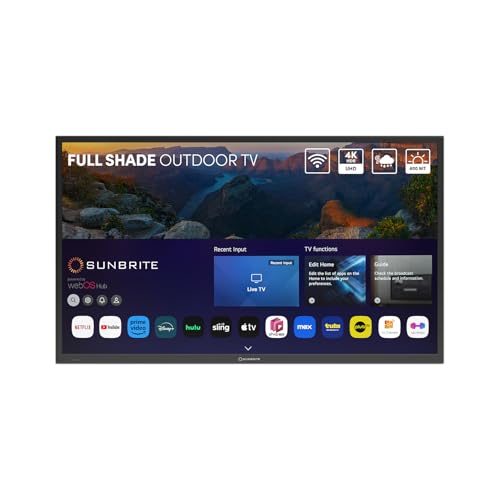
SunBrite Veranda 4 55″ — Best for covered patios (full shade)
Sunlight rating: full shade. The Veranda 4 closes the guide with the pick most buying advice forgets: the television for the covered patio, the deep porch, the pergola with a real roof, where direct sun never lands. SunBrite’s Veranda series is designed for exactly that placement, and this 55-inch Veranda 4 is a smart outdoor TV with 4K UHD and HDR, built weatherproof for a life lived permanently outside in the shade. Its rating is not a limitation to apologise for; it is a specialisation to match correctly.
Why does full shade need its own television at all? Because a covered patio is still an outdoor environment: humidity, temperature swings, dust, insects and ambient daylight far beyond any indoor room. An indoor set on a covered porch dies the same death as one in the open, only slower and with more false confidence. The Veranda’s weatherproof build addresses the environment, while its panel is specified for shaded ambient light rather than for fighting direct sun, which is why it can be priced below its partial-sun siblings without being a lesser product. It is the right tool, honestly labelled.
The discipline is in the matching. Put the Veranda where its rating says, under genuine cover, and it will serve for years with smart features and a proper outdoor picture for films, sport and streaming in the shade. Put it on a wall that catches two hours of direct evening sun and you have misapplied a specialised tool, and no warranty conversation will be improved by the word patio. SunBrite makes the partial-sun Signature for that wall, and it is two reviews above this one.
One more quiet virtue of the shade specialisation: because the Veranda’s panel is not fighting direct sun, it runs its backlight within itself, which suits long, gentle duty, the day-long tournament, the slow Sunday of sport and news under the porch roof. Specialisation, properly matched, is not a compromise at all; it is efficiency wearing the right label.
For the household whose outdoor life happens under a roof, and in many climates that is the household that uses its patio most, the Veranda 4 is not the budget afterthought of this guide. It is the precision pick, and its owners tend to be the most satisfied in the category, because their placement and their television were designed for each other.
- Panel: 55-inch, 4K UHD HDR
- Sunlight rating: full shade (Veranda series)
- Build: weatherproof outdoor construction
- Type: smart outdoor TV
- Model: SB-V4-55-BL
Strengths
- A specialist full-shade design, weatherproof for permanent outdoor life under cover.
- Priced for its specialisation rather than for sun-fighting it will never be asked to do.
- Smart features and 4K HDR cover the covered patio’s real viewing completely.
Trade-offs
- Full shade only, absolutely: direct sun placements will overwhelm and can damage it.
- Its panel is not specified for bright, open placements, by design.
- Buyers whose cover is partial should step up to a partial-sun pick instead.
Best for: covered patios, deep porches and roofed pergolas in permanent shade. Not suited for: any wall that receives direct sun, however briefly, on a regular basis.
How Does an Outdoor Television Live Through the Seasons?
Spring is installation season, and it is also inspection season for existing owners: ten unhurried minutes with a cloth, a ladder and a checklist in April is what stands between the household and a failure discovered in front of guests in June: check the mount’s fixings after winter, clear the vents and cable entries of the debris and tenants that a quiet season invites, and run the set through its paces before the first gathering rather than during it. Summer is the working season, where the disciplines are shade honesty and ventilation: a set mounted where a new tree or a moved parasol has changed its sun exposure should be re-rated with the same honesty as the original purchase, because patios evolve and ratings do not.
Autumn asks for cleaning and cover discipline. Pollen and dust bake onto an outdoor screen across a summer, and the correct cleaning is the gentle one, a soft cloth, minimal moisture, no solvents on the panel’s treatment. Winter divides households by climate. In mild regions the set stays mounted and covered, ready for the bright cold day that makes outdoor viewing a pleasure. In harsh ones, some owners bring the set into storage, and if that is your plan, the mount and the cable entries should be capped and the set stored upright in its cover, with the spring recommissioning treated as the small ceremony it is.
Keep the maker’s manual with the house documents rather than in the garage, because the details that matter in year three, the temperature range, the cleaning instructions, the mount’s torque, are exactly the ones nobody remembers from installation day.
Across all seasons, the habit that protects the investment is the cover, fitted whenever the set will sit for more than a day. Weatherproofing is engineered for weather, but ultraviolet, dust and insects are cumulative, and the cover is what stands between a five-year screen and a ten-year one.
Which Pick Suits Which Outdoor Life?
The entertainers, whose patio fills with people for sport and film nights all summer, belong with the 65-inch sets: the Signature 2 for specialist build, the Neptune when the installation itself is the project. The quiet couple whose covered porch is a morning-coffee and evening-film retreat belong with the Veranda 4, and they will likely be the most satisfied owners in this entire guide, because no pick here is more exactly matched to its habitat. The family with children, balls and a dog belongs with the Furrion, whose impact-resistant screen was designed by people who clearly have met a family.
The design-conscious household with a beautiful terrace and a flagship budget belongs with the Terrace, which looks and behaves like the Samsung flagship it is. And the experimenter, the household trying outdoor viewing for its first full summer, belongs with the Sylvox: capable, bright, honestly rated, and priced so that the lesson, whatever it turns out to be, is affordable. Notice that every one of those matches began with the sun and the space, and only then reached the brand. That order is the guide in one sentence.
Why Not a Projector, or a Bright Indoor Set in a Weatherproof Box?
Both alternatives have their advocates, and both deserve their hearing before this guide’s picks take your money. The projector’s case is scale and occasion: a huge image for a film night, packed away afterwards. Its limits are daylight, where even a strong projector washes out until dusk, and ritual, the screen, the alignment, the speakers, assembled for every use. A household whose outdoor viewing is the Saturday film after sunset can be genuinely happy with one. A household that wants the match at four in the afternoon, the news at breakfast and a screen that is simply there, cannot, and that household is this guide’s reader.
The weatherproof enclosure’s case is price: a box rated for the outdoors around an indoor television you already own or can buy cheaply. Its limits are heat, since a sealed box around a set that vents its warmth is a negotiation the indoor panel usually loses slowly, glare, since the enclosure’s own window adds a reflective layer, and sound and access, muffled speakers and remotes negotiating through plastic. Enclosures have saved many patios money and some have worked for years, but they are a compromise with a fan and a prayer where the sets in this guide are a design. Buy the compromise knowingly if the budget demands it; do not mistake it for the category.
The through-line of both alternatives is that they optimise one variable, scale or price, by spending the others. The purpose-built sets in this guide are what remains when a household wants the whole list at once: daylight, permanence, simplicity and a picture worth gathering around. That is a narrower and more expensive desire, and it is also, judging by the summers these televisions anchor, a very common one.
Shade Is a Specification: How the Six Outdoor Sets Divide by Sunlight
| Pick | Size | Sun rating | Distinguishing feature | Natural home |
|---|---|---|---|---|
| Samsung The Terrace | 55″ | Partial sun | Neo QLED, anti-glare | The flagship patio wall |
| SunBrite Signature 2 | 65″ | Partial sun | Specialist build, larger size | The big terrace |
| Furrion Aurora Partial-Sun 2 | 55″ | Partial sun | Impact-resistant screen, Wi-Fi antennas | The hard-used family deck |
| Peerless-AV Neptune | 65″ | Partial sun | Tilting outdoor mount included | The permanent installation |
| Sylvox Deck Pro 3.0 | 55″ | Partial sun | IP56, 1000-nit class, Google TV | The bright budget patio |
| SunBrite Veranda 4 | 55″ | Full shade | Weatherproof shade specialist | The covered porch |
The distinguishing-feature column is where the personalities live, and it is worth a slow read before the rating column settles the shortlist. Two households can share the same partial-sun wall and need different televisions, the one with toddlers needing the Furrion’s armour, the one with a cinema habit needing the Terrace’s panel, the one with a drill-shy wall needing the Neptune’s bundle. Ratings narrow the field; lives pick the winner.
Read the sun rating column as a set of promises with legal force. Five of these televisions promise to thrive where the sun visits part-time; one promises the shade; none promises the full glare of an exposed wall all day, and a guide that respected its readers would rather leave that row empty than fill it with a lie. If your wall is the missing row, shop the full-sun class deliberately, with this guide’s framework in hand.
How Do You Install and Run an Outdoor Television Properly?
Mount first, and mount for weather: an outdoor-rated mount, into structure rather than cladding, with the set’s weight and the wind’s opinion both respected. The Neptune buyer has this solved in the box; everyone else should buy the mount with the same seriousness as the screen. Route cables through the set’s gasketed entries as the maker intends, because the weather seal you casually defeat with a dangling cable is the one the warranty assumes you kept. Power should come from a properly protected outdoor outlet, installed by an electrician if the patio lacks one; extension leads across a lawn are a season’s accident waiting for its date.
Height and angle repay thought before the drill comes out. Outdoor seating is lower and more reclined than a living room’s, loungers and deck chairs rather than sofas, so the screen’s centre usually belongs a little lower than indoor instinct suggests, with the tilt the Neptune’s mount provides used to meet the audience’s eyes. Test the sightlines from the actual furniture with a cardboard template or a tape outline at the proposed position, at the hour the patio is most used, and let the glare you can see then, rather than the glare you imagine, settle the final angle.
Network and sound decide whether the installation gets used. Test the Wi-Fi at the mounting spot with a phone before the set goes up; if it is weak, the Furrion’s antennas, a mesh node indoors near the patio door, or a wired run are the fixes, in ascending order of effort. For sound, remember that outdoors has no walls to help: the sets’ own speakers serve conversation-level viewing, but film nights and sport with a crowd want an outdoor-rated soundbar or speakers, placed under the same cover as the screen. Finally, buy the cover. Even weatherproof sets live longer and cleaner under a simple fitted cover between uses, and it takes twenty seconds to fit on the way indoors.
Which Patio TV Mistakes Ruin the Most Summers?
The founding mistake is the indoor television carried outside in May and mourned in August, killed by condensation and heat that its design never contemplated. The second is rating optimism: calling a wall partial sun because it is shaded at the hour you happened to look, when July afternoons tell a different story. Rate the wall at its worst, in its worst month. The third is the orphan installation, a fine outdoor set on an indoor mount, fed by an indoor extension lead, streaming over Wi-Fi that does not reach, a system failing at every joint except the panel.
A fifth mistake is buying the screen and deferring the shade. Households often discover after installation that a modest shade sail or a pergola panel would have moved their wall down a full category, letting a cheaper set do the work or a better set do it easily. Price the shade in the same afternoon as the television; the two purchases are one decision wearing two hats, and the shade is usually the cheaper half of it.
The fourth mistake is forgetting the neighbours and the light. An outdoor screen at full brightness and volume at midnight is a neighbourhood event whether you intend it or not; the households that enjoy their patios longest are the ones whose setups are considerate by design, angled inward, covered when idle, and quiet after hours. Buy the television for the summer you want to be invited to as well as the one you want to host.
Final Recommendation
Match the rating to the wall and this category becomes simple. For the classic partial-sun patio, the Samsung Terrace is the flagship answer, the SunBrite Signature 2 the larger specialist alternative, the Furrion Aurora the durable value, the Peerless-AV Neptune the complete installed package, and the Sylvox the bright budget insurgent. Under a roof, the SunBrite Veranda 4 is the precision pick and should not be traded up out of habit. Do that matching honestly, install the system around the screen properly, and the first evening the match goes long, the light goes gold and nobody suggests moving indoors, the patio will have become what you actually bought: another room of the house, with a better ceiling.
Frequently Asked Questions
Can I just use a regular TV outside if I bring it in at night?
People do, and the television pays for it. Condensation forms as temperatures swing, dust and insects enter through vents designed for a living room, and ultraviolet and heat age the panel even in shade. A season or two is the usual sentence. A purpose-built outdoor set costs more because it is engineered against every item on that list, and it stays mounted, ready and warrantied for the life it is actually living.
What exactly counts as partial sun?
A placement where the screen receives direct sunlight for part of the day, typically a few hours, and shade for the rest: the wall under an eave, the terrace shaded by the house for most of its hours. Rate your own wall by watching where the sun actually strikes it across a day in the brightest month, and if the honest answer is most of the day, that is a full-sun placement regardless of what the patio is called.
None of these is rated for full sun. What should a full-sun buyer do?
Shop the dedicated full-sun class, which the major outdoor makers sell as separate, brighter and hardier lines, and budget for the step up, because it is real. Alternatively, change the placement: a shade sail, a pergola panel or a different wall can move a spot into partial-sun territory for less than the price difference between the classes. What a full-sun buyer should not do is install a partial-sun set and hope; the rating is the engineering, not a suggestion.
How do I get streaming and sport to an outdoor TV?
The smart picks here run the usual services on their built-in platforms where fitted, and every set accepts a streaming stick or a console in its weatherproof input compartment where provided. The practical bottleneck is usually Wi-Fi reach rather than the television, so test the signal at the wall first and solve it with placement, antennas or a mesh node. For broadcast, an outdoor aerial or a streaming live-TV service covers the sport.
Do outdoor TVs need covers if they are weatherproof?
Weatherproof means the set survives the weather, not that it enjoys it. A fitted cover keeps dust, pollen, insects and ultraviolet off the screen between uses, reduces cleaning, and extends the set’s best years. It is the cheapest accessory in the whole installation and the one owners most consistently recommend after a season.
Can an outdoor TV stay outside all winter?
The sets in this guide are built and rated for permanent outdoor life, and in most climates they stay mounted year-round under a cover. Check your chosen model’s operating and storage temperature range in its listing or manual against your region’s extremes; in genuinely severe winters, bringing the set into storage is the cautious route some owners take. Either way, the cover and the seasonal inspection in this guide are what separate a set that ages gracefully from one that merely ages.
How big should a patio television be?
Bigger than the indoor instinct suggests. Outdoor seating sits further back and spreads wider, daylight shrinks a picture’s apparent impact, and groups watch together. A 55-inch set serves an intimate patio well; a terrace where people sit three or four metres away should look at the 65-inch picks. Measure from the furthest regular seat, not the closest, because that viewer is the one the size is for.
What about sound outdoors, where there are no walls?
Plan for it separately. Television speakers are tuned for rooms, and outdoors their sound disperses; dialogue over a barbecue’s conversation is the first casualty. An outdoor-rated soundbar or a pair of outdoor speakers, mounted under the same cover as the screen, restores the balance. Keep maximum volume neighbourly; outdoors, your sound is everyone’s sound.
Related Guides
For the indoor side of the same problems, read our anti-glare television guide for rooms with difficult windows, the Roku television roundup for the simplest indoor streaming, and our QLED 4K guide to the brightest panels for living rooms.


