What's inside
- Where to buy
- Key Takeaways
- Quick Picks
- How did we choose these anti-theft travel backpacks?
- How do the six travel backpacks compare on security, honestly?
- What is the difference between TSA-friendly and anti-theft, exactly?
- How do you carry a travel backpack so a thief gives up?
- Where should valuables live inside a travel backpack?
- What can an anti-theft backpack not protect you from?
- What mistakes do anti-theft backpack buyers keep making?
- How do you layer protection for a genuinely high-risk trip?
- Which pick suits which kind of trip?
- How do airports change what “secure” means for a backpack?
- What should you do in the first ten minutes after a bag is stolen?
- How do you keep an anti-theft routine from ruining the trip?
- Should students and digital nomads think about anti-theft differently?
- What does “water-resistant” have to do with travel security?
- Final Recommendation
- Frequently Asked Questions
- Related Guides
As an Amazon Associate I earn from qualifying purchases. This post may contain affiliate links at no extra cost to you.
gizmoverdict.com is reader-supported. When you buy through links on our site, we may earn an affiliate commission.
Where to buy
The best backpacks for travel anti theft laptop carry start with a distinction most product pages blur on purpose, so this guide will make it in the first hundred words: a TSA-friendly backpack and an anti-theft backpack are not the same thing. TSA features — lay-flat laptop sections, ScanSmart layouts — exist to speed you through a security checkpoint. Anti-theft features exist to frustrate a thief: pockets hidden against your back, organisers that shield your cards from electronic skimming, designs that keep zips and openings away from strangers’ hands in a crowd. Some bags offer one family of features, some offer the other, a few offer elements of both, and the six verified picks below are labelled with complete precision about which is which, because buying a checkpoint convenience under the impression that you bought theft protection is the most dangerous mistake in this category.
Here is the honest census. Two picks state anti-theft design in their very names and titles: the MATEIN Anti-Theft Slim and the MATEIN 15.6 travel backpack, whose listing calls it an anti-theft bookbag. One pick, the SWISSGEAR 1900, carries a genuinely security-relevant feature in its RFID organiser, which shields cards and documents from skimming, alongside its TSA ScanSmart layout. The remaining three — the SwissGear 2769, the tomtoc 40L and the Targus Drifter II — are strong travel backpacks whose security value lies in sound design, close carry and sensible packing rather than in named anti-theft hardware, and their reviews say exactly that. Read the labels, not the vibes.
None of this makes the honest travel bags poor choices. Theft resistance in real journeys is a system — bag design, packing discipline, and the traveller’s own habits — and a well-made ordinary backpack carried intelligently outperforms a feature-laden bag carried carelessly every single day. This guide therefore does two jobs: it identifies the bags with verified protective features for travellers who want them, and it teaches the carrying system that makes any of the six picks meaningfully safer than the average backpack on the same train.
Key Takeaways
- TSA-friendly and anti-theft are different promises — ScanSmart means fast screening, not theft protection, and this guide never confuses them.
- Only the two MATEIN picks state anti-theft design in their listings; the SWISSGEAR 1900 adds a verified RFID organiser against skimming.
- The SwissGear 2769, tomtoc 40L and Targus Drifter II are included as strong travel carriers, honestly labelled as lacking named anti-theft hardware.
- Your habits are half the system: valuables against your back, bag in front in crowds, nothing precious in outer pockets.
- For high-risk itineraries, layer up — protective bag, sensible packing, and a money belt or hidden pouch for the truly irreplaceable.
Quick Picks
| Pick | Badge | Why it is here |
|---|---|---|
| MATEIN Anti-Theft Slim 15.6 | Best stated anti-theft design | A slim 15.6-inch travel backpack whose listing leads with anti-theft intent for daily travel carry. |
| MATEIN Travel Laptop Backpack 15.6 | Best all-round protected commuter | Listed as an anti-theft bookbag with a slim business profile and water resistance. |
| SWISSGEAR 1900 ScanSmart | Best against skimming | An RFID organiser guards cards and documents, inside a 31L TSA-friendly travel organiser. |
| SwissGear 2769 ScanSmart | Best checkpoint traveller | ScanSmart lay-flat convenience for up to 16-inch laptops — a travel feature, honestly not an anti-theft one. |
| tomtoc Travel Backpack 40L | Best one-bag security by simplicity | Forty carry-on litres that keep everything with you in the cabin — nothing checked, nothing separated. |
| Targus Drifter II | Best rugged travel carrier | Durable water-resistant build for up to 17-inch laptops, for travellers who prize toughness over features. |
How did we choose these anti-theft travel backpacks?
We read the listings the way a careful lawyer reads a contract: only what is written counts. A pick could anchor the anti-theft end of this guide only if its own title or listing claimed a protective feature — the word anti-theft, or a specific mechanism like an RFID-shielded organiser. Claims we could not find in a listing do not appear in these reviews; you will find no invented lockable zips, no imagined hidden pockets, no cut-proof fabrics conjured from optimism. Where a bag’s security story is behavioural — carry it well and it serves you well — the review frames it in those terms and trusts you to prefer the truth.
The rest of the selection weighed travel competence, because an anti-theft bag that fails as luggage protects a miserable trip very securely. Laptop fits are stated per listing — 15.6 inches for the two MATEINs, most 17-inch machines for the 1900, up to 16 for the 2769, up to 17.3 for the tomtoc, up to 17 for the Drifter — and capacities are quoted only where the maker states them. Between them, the six cover the slim daily traveller, the organised business flyer, the one-bag tourist and the rough-itinerary worker, which is the real population of people who search for this category.
We also considered what anti-theft design cannot do, and the guide returns to it in the advice sections: no backpack defeats a determined thief with time and privacy, and none should be treated as a safe. These bags win the realistic contests — the crowded platform, the distracted café moment, the opportunistic hand, the skimming reader in a queue — and a guide that promised more would be selling you a feeling instead of a product.

MATEIN Anti-Theft Slim 15.6 — Best stated anti-theft design
Start with the name, because in this case the name is the specification: this MATEIN is sold as an anti-theft slim travel laptop backpack for 15.6-inch machines, water-resistant, lightweight, and aimed at the daily commute and travel overlap where most laptop theft actually happens — not in dramatic heists, but in the unattended minute, the crowded carriage, the bag set down by a café chair. A slim profile is itself a security decision: the bag rides close, presents a small target, fits between your feet or against your legs in transit, and never becomes the bulky stranger magnet that a 40-litre pack turns into on a packed metro.
The daily-carry framing matters. This is the bag for the traveller whose journey is a commute plus a connection: train to the airport, flight, train again, with the laptop, documents and valuables consolidated in one close-fitting carrier. Its listing speaks to students, teachers, nurses and daily travellers — people whose bags live in shared, busy spaces all day — and the anti-theft intent answers that environment directly. Water resistance covers the weather legs of the journey, and the slim shape slips into overhead racks and under seats where larger bags must fend for themselves in distant lockers, out of sight and out of mind, which is precisely where bags get stolen.
Its limits are the limits of its class. Slim means selective: this is a laptop, documents and essentials carrier, not a weekend wardrobe, and travellers packing clothing should look at the tomtoc further down. Anti-theft design, even stated as plainly as here, also buys resistance and delay rather than immunity — it makes the opportunist move on to an easier bag, which is a victory worth having, but the owner must still supply the attention half of the system. For close-carry daily travel with a 15.6-inch laptop, though, no pick in this guide states its protective purpose more directly.
- Stated laptop fit: 15.6 inches
- Design intent: anti-theft, slim (per listing)
- Shell: water-resistant, lightweight (per listing)
- Audience in listing: commute, college, daily travel
Strengths
- Anti-theft purpose stated outright in the listing
- Slim, close-riding profile suits crowded transit
- Fits under seats and within sight, where safer bags live
Trade-offs
- Slim volume excludes clothing-heavy packing
- Protection is resistance and deterrence, not a guarantee
- 15.6-inch ceiling excludes larger laptops
Best for: daily travellers and commuters who keep a 15.6-inch laptop in crowded shared spaces. Not suited for: one-bag tourists packing several days of clothing.

MATEIN Travel Laptop Backpack 15.6 — Best all-round protected commuter
The second MATEIN in this guide is the grey 15.6-inch travel backpack whose listing describes it, among its other roles, as an anti-theft bookbag — a slim, sturdy business daypack, water-resistant, sized as a personal-item bag for flights. Where its slimmer sibling above is the specialist, this is the generalist: the bag a student, consultant or hybrid worker can carry through an ordinary week of offices and campuses, then take straight to the airport as the under-seat companion to a cabin suitcase, with its anti-theft character working quietly the whole time.
That personal-item dimension is a security feature in disguise, and worth dwelling on. A bag small enough to qualify as a personal item stays with you — under the seat, at your feet, inside your field of attention — rather than surrendering to an overhead bin three rows away where anyone’s hand can visit it during a darkened cabin’s quiet hours. Combined with the slim business profile that draws no attention in professional settings, the design’s philosophy emerges: the safest bag is the one that never leaves your custody and never advertises its contents. It is a less cinematic theory of anti-theft than locks and slash-proofing, and for most real journeys it is the more effective one.
Expect, in exchange, a businesslike rather than luxurious object: the grey finish is chosen to disappear, the organisation serves documents and daily tech rather than a photographer’s or gamer’s sprawling kit, and the 15.6-inch fit draws the usual hard line against bigger machines. Travellers whose laptop is larger should not squeeze and hope — the SWISSGEAR and tomtoc picks below exist for them. For the mainstream 15.6-inch travelling professional, this MATEIN is the guide’s most balanced answer: protected by design, presentable everywhere, and priced by a brand that competes on value.
- Stated laptop fit: 15.6 inches
- Design intent: anti-theft bookbag (per listing)
- Profile: slim business daypack, personal-item size (per listing)
- Shell: water-resistant; colour in listing: grey
Strengths
- Anti-theft character inside a fully business-appropriate design
- Personal-item sizing keeps the bag in your custody on flights
- Equally at home in a week of commuting and a weekend of travel
Trade-offs
- Organisation is business-focused, not expedition-grade
- Hard 15.6-inch laptop ceiling
- Understated styling will not excite design-led buyers
Best for: 15.6-inch laptop professionals who mix commuting and flying. Not suited for: travellers with larger laptops or multi-day clothing loads.

SWISSGEAR 1900 ScanSmart — Best against skimming
The 1900’s security credential is specific, and this review will be equally specific: its listing names an RFID organiser, a shielded section that prevents contactless cards and e-passports from being read by a skimming device passed near your bag. That is a real, bounded, verifiable protection against a real, bounded crime — electronic pickpocketing in crowded places — and it is worth more than a paragraph of vague “anti-theft” atmosphere. Alongside it, the bag is a 31L, 1200D polyester travel organiser with a TabletSafe pocket, a trolley sleeve, and a ScanSmart laptop section for most 17-inch machines — which, to repeat the guide’s founding distinction, is a TSA convenience for fast screening, valuable on its own terms and not a theft feature.
Judge the 1900, then, as a travel system with one genuine anti-theft component and a great deal of organisational intelligence. Its many assigned pockets serve security indirectly: a traveller whose passport, cards, laptop and tablet each live in a known place notices an absence immediately and fumbles never, and fumbling in public — bag open, attention inward, belongings displayed — is the moment opportunists wait for. The bag’s structure keeps you brisk and closed at exactly the moments when travel makes other people vulnerable.
Its honest debits mirror its virtues. It is a substantial, structured bag, heavier in spirit than the slim MATEINs and designed for travellers who pack a mobile office; minimalists will find it more bag than their journey needs. And its protective story, skimming aside, is the behavioural one — no hidden fortress pockets are claimed here, because the listing does not claim them. If your threat model centres on crowded terminals, card skimming and general travel chaos, the 1900 answers it with organisation and one very specific shield. That is a respectable, truthful offer.
- Stated laptop fit: most 17-inch laptops
- Stated capacity: 31L
- Security feature: RFID organiser (per listing)
- Checkpoint feature: ScanSmart lay-flat section — TSA convenience, not anti-theft
Strengths
- RFID organiser gives verified protection against skimming
- Deep organisation keeps you brisk and closed in public
- Large laptop fit and 31L suit serious business travel
Trade-offs
- Structured and substantial — more bag than minimal trips need
- No further anti-theft hardware is claimed by the listing
- ScanSmart helps at checkpoints, not against thieves
Best for: business travellers worried about skimming in crowded terminals. Not suited for: minimalists or travellers wanting a slim daily profile.
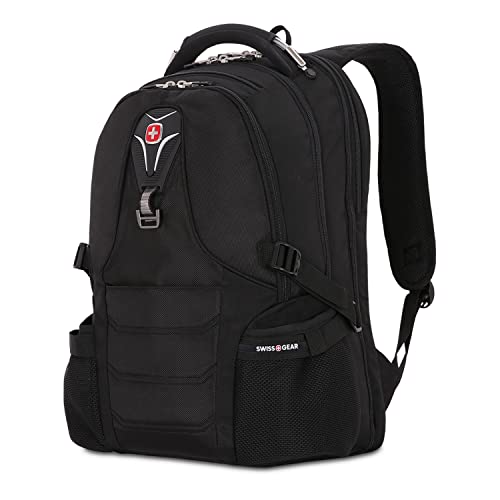
SwissGear 2769 ScanSmart — Best checkpoint traveller
The 2769 is in this guide under a label it did nothing to earn falsely, so let this review be the clearest in the set: its listing promises a ScanSmart, TSA-friendly backpack for laptops up to 16 inches, for work, school and travel — and ScanSmart is a checkpoint technology. The laptop section opens flat so the machine can be screened in the bag at many US checkpoints. That saves minutes and hassle. It does not lock, hide, shield or harden anything, and a traveller who buys this bag believing otherwise has been failed by whoever sold it to them, not by the bag, which delivers exactly what its name advertises.
What, then, is it doing in an anti-theft guide? Two things. First, category honesty requires showing readers where the boundary lies, with a respected example standing on the far side of it — many shoppers arrive at this category holding exactly this confusion. Second, the 2769 is a genuinely good travel backpack whose security is of the practical kind: a well-made bag from a travel specialist, carried close, packed sensibly, with the laptop in a dedicated section rather than advertising itself through a thin daypack wall. In low-risk itineraries — direct flights, business hotels, familiar cities — that practical level is the level most travellers actually need, and paying for heavier protection can be its own kind of waste.
Choose it with open eyes and it will serve you well: up to 16-inch laptops, SwissGear’s travel build, and the smoothest security-lane routine in this price territory. Choose the MATEINs above it if your journeys take you through genuinely crowded, high-opportunism environments where stated anti-theft design earns its premium. The guide’s job is to make that a conscious decision rather than a marketing accident, and the 2769 — a good bag, honestly described — is the perfect instrument for making it.
- Stated laptop fit: most 16-inch laptops
- Headline feature: ScanSmart TSA-friendly layout (per listing)
- Anti-theft hardware: none claimed in the listing
- Intended use in listing: work, school, travel
Strengths
- Excellent checkpoint routine for frequent flyers
- Travel-specialist build and organisation
- 16-inch fit covers larger laptops than the MATEIN pair
Trade-offs
- No anti-theft features — included for honest contrast
- Security depends entirely on your carrying habits
- Less organisational depth than the 1900
Best for: frequent flyers in lower-risk itineraries who value fast screening. Not suited for: travellers who need stated anti-theft protection — choose a MATEIN above.

tomtoc Travel Backpack 40L — Best one-bag security by simplicity
The tomtoc’s security argument is architectural rather than mechanical, and it is stronger than it first sounds: everything you own on the trip is in one bag, and that bag is in the aircraft cabin with you. Its listing states a 40L TSA carry-on, flight approved, water-resistant, with a laptop fit up to 17.3 inches. No checked luggage to be pilfered out of sight, no second bag to be forgotten in a taxi, no separation between the traveller and the valuables at any point in the journey. A remarkable share of travel theft is really travel loss-of-custody, and this design abolishes the category.
Within the cabin, custody continues to do the work. A 40L bag rides in the overhead bin or, on smaller aircraft, at your feet — either way, inside your journey’s perimeter rather than in a hold. The laptop sits in its own section within that perimeter, and the bag’s travel-first organisation keeps documents and small valuables distributed in interior spaces rather than dangling in exterior pouches. None of this is anti-theft hardware, and this review claims none; it is the security of consolidation, which experienced one-bag travellers swear by precisely because it removes opportunities instead of resisting them.
The debits are physical. Forty litres consolidated is forty litres carried, and a full one-bag load plus a large laptop tests shoulders on long airport walks. In a dense crowd — the exact environment the MATEINs are shaped for — a big bag is also a bigger presence to guard, swinging behind you where your eyes are not. The one-bag traveller’s answer is behavioural: bag to the front in crush conditions, bag between the feet at stops, valuables in the innermost compartments. Accept those habits and the tomtoc’s simplicity becomes a genuine security strategy; reject them and no bag in this guide will save the trip.
- Stated laptop fit: up to 17.3 inches
- Stated capacity: 40L
- Travel status: TSA carry-on, flight approved (per listing)
- Anti-theft hardware: none claimed — security by consolidation
Strengths
- One cabin bag means nothing is ever checked or separated
- Largest laptop fit and volume in this guide
- Interior organisation keeps valuables off the surface
Trade-offs
- No named anti-theft features
- Big profile needs active guarding in crowds
- Full loads are heavy on long walks
Best for: one-bag travellers whose security strategy is never losing custody. Not suited for: travellers wanting protective features built into the bag itself.

Targus Drifter II — Best rugged travel carrier
The Drifter II closes the guide as the pragmatist’s travel bag: a durable, water-resistant Targus backpack for laptops up to 17 inches, built for business and travel, with no anti-theft claims in its listing and no pretensions in this review. Its security contribution is the oldest one in luggage — toughness and anonymity. A bag that does not tear, burst a zip or shed a strap in a distant city is a bag whose contents stay inside it, and a plain black-and-grey workhorse announces nothing about whether it holds a workstation or a change of shoes.
There are itineraries where that profile is exactly right. The field engineer flying to a plant, the trainer touring regional offices, the aid worker or journalist whose travel is more about endurance than terminals — these travellers face weather, vehicles, rough handling and long days, and their bag’s first duty is to survive the trip intact with the laptop working at the end of it. The Drifter’s durable materials and simple, capacious layout serve that duty, and its lack of delicate features is, in context, a feature: there is little on it to break.
What it will not do is protect you in a crowd by design, speed you through checkpoints with a lay-flat section, or shield your cards from a skimmer. Travellers whose risk is urban and opportunistic should take the MATEINs seriously; travellers whose risk is distance and weather can take the Drifter. Including it in this guide is a deliberate editorial act: a category about travel security that only lists feature bags would fail the readers whose security problem is actually a durability problem, and there are more of them than marketing suggests.
- Stated laptop fit: up to 17 inches
- Shell: durable, water-resistant material (per listing)
- Anti-theft hardware: none claimed in the listing
- Model reference in listing: TSB239US
Strengths
- Tough build keeps contents inside the bag on rough itineraries
- Anonymous styling advertises nothing
- Simple layout leaves little to fail far from home
Trade-offs
- No anti-theft or checkpoint features at all
- Security is entirely the carrier’s responsibility
- Workwear looks rather than polished travel styling
Best for: rough-itinerary travellers whose main risk is the journey itself. Not suited for: crowd-heavy urban travel where stated anti-theft design matters.
How do the six travel backpacks compare on security, honestly?
| Backpack | Stated anti-theft element | TSA element | Stated laptop fit |
|---|---|---|---|
| MATEIN Anti-Theft Slim | Anti-theft design (listing) | Not stated | 15.6″ |
| MATEIN Travel 15.6 | Anti-theft bookbag (listing) | Not stated | 15.6″ |
| SWISSGEAR 1900 | RFID organiser | ScanSmart lay-flat | Most 17″ |
| SwissGear 2769 | None claimed | ScanSmart lay-flat | Up to 16″ |
| tomtoc Travel 40L | None claimed | Carry-on approved | Up to 17.3″ |
| Targus Drifter II | None claimed | Not stated | Up to 17″ |
Keep this table. It is the whole category in miniature: two bags with anti-theft in their names, one with a specific electronic shield, and three honest travel bags whose protection is you. Any seller whose pitch contradicts a row of this table is pitching, not informing.
What is the difference between TSA-friendly and anti-theft, exactly?
TSA-friendly design answers a regulator’s question: how fast can this bag be screened? A lay-flat or ScanSmart laptop section lets the machine travel through the scanner inside the bag, unfolded like an open book, at many United States checkpoints. It is a convenience engineered for a thirty-second moment in your journey, and a genuinely pleasant one — anyone who has repacked a bag on a filthy terminal floor while a queue breathed down their neck understands its value. But the scanner does not care about your bag’s safety after the checkpoint, and neither does the feature.
Anti-theft design answers a criminal’s question: how easy is this bag to take from, or take entirely? Its vocabulary is concealment and friction — openings placed where the owner’s body guards them, compartments a stranger cannot reach in a crowd, shielding that stops electronic reading of your cards, and shapes that stay close and unremarkable. The two vocabularies share no words. A bag can speak either, both or neither, and the comparison table above sorts this guide’s six picks accordingly. When you shop beyond this guide, perform the same sorting yourself: find the specific protective mechanism named in the listing, or conclude — correctly — that there isn’t one.
Why does the confusion persist? Because “travel security” is a phrase that sells, and a bag photographed at an airport acquires a security aura regardless of its features. Retail copy exploits the aura; this guide exists to dispel it. Neither feature family is superior — frequent flyers may rationally value the checkpoint speed more — but they are purchased for different journeys, and the traveller who knows which problem they are solving will solve it, while the traveller sold a blur will solve neither.
How do you carry a travel backpack so a thief gives up?
Thieves who target backpacks are economists: they spend seconds, avoid attention, and abandon any bag whose price in effort rises. Your carrying habits set that price. In crowds — markets, festival streets, crush-loaded transit — swing the bag to your front. It looks unglamorous and it ends the entire category of behind-your-back zip theft at a stroke, which is why seasoned travellers in busy cities do it without embarrassment. On a quiet street, one shoulder is an invitation; two straps, bag close, is a closed door.
At stops, the rules are physical. In a café, the bag goes between your feet with a strap looped around a leg or chair — not on the chair back, not beside you on the bench, not under the table’s far side where a passing hand can slide it away. On trains, it rides between your feet or on your lap in crowded services, and in the rack only when the rack is in your sightline and the valuables have migrated to your person. In queues, keep a hand resting on the bag when it is on the ground; contact is information, and you will feel what your eyes, fixed on the departure board, would miss.
Sound is part of the system too, though nobody lists it as a feature. A bag whose zips and hardware announce every touch keeps its owner informed in the dark of a night train or the noise of a crowded station hall; more practically, the discipline of keeping closures fully shut means any interference must first defeat a closed zip, which takes the two things thieves least want to spend — time and noise. Half-open bags, by contrast, can be harvested silently. Close the bag. It is the cheapest sentence in this guide and the one that does the most work.
Finally, manage the performance of wealth. The laptop should never be flashed in a risky environment and then visibly re-bagged; work sessions in public end with the machine disappearing into the bag without ceremony, and the bag leaving with you every single time — to the counter, to the restroom, everywhere. More laptops are stolen during the “just for a minute” absence than in any crowd. The best anti-theft feature ever designed is an owner who never gives the bag a minute alone, and it is available for every pick in this guide at no extra charge.
Where should valuables live inside a travel backpack?
Think in rings. The outer ring — front pouches, side pockets, anything a hand can reach while you wear the bag — holds only the replaceable and the worthless: tissues, a paperback, the cable you could lose without swearing. The middle ring holds the day’s working layer: charger, notebook, headphones, items whose loss would inconvenience rather than wound. The inner ring, deepest in the bag and closest to your back when worn, holds the laptop, passport, cards and cash reserve — the things whose loss ends trips.
Documents deserve a special note. Your passport should not share a pocket with anything you retrieve in public, because every retrieval is a display. Keep it in the inner ring, in its own sleeve or pouch, and carry a photograph of it on your phone for the hundred situations that need the number rather than the booklet. Cards split deliberately: the daily card rides accessible, the backup card lives in the inner ring, and if the SWISSGEAR 1900’s RFID organiser is your bag’s shield, the cards belong inside it — a shield only works on what it covers, a sentence so obvious that travellers violate it weekly.
The laptop itself sits against your back in its dedicated section in every pick here, which is the correct address for three reasons: it is the hardest place for a stranger to reach, the place your body notices contact, and the position where the machine is best protected from knocks. Resist the temptation to stuff that section with documents and cables “for convenience” — on TSA-layout bags it also breaks the lay-flat screening you may have paid for, and on all bags it presses hard objects against the one device that hates pressure.
What can an anti-theft backpack not protect you from?
From the bag being taken whole, in the scenarios where bags are taken whole: left in a vehicle, surrendered to an unlocked room, set down in a crowd while you photograph the view. Design features address access to a carried bag; they do nothing for an absent one. This is why the guide keeps returning to custody — the tomtoc’s consolidation, the MATEIN personal-item sizing, the café rules — because custody is the layer where most travel loss is actually decided.
Nor can any backpack in this guide promise to defeat a knife, a determined snatch or a professional crew; slash-resistance and locking hardware exist in the wider market, but no listing in this pool claims them, so this guide neither recommends nor implies them. Travellers whose itineraries genuinely involve such risks need a different conversation — about insurance, decoys, money belts and itinerary design — in which the backpack is a minor character. Honesty about the ceiling of a product category is part of reviewing it, and the ceiling here is opportunism: these bags, carried well, make you a hard target for the common, quick, quiet thefts that make up the overwhelming majority of travel losses. Against that majority, they are enough. Against the rest, awareness is the only product on offer, and at least it is free.
What mistakes do anti-theft backpack buyers keep making?
The founding mistake is the one this guide opened with: buying a TSA feature and believing it is a theft feature. It is made in good faith by thousands of travellers a year, encouraged by vague category pages, and it leaves them confidently unprotected in exactly the environments they bought the bag for. The second mistake is the mirror image — buying stated anti-theft design and then carrying the bag like an ordinary one: on one shoulder, on the café chair’s back, valuables in the front pouch because it is handy. Design and behaviour are multipliers, and a zero in either column zeroes the product.
Third, buyers concentrate all their valuables in the bag and call the concentration security. Passport, cards, cash, laptop, backup drive — one bag, one theft, total loss. Split the irreplaceable across your person and your bag, keep the backup card and an emergency cash reserve out of the backpack entirely, and the worst day becomes a bad day instead of a stranded one. Fourth, they buy the biggest bag for a security brief: large packs ride further from the body, swing wider in crowds and spend more time out of their owner’s sight in racks and bins. For protective purposes, the slim MATEINs in this guide are not the budget option — they are the doctrine option.
Fifth, they never rehearse the checkpoint. A TSA-layout bag delivers its benefit only if the laptop section contains the laptop alone and opens fully; a section stuffed with cables earns the slow lane and a hand search, in public, with the bag’s contents displayed — an anti-theft own goal scored at the one moment the whole airport is watching. And sixth, they forget that zips wear. A travel bag’s closures are its locks in practice; a failing main zip on any pick here should be repaired or the bag retired before a journey, not discovered at a foreign train station with the laptop visible through the gap.
How do you layer protection for a genuinely high-risk trip?
When the itinerary earns real concern — overnight trains, festival cities, regions your insurer asks questions about — build the system in layers and let the backpack be only one of them. The innermost layer is on your body: a money belt or hidden pouch carrying the passport, backup card and emergency cash, immune to anything that happens to any bag. The next layer is the bag choice itself: a stated anti-theft design like the MATEIN pair, sized slim, carried in front in crowds. Around that goes behaviour: the café rules, the custody discipline, the refusal to flash the laptop in exposed places.
Then come the digital layers, which travellers forget until they need them. The laptop should be encrypted, backed up before departure, and signed into its manufacturer’s find-my-device service; a stolen machine whose data is safe and whose replacement is an errand is a different loss from a stolen machine that takes your work and identity with it. Photograph your documents, store the copies in the cloud and with a trusted person at home, and carry the insurer’s number somewhere that is not the bag.
Finally, insure and accept. Some risk survives every layer, and the traveller who has layered honestly can do the most important thing of all: relax into the journey. Paranoia is not a security strategy — it is a tax on the trip you took all this trouble to enjoy. The point of the bags and habits in this guide is to buy that relaxation legitimately, with systems that work while you are busy looking at the world instead of guarding your back.
Which pick suits which kind of trip?
Take the city break first: three days, one hotel, dense sightseeing, transit passes and crowded old-town streets. The laptop travels for the evenings — photos, bookings, a film — and the days are spent in exactly the crush conditions this category exists for. The MATEIN Anti-Theft Slim is the shape of that trip: close, quiet, sized for the machine and the day’s essentials, happy under a café table between your feet. Its owner gives up wardrobe space and gains the thing the trip actually risks.
The business circuit is a different silhouette. Flights weekly, laptops at 15.6 or 17 inches, cards and documents that must stay organised and shielded, hotels with safes and clients with impressions to make. Here the choice splits by laptop: the MATEIN 15.6 Travel for the mainstream machine in a personal-item profile, the SWISSGEAR 1900 for the 17-inch traveller who wants the RFID organiser and the mobile-office structure. Both look correct in a meeting room, which on this circuit is a security feature too — the bag that belongs attracts no second look.
The long one-bag journey — a fortnight, three climates, trains between — belongs to the tomtoc, with custody as its doctrine and the traveller’s habits as its hardware. And the expedition at the rough end, where the laptop is a tool among tools and the road is the risk, belongs to the Drifter II. Trips differ; threats differ; the guide’s six answers differ accordingly, and a reader who can name their trip can name their bag.
How do airports change what “secure” means for a backpack?
Airports are the one environment where your bag is routinely, legitimately opened, separated from you and handled by strangers — which makes them a useful stress test for security thinking. The screening moment rewards the TSA-layout designs: laptop section flat, nothing else in it, bag closed again in seconds. The separation moments — the bin, the belt, the moment your bag clears the arch before you do — reward the opposite quality: a bag so unremarkable and so closed that thirty seconds out of your hands contains no opportunity at all. Zips fully closed, nothing dangling, nothing in the outer pockets worth a hand’s detour.
The gate area adds its own chapter. Bags fall asleep there, figuratively and sometimes literally with their owners, and the seasoned routine is tactile: bag against the leg, strap around an ankle while seated, laptop section facing your body rather than the aisle. On the aircraft, custody splits by bag size — the personal-item MATEIN rides at your feet in your territory, while the tomtoc’s 40 litres go overhead, which is precisely why its doctrine is consolidation with valuables riding in the innermost spaces rather than in anything resembling a quick-access pouch.
None of this requires fear; airports are statistically kind to luggage. It requires rhythm — the same small closures and contacts repeated until they are manners rather than measures. Travellers who build the rhythm find that it transfers everywhere: stations, cafés, conference halls. The airport, in that sense, is where an anti-theft traveller is trained, whatever bag they happen to be carrying.
What should you do in the first ten minutes after a bag is stolen?
Rehearse this once, calmly, and hope to waste the rehearsal. Minute one: confirm the loss is theft and not misplacement — retrace, ask, check the café’s counter — because half of all “stolen” bags are standing where their owners left them. If it is gone, the phone in your pocket becomes the command centre: change the passwords that matter, starting with email, since email resets everything else; trigger the laptop’s find-and-lock service; call the bank about the cards that were in the bag; and note the time, because insurers and police reports both run on specifics.
Then the documents. If your passport travelled separately — as this guide’s layering advice insists — you are inconvenienced. If it was in the bag, your embassy or consulate is the next call, and the photographs of documents stored in the cloud become the most valuable files you own. File the police report even when recovery seems hopeless; insurance claims and replacement documents both lean on it.
Notice what this protocol assumes: backups made before departure, document copies in the cloud, a backup card outside the bag, a phone that survived because it was on your body. Every one of those assumptions is a decision you make at home, in comfort, for free. The anti-theft backpack buys you odds; the preparation buys you the aftermath. A complete traveller purchases both, and this guide has now sold you the second one at the unbeatable price of a few paragraphs’ attention.
How do you keep an anti-theft routine from ruining the trip?
By making it small. The travellers who sustain good security for a whole journey are never the ones performing elaborate rituals at every doorway; they are the ones with five habits so practised they cost no attention at all. Bag closed — always, the moment anything goes in or out. Bag in contact — feet, leg, hand, back — whenever it is not on both shoulders. Valuables inward, split, and boring. Laptop invisible in risky places. And the one-minute rule inverted: the bag never spends a minute alone, so you never have to wonder about the minutes.
Everything else is situational garnish. In a quiet village, relax like a local. In a festival crush, bag to the front like a veteran. The skill is calibration, and calibration comes from the same place as good travelling generally: watching how the people who live there carry their own things, and quietly copying them. No product in this guide, or anywhere, substitutes for that observation — the bags are equipment for a traveller, and the traveller remains, reassuringly, the main technology.
Should students and digital nomads think about anti-theft differently?
Yes, because their exposure is longer and their environments are shared. A tourist passes through a risky square; a student lives in the library, the shared kitchen, the overnight bus, week after week, and probability compounds over semesters in a way it never does over holidays. For that reader, the slim MATEIN designs earn a special recommendation: the laptop is their livelihood and their coursework in one object, the bag is in communal spaces daily, and a stated anti-theft design sized to stay on the body or between the feet is worth more than any feature aimed at airports.
Digital nomads add a second twist: their bag is also their office, and it sits in coworking spaces and cafés for entire working days, in cities they may have arrived in last week. Their discipline is the café protocol from this guide, industrialised — bag anchored, valuables split, laptop locked to the table by habit of never leaving it, work backed up to the cloud continuously because the machine’s loss must be an errand, not a catastrophe. For both groups, the lesson of this category scales with exposure: the longer your laptop lives in public, the more the boring layers — design, custody, backups — outperform any single clever feature.
What does “water-resistant” have to do with travel security?
More than the phrase suggests, and every pick in this guide except the SwissGear pair states some form of it. A soaked bag is a vulnerable bag: its owner sets it down in places they would never choose, opens it to rescue the contents, displays the laptop while rearranging wet layers, and generally performs the distracted, belongings-spread pantomime that opportunists watch for. Weather resistance is therefore a quiet security property — it keeps the system closed and the owner composed when the sky misbehaves. It is not waterproofing, and a storm still demands a cover or a doorway, but the showers of ordinary travel are exactly the moments when composure is most often lost and most worth keeping.
Final Recommendation
If stated anti-theft design is what you came for, the guide’s answer is uncomplicated: the MATEIN Anti-Theft Slim for the closest, quietest daily carry, and the MATEIN 15.6 Travel for the same protection in a more businesslike, personal-item form. If your fear is specifically electronic — cards skimmed in a crowd — the SWISSGEAR 1900’s RFID organiser is the one verified shield in the set, wrapped in an excellent travel organiser. And if your itinerary is honestly lower-risk, the 2769, the tomtoc and the Drifter II will serve you well, provided you choose them for what they are: a checkpoint sprinter, a one-bag consolidator and a rugged survivor. Whichever of the six lands on your back, spend the journey’s first day deliberately — zips closed by reflex, bag in contact at every stop, valuables riding in the inner ring — because habits installed on day one protect you on every day after, in every city, in bags you have not bought yet. Buy the bag that matches your real threat, carry it like you mean it, and the most likely outcome — by a very wide margin — is that your laptop comes home with you, along with the trip you actually wanted.
Frequently Asked Questions
Does TSA-friendly mean my backpack is anti-theft?
No. TSA-friendly and ScanSmart describe how a laptop section opens for security screening — a convenience for checkpoints. Anti-theft design describes resistance to thieves: concealed or protected access, anti-skimming shielding, close-carry shapes. A bag can have either, both or neither; the comparison table in this guide sorts all six picks by exactly that distinction, using only what their listings claim.
What does an RFID organiser actually protect?
It shields contactless payment cards and e-passports from being read wirelessly by a skimming device at close range — the crime sometimes called electronic pickpocketing. The SWISSGEAR 1900’s listing names an RFID organiser, so cards and documents placed inside it gain that protection. It protects only what is inside the shielded section, and it does nothing against physical theft of the bag or its contents.
Is an anti-theft backpack worth it for a normal holiday?
For most holidays in familiar, lower-risk destinations, a well-made travel backpack carried with the habits in this guide is sufficient, and the honest travel picks here exist for exactly that reader. Where anti-theft design earns its place is crowded, opportunism-rich environments — packed transit systems, markets, festivals, overnight trains — and for travellers carrying a laptop they cannot afford, professionally or financially, to lose. Judge by itinerary, not by anxiety.
Where is the safest place for a laptop inside a backpack?
In its dedicated section against your back, as all six picks arrange it. That position is hardest for a stranger to reach while you wear the bag, closest to your body’s awareness of contact, and best protected from knocks. Keep that section for the laptop alone — extra hard objects pressed against the machine risk screen pressure damage and, on lay-flat designs, defeat the screening layout.
Is a smaller backpack really safer than a bigger one?
Generally, yes, for the environments this category worries about. A slim bag stays against your body, fits at your feet in transit and cafés, qualifies as a personal item that never leaves your custody on a flight, and presents a smaller, less promising target in a crowd. A large bag earns its keep when the trip genuinely needs its volume — the tomtoc’s one-bag doctrine is a real strategy — but it should be chosen for the packing, with its guarding costs understood, rather than by default. When in doubt, the smaller bag that still fits your laptop and your day is the safer traveller.
Should I put a tracker in my travel backpack?
A small Bluetooth tracker in an inner compartment is a reasonable extra layer for many travellers: it will not prevent a theft, and its range and network depend on the ecosystem it belongs to, but it can help locate a bag mislaid in a terminal or left in a taxi — the loss scenarios that, as this guide keeps noting, outnumber dramatic thefts. Treat it as a recovery aid for honest mistakes, yours and others’, rather than as a security system, keep it in the inner ring where a quick hand will not find and discard it, and remember that it supplements the custody habits rather than replacing a single one of them.
Can a thief still steal an anti-theft backpack?
Yes, if it is left unattended, and no design feature in any listing here claims otherwise. Anti-theft design resists access to a carried bag and deters the opportunistic thefts that dominate travel crime statistics. Against loss of custody — the bag set down, left in a vehicle, surrendered to an unlocked space — only your habits protect you, which is why this guide teaches them alongside the products.
Related Guides
Travelling with the rest of your tech? Best Acer Laptops: Aspire, Swift and Chromebook Picks for Work, Study and Travel covers the machine itself, and Best Accessories for Laptops: Docks, Stands, Sleeves and Cooling Pads rounds out the kit that rides inside these bags.


