What's inside
- Where to buy
- Key Takeaways
- Quick Picks
- How did we choose these compact laptop backpacks?
- How do the six compact backpacks compare side by side?
- What fits in a compact laptop backpack — honestly?
- How do you pack a compact backpack so it stays compact?
- Why does a smaller bag change how a commute feels?
- What mistakes do buyers of compact laptop backpacks keep making?
- Which compact pick matches which kind of day?
- How does compact carry work for travel?
- How do you live with a compact bag in winter?
- What should you check in the first month with a compact backpack?
- How long do compact backpacks last?
- Should students choose compact bags?
- What is the difference between a compact backpack and a laptop sleeve with straps?
- How do compact backpacks handle cycling commutes?
- What does compactness cost — and when is it worth paying more?
- How do you keep a compact bag from becoming a cluttered one?
- What is the compact bag’s place in a two-bag life?
- Final Recommendation
- Frequently Asked Questions
- Related Guides
As an Amazon Associate I earn from qualifying purchases. This post may contain affiliate links at no extra cost to you.
gizmoverdict.com is reader-supported. When you buy through links on our site, we may earn an affiliate commission.
Where to buy
The best compact laptop backpacks are built on a refusal: the refusal to carry air. Most backpacks are sold by volume, and volume is a trap — a big bag fills with just-in-case, rides wide in crowds, sags when half empty and turns a laptop commute into a luggage exercise. The compact philosophy inverts it. A slim body, a low litre count, a laptop held close, and exactly the day’s necessities arranged with intent: that is the proposition, and the six verified picks below embody it in their listings — stated capacities at 20, 24 and 26 litres, slim profiles named outright, and designs that treat smallness as the feature rather than the apology.
Compact does not mean fragile or toy-like, and this guide’s picks prove the range of the idea. At one end sits a slim anti-theft commuter for a 15.6-inch laptop; at the other, a rugged 26-litre Thule that is compact only by the standards of outdoor packs — included deliberately as the category’s ceiling, so readers can see where compact ends. Between them stand two 20-litre designs from Peak Design that hide a full camera system inside an everyday silhouette, a 24-litre tomtoc that has become the reference size for the disciplined daily load, and a SwissGear travel design that packs a 16-inch laptop and a checkpoint routine into a trim profile.
Who is compact for? The commuter on crowded transit, where inches are territory. The traveller who wants a personal item that never leaves their feet. The minimalist whose laptop, charger, notebook and layer constitute a complete and satisfying kit. And — quietly, the largest group — everyone whose current bag is half empty five days a week and has started to suspect the bag, not the load, is the problem. If that suspicion brought you here, this guide is the confirmation and the cure.
Key Takeaways
- Compact is a profile before it is a number: slim against the back, low in litres, and honest about the load it serves.
- Stated sizes here run 20L, 24L and 26L — the tomtoc 24L is the reference daily volume, the Peak pair the smallest full systems.
- The MATEIN Anti-Theft Slim is the truest compact commuter: slim by name, 15.6-inch fit, close-riding by design.
- A compact bag disciplines packing permanently — owners carry less, find things faster and stop hauling just-in-case.
- Check the laptop fit with extra care in this category: compact bags draw their size lines firmly, at 15, 15.6 or 16 inches here.
Quick Picks
| Pick | Badge | Why it is here |
|---|---|---|
| tomtoc 24L Laptop Backpack | Best all-round compact | 24L fitted for laptops up to 16 inches — the disciplined day’s reference volume in a clean profile. |
| MATEIN Anti-Theft Slim 15.6 | Best slim commuter | Slim by name and anti-theft by design, for 15.6-inch laptops in crowded daily transit. |
| Peak Design Everyday Backpack 20L | Best compact system | A full divider-based carry system for camera and 15-inch laptop inside a 20L everyday body. |
| Peak Design Everyday Backpack Zip 20L | Best compact profile | The smoothest 20L silhouette here, with a 270-degree zip and a 15-inch laptop sleeve. |
| SwissGear 2769 ScanSmart | Best compact traveller | A trim TSA-friendly design that still takes laptops up to 16 inches for work, school and travel. |
| Thule Chasm Backpack 26L | Best rugged compact ceiling | 26L of Thule toughness — the largest bag that can still honestly be called compact in this guide. |
How did we choose these compact laptop backpacks?
The filter combined a stated size with a stated shape. A pick needed a capacity in the compact band — 20 to 26 litres where a figure is published — or a listing that names slimness as the design’s intent, as the MATEIN’s does. Laptop fits were then checked to keep the guide useful across the real compact population: 15 inches for the Peak pair, 15.6 for the MATEIN, up to 16 for the tomtoc and the SwissGear, with the Thule included as a laptop-carrying rugged option at the band’s upper edge. Anything whose brief was volume — the 30- and 40-litre travel class — was excluded no matter how good, because a compact guide with a 40-litre pick in it would be a prank.
Within the band, we weighted the qualities compact buyers actually live with: how the bag rides in a crowd, whether it stands or slumps at a desk, how completely it disappears under a train seat or a café table, and whether its organisation respects the small load rather than fragmenting it into a dozen pockets designed for a bigger bag’s cargo. Compactness is an ergonomic property before it is a dimensional one, and the reviews below judge it that way.
We also kept the category honest about its trade. Every litre not carried is a litre that cannot swallow the unexpected — the parcel, the purchase, the extra layer the weather suddenly demands. The reviews name, for each pick, the moment its size will pinch, because a compact bag bought with open eyes becomes a beloved discipline, and one bought on a photograph becomes a return label.

tomtoc 24L Laptop Backpack — Best all-round compact
Twenty-four litres has quietly become the connoisseur’s size, and the tomtoc is the reason made physical. Its listing states the fit — laptops up to 16 inches, the 16-inch MacBook Pro class named — the capacity, and the intended lives: work, commute, business, college, weekend trips. In person-sized terms, 24L is a laptop, its charger, a notebook, a layer, lunch and a paperback, arranged in a bag that keeps a clean, close profile through all of it. Nothing about the day is missing, and nothing about the bag suggests a removal business. That balance — complete but not capacious — is the compact ideal, and this pick is its benchmark.
The tomtoc’s laptop-first heritage matters at this size. A compact bag has no spare volume to hide a badly placed laptop compartment; the machine must ride against the back, held properly, in a bag drawn around it. tomtoc built its name on protective electronics carry, and while this review claims only what the listing states, the brief’s priorities are legible: this is a daypack designed from the laptop outward, for owners whose computer is the day’s most important and most expensive passenger. The 16-inch fit widens the welcome to the newer creator class without inflating the bag for everyone else — a neat trick of proportion.
The pinch points are the category’s own. A gym kit plus a workday will not fit; a weekend’s clothing turns the “weekend trips” of the listing into an exercise in ruthless editing; and buyers who habitually rescue objects — parcels, purchases, other people’s forgotten chargers — will find 24L a strict editor of their kindness. For the disciplined daily load, though, the tomtoc is the guide’s clearest recommendation: the compact bag against which the others’ compromises are measured.
- Stated laptop fit: up to 16 inches, including 16-inch MacBook Pro class
- Stated capacity: 24L
- Intended use in listing: work, commute, business, college, weekend trips
- Design focus: laptop-first everyday carry
Strengths
- The reference compact volume — complete for the day, nothing spare
- Stated 16-inch fit without an inflated silhouette
- Clean profile suits office, campus and transit equally
Trade-offs
- Gym kit or weekend clothing breaks the budget of litres
- No room for the habitual rescuer of objects
- Pocket-by-pocket detail is left for the product page to show
Best for: commuters and students with a disciplined daily load and a laptop up to 16 inches. Not suited for: travellers packing clothing or carriers of bulky extras.

MATEIN Anti-Theft Slim 15.6 — Best slim commuter
The MATEIN wears its two defining adjectives in its name — anti-theft, slim — and in the compact category the second may matter even more than the first. This is a slim, water-resistant, lightweight travel laptop backpack for 15.6-inch machines, aimed at the commute and daily travel, and its slimness is a complete philosophy of crowded-space living: the bag rides close enough to forget, fits between the feet on any train, slides under any café table, and never becomes the wide, swinging obstacle that full-size packs turn into at rush hour. Compactness, here, is not a smaller version of a big bag. It is a different relationship with public space.
The anti-theft intent compounds the profile’s virtues. A bag that stays against your body, in your sightline and at your feet is a bag that spends its day in custody, and the stated anti-theft design addresses the environments the listing names — college, commuting, daily travel — where bags are set down in shared rooms and carried through crowds. For the student whose laptop lives in libraries and lecture halls, or the commuter whose railway carriage is a daily crush, the combination of slim and protected is not two features. It is one argument, made twice.
The boundaries are drawn by the same slimness. Fifteen-point-six inches is the ceiling and the standard — owners of 16-inch machines must look at the tomtoc or the SwissGear in this guide — and the volume serves the day, not the weekend: a laptop, its kit, documents and essentials, with clothing limited to a layer rather than a wardrobe. Within that brief, though, the MATEIN is the most single-minded pick here, and single-mindedness, in the compact category, is the highest compliment available.
- Stated laptop fit: 15.6 inches
- Design intent: anti-theft, slim (per listing)
- Shell: water-resistant, lightweight (per listing)
- Audience in listing: commute, college, daily travel
Strengths
- Slimmest, closest-riding profile in the guide
- Anti-theft design aimed at crowded shared spaces
- Lightweight build suits long daily carries
Trade-offs
- Hard 15.6-inch laptop ceiling
- Day-sized volume excludes clothing-heavy loads
- Less organisational sprawl than travel designs
Best for: students and commuters in crowded transit with 15.6-inch laptops. Not suited for: 16-inch owners or weekend packers.

Peak Design Everyday Backpack 20L — Best compact system
Twenty litres is where most bags give up and become a pouch with straps. The Everyday 20L instead contains a system: its listing names FlexFold dividers, dual side access and a MagLatch top — a full reconfigurable interior for camera carry and daily life — plus a laptop sleeve stated for a 15-inch machine. That density of design inside a compact body is this pick’s whole claim, and it is aimed at a specific, growing reader: the person whose bag must be small because their day is mobile, but organised because their kit is serious. Photographers will recognise the divider system from this site’s camera guide; here, judge it as a compactness technology, because configurable cells are how 20 litres behaves like 28.
The trick is that dividers abolish dead space. An ordinary 20L bag is a bucket whose usable volume depends on the shapes you pour into it; the Everyday’s folding partitions reshape the interior around each day’s actual cargo — camera-shaped on Saturday, office-shaped on Monday — so almost every litre works. Add the side access, which lets the bag be used without being unpacked, and the compact body stops feeling like a compromise at all. It feels like an edit: the same capabilities, with the waste removed.
The costs are the system’s weight and the laptop ceiling. Structure is never free, and this 20L carries more design per litre — and more grams — than the simple picks around it. The 15-inch laptop limit is also firm, excluding the 16-inch class entirely. And minimalists who carry three objects will find the divider architecture underemployed, like a filing cabinet bought for a postcard. For the compact carrier whose load is varied and valuable, though, no bag in this guide does more with less room.
- Stated laptop fit: 15-inch laptop
- Stated capacity: 20L
- Interior system: FlexFold dividers, dual side access, MagLatch top (per listing)
- Colour in listing: black
Strengths
- Reconfigurable interior makes 20L behave like much more
- Side access suits a mobile, stop-start day
- Serious kit organisation in the guide’s smallest class
Trade-offs
- Structure adds weight per litre
- Firm 15-inch laptop ceiling
- Over-engineered for a three-object daily load
Best for: mobile carriers whose varied kit travels with a 15-inch machine. Not suited for: owners of 16-inch laptops or true minimalists.

Peak Design Everyday Backpack Zip 20L — Best compact profile
If the Everyday 20L is compactness as engineering, the Zip is compactness as tailoring. Its listing describes a 20L pack with a 270-degree zip opening, dual side pockets and the same FlexFold divider family inside, for a 15-inch laptop — but the quality that defines it in person is the silhouette: smooth, minimal, uninterrupted, the bag most likely in this guide to be mistaken for a fashion object rather than equipment. In compact design, the profile is not decoration. A smooth bag slides into the gaps of a crowded day — between seats, under desks, past turnstiles — without snagging on them, literally and socially.
The wraparound zip is the profile’s working partner. Opening the bag fully, like a case, suits the compact packer especially well, because small bags punish rummaging: there is no room for a sediment layer, and a design that displays everything at once keeps the interior honest. Hotel rooms, coworking desks, the nightly repack of a travelling week — the Zip’s layout turns each into a thirty-second audit. The dividers, meanwhile, give the 20L the same shape-shifting interior as its sibling, so the clean face is not bought with a bucket’s chaos inside.
Choose between the two Peak designs by temperament. The Zip gives up the MagLatch’s instant, load-adjusting top entry of the Everyday, and its access is deliberate rather than spontaneous — a trade the tidy accept gladly and the hurried should not. It shares the 15-inch laptop ceiling and the structure’s weight. What it returns is the guide’s most liveable compact object: a bag that looks like nothing, organises like everything, and disappears into a professional day more completely than any pick here.
- Stated laptop fit: 15-inch laptop
- Stated capacity: 20L
- Access: 270-degree zip, dual side pockets (per listing)
- Interior system: FlexFold dividers (per listing)
Strengths
- Smoothest, most discreet silhouette in the guide
- Full-opening zip makes small-space packing visible and honest
- Divider system retained in full
Trade-offs
- No instant top access of the MagLatch design
- Firm 15-inch laptop ceiling
- Structure adds weight, as with its sibling
Best for: design-conscious professionals with a 15-inch laptop and a tidy load. Not suited for: users who live on one-handed top access.
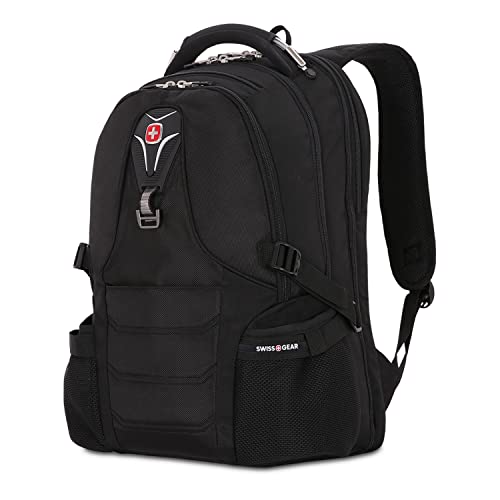
SwissGear 2769 ScanSmart — Best compact traveller
The 2769 earns its compact place on profile rather than a published litre figure: a trim, travel-bred SwissGear design whose listing promises a ScanSmart TSA-friendly layout for laptops up to 16 inches, for work, school and travel. Among this guide’s picks it is the traveller’s compact — the bag for the person whose small load still passes through airports, and who refuses to choose between a slim daily profile and a civilised security routine. The lay-flat laptop section opens for screening and closes in seconds, a rhythm the daily flyer learns to love, and the whole bag keeps the close, unembellished shape that compact travelling demands.
The 16-inch fit is its quiet distinction in this company. The Peak pair stop at 15, the MATEIN at 15.6; the 2769 takes the newer 16-inch class inside a still-trim body, which makes it the compact answer for owners of larger laptops who decline to be exiled to the travel-bag category for their screen size. SwissGear’s travel specialisation underwrites the rest: this is a maker’s whose entire catalogue is the journey, and the 2769’s organisation reflects a commuter-flyer hybrid life rather than a hiker’s or a student’s.
Its concessions are depth and specification. The organisation is a step below its larger 1900 sibling’s mobile office, and the listing does not publish a litre capacity, so this guide classes it by profile and brief rather than by a number it was never given. Travellers who need the number, or the volume it would describe, should take the tomtoc’s stated 24L as their reference. For the 16-inch owner whose trips are frequent and whose load is disciplined, the 2769 remains a singularly well-aimed design.
- Stated laptop fit: most 16-inch laptops
- Layout: ScanSmart TSA-friendly (per listing)
- Capacity: not stated in the listing — compact by profile
- Intended use in listing: work, school, travel
Strengths
- 16-inch fit inside a trim, compact profile
- Checkpoint routine suits frequent flyers
- Travel-specialist design and organisation
Trade-offs
- No published litre capacity to compare
- Less organisational depth than the 1900
- Less minimal than the true slim picks
Best for: travelling professionals with 16-inch laptops and disciplined loads. Not suited for: buyers who shop by stated litre figures alone.

Thule Chasm Backpack 26L — Best rugged compact ceiling
Every category needs its boundary marker, and the Chasm is this one’s: a 26L Thule in black, from a maker whose natural habitat is the roof rack and the trailhead, carrying a laptop within a rugged general design. Twenty-six litres of Thule is not slim, and this guide does not pretend otherwise — the Chasm is compact the way a estate car is compact, by comparison with the trucks. It is here because a real population of compact buyers lives outdoors: their “small bag” must survive weather, abrasion and the boot of a vehicle, and for them the Chasm is the smallest honest option, the point where ruggedness and compactness stop arguing.
Judge it on that population’s terms. The cyclist who rides to a trail-adjacent office, the field researcher whose commute ends where the pavement does, the traveller whose personal item must also be their daypack at a rugged destination — these readers need Thule’s build philosophy in the smallest available dose, and the Chasm’s 26L delivers it with room for the laptop, the layers and the day’s tools in one weather-ready body. Its volume also gives it the guide’s most forgiving packing: where the 20L pair demand editing, the Chasm merely requests it.
The costs are the boundary’s own. Against the MATEIN or the tomtoc, the Chasm is wider, heavier in spirit and far more bag than a train carriage wants; its laptop story is that of a capable general pack rather than a laptop-first design, and this review claims no dedicated system for it beyond the listing’s own framing. Buy it when your compact life is rugged. Buy anything else in this guide when it is merely urban — the distinction is the review.
- Stated capacity: 26L
- Brand line: Thule Chasm, black (per listing)
- Laptop role: laptop carry within a rugged general pack
- Position in guide: the compact category’s upper boundary
Strengths
- Outdoor-grade toughness in the smallest Thule dose
- Most forgiving packing of the six picks
- One bag for office-adjacent and trail-adjacent days
Trade-offs
- Largest and widest presence here — compact only by outdoor standards
- Not a laptop-first design
- Overbuilt for purely urban commuting
Best for: rugged-life carriers who need compactness with outdoor durability. Not suited for: crowded-transit minimalists or slim-profile seekers.
How do the six compact backpacks compare side by side?
| Backpack | Stated size | Stated laptop fit | Compact character |
|---|---|---|---|
| tomtoc 24L | 24L | Up to 16″ | The balanced reference |
| MATEIN Anti-Theft Slim | Not stated — slim | 15.6″ | The closest rider |
| Peak Everyday 20L | 20L | 15″ | The system in miniature |
| Peak Everyday Zip 20L | 20L | 15″ | The tailored profile |
| SwissGear 2769 | Not stated — trim | Up to 16″ | The travelling compact |
| Thule Chasm | 26L | Laptop carry | The rugged ceiling |
The table arranges the category as a spectrum rather than a podium: from the Peak pair’s engineered smallness, through the tomtoc’s balance and the MATEIN’s slimness, to the Chasm’s boundary. Compactness is not one virtue but a family of them, and the right pick is the one whose version of small matches the spaces your day actually squeezes through.
What fits in a compact laptop backpack — honestly?
Do the inventory before the romance. A compact bag in the 20–26L band carries, in its natural state: your machine and the brick that feeds it, something to write in, a bottle, a layer or small umbrella, and a modest lunch box, and the small technology — earbuds, cables, a phone charger — in a pouch. That is a complete working day for most people, and naming it plainly is this guide’s favour to you: if your day is on that list, compact will feel like liberation. If your day also contains gym kit, a change of shoes, a camera with two lenses and the shopping, then your day is not a compact day, and no review’s enthusiasm should talk you out of your own arithmetic.
The borderline items deserve their own audit. A hardback novel is a luxury a 20L bag notices; a paperback is not. A full-size over-ear headphone case is a quarter of a small bag’s main compartment; earbuds are a rounding error. A 16-inch laptop in a compact bag consumes the design’s whole brief, leaving the day to arrange itself around the machine — which the tomtoc and the 2769 accept as their assignment, and the 15-inch Peak pair decline by specification. Walk your own inventory through these trades and the correct pick usually identifies itself before the comparison table is even consulted.
There is one more fit question, and it is about the future rather than the day: your next laptop. Compact bags are bought against a machine, and machines are replaced on a three-to-five-year rhythm that trends, lately, toward the 16-inch class. A reader whose current 15-inch laptop is due a refresh within the year should weigh the 16-inch-fitting picks in this guide — the tomtoc and the SwissGear — with a seriousness beyond today’s fit, because a compact bag that cannot accept next year’s machine is a short tenancy disguised as a saving. The category rewards the buyer who shops for the laptop they are about to own as faithfully as for the one on the desk.
And keep one honest reserve in mind: compact bags reward the traveller who edits, and editing is a skill with a learning curve. The first week with a smaller bag feels like loss. The fourth week feels like fluency — everything known, everything placed, nothing carried twice. Buyers who judge a compact bag on day one are grading a language course by its first lesson.
How do you pack a compact backpack so it stays compact?
The governing rule is that everything earns its place daily, not once. Compact packing fails by accumulation — the just-in-case layer that never leaves, the second cable, the novel finished in March still riding in June — so the compact owner’s ritual is the weekly empty-and-question: each object must state its business or move out. It takes two minutes, and it is the difference between a compact bag and a small bag in denial.
Within the day, pack in the order of the body’s needs. The laptop anchors the back panel in every pick here. The heaviest remaining item — usually the charger — sits low and close to that panel, because a compact bag’s charm depends on its balance, and a small bag with a wandering load feels larger than a big bag with a settled one. Soft items fill the face of the compartment, where they compress kindly; the bottle rides where a leak would do least harm and where its weight does not swing; the pouch of small technology takes the top, because small technology is what hands reach for in transit.
Finally, protect the profile. A compact bag’s silhouette is its social contract — the thing that lets it into crowded carriages and under small tables — and overfilling breaks the contract even when the zips still close. If the bag will not close without persuasion, the load, not the bag, is wrong: edit on the spot, carry the overflow item in a hand like a civilian, and let the lesson edit tomorrow’s packing list. Compactness maintained by a thousand small refusals is still compactness, and it compounds into the lightest daily carry of your working life.
Why does a smaller bag change how a commute feels?
Because so much of commuting is negotiation with space, and a compact bag wins negotiations by default. It takes the seat beside a stranger without apology. It turns sideways through the ticket gate’s narrow mercy. It lives at your feet on the train, in your territory, instead of in a rack three rows away where your laptop spends the journey in someone else’s reach. It comes with you to the café counter and the restroom without a committee decision, because carrying it costs nothing. Each of these is a small mercy; a twice-daily commute multiplies small mercies into a quality of life.
There is a posture dividend too. A compact load is a light load — the category’s discipline caps what you can accumulate — and it rides close, so the walk from the station stops being a porter’s exercise. Owners of compact bags consistently report the same surprise: they start walking the last stop, taking the stairs, choosing the scenic platform exit, because the bag has stopped taxing every decision. No specification sheet lists “willingness to walk” as a feature. It may be the most valuable one in this guide.
What mistakes do buyers of compact laptop backpacks keep making?
The first is buying compact as an aspiration rather than a description — choosing the 20L for a 28L life and spending a year angry at a bag that told the truth in its listing. Measure your load before you measure bags; the inventory section above is the instrument. The second is ignoring the laptop ceiling in the excitement of smallness: the Peak pair’s 15-inch limit and the MATEIN’s 15.6 are firm, and a 16-inch machine in this guide belongs to the tomtoc or the SwissGear. Compact bags forgive many things; arithmetic is not among them.
Third, buyers confuse compact with cheap, and discover that small bags concentrate their quality into fewer, harder-working components — a compact bag’s zips open as often as a big bag’s, its straps carry a similar daily duty, and skimping shows faster, not slower. Fourth, they keep a “big bag for big days” that quietly becomes the everyday bag again, because the compact discipline was never given its month to become a habit. And fifth, they overfill: the strained zip and the broken profile, repeated daily, convert the category’s whole promise into a smaller version of the original problem. The bag is an editor. Let it edit.
Which compact pick matches which kind of day?
The transit commuter comes first, because the category was invented in her carriage. Her day is a crush, a platform, a short walk, a desk — and her bag must be furniture for one. If her laptop is the 15.6 standard, the MATEIN Slim is her portrait; if it is a 16-inch machine, the tomtoc 24L keeps the same manners at the larger fit. The travelling professional with the small load and the frequent checkpoint belongs to the SwissGear 2769, whose compactness is measured in airport minutes as much as in inches.
The creative with the varied kit — camera some days, samples others, a laptop always — belongs to the Peak pair, split by taste: the Everyday for access, the Zip for profile. And the outdoors-leaning carrier, whose compact day ends at a trailhead or a site gate, belongs to the Chasm, accepting its width as the price of its constitution. Six bags, and the day chooses among them more honestly than any ranking could — which is why this guide keeps asking about your day and declining to crown a winner in the abstract.
How does compact carry work for travel?
Beautifully, within its doctrine: the compact bag is the personal item, the under-seat citizen, the piece of luggage that never surrenders custody. Paired with a rolling suitcase, it forms the classic two-piece system — clothes in the roller, technology and documents in the compact bag at your feet — and for trips up to a long weekend, disciplined packers run the compact bag alone and travel at a speed checked-luggage travellers have forgotten exists. Several picks here are shaped by that life: the MATEIN’s slim custody, the 2769’s checkpoint routine, the tomtoc’s stated weekend-trip brief.
The doctrine’s limit is the wardrobe. A compact bag will not host a week of clothing beside a laptop, and pretending otherwise produces the strained-zip traveller, miserable by day two. The honest systems are the pairings: compact plus roller for the week, compact alone for the weekend, compact plus a packed duffel for the expedition — with the Chasm waiting at the rugged end of all three. Travel light is a skill; travel compact is its equipment, and the equipment in this guide is ready when the skill is.
How do you live with a compact bag in winter?
Winter is the compact category’s annual examination, because the season’s clothing is volume with a weather forecast attached. The coat you wear is no problem; the layer you carry for the office’s arctic air-conditioning, the gloves, the hat, the umbrella that November insists on — together they can claim a third of a 20L bag before the laptop’s charger has had its say. The compact owner’s winter doctrine has three articles. Wear the bulk, never pack it: the heavy layer travels on your body, where it is clothing, rather than in the bag, where it is cargo. Choose the umbrella small and the gloves thin, and let them live in the bag permanently as citizens rather than visitors. And accept the season’s one concession — on the coldest, wettest weeks, the 24L and 26L picks in this guide earn their extra litres, which is precisely why the category’s band ends at 26 rather than at 20.
Summer administers the opposite exam: the bag is fine and the carrier overheats. A compact bag’s small back panel is a genuine mercy in heat — less contact, less trapped warmth — and the slim picks here ride cooler than any full-size pack. The season’s discipline is hydration geometry: the bottle is the day’s bulkiest citizen, and owners who switch to a slimmer bottle in summer reclaim space they did not know they were spending. Two seasons, two small adjustments, and the compact life continues unbroken — which is the real test of any system that asks to be carried daily.
What should you check in the first month with a compact backpack?
Keep a list — on paper, in the bag’s front pocket — of everything the size made you leave behind, and everything you carried and never touched. The first list is the bag’s honest cost; the second is your old habit’s confession. Most owners find the second list longer, and that discovery is the moment compactness stops feeling like deprivation and starts feeling like information. If the first list grows instead — real needs, repeatedly refused — the bag is too small for your life, and the correct response is to move one step up this guide’s spectrum while the returning is easy, not to wage war on your own requirements.
Also watch the bag’s manners in your actual spaces. Does it stand at your desk or slump against it? Does it fit the locker, the footwell, the under-desk geography of your working day? Compact bags are bought for spaces as much as for loads, and a month of real rooms teaches more than any specification — including whether the profile you chose, slim or tailored or rugged, matches the architecture of your life. The goal of the month is a verdict you trust, because a compact bag is a long relationship conducted in public, twice a day.
How long do compact backpacks last?
As long as their larger siblings, and sometimes longer in spirit, because a compact bag’s loads are capped by its own discipline — it simply cannot be asked to carry the twenty-kilo emergencies that age big bags early. The wear points are the familiar ones: the laptop compartment’s zip, worked twice daily; the strap anchors; the base, meeting the world’s floors. The small bag’s countervailing risk is the strained closure — a compact bag habitually overfilled spends its life under tension, and its zips will present the invoice years before a respected bag’s would. Keep the load honest and any pick in this guide should serve the three-to-five-year span of the laptop it carries, and be ready, at the end of it, to be replaced by a bag one size more certain — because by then you will know your number exactly, and knowing your number is the whole education this category offers.
Should students choose compact bags?
Students are the compact category’s natural citizens and its most tempted deserters. Natural citizens, because the student’s day is transit-shaped — lectures across a campus, libraries, part-time work, the train home — and a slim bag that lives at the feet and in the sightline serves every hour of it, with the MATEIN’s anti-theft slimness answering the shared-space reality of student life directly. Tempted deserters, because the student’s load occasionally explodes — the library haul, the lab kit, the day of three deadlines and two societies — and a single explosive day can talk a student out of a bag that serves the other ninety percent beautifully.
The resolution is the same as the traveller’s: a system, not a single bag. The compact bag is the daily instrument; a cheap tote or the library’s own bag absorbs the explosive days. Students who build that pairing get the compact life without its rare frustrations, at a total cost below one large premium pack — an arithmetic that student budgets, and student backs on crowded buses, both appreciate.
What is the difference between a compact backpack and a laptop sleeve with straps?
The question arrives honestly, because the categories approach each other at the slim end. A sleeve with straps — the minimal carriers that hold a laptop, a charger and very little else — is a legitimate tool for the shortest, lightest journeys: across a campus, between meeting rooms, from a car to a desk. Its limit is the day itself. The moment the day adds lunch, a bottle, a layer and a notebook, the sleeve-carrier is full and its owner is carrying the overflow in their hands, which is the precise moment a compact backpack’s extra litres stop being a luxury. The six picks in this guide all live on the backpack side of that line: each can host a complete day, not merely a machine in transit. Choose the sleeve for journeys measured in minutes and the compact bag for days measured in hours, and if your life contains both, the compact bag is the one to own — it covers the sleeve’s territory adequately, while the reverse has never once been true.
How do compact backpacks handle cycling commutes?
They are the cycling commuter’s natural format, for reasons of simple geometry. A slim, close load moves with the rider rather than penduluming behind them, clears the saddle and the hips in traffic, and presents the smallest possible sail to a crosswind. Several shells in this set are listed as water-resistant, and they shrug off road spray, and the category’s capped loads keep the rider’s back — the engine of the whole enterprise — cooler than any expedition pack would. The MATEIN’s slimness and the tomtoc’s proportion are the urban cyclist’s two dialects of the same answer.
The cycling-specific disciplines are few and firm. Nothing hard rides against the laptop panel, because vibration is pressure with patience. The bag’s straps are set so the load sits high and still; a compact bag carried low and loose on a bike becomes the swinging problem it was bought to avoid. And the laptop itself, for riders whose route is long or rough, earns a second thought about fit — the snugger compartments in this guide hold their machines the way cycling requires. Ridden that way, a compact bag turns the commute into the day’s best hour, which is more than any other size of bag has ever claimed.
What does compactness cost — and when is it worth paying more?
Compact bags invert the usual pricing logic of luggage, where money buys volume. Here, money buys the engineering of less: the divider systems that make 20 litres behave like more, the materials that keep a slim bag structured instead of slumped, the design that makes a small silhouette read as intentional rather than cheap. That is why the Peak pair sit at the category’s premium end and why their premium is defensible — you are paying for capability per litre, the densest metric in the business. At the other end, the MATEIN proves that honest slimness needs no premium at all, and the tomtoc occupies the considered middle, charging for proportion and fit rather than for systems.
The reader’s rule is to pay for the constraint you actually feel. If your pain is space in crowds, the slim value pick solves it completely and the premium buys nothing you will notice. If your pain is organising a varied kit in a small body, the divider premium is the entire product and skimping reinstates the pain. Compactness, like everything else in the backpack world, is a matching exercise — and the match, once made, pays its dividend twice a day, in both directions, for years.
How do you keep a compact bag from becoming a cluttered one?
Small bags clutter faster than big ones because they have nowhere to hide a mess — which is, paradoxically, their greatest organisational gift. The discipline that works is address-based: every category of object owns exactly one place, and returns to it the moment it is used, because in twenty litres a single homeless charger can occupy the space a notebook needed. The pouch system is the enforcement arm of the policy — small technology lives in its pouch or not at all — and the weekly emptying described earlier is its audit. Owners who run this system find that a compact bag stays findable in the dark, in a hurry, with one hand, which is the operational definition of organised. Owners who do not are carrying a small bag with a big bag’s interior life, and the remedy is never a bigger bag. It is the audit, performed once, honestly, with a bin nearby for the archaeology.
What is the compact bag’s place in a two-bag life?
Most adults who try compactness seriously end up, happily, with two bags: the compact daily instrument in this guide, and a larger travel bag for the weeks that need one. The pairing works because each bag is honest — neither is asked to impersonate the other, neither spends its life strained or slumped — and because the compact bag, used daily, teaches the packing discipline that makes the big bag’s occasional outings lighter too. If you are choosing your first compact bag while owning a serviceable larger one, you are not duplicating. You are specialising, and the specialisation is the point: the right tool, at the right size, for the day actually being lived.
Final Recommendation
Choose the smallest bag that honestly fits your day, and let it reform your carrying. For most readers that answer is the tomtoc 24L — the balanced centre of the category, with a 16-inch fit and a complete daily brief. For the crowded-transit commuter with a 15.6-inch machine, the MATEIN Slim is the purest compact instrument here. For the carrier whose small load is also a serious kit, the Peak Everyday 20L packs a system into the smallest body, and its Zip sibling does the same in a smoother suit. The SwissGear 2769 serves the travelling 16-inch owner, and the Thule Chasm stands ready where compact life gets rugged. Buy by your inventory, pack by the rules above, and within a month the question will reverse itself — you will not wonder how you carried so little, but why you ever carried more.
Frequently Asked Questions
What size counts as a compact laptop backpack?
In this guide, the band runs from 20L to 26L where capacities are stated, together with slim-profile designs whose listings name slimness as the intent. The working definition is ergonomic as much as numeric: a compact bag rides close, fits at your feet in transit, and serves a disciplined daily load without spare volume inviting accumulation.
Will a compact backpack fit a 16-inch laptop?
Some will. In this guide the tomtoc 24L and the SwissGear 2769 state fits up to 16 inches, while the Peak Design pair state 15 inches and the MATEIN states 15.6. Compact bags draw these lines firmly because their proportions depend on them, so honour the stated fit for your machine rather than hoping a slim bag will stretch.
Is 20L enough for a daily commute?
For the standard inventory — laptop, charger, notebook, bottle, layer, lunch and small technology — yes, provided the load is edited rather than accumulated. The Peak 20L pair in this guide are built for exactly that day. If your day routinely adds gym kit or a change of shoes, step up to the 24L tomtoc or accept a second bag for the extras; the honest litre count is the one your inventory dictates.
What is the smallest practical load a compact bag should still handle?
Judge the floor as carefully as the ceiling. On the lightest days — laptop, phone, keys, a paperback — a compact bag should carry its near-emptiness gracefully, without slumping into a shapeless sack or swinging its single resident around. Structured designs like the Peak pair hold their architecture at any load, and the slim MATEIN simply has less architecture to lose. A bag that only behaves when full will annoy you on exactly the days compactness was bought for, so if you try one in a shop, try it twice: once with your full inventory, and once with almost nothing, and believe both performances.
Are compact backpacks suitable for tall or broad carriers?
Mostly yes, with one check: the harness. A compact bag on a tall frame can sit high and small if its straps run short, so carriers at the extremes of height should try the loaded bag on, or at least favour the designs here with the most conventional, adjustable harnesses — the tomtoc and the SwissGear travel pattern — over the most minimal silhouettes. The load itself is rarely the issue, since compact discipline caps the weight; the fit of the bag to the back is the whole question, and it is a question only your own shoulders can answer, ideally in a shop, loaded, on a staircase.
Can a compact backpack be my only travel bag?
For a weekend, in disciplined hands, yes — several picks here are briefed for exactly that. For a week, pair it with a rolling suitcase and let the compact bag serve as your personal item and technology carrier, which is the role it performs better than any larger design. The category’s promise is a lighter life, not a magic one.
Should I size up if I am between a 20L and a 24L day?
Size for the day you have four times a week, and let the fifth day improvise with a tote or a hand-carried item. Most between-size readers discover, a month into the smaller bag, that the fifth day’s overflow was mostly habit wearing a costume of necessity — and that the four ordinary days, which constitute their actual life, are better in the smaller bag every single time. If the overflow proves real and weekly, the step from 20L to the tomtoc’s 24L is the gentlest in the category, and nothing about the experiment is wasted: you will have learned your true number, which is the knowledge every bag purchase after this one will spend.
Do compact backpacks protect laptops as well as larger ones?
The compartment principles are the same — a dedicated home against the back panel, a snug fit, nothing hard sharing the space — and compact bags add a quiet advantage: their loads cannot build the momentum that loose contents in a big bag can. Judge any specific bag by its compartment design and fit for your machine, using the same tests as any category, and a compact pick will hold its own.
Related Guides
For the machine and its companions, see Best Accessories for Laptops: Docks, Stands, Sleeves and Cooling Pads, and for the camera-carrying side of the Peak Design story, Best Backpacks for Sony Mirrorless Cameras: Side Access, Laptop Sleeves and Room for Three Lenses.
Related guides
- Best 1440p 165Hz Monitors: One Native 165Hz Pick, Three 180Hz Upgrades, an Overclock Headline and a 160Hz Ultrawide
- Best 13×19 Professional Printers
- Best 3rd Party MacBook Chargers: 96W-Class Alternatives, the 100W Cable Rule, and the Apple Benchmark
- Best Built PC: Six Prebuilt Gaming PCs Judged on Parts, Power and Upgrades


