What's inside
- Where to buy
- Key Takeaways
- Quick Picks
- How did we choose these affordable Bluetooth headsets?
- Single ear or both ears — which shape suits your work?
- How should you read battery claims on this shelf?
- The six headsets in detail
- Bluetooth versions and codecs — what actually matters here?
- The etiquette and craft of living on an earpiece
- Comparison table
- How do you test call quality before the return window closes?
- What about driving rules and safety with an earpiece?
- Keeping, charging and not losing a tiny working tool
- Who should skip this category entirely?
- What mistakes do affordable Bluetooth headset buyers keep making?
- Setting up two devices without losing your mind
- Final Recommendation
- A word on workplaces that issue headsets — and choosing your own
- Frequently Asked Questions
- What does the warranty and returns picture look like at this price?
- Related Guides
As an Amazon Associate I earn from qualifying purchases. This post may contain affiliate links at no extra cost to you.
gizmoverdict.com is reader-supported. When you buy through links on our site, we may earn an affiliate commission.
Where to buy
The best affordable bluetooth headsets live on Amazon in large numbers, and five of the six models in this guide carry verified listings there. The sixth — Poly’s Voyager 5200 — is covered in prose as the class benchmark: the single-ear headset that professionals measure the budget crowd against, priced a clear step above the word “affordable” and included so you can see exactly what the extra money buys and what it does not.
This category is really two families wearing one name. The first is the single-ear earpiece: a small hook-and-bud design that leaves one ear open to the world, built for drivers, warehouse staff, dispatchers and anyone whose job is talking while their hands and eyes do something else. The second is the light over-ear headset with a boom, made for desks and video calls. Four of our five linked picks belong to the earpiece family or straddle it, because at affordable prices that is where the honest value concentrates — a cheap over-ear headset competes with every gaming and office brand alive, while a cheap earpiece competes mainly on call clarity, battery and whether it stays on your ear at hour six.
One warning before the names, because this shelf’s favourite trick is arithmetic. Battery figures on earpiece listings often describe the charging case’s total reserves, not the earpiece itself — a “72-hour” headset may talk for a workday and then need its case, which is fine, but it is not the same promise as 72 hours on your ear. We flag, pick by pick, which numbers belong to the case and which to the device, using the listing titles themselves as the source. Affordable does not have to mean slippery, and this guide declines to repeat figures it cannot attribute honestly.
Key Takeaways
- The LEVN headset is the balanced default: a trucker-bred earpiece with AI noise cancelling on the microphone, a hardware mute button and a stated 65 hours of working time.
- HEIBAS sells endurance by the case — its 72-hour figure is the charging case talking, with a 500mAh reserve that refuels the earpiece repeatedly between wall charges.
- The 100-hour earpiece pushes the same case-assisted arithmetic further and adds dual-device connection, suiting drivers who live away from sockets for days.
- JIAMQISHI is the desk-leaning option of the earpiece crowd, bundling a USB dongle so a laptop treats it as a proper call device rather than a Bluetooth gamble.
- The over-ear wireless headset in this list is the pick for screen-based workers who want both ears covered and a charging base waiting at the desk.
- Poly’s Voyager 5200, in prose, remains the refinement benchmark — buy the budget picks for value, and know precisely which polish you are trading away.
Quick Picks
| Pick | Badge | Why it is here |
|---|---|---|
| LEVN Bluetooth Headset with Microphone | Best Overall Value | Trucker-proven earpiece formula: microphone noise cancelling, a real mute button and long stated working time. |
| HEIBAS Bluetooth Headset with Charging Case | Best Endurance System | A 500mAh case stretches the earpiece across days; the honest way to read its 72-hour headline. |
| Bluetooth Headset 100Hrs Earpiece (Bluetooth 6.1) | Best for Long-Haul Days | Dual noise-cancelling mics, dual-device pairing and the biggest endurance claim in this guide, case included. |
| JIAMQISHI Wireless Headset with Mic | Best for Laptop Callers | The bundled USB dongle makes a PC treat it like a dedicated call device, with mic mute on board. |
| Wireless Headset with Mic for Work (Charging Base) | Best Over-Ear Routine | Both ears, a boom and a base to live on — the desk worker’s version of this category. |
| Poly Voyager 5200 | Prose-Only Benchmark | The professional earpiece standard for wind handling and voice polish, at a professional price. |
How did we choose these affordable Bluetooth headsets?
Affordability was the entry ticket, not the ranking. Once a headset was in the class, we scored the things that decide a working day: microphone behaviour first, because a call headset that sounds bad is a paperweight with a battery; wearing security second, since an earpiece that works loose on a motorway or a warehouse floor fails at its only job; honest endurance third, with case-assisted figures labelled as such; and connection manners fourth — multipoint pairing, dongle options, and controls that can be found by touch at speed. Listings were verified against this batch’s pool, and every battery claim in the sections below is attributed to its listing rather than asserted as tested fact.
We also refused a temptation this category invites: padding the list with true-wireless earbuds. Earbuds are a fine product and a different one — they serve music first and calls second, seal both ears, and vanish into pockets and washing machines. The headsets here keep a boom near your mouth and at least the option of an open ear, and that specialisation is the entire point of the shelf.
Single ear or both ears — which shape suits your work?
The single-ear design is a safety and awareness tool before it is an audio device. Drivers, couriers, floor staff and parents on call all share a requirement: the world must stay audible. Traffic, a forklift’s reverse alarm, a child in the next room — an open ear keeps you a citizen of your surroundings while the other ear conducts business. The costs are equally real. With one channel you get mono conversations, no stereo media worth the name, and a listening experience that tires some people over very long calls, because one ear does all the work while the other supervises the universe.
The over-ear shape inverts the bargain. Both ears covered means calls sound fuller and less fatiguing across a desk day, background noise in your own room recedes a little, and media between meetings is genuinely pleasant. In exchange you are insulated — the doorbell, the colleague, the announcement all arrive muffled — and the device is unmistakably office equipment, where an earpiece can pass almost unnoticed. Neither shape is the grown-up version of the other; they are tools for different postures toward the world, and the cheapest mistake in this category is buying the shape your neighbour loves for the job only you do.
A hybrid habit worth naming: many earpiece owners keep the device in one ear for calls and simply accept mono podcasts at the wheel, while many desk workers keep an earpiece in the drawer for the days they work from a café or a car. The two families complement rather than replace each other, which is why this guide ranks them side by side instead of crowning one design.
How should you read battery claims on this shelf?
With a pencil. Three different quantities hide behind the word “hours” on earpiece listings: the talk time of the earpiece itself on one charge, the total playtime available when a charging case keeps refuelling it, and occasionally a standby figure that measures how long the device can sit doing nothing. All three are legitimate numbers; only the first describes your Tuesday. The case-assisted totals — and both the HEIBAS and the 100-hour pick in this guide headline them — are still meaningful, because a driver who charges weekly from a case lives differently from one who hunts a cable nightly. The sin is not the arithmetic, it is the ambiguity, so this guide names the source of each figure wherever the listing lets us.
Real-world talk time also shrinks with volume, distance from the phone and cold weather, and grows with nothing at all — physics is not negotiable in either direction. A prudent buyer discounts any headline by a comfortable margin and asks whether the remainder still covers their longest plausible day. If it does, endurance stops being a specification and becomes a non-issue, which is exactly where a working tool wants its battery to be.
The six headsets in detail
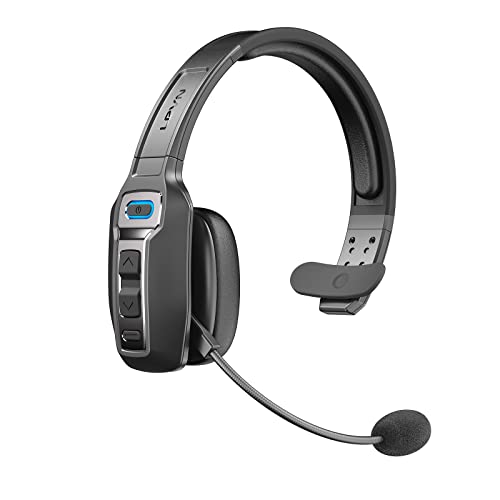
LEVN Bluetooth Headset with Microphone — Best Overall Value
LEVN built its reputation in truck cabs, and the priorities show in the right order. The microphone’s AI noise cancelling exists for the reality of a working vehicle — engine, road roar, a window cracked open — and its job is to make the driver’s voice the only thing a dispatcher or a spouse has to listen to. The mute button is a physical control rather than an app setting, which matters when a cough, a siren or a private aside arrives mid-call at sixty miles an hour. The stated 65 hours of working time puts charging into weekly rather than nightly territory for most users, and the on-ear hook design spreads the wearing across the ear rather than relying on a bud wedged in the canal.
As with every earpiece here, the media story is modest: mono audio for calls and spoken word, perfectly serviceable for talk radio and podcasts, not a music device. Fit is the variable to respect — the hook suits most ears and annoys some, particularly with certain glasses frames competing for the same real estate. Within the affordable class, though, this is the formula executed with the fewest asterisks: the features a working caller actually touches daily, a battery story told in working time, and a price that treats the headset as the consumable tool it honestly is in a driver’s life.
- Form: single-ear on-ear earpiece with hook
- Microphone: AI noise cancelling, hardware mute button
- Stated endurance: 65 hours working time per the listing
- Audience: truckers and mobile workers first, general callers second
- Media: mono spoken word — calls are the design centre
Strengths
- Microphone processing proven in the noisiest workplace there is — a cab
- A real mute button, findable by touch without leaving the road visually
- Working-time battery framing that maps onto a real week of shifts
Trade-offs
- Single-ear mono is the design — music lovers should look elsewhere entirely
- Hook fit fights some glasses frames and smaller ears
- Brand support and accessories are thinner than the enterprise names
Best for: drivers and mobile workers who need callers to hear them clearly from loud places. Not suited for: desk workers wanting stereo calls, or anyone shopping for a music device.
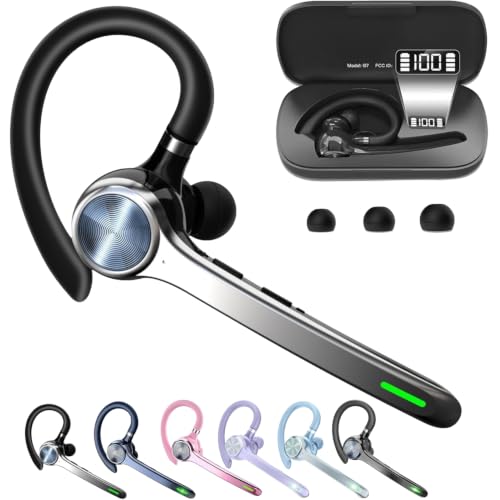
HEIBAS Bluetooth Headset with Charging Case — Best Endurance System
The HEIBAS pitch becomes honest the moment you read its headline correctly: the 72 hours belong to the system, not the earpiece. The earpiece itself is a light work earpiece with a mute button and hands-free calling manners; the 500mAh charging case is the endurance engine, refuelling it repeatedly so the pair can travel for days between wall sockets. For a trucker on a multi-day run or a worker whose charging opportunities are opportunistic — a depot here, a diner there — that architecture is genuinely more useful than a marginally larger battery sealed inside the earpiece would be.
The case also solves the earpiece family’s oldest problem, which is loss. A device with a home is a device that survives; the case gives the HEIBAS a parking place in the cab or the bag, protects it between shifts, and keeps the whole system findable. What you give up versus the LEVN is a degree of cab-proven microphone pedigree — the HEIBAS processing is competent rather than celebrated — and what you gain is a charging story that bends around irregular lives. Judge it as logistics equipment as much as audio equipment, and its place in this guide makes sense.
- Form: single-ear earpiece with charging case
- Case: 500mAh reserve, multiple earpiece refuels
- Stated endurance: 72 hours total playtime via the case, per the listing
- Controls: mute button for hands-free calling
- Audience: drivers and field workers away from sockets
Strengths
- Case-based endurance that fits irregular, mobile working patterns
- A protective home for the earpiece between uses — fewer losses
- Simple, call-focused controls with nothing extraneous to learn
Trade-offs
- The headline hours need the case — the earpiece alone is ordinary
- Microphone polish trails the LEVN’s cab-tested processing
- One more object to keep track of in an already crowded cab or bag
Best for: workers whose week contains long stretches far from a charger. Not suited for: buyers who want the longest single-charge earpiece and no case in the equation.

Bluetooth Headset 100Hrs Earpiece (Bluetooth 6.1) — Best for Long-Haul Days
This earpiece competes on superlatives: a stated 100 hours of endurance, Bluetooth 6.1, dual noise-cancelling microphones and dual-device connection. Read with the discipline this guide opened with — the hundred hours is a system figure in the case-assisted tradition of this shelf — it still describes a device aimed squarely at people whose work happens far from desks: long-haul drivers, field technicians, anyone whose phone lives in a pocket and whose calls arrive all day. Dual-device connection is the sleeper feature in that life, letting a work phone and a personal phone share one earpiece without a re-pairing ritual at every swap.
The dual microphones deserve a measured word. Two mics give noise-cancelling algorithms more evidence to separate voice from environment, and in steady noise — engines, wind at a cracked window — the arrangement generally helps. It does not repeal physics, and in chaotic, voice-filled noise every system in this class struggles together. HD audio claims on the listing should be heard as call clarity rather than music fidelity; this remains a mono earpiece with a job to do. As with the HEIBAS, the value case is endurance plus connection manners at an affordable level — a combination the benchmark brands charge considerably more to assemble.
- Form: single-ear earpiece, case-assisted system
- Stated endurance: 100 hours per the listing, case included
- Microphones: dual noise-cancelling arrangement
- Connections: dual-device pairing, Bluetooth 6.1
- Audience: long-haul and field roles with two phones
Strengths
- The largest endurance story in this guide for life away from sockets
- Dual-device connection that suits the two-phone working pattern
- Dual microphones feeding the voice-isolation processing
Trade-offs
- Headline hours are case-assisted — plan around the earpiece’s own shift
- Newer Bluetooth version numbers matter less than fit and microphone tuning
- Unbranded support and accessory availability are the usual gamble
Best for: two-phone workers and long-haul drivers who charge opportunistically. Not suited for: buyers who distrust system battery figures on principle and want one simple number.
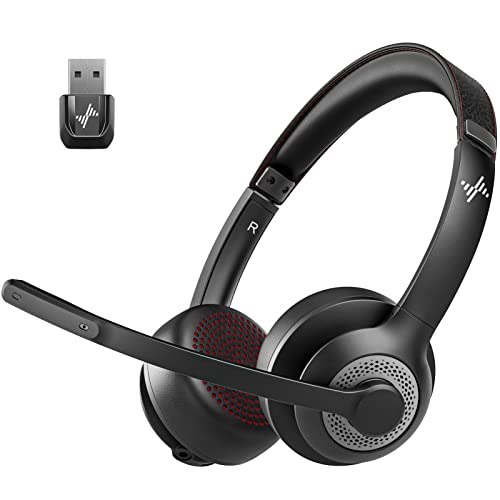
JIAMQISHI Wireless Headset with Mic — Best for Laptop Callers
The JIAMQISHI is the earpiece family’s desk cousin: a Bluetooth V5.2 headset whose defining accessory is a USB dongle. That small stick changes its working life, because a laptop that might otherwise shuffle the headset between Bluetooth profiles — music-grade one moment, tinny call-grade the next — instead sees a dedicated audio device and behaves accordingly. For home workers whose calls run through a computer rather than a phone, the dongle is not a bonus; it is the difference between a headset that is configured once and one that is negotiated with daily. Mic mute is on board, as it must be for this audience.
Its noise-cancelling microphone follows the family pattern — the cancellation serves your listeners, stripping your room from your voice — and the headset’s lighter, over-ear-leaning wear suits seated work better than a motorway. What it does not pretend to be is a travel endurance champion or a truck-cab instrument; its battery and build are calibrated for the radius between a desk, a kitchen and a garden office. Within that radius it is one of the more thoughtfully assembled affordable options, precisely because its maker understood that the dongle, not another Bluetooth decimal, is what laptop callers actually lack.
- Form: light wireless headset for PC and phone calls
- Connections: Bluetooth V5.2 plus bundled USB dongle
- Microphone: noise-cancelling, with mic mute
- Audience: laptop-based home workers
- Strength: connection stability on computers above all
Strengths
- Dongle connection that ends laptop Bluetooth profile roulette
- Mic mute placed for meeting life rather than marketing copy
- Light wearing style suited to seated, screen-based days
Trade-offs
- Not built or tuned for vehicle noise like the trucker picks
- Endurance is desk-scale rather than expedition-scale
- The dongle is one more small object to keep with the laptop
Best for: home workers whose calls live on a laptop and whose Bluetooth has betrayed them before. Not suited for: drivers, or anyone whose workplace has wheels.

Wireless Headset with Mic for Work (Charging Base) — Best Over-Ear Routine
In a guide dominated by earpieces, this over-ear headset is the representative of the other family, and its argument is routine. It covers both ears for fuller, less fatiguing calls, carries its microphone on a boom where voices are captured best, connects to a computer by dongle as well as Bluetooth, and — the detail owners end up praising — returns each evening to a charging base that keeps it powered, parked and findable. Affordable over-ear headsets often feel like a pile of compromises; the base turns this one into a small system, and systems are what working days run on.
Its noise cancelling, to keep the taxonomy clean, works at the microphone for your callers’ benefit; the cups’ contribution to your own quiet is the passive kind that any closed over-ear design provides. That is the correct allocation for its audience — a home-office worker’s callers matter professionally in a way their own room tone does not — but buyers whose primary wish is personal silence should spend in a different category entirely. As the affordable route into a two-ear, boom-and-base working life, it is the most complete package in this guide.
- Form: over-ear headset with boom microphone
- Connections: Bluetooth plus USB dongle
- Stand: charging base included
- Microphone: noise-cancelling for call clarity, hardware mute button
- Audience: desk-based callers wanting both ears covered
Strengths
- The charging base builds a start-every-day-charged routine
- Two-ear calls are kinder across a long meeting schedule
- Dongle and Bluetooth cover computer and phone without fuss
Trade-offs
- Both ears covered means the world goes muffled — no good for mobile work
- No active cancellation for your own ears; the mic side does the processing
- Desk-shaped design that travels less gracefully than an earpiece
Best for: home-office professionals who want an affordable, complete call station. Not suited for: anyone who takes calls while moving through the physical world.
Poly Voyager 5200 — Prose-Only Benchmark
The Voyager 5200 is what the earpiece wants to be when it grows up. Poly — the Plantronics lineage — built its name on professional voice gear, and the 5200’s speciality is the hardest environment a microphone faces: wind. Its windscreening and multi-microphone processing keep a voice intelligible on a blustery pavement in a way that makes budget rivals sound like weather stations, and its fit, voice prompts and wearing polish reflect decades of designing for people who talk for a living. It is the benchmark because professionals who could expense anything keep choosing it.
It is prose-only here for the honest reason that it lives a price tier above this guide’s premise. That gap buys refinement rather than a different category of function: the affordable picks above will make you clear in most conditions, stay on most ears, and survive most weeks between charges. What they will not do is match the 5200’s composure in wind, its accessory ecosystem, or its support infrastructure. Read it as the measuring stick — and as the upgrade path for the reader who tries an affordable earpiece, discovers the form suits their life, and later wants the definitive version of it.
- Form: professional single-ear earpiece
- Speciality: wind handling and voice clarity outdoors
- Microphones: multi-mic array with WindSmart processing
- Positioning: a tier above this guide’s affordable premise
- Role here: the refinement benchmark and future upgrade path
Strengths
- Outdoor call clarity that defines the professional class
- Wearing comfort and controls refined over many product generations
- Accessory and support ecosystem the budget brands cannot match
Trade-offs
- Priced beyond the affordable brief of this guide
- Its endurance figures are earpiece-scale, not case-assisted spectacles
- Overkill for callers whose environment is a quiet room
Best for: professionals whose calls happen outdoors and whose voice is their livelihood. Not suited for: the budget brief of this article — which is precisely why it is the benchmark and not a pick.
Bluetooth versions and codecs — what actually matters here?
Very little, and understanding why will save you money. Newer Bluetooth versions mainly improve connection efficiency, range behaviour and the plumbing for features like multipoint; they do not transform call quality, because call audio travels over Bluetooth’s long-established hands-free channels, which are narrow by design — your caller’s voice was never going to sound like a studio recording through any version number. The leap shoppers imagine between Bluetooth 5.2 and 6.1 exists mostly in the listing’s headline. What genuinely differs between the picks in this guide is microphone hardware, processing and fit, none of which a version badge can summarise.
Range claims deserve the same translation. Bluetooth figures are measured in open air; your body, your vehicle’s metal and your home’s walls all tax the signal, and the practical range of any of these headsets is “the same room, the same vehicle, or a pocket on your person” — which happens to be exactly where call headsets live. The failure mode to actually test is the walk-away: how far into the next room your call survives before it crackles, and whether the headset reconnects gracefully when you return, because a device that demands manual re-pairing after every kettle trip will be abandoned by Friday.
Latency, the third spec-sheet ghost, barely haunts this category at all. A fraction of delay that would disgrace a gaming headset is invisible in a phone call, where human conversation tolerates pauses gracefully. It matters only if you plan to watch video through the earpiece, where lip-sync can drift — one more reason these devices are specialists, and proud of it.
The etiquette and craft of living on an earpiece
An always-worn earpiece changes how the world reads you, and the craft is managing that signal. Colleagues and customers cannot tell whether you are mid-call or available, so wearers develop small rituals: the visible mute check before a private conversation, the earpiece removed or obviously parked during face-to-face talk, the hand raised to the ear when a call begins so bystanders understand the sudden conversation with nobody. None of this is in any manual, and all of it decides whether the device makes you look efficient or distracted. The headsets with clear busy indicators and unambiguous mute states — a button you can feel, a boom that flips — are quietly serving this social function as much as a technical one.
There is a vocal craft, too. A good earpiece microphone rewards a normal speaking voice at normal volume; the instinct to project, inherited from bad speakerphone years, makes processing work harder and callers tireder. Speak as though the person were beside you, keep the microphone’s position consistent — small movements of a hook earpiece change your level more than any setting — and let the noise cancelling do the fighting with the environment. Callers consistently rate a calm, steady voice as “clearer” than a louder one through identical hardware, which is the cheapest upgrade in this entire guide.
Comparison table
| Headset | Shape | Endurance story, honestly read | Connection notes | Choose it when |
|---|---|---|---|---|
| LEVN Bluetooth Headset | Single-ear hook | 65 hours of working time stated for the earpiece’s own life | Bluetooth to phone; mute on the device | Cab noise is your enemy and callers must hear you |
| HEIBAS Bluetooth Headset | Single-ear with case | 72 hours total, delivered by the 500mAh case in refuels | Bluetooth; case doubles as the earpiece’s home | Your week strays far from wall sockets |
| Bluetooth Headset 100Hrs | Single-ear with case | 100 hours as a system figure, case-assisted | Dual-device pairing over Bluetooth 6.1 | Two phones, long routes, opportunistic charging |
| JIAMQISHI Wireless Headset | Light headset, desk-leaning | Desk-scale battery for a seated working day | Bluetooth V5.2 plus a USB dongle for the laptop | Your calls run through a computer that hates Bluetooth |
| Wireless Headset with Mic for Work | Over-ear with boom | Base-charged daily; built around a desk routine | Bluetooth plus dongle, charging base included | You want both ears covered and a system that parks itself |
| Poly Voyager 5200 | Single-ear, professional | Earpiece-scale figures, honestly stated | Bluetooth with professional pairing manners | Wind is your workplace and voice is your income |
How do you test call quality before the return window closes?
Call headsets can only be judged from the other end, so recruit a witness. Ring someone patient from your three real environments — the vehicle, the kitchen with appliances running, the pavement on a breezy day — and ask them to grade your voice, not your headset: could they follow every word, did the background compete, did your voice thin out or clip when the noise rose? Then record a voicemail to yourself and listen back with fresh ears; the robotic artefacts of over-eager noise processing are obvious on playback in a way they never are live. Test the mute with something at stake in miniature — a cough, a doorbell — because the button you cannot find by touch in a calm room will not find itself in a crisis.
Test the wearing, too, across a genuine stretch rather than a try-on. Earpieces reveal their fit at hour three, not minute three, and glasses wearers should run the test with their glasses on, since hook-and-frame conflicts are the commonest silent return reason in this category. Finally, test the connections you will actually use: both phones if you carry two, the laptop if it hosts your meetings, the walk-away range between your desk and your kettle. A headset that passes your own week, in your own noise, has passed the only review that will ever matter to you.
What about driving rules and safety with an earpiece?
The single-ear design exists partly because many jurisdictions restrict covering both ears while driving, and hands-free calling laws in much of the world are the reason the trucker earpiece is a product category at all. Rules vary by place and change over time, so treat any specific claim — including anything you read in a listing — as a prompt to check your own local requirements rather than as settled fact. What does not vary is the underlying logic: one ear open keeps you connected to traffic sounds, sirens and the vehicle itself, and that awareness is a feature no amount of transparency processing fully replaces at motorway speed.
Safety also has a volume dimension. An earpiece turned up to fight cab noise through sheer loudness is doing the job the hard way; the microphone-side processing in these picks is what your callers hear, but your own listening level is your responsibility, and a well-sealed fit at moderate volume beats a loose fit at full blast on every axis. If your working day leaves your ear tired or ringing, the fit or the level — or both — needs attention before the next shift, not a louder successor headset.
Keeping, charging and not losing a tiny working tool
Earpieces die the deaths of small things: left in a shirt that gets washed, set down on a roof during a delivery, drained flat in a glovebox through winter. The countermeasures are embarrassingly procedural. A case that lives in one place — the HEIBAS pattern — turns storage into a habit loop; a lanyard or a magnetic neckband accessory catches the mid-shift removal; a charging spot that is always the same spot means the device is always findable and usually charged. Workers who treat the earpiece like keys — same pocket, same hook, same nightly home — keep theirs for years, while identical hardware in chaotic hands lasts a season.
Battery care in this class is mostly about avoiding extremes rather than rituals. Small lithium cells dislike being stored flat for months and dislike heat more; a headset that lives on a dashboard through summer is aging faster than its twin in a drawer. None of the picks here costs enough to justify anxiety, but all of them cost enough to justify a parking place, and the difference between a two-year earpiece and a four-month one is usually logistics rather than luck. When a battery does fade — and in this class, fading after a couple of hard years is normal rather than defective — the affordable premise of the category is the consolation: replacement is a purchase, not a repair saga.
Who should skip this category entirely?
Three kinds of buyer. The music-first listener, who will hear the mono, call-tuned audio of every earpiece here as a betrayal and should buy earbuds designed for listening, adding call ability as a bonus rather than a brief. The heavy meeting participant whose organisation lives in one platform all day, who may be better served by a certified office headset with platform-integrated controls — the over-ear pick here gestures at that world, but the dedicated work category serves it fully. And the gamer, for whom Bluetooth’s call-grade audio and latency are the wrong tool entirely and who belongs in the low-latency wireless gaming shelf instead.
Everyone else with a phone, a voice and a noisy day is this category’s citizen, and the reason it thrives at affordable prices is that its core job — carry a voice clearly between two people, all day, without imprisoning either ear or either hand — is a solved problem at modest cost. The premium benchmark exists, and it is better in the wind; but the distance between these picks and that benchmark is smaller than the distance between any of them and a phone held to your ear in a truck cab, which is the comparison that actually governs most buyers’ lives.
What mistakes do affordable Bluetooth headset buyers keep making?
The arithmetic mistake leads: reading a case-assisted battery figure as earpiece endurance, then feeling betrayed on day two. The shape mistake follows — buying a single earpiece for stereo desk calls, or an over-ear headset for mobile work — because the two families share a category name and almost nothing else. Third is judging a call headset by listening to music through it in a quiet room, a test that measures the one thing it was not built for while ignoring the microphone it was.
Fourth, buyers chase Bluetooth version numbers as though they were quality grades; within this class, fit, microphone tuning and battery architecture separate the good from the grim far more than a decimal point does. Fifth, they forget the second phone, the laptop, the tablet — and discover the headset they bought pairs grudgingly with the device their job actually uses. And sixth, they throw away the case: on case-assisted models the case is half the product, and losing it quietly halves the headset they thought they owned.
Setting up two devices without losing your mind
Multipoint pairing fails in predictable ways, and most of them are ordering problems. Pair the headset to your primary device first — the one that must never lose the connection, usually the work phone or the laptop’s dongle — and only then add the second device, because several headsets treat the first pairing as the favourite when both compete. Decide in advance which device owns media and which owns calls; a personal phone that hijacks the earpiece for a notification chirp mid-meeting is a configuration error, not a haunting. Turn off media audio for the work device, or calls for the personal one, in each device’s Bluetooth settings, and the two-device life becomes the calm arrangement the feature promises.
Dongles simplify this further where they apply. A laptop on a dongle is, to the headset, a dedicated partner with no profile moods, which is why the JIAMQISHI and the over-ear pick make such natural desk anchors in a two-device setup: dongle to the computer, Bluetooth to the phone, and the headset arbitrates. When something does go sideways — and across months of updates, something eventually will — the recovery ritual is always the same: forget the headset on both devices, reset the headset if its manual offers one, and rebuild the pairing in the order above. Ten unglamorous minutes, once a season, is the true maintenance cost of the dual-device life.
Final Recommendation
Start with your posture toward the world. If your calls happen in motion — cab, warehouse, pavement, school run — the earpiece family is your shelf, and within it the LEVN is the balanced default for voice-first value, the HEIBAS the choice when charging opportunities are scarce and scattered, and the 100-hour dual-device earpiece the long-haul specialist with two phones to serve. If your calls happen at a screen, the JIAMQISHI’s dongle solves the laptop problem that quietly ruins more home-working days than any microphone, and the over-ear headset with its charging base is the affordable way to make the whole arrangement feel like a system rather than a gadget. Keep the Poly Voyager 5200 in mind as the truth-teller at the top of the category: everything in this guide is a negotiation with its standard, and for the money asked, these five negotiations land remarkably close.
A word on workplaces that issue headsets — and choosing your own
Many drivers and call workers are handed a headset by an employer and wonder whether buying their own is indulgence. Sometimes it is; sometimes the issued unit is a false economy that its wearer pays for in daily irritation — a hook that aches by lunch, a battery that dies before the shift does, a microphone that makes every customer ask for repeats. The affordable class in this guide exists in that gap: the price of a personal LEVN or HEIBAS is low enough that workers routinely self-fund the upgrade, keep the issued unit as a spare in the glovebox, and consider it among the better money they spend on their working comfort. Check any workplace rules about personal devices on work systems first — some regulated environments care — but where the choice is yours, the arithmetic of eight hours a day against a modest one-off price resolves quickly.
The reverse journey happens too: a worker buys an affordable earpiece for a personal project, discovers the form transforms their phone life, and starts agitating for the benchmark model at the next equipment refresh. That is the healthiest way the Voyager 5200 earns its price — not as a first leap, but as a proven appetite. Categories with honest budget tiers let people audition a way of working before committing to its flagship, and this one, at its best, is exactly that ladder.
Frequently Asked Questions
What does “72-hour” or “100-hour” battery life really mean on an earpiece?
Usually, that the charging case can refuel the earpiece enough times to total that many hours of use between wall charges — not that the earpiece itself talks for that long on one charge. The HEIBAS figure in this guide is explicitly case-based, with a 500mAh case doing the refuelling. The system total is still useful for planning a week away from sockets, but your longest single day is governed by the earpiece’s own charge, so check that number in the listing before buying.
Can I listen to music on a single-ear headset?
You can, in mono, and for podcasts, audiobooks and talk radio that is often perfectly satisfying — spoken word survives one ear gracefully. Music loses its stereo image and much of its pleasure, and no earpiece in this guide pretends otherwise. If media matters alongside calls, the over-ear pick here is the compromise, and a separate pair of earbuds for listening is the solution most working callers eventually adopt.
What does multipoint or dual-device connection actually do?
It lets the headset stay connected to two devices at once — classically a work phone and a personal phone, or a laptop and a phone — and switch to whichever one rings or plays, without unpairing and re-pairing. For two-phone workers it removes a daily friction entirely. Note that you still hear one device at a time; the feature is about instant switching, not mixing two calls into one ear.
Why does my headset sound fine on my phone but poor on my laptop?
Because computers juggle Bluetooth audio profiles less gracefully than phones do, and a headset can end up in a music-oriented mode with a muffled microphone, or a call mode with thin sound, depending on the order of pairing and the apps involved. This is precisely the failure the JIAMQISHI’s bundled dongle exists to prevent: the dongle presents the headset to the laptop as a dedicated call device, and the negotiation disappears.
How do I stop my earpiece falling off during the day?
Fit is a system, not a moment: seat the bud or hook as the maker intends, try every ear tip or stabiliser in the box rather than the one fitted by default, and route any cable or hook so clothing does not tug it. Glasses wearers may need to put the earpiece on before their frames, or choose the frame order that shares the ear peacefully. If a model still works loose after honest adjustment, believe it — ears vary more than product pages admit, and a different shape is a better answer than a tighter squeeze.
Which ear should I wear it on?
Whichever you prefer — nearly every earpiece here can rotate or swap for left or right wear — but the choice interacts with your life more than you would expect. Drivers in countries with left-hand traffic often favour the window side for the open ear’s traffic awareness, desk workers favour the side away from their mouse hand’s traffic, and people who also hold a phone to one ear habitually give the headset the other. There is no acoustic difference worth chasing; pick the side your day already leans toward, and switch for a week if ear fatigue suggests your first choice was wrong.
Can one of these replace my earbuds for everything?
For calls, podcasts and audiobooks, many owners find an earpiece quietly takes over their listening day, because it is always charged, always paired and never sealing them off from the world. For music with any ambition, no — the mono, voice-tuned drivers in this category are specialists, and asking them to be your only audio device is how people end up unfairly disappointed in excellent tools. The common end-state is a small stable: an earpiece for the working voice, earbuds for the evening’s music, each bought affordably because neither had to do everything.
Is a cheap Bluetooth headset safe to wear all day?
At sensible volumes, the practical risks are fit and level rather than the radio. Keep listening volume moderate — you should never need to shout over your own headset — take the device off periodically across a long day, and treat ear fatigue or ringing as a signal to change fit or level, not to push through. This guide offers no medical advice beyond that common sense; persistent discomfort belongs in a conversation with a professional, not a product upgrade.
What does the warranty and returns picture look like at this price?
Brief, and worth planning around. Affordable headsets typically carry short warranties and support that runs through the seller rather than a service network, which is a structural fact of the class rather than a scandal. The practical defence is front-loaded: buy from a channel with a painless returns window, run the full shakedown from the testing section in the first days — calls from your real noise, a long wearing session, both device pairings — and let any infant fault surface while returning is a formality. A headset that survives its first fortnight of honest work usually survives its intended life, because the failure modes of this class are mostly present from birth or caused by loss and water rather than slow electronic decay. Keep the order details with the case, and the modest paperwork of the category stays modest. One more habit separates satisfied owners from serial returners in this class: they read the pairing and reset instructions before they need them, ideally saving the manual’s key page as a photo on the phone the headset serves. Bluetooth oddities are almost never defects — they are states, and states have exits — but an exit you must search for at midnight in a lay-by feels exactly like a defect. The two minutes of preparation convert most future “broken headset” moments into minor anecdotes, and in a category bought for calm working days, that conversion is worth more than several of the specifications on the box. The same realism applies to the accessories shelf that gathers around a successful earpiece: spare ear tips in your size, a second charging cable that lives in the vehicle, perhaps a small hard case for the earpiece that travels loose. Each costs little, each removes a specific future annoyance, and together they cost less than the difference between this tier and the next. Affordable ownership done well is not about buying the cheapest object and hoping; it is about buying the honest object and then spending the small change that makes it dependable — a philosophy the best owners in this category arrived at long before any guide wrote it down for them. It also explains a pattern in owner reviews that puzzles first-time shoppers: the fiercest loyalty attaches not to the most featured model but to the one whose small system — case, cable, fit, pairing — a worker has fully domesticated. Once a headset disappears into a routine, its specifications stop mattering and its reliability becomes the whole story, which is why the final recommendation below ranks routines and working patterns above any single number a listing can print. Keep that hierarchy in mind while reading the picks back: a model that looks plain on paper may be the one whose routine fits your Tuesdays, and in this category the Tuesday test outranks the spec sheet every single time it is honestly applied by an owner who pays attention. If a pick in this guide matches your Tuesdays on paper, order it through a channel with an easy return, run the shakedown week without mercy, and keep it only if your own noise, your own ears and your own two devices all vote yes together at the end of that honest trial. That discipline — buy the routine, test the week, keep what survives — is worth more than any single recommendation printed above it, including ours.
Related Guides
Callers who discover their real enemy is the room itself should read our guide to active noise cancelling headsets, which untangles cup cancellation from microphone processing in full. If your calls are really meetings and your budget stretches a little further, our look at headsets for clear voice work goes deeper on boom microphones, and gamers arriving from the other direction may prefer our affordable wireless gaming headset roundup for the entertainment side of Bluetooth’s family tree. Headset buyers who also play VR should read the best 6dof standalone vr headsets before choosing a shared audio setup.



[…] going with best 50 dollar gaming headsets to see what the tier below this one keeps and cuts, best affordable gaming headsets pc for the PC-only view of the same problem, and best affordable wireless gaming headsets when you are […]