What's inside
- Key Takeaways
- Quick Picks: The Best 3 Bank Chargers at a Glance
- How Did We Choose These 3 Bank Chargers?
- How Does a 24V or 36V Trolling System Charge From Three Banks?
- How Do the Six 3 Bank Chargers Compare?
- How Should You Install a 3 Bank Charger?
- What Mistakes Do Multi-Bank Owners Make?
- How Does Lithium Change the 3 Bank Decision?
- How Do Trolling Batteries Age as a Pair?
- What Should Winter Storage Look Like for a Three-Battery Boat?
- How Much Does Shore Power Reliability Matter?
- How Do You Extend Charger Leads and Handle Awkward Layouts?
- What Does a Bank Indicator Actually Tell You?
- How Should You Choose Between NOCO and Minn Kota Here?
- What Does Tournament Fishing Demand From a Charger?
- How Do You Maintain the Charger Itself?
- Why Do Guides and Charter Boats Standardise Their Charging?
- What Should You Check on a Used Boat’s Charger?
- How Do Battery Switches and Isolators Interact With Bank Charging?
- A Note on Fours and the Boats That Need Them
- What Should You Record About a Three-Battery Installation?
- How Do You Budget for a Whole Three-Battery System?
- Final Recommendation
- Frequently Asked Questions
- Related Guides
As an Amazon Associate I earn from qualifying purchases. This post may contain affiliate links at no extra cost to you.
gizmoverdict.com is reader-supported. When you buy through links on our site, we may earn an affiliate commission.
Where to buy: all six onboard chargers below link to their Amazon listings, where bank configuration, total output and the current model revision can be verified before you commit to an installation.
A three-bank charger exists to solve a problem that only boat owners fully understand. The best 3 bank chargers are not three chargers in a trench coat and they are not a single charger with its output split hopefully across a tangle of leads. Each bank is an independent charger in its own right, with its own leads, its own sensing and its own charge stages, all sharing one waterproof housing and one shore-power cord. Connect three batteries and each is charged and maintained according to its own condition, as if three separate smart chargers had been bolted into the boat.
The typical installation explains why three is the magic number. A serious fishing boat runs one starting battery for the engine and two deep-cycle batteries wired in series to feed a 24-volt trolling motor, or three in series for a 36-volt motor alongside the starter. Those batteries live utterly different lives: the starter sips, the trolling pair are drained for hours. A single-output charger forced to treat them as one battery would undercharge the workers and overcharge the idler, which is why bank independence is the entire point of this category and the first thing to verify in any model.
Output per bank is the second thing, and this guide states it for every pick because headline totals conceal it. A charger advertised at thirty amps with three banks delivers ten amps to each battery, not thirty to one, and the right per-bank figure depends on the size of the trolling batteries and how quickly the boat must turn around between trips. The six picks below span five to fifteen amps per bank, covering everything from a small aluminium boat kept on a trailer to a tournament rig that fishes dawn after dawn.
Key Takeaways
- Each bank charges independently, so a flattened trolling battery and a full starting battery each receive exactly the treatment they need.
- Always read output per bank: totals in this category are the sum of three separate chargers, never a single deliverable current.
- Onboard chargers live in the boat permanently and are sealed for marine compartments, a different species from portable bench chargers.
- Lithium compatibility separates the generations here: the Minn Kota Precision PCL models and the NOCO units address lithium, while the older MK 330D belongs to the lead-acid era.
- Match amps per bank to turnaround time; overnight at a dock forgives five amps, while daily tournament fishing rewards ten or fifteen.
Quick Picks: The Best 3 Bank Chargers at a Glance
| Pick | Badge | Why it made the cut |
|---|---|---|
| NOCO GEN5X3 | Best compact 3-bank | Five amps per bank in a small sealed case suits trailer boats and overnight charging rhythms. |
| NOCO GENPRO10X3 | Best heavy-duty NOCO | Ten amps per bank with full waterproofing for serious fishing boats that fish consecutive days. |
| Minn Kota Precision MK 330 PC | Best lead-acid precision | Ten amps per bank with battery-type selection per bank and a reputation earned in tournament service. |
| Minn Kota MK 330D | Best proven older design | The long-running digital onboard charger at ten amps per bank for lead-acid fleets on a budget of complexity. |
| Minn Kota Precision MK-345PCL | Best for lithium and speed | Fifteen amps per bank and lithium-ready Precision charging for the fastest turnarounds in this list. |
| Minn Kota Precision MK-318PCL | Best lithium value per bank | Six amps per bank with the same PCL lithium capability, sized for smaller boats and gentler schedules. |
How Did We Choose These 3 Bank Chargers?
True bank independence was the non-negotiable entry condition. A pick had to sense, charge and maintain each of its three batteries separately, with no shared compromise voltage and no requirement that the batteries match in type or state. Any product that merely divided one output among three sets of leads was excluded, because that design recreates exactly the unequal charging this category exists to abolish.
Marine survivability came next. These units live in compartments that fill with spray, condensation and vibration, so full waterproof sealing, corrosion-resistant construction and mounting designed for permanent installation were all required. A charger that must be removed before the boat is washed down has misunderstood its assignment, and none of the six picks makes that mistake.
We then mapped per-bank output against realistic use. Five or six amps per bank serves boats that charge overnight between weekend trips. Ten amps per bank serves bigger trolling batteries and shorter turnarounds. Fifteen amps per bank serves lithium conversions and tournament schedules where the boat fishes again at dawn. Each pick is recommended inside the rhythm its output supports, rather than ranked as if more were simply better for everyone.
Chemistry coverage marked the generational divide in the list. Modern picks address lithium iron phosphate explicitly, reflecting how completely lithium has taken over serious trolling service, while the older Minn Kota digital design remains a lead-acid tool and is framed that way honestly. Buyers should read that divide as the first fork in their decision, before brand loyalty or price enters the conversation.
How Does a 24V or 36V Trolling System Charge From Three Banks?
The wiring confuses newcomers, so it deserves a plain explanation. Two batteries in series produce twenty-four volts for the trolling motor, yet each battery remains a twelve-volt unit with its own state of charge, and a three-bank charger connects one bank to each battery individually. The charger never sees twenty-four volts at all; it sees three twelve-volt batteries, one of which happens to be a starter, and it charges each on its own merits while the series connection sits undisturbed.
This arrangement quietly fixes the oldest problem in trolling batteries. In a series pair, one battery always ages slightly faster than the other, and charging the pair as a unit lets the stronger battery dominate the process while the weaker one falls further behind with every cycle. Independent banks arrest that divergence by finishing each battery completely on its own schedule, which is a large part of why boats fitted with proper multi-bank chargers report trolling batteries lasting seasons longer than identical batteries charged as a pair.
The same logic scales to the 36-volt systems on larger bass boats, where three trolling batteries join the starting battery and owners move to four-bank chargers outside this guide’s scope. For the great majority of boats running a starter plus a 24-volt trolling pair, three banks is the exact fit, neither a bank short nor a bank wasted.
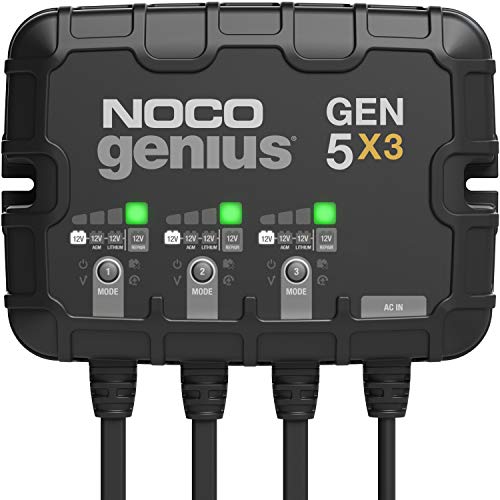
NOCO GEN5X3 — Best compact 3-bank
The GEN5X3 is the three-bank idea distilled to its essentials: three independent five-amp chargers in a compact sealed housing, designed to be mounted once in a boat and then to disappear from the owner’s thoughts. Five amps per bank will not win a race, and this unit should be bought by owners whose rhythm gives it time, the trailer boat that fishes Saturday and charges until the following weekend, or the dock boat plugged in whenever it is not on the water. For those rhythms five amps is not a compromise at all, merely the correct amount of electricity delivered at the correct gentleness.
NOCO’s modern charging behaviour carries across all three banks, including modes suited to the lithium batteries increasingly fitted to smaller boats, temperature awareness and the automatic maintenance that holds each battery at full while the boat waits. The value of that maintenance is easy to underestimate until it is imagined in triplicate: three batteries, each at a different state when the boat docks, each floated individually for a month, each ready on the same morning.
Physical size is a genuine virtue in this class, because battery compartments on smaller boats are crowded places where a bulky charger competes with pumps, plumbing and the batteries themselves. The GEN5X3 fits where larger units cannot, and its sealed construction tolerates the damp reality of those compartments without ceremony. Owners of large trolling batteries on tight schedules should read on to the ten- and fifteen-amp picks; owners of ordinary boats on ordinary schedules may have found their charger already.
- Format: permanently mounted onboard charger, three banks
- Output: 5 amps per bank, 15 amps in total
- Sealing: waterproof construction for marine compartments
- Control: fully independent charging and maintenance per bank
- Role: trailer boats and dock boats with overnight charging time
Strengths
- Compact case fits the crowded compartments of smaller boats.
- Three genuinely independent banks protect trolling pairs from diverging.
- Modern chemistry support includes the lithium batteries small boats now carry.
Trade-offs
- Five amps per bank is slow for large, deeply drained trolling batteries.
- Back-to-back fishing days can outpace its recovery speed.
- It offers no help for a fourth battery in a 36-volt plus starter layout.
Best for: ordinary fishing boats that charge overnight or between weekends. Not suited for: tournament schedules or very large trolling batteries.
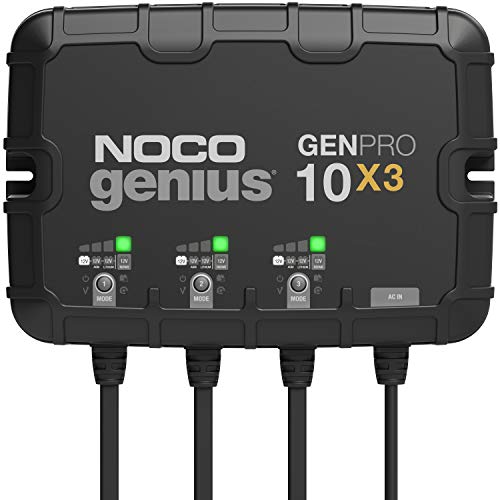
NOCO GENPRO10X3 — Best heavy-duty NOCO
The GENPRO10X3 doubles the GEN5X3’s commitment, delivering ten amps to each of three banks from a housing built to the same sealed, permanently installed philosophy. Thirty amps in total sounds like a headline, and for once the headline understates the practical point, which is turnaround: a trolling pair drained by a long day’s fishing can be returned to full across a single night with hours to spare, ready for the same work tomorrow. That capability is what separates a weekend charger from a working boat’s charger.
The PRO line’s construction suits the harder life its output implies. These are chargers for boats that fish in weather, travel on trailers over rough roads and store in compartments that see real water, and the waterproofing and mounting reflect that expectation. Each bank still behaves with the full repertoire of modern smart charging, tapering and maintaining individually, so the extra muscle never becomes roughness applied to a battery that only needed a top-up.
Owners should match this unit to batteries that can use it. Ten amps per bank is wasted on a pair of small trolling batteries in a jon boat, and the GEN5X3 serves that boat better and cheaper. Fitted to a serious bass or walleye rig with large deep-cycle or lithium batteries, though, the GENPRO10X3 is the charger that removes charging from the list of things a fishing trip must be planned around.
- Format: heavy-duty onboard charger, three banks
- Output: 10 amps per bank, 30 amps in total
- Sealing: fully waterproof marine construction
- Control: independent smart charging and float on every bank
- Role: serious fishing boats fishing consecutive days
Strengths
- Ten amps per bank turns big trolling batteries around overnight.
- Sealed build matches the conditions working boats actually meet.
- Independent maintenance keeps all three batteries ready together.
Trade-offs
- Output is wasted on small boats with small batteries.
- Installation deserves time and proper wiring at this power level.
- It is a substantial purchase beside the five-amp alternatives.
Best for: dedicated anglers running large trolling batteries day after day. Not suited for: small trailer boats or occasional weekend use.

Minn Kota Precision MK 330 PC — Best lead-acid precision
Minn Kota’s Precision line earned its name in the trolling world by treating each bank as a battery-specific instrument rather than a tap. The MK 330 PC delivers ten amps per bank, and its defining habit is letting the owner tell each bank what kind of battery it serves, with settings for the lead-acid family including flooded, AGM and gel, so a boat running an AGM starter beside flooded trolling batteries charges each on the correct profile from the same box. That per-bank tailoring is a sophistication the simpler digital models never offered.
Precision models also built their following on battery care features aimed at longevity: automatic temperature compensation, a battery health approach that avoids the chronic undercharging which kills trolling batteries early, and construction sealed for the marine environment with the mounting solidity tournament boats demand. In service these chargers developed a reputation for making batteries last, which in a three-battery boat is a saving multiplied by three every time replacement is postponed.
The honest framing for a modern buyer is that this is a lead-acid-era flagship. Owners converting to lithium trolling batteries should look to the PCL models below, which were created for exactly that transition. Owners committed to lead-acid, whether flooded or AGM, will find the MK 330 PC remains a deeply considered tool whose per-bank battery selection still feels ahead of much of the market.
- Format: onboard Precision charger, three banks
- Output: 10 amps per bank, 30 amps in total
- Tailoring: battery type selectable bank by bank
- Chemistries: flooded, AGM and gel lead-acid profiles
- Control: temperature-compensated charging and maintenance
Strengths
- Per-bank battery selection matches mixed lead-acid installations perfectly.
- Ten amps per bank supports serious trolling batteries and quick turnarounds.
- A long tournament-proven record for extending battery life.
Trade-offs
- Lithium trolling batteries belong to the newer PCL models instead.
- Its feature depth asks the owner to set each bank thoughtfully.
- Premium positioning beside simpler digital alternatives.
Best for: lead-acid boats mixing battery types across starter and trolling duties. Not suited for: lithium conversions or owners wanting zero configuration.

Minn Kota MK 330D — Best proven older design
The MK 330D is the elder statesman of this list, a digital onboard charger that has been bolted into fishing boats for years and continues to sell on the strength of that service. It offers three banks at ten amps each, automatic multi-stage charging for lead-acid batteries, and the sealed, shock-resistant construction the category requires, without the per-bank battery tailoring or lithium ambitions of its Precision descendants. For a lead-acid boat whose owner values a known quantity, that restraint is a feature.
Its longevity in the market carries information a specification sheet cannot. A design that survives season after season in damp compartments, across thousands of installations, has demonstrated the things buyers actually fear failing: seals, connections, tolerance of vibration and of being forgotten. Owners replacing a dead charger of the same model often buy another without shopping around, which is the most honest review any marine product can receive.
The boundaries are equally clear. This is a charger for flooded and AGM lead-acid batteries, and the lithium wave that has transformed trolling motors passes it by entirely; pairing it with lithium batteries would be a category error regardless of its virtues. Within its era it remains a rational purchase, particularly for owners refitting an older boat whose batteries and budget are both lead-acid, but it should be bought as the proven past of the category rather than as its future.
- Format: digital onboard charger, three banks
- Output: 10 amps per bank, 30 amps in total
- Chemistries: lead-acid batteries, flooded and AGM service
- Control: automatic multi-stage charging per bank
- Build: sealed and resistant to shock and vibration
Strengths
- A service record measured in years across countless boats.
- Ten amps per bank remains a strong, useful specification.
- Simple operation with nothing to configure wrongly.
Trade-offs
- No lithium charging capability of any kind.
- No per-bank battery-type selection for mixed installations.
- Newer Precision models outclass it in battery care features.
Best for: lead-acid boats wanting proven, uncomplicated onboard charging. Not suited for: lithium trolling systems or mixed-chemistry installations.
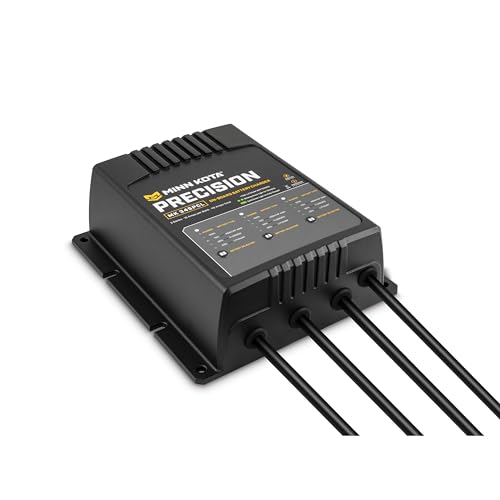
Minn Kota Precision MK-345PCL — Best for lithium and speed
The MK-345PCL is what the three-bank category looks like after the lithium revolution. Fifteen amps per bank is the fastest charging in this guide, forty-five amps in total, and the PCL designation marks Minn Kota’s Precision line rebuilt for lithium iron phosphate alongside the lead-acid family, including the wake and charge behaviour lithium batteries require. A tournament angler running lithium trolling batteries, who drains them hard and needs them full by the next dawn launch, is holding the exact brief this charger was designed from.
Speed with lithium is about more than convenience. Lithium batteries accept high charge rates happily where lead-acid would protest, so fifteen amps per bank converts directly into hours saved rather than into heat and gassing, and the Precision electronics manage the lithium profile with the same per-bank attentiveness the line built its name on. Lead-acid batteries in the same boat, a common transitional arrangement with a lead starter beside lithium trolling power, remain fully supported on their own settings.
Nothing about this level of capability is casual. The unit is a serious installation for serious boats, its output demands wiring and mounting done properly, and its price of admission only makes sense where the batteries it serves are equally serious. For the growing fleet of lithium-powered tournament and guide boats, though, it is not an extravagance but the matching half of the system, and charging a costly lithium bank with anything less considered wastes the investment the batteries represent.
- Format: Precision onboard charger, three banks, lithium-ready
- Output: 15 amps per bank, 45 amps in total
- Chemistries: lithium iron phosphate plus lead-acid family
- Tailoring: per-bank battery selection in the Precision manner
- Role: fastest turnarounds for high-demand fishing boats
Strengths
- Fifteen amps per bank is the quickest recovery available here.
- Proper lithium support protects an expensive trolling investment.
- Per-bank tailoring handles transitional mixed installations gracefully.
Trade-offs
- Far more charger than a casual weekend boat can use.
- Installation at this output level deserves professional care.
- Lead-acid-only owners pay for lithium talents they will never call on.
Best for: lithium-powered tournament and guide boats on daily schedules. Not suited for: small boats, tight budgets or purely lead-acid fleets.

Minn Kota Precision MK-318PCL — Best lithium value per bank
The MK-318PCL answers the reasonable objection that not every lithium boat fishes tournaments. At six amps per bank it brings the same PCL lithium capability as its fifteen-amp sibling to smaller boats and calmer schedules, where trolling batteries are modest, nights at the dock are long, and the owner’s need is correctness rather than speed. A lithium battery charged properly at six amps overnight is exactly as full in the morning as one charged at fifteen, provided the night was long enough, and for most recreational boats it always is.
This sizing also suits the way lithium has spread beyond tournament rigs. Smaller boats, kayaks with serious electronics and modest bass boats now run single lithium batteries or compact pairs whose capacities match a six-amp bank comfortably. Those owners previously faced a poor choice between lead-acid-era chargers that mishandled their batteries and flagship units sized for another world; the 318PCL exists in the sensible middle they were waiting for.
Precision habits complete the package: per-bank awareness of battery type, temperature-conscious charging and maintenance that holds each battery ready through storage. Its limits are the mirror of its virtues, since big lithium banks on short turnarounds will find six amps a constraint, but as the proportionate lithium charger for the majority of boats that have converted, it may be the most quietly sensible pick in this entire list.
- Format: Precision onboard charger, three banks, lithium-ready
- Output: 6 amps per bank, 18 amps in total
- Chemistries: lithium iron phosphate plus lead-acid profiles
- Tailoring: per-bank battery selection
- Role: smaller lithium boats with overnight charging rhythms
Strengths
- Genuine lithium charging at a recreational scale and pace.
- Six amps per bank suits the battery sizes smaller boats carry.
- Precision per-bank care extends battery life across all three banks.
Trade-offs
- Large banks drained daily will want the fifteen-amp model.
- Lead-acid owners can find the same pace for less commitment elsewhere.
- Still a permanent installation, with the fitting effort that implies.
Best for: recreational lithium boats charging overnight between trips. Not suited for: tournament turnarounds or the largest trolling banks.
How Do the Six 3 Bank Chargers Compare?
| Charger | Per bank | Total | Lithium | Defining strength |
|---|---|---|---|---|
| NOCO GEN5X3 | 5A | 15A | Supported | Compact sealed simplicity |
| NOCO GENPRO10X3 | 10A | 30A | Supported | Heavy-duty overnight power |
| Minn Kota MK 330 PC | 10A | 30A | Lead-acid era | Per-bank lead-acid tailoring |
| Minn Kota MK 330D | 10A | 30A | Not supported | Proven uncomplicated service |
| Minn Kota MK-345PCL | 15A | 45A | Supported | Fastest lithium turnaround |
| Minn Kota MK-318PCL | 6A | 18A | Supported | Lithium care at gentle pace |
Read the per-bank column first and the lithium column second; together they sort this list faster than any brand comparison. A boat’s batteries and its calendar between trips decide the correct row, and every other consideration, from mounting size to budget, is refinement applied afterwards.
How Should You Install a 3 Bank Charger?
Plan the installation around cable reach and air. Mount the unit where its three bank leads reach their batteries without strain or extension improvisation, high in the compartment where bilge water reaches last despite the waterproofing, and with enough surrounding space for the heat of a hard charging night to escape. Sketch the routing before drilling anything, because the neatest installations follow the boat’s existing cable paths and the ugliest ones fight them for years.
Connect each bank to its own battery with the leads as supplied, keeping polarity certain and ring terminals tight, and resist any temptation to bridge or share connections between banks for tidiness. Independence is the product you bought; the wiring must preserve it. The AC side deserves a proper inlet and, where the boat’s shore-power system is anything more than an extension cord to a dock outlet, the judgement of a marine electrician, since mains voltage and water remain a combination that punishes improvisation.
Commission the system by watching one full cycle. Charge from a partially used state, confirm each bank progresses and settles independently, and check that no lead or terminal warms under load. Then build the habit that makes onboard charging pay: plug in every time the boat is stored with power available, without debating whether this trip used enough battery to bother. The batteries that last longest belong to owners for whom plugging in is part of tying up.
What Mistakes Do Multi-Bank Owners Make?
Buying by total amps is the first, encouraged by packaging that sums three banks into one heroic number. A buyer expecting thirty amps into a single battery from a three-bank unit has purchased a misunderstanding, and the correction is to shop by the per-bank column of the comparison table above, matched against the largest battery and the shortest night in the boat’s real calendar.
Mixing battery ages and types within a trolling pair is the second. Independent banks forgive a great deal, but a new battery paired with a dying one in series service will still be dragged by its partner during discharge, whatever the charger does afterwards. Replace trolling pairs together where possible, and let the charger’s independence handle the smaller differences that remain rather than structural ones.
Neglecting the starting battery is the third, because attention follows the expensive trolling bank while the humble starter, often the oldest battery in the boat, is left to its own devices. A three-bank installation already includes the starter in its care; owners undermine that gift when they wire only the trolling pair and leave the starter to chance and alternator mercy.
Finally, some owners unplug the charger the moment indicators settle and then leave the boat for a month, discarding the maintenance that justified the installation. Onboard chargers are designed to stay connected on shore power, holding each bank at readiness, and the boats that greet their owners with three full batteries in spring are the ones whose chargers were allowed to do that quiet work all winter.
How Does Lithium Change the 3 Bank Decision?
Lithium trolling batteries rearranged this category’s priorities within a few seasons. Their virtues for fishing are obvious: far lighter than lead-acid for the same usable energy, steady voltage through the discharge, and a tolerance for partial charging that lead-acid never had. Their demand in return is a charger that speaks their language, with the correct voltage profile and the ability to wake a battery whose protection system has shut it down at low charge, which is precisely the capability the PCL models and the NOCO units in this list were built to provide.
The transition period is where owners most need this guide’s honesty. A boat mid-conversion, lithium for trolling and lead for starting, needs per-bank chemistry selection above every other feature, and two of the older picks here cannot offer it at all. Completing the conversion includes the charger in the budget from the start, not as an afterthought when the new batteries behave strangely on old electronics.
Owners staying with lead-acid lose nothing by that loyalty. Flooded and AGM trolling batteries remain capable and far cheaper to buy, and the lead-acid picks in this list will care for them superbly. The decision is about the batteries in the boat and the seasons ahead, and the charger should be the last component chosen, fitted to a battery plan rather than forcing one.
How Do Trolling Batteries Age as a Pair?
Series pairs age in conversation with each other, and understanding their relationship explains many mysterious losses of trolling power. Each discharge draws identical current through both batteries, yet small differences in capacity mean the weaker battery is always worked slightly deeper, and deeper work ages it slightly faster, so the gap widens with every trip in a slow spiral. Independent bank charging interrupts the charging half of that spiral by guaranteeing both batteries reach a genuine full state every time, which cannot erase a capacity gap but stops the charger from enlarging it.
Owners can slow the discharge half of the spiral with habits rather than hardware. Avoid running a pair to exhaustion, since the weakest battery suffers most at the bottom of the discharge, and recharge promptly after every outing rather than letting the pair sit empty while the weekend’s other chores are done. When one battery of a pair finally fails, replacing both remains the sound advice, because a fresh battery married to a tired partner inherits the partner’s limitations within a season.
Testing the pair individually, rather than as a combined twenty-four volts, reveals the truth early. A pair that delivers disappointing thrust often contains one honest battery and one impostor, and a per-battery load test names the impostor before an important trip does. Three-bank owners are better placed than anyone to act on that knowledge, since their charger has been treating the batteries as individuals all along.
What Should Winter Storage Look Like for a Three-Battery Boat?
The ideal winter for a boat on shore power is almost offensively simple: batteries left in place, fully charged, with the onboard charger connected and maintaining each bank while the boat sleeps. Removing batteries to a garage adds handling risk and loses the charger’s whole advantage, and is justified only where the boat winters somewhere without power, in which case the batteries should travel to the maintainer rather than the other way around and be stored cool, charged and off bare concrete if the owner follows tradition.
Before the long rest, give the system one deliberate service. Clean and tighten every terminal the charger and the boat depend on, check the trolling batteries’ state with an individual test if any doubt exists, and confirm each bank’s indicator shows maintenance rather than a fault nobody will see until April. Boats stored outdoors deserve a mid-winter visit that includes the charger among its checks, since a tripped dock breaker in November silently cancels four months of maintenance.
Spring then becomes a recommissioning of everything except the batteries, which emerge exactly as they were parked. Owners new to onboard charging consistently describe that first spring as the moment the installation paid for itself, because the alternative biography of a three-battery boat, involving removal, bench charging in sequence and at least one sulfated casualty, is a story the fishing world knows far too well.
How Much Does Shore Power Reliability Matter?
An onboard charger is only as dependable as the electricity feeding it, and marina and yard power supplies have personalities of their own. Breakers trip, neighbours unplug what they mistake for their own cord, and long extension runs sag under load. Owners who depend on winter maintenance should secure their connection physically, confirm the outlet actually delivers power after every yard visit, and treat a charger indicator check as part of leaving the boat rather than as an optional extra.
Surge protection deserves a thought in exposed locations, since the same storms that test a boat’s covers can send spikes down a dock’s wiring into the most expensive electronics aboard. A charger is a comparatively affordable victim, yet losing it in November without noticing converts a protected battery bank into an unprotected one for the whole season. The mid-winter check recommended above exists largely to catch exactly this quiet failure mode.
How Do You Extend Charger Leads and Handle Awkward Layouts?
Real boats rarely arrange their batteries in a neat row beneath the charger, and the resulting temptation is to improvise with whatever wire is aboard. Resist it in favour of the maker’s own extension leads where they exist, since lead length and gauge are part of the charger’s design: an undersized extension drops voltage on its way to a distant battery, and the bank at the end of it charges against a distorted picture of that battery’s state. Where a battery truly cannot be reached within the approved lead arrangements, moving the charger is usually the better engineering answer than stretching the leads.
Awkward layouts also argue for planning the whole electrical neighbourhood at once. The charger, the batteries, the bilge pump’s float switch wiring and any battery switches all compete for the same dry, reachable territory, and an hour spent arranging them as a system saves years of working around a tangle. Label each bank’s leads at both ends during installation, a kindness to your future self and to any mechanic who later meets the boat as a stranger.
What Does a Bank Indicator Actually Tell You?
Owners sometimes treat charger indicators as decoration, yet across three banks they form a comparative instrument no single charger can offer. Banks that progress together describe batteries ageing together. A bank that consistently finishes hours before its siblings is reporting a battery with shrinking capacity, while a bank that never quite settles may be reporting a battery converting charge into heat, or a connection corroding quietly at a terminal nobody has cleaned since installation.
Reading those patterns requires only that the owner glance at the charger with the same attention given to fuel and oil, and record anything odd in the boat’s notebook. Marine batteries rarely fail without first filing a report through their charger; they fail unheard, in boats whose owners never learned to listen to equipment that was speaking plainly for seasons.
How Should You Choose Between NOCO and Minn Kota Here?
Brand choice in this list is less tribal than fishing culture suggests, because the two makers emphasise different virtues. NOCO’s onboard units bring the company’s compact, chemistry-broad smart charging into sealed cases, attractive to owners whose boats mix lithium ambitions with a desire for fit-and-forget simplicity. Minn Kota’s Precision line answers with per-bank battery tailoring and a heritage inside trolling itself, attractive to owners who think of the charger as part of the fishing system rather than as an appliance.
The practical method is to let the batteries arbitrate. List the three batteries in the boat today and the three most likely to be there in three years, note their chemistries and sizes, and read the comparison table’s per-bank and lithium columns against that list. The correct brand is whichever row survives that arithmetic with the fewest compromises, and owners who choose that way rarely join the dockside debates, because their batteries keep settling the argument every morning.
What Does Tournament Fishing Demand From a Charger?
Tournament schedules compress every weakness in a boat’s electrical system into public view. Practice days and competition days arrive consecutively, launches happen in darkness, and a trolling battery that begins the morning at ninety percent rather than full can fade during the final hour when position is decided. Chargers in that world are judged by a single standard: whether the boat leaves the dock electrically identical every morning regardless of how hard the previous day ran, which is why the high-output lithium picks exist and why their owners describe them as equipment rather than accessories.
Amateur anglers fishing long weekends face the same physics at a gentler tempo, and the honest way to borrow tournament wisdom is to scale it rather than copy it. If your longest sequence is two hard days, a ten-amp bank restores the pair across the night between them with room to spare, and the money saved against flagship hardware buys seasons of bait and fuel. The category rewards owners who match the tool to their actual calendar, which is why this guide keeps returning to the clock as faithfully as to the chemistry.
How Do You Maintain the Charger Itself?
An onboard charger asks for almost nothing, which is exactly why its few needs are forgotten. Once a season, with shore power disconnected, inspect every lead for chafing where it passes a bulkhead, confirm the ring terminals are tight and bright, and check the mounting fasteners against the vibration that loosens everything aboard a boat eventually. Wipe salt and grime from the case so its indicators stay legible, and verify the AC inlet and cord for the damage that dock life inflicts quietly.
That ten-minute ritual protects a far larger investment than the charger itself, because the charger stands guard over three batteries whose combined replacement cost dwarfs it. Owners who build the inspection into the same spring routine as impellers and trailer bearings rarely meet a charging failure at all, and when the unit finally ages out after years of service, its replacement inherits an installation that was kept worthy of it.
Why Do Guides and Charter Boats Standardise Their Charging?
Professional boats answer the charger question once and then repeat the answer across a fleet, because a guide’s income depends on mornings that begin without electrical negotiation. Standardising on one proven three-bank model means every boat in the operation behaves identically at the dock, spare units interchange, and a substitute captain meets familiar indicators instead of a stranger’s installation. The lesson transfers to private owners with two boats or with friends who trailer together: shared knowledge about one charger’s habits is worth more than a marginal specification advantage scattered across three different systems nobody fully understands.
Standardisation also disciplines battery buying. A fleet that charges identically discovers quickly which battery brands survive its routine and which fade, because the charger stops being a variable in the experiment. Private owners running the same charger for years gain the same intelligence more slowly, and it is one of the unglamorous reasons experienced anglers resist changing a charging setup that works, long after newer models promise more.
What Should You Check on a Used Boat’s Charger?
Buyers of used fishing boats inherit a charger along with the hull, and a few checks reveal whether it is an asset or a pending expense. With the boat plugged in, confirm every bank shows sensible behaviour rather than one sitting dark or faulted, feel for a bank lead or terminal running warm, and ask the seller when the batteries were last replaced, since a charger blamed for old batteries is common and a charger that has been cooking new ones is a warning. Inspect the case for the cracks and swollen seals that announce a hard life in a wet compartment.
A charger that passes those checks, from any maker in this list, can serve for years more and should be budgeted as sound equipment. One that fails them enters the negotiation honestly, because replacing a three-bank unit and possibly the batteries it neglected is a real cost the purchase price should acknowledge before the boat changes hands.
How Do Battery Switches and Isolators Interact With Bank Charging?
Many boats carry battery switches that combine or isolate the starting and house circuits for emergency starting, and owners occasionally worry that a switch left in a combining position defeats the independence their charger works to provide. During charging, combined batteries are indeed treated by their banks as a connected pair, which distorts the individual care that justifies the whole installation. The tidy habit is to store the boat with its switches in the position the boat’s maker recommends for charging, usually separating the batteries, and to make that position part of the same tying-up routine as the shore cord itself.
Automatic charging relays, which link batteries when an alternator runs so the engine can charge the house bank underway, generally rest open when the boat is docked and leave the onboard charger’s banks to their separate work. Owners refitting older boats with modern relays and modern chargers together should have the combination planned as one system, since each device was designed assuming a simpler boat than the one created by fitting both thoughtlessly.
A Note on Fours and the Boats That Need Them
Owners of 36-volt trolling systems plus a starting battery will already have counted four batteries and recognised that this guide’s category stops one short of their boat. The principles transfer unchanged: shop by amps per bank, insist on genuine independence, match the charger to the chemistry actually fitted, and expect lithium boats to need lithium-rated hardware. A four-bank version of the philosophies above, rather than a three-bank unit plus a portable charger improvised for the starter, preserves the single-cord simplicity that makes onboard charging worth installing in the first place.
What Should You Record About a Three-Battery Installation?
Label the batteries themselves with their fitting dates and their positions, starter or trolling port and starboard, in marker on the case where the writing survives the compartment. When one battery in a pair begins to fade, that small record converts suspicion into identification instantly, and when the pair is replaced together the new dates reset the boat’s electrical biography cleanly. Pair the labels with a line in the boat’s log whenever a bank’s indicator behaves unusually, and the installation acquires the memory that separates maintained boats from merely equipped ones.
How Do You Budget for a Whole Three-Battery System?
Viewed honestly, the charger is the smallest cheque in a three-battery boat. Three quality batteries, their cabling and switches, and the trolling motor they feed all cost more, and all depend on the charger’s daily competence for their lifespan. That arithmetic reverses the usual shopping instinct: the charger is the last place to economise, because a cheap failure there taxes every expensive component downstream of it, season after season, in batteries replaced years before their time.
The same arithmetic rewards buying one level of output above the minimum the calendar demands. A charger working comfortably inside its capacity runs cooler, lasts longer and leaves margin for the season the batteries are larger or the trips run longer than planned. Owners who size exactly to today’s arithmetic often buy twice; owners who leave headroom, in this category as in most of boating, usually buy once and then forget the subject entirely.
There is a particular satisfaction, known to every owner in this category, in stepping aboard before dawn and hearing three batteries answer at once: the engine without hesitation, the trolling motor without fading, the electronics without complaint. Nobody applauds the charger for that morning, which is rather the point of it.
Ask around any marina and the pattern repeats with suspicious consistency: the boats whose owners stopped thinking about batteries years ago are never the ones with the newest batteries. They are the ones whose charger was chosen by chemistry and calendar, fitted carefully once, and then trusted to work in the dark, in the rain and in the months when nobody visits at all.
That is the whole promise of this category, stated once more without decoration: three batteries, three independent guardians, one cord, and a boat that is ready whenever its owner is.
Final Recommendation
Start with your batteries and your calendar. Lead-acid boats on relaxed schedules are served beautifully by the GEN5X3 or, where per-bank tailoring appeals, the MK 330 PC, while the MK 330D remains the proven simple choice for an older lead-acid refit. Lithium boats should choose between the MK-318PCL for overnight rhythms and the MK-345PCL where dawn turnarounds are non-negotiable, with the GENPRO10X3 standing as the heavy-duty all-rounder for big batteries of either chemistry family. Every one of those pairings works; every mismatch in this category can be traced to ignoring either the chemistry or the clock.
Fit the charger properly, plug in without debating it, and let three independent banks do in silence what no single charger and no memory-dependent routine ever managed. The reward arrives on the first cold morning when the engine starts, the trolling motor pulls all day, and nobody aboard gives the batteries a thought, which is the highest state a boat’s electrical system can achieve.
Frequently Asked Questions
Can a 3 bank charger charge three batteries at different rates?
Yes, and that independence is the point of the design. Each bank senses and serves its own battery, so a full starting battery can sit in maintenance while a drained trolling battery beside it charges at the bank’s full rate.
Does a 30 amp 3 bank charger deliver 30 amps to one battery?
No. The total is the sum of three independent banks, in that example ten amps each. A single battery connected to one bank receives that bank’s output only, regardless of the headline total.
Can one bank charge a battery in a 24 volt series pair?
Yes. Each bank connects across one twelve-volt battery within the pair and charges it individually, which is the correct way to maintain series trolling batteries and prevents the pair from drifting out of balance.
Do I need a lithium-specific charger for lithium trolling batteries?
You need a charger with an explicit lithium profile and, ideally, a wake function for batteries whose protection has shut them down. The PCL and NOCO picks here provide that; the older lead-acid-only models should not be used on lithium batteries.
Can a 3 bank charger stay plugged in all winter?
That is its intended life. Once each bank finishes charging it moves into maintenance, holding its battery at full without overcharging, so a boat on shore power can remain connected through storage with occasional checks.
What size charger do I need for back-to-back fishing days?
Work backwards from the night. Large trolling batteries drained daily generally want ten amps per bank or more to be full by morning, which points to the GENPRO10X3, the MK 330 PC for lead-acid, or the fifteen-amp MK-345PCL for lithium tournament use.
Related Guides
Further reading: our guide to the best 10 amp battery chargers, our roundup of the best 12v solar trickle chargers for boats without shore power and our selection of the best agm chargers for marine batteries.


