What's inside
- Key Takeaways
- Quick Picks: The Best 12v Solar Trickle Chargers Summarised
- How Did We Assess These Solar Maintainers?
- How Much Energy Does a Small Panel Really Make?
- How Do the Six Solar Kits Compare?
- MPPT, PWM or a Bare Diode: Why Does the Controller Matter?
- Where Should You Mount the Panel, and at What Angle?
- What Mistakes Do Solar Maintainer Owners Make?
- How Do You Size a Solar Kit for Your Own Vehicle?
- How Does Solar Maintenance Suit Boats on Moorings?
- What About Vehicles Stored Indoors or Under Covers?
- How Long Do Solar Maintainer Kits Last?
- How Should You Connect a Solar Kit Safely?
- What Happens to a Solar System in Snow Country?
- Can One Panel Maintain Two Batteries?
- How Do You Test Whether Your Solar System Is Winning?
- Why Does Battery Size Change the Solar Calculation?
- A Word on Panels Fitted to the Vehicle Itself
- How Should You Combine Solar With Occasional Mains Charging?
- What Should You Do When a Maintained Battery Still Fades?
- Final Recommendation
- Frequently Asked Questions
- Related Guides
As an Amazon Associate I earn from qualifying purchases. This post may contain affiliate links at no extra cost to you.
gizmoverdict.com is reader-supported. When you buy through links on our site, we may earn an affiliate commission.
Where to buy: every solar kit below links to its Amazon listing, where panel wattage, controller type and included mounting hardware can be confirmed for the current version before ordering.
Every charger in this guide carries a warning that should be printed on the box in larger type: the best 12v solar trickle chargers maintain batteries, they do not rescue them. A solar trickle kit exists to replace, day by day, the small amount of charge a stored battery loses to self-discharge and to a vehicle’s sleeping electronics, using sunlight instead of a mains socket. Point one at a battery that is already flat and the same kit becomes a lesson in patience measured in weeks, because the energy in a day of winter sun through a small panel is genuinely tiny compared with the capacity of a car battery.
Within that honest boundary, solar trickle charging is a wonderful solution to a real problem. Plenty of vehicles live where no mains power reaches: boats on moorings, tractors in field barns, classic cars in rented lock-ups, RVs in open storage yards and gate or trailer batteries far from any building. For those batteries the alternative to solar is either periodic visits with a portable charger or the slow death of standing discharged. A panel on a roof or a post, quietly offsetting the losses every bright day, converts that story into one where the battery is simply ready, indefinitely.
Wattage is the specification that decides how much maintaining a kit can do, and this list spans from seven and a half watts to fifty for a reason. A small panel suffices for a bare battery with no parasitic drain in a sunny climate, while a modern car with sleeping alarms and trackers, stored under a northern winter sky, can defeat the same panel entirely. The reviews below therefore discuss each kit’s realistic parish: the size of battery, the level of drain and the amount of sun its wattage can honestly serve.
Key Takeaways
- Solar trickle charging replaces daily losses; it is not a method for refilling a flat battery, whatever the packaging photographs suggest.
- Panel wattage is a budget of daily energy, and matching it to the vehicle’s parasitic drain and your climate matters more than brand.
- A proper charge controller, especially an MPPT design, protects the battery from overcharge and stops the panel draining it back at night.
- Placement decides performance: a shaded or steeply angled small panel may deliver a fraction of its rating for months at a time.
- Start with a fully charged battery, because a solar maintainer asked to begin from empty is being set up to fail.
Quick Picks: The Best 12v Solar Trickle Chargers Summarised
| Pick | Badge | Why it made the cut |
|---|---|---|
| POWOXI 7.5W Solar Trickle Kit | Best for a bare stored battery | A modest panel with a smart controller, sized for motorcycles and batteries with almost no standby drain. |
| Voltset 20W Solar Panel Kit | Best mid-size all-rounder | Twenty watts covers most stored cars and boats with real parasitic loads, with a controller and waterproof build. |
| SUNER POWER 12W MPPT Maintainer Pro | Best efficiency at small size | An MPPT controller squeezes more from twelve watts than simpler electronics manage, suiting dull climates. |
| SUNAPEX 12V Solar Trickle Kit | Best simple portable kit | A straightforward waterproof panel and controller package for vehicles that move between storage spots. |
| SOLPERK 20W Solar Panel Kit | Best mounting flexibility | An adjustable bracket and weather-sealed MPPT controller make permanent outdoor fitting easier. |
| SUNER POWER 50W Solar Panel Kit | Best for hungry batteries | Fifty watts gives real headroom for larger batteries, twin-battery boats and short winter days. |
How Did We Assess These Solar Maintainers?
We began by refusing to judge any kit as a charger in the mains sense. The questions were instead about maintenance arithmetic: how much energy the panel can harvest on an ordinary day in its likely home, whether the controller manages that energy intelligently, and whether the whole kit survives the weather where stored vehicles actually live. A kit that aced those tests at seven watts outranks, for its proper job, a kit that fails them at twenty.
Controller quality formed the second filter. The panel is only half a solar charger; the electronics between panel and battery decide whether the battery is protected from overcharge on a blazing day, prevented from leaking charge back into a dark panel at night, and held at a sane maintenance voltage in between. Kits with genuine controllers, and especially MPPT designs that convert excess panel voltage into extra current, were favoured over bare panel-and-diode arrangements that ask the battery to absorb whatever the sun delivers.
Weatherproofing and cabling were examined as practicalities rather than as brochure claims. These kits live outdoors for years, so sealed panels, corrosion-resistant connections, enough cable to reach from a sunny mounting point to a shaded battery, and mounting hardware that survives wind all counted. A kit that must be brought indoors when it rains is not a maintainer at all, merely a fair-weather accessory.
Finally we spread the wattages deliberately, because the correct panel for a motorcycle battery in Arizona is an absurd panel for a diesel truck in Scotland. Each review names the drain and climate its wattage can serve, and the buying sections that follow the reviews explain the arithmetic in plain terms so readers can size their own installation rather than copying someone else’s sunshine.
How Much Energy Does a Small Panel Really Make?
The honest unit is not watts but watt-hours per day. A panel rated at twenty watts produces that figure only in strong, direct sun aimed squarely at its surface, and a stored vehicle rarely enjoys those conditions for long. Across a full day the same panel might harvest somewhere between forty and one hundred watt-hours depending on season, latitude, angle and cloud, which at twelve volts translates to a handful of amp-hours. Set against a car battery holding sixty amp-hours or more, the scale becomes clear: a good day replaces a few percent of capacity.
That few percent is exactly the right size for the intended job. A healthy battery loses a small fraction of its charge each week to self-discharge, and a modern car’s sleeping electronics add a daily draw that a mid-size panel in decent sun can match or beat. The system works when harvest and losses are in balance across the week, including the dull days, which is why sizing with headroom matters and why winter, with its short dim days and long nights of parasitic drain, is the season that exposes undersized kits.
Owners can improve the balance from both sides. Reducing the drain, by disconnecting a battery or switching off hungry accessories during storage, shrinks the target the panel must hit. Improving the harvest, by siting the panel in unobstructed sun at a sensible angle and keeping its surface clean, enlarges what the panel delivers. Solar maintenance succeeds as a small system, and both sides of the ledger deserve attention before a bigger panel is blamed or bought.
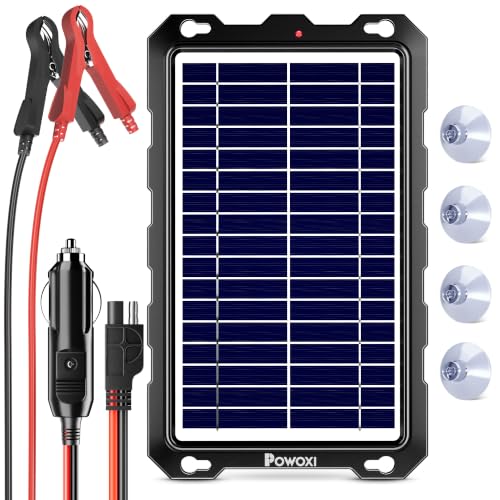
POWOXI 7.5W Solar Trickle Kit — Best for a bare stored battery
The POWOXI kit represents the smallest sensible unit of solar maintenance: a seven-and-a-half-watt panel paired with a smart charge controller, intended for batteries whose only enemy is self-discharge. A motorcycle battery in a dry barn, a mower battery in a shed with a sunny wall, or a classic car’s battery disconnected for winter all fit its parish, provided the sun reaches the panel for a decent part of the day. Within that parish it performs the essential trick of this whole category, arriving each spring to a battery that behaves as if the winter never happened.
The controller is what separates this kit from the cheapest bare panels sold for the same purpose. It manages the panel’s variable output into a safe charging pattern and guards against the reverse flow that can drain a battery into a dark panel overnight. On a small battery that protection matters disproportionately, because a compact battery has little capacity to spare for either overcharge on a bright day or leakage across a long night.
Buyers must simply respect the wattage. Ask this panel to offset a modern car’s alarm, tracker and sleeping computers through a cloudy month and it will lose slowly and politely, and the battery will be found discharged despite the owner’s faith. That is not a defect in the kit but a mismatch in the assignment, and the larger panels further down this list exist precisely for those hungrier vehicles.
- Format: small solar panel kit with smart controller
- Panel: 7.5 watts for light maintenance duty
- Protection: controller safeguards against overcharge and reverse drain
- Build: waterproof panel for outdoor mounting
- Role: motorcycles, mowers and disconnected stored batteries
Strengths
- Proper controller protection at the smallest useful size.
- Ideal scale for batteries with almost no parasitic load.
- Simple installation suits sheds, barns and moorings without power.
Trade-offs
- Seven and a half watts cannot feed a modern car’s standby appetite.
- Dull winter climates may outpace its harvest entirely.
- It will not recover a battery that starts its service already flat.
Best for: a single small battery stored in decent sun with minimal drain. Not suited for: modern cars in winter storage or any battery needing recovery.
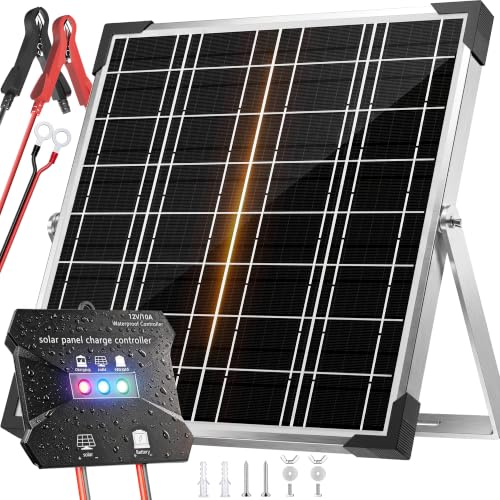
Voltset 20W Solar Panel Kit — Best mid-size all-rounder
Twenty watts is where solar maintenance becomes a realistic answer for ordinary vehicles, and the Voltset kit is built squarely on that threshold. Its panel harvests enough across an average week to hold a stored car or boat battery against the combined appetite of self-discharge and modest electronics, while its smart controller keeps the delivery within the battery’s comfort and its waterproof construction accepts life on a roof, a deck or a storage-yard post without complaint.
The kit’s appeal is its lack of drama in either direction. It is not so small that owners must calculate anxiously, nor so large that mounting becomes a construction project, and the included controller and cabling make a complete installation rather than a panel in search of accessories. For the commonest solar scenario in this entire category, a car or boat stored outdoors away from mains power in a temperate climate, it is the proportionate answer.
Judgement is still required at the extremes. A vehicle with an aftermarket alarm and tracker sleeping through a northern December may still outspend twenty watts, and a battery bank in a large RV will regard it as a gesture. Owners in those positions should step up to the fifty-watt pick rather than asking this kit to perform beyond its arithmetic, a theme this guide repeats because disappointment in solar almost always begins as undersizing.
- Format: solar panel kit with smart charge controller
- Panel: 20 watts for mainstream maintenance duty
- Protection: controller-managed charging with safety protections
- Build: waterproof design for car, boat and RV storage
- Role: stored vehicles with ordinary parasitic loads
Strengths
- Wattage matches the commonest storage scenarios honestly.
- Controller protection guards the battery in both directions.
- Complete kit form makes installation a single job.
Trade-offs
- Hungry electronics in deep winter can still outpace it.
- Large RV or twin-battery installations need more panel.
- Performance depends heavily on an unshaded mounting site.
Best for: stored cars and boats with normal standby drains in reasonable sun. Not suited for: big battery banks or heavily shaded storage.
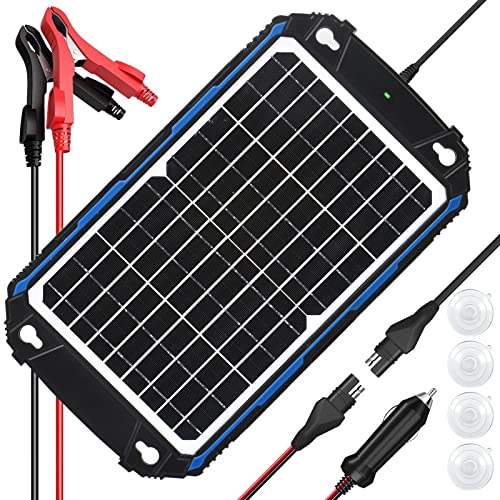
SUNER POWER 12W MPPT Maintainer Pro — Best efficiency at small size
This SUNER POWER model makes an argument that electronics can substitute for area. Its twelve-watt panel is modest, but the built-in MPPT controller converts the panel’s output more cleverly than simpler regulators, harvesting extra energy particularly in the cold, bright conditions where panel voltage runs high and basic controllers waste the surplus. For owners whose mounting space is limited, or whose climate delivers more gloom than glare, that efficiency can be worth several nominal watts of a cheaper panel.
MPPT also brings disciplined battery management with it: staged charging behaviour, protection against overcharge and reverse flow, and a maintenance approach that treats the battery as something to be preserved rather than merely connected to the weather. On a small panel the discipline shows up as consistency, delivering useful maintenance across marginal days when a cruder kit would contribute almost nothing.
The ceiling remains the panel itself, and no controller can invent sunshine. Twelve efficient watts still lose to a tracker-equipped car in a dark month, and buyers should read this pick as the best tool for small batteries and tight spaces, not as a loophole in the arithmetic that governs the whole category. Within its brief, though, it is the most technically accomplished kit in this list.
- Format: compact solar maintainer with advanced controller
- Panel: 12 watts backed by MPPT conversion
- Protection: ultra-smart controller with multiple safeguards
- Build: waterproof panel for permanent outdoor exposure
- Role: small batteries, tight mounting spaces, dull climates
Strengths
- MPPT harvests more from every bright interval than basic controllers.
- Strong protection behaviour for a kit of this size.
- Fits mounting spots where a larger panel cannot go.
Trade-offs
- Twelve watts remains twelve watts on a sunless week.
- The technology premium buys little in reliably sunny climates.
- Not a candidate for vehicles with heavy standby drains.
Best for: small batteries and awkward, space-limited sunny spots. Not suited for: large vehicles or owners expecting recovery charging.

SUNAPEX 12V Solar Trickle Kit — Best simple portable kit
The SUNAPEX kit is the straightforward member of this group: a waterproof solar panel with a smart controller that prevents overcharging, packaged as a portable maintainer for cars, boats and equipment that may not spend every winter in the same place. Its wattage sits in the smaller class, suited to batteries with modest drains, and its virtue is that it asks almost nothing of its owner beyond a sunny placement and a secure connection.
Portability changes how a solar kit gets used. A panel that can move from the stored car to the boat to the mower across a year serves a household fleet in a way fixed installations cannot, and this kit’s simple cabling and tolerant controller suit that itinerant life. The discipline it requires is the owner’s: each new assignment deserves a thought about whether the panel’s harvest matches that battery’s drain, since the kit cannot resize itself between jobs.
As with every small panel here, its honest ceiling should be respected. It maintains; it does not rescue, and in poor sun it maintains less. Buyers who understand it as a movable guardian for small and medium batteries, rather than as a universal solar answer, will find it a useful and unpretentious tool that earns its storage space.
- Format: portable solar trickle kit with controller
- Panel: smaller-class wattage for light to moderate drains
- Protection: smart controller prevents overcharging
- Build: waterproof and portable for changing assignments
- Role: cars, boats and equipment stored away from mains
Strengths
- Portability lets one kit guard several machines across a year.
- Controller protection is included rather than left to chance.
- Simple setup suits non-technical owners and temporary storage.
Trade-offs
- Modest wattage limits it to lighter maintenance work.
- Moving the kit means its previous battery loses its guardian.
- Permanent installations may prefer a bracketed panel instead.
Best for: households rotating one solar guardian among stored machines. Not suited for: fixed large installations or heavy parasitic loads.

SOLPERK 20W Solar Panel Kit — Best mounting flexibility
The SOLPERK kit treats mounting as a first-class feature, which experienced solar owners will recognise as wisdom. Its twenty-watt panel arrives with an adjustable bracket, letting the installer tilt the panel toward the sun’s seasonal path rather than accepting whatever angle a roof or wall imposes, and its MPPT controller carries a strong waterproof rating for life in genuinely exposed positions on boats, RVs and remote equipment.
Angle is worth real energy. A panel laid flat under a high summer sun performs respectably and then fades badly as the sun drops toward winter, while a tilted panel aimed at the low sun keeps harvesting through the months when batteries need the most help and days offer the least. The bracket therefore converts directly into winter reliability, which is the metric by which solar maintainers should be judged and the one glossy summer specifications conceal.
Twenty watts with MPPT efficiency places this kit at the capable end of the mid-size class, able to hold most single stored vehicle batteries in most climates when sited well. It shares the class ceiling against very large banks and very hungry vehicles, where the fifty-watt pick takes over, but for a permanent installation on one boat or vehicle it may be the most thoughtfully complete package in this guide.
- Format: solar panel kit with adjustable mounting bracket
- Panel: 20 watts with MPPT controller efficiency
- Protection: sealed controller with high waterproof rating
- Build: bracket allows seasonal tilt toward the sun
- Role: permanent fitting on boats, RVs and stored vehicles
Strengths
- Adjustable tilt materially improves winter harvest.
- MPPT controller extracts strong value from twenty watts.
- Weather sealing suits exposed marine and yard installations.
Trade-offs
- Bracket fitting takes more effort than laying a panel flat.
- A single vehicle battery is its natural limit of ambition.
- Shaded moorings defeat it as surely as any solar kit.
Best for: permanent outdoor installations where winter performance matters. Not suited for: shaded storage or twin-bank boats needing more wattage.

SUNER POWER 50W Solar Panel Kit — Best for hungry batteries
Fifty watts changes the conversation from whether solar maintenance can work to how much work it can cover. This SUNER POWER kit pairs its larger panel with an MPPT controller and a full set of safety protections, aiming at the assignments that defeat smaller kits: large batteries, twin-battery boats, RVs with meaningful standby loads, and any vehicle stored where winter days are short and frequently grey. Its harvest across a dull week can exceed what a seven-watt panel gathers in a bright month.
Scale brings responsibilities alongside capability. A panel of this size needs a proper mounting position and secure fixing against weather, and its controller’s discipline matters more, not less, because fifty watts in blazing sun can overcharge a small battery that a tiny panel would never threaten. The MPPT controller’s staged management and protections are therefore integral to the product rather than decoration, and owners should still match the kit to a battery bank large enough to absorb its generosity.
Even at fifty watts the founding rule of this guide survives intact. This kit maintains larger systems superbly and can slowly improve a partially discharged battery across sunny weeks, but it remains a maintainer, not a recovery charger for a bank flattened by a fault. Owners who grasp that distinction gain the strongest solar guardian in this list; owners who ignore it will merely be disappointed at a larger scale.
- Format: large solar maintainer kit with MPPT controller
- Panel: 50 watts for demanding maintenance duty
- Protection: smart MPPT management with multiple safety protections
- Build: waterproof construction for permanent outdoor use
- Role: big batteries, twin banks, RVs and northern winters
Strengths
- Real headroom for hungry vehicles and short winter days.
- MPPT control keeps a powerful panel safe for the battery.
- Covers twin-battery and large single-battery installations.
Trade-offs
- Oversized for a motorcycle or mower battery’s needs.
- Mounting a larger panel demands a suitable, secure site.
- Still a maintainer, not a rescue charger for flat banks.
Best for: large batteries, boats and RVs stored far from mains power. Not suited for: tiny batteries or anyone expecting rapid recovery charging.
How Do the Six Solar Kits Compare?
| Kit | Panel | Controller | Natural assignment |
|---|---|---|---|
| POWOXI Trickle Kit | 7.5W | Smart controller | Bare battery, minimal drain |
| Voltset Kit | 20W | Smart controller | Ordinary stored car or boat |
| SUNER POWER Pro | 12W | MPPT | Small battery, tight space |
| SUNAPEX Kit | Smaller class | Smart controller | Portable, rotating duty |
| SOLPERK Kit | 20W | MPPT | Permanent tilted installation |
| SUNER POWER 50W | 50W | MPPT | Large banks and hard winters |
The table’s lesson is that wattage and controller quality trade against each other only within limits. An efficient twelve watts can rival a crude twenty in poor light, while no controller lifts seven watts into truck-in-winter territory. Size the panel for the worst month the battery must survive, then let controller quality decide between candidates of similar size.
MPPT, PWM or a Bare Diode: Why Does the Controller Matter?
The simplest solar products connect a panel to a battery through little more than a diode that blocks reverse flow at night. Such arrangements can work on tolerant batteries in kind climates, but they surrender control of voltage entirely, overcharging on bright days and undercharging on dull ones, and they waste the panel’s higher-voltage output. They are the solar equivalent of an unregulated transformer charger, with the same slow consequences for battery health.
PWM controllers improve matters by switching the connection rapidly to hold a target voltage, delivering proper staged charging at modest cost and wasting some potential harvest in the process. MPPT controllers go further, converting the panel’s surplus voltage into additional charging current, which is why they shine in cold, bright weather and with panels whose voltage sits well above the battery’s. On small maintenance kits the difference is a useful margin rather than a transformation, yet margins are exactly what winter sizing is made of.
For the buyer the practical reading is simple. Insist on a real controller of either smarter type, treat MPPT as worth having where sun is scarce or panel space is tight, and regard any kit whose protection amounts to a diode and a promise as a false economy measured in shortened battery life.
Where Should You Mount the Panel, and at What Angle?
Site selection decides more solar installations than equipment choice ever will. The panel needs the most unobstructed sun available, which in practice means walking the storage site at different hours and watching where shadows from masts, trees, buildings and other boats actually fall across the seasons. A spot that is sunny at noon in June may be shaded all day in December, and the battery’s hardest test arrives in December.
Angle follows latitude and season. A tilt roughly equal to your latitude, facing the equator, is the standard compromise for year-round maintenance, steepened further if winter performance matters most, since the winter sun rides low and a steeper panel also sheds rain and debris more willingly. Adjustable brackets such as the SOLPERK’s let owners chase that winter angle deliberately, which is why mounting hardware earned its own pick in this guide.
Cleanliness and security finish the job. A film of dust, leaves or bird droppings can steal a surprising share of a small panel’s output, so an occasional wipe during other checks is maintenance of the maintainer. Fixings should resist both weather and casual theft in public storage yards, and cables should be routed where they cannot chafe, trip or be cut by a strimmer during somebody else’s tidy-up.
What Mistakes Do Solar Maintainer Owners Make?
Connecting a solar kit to an already flat battery and expecting recovery is the founding error of the category. The kit then spends its whole harvest on a hopeless deficit, the battery sits discharged and sulfating, and the owner concludes that solar does not work. Charge the battery fully by mains first, then let solar hold the result, and the same equipment suddenly appears miraculous.
Undersizing for winter is the second error, usually made by shopping in summer. A panel that keeps pace in July may deliver a third of that energy in January while the vehicle’s parasitic drain continues undiminished, and the battery declines so slowly that the failure is discovered only in spring. Size for the worst month, or plan a mains top-up in midwinter, and the system remains honest.
Ignoring the controller is the third. Owners sometimes bypass a failed controller and wire the panel directly, reasoning that a small panel cannot harm a large battery. In strong sun it can, through weeks of uncontrolled voltage, and at night the unblocked panel becomes a load rather than a source. The controller is not an accessory; it is the half of the product that makes the other half safe.
Finally, many owners never check the system after installation. A connector corroded green, a panel shaded by a growing hedge or a cable gnawed in a barn can reduce a good kit to decoration, and only a seasonal glance at the battery’s state reveals it. Solar maintenance is low-effort, not no-effort, and the effort is a minute’s inspection whenever the vehicle is visited.
How Do You Size a Solar Kit for Your Own Vehicle?
Begin by estimating the daily loss you must replace. A disconnected battery loses only its self-discharge, a small daily amount that even the smallest kit here covers in fair sun. A connected modern vehicle adds its parasitic draw, which owners can measure with a meter or approximate from experience: if the car cannot sit three weeks without struggling to start, its drain is substantial and the panel should be sized generously or the battery disconnected during storage to shrink the problem.
Then discount the panel for your reality. Assume a small number of effective full-sun hours per day in the worst month, multiply by the panel’s wattage, and compare the result with the daily loss in watt-hours. If the harvest does not exceed the loss with room to spare for cloudy spells, move up a size or reduce the drain. This arithmetic, done once on paper, prevents the slow-motion disappointment that gives solar maintenance an undeserved reputation among owners who guessed.
Leave headroom for ageing and circumstance. Panels lose a little output across years, storage sites gain new shadows, and vehicles acquire hungrier accessories. A kit bought with margin absorbs all three without a second purchase, which is why this guide’s recommendations lean a size larger than summer arithmetic suggests.
How Does Solar Maintenance Suit Boats on Moorings?
A boat on a swinging mooring is the purest case for solar in this entire series, because no shore cable reaches it and its batteries face a uniquely hostile combination of duties. An automatic bilge pump may run after rain, instruments and alarms sip continuously, and the battery that starts the engine shares the boat with all of them for weeks between visits. A battery that dies out there is not merely an inconvenience; it can mean a pump that stops, and a boat that fills.
Sizing for a mooring should therefore be conservative to the point of generosity. The panel must cover the pump’s average appetite across the wettest month, not the driest, and the fifty-watt class earns serious consideration wherever a single battery carries both starting and safety duties. Mounting must survive gales and gulls alike, with cables led below deck through proper glands rather than trapped in a hatch seal that will eventually let the sea in.
Owners should also build inspection into every visit: glance at the controller’s indication, check the battery has held its charge since the last trip, and clear the panel of the deposits that seabirds provide free of charge. A solar system on a mooring is safety equipment as much as convenience, and treating its checks with the same seriousness as checking the mooring lines themselves is the correct level of respect.
What About Vehicles Stored Indoors or Under Covers?
Solar’s obvious limit is darkness, and many stored vehicles live in it: garages, barns with the panel’s vehicle deep inside, and cars under covers that shade everything equally. The solutions are placement tricks rather than bigger panels. A panel can live outside the building on a wall or post with its cable run to the battery within, sit in the one sunny window the barn possesses, or, for a covered car outdoors, mount on a frame above the cover where the sun actually falls.
Each arrangement trades convenience for harvest and deserves an honest test before winter commits to it. Connect the system in autumn, record the battery’s state monthly, and let the evidence decide whether the siting works. Owners who discover a shortfall early can move the panel, enlarge it or arrange a single midwinter mains charge, all of which are cheaper than the battery that a whole season of optimism would have consumed.
Vehicles stored truly without any daylight access are simply not solar candidates, and this guide will not pretend otherwise. Those batteries belong to mains maintainers or to a rotation of visits with a portable charger, and recognising the boundary keeps solar’s reputation intact for the many storage situations where it genuinely excels.
How Long Do Solar Maintainer Kits Last?
The panel itself is usually the longest-lived component in any charging story told in this series. Photovoltaic cells degrade slowly, losing a small percentage of output across years rather than failing suddenly, and a well-made panel can remain useful long after the vehicle it first served has been sold. The shorter-lived parts are the ones owners can inspect and replace: cables whose insulation hardens and cracks in sunlight, connectors that corrode in marine air, and controllers whose electronics eventually tire of heat and damp.
That pattern argues for buying kits whose components can be separated and renewed, and for installations that keep the controller somewhere dry even when the panel must live in the weather. It also argues for a mid-life review of any installation: after a few seasons, clean every connection, confirm the controller still cycles correctly, and measure whether the panel’s harvest still balances the battery’s losses. A kit maintained at that modest level can plausibly serve two or three successive vehicles, which transforms its economics from accessory to infrastructure.
How Should You Connect a Solar Kit Safely?
Installation follows the same electrical manners as any charging work, with one solar peculiarity: the source cannot be switched off, only shaded. Connect the controller to the battery first where the instructions require that order, so the controller wakes up knowing its battery voltage before the panel is attached, then make the panel connection, ideally with the panel covered or turned away from the sun to avoid a live spark at the terminals. Polarity deserves a double check, since a reversed panel connection can damage a controller that would have forgiven almost anything else.
Fusing near the battery is cheap wisdom on any permanent installation, protecting the wiring if a cable chafes through against a bulkhead or a chassis edge over years of vibration. Route cables with drip loops where they enter enclosures, so rain runs off rather than along the wire into the electrics, and secure them against the flapping that wind and road travel guarantee. None of this requires an electrician for a twelve-volt maintainer, but all of it separates installations that last a decade from those that fail mysteriously in their second winter.
After connecting, verify the system under real sun before trusting it: the controller should show charging, the battery voltage should rise gently across a bright day, and nothing should grow warm at the connections. That half-day of observation, done once, is the commissioning that turns a box of parts into a system whose silence for the rest of the year can be believed.
What Happens to a Solar System in Snow Country?
Snow attacks solar maintenance twice, by covering the panel and by coinciding with the shortest days of the year, yet the situation is less hopeless than it first appears. A steeply tilted panel sheds snow far more readily than a flat one, which is another practical dividend of the adjustable brackets recommended earlier, and a dark panel that peeks through a thin covering can warm itself clear from a small starting patch on a bright day. Owners in serious snow country should mount panels where they can be brushed clear during visits, and should size them assuming some lost days are simply written off.
Cold itself is not the enemy of the panel, which actually produces voltage more eagerly at low temperatures, one reason MPPT controllers earn their keep in winter by converting that surplus. The enemy is the combination of scarce light and a battery whose own capacity shrinks in the cold while its vehicle’s demands stay constant. Honest northern owners therefore treat solar as the main defence and a monthly check as the reserve, topping up by mains in the darkest weeks if the battery’s state dips, rather than demanding the panel perform a miracle it never promised.
Can One Panel Maintain Two Batteries?
Owners of twin-battery boats and two-car storage inevitably ask whether one good panel can guard both, and the answer divides by wiring. Two batteries of the same age and type, wired in parallel as a single bank, are maintained by one kit exactly as one larger battery would be, with the panel sized to the combined self-discharge. Two separate batteries, perhaps a starting battery and a house battery with different duties, deserve either separate kits or a dual-output arrangement, because a single controller connected across both will tend to favour whichever battery accepts charge more readily and can leave the other quietly behind.
The pragmatic compromise in small fleets is rotation with discipline: the panel guards the battery at greatest risk, usually the one carrying parasitic loads, while the disconnected spare is checked and topped up on visits. Rotation fails only when it depends on memory, so a note fixed to the storage door, recording which battery holds the panel and when it last moved, converts a hopeful arrangement into a system. Where the batteries protect something important, such as a boat’s bilge pump, separate kits stop being a luxury and become the design.
How Do You Test Whether Your Solar System Is Winning?
Feelings about solar are unreliable in both directions, so a simple measurement routine settles the question for any installation. Record the battery’s resting voltage, ideally in the morning before the panel wakes, at the start of storage and then monthly. A system in balance shows a battery that begins each check near full and never trends downward across the season. A system losing ground shows the trend early, while there is still time to enlarge the panel, cut the drain or schedule a mains visit, rather than in spring when the battery has already paid for the discovery.
Owners without a meter can read the same story in behaviour: an engine that cranks with the same enthusiasm in March as it did in October is a maintained battery announcing itself. Either way, the test transforms solar from an act of faith into a monitored system, and monitored systems are the ones still working five winters later when the fit-and-forget installations have silently become garden ornaments with cables.
Why Does Battery Size Change the Solar Calculation?
Capacity cuts both ways in solar sizing, and owners often consider only one direction. A large battery holds a deep reserve, so a week of dull weather barely dents it, yet refilling that reserve after any real discharge is beyond a trickle panel’s ambition. A small battery, by contrast, can be genuinely improved by a sunny week, but its small reserve also means a modest parasitic drain empties it quickly when the panel falls behind. The maintainer’s job is to keep either battery near the top of its range, where its size works for the owner rather than against them.
That is why the pairing tables in this guide speak of drains and climates before capacities. A huge battery with no parasitic load in a sunny yard is an easy assignment, while a small battery feeding an alarm through a dark winter is a hard one. Judge your own installation by the balance of harvest and loss across its worst month, and the panel size follows from the arithmetic rather than from the battery’s label or from a neighbour’s success in a different climate with a different car.
A Word on Panels Fitted to the Vehicle Itself
Some owners mount the panel permanently on the vehicle, a roof panel on a camper or a deck panel on a boat, and gain a system that travels with its battery and needs no thought at each new storage spot. The compromise is that the vehicle’s parking then decides the harvest: a camper stored nose-in under trees carries its panel into the shade with it. Fixed vehicle mounting suits machines that live outdoors in the open by design, while machines stored in changing places are often better served by a panel mounted to the place rather than to the vehicle.
Whichever arrangement is chosen, vibration and weather sealing at the cable entries decide how many seasons it survives, and a yearly once-over of mounts, glands and connectors belongs in the same routine as checking tyre pressures after storage. Solar hardware fails slowly and visibly when it fails at all, which makes it unusually forgiving of owners who simply look at it occasionally.
How Should You Combine Solar With Occasional Mains Charging?
The strongest storage systems in this whole series are quietly hybrid. Solar handles the ordinary weeks flawlessly and free of charge, while the owner schedules one or two mains sessions across a long winter to guarantee the battery reaches a complete, charger-finished full charge at least occasionally. That combination covers solar’s two weaknesses, the darkest weeks and the absorption stage’s appetite for steady power, without surrendering its independence for the majority of the year.
Owners who adopt the hybrid pattern should treat the mains session as a service appointment rather than an admission of defeat: clean the terminals, check the battery’s state properly, let a smart charger finish its whole programme, and reconnect the solar kit to a battery that is verifiably full. Batteries maintained that way routinely outlast the vehicle systems around them, and the solar panel’s job for the following months becomes the easy one of defending a position already won.
One closing observation from years of storage yards: the owners who succeed with solar are rarely the ones with the largest panels. They are the ones who walked their storage site at dusk, noticed where the shadow of the neighbouring mast actually fell, and moved a modest panel two metres to the left. Attention, in this category, harvests more energy than money does, and every kit in this guide rewards it in direct proportion.
What Should You Do When a Maintained Battery Still Fades?
Work through the system in order before replacing anything. Verify the battery itself with a proper test, since a failing battery can out-consume a healthy panel’s entire harvest and masquerade as a solar problem. Then measure or observe the panel’s contribution across a bright day, inspect every connection for the green corrosion that marine and farm environments breed, and re-walk the site for new shade. Most fading systems confess at one of those four stops, and the fix is usually a cleaning, a moved panel or an honest battery replacement rather than a larger kit bought in frustration.
The owners who get this right share one more trait worth copying: they decide the system’s success by the battery’s condition in spring, never by the panel’s appearance in the shop. Judged on that single honest measure, every kit in this guide has a storage yard somewhere where it is quietly, completely succeeding.
Budget a few minutes at installation for photographs of the wiring and the panel’s position, filed with the vehicle’s papers. When a system needs attention years later, or passes to a new owner with the vehicle, those pictures explain an installation faster than any manual and preserve the thinking that made it work.
Solar maintenance, done properly, is the closest thing vehicle storage offers to a free lunch, and like most free lunches it is served only to those who read the terms, which in this case are written in watts, shade and season.
Final Recommendation
Match the panel to the hungriest month and the greediest drain, and solar maintenance becomes one of the most satisfying technologies in vehicle ownership. The POWOXI guards a bare battery, the SUNER POWER Pro does the same work cleverly in tight spaces, the Voltset and SUNAPEX cover ordinary stored vehicles in fixed and portable roles, the SOLPERK adds the tilt that winter rewards, and the fifty-watt SUNER POWER stands guard over the big banks and dark climates that defeat the rest.
Start whichever kit you choose with a battery charged full by other means, site its panel like you mean it, and check the arrangement whenever you pass. Do those three things and the sun, which was quietly discharging nothing and helping nobody, becomes the most reliable member of your storage routine.
Frequently Asked Questions
Can a solar trickle charger charge a dead battery?
Not in any useful timescale. A trickle panel replaces small daily losses, so a dead battery represents weeks or months of harvest even in good sun, during which the battery sulfates further. Recharge a flat battery with a mains charger first, then connect solar to maintain the result.
Will a solar panel overcharge my battery?
A kit with a proper charge controller will not, because the controller regulates voltage and stops or floats the charge when the battery is full. A bare panel connected without a controller genuinely can overcharge in strong sun, which is why every pick in this guide includes controlled electronics.
Does a solar maintainer work on cloudy days?
It works at reduced output, since panels generate from daylight rather than only from direct sunshine. Extended dull weather lowers the harvest substantially, which is why sizing for the worst month, rather than for average conditions, decides whether a system succeeds.
Can the panel drain the battery at night?
Without blocking protection it can, because a dark panel can draw a small reverse current. The controllers in these kits prevent that flow, another reason the electronics matter as much as the panel itself.
What size panel does a stored car need?
A disconnected battery in decent sun can be held by the smallest kits here. A connected modern car with alarms and trackers usually wants the twenty-watt class or better, and vehicles in northern winters or partial shade should consider fifty watts or a battery disconnect to reduce the drain.
Where is the best place to mount a solar trickle panel?
Wherever receives the most unobstructed sun across the whole day and year, tilted toward the equator at roughly your latitude angle, steeper if winter matters most. On boats and RVs that usually means a roof, rail or post clear of mast and rigging shadows.
Related Guides
Related reading: our guide to the best 12 volt battery chargers for mains-powered care, our roundup of the best 3 bank chargers for boats on shore power and our look at the best 10 amp battery chargers for recovery work.


