What's inside
- Key Takeaways
- Quick Picks
- How Did We Choose These Picks?
- What Does “5.1 Atmos” Actually Mean, and Why Is the Label Wrong?
- How Do These Six Atmos Routes Stack Up?
- How Should You Plan a Real 5.1.2 Upgrade Path?
- What Mistakes Do Buyers Make When Chasing Atmos on a 5.1 Budget?
- Which Receiver Features Actually Matter for an Atmos Build?
- How Should You Place and Calibrate the Height Layer?
- What Will Each Route Actually Cost You in Total?
- Where Does Atmos Content Actually Come From?
- How Hard Is the Wiring, Really?
- Final Recommendation
- Frequently Asked Questions
- Related Guides
As an Amazon Associate I earn from qualifying purchases. This post may contain affiliate links at no extra cost to you.
gizmoverdict.com is reader-supported. When you buy through links on our site, we may earn an affiliate commission.
Where to buy: Every linked pick below is sold through Amazon, where you can check current availability and delivery options before you commit. One warning before the list itself: most of what shoppers call “5.1 Atmos speakers” is not Atmos hardware at all, and this guide refuses to pretend otherwise. Read the first section before you spend anything, because the honest answer to this search shapes every pick that follows.
Here is the problem with shopping for the best 5.1 Atmos speakers: the phrase describes something that does not technically exist. Dolby Atmos is an object-based format that needs height information — sound placed above the listening plane, not just around it. A system written as 5.1 has five ear-level channels and one subwoofer. There is no height channel in that count, so a plain 5.1 speaker package, played through any receiver, cannot reproduce Atmos as Atmos. What actually delivers the format is a 5.1.2 or 5.1.4 layout — the same five ear-level speakers and sub, plus two or four height or up-firing speakers — or a soundbar that virtualizes height with processing and reflected sound. Everything in this guide is organized around that fact. Some picks below are genuine building blocks for a real Atmos room once you add height speakers and an Atmos-capable receiver. One pick is a bundle that already includes exactly that receiver. One pick is a self-powered system with no Atmos decoding at all, included deliberately as the contrast case so you can see what the money buys when height is not part of the deal. And the final pick is prose-only: the soundbar route, which is the only way to get something calling itself Atmos without running a single speaker wire to the ceiling.
That framing may sound like a lecture, but it will save you from the most common disappointment in this category: buying a handsome 5.1 package, mounting it beautifully, pressing play on an Atmos mix, and hearing a perfectly good 5.1 downmix while the receiver’s display quietly shows Dolby TrueHD instead of Atmos. The speakers were never the missing piece. The missing pieces were the height channels and the decoder. So this guide grades each system on two questions at once: how well does it do the 5.1 job today, and how honestly and cheaply does it get you to real Atmos tomorrow?
Key Takeaways
- No speaker package labeled 5.1 plays Dolby Atmos by itself; Atmos requires height channels, which means a 5.1.2 or 5.1.4 layout or a virtualizing soundbar.
- The Klipsch Reference Theater Pack bundled with the Onkyo TX-NR7100 is the only pick here that arrives with an Atmos-decoding receiver in the box, which makes it the shortest honest path to real height sound.
- Passive 5.1 packages from Klipsch, Fluance, and Monoprice are Atmos foundations, not Atmos systems — budget for the receiver and a pair of height speakers from day one.
- The Logitech Z906 decodes Dolby Digital and DTS only; it is a fine powered 5.1 system and a useful reality check, but no setting or cable will make it an Atmos rig.
- If running wires for height speakers is impossible in your room, a dedicated Atmos soundbar is the legitimate alternative, and it is covered as a prose-only route rather than disguised as a speaker package.
Quick Picks
| Pick | Badge | Why it is here |
|---|---|---|
| Klipsch Reference Theater Pack 5.1 Bundle with Onkyo TX-NR7100 Receiver | Only true Atmos starting point | The bundle pairs the compact Klipsch satellites with a 9.2-channel Atmos receiver, so decoding and amplification are solved in one purchase. |
| Klipsch Reference Theater Pack 5.1 | Best compact foundation | Small, efficient satellites that are easy to place and easy for a modest receiver to drive — but plain 5.1 until you add height speakers. |
| Fluance Signature HiFi 5.1 System (HF51BR) | Best full-size foundation | Tower-based front stage with real cabinet volume for large rooms, sold as a plain 5.1 set that needs an Atmos receiver and heights added. |
| Monoprice HT-35 Premium 5.1-Channel System | Budget foundation | The lowest-cost way into a matched passive 5.1 layout with a powered subwoofer, leaving budget room for the receiver that makes Atmos possible. |
| Logitech Z906 5.1 Surround Sound Speaker System | The honest contrast — no Atmos | A self-powered THX-certified system that decodes Dolby Digital and DTS and nothing newer; buy it for what it is, never for height effects. |
| Atmos soundbar route (prose-only) | Wire-free alternative | A single bar with up-firing drivers or virtualization is the practical Atmos answer for renters and rooms where ceiling wiring is off the table. |
How Did We Choose These Picks?
We started by throwing out every product whose marketing implied that a box of five speakers and a subwoofer could somehow produce height effects on its own. That filter removed a surprising amount of the market. What remained fell into four honest groups: passive 5.1 packages that can serve as the ear-level layer of a real 5.1.2 build, a bundle that includes the Atmos receiver those packages need, one powered system that makes no Atmos claim once you read its spec sheet carefully, and the soundbar category, which handles height in an entirely different way. Within the passive group we weighed satellite size against room size, because a compact satellite package and a tower-based package solve different problems, and we checked sensitivity and impedance in general terms so that a mid-range receiver would not be strained. We also verified each linked product against its current listing details before including it, and where a listing’s name could mislead — a bundle, a model year, a plain 5.1 set wearing Atmos-adjacent language — the pick sections below say so in plain words.
One more selection rule mattered: upgrade path. A 5.1 package earns its place here only if adding two height speakers later is physically sensible — satellites small enough to complement ceiling or up-firing additions, a center channel voiced to match the rest of the family, and a subwoofer that will not be outclassed once the system grows. Systems that trap you in a dead end, with proprietary connections or speakers that cannot be reused in a larger layout, were left out.
What Does “5.1 Atmos” Actually Mean, and Why Is the Label Wrong?
Channel notation is a contract. The first number counts ear-level speakers, the second counts subwoofers, and the third — the one that matters here — counts height channels. Atmos mixes carry metadata that tells the decoder where to place sounds in three-dimensional space, and the height layer is what separates an Atmos presentation from a good 5.1 presentation. When a helicopter crosses the screen in a 5.1 downmix, it travels from front-left to rear-left at ear height. In a true 5.1.2 rendering, it rises. That rise is the entire product being sold under the Atmos name, and it physically cannot happen without speakers assigned to height duty, either mounted high, installed in the ceiling, or firing upward to reflect off it.
Receivers enforce this honestly even when retailers do not. Feed an Atmos track to an Atmos receiver driving only 5.1 speakers and the receiver will decode the 7.1 Dolby TrueHD core and play that. The height objects are folded into the ear-level bed. Nothing is broken and nothing sounds bad — it simply is not Atmos, in the same way that a stereo downmix of a 5.1 track is not surround sound. Keep that mechanism in mind while reading the picks: for the passive packages, the speakers are the foundation and the receiver plus height speakers are the Atmos part. For the soundbar route, processing and reflection fake the height layer with varying success. For the Z906, there is no Atmos decoding silicon in the chain at all.
There is also a middle path worth knowing about before you buy: Dolby Atmos Height Virtualization and similar DSP modes, offered on some receivers, simulate height from a 5.1 layout. Opinions on the effect range from pleasantly surprised to unconvinced, and it depends heavily on the room. It is a legitimate feature to enjoy if your receiver offers it, but it is a simulation layered on top of a 5.1 system, and this guide does not count it as turning a 5.1 package into an Atmos speaker system.

Klipsch Reference Theater Pack 5.1 Bundle with Onkyo TX-NR7100 Receiver — Only true Atmos starting point
This bundle exists because Klipsch and Onkyo understood the assignment better than most of the category. The speaker half is the Reference Theater Pack: five compact satellite speakers built around Klipsch’s horn-loaded tweeter design, plus a powered subwoofer, all voiced to match. The electronics half is the Onkyo TX-NR7100, a 9.2-channel receiver with Dolby Atmos decoding, Dirac Live room correction, and enough powered channels to run 5.1.2 or 5.1.4 the moment you add height speakers — or a full 7.1.2 layout if your room grows. That second half is what no other pick in this guide includes, and it is the difference between owning Atmos-capable hardware and owning a promise.
Consider what the purchase sequence looks like without the bundle. You buy a passive 5.1 package, then shop separately for a receiver, then discover that the entry-level receivers you were pricing handle 5.1.2 at best with pre-outs you do not have, then re-shop. The bundle collapses that into one decision, and the pairing is sensible: Klipsch satellites are notably efficient, so the Onkyo’s amplification is never working hard at sane listening levels, which leaves headroom for the dynamic peaks that movie mixes save for exactly the moments you bought the system for. Dirac Live is the quiet star here. Satellite speakers placed where furniture allows, rather than where geometry demands, benefit enormously from competent room correction, and Dirac is a step above the basic auto-setup routines bundled with cheaper receivers.
The honest limits are the satellites themselves. Small enclosures mean the crossover to the subwoofer sits relatively high, so the sub does real midbass work and its placement matters more than it would with tower speakers; park it in a corner without measuring and male voices can thicken. The pack also ships without height speakers, because it is a 5.1 speaker set — the bundle solves decoding and amplification, not the physical height layer. Budget for a pair of add-on height speakers, in-ceiling or up-firing, to complete the format the receiver is ready for. Until they arrive you own an excellent 5.1 system with Atmos decoding waiting patiently in reserve.
- Configuration: 5.1 speaker package plus 9.2-channel AV receiver in one bundle
- Receiver: Onkyo TX-NR7100 with Dolby Atmos decoding and Dirac Live room correction
- Speakers: Five horn-loaded satellites and a powered subwoofer, matched voicing
- Atmos status: Decoding and amplification included; height speakers sold separately
- Expansion: Receiver supports height layouts up to 5.1.4 or 7.1.2 with added speakers
Strengths
- Removes the receiver guesswork entirely — the decoding half of Atmos is in the box.
- Dirac Live correction flatters the imperfect satellite placements real rooms force on you.
- Efficient satellites leave the receiver relaxed and dynamic at family listening levels.
Trade-offs
- Still not Atmos out of the box; a pair of height speakers is a required second purchase.
- Compact satellites lean on the subwoofer for midbass, so sub placement needs care.
- The bundle costs more upfront than any speaker-only package on this page.
Best for: Buyers who want one purchase to put them a single pair of height speakers away from genuine Atmos. Not suited for: Anyone who already owns a good receiver — buy the speaker pack alone instead.

Klipsch Reference Theater Pack 5.1 — Best compact foundation
Sold on its own, the Reference Theater Pack is the same five satellites and powered subwoofer as in the bundle above, and it needs to be described with complete clarity: this is a plain 5.1 system. It contains no height speakers and no electronics, so connected to a non-Atmos receiver it will never play Atmos, and connected to an Atmos receiver it plays the ear-level layer beautifully while the height objects wait for speakers that are not in this box. We rank it as the best compact foundation because, as foundations go, it is unusually well behaved. The horn-loaded tweeters give the satellites an efficiency that small speakers rarely offer, which means modest receivers drive them to satisfying levels without strain, and dialogue clarity — the thing compact systems usually sacrifice — is a genuine strength.
Placement flexibility is the other reason this pack keeps winning living rooms. The satellites are small enough for shelves, stands, or wall mounts, and their matched voicing means pans across the front stage do not change character as they cross the center channel. The subwoofer is a wireless-capable design in this family, which matters more than it sounds: the best sub position in most rooms is not beside the TV, and a wireless link lets you put the sub where the room measures well rather than where the cable reaches. In a 5.1.2 future, these satellites also make visual sense alongside added height speakers, because nothing about their scale fights with in-ceiling or up-firing additions.
Where does it run out of road? Room size. In a large, open-plan space, compact satellites at distance lose the midbass body that towers keep, and you will hear the subwoofer working as a localization risk if the crossover creeps up. The pack is also entirely dependent on the receiver you pair it with for any future beyond 5.1 — buy a receiver without Atmos and pre-outs today, and this foundation’s upgrade path closes. Treat the receiver purchase as part of this pick, even though it is not in the box.
- Configuration: Passive 5.1 package — five satellites plus powered subwoofer
- Design: Horn-loaded tweeters for high efficiency from small enclosures
- Atmos status: Plain 5.1; requires an Atmos receiver plus height speakers to become a 5.1.2 system
- Receiver: Not included — a separate purchase, and it decides your upgrade path
- Placement: Shelf, stand, or wall-mount friendly; subwoofer placement flexible
Strengths
- Dialogue stays crisp at low and moderate volumes, where compact systems usually mumble.
- Easy load for entry-level and mid-range receivers alike.
- Small footprint disappears into rooms that cannot host towers.
Trade-offs
- No Atmos capability whatsoever until receiver and height speakers join the system.
- Large rooms expose the satellites’ limited midbass reach.
- Total system cost is deceptive — the receiver is a second, unavoidable purchase.
Best for: Small-to-medium rooms building toward 5.1.2 in two steps. Not suited for: Anyone expecting Atmos from this box alone, or filling a very large open-plan space.

Fluance Signature HiFi 5.1 System (HF51BR) — Best full-size foundation
Fluance’s Signature package takes the opposite physical approach to the Klipsch pack: instead of satellites, the front left and right channels are full 3-way floorstanding towers, joined by a matched center, a pair of surrounds, and the DB10 subwoofer. It is also, with the same clarity as above, a plain 5.1 system. Nothing in the box decodes anything and nothing fires upward. What the towers buy you is the ear-level layer done with real cabinet volume — deeper natural bass extension from the front stage, a crossover point low enough that the subwoofer handles only true low frequencies, and the kind of front-stage scale that makes orchestral scores and stadium broadcasts feel wide rather than tall-but-thin. For a big room, this is the more convincing foundation.
The path to Atmos from here is arguably easier than from the Klipsch pack in one respect: towers give up-firing height modules a natural perch. Many owners place add-on Atmos modules on top of the front towers, angled to bounce height information off the ceiling, and the Signature towers’ flat tops and stable stance suit that trick. Alternatively, the surrounds’ voicing matches the family if you later expand within the line. The receiver requirement is unchanged and non-negotiable: an Atmos-decoding model with at least seven amplified channels for 5.1.2, nine if 5.1.4 is the goal. Fluance sells speakers, not electronics, so that choice — and its budget — is yours.
Ownership realities: towers dominate a room visually and physically, need breathing room from walls to sound their best, and make this the wrong answer for a bedroom or a rental with a strict no-big-furniture mood. The DB10 subwoofer is competent for its class but is the component most likely to be upgraded first in a large space. And because the front stage is so capable, a cheap receiver will be exposed; this package deserves mid-range amplification with good room correction, which pushes the true total well past the sticker.
- Configuration: Passive 5.1 package with 3-way floorstanding front towers
- Subwoofer: Fluance DB10 powered subwoofer included
- Atmos status: Plain 5.1; towers provide a natural platform for add-on up-firing height modules
- Receiver: Not included; choose an Atmos model with 7–9 amplified channels
- Room fit: Medium-to-large dedicated spaces
Strengths
- Front-stage scale and midbass body that satellite packages cannot reproduce.
- Low crossover to the sub keeps bass non-localized and voices natural.
- Tower tops make the up-firing height module route genuinely practical.
Trade-offs
- Towers demand floor space, wall clearance, and visual commitment.
- Deserves a mid-range receiver, so the all-in cost climbs quickly.
- The included subwoofer is the first upgrade candidate in big rooms.
Best for: Dedicated movie rooms where the front stage matters most and Atmos heights arrive in phase two. Not suited for: Small rooms, discreet installs, or buyers counting on the package price being the whole budget.

Monoprice HT-35 Premium 5.1-Channel System — Budget foundation
The HT-35 is Monoprice doing what Monoprice does: a matched set of five compact speakers and a powered subwoofer at a price that leaves most of your budget intact for the electronics. That last point is precisely why it belongs in an Atmos conversation. The total cost of a real 5.1.2 system is dominated by the receiver, and every currency unit not spent on the ear-level speakers is available for the component that actually decodes height information. Bought with clear eyes — as a competent 5.1 layer awaiting an Atmos receiver and a pair of height speakers — the HT-35 is a rational allocation of money, not a compromise to apologize for.
Set expectations by physics. The satellites are small, the subwoofer is modest, and the system is voiced for nearfield-to-medium rooms: apartments, bedrooms turned media rooms, secondary TV spaces. Within that envelope it does the important things right — matched drivers across all five channels so effects pan coherently, a powered sub that relieves the receiver of low-frequency duty, and standard binding posts that accept ordinary speaker wire and will still make sense when the speakers are repositioned as your layout grows. The powered subwoofer also means the HT-35’s satellites can be driven by receivers of very modest power without distress.
The ceiling on performance is real. Play it loud in a big room and the small drivers compress; ask the sub for infrasonic movie effects and it will decline politely. There is also no upgrade elegance here — when you eventually want more, you replace rather than extend, because this is a closed value package rather than a family of matched separates. But judged as the cheapest honest doorway into a layout that can become 5.1.2, it earns its slot.
- Configuration: Passive 5.1 package — five compact speakers plus powered subwoofer
- Atmos status: Plain 5.1 layer; Atmos depends entirely on the receiver and added height speakers
- Receiver: Not included; modest power requirements suit entry-level models
- Room fit: Small-to-medium rooms and secondary setups
- Connections: Standard speaker terminals, ordinary wire, no proprietary links
Strengths
- Preserves budget for the Atmos receiver, which is where the format actually lives.
- Matched voicing across all five channels keeps pans seamless.
- Gentle power demands pair safely with entry-level receivers.
Trade-offs
- Small drivers run out of composure at high volume in large spaces.
- Subwoofer extension is modest; deep movie bass is not its party trick.
- A closed package — future upgrades mean replacement, not extension.
Best for: Budget-first builders who understand the receiver is the real Atmos purchase. Not suited for: Large rooms, high-volume listening, or anyone wanting a system that grows piece by piece.
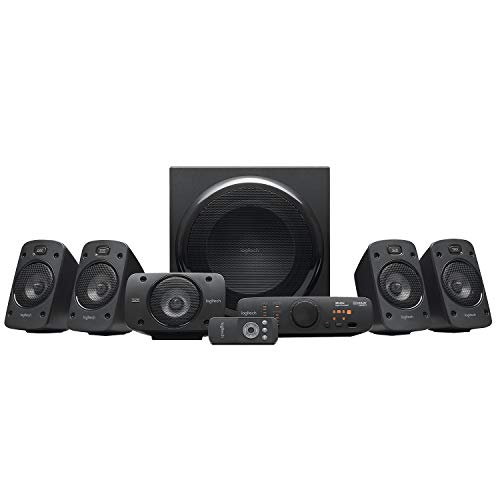
Logitech Z906 5.1 Surround Sound Speaker System — The honest contrast: no Atmos
The Z906 is here to keep everyone honest, including us. It is a self-powered 5.1 system — amplification built in, a control console, decoding for Dolby Digital and DTS, THX certification, and a long production life that has made it the default answer for powered surround on desks and in small living rooms. It is also, categorically, not an Atmos product. Its decoders predate the format’s consumer rollout; there is no height processing, no eARC Atmos passthrough trick, no firmware update coming to change that. An Atmos soundtrack played through a Z906 arrives as its 5.1-compatible core, which sounds good and is not Atmos. Any listing, review, or salesperson implying otherwise is selling you the downmix at an Atmos price.
Judged on its actual merits, the Z906 remains easy to recommend for its actual job. Setup takes an afternoon at most: five satellites, a ported subwoofer that doubles as the amplifier hub, speaker wire included in spirit if not in audiophile grade, and inputs for several sources at once — optical, coaxial, analog 5.1, stereo. For a PC battlestation or a console corner, that simplicity is the product. The sound signature favors impact: strong bass presence, clear effects placement, and enough total output to make a small room feel cinematic. It has survived on the market for years because the formula works.
Why include a non-Atmos system in an Atmos guide at all? Because many readers searching this phrase do not actually need height effects — they need surround sound for a desk or a small room, and the Atmos label is just the vocabulary the market taught them. If that is you, the Z906 is the honest purchase and the packages above are over-engineering. If height effects are genuinely the point — the rain overhead, the flyover that rises — then the Z906 is the control case that shows what your money is not buying, and the bundle at the top of this page is where the format actually starts.
- Configuration: Self-powered 5.1 system — amplification and decoding built in
- Decoding: Dolby Digital and DTS; no Dolby Atmos decoding of any kind
- Certification: THX certified
- Inputs: Multiple digital and analog inputs for PC, console, and TV sources
- Atmos status: None — included as the contrast case, not as an Atmos option
Strengths
- No receiver to buy, configure, or find shelf space for.
- Proven, punchy performance for desks and small living rooms.
- Generous input selection handles several sources simultaneously.
Trade-offs
- Zero Atmos capability, permanently — the decoders simply do not include it.
- Closed system; no channel can be upgraded or repurposed later.
- Bass-forward tuning is fun for films, less neutral for critical music listening.
Best for: Buyers who realize they want great 5.1, not height effects. Not suited for: Anyone whose actual goal is Atmos — full stop.
The Atmos Soundbar Route — Wire-free alternative (prose-only)
The sixth way to answer this search involves no speaker package at all. A modern Atmos soundbar packs the left, center, and right channels into one enclosure, adds dedicated up-firing drivers that bounce height information off your ceiling, and pairs with a wireless subwoofer and, in the better systems, wireless rear surrounds. This site covered dedicated Atmos soundbars in an earlier batch of guides, so this pick is presented prose-only here rather than linked — but it belongs in the decision, because for a large share of households it is the rational one. No receiver, no speaker wire, no ceiling work, and a height effect that, in a room with a flat, reflective ceiling at a sensible height, is genuinely perceptible.
Be clear-eyed about the physics trade. Reflected height is an approximation: it depends on ceiling material, ceiling height, and seating position, and it smears precision compared with discrete height speakers. A popcorn ceiling or vaulted space can reduce the effect to a vague spaciousness. The ear-level layer is also a compromise — a bar’s drivers sit close together, so the front soundstage is narrower than separated speakers, and wireless rears, where offered, are the difference between real surround and a wide stereo illusion. What you are buying is convenience and a credible version of the format, and for renters, minimalist rooms, and anyone whose alternative is no height sound at all, that trade is often correct.
The buying rule for this route: insist on physical up-firing drivers rather than virtualization-only processing if your ceiling cooperates, confirm the bar decodes Atmos over eARC from your TV or through its own HDMI input, and treat “Atmos compatible” phrasing on a stereo bar as the marketing fog this whole guide exists to clear. If your ceiling is vaulted or very high, skip the reflection gamble entirely and put the money toward the receiver-based path at the top of this page.
- Configuration: Single bar with up-firing drivers, wireless subwoofer, optional wireless rears
- Atmos status: Real decoding with reflected height — an approximation of discrete height speakers
- Requirements: Flat, reflective ceiling at moderate height; eARC-equipped TV or HDMI input on the bar
- Receiver: None — decoding and amplification are built into the bar
- Coverage: Presented prose-only; see this site’s dedicated soundbar guides for linked models
Strengths
- The only Atmos route with zero speaker wire and zero receiver.
- Height effect is real and perceptible in cooperative rooms.
- Installs in minutes and suits renters and minimalist spaces.
Trade-offs
- Reflected height collapses with vaulted, very high, or absorptive ceilings.
- Front soundstage is narrower than separated speakers can deliver.
- Virtualization-only models trade on the Atmos name with the least effect.
Best for: Renters and wire-averse rooms with flat ceilings. Not suited for: Vaulted-ceiling rooms or listeners who want pinpoint height placement.
How Do These Six Atmos Routes Stack Up?
| Pick | Type | Atmos out of the box? | What you must add | Room fit |
|---|---|---|---|---|
| Klipsch Pack + Onkyo TX-NR7100 bundle | Passive speakers + receiver bundle | Decoding yes, height speakers no | One pair of height speakers | Small to large |
| Klipsch Reference Theater Pack 5.1 | Passive package | No | Atmos receiver + height speakers | Small to medium |
| Fluance Signature 5.1 (HF51BR) | Passive tower package | No | Atmos receiver + height speakers or modules | Medium to large |
| Monoprice HT-35 | Passive budget package | No | Atmos receiver + height speakers | Small to medium |
| Logitech Z906 | Self-powered system | Never | Nothing — it is a finished 5.1 system | Desk to small living room |
| Atmos soundbar route | Powered bar system | Yes, via reflected height | Nothing, if your ceiling cooperates | Small to medium, flat ceiling |
Read the third column as the guide’s thesis in miniature. Only two rows involve Atmos on day one, and one of those two is an approximation. Everything else is a foundation plus a shopping list. That is not a reason to avoid the foundations — discrete speakers remain the best-sounding endgame — but it is a reason to budget honestly and to distrust any product page where the third column is left blurry.
How Should You Plan a Real 5.1.2 Upgrade Path?
Start with the receiver, even if you buy it second. For 5.1.2 you need at least seven amplified channels and Atmos decoding; for 5.1.4, nine. Room correction quality matters more than small differences in rated power, because your speakers will sit where the room allows. Next, the ear-level five: keep them matched, keep the center channel from the same family as the fronts, and place the surrounds slightly behind and above ear level at the listening position. The subwoofer goes where a crawl test — sub at your seat, you walking the room’s edges listening for evenness — says it behaves, not where the furniture catalog suggests.
Height speakers come last and offer three flavors. In-ceiling speakers are the most precise and the most committed. On-ceiling or high wall-mounted speakers angled down are nearly as good and far less invasive. Up-firing modules sitting on your front speakers are the easiest install and the most room-dependent. Whichever you choose, run the receiver’s calibration again afterward, verify the receiver’s display actually reports an Atmos decode with an Atmos source playing, and resist judging the height layer with content that barely uses it — a dialogue-driven drama will not demo your ceiling.
What Mistakes Do Buyers Make When Chasing Atmos on a 5.1 Budget?
The first mistake is believing the label on a speaker box. Speakers do not decode formats; electronics do. The second is buying a receiver with exactly the channels for today and no path to tomorrow — a 5.1 receiver strands a good speaker package permanently. The third is mounting height speakers and then feeding them a non-Atmos mix, concluding the format is a gimmick; check the source and the receiver display first. The fourth is neglecting the ceiling in an up-firing setup, where a vaulted or heavily textured ceiling quietly eats the effect you paid for. The fifth is placing the subwoofer by symmetry rather than by measurement, then blaming the speakers for boomy dialogue. Each of these is a planning error, not a product defect, and each is cheaper to avoid on paper than to fix in the room.
Which Receiver Features Actually Matter for an Atmos Build?
Because the receiver is where Atmos lives, its spec sheet deserves more scrutiny than any speaker’s. Channel count is the first gate: seven amplified channels minimum for 5.1.2, nine for 5.1.4, and beware receivers advertised as “7.2” that process nine channels but amplify seven — processing without amplification means external amps for the extra channels, which is a fine path but should be a chosen one, not a surprise. Room correction is the second gate, and it is not a luxury feature. Your height speakers will sit at angles dictated by joists and furniture; your surrounds will rarely be equidistant. A competent correction system — and the better tiers of the major systems genuinely differ from the basic ones — measures each speaker’s distance, level, and room interaction and compensates, which is the difference between height effects that image overhead and height effects that merely sound louder.
Third, check the HDMI chain. Your TV, receiver, and sources must agree on eARC if you stream from TV apps, and on the video formats you actually use; a receiver that bottlenecks a console’s high-refresh output will annoy you daily, unlike a missing legacy input you would never touch. Fourth, look at how the receiver handles the subwoofer: independent dual-sub outputs and bass management with sensible crossover slopes matter because, as the picks above show, compact satellites hand real midbass work to the sub, and sloppy integration there muddies dialogue — the one flaw nobody forgives in a movie system. Finally, streaming and control features are worth ten minutes of thought and no more; they age faster than amplifiers do, and an external streamer replaces them cheaply, while a well-built amp section serves for a decade.
A word on power ratings, because they mislead more shoppers than any other number. Receivers are commonly rated with two channels driven; a nine-channel receiver delivering its headline wattage to all channels at once is rare at sane prices. In practice this matters less than it appears: movie peaks are brief, most channels idle most of the time, and efficient speakers — the Klipsch approach — need startlingly little power to reach reference-adjacent levels in ordinary rooms. Buy for channels, correction, and connectivity; let power take care of itself unless your speakers are known to be inefficient or your room is genuinely vast, in which case the Fluance-style tower route and a receiver with pre-outs for a future power amp is the grown-up answer.
How Should You Place and Calibrate the Height Layer?
Placement begins before any speaker is mounted, with the listening position. Everything — angles, distances, levels — is referenced to the main seat, so decide where that is and be honest if the honest answer is a three-seat sofa rather than a single throne; calibration systems that support multiple measurement positions will average the sofa into decency, while a single-point measurement makes one cushion glorious and the others odd. For a 5.1.2 layout, the height pair belongs above and slightly in front of the listening position if ceiling-mounted, or on top of the front speakers if up-firing. For 5.1.4, the pairs split front and rear of the seat, which is what allows overhead movement to track front-to-back rather than hovering in a single band.
Ear-level placement has its own quiet rules. The center channel should sit as close to screen height as furniture allows, angled toward ear level, because dialogue anchored noticeably above or below the picture pulls attention out of the film. Surrounds belong slightly behind the listening line and a little above ear height — not in the rear corners firing forward like a second front stage. The subwoofer, again, goes where the crawl test validates. None of this requires instruments beyond a tape measure and patience, and all of it pays more than the same money spent on marginally better speakers placed carelessly.
Calibration is a procedure, not a button. Run the receiver’s auto-setup with the microphone at ear height at the main seat, in a quiet room, with the mic on a tripod or stack of books rather than a cushion that absorbs the very reflections being measured. Then check what it decided: speaker distances should roughly match your tape measure, crossovers for compact satellites should land in the upper bass region rather than at full-range, and the subwoofer level should not sit at either extreme of its range, which signals a gain mismatch at the sub itself. Play a film you know well — not a demo reel — and adjust the center channel up a decibel if dialogue competes with effects, because intelligibility at your actual listening volume is the metric that decides whether the system gets used nightly or only for showcases. Re-run the whole routine after adding height speakers; the receiver cannot calibrate channels it has not measured.
One calibration trap deserves naming: dynamic volume and late-night modes are genuinely useful in apartments, but engage them knowingly. They compress the dynamic range that Atmos mixes use to place quiet height cues against loud ear-level action, so a system that seems to have no height effect at midnight may simply be a system whose compression has ironed the height layer flat. Demo your height speakers in the receiver’s full-range mode first; reach for the gentle modes after you know what the system can do.
What Will Each Route Actually Cost You in Total?
Sticker prices lie by omission in this category, so think in systems rather than boxes. The passive packages carry three hidden companions: a receiver, speaker wire and the small hardware of mounting, and the height speakers that complete the format. Depending on the tier you choose, the receiver alone commonly rivals or exceeds the speaker package’s price, and that is not a rip-off — it is where the decoding, amplification, and correction live. The bundle at the top of this guide exists precisely to make that total visible in one number, leaving only the height pair as the known second step. The soundbar route hides the least: the bar, its subwoofer, and optional rears are the whole system, with a wall mount and an HDMI cable as the typical extras. The Z906 hides nothing at all, which is part of its enduring appeal.
The cost nobody budgets is the second purchase made in frustration. Buyers who choose a non-Atmos receiver to save money, then discover the format gap, pay for two receivers. Buyers who choose virtualization-only soundbars for a vaulted room pay for a bar and then a receiver-based system. The cheapest Atmos system is the one bought once, with the channel count and decoding chosen for the layout you actually intend to finish. If the full 5.1.2 total is out of reach today, the respectable sequence is a good Atmos receiver and the ear-level package now, height speakers later — the receiver’s correction and decoding are ready when the speakers arrive, and nothing bought in phase one is discarded in phase two.
Where Does Atmos Content Actually Come From?
A finished system still needs something to play. Streaming services carry the widest Atmos catalog for films and series, delivered in a compressed form that sounds convincingly spacious; discs carry the lossless version, which rewards better systems with firmer bass and cleaner height placement. Games on current consoles increasingly mix in Atmos or spatial audio, and there the height layer does practical work — vertical cues in a game are information, not garnish. Music in Atmos exists and divides opinion; some mixes use the height layer for genuine envelopment, others for novelty that wears thin by the second track. The practical advice: verify your source is actually sending Atmos — the receiver’s display or info screen will say so — because apps default to stereo or plain surround in more situations than their marketing suggests, and a system blamed for a missing height effect is often a system being fed a mix that never had one.
How Hard Is the Wiring, Really?
Installation fear sells a lot of soundbars, so let us be concrete about what a receiver-based build involves. Ear-level wiring is ordinary speaker cable run along baseboards, under rugs rated for it, or through walls where local code and your confidence allow; it is tedious rather than difficult, and it happens once. Height wiring divides by type. Up-firing modules need a short run up the back of your front speakers — the easiest cable in the whole system. High wall-mounted speakers need a vertical run that a cable channel can hide respectably. In-ceiling speakers are the one genuinely involved job: cutting, fishing wire through ceiling joists, and patching if you ever reverse it, which is why renters should admire them in other people’s houses. Wireless subwoofer links, offered on some packages, remove the single most awkward cable, because subwoofer placement freedom is worth more than any other cable’s convenience.
Time estimates from real installs are worth stating plainly, because they decide which route a household actually finishes.
Time estimates from real installs: a 5.1 package on stands or shelves, wired visibly but neatly, is an afternoon. Adding up-firing heights adds under an hour. Wall-mounting surrounds and heights with hidden channels is a weekend. In-ceiling work is a weekend plus a helper and a tolerance for dust. None of it requires an installer for a competent DIYer, but all of it rewards measuring twice — speaker positions are geometry, and geometry forgives slowly. If the honest self-assessment is that none of these weekends will ever be given to this project, that is useful information, and it points directly at the soundbar row of the comparison table rather than at a speaker package that will sit in its box auditioning for a motivation that never arrives.
There is a sixth mistake, quieter than the rest: judging the finished system with the wrong scene. Height mixes vary enormously by title and even by scene within a title, and a system evaluated on a talky drama will be declared a failure by an owner who never plays the flyover, the storm, or the stadium crowd that the height layer was bought for. Keep two or three demanding scenes as your reference checks, return to them after any placement or calibration change, and let ordinary content be ordinary — a system that makes dialogue clear and effects honest on a weeknight has done most of its job even when the ceiling channels are resting.
Final Recommendation
If you want the shortest honest road to real Atmos, buy the Klipsch and Onkyo bundle, add a pair of height speakers, and be done deliberating — it is the only pick where the decoding half of the format arrives in the same shipment as the speakers. If you already own or plan to choose your own receiver, the standalone Klipsch pack suits compact rooms and the Fluance Signature suits larger ones, with the Monoprice HT-35 as the budget allocation that protects the receiver fund. If a frank look at your room says wires and ceilings are not happening, take the soundbar route without a shred of guilt, and if height effects were never truly the point, the Z906 will make you happy for years. What you should not do is pay Atmos money for a plain 5.1 box and a hopeful label — the height channel is a physical thing, and the systems that respect that fact are the ones still satisfying their owners when the demo clips end and the ordinary Tuesday-night movie begins.
Frequently Asked Questions
Can a 5.1 speaker system play Dolby Atmos?
Not by itself. A 5.1 layout has no height channels, so an Atmos soundtrack is played as its 5.1 or 7.1 core mix. To hear Atmos as Atmos you need a 5.1.2 or 5.1.4 layout — height speakers added — or a soundbar that reflects or virtualizes height information.
What is the difference between 5.1, 5.1.2, and 5.1.4?
The numbers count ear-level speakers, subwoofers, and height speakers in that order. A 5.1.2 system is a 5.1 system plus two height channels; 5.1.4 uses four, which allows height effects to move front-to-back overhead as well as side-to-side.
Do I need a special receiver for Atmos?
Yes. The receiver must decode Dolby Atmos and have enough amplified channels for your layout — seven for 5.1.2, nine for 5.1.4. The speakers themselves are ordinary; the decoding and channel count live in the electronics.
Are up-firing speakers as good as ceiling speakers?
They are a workable approximation in rooms with flat, reflective ceilings at moderate height, and noticeably weaker with vaulted, high, or sound-absorbing ceilings. In-ceiling or on-ceiling speakers place height sound more precisely and predictably.
Will the Logitech Z906 ever support Atmos through an update?
No. Its built-in decoders handle Dolby Digital and DTS, and the limitation is in the hardware design, not software. It remains a strong powered 5.1 system for sources that do not require height decoding.
Can I add height speakers to any 5.1 package later?
Physically, yes — height speakers are ordinary speakers assigned to height duty, and any passive 5.1 package can serve as the ear-level layer. The real gate is the receiver: it must decode Atmos and amplify the extra channels. If your current receiver is a 5.1 model, the receiver upgrade comes first, and the package you already own simply continues in its role.
Does Atmos height virtualization make a 5.1 system an Atmos system?
It makes a 5.1 system with a height simulation mode. Some receivers offer DSP that synthesizes a sense of height from ear-level speakers, and it can be enjoyable, especially for games. It is not discrete Atmos playback, and buying decisions should treat it as a bonus feature rather than a substitute for height channels.
Is an Atmos soundbar better than a 5.1 speaker package?
It is better at being installed quickly and delivering a height effect without wires. A discrete 5.1.2 speaker system sounds larger, places effects more precisely, and upgrades piece by piece. The right answer depends on your room and your tolerance for installation work.
Related Guides
Building out the rest of the room? See our guides to the best 5.1 speakers overall, 5.1 home theater speakers that work without a receiver, and the best 5.1 soundbars for the wire-free side of the category.


