Our Top Picks
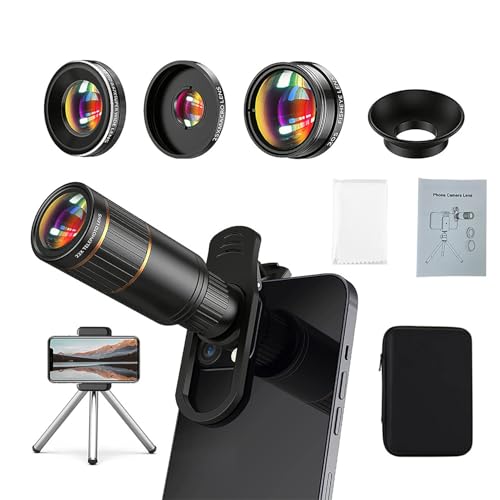
 Xenvo Pro Lens Kit for iPhone and Android3.4 x 2.7 x 2.6 inches3.4 x 2.7 x 2.6 inches0 poundsCheck on Amazon


What's inside
- Glass that borrows the phone you already own
- Three ways to attach: clamps, cases and monocular bodies
- The seventeen millimetre thread, this niche’s closest thing to a standard
- Magnification numbers and the subjects they actually suit
- Light loss: the tax every magnification quietly collects
- Vignetting, distortion and other edge behaviour
- Finding the true main camera on a multi-camera phone
- Optical reach from glass versus enlargement from software
- Tripods, gimbals and the physics of staying still
- Choosing by subject instead of by superlative
- Focus distances, working ranges and other quiet specifications
- Reading listings like an engineer, not an audience
- Care, carrying and keeping glass honest
- Camera bumps, plateaus and the geometry of specific handsets
- Weather, shimmer and other field conditions
- A sensible first kit and the path beyond it
- Failure stories and the diagnoses hiding inside them
- Deciding how much magnification is genuinely enough
- Check prices on Amazon
- The buying checklist that ends the search
As an Amazon Associate I earn from qualifying purchases. This post may contain affiliate links at no extra cost to you.
Reader note: Links on this page include referral links. When a reader buys through one of them, this site may earn a commission from the merchant involved, while the reader’s checkout total remains exactly what it would have been otherwise.
Glass that borrows the phone you already own
An add-on zoom lens is a self-contained optical assembly that parks in front of an Android phone’s camera and enlarges the scene before photons ever touch the sensor. Everything in this guide belongs to that single category: external telephoto and zoom attachments designed for handsets, whether they grip with a clamp, screw into a threaded case or perch on a monocular body. Built-in phone lenses, interchangeable camera optics and digital enlargement tricks sit outside the scope deliberately, because mixing categories produces shopping lists that help nobody. Accessory manufacturers publish the raw material of comparison themselves, listing magnification, element counts, thread dimensions and minimum focusing distances on their specification pages. Those published figures, combined with recurring patterns in owner feedback, form the evidence base for every judgement that follows.
The physics begins with the image circle. An attachment gathers light through its own front element, bends it through internal groups and projects a circular picture toward the phone’s tiny lens waiting behind. That circle must cover the phone camera’s field of view generously, or the corners of the frame darken and the edges dissolve into smear. Because phone lenses sit nearly flush with the body and vary in position between models, the mechanical marriage between attachment and handset matters as much as the glass recipe. Owners frequently report that a lens praised by a friend disappointed them purely because its circle suited the friend’s phone geometry better. Treating compatibility as an optical question rather than a marketing claim is the first discipline this accessory category teaches.
Expectations deserve calibration before any product names enter the conversation. A well-matched attachment genuinely extends reach, pulling distant signage, wildlife and stage performers closer with real optical detail. It will not convert a phone into a professional telephoto system, because sensor size, aperture and processing pipelines remain those of a handset. The honest promise is narrower and still valuable: more usable pixels on a faraway subject than cropping alone would deliver, in a package that slips into a jacket pocket. Readers who accept that promise shop calmly, prioritising alignment, steadiness and light over headline magnification. Readers hunting miracle numbers tend to buy twice, which is the most expensive habit in this entire niche.
Three ways to attach: clamps, cases and monocular bodies
Clip-on mounts dominate the entry tier because they ask nothing of the phone beyond a few millimetres of body to grip. A spring clamp or screw-driven jaw positions a threaded barrel over the camera, and the whole assembly attaches or detaches in seconds. That speed suits travellers who zoom occasionally and refuse to live inside a special case. The weakness hides in repeatability: each mounting lands slightly differently, and a millimetre of drift at high magnification moves the image circle enough to darken a corner. Careful owners develop a ritual of seating the clamp, checking all four corners on screen and nudging until the shading clears. Rubber-lined jaws protect glass backs and camera surrounds, so inspecting the padding quality on a prospective clip matters more than its colour or branding.
Case-based mounts trade spontaneity for precision. A dedicated phone case carries a threaded socket moulded or bonded directly above the main camera, so a lens screwed into that socket returns to the identical position every single time. Photographers who shoot daily with an attachment usually migrate toward this arrangement, because repeatable alignment eliminates the corner-checking ritual that slows clip users down. The costs are bulk, model specificity and the need to buy a fresh case alongside every phone upgrade. Some case systems extend beyond one socket, offering a small ecosystem of compatible wide, macro and telephoto barrels sharing the same thread. That ecosystem logic can justify the case investment for committed users while remaining pointless expense for the merely curious.
Monocular-style attachments occupy the far shore of magnification. Here a compact spotting monocular, complete with its own focusing barrel and generous objective lens, couples to the phone through an eyepiece adapter and holder. The phone stops being the optical engine and becomes a recording screen bolted to a small telescope. Reach climbs dramatically compared with barrel-style phone lenses, and so do the demands: focusing turns manual, the field of view narrows to a tunnel and hand-holding becomes an exercise in frustration. These rigs belong on tripods, aimed at nests, moonrises, distant regattas and other patient subjects. Their specification sheets quote monocular magnification rather than phone-lens multipliers, a distinction the magnification section below unpacks carefully.
The seventeen millimetre thread, this niche’s closest thing to a standard
Measure the mounting thread on most serious phone-lens barrels and one dimension recurs: seventeen millimetres. That shared thread lets a barrel from one maker screw into a case or clip from another, turning isolated purchases into a gradually assembled kit. Buyers should still verify thread claims on the manufacturer’s page rather than assuming universality, because a minority of brands use proprietary pitches or bayonet fittings that merely resemble the standard. A lens that threads smoothly by hand, without grit or wobble, signals correct machining; forcing a reluctant thread damages both parties and ruins alignment permanently. Keeping threads clean matters too, since pocket lint and beach sand migrate into the fine grooves and grind quietly at every change.
The thread’s real gift is upgrade insurance. Phones turn over every few years, camera bumps migrate across the rear panel, yet a seventeen millimetre barrel survives each transition needing only a new case or clip to remount. Hobbyists who began with one modest telephoto barrel often accumulate a small pouch of optics across several handset generations. That longevity argues for spending on glass quality rather than on the mount bundled in the box, because the mount is the disposable half of the partnership. Retail listings sometimes obscure thread dimensions behind phrases about universal fit, which usually describes the clip rather than the optical interface. When a listing refuses to state the thread plainly, the manufacturer’s own documentation settles the question.
Adapters complicate the picture in useful ways. Step rings and converter mounts exist for barrels orphaned by an older standard, although each extra interface adds a chance for tilt and light leaks. A tilted barrel projects its circle off-centre, producing one-sided softness that owners often misdiagnose as a defective lens. Testing an adapted setup against a plain wall or a page of text reveals asymmetry quickly, because even illumination and uniform sharpness should greet a correctly seated optic. Where an adapter proves necessary, metal examples hold alignment better than plastic ones under the leverage of a long barrel. Simplicity remains the guiding aesthetic: the fewer joints between phone and front element, the fewer mysteries later.
Magnification numbers and the subjects they actually suit
Accessory barrels for phones cluster into recognisable magnification bands, each with a natural habitat. Modest telephoto attachments around twice the main camera’s view behave like a portrait lens, flattering faces, isolating products and compressing backgrounds gently without demanding support gear. Mid-range options in the region of three to six times magnification open up architecture details, zoo enclosures and school performances from the back row. Beyond that territory, barrels marketed with very large multipliers lean on narrow apertures and small image circles, and their results grow temperamental. The specification that quietly predicts satisfaction is not the multiplier at all but the combination of aperture, circle size and focusing range printed beneath it.
Monocular attachments speak a different numerical dialect. Their ratings describe the monocular’s own magnification of the naked-eye view, which then gets photographed through an eyepiece by the phone. Stacking that figure against barrel multipliers in a single comparison table produces nonsense, yet listings cheerfully invite the error. A sensible reader evaluates monocular rigs against other monocular rigs, judging objective diameter, eye relief and adapter stability. For static distant subjects, the format delivers reach no pocket barrel approaches. For anything moving unpredictably, its narrow tunnel of view turns tracking into guesswork and the phone’s own zoom often serves better despite lower detail.
Variable-zoom attachments promise flexibility and deliver compromise, as zoom mechanisms miniaturised into a phone accessory sacrifice the correction that fixed-focal barrels enjoy. Most phone-lens zooms change magnification by moving internal groups through a short range, and image quality typically peaks somewhere in the middle of that travel. Owners frequently report settling on one favoured setting and leaving it there, which quietly argues for buying the fixed barrel at that setting instead. Zoom attachments retain one genuine virtue for video, where reframing smoothly without swapping hardware matters more than ultimate stills sharpness. Matching the mechanism to the medium prevents the common regret of buying a stills tool for a filming habit, or the reverse.
Light loss: the tax every magnification quietly collects
No attachment enlarges an image for free. Spreading a scene’s light across a magnified view dims the result, and accessory optics add their own absorption and reflection losses at every glass surface. Manufacturers express the consequence indirectly through aperture figures, and a telephoto barrel with a modest opening forces the phone toward slower shutter speeds or higher sensitivity settings. Phone sensors, small by camera standards, show noise quickly once sensitivity climbs, which is why attachment photographs taken at dusk often look grainier than the same scene shot unmagnified. Readers comparing against dedicated gear in best 1 cmos sensor cameras will see how much sensor area changes that low-light equation. Within the phone world, the practical defence is timing: zoom attachments reward bright conditions extravagantly and punish dim ones without mercy.
Coatings and element design decide how gracefully a lens pays its light tax. Multicoated elements transmit more light and suppress the internal reflections that wash contrast out of backlit scenes. A cheap barrel aimed toward a bright sky may veil the whole frame in haze, while a better-corrected optic keeps edges distinct and colours saturated. Flare behaviour also reveals itself in night street scenes, where point lights sprout ghosts and streaks through mediocre glass. Reading owner feedback with those specific artefacts in mind separates informative reviews from empty enthusiasm. Photographers who shoot toward light often, such as sunset watchers and concert-goers, should weight coating quality above an extra notch of magnification.
Exposure strategy adapts once the tax is understood. Bracing the phone, choosing the attachment for the brightest part of an outing and letting the camera application lock exposure on the subject all recover quality that specifications alone cannot promise. Some camera applications permit manual sensitivity ceilings, preventing the phone from pursuing brightness into unacceptable noise. Burst capture helps as well, because one frame in a rapid sequence often catches a steadier instant than its neighbours. None of these habits require new spending, which makes them the highest-value advice in this section. The photographers who thrive with phone telephoto gear are invariably the ones who plan around light rather than fighting it afterwards in an editing application.
Vignetting, distortion and other edge behaviour
Darkened corners, known as vignetting, are the signature fault of phone attachments and the first thing to check on any candidate. The cause is geometric: the projected image circle fails to cover the phone lens’s full view, so illumination falls away toward the frame edges. Mild vignetting at the widest view sometimes vanishes once the phone applies a slight digital crop or the user zooms a fraction inward. Severe vignetting that survives those remedies marks a fundamental mismatch between barrel and handset. Owner feedback repeatedly describes corner darkness appearing on one phone model while the identical barrel behaves on another, reinforcing that fit is a pairing rather than a property. Buying from sellers with painless return arrangements is therefore a technical decision, not merely a consumer comfort.
Distortion bends straight lines, and telephoto attachments generally distort less than their wide-angle siblings because their narrower view samples the calmer centre of the optical design. Even so, pincushion bending appears in architectural shots from some barrels, pulling rooflines subtly inward. Phone processing may correct distortion for its own lens while remaining blind to an attachment’s signature, leaving the bend visible in the saved file. Editing applications can straighten moderate cases afterwards, at the cost of cropping into the frame edges. Photographers of buildings and documents should examine full-frame sample images from any barrel under consideration, looking specifically at horizons and door frames near the borders. A lens that keeps geometry honest at the edges usually manages sharpness there too, since both virtues flow from the same correction budget.
Chromatic aberration paints coloured fringes along high-contrast boundaries, purple or green outlines betraying the glass’s struggle to focus all wavelengths together. Attachments built with low-dispersion elements suppress this fringing, and their specification sheets advertise the fact when it applies. Fringing grows worse toward the corners and under hard backlight, which is why test scenes involving tree branches against bright sky expose it so reliably. Software correction in the phone targets its native lens profile, not the attachment’s, so residual colour often survives into the final image. Moderate fringing yields to editing tools; severe fringing in the centre of the frame does not. Shoppers should treat centre-frame fringing in sample images as a disqualifying fault rather than a quirk to forgive.
Softness at the edges deserves a more forgiving reading than centre softness. Nearly every attachment resolves less detail near its circle’s boundary, because optical correction concentrates where the designer expects the subject to live. Portraits, animals and products usually sit centrally, so gentle edge falloff passes unnoticed or even flatters the composition. Landscape photographers, who need corner-to-corner integrity, feel the limitation most and should favour barrels whose published circle comfortably exceeds their phone’s requirements. Rotating a suspect barrel slightly and watching whether the soft zone follows the rotation separates lens faults from phone faults during troubleshooting. That small diagnostic, learnable in a minute, has saved many owners from returning healthy hardware.
Finding the true main camera on a multi-camera phone
Modern Android handsets carry two, three or four rear cameras, and an attachment only makes sense over one of them: the main wide camera. That unit owns the largest sensor, the brightest aperture and the focusing system the phone defaults to for ordinary photography. The ultra-wide neighbour distorts an attachment’s circle hopelessly, while any built-in telephoto camera already supplies its own magnification and conflicts with an external barrel stacked in front. Locating the main camera sounds trivial until a symmetrical camera plateau hides the hierarchy. Manufacturer diagrams in support documentation identify each lens position explicitly, and covering lenses one at a time while watching the preview confirms the mapping empirically.
Software behaviour complicates the physical alignment. Phones switch cameras automatically as lighting and zoom levels change, so a handset may abandon the main camera mid-session and leap to its telephoto unit, leaving the attachment staring at a lens the software no longer uses. Forcing the main camera through a professional or manual mode, where the application offers one, keeps the pairing stable. Some camera applications also engage the ultra-wide for close subjects under a macro label, another silent switch that ruins an aligned setup. Owners frequently report mysterious focus hunting that resolves the moment automatic switching is tamed. Readers who also rely on their handset’s native optics can compare behaviour against best 5g camera phones, where main-camera specifications across recent models are laid out in detail.
Alignment precision scales with magnification. A two-times barrel forgives a millimetre of eccentricity; a high-power monocular adapter punishes a fraction of that with a crescent of darkness swallowing one side of the frame. Case mounts earn their keep here, because their fixed socket removes human placement from the equation. Clip users should align with the phone awake and the preview visible, centring the circle by its corners rather than by feel. Once aligned, avoid bumping the assembly while reaching for the shutter; a remote release or self-timer removes the final nudge. Focus then belongs to the phone’s autofocus acting through the attachment for barrel lenses, while monocular rigs demand the focusing barrel be set first and the phone’s focus locked afterwards.
Optical reach from glass versus enlargement from software
Digital zoom crops the sensor’s output and enlarges what remains, discarding pixels in exchange for framing. Modern processing disguises that loss skilfully at mild ratios, fusing multiple frames and sharpening edges until the result looks plausible on a phone screen. Push further and the fabrication shows: textures smear, fine lettering dissolves and noise patterns repeat unnaturally. An optical attachment attacks the problem from the opposite direction, magnifying the scene before capture so the sensor spends its full resolution on the narrowed view. Genuine detail, such as feathers, brickwork or distant facial features, survives in the file rather than being invented by an algorithm. That difference in information content, not any romantic preference for glass, is the entire case for carrying an attachment.
The comparison flips in some everyday circumstances. The phone’s own zoom responds instantly, refocuses continuously and stabilises through the same pipeline as every other shot, making it the pragmatic choice for fleeting moments. A child scoring an unexpected goal will not wait while a barrel is aligned. Built-in telephoto cameras on higher-end handsets occupy the middle ground, delivering true optical magnification at one fixed ratio with total convenience. Attachments justify their fussiness when the desired reach exceeds the built-in ratio, when the handset lacks a telephoto camera entirely, or when a monocular rig opens distances no phone roadmap addresses. Honest photographers keep both tools and choose per moment, rather than pledging loyalty to either philosophy.
Video sharpens the distinction further. Cropping into a video frame consumes the resolution margin that stills can spare, so digital zoom during recording degrades visibly sooner. An attachment preserves the full frame’s pixel count at its chosen magnification, benefitting footage of ceremonies, wildlife and stage events. Action-oriented readers sometimes weigh small dedicated recorders from best 1080p action cameras for moving subjects, reserving phone attachments for deliberate, stationary filming. Audio deserves a thought as well, since a bulky barrel or monocular holder can crowd the phone’s microphones and muffle sound. Checking a short test recording with the rig attached prevents discovering silenced vows or muted commentary after an unrepeatable event.
Tripods, gimbals and the physics of staying still
Magnification multiplies everything, including tremor. A handshake invisible at the main camera’s natural view becomes a sweeping sway through a strong telephoto attachment, because angular movement translates into larger image displacement as focal length grows. Support therefore stops being an accessory and becomes part of the optical system. A compact tabletop tripod with a phone clamp handles seated and low-angle work, while a full-height travel tripod serves standing observation and events. The clamp deserves scrutiny equal to the legs: it must grip the phone without pressing volume or power keys, and its jaws should clear the attachment barrel’s swing. Owners frequently report that upgrading a flimsy bundled tripod transformed a disappointing lens into a satisfying one, with no change to the glass at all.
Gimbals promise motion smoothness rather than static stability, and their marriage with attachments needs care. A phone gimbal balances around the handset’s weight and dimensions; a heavy front barrel shifts that balance, sometimes beyond the motors’ comfortable authority. Manufacturer documentation for gimbal models lists payload and clearance figures that predict compatibility better than enthusiasm does. Where balance succeeds, the pairing shines for slow pans across landscapes or tracking a walking subject at moderate magnification. Where it fails, motors strain, horizons drift and battery life collapses. Counterweight kits exist for front-heavy rigs, adding another layer of setup that casual users rarely tolerate twice. The pragmatic verdict from owner patterns is consistent: tripods for reach, gimbals for movement, and modest magnification whenever a gimbal carries the load.
Monocular rigs settle the support question by force. Their magnification and narrow view make handheld phone photography an exercise in pursuing a wandering circle, so a tripod with a smooth panning head becomes effectively mandatory. The adapter joining phone to eyepiece must hold the handset rigidly, because any flex reintroduces the vignetting the alignment ritual removed. Birdwatchers and astronomy hobbyists, the natural constituency for these rigs, already own suitable supports from their primary hobby, which softens the total investment. Beginners should budget the support and adapter alongside the monocular from the outset, treating the trio as one product. A shaky photograph of a distant bird documents the photographer’s optimism rather than the bird, and no editing application repairs motion that smeared the capture itself.
Choosing by subject instead of by superlative
Wildlife and birdsong mornings reward patience, reach and support in that order. A birder working from a hide or a garden chair can exploit a monocular rig’s magnification fully, because the subject returns to predictable perches and the tripod carries the stability burden. Readers whose curiosity outgrows phone rigs often graduate toward dedicated optics compared in best birding cameras and lens, and that pathway is healthy rather than a failure of the phone setup. Within the attachment world, brightness matters enormously at dawn and dusk when animals move most, favouring larger objective diameters over extra magnification. Camouflage etiquette also applies: a bright phone screen and repeated arm movements flush subjects that a quiet, pre-aimed rig would have kept. Setting up before the subject arrives, then waiting, is the oldest technique in the discipline and costs nothing.
Travel photographers face a weight-and-readiness equation rather than a pure reach problem. A slim two-times or three-times barrel in a coat pocket gets carried daily, while a monocular kit stays at the hotel precisely when a distant bell tower or harbour detail calls. City explorers benefit from moderate magnification that isolates architectural ornaments, signage and street scenes across plazas without attracting attention. Museums and galleries generally forbid tripods and sometimes attachments altogether, so handheld-friendly barrels suit cultural itineraries. The traveller’s real enemy is decision friction at the moment of shooting; a clip that mounts in seconds preserves spontaneity that a threaded case system, already worn on the phone, removes entirely. Choosing the mount style matching your walking rhythm matters more than squeezing another multiplier from the glass.
Parents filming school concerts and youth sports occupy a third distinct niche. Their subjects move predictably within a bounded stage or pitch, lighting is mediocre and the seating is fixed far from the action. Moderate telephoto barrels on a small tripod or monopod steadied against a seat back serve this crowd well, while extreme magnification magnifies both the dimness and the shake beyond usefulness. Recording video rather than stills forgives lower per-frame detail and captures the applause and commentary that memory actually treasures. Checking venue rules about recording and support equipment avoids a confrontation at the door. A spare battery pack matters more here than any optical refinement, because a dead phone records nothing at any magnification.
Product sellers and hobby documenters work at the opposite distance extreme, yet telephoto attachments serve them by allowing a working gap that keeps hands, shadows and reflections out of the frame. A modest barrel lets a seller photograph small goods from far enough back that the phone itself never mirrors in glossy packaging. Model builders, coin collectors and garden diarists share that need for standoff distance combined with subject isolation. Focus distance specifications decide suitability here, since some telephoto barrels refuse to focus closer than several metres. Reading the minimum distance figure before purchase prevents the absurd outcome of a lens too powerful to use in the room where the hobby lives. Diffused household lighting, patiently arranged, flatters small subjects more than magnification ever will.
Focus distances, working ranges and other quiet specifications
Every telephoto attachment carries a minimum focusing distance, and that number quietly deletes whole categories of subject when ignored. Long barrels engineered for distant viewing may stay blurry until the subject stands many metres away, rendering them useless for the butterfly on a nearby fence. Specification pages state the figure, although sometimes in the fine print beneath marketing photography of conveniently distant landmarks. Owners planning mixed use should favour designs whose range begins within a few metres, accepting a little less ultimate reach in exchange for daily versatility. Close-focus behaviour also interacts with the phone’s autofocus, which hunts more as light falls and magnification rises. Locking focus on a static subject, where the camera application permits, ends that hunting decisively.
Depth of field narrows as magnification climbs, a relationship borrowed directly from conventional optics. At high power, the plane of acceptable sharpness can shrink to centimetres, so a bird’s eye may sit crisp while its tail feathers dissolve. That shallowness can be wielded creatively for portraits, isolating a face from a distracting backdrop more convincingly than software blur modes that guess at edges. It also punishes sloppy focus on group subjects arranged at staggered depths. Stopping down is not an option on fixed-aperture attachments, leaving focus placement and subject arrangement as the photographer’s only levers. Understanding this before a family outing prevents a card full of almost-sharp group portraits.
Filter threads and lens hoods form the supporting cast of specifications. Some barrels accept small filters over the front element, enabling polarisers that tame reflections on water and glass or neutral-density filters that lengthen video exposures. Hoods, where offered, shield contrast from stray light and give the front element a first line of defence against knocks. Both features signal a maker designing for photographers rather than for impulse buyers. Their absence is not disqualifying at modest prices, but their presence at any tier deserves weight in a close decision. A polariser in particular transforms telephoto views across harbours and wetlands, cutting surface glare that no amount of magnification could penetrate.
Reading listings like an engineer, not an audience
Accessory marketing speaks in superlatives while engineering speaks in millimetres, grams and element diagrams, and the buyer fluent in the second language rarely regrets a purchase. A trustworthy listing states the thread standard, the magnification basis, the aperture, the focusing range and the weight without being asked. It shows sample images at full frame rather than cropped centres, because the corners are where honesty lives. Compatibility claims name specific phone models or, better, explain the geometric requirement any handset must satisfy. Vague promises of universal fit paired with astronomical magnification figures mark the category’s least reliable corner. Cross-checking a marketplace listing against the manufacturer’s own page takes two minutes and exposes most embellishments instantly.
Weight and dimensions deserve the same scepticism as optical claims, because a barrel that unbalances the phone discourages the carrying that makes it useful. Long attachments lever against clips and case sockets, and that leverage grows with every gram at the front element. A published weight lets buyers judge whether their chosen mount can hold the pairing steady through a day of handling. Pocketability also depends on the cap and case provision in the box; optics shipped without protection arrive pre-scratched by their first week in a bag. Owner feedback mentioning looseness after a month of use points at thread or clamp wear, a durability signal no specification sheet advertises. Patterns across many owners outweigh any single glowing or furious account.
Warranty and return terms complete the engineer’s reading. Optical accessories suffer a higher mismatch rate than most electronics simply because phone geometries vary so widely, so a seller confident in painless returns is underwriting the fit risk personally. Warranty length on coatings and mount mechanisms hints at the maker’s own durability expectations. Keep the packaging until the pairing has survived a real outing, since the faults that matter, such as one-sided softness or a wandering clip, reveal themselves under field conditions rather than on the kitchen table. Documenting a fault with a repeatable test scene, like a brick wall photographed square-on, converts a return conversation from opinion into evidence. Methodical buyers get refunds; vague complainers get store credit and resentment.
Care, carrying and keeping glass honest
Front elements live dangerously, protruding toward a world of keys, grit and table edges. Caps on both ends whenever the barrel leaves the phone form the cheapest protective habit available, and a hard pouch earns its pocket space on any journey longer than a neighbourhood walk. Cleaning follows photographic convention: blow loose grit away first, then use a microfibre cloth with a breath of fog or a drop of lens fluid, working gently from centre outward. Wiping dry dust across a coating grinds the very scratches owners later blame on manufacturing. Threads benefit from the same respect, cleared with a soft brush so grit never enters the mount’s fine grooves. A lens kept clean and capped holds its resale value and its optical dignity for years.
Storage conditions matter quietly. Prolonged heat inside a parked car stresses cements and coatings, while damp bags invite the internal fogging and fungal threads that ruin optics permanently. A silica gel packet inside the pouch costs almost nothing and defends against the moisture half of that threat. Phones themselves dislike the same extremes, so the pairing usually shares whatever shelter the owner provides. Before an important outing, a ten-second inspection of both the attachment’s elements and the phone’s own camera glass catches the fingerprint that would otherwise haze every frame. That tiny ritual, repeated until automatic, separates consistently pleased owners from perpetually puzzled ones. Small habits, faithfully kept, quietly outlast expensive glass in the field.
Transport between locations is where mounts earn scrutiny. A barrel left screwed into a case socket while the phone rides in a pocket endures bending forces the socket was never shaped to resist. Removing the optic for transit, or carrying the assembled rig in a rigid pouch, prevents the slow thread damage that manifests as a permanent tilt. Photographers who move between viewpoints at one site often keep the rig assembled on a tripod carried over the shoulder, a reasonable compromise when distances are short and terrain is kind. Judgement, as ever, scales with the value of the glass involved.
Camera bumps, plateaus and the geometry of specific handsets
Android rear design has drifted toward wide camera plateaus, pill-shaped islands and corner clusters, and each layout courts the attachment differently. A clamp needs purchase on the body without rocking against a raised plateau edge, while a case socket sidesteps the entire question by building alignment into the shell. Phones whose main camera sits at a plateau’s corner give clips an easier target than centre-mounted arrays buried among sibling lenses. Flash position matters as well, since a barrel or clamp shadowing the LED ruins the flash’s usefulness and occasionally confuses exposure metering. Owners of folding handsets face a doubled puzzle, because the camera arrangement changes character between folded and unfolded states. Checking the accessory maker’s fit notes against your exact model, rather than its family name, prevents the majority of these geometric disappointments.
Thick protective cases worn daily create another silent incompatibility. A clip measured for a bare phone may refuse to close over a rugged case, and a threaded socket case obviously replaces the favourite shell entirely during shooting sessions. Some photographers accept a two-case life, swapping shells when the light turns promising, while others choose slimmer daily protection to keep clip access painless. The phone’s own lens glass also sits at slightly different depths beneath cover glass across models, altering the gap an attachment must bridge. Excess gap invites stray light and softness; insufficient gap risks the barrel’s rear element kissing the phone’s glass. Neither fault appears in a spec sheet, which is why fit reports from owners of the identical handset carry unusual weight in this category.
Stabilisation hardware inside the phone adds a final geometric wrinkle. Sensor-shift and lens-shift systems move the imaging assembly by fractions of a millimetre during capture, and an attachment rigidly aligned at rest remains aligned through those micro-movements in normal use. Problems arise only when a heavy barrel’s leverage flexes a weak clip mid-exposure, a mechanical rather than electronic failure. This is one more reason the mount deserves budget priority over marginal glass upgrades. A modest barrel held perfectly still will out-photograph a superior barrel trembling on a bargain clamp every single time. Experienced owners phrase it as a proverb: buy the steadiness first and the magnification second.
Weather, shimmer and other field conditions
Distance itself becomes an optical element outdoors, because the air between photographer and subject bends light whenever temperature layers mix. Heat shimmer over sun-baked tarmac, rooftops or water can ripple a magnified view until edges swim, and no attachment corrects turbulence in the atmosphere. Shooting early or late, choosing overcast intervals and shortening the air path by moving closer all mitigate the effect more honestly than any purchase. Owners frequently report baffling softness on hot afternoons that vanishes the following morning with the same equipment, and atmospheric shimmer is usually the unnamed culprit. Recognising it saves lenses from unjust returns and photographers from unjust self-doubt.
Wind attacks from the other direction, exciting vibration in tripods, monopods and the photographer’s own stance. A rig steady in a showroom may tremble on a clifftop path, which is why fieldcraft includes sheltering behind terrain, lowering the tripod’s centre column and hanging a bag from its hook for ballast. Rain threatens both the phone and the attachment’s coatings, and few phone-lens accessories claim meaningful weather sealing. A simple cover, a microfibre cloth in a sealed pocket and the discipline to stop when conditions turn hostile protect the investment. Cold weather drains phone batteries faster and stiffens focusing rings on monocular barrels, small frictions worth anticipating before a winter outing rather than discovering at a frozen viewpoint.
Dust and salt air complete the environmental roster. Coastal photographers learn to keep caps on until the moment of capture, because a single gust can sandblast a front element with abrasive spray. Desert and festival environments deliver fine particulates that migrate into threads and focusing mechanisms with similar enthusiasm. A blower carried in the kit earns its negligible weight in such places. None of these hazards argue against taking attachments into the field; they argue for treating fieldcraft as part of the optical system, inseparable from the glass itself. The photographers whose galleries impress are usually those whose habits survived the weather that sent everyone else home.
A sensible first kit and the path beyond it
Beginners assemble better kits by sequencing purchases around evidence from their own shooting. Start with one moderate barrel in the mount style matching your phone and habits, plus the steadiest support your bag realistically carries. Shoot with that pairing for a full season of outings, noting which subjects escaped your reach, which light defeated your aperture and which rituals annoyed you into leaving the lens behind. Those notes, written from experience, specify the second purchase far more accurately than any review can. Perhaps the answer is a brighter barrel at the same magnification; perhaps it is a monocular rig for a newly discovered birding obsession; perhaps it is simply a better case mount curing an alignment grudge.
The upgrade path forks again at video. A shooter drifting toward filming should prioritise smooth focusing behaviour, microphone clearance and gimbal compatibility in the next purchase, while a stills devotee chases coatings, circle size and edge correction. Mixing the priorities produces the classic drawer of almost-right accessories every hobby accumulates. Selling the outgrown barrel into the active second-hand market funds the correction and keeps good glass circulating. Keeping a simple log of which attachment served which outing sounds bureaucratic until the pattern of actual use argues, undeniably, for the next step. Taste in this niche is empirical or it is merely shopping.
Community knowledge accelerates the whole journey. Owner groups organised around specific barrel families trade alignment tricks for particular handsets, support combinations that survived real weather and honest galleries showing faults alongside triumphs. Reading those archives before buying converts other people’s tuition into your own savings. Manufacturers occasionally appear in such spaces answering fit questions, another resource unavailable at the moment of a marketplace impulse purchase. The deliberate buyer arrives at checkout already knowing the ritual, the support and the likely disappointments of the chosen pairing. What remains is the pleasure of the first clear frame, earned rather than chanced upon.
Failure stories and the diagnoses hiding inside them
Nearly every disappointed owner describes one of a handful of recurring failures, and each failure carries its diagnosis on its face once the vocabulary exists. A frame dark on one side only, with the shadow creeping further during a session, announces a mount that is migrating under the barrel’s weight. The remedy is mechanical: a firmer clamp, a case socket or a shorter, lighter optic. A frame uniformly soft despite careful support usually indicts focus, either the phone locking onto a foreground branch instead of the distant subject or a monocular barrel whose own focus ring was never set before the phone’s focus locked. Photographing a high-contrast target at a known distance separates those two suspects within minutes.
Washed-out, low-contrast images under bright skies point toward stray light entering the gap between attachment and phone, or toward uncoated elements scattering the scene internally. Cupping a hand around the junction during a test frame reveals the leak instantly when contrast leaps. Colours that smear into rainbow edges along every roofline indicate chromatic aberration beyond what editing can forgive, and the honest remedy is a better-corrected barrel rather than another settings expedition. Owners sometimes blame the phone for each of these faults in sequence, replacing handsets while the guilty accessory rides along to the next device. Keeping the attachment constant and varying one factor at a time is the dull, decisive method that isolates culprits.
A different family of failures involves the phone’s software quietly changing the rules mid-session. The camera application may leap to the ultra-wide unit when a subject approaches, switch to the built-in telephoto at a zoom threshold or engage a night mode whose multi-frame blending smears moving subjects behind the attachment. Each behaviour is sensible for unaided photography and sabotage for an aligned rig. Learning where your application hides its lens-selection and mode controls is therefore part of owning the accessory, as essential as the alignment ritual itself. Owners who tame those settings describe an overnight transformation in their results, with the same glass suddenly performing as the reviews promised. The lens had never been the problem; the partnership had simply never been introduced properly.
Expectation failures form the final and saddest family, because no adjustment cures them. A buyer who imagined a pocket barrel would match a dedicated telephoto system for birds in flight will find every result wanting, regardless of the barrel’s genuine competence. The category rewards subjects that cooperate: stationary, distant, well-lit and patient. Matching ambition to that envelope before spending is the cheapest satisfaction available anywhere in this guide. Photographers who internalise the envelope often produce startlingly good work within it, while better-equipped optimists collect frustration at higher magnification. Knowing which photographer you are, honestly and in advance, is the true first purchase.
Deciding how much magnification is genuinely enough
The ladder of magnification tempts every buyer upward, so a deliberate stopping rule helps. Begin by naming the three subjects you photograph most at a distance, honestly and from recent memory rather than aspiration. Measure their typical range in the plainest terms available: across a classroom, across a football pitch, across a lake. Moderate barrels cover the first two territories comfortably for most handsets, and only the third begins arguing for monocular territory with its attendant tripod discipline. Buyers who skip this exercise routinely own too much magnification for their subjects and too little light for their magnification. The mismatch, not the merchandise, generates the disappointment that fills return queues.
Screen size and sharing habits set another natural ceiling. Images destined for family group chats and social feeds are viewed on handset displays, where moderate optical reach already looks dramatic and extreme reach mostly adds shake. Photographers printing large or cropping aggressively for exhibitions legitimately demand more from the file, and their support budgets should grow in step. Neither audience is wrong; they are simply shopping for different artefacts while reading the same listings. Declaring your real audience before checkout quietly eliminates half the catalogue. What remains can be judged on coatings, mounts and honesty of specification, the grounds where good purchases are actually decided.
One further restraint deserves mention, because restraint is unfashionable in accessory marketing: the phone already in your pocket may carry a competent built-in telephoto camera that covers your honest subjects entirely. In that case the correct purchase might be a better tripod clamp, a remote release and nothing optical whatsoever. Attachments earn their money at the margins where built-in hardware stops, and identifying that margin precisely is the whole skill this guide has been circling. Buy for the gap you can describe in a sentence, and the resulting kit will feel inevitable rather than accumulated.
Check prices on Amazon
Live listings for the shortlist in this guide are pulled from Amazon below, so prices and availability are always current at the moment you look.


The buying checklist that ends the search
Reduce the decision to a sequence of gates and let any candidate fail early and cheaply. Gate one is category honesty: the product must be an external zoom or telephoto attachment for a phone, in clamp, case-thread or monocular form, with no dedicated-camera optics smuggled into the shortlist. Gate two is geometry: the mount must centre the barrel over your handset’s main camera, ideally through the seventeen millimetre thread or a case socket made for the exact model. Gate three is light: the aperture and published circle must suit the conditions you actually shoot in, not the noon sunshine of the brochure. Gate four is support: the magnification chosen must match the tripod, clamp or gimbal you genuinely intend to carry. A candidate passing all four gates has earned its place in the bag.
Then weigh the intangibles that listings cannot capture. Sample galleries showing full frames in mixed light reveal more character than any specification table. Owner accounts describing alignment rituals, return experiences and month-three durability sketch the ownership reality awaiting you. The ecosystem question, whether this barrel begins a threaded collection or stands alone, shapes how much its quality deserves to stretch the budget. None of these judgements require haste, and the second-hand market for quality barrels remains liquid enough that a careful first purchase is rarely a life sentence. Buy the mount for your real phone, the magnification for your real subjects and the support for your real patience.
An external zoom lens will never be the most convenient way to photograph a distant subject, and that inconvenience is precisely its character: deliberate, tactile and quietly rewarding when the light, the alignment and the moment finally agree.


